* Study carried out at the Pedro Ernesto University Hospital of the Universidade do Estado do Rio de Janeiro – UERJ, Rio de Janeiro State University – Rio de Janeiro, Brazil.
1. PhD in Medicine from the Universidade do Estado do Rio de Janeiro – UERJ, Rio de Janeiro State University – School of Medical Sciences, Rio de Janeiro, Brazil. 2. Adjunct Professor. Universidade do Estado do Rio de Janeiro – UERJ, Rio de Janeiro State University – School of Medical Sciences and Professor at the Universidade Gama Filho – UGF, Gama Filho University – Rio de Janeiro, Brazil.
3. Adjunct Professor. Universidade do Estado do Rio de Janeiro – UERJ, Rio de Janeiro State University – School of Medical Sciences, Rio de Janeiro, Brazil. 4. Physician in training in the Department of Radiology and Diagnostic Imaging of the Pedro Ernesto University Hospital of the Universidade do Estado do Rio de Janeiro – UERJ, Rio de Janeiro State University – School of Medical Sciences, Rio de Janeiro, Brazil.
5. Adjunct Professor at the Institute of Biology. Universidade do Estado do Rio de Janeiro – UERJ, Rio de Janeiro State University – Rio de Janeiro, Brazil. 6. Full Professor. Universidade do Estado do Rio de Janeiro – UERJ, Rio de Janeiro State University – School of Medical Sciences, Rio de Janeiro, Brasil. Correspondence to: Agnaldo José Lopes. Rua José do Patrocínio, 290/405, Grajaú, CEP 20560-160, Rio de Janeiro, RJ, Brasil.
Tel: 55 21 2576 2030. E mail: [email protected]
Submitted: 21 December 2006. Accepted, after review: 26 March 2007.
Correlation of tomographic findings with pulmonary function parameters
in nonsmoking patients with idiopathic pulmonary fibrosis*
Agnaldo José Lopes1, Domenico Capone2, Roberto Mogami3, Daniel Leme da Cunha4, Pedro Lopes de Melo5, José Manoel Jansen6
Abstract
Objective: To correlate tomographic findings with pulmonary function parameters in patients with idiopathic pulmonary fibrosis (IPF). Methods: A cross-sectional study was carried out, in which 30 nonsmoking patients with IPF were evaluated. Using a semiquantitative scoring system, the following high-resolution computerized tomography (HRCT) findings were quantified: total interstitial disease (TID), reticular abnormality/honeycombing, and ground-glass opacity (GGO). The functional variables were measured by spirometry, forced oscillation technique (FOT), helium dilution method, as well as the single-breath method of measuring diffusion capacity of the lung for carbon monoxide (DLCO). Results: Of the 30 patients studied, 18 were female, and 12 were male, with a mean age of 70.9 years. We found that TID and reticular abnormality and honeycombing correlated significantly (negative correlations) with the measurements of forced vital capacity (FVC), total lung capacity (TLC), DLCO, and dynamic respiratory compliance were found, as well as that GGO correlated significantly (and positively) with residual volume/TLC. The ratio of forced expiratory flow between 25 and 75% of FVC to FVC (FEF25-75%/FVC) correlated
positively with TID, reticular abnormality/honeycombing, and GGO. Conclusion: In IPF patients, the measurements of volume, diffusion, and dynamic compliance are the physiological variables which best reflect the extent of the interstitial disease on HRCT scans.
Introduction
Idiopathic pulmonary fibrosis (IPF) is a chronic interstitial fibrosing disease and, by definition, of unknown etiology, limited to the lung. It is clas-sified as one of the forms of idiopathic interstitial pneumonia, characterized by the usual interstitial pneumonia (UIP) histologic pattern.(1)
In pulmonology practice, imaging and respi-ratory function tests are the examinations most frequently used in the management of IPF. Surgical lung biopsy, although essential to the definition of a diagnosis of UIP, is an invasive method. Therefore, it is not indicated during the follow-up and evalu-ation of the therapeutic response. In addition, the region examined may not represent the anatomopa-thology of the lungs as a whole, which hinders correlation studies.(1-3) Therefore, in view of the
routine use of radiological and pulmonary function tests, it is fundamental to determine the correlation between these two methods.
Since the 1960s, results of imaging methods have been correlated with those of pulmonary func-tion tests. Initially, chest X-rays were used in this type of study. However, the extent of radiological involvement did not correlate well with the intensity of the functional disturbance in IPF.(4)
Another radiological method used in the correla-tion with pulmonary funccorrela-tion is the high-resolucorrela-tion computerized tomography (HRCT). Since its advent, HRCT has been recognized as an important tool in the evaluation of IPF. It is currently considered the best method of evaluating the extent of pulmonary involvement.(5) This has encouraged the conduction
of studies with the aim of evaluating the correla-tion between the extent of the interstitial disease and functional abnormalities. However, due to the inclusion of individuals with occupational diseases and connective tissue disease, as well as smokers and former smokers, in these samples, there has been great variability in the results.(6-10) Some of
these studies and international consensuses empha-size the pronounced influence of emphysema on the interpretation of pulmonary function tests, highlighting its interference with the study of corre-lations.(1,6,7)
Therefore, our objective was to correlate imaging with pulmonary function in nonsmoking individuals with IPF. To that end, we used HRCT and various testing methods, including spirometry, forced
oscil-lation technique (FOT), helium dilution method and determination of single-breath diffusing capacity of the lung for carbon monoxide (DLCO), for a more detailed analysis of pulmonary function.
Methods
From March of 2005 to November of 2006, a descriptive cross-sectional study was conducted, evaluating 41 nonsmoking patients diagnosed with IPF. Participants were previously informed about the objective of the study and gave written informed consent, according to current ethical norms. The protocol was approved by the Ethics in Research Committee of the Pedro Ernesto University Hospital of the Rio de Janeiro State University.
Considering the objectives of the study, one of the inclusion criteria was a surgical lung biopsy consistent with a diagnosis of UIP. In the absence of histopathological material, patients were eligible for inclusion in the study if they met all of the major criteria and at least three of the minor criteria, as follows(1,11):
Major criteria: no history of known diseases which affect the lung in a similar form, such as collagen-related diseases, environmental expo-sure and expoexpo-sure to drugs; restricted pulmonary function and/or gas exchange alteration; HRCT findings of infiltrates in the lung bases and ‘little’ ground-glass opacity; and transbronchial biopsy or bronchoalveolar lavage ruling out other known diseases.
• Minor criteria: aged 50 and above; dyspnea of insidious onset and unknown cause; having the disease for over three months; and ‘velcro’ type bibasilar rales.
• Smokers and former smokers were excluded, as were individuals with asthma and those with a history of another pleuropulmonary disease or congestive heart failure.
The following instruments were used in the clin-ical, radiological and functional evaluation:
related to the time since diagnosis, treatment of the disease, respiratory symptoms and comorbidities. Using this instrument, dyspnea was graded based on the scale established by the American Thoracic Society.(12)
b) Pulmonary function testing comprised FOT, spirometry, helium dilution method and determination of single-breath DLCO. The FOT was performed using an impedance analyzer, and the following parameters were evaluated: resistance at the intercept (R0), slope of resistance (S), mean resistance (mR) and dynamic respiratory compliance (Crs,dyn).
(13) The remaining tests were carried out using
the Collins Plus Pulmonary Function Testing Systems (Warren E. Collins, Inc., Braintree, MA, USA) and followed the standardization and interpretation of the Brazilian Thoracic Society.(14) Equations devised by Pereira
(spirometry) and Neder (static lung volumes and diffusion) were used in the interpretation of the following parameters(15-17):
• spirometry: forced vital capacity (FVC), forced expiratory volume in one second (FEV1), FEV1/FVC ratio, forced expiratory flow between 25 and 75% of FVC (FEF25-75%)
and FEF25-75%/FVC ratio;
• helium dilution method: residual volume (RV), total lung capacity (TLC) and RV/TLC ratio; and
• determination of single-breath DLCO. c) the following technique was used for
HRCT: GE equipment, HISPEED model; 1-mm thick slices, at 1.5 s intervals and increased by 10 mm; image reconstruc-tion with a 512 × 512 pixel matrix, using a high resolution algorithm; 1000 HU width window; −700 HU medium window level. Interpretation of tomographic findings was performed according to a consensus among four radiologists with extensive experi-ence in interstitial disease. In the absexperi-ence of histologic material, the diagnosis of IPF by HRCT was accepted only upon concordance of all readers and if all clinical and func-tional criteria described above were met. An initial overall analysis of the HRCT (without considering cut-off levels) was conducted, in search of the following findings: nodules, ground-glass opacities, reticular abnormality,
honeycombing (cysts < 3 mm and > 3 mm), traction bronchiectasis, air trapping areas and emphysema.(18,19) Subsequently, the HRCT was
evaluated as to the extent and intensity of interstitial lung involvement, considering five cut-off levels: 1) origin of major vessels; 2) aortic arch level; 3) carina; 4) confluence of pulmonary veins; and 5) 1 cm above the right diaphragm.(6,19-21) Using a semiquantitative
evaluation system, each of these levels (right and left, separately, totaling 10 levels) was analyzed as to the following aspects:
• Score of total interstitial disease (TID, including reticular abnormality, honey-combing, ground-glass opacity and other alterations):
0) no alteration;
1) interstitial disease involving ≤ 5% of the area;
2) interstitial disease involving 6-25% of the area;
3) interstitial disease involving 26-49% of the area;
4) interstitial disease involving 50-75% of the area; and
5) interstitial disease involving > 75% of the area.(10,22,23)
• Score of extent of reticular abnormality and honeycombing:
0) no reticular abnormality or honey-combing;
1) reticular abnormality and no honeycombing;
2) honeycombing (with or without reticular abnormality) involving < 25% of the area;
3) honeycombing involving 25-49% of the area;
4) honeycombing involving 50-75% of the area; and
5) honeycombing involving > 75% of the area.(10,22,23)
• Score of ground-glass opacity extent: 0) no ground-glass opacity;
1) ground-glass opacity involving ≤ 5% of the area;
2) ground-glass opacity involving 6-25% of the area;
4) ground-glass opacity involving 50-75% of the area; and
5) ground-glass opacity involving > 75% of the area.(10,22)
For the analysis of HRCT findings, estimated pulmonary involvement was obtained using an influ-ence factor (‘weight’) to correct different pulmonary volumes at each level, as follows(19):
• origin of major vessels - weight = 0.129; • aortic arch level - weight = 0.190; • carina - weight = 0.222;
• confluence of pulmonary veins - weight = 0.228; and
• 1 cm above the right diaphragm - weight = 0.230.
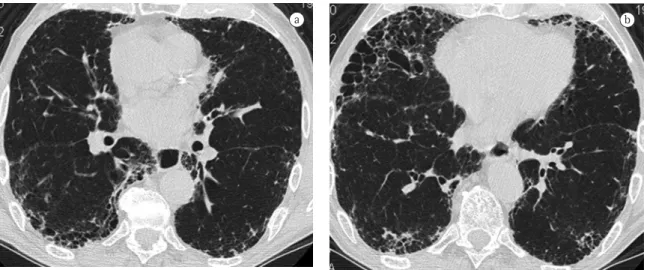
In the end, TID, reticular abnormality/honey-combing and ground-glass opacity levels were obtained by totaling the scores for each level. An example of how these scores were obtained is shown in Figure 1.
After clinical and functional criteria had been applied, HRCT findings had been analyzed and the surgical lung biopsy material had been reviewed, 11 patients were excluded from the study. Therefore, the final sample comprised 30 patients with IPF.
The statistical program used was Statistica 5.01b (StatSoft, Inc., Tulsa, OK, USA). All variables
were initially analyzed descriptively. The analysis of continuous variables was carried out through observation of minimum and maximum values, and calculation of means and standard deviations. Absolute and relative frequencies were calculated for categorical variables. Correlations between func-tional indices and tomographic scores were studied using Pearson’s parametric test, since variables presented normal distribution. In this study, values of p ≤ 0.05 were considered significant.
Results
Clinical characteristics of the sample are demonstrated in Table 1, where we can see that, of the 30 patients evaluated, 18 were female, and 12 were male. Mean age was 70.9 years, ranging from 51 to 93 years. In 15 of the 30 patients, the diagnosis of IPF was confirmed by antemortem open lung surgical biopsy; in the other 15, diag-nosis was given based on the American Thoracic Society criteria.(1)
Mean and standard deviation of pulmonary function indices are given in Table 2. Restrictive syndrome was diagnosed in 26 patients of the sample (only four presented normal TLC), and 11 patients presented supranormal
volume-nor-a b
Figure 1 - Example of extent of disease score obtained on high-resolution computerized tomography of an 80-year-old man with idiopathic pulmonary fibrosis. At cut-off levels 1, 2 and 3, the test was normal. At level 4 (confluence of pulmonary veins, Figure 1a), test was given degree 2 (honeycombing involving <25% of the area) for both lungs
(total = 4). At level 5 (1 cm above right diaphragm, Figure 1b), degree 3 (honeycombing involving 25 to 49% of the area) for right lung and 2 for left lung (total = 5). After applying correction factors for each cut-off level, scores
malized flows (FEF25-75%/FVC ratio above 150% of theoretical value).(15) None of the patients evaluated
presented airflow limitation. The DLCO was at the lower limit of normality or below 40% of the theo-retical value in 29 and 17 patients, respectively.
Regarding tomographic alterations, we did not observe nodules, areas of air trapping or emphyse-matous lesions in any of the tests, whereas reticular abnormality and honeycombing were detected in 30 and 26 cases, respectively. Ground-glass opaci-ties were noticed in only 11 cases (36.7% of the sample) and, in all of them, the areas were not very extensive. Table 3 shows the principal tomographic findings detected in this group of patients, as well as mean scores.
Linear correlation coefficient values between pulmonary function parameters and parameters obtained by tomographic analyses are expressed in Table 4.
The analysis of 30 tomography scans revealed better results for measurements of volume, compli-ance and diffusion, which correlated negatively with tomographic scores. To a lesser extent, corrected expiratory flow rates (FEF25-75%/FVC) also correlated positively with the scores evaluated.
Discussion
In this study, we carefully eliminated the effects of tobacco on pulmonary function tests. To that end, only nonsmokers were analyzed. Similarly,
individ-uals with concomitant asthma were excluded, since airflow limitation is one of the characteristics of the disease. The HRCT analysis was performed using the visual method of interpretation and quantifica-tion of the lesions, since this method most closely approximates that used in pulmonology practice.
In our cases, we observed that restrictive defect occurred in 86.7%, in contrast to the findings of most studies, in which, by virtue of not excluding smokers or former smokers, pulmonary volumes were found to be relatively preserved in a significant portion of the study samples.(24,25) This difference
is due to the effect of emphysema which, through air trapping and hyperinflation of the lungs, can ultimately mask the effect of fibrosis in decreased pulmonary volumes.(1) Regarding
volume-normal-ized flows, it is interesting to note the extremely high mean FEF25-75%/FVC ratio observed in individ-uals with IPF (150.4% of the theoretical value). This finding is fundamental, since it has an important relationship with the prognosis.(26)
There are no FOT values of normality for dynamic compliance. However, the extent of the effect of fibrosis on the Crs,dyn of the patients studied can be easily evaluated, considering the mean found in the present study (10 mL/cmH2O) and the mean values previously reported for normal individuals (40 mL/cmH2O).(27)
Another pulmonary function finding that draws our attention is the measurement of diffu-sion capacity, <40% of the theoretical value in 56.7% of the cases. Recently, one study presented an IPF grading system based solely on the analysis of pulmonary function. In that study, the authors established a cut-off point of 40% of the theoret-ical value in DLCO in order to set the patients with limiting disease apart from those with advanced disease and stated that, in the latter, lung transplant should be formally indicated.(2)
In IPF, no other test facilitated the diagnostic evaluation as much as did HRCT, which allows the acquisition of detailed images, close to macroscopic anatomy, with almost 90% accuracy in the diag-nosis of the disease.(1,23) In addition to allowing
early diagnosis, this technique also helps limit the number of differential diagnoses and allows the evaluation of disease activity and extent of inter-stitial involvement. In patients with IPF, the extent of fibrosis on the HRCT has proven to be one of the most reliable prognostic indices.(1,28) In our study Table 1 - Clinical characteristics of 30 patients with
idiopathic pulmonary fibrosis.
Characteristic n % Mean
Age (years) - - 70.9
Gender
Female 18 60.0
-Male 12 40.0
-Time since diagnosis (months) - - 20.2a
Previous or current treatment 14 46.7
-Clubbing 19 63.3
-Dyspnea
Degree 0 3 10.0
-Degree 1 10 33.3
-Degree 2 4 13.3
-Degree 3 7 23.3
-Degree 4 6 20.0
-aTime since diagnosis, at evaluation, ranged from 1 month to
sample, we observed the presence of honeycombing and traction bronchiectasis in 86.7% and 90% of the cases, respectively, in accordance with other studies which diagnosed these lesions in up to 96% of the cases.(5,10) A ground-glass pattern was a less
common finding, and, when present, the areas were not very extensive.
In the sample studied, TID and reticular abnor-mality/honeycombing presented the strongest
correlations with the measurements of volume, whose pathophysiological expression is the remod-eling and distortion process of lung architecture. However, in the present study, volume correlation coefficients with TID and reticular abnormality/ honeycombing were far greater than those found by other authors.(5,6,29) Considering the fact that
those researchers did not exclude smokers from their samples, this discrepancy can be attributed to the influence of emphysema on functional param-eters, increasing pulmonary volumes and thereby decreasing the strength of the correlation.(1)
This supposition can also be based on the anal-ysis of the correlation between TID and Crs,dyn, as well as that between reticular abnormality/honey-combing and Crs,dyn. The compliance previously mentioned represents the overall properties of the respiratory system, including pulmonary compli-ance, which constitutes the most reliable expression of alteration in pulmonary mechanics in patients with IPF without the coexistence of emphysema. The Crs,dyn is physically expressed as the relation of volume variation by the total pressure variation in the respiratory system (alveolar pressure minus atmospheric pressure). It represents, in practice, how easily the respiratory system, including the lungs and the chest wall, achieves TLC. It is known that volume reduction decreases both pulmonary compli-ance and the complicompli-ance of the chest wall, which can explain, at least in part, the results obtained.(13)
Since its measurement is noninvasive, the potential for use of Crs,dyn in the evaluation of these patients is high. In addition, to our knowledge, there are no studies in the literature correlating Crs,dyn with HRCT findings in IPF.
The ground-glass opacity was initially related to inflammatory cellular content, which indicates disease activity. However, the lesion has been more recently identified when associated with areas of little intense septal fibrosis or honeycombing with very small cysts, out of the limits of the resolving power of HRCT and, therefore, may not reflect inflammatory activity.(1,30) The significant correlation
between the score of total extent of ground-glass opacity and RV/TLC (positive correlation) is difficult to explain, since the increased RV/TLC ratio does not discriminate anything in isolation, and should be interpreted considering the parameters it comprises. However, it is of note that, in interstitial fibrosis,
Table 2 - Results of pulmonary function tests observed in idiopathic pulmonary fibrosis.
Functional index Mean Standard deviation
FVC (%T) 62.7 18.3
FEV1 (%T) 70.2 18.0
FEV1/FVC (%T) 113.7 10.1
FEF25-75% (%T) 110.4 47.3 FEF25-75%/FVC (%T) 150.4 94.9
R0 (cmH2O/L/s) 3.1 1.7
S (cmH2O/L/s2) −35.1 57.4
mR (cmH2O/L/s) 2.7 1.2
Crs.dyn (L/cmH2O) 0.0096 0.0050
TLC (%T) 57.7 16.6
RV (%T) 70.2 24.4
RV/TLC (%T) 128.7 28.9
DLCO (%T) 36.7 16.4
%T: percentage of theoretical value; Crs,dyn: dynamic respiratory compliance; FVC: forced vital capacity; TLC: total lung capacity; DLCO: diffusing capacity of the lung for carbon monoxide;
FEF25-75%: forced expiratory flow between 25% and 75%;
mR: mean resistance; R0: resistance at the intercept; S: slope of
resistance; FEV1: forced expiratory volume in one second; and
RV: residual volume.
Table 3 - Tomographic alterations observed in patients with idiopathic pulmonary fibrosis.
Alteration on HRCT n % Mean and standard
deviation (±)
Reticular abnormality 30 100.0
-Honeycombing 26 86.7
-Cysts < 3 mm 25 83.3
-Cysts > 3 mm 10 33.3
-Traction bronchiectasis 27 90
-Ground-glass opacities 11 36.7
-TID score - - 3.93 ± 1.81
Ret+Hon score - - 3.88 ± 1.79
GGO score - - 0.54 ± 0.29
HRCT: high-resolution computerized tomography; TID: total
interstitial disease (highest possible score = 10); Ret+Hon:
reticular abnormality and honeycombing (highest possible
this increased ratio does not necessarily imply an accompanying airway disease.(14)
In these patients, all of the tomographic scores evaluated correlated positively with FEF25-75%/FVC. This is an important finding, since the higher ratio strongly suggests increased elastic force exerted by the connective tissue abnormally deposited in the parenchyma, keeping airways open.
In IPF, DLCO determination is more sensitive than are other tests performed at rest, and DLCO can be decreased even when static volumes are still preserved. Its reduction reflects both loss of capil-lary blood volume and ventilation/perfusion ratio imbalance.(1) Similarly to other authors, we observed
that, in this sample, DLCO correlated significantly with TID and reticular abnormality/honeycombing scores.(6,8,10,26) This finding shows the importance of
the DLCO value during the follow-up on IPF since, even excluding individuals with emphysema, the measurement remained strongly associated with HRCT findings consistent with fibrosis.
A critical analysis of the results of the present study and its limitations is called for. The UIP pattern is the histologic pattern that identifies
patients with IPF. However, in the sample evaluated, surgical biopsy samples were available for only half of the patients, requiring that clinical, radiological and functional parameters be adopted as inclusion or exclusion criteria. Another limitation was the use of semiquantitative scores to evaluate the extent of abnormalities on HRCT scans, although previous studies showed a perfectly acceptable degree of interobserver variation.(18) In addition, the HRCT
scans were evaluated by four experienced radiolo-gists, which increases the reliability of the results.
In conclusion, the present study shows that, in nonsmoking individuals with IPF, the physiological variables that best reflect the extent of the disease on HRCT scans are the measurements of volume, diffusion and compliance.
Acknowledgments
We would like to thank the physicians who, in various ways, helped us carry out this study: Alberto José da Araújo; André da Costa Furtado; Angela Santos Ferreira; Arnaldo José Noronha; Hermano Albuquerque de Castro; Isabela Cristina Torres de Mendonça; Jacyr Antônio Abbud Filho; Jaime da Cunha Barros; Lilian Pinto de Azevedo Oliveira; Luiz Augusto Alves Carneiro Vianna; Mara Negreiros Carvalho; Pedro Cezar Fagundes; Roger Abramino Levy; Rogério de Mattos Bártholo; Thaís Emanuele Leite Ribeiro; and Thiago Prudente Bártholo.
References
1. American Thoracic Society. Idiopathic pulmonary fibrosis: diagnosis and treatment. International consensus statement. American Thoracic Society (ATS), and the European Respiratory Society (ERS). Am J Respir Crit Care Med. 2000;161(2 Pt 1):646-64.
2. Egan JJ, Martinez FJ, Wells AU, Williams T. Lung function estimates in idiopathic pulmonary fibrosis: the potential for a simple classification. Thorax. 2005;60(4):270-3.
3. Webb WR, Müller NL, Naidich DP. Diseases characterized primarily by linear and reticular opacities. In: Webb WR, Müller NL, Naidich DP, editors. High-resolution CT of the lung. 2nd ed. Philadelphia: Lippincott Williams and Wilkins; 1996. p. 109-48.
4. Staples CA, Müller NL, Vedal S, Abboud R, Ostrow D, Miller RR. Usual interstitial pneumonia: correlation of CT with clinical, functional, and radiologic findings. Radiology. 1987;162(2):377-81.
5. Lynch DA, Travis WD, Muller NL, Galvin JR, Hansell DM, Grenier PA, et al. Idiopathic interstitial pneumonias: CT features. Radiology. 2005;236(1):10-21.
6. Wells AU, King AD, Rubens MB, Cramer D, du Bois RM, Hansell DM. Lone cryptogenic fibrosing alveolitis: a
Table 4 - Correlations between functional indices and high-resolution computerized tomography scores in idiopathic pulmonary fibrosis.
Functional index TID score Ret + Hon score
GGO score
FVC (%T) −0.85b −0.84b −0.29
FEV1 (%T) −0.80b −0.79b −0.31
FEV1/FVC (%) +0.32 +0.31 −0.01
FEF25-75% (%T) +0.20 +0.19 +0.26 FEF25-75%/FVC (%T) +0.64b +0.62b +0.61b
R0 (cmH2O/L/s) −0.28 −0.27 −0.07
S (cmH2O/L/s2) +0.29 +0.29 −0.01
mR (cmH2O/L/s) −0.27 −0.25 −0.12
Crs.dyn (L/cmH2O) −0.68b −0.69b −0.22
TLC (%T) −0.86b −0.86b −0.18
RV (%T) −0.58a −0.60a +0.20
RV/TLC (%) +0.14 +0.11 +0.62b
DLCO (%T) −0.80b −0.79b −0.24
%T: percentage of theoretical value; Crs,dyn: dynamic respiratory compliance; FVC: forced vital capacity; TLC: total lung capacity; DLCO: diffusing capacity of the lung for carbon monoxide;
FEF25-75%: forced expiratory flow between 25% and 75%;
mR: mean resistance; R0: resistance at the intercept; S: slope
of resistance; TID: total interstitial disease; FEV1: forced
expira-tory volume in one second; RV: residual volume.ap < 0.005; and
19. Wells AU, Rubens MB, du Bois RM, Hansell DM. Serial CT in fibrosing alveolitis: prognostic significance of the initial pattern. AJR Am J Roentgenol. 1993;161(6):1159-65. 20. Chan TY, Hansell DM, Rubens MB, du Bois RM, Wells AU.
Cryptogenic fibrosing alveolitis and the fibrosing alveolitis of systemic sclerosis: morphological differences on computed tomographic scans. Thorax. 1997;52(3):265-70.
21. Copley SJ, Wells AU, Sivakumaran P, Rubens MB, Lee YC, Desai SR, et al. Asbestosis and idiopathic pulmonary fibrosis: comparison of thin-section CT features. Radiology. 2003;229(3):731-6.
22. Kazerooni EA, Martinez FJ, Flint A, Jamadar DA, Gross BH, Spizarny DL, et al. Thin-section CT obtained at 10-mm increments versus limited three-level thin-section CT for idiopathic pulmonary fibrosis: correlation with pathologic scoring. AJR Am J Roentgenol. 1997;169(4):977-83. 23. Misumi S, Lynch DA. Idiopathic pulmonary fibrosis/usual
interstitial pneumonia: imaging diagnosis, spectrum of abnormalities, and temporal progression. Proc Am Thorac Soc. 2006;3(4):307-14.
24. Cherniack RM, Colby TV, Flint A, Thurlbeck WM, Waldron JA Jr, Ackerson L, et al. Correlation of structure and function in idiopathic pulmonary fibrosis. Am J Respir Crit Care Med. 1995;151(4):1180-8.
25. Doherty MJ, Pearson MG, O’Grady EA, Pellegrini V, Calverley PM. Cryptogenic fibrosing alveolitis with preserved lung volumes. Thorax. 1997;52(11):998-1002.
26. Schwartz DA, Helmers RA, Galvin JR, Van Fossen DS, Frees KL, Dayton CS, et al. Determinants of survival in idiopathic pulmonary fibrosis. Am J Respir Crit Care Med. 1994;149(2 Pt 1):450-4.
27. Di Mango AM, Lopes AJ, Jansen JM, Melo PL. Changes in respiratory mechanics with increasing degrees of airway obstruction in COPD: detection by forced oscillation technique. Respir Med. 2006;100(3):399-410.
28. Churg A, Müller NL. Cellular vs fibrosing interstitial pneumonias and prognosis: a practical classification of the idiopathic interstitial pneumonias and pathologically/radiologically similar conditions. Chest. 2006;130(5):1566-70.
29. Wells AU, Hansell DM, Rubens MB, Cailes JB, Black CM, du Bois RM. Functional impairment in lone cryptogenic fibrosing alveolitis and fibrosing alveolitis associated with systemic sclerosis: a comparison. Am J Respir Crit Care Med. 1997;155(5):1657-64.
30. Lynch DA. Ground glass attenuation on CT in patients with idiopathic pulmonary fibrosis. Chest. 1996;110(2):312-3. functional-morphologic correlation based on extent of
disease on thin-section computed tomography. Am J Respir Crit Care Med. 1997;155(4):1367-75. Erratum in: Am J Respir Crit Care Med 1997;156(2 Pt 1):676-7.
7. Xaubet A, Agusti C, Luburich P, Roca J, Monton C, Ayuso MC, et al. Pulmonary function tests and CT scan in the management of idiopathic pulmonary fibrosis. Am J Respir Crit Care Med. 1998;158(2):431-6.
8. Wells AU, Desai SR, Rubens MB, Goh NS, Cramer D, Nicholson AG, et al. Idiopathic pulmonary fibrosis: a composite physiologic index derived from disease extent observed by computed tomography. Am J Respir Crit Care Med. 2003;167(7):962-9.
9. Best AC, Lynch AM, Bozic CM, Miller D, Grunwald GK, Lynch DA. Quantitative CT indexes in idiopathic pulmonary fibrosis: relationship with physiologic impairment. Radiology. 2003;228(2):407-14.
10. Lynch DA, David Godwin J, Safrin S, Starko KM, Hormel P, Brown KK, et al. High-resolution computed tomography in idiopathic pulmonary fibrosis: diagnosis and prognosis. Am J Respir Crit Care Med. 2005;172(4):488-93.
11. Costabel U, King TE. International consensus statement on idiopathic pulmonary fibrosis. Eur Respir J. 2001;17(2):163-7.
12. Stulbarg MS, Adams L. Manifestations of respiratory disease. In: Murray JF, Nadel JA, editors. Textbook of respiratory medicine. 2nd ed. Philadelphia: WB Saunders; 1994. p.511-28.
13. Melo PL, Werneck MM, Giannella-Neto A. Avaliação de mecânica ventilatória por oscilações forçadas: fundamentos e aplicações clínicas. J Pneumol. 2000;26(4):194-206. 14. Sociedade Brasileira de Pneumologia e Tisiologia.
Diretrizes para Testes de Função Pulmonar. J Pneumol. 2002;28(Supl 3):S1-S238.
15. Pereira CAC, Barreto SP, Simões JG, Pereira FWL, Gerstler JG, Nakatani J. Valores de referência para espirometria em uma amostra da população brasileira adulta. J Pneumol. 1992;18(1):10-22.
16. Neder JA, Andreoni S, Castelo-Filho A, Nery LE. Reference values for lung function tests. I. Static volumes. Braz J Med Biol Res. 1999;32(6):703-17.
17. Neder JA, Andreoni S, Peres C, Nery LE. Reference values for lung function tests. III. Carbon monoxide diffusing capacity (transfer factor). Braz J Med Biol Res. 1999;32(6):729-37. 18. Collins CD, Wells AU, Hansell DM, Morgan RA, MacSweeney