C
ARTA|
L
ETTER505 Autores
Gioacchino Li Cavoli 1
Luisa Bono 1
Calogera Tortorici 1
Tancredi Vincenzo Li Cavoli 1
Ugo Rotolo 1
1 Nephrology and Dialysis
Department, Civico and Di Cristina Hospital, Palermo Italy.
Data de submissão: 16/06/2015. Data de aprovação: 01/07/2015.
Correspondência para: Gioacchino Li Cavoli. Nephrology and Dialysis Department, Civico and Di Cristina Hospital.
43 via Francesco Cilea Palermo, Palermo, Italy.
CEP: 90144.
E-mail: [email protected]
Post-Legionellosis Proliferative Glomerulonephritis
Glomerulonefrite proliferativa associada à Legionellose
To the Editor:
Today in developed countries, infection-related glomerulonephritides are incommon and often associated with debilitating diseases. Legionnaires’ disease (LD) is one of the most common causes of severe community-acquired acute pneumonia in Europe and in up to 40% of cases of hospital-acquired pneumonia.1 The acute kidney
injury (AKI) in LD is a well described complication but the renal morphology has only been reported in a few cases. The Tubulointerstitial Nephritis (TIN) is the most diagnosed histological change;2 instead, there are very few
reports describing the glomerular injury.3,4
Our experience: a 41-year-old female, presented with mild dyspnoea, cough and acute renal failure (oliguria, creatinine: 5.5 mg/dL). Four weeks before, she suffered from flu-like syndrome; chest X-ray showed left lung infiltration and she was treated with ceftriaxone and claritromycine. At admission: blood pressure was 140/80 mmHg and cardiovascular, respiratory and abdomen examinations were unremarkable. Laboratory investigations: Hb 9.9 gr/dL, WBC 9960 × 109/L, PCR 15 mg/dL, proteinuria 3.8
g/24 h, ANA positive 1:80; HBV, HCV, Ab-DNA, ENA, c-ANCA and p-ANCA: negative. C3, C4, Immunoglobulin levels were normal. Chest X-ray and abdominal ultrasonography showed normal findings. A renal biopsy was performed: among 24 glomeruli, 7
DOI: 10.5935/0101-2800.20150080
J Bras Nefrol 2015;37(4):505-506
Post-Legionellosis Proliferative Glomerulonephritis
506
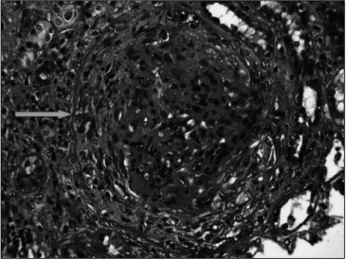
Figure 1. Fibrocellular crescent (green arrow) with compression of
residual glomerular tuft (PAS, x 400). patients with AKI and recent LD, a post-infection
immunocomplex glomerulonephritis should be considered; we stress the importance of the renal biopsy in the differential diagnosis of AKI in LD.
R
EFERENCES1. Diederen BM. Legionella spp. and Legionnaires’ disease. J In-fect 2008;56:1-12.
2. Daumas A, El-Mekaoui F, Bataille S, Daniel L, Caporossi JM, Fournier PE, et al. Acute tubulointerstitial nephritis compli-cating Legionnaires’ disease: a case report. J Med Case Rep 2012;6:100.
3. Hariparsad D, Ramsaroop R, Seedat YK, Patel PL. Mesangial proliferative glomerulonephritis with Legionnaires’ disease. A case report. S Afr Med J 1985;67:649-50.