Surgical antisepsis practices and use of surgical gloves as a
potential risk factors to intraoperative contamination
Antissepsia cirúrgica e utilização de luvas cirúrgicas como potenciais fatores de risco para
contaminação transoperatória
Antisepsia quirúrgica y el uso de guantes quirúrgicos como potenciales factores de riesgo para
contaminación durante la cirugía
Adriana Crisina de Oliveira1
Camila Sarmento Gama1
1. Universidade Federal de Minas Gerais.
Belo Horizonte, MG, Brazil.
Corresponding author: Adriana Crisina de Oliveira.
E-mail: [email protected]
Submited on 07/01/2015. Accepted on 02/25/2016.
DOI: 10.5935/1414-8145.20160051
A
bstrActObjective: This study aimed to investigate the practice of surgical hand antisepsis and integrity of sterile gloves after use by the
surgical team in a teaching hospital in the city of Belo Horizonte, Southeastern Brazil. Methods: A cross-sectional study was
conducted involving the gynecology service in April 2013. Data were collected through observation of surgical hand antisepsis and test to evaluate surgical glove perforation after use. A descriptive statistical analysis was performed. Results: Only 16% of
surgeons accomplished the technique and time recommended for the practice of surgical hand antisepsis. Regarding gloves, there were 11.1% of perforations, 31.8% of which were noticed. Conclusions: The results presented reveal that failures in
these procedures occur routinely, being able to interfere with patients and healthcare workers' safety, prompting relection on the theme in diferent health institutions.
Keywords: Hand Disinfection; Gloves, Surgical; Surgery.
r
esumoObjetivo: Objetivou-se investigar a prática da antissepsia cirúrgica das mãos e a integridade das luvas estéreis após seu uso
pela equipe cirúrgica de um hospital universitário de Belo Horizonte. Métodos: Realizou-se um estudo transversal envolvendo
o serviço de ginecologia, em abril de 2013. Os dados foram coletados por meio da observação da prática da antissepsia cirúrgica das mãos e teste para avaliação de perfuração das luvas após seu uso. Foi realizada uma análise estatística descritiva.
Resultados: Somente 16% dos cirurgiões cumpriram com a técnica e tempo recomendados para a prática antissepsia cirúrgica
das mãos. Para as luvas registrou-se 11,1% de perfurações e 31,8% foram percebidas. Conclusão: Evidenciou-se no presente
trabalho que falhas nesses procedimentos ocorrem rotineiramente, sendo capazes de interferir na segurança do paciente e do proissional, incitando a relexão acerca da temática em diferentes instituições de saúde.
Palavras-chave: Desinfecção das Mãos; Luvas Cirúrgicas; Cirurgia.
r
esumenObjetivo: Investigar la práctica de la antisepsia quirúrgica de las manos y la integridad de los guantes estériles después de
su utilización por el equipo quirúrgico de un hospital universitario de Belo Horizonte. Métodos: Estudio transversal realizado
con el servicio de ginecología en abril de 2013. Los datos fueron recolectados mediante la observación de la práctica de la antisepsia quirúrgica de las manos y pruebas para la evaluación de perforación de los guantes después del uso. Se realizó un análisis estadístico descriptivo. Resultados: Sólo 16% de los cirujanos han cumplido con la técnica y el tiempo recomendados
para la antisepsia quirúrgica de las manos. Para los guantes, el 11,1% tuvieron perforaciones y el 31,8% fueron percibidos.
Conclusión: Las fallas en estos procedimientos se producen rutinariamente, pudiendo interferir en la seguridad del paciente y
del profesional, culminando en la relexión acerca del tema en diferentes instituciones de salud.
INTRODUCTION
Surgical site infections (SSI) are the most frequent
complications in patients undergoing surgeries, corresponding
to 38% of all infections in this population1. The occurrence of SSI depends on factors associated with patients and the team, although mainly on the possibility of surgical wound contamination during the surgical procedure. During the intraoperative period, it is essential to prevent surgical wound contamination, capable of causing SSI as microorganisms will be directly in contact with the open cavity being manipulated2.
Although the SSI is multifactorial, the surgical team has a key role in the prevention of factors associated with the surgical procedure during the pre- and intraoperative periods. Surgical hand antisepsis and the use of sterile surgical gloves should be emphasized as measures capable of directly interfering with SSI pathogenesis, in the sense that they contribute to the
reduction/elimination of microorganism contamination of surgical
wounds, the sine qua non for the development of an infection3. In this sense, the hands of surgical team professionals have an important role. It has been proved that they are colonized by potentially pathogenic microorganisms associated with the occurrence of infectious outbreaks in surgical patients4,5. This shows the need to perform surgical hand antisepsis efectively and to use sterile gloves that prevent direct contact of hands with the manipulated cavity, thus protecting patients and professionals.
Surgical antisepsis or preoperative hand preparation aims to eliminate the transient microbiota and reduce the resident one, in addition to inhibiting the growth of microorganisms in the surgical team's gloved hands during surgery. This is performed during the preoperative period through hand hygiene with antiseptic substances that have broad and persistent antimicrobial properties. Additionally, the eicacy depends on the selection of the antiseptic agent, application method and
duration of process6.
The practice of surgical hand antisepsis is strongly recom
-mended by associations/societies and organizations such as the World Health Organization (WHO)6, Association of Perioperative Registered Nurses (AORN)4, Centers for Disease Control and Prevention (CDC)1, Brazilian Ministry of Health and Agência Nacional de Vigilância Sanitária (ANVISA - Brazilian Health Surveillance Agency)7. However, despite its relevance, studies have shown insuicient adherence of surgeons whether in terms of time spent on this procedure or technique used for such8.
Apart from surgical hand antisepsis, the use of sterile surgical gloves is also an essential measure to prevent SSI by creating a physical barrier against microorganisms found in the hands of health care workers, in the environment and in
patients6,8.
Sterile gloves are used to complement surgical hand antisepsis and they are both equally indispensable. However, their use does not guarantee total safety for professionals and patients, as (micro) perforations/tears were a common occurrence, preventing them from achieving their purposes9. These defects often pass unnoticed by health care workers and the procedure is performed uninterruptedly, exposing patients
to potentially infectious microorganisms10.
In view of what has been described, the present study aimed to investigate the practice of surgical hand antisepsis and integrity of sterile gloves after their use among surgical team members of the gynecology service of a university hospital located in the city of Belo Horizonte, Southeastern Brazil.
Literature Review
Surgical hand antisepsis is usually part of a routine procedure performed by the surgical team and adherence is actually not a problem, diferently from hand hygiene. Thus, the literature shows extensive publications on hand hygiene techniques and adherence, whereas there are few studies on hand antisepsis aspects8, none of which were Brazilian.
Hand antisepsis depends on meeting requirements such as adequate antiseptic selection, not wearing jewelry, nail care, subungual area cleaning and hand washing4,7,9,11.
Preoperative preparation of the surgical team's hands must begin with timing. Although this is a recommended stage, there is little consensus on the ideal time for efectiveness of the antiseptic agent. Studies demonstrate that brushing for two minutes during surgical hand antisepsis is as efective as ten minutes in terms of reduction of bacterial count1. Thus, the CDC instructs that this time should be at least two minutes and at most ive minutes1, the AORN recommends from three to ive minutes according to the product manufacturer's instructions12 and ANVISA recommends the irst antisepsis moment of the day should be performed for three to ive minutes and the subsequent ones for two to three minutes7.
this water low in one direction exclusively, from the ingertips to the elbow, and moving one's arm forwards or backwards is not recommended at this stage4,6,9.
In all movements during this process, care must be taken not to splash water on the surgical scrubs. Finally, taps must be turned of without disinfected body parts touching contaminated areas. Hands and forearms must not be shaken, instead, they must be dried using a sterile towel and aseptic technique before surgical scrubs can be worn. Drying must be performed from the ingertips to the elbow, pressing diferent parts of the towel against one's body, rather than rubbing it4,6,9.
Aiming to complement the practice of surgical hand antisep
-sis, sterile surgical gloves are used as they act as barriers against microorganisms, although not being capable of eliminating them. On the contrary, they create a humid environment in the hands that promotes the proliferation of microorganisms and which is particularly higher when surgical hand antisepsis is not performed. Therefore, in case of glove perforation, transference of such pathogens through holes, however microscopic, can occur more easily, thus increasing the risk of contamination of the surgical site, which can lead to SSI.
For this reason, the use of gloves does not replace the practice of preoperative hand preparation6.
In this sense, surgical hand antisepsis and the use of sterile surgical gloves should be emphasized as extremely important preventive measures capable of interfering with SSI pathogenesis. Such measures must be adequately performed to guarantee their efectiveness and, consequently, patients' safety.
METHODS
A cross-sectional study with a quantitative approach was performed at a large university hospital in the city of Belo Horizonte, Southeastern Brazil, including the gynecology service team members in elective surgeries performed in April 2013.
Surgeons, preceptors, residents and surgical technologists were eligible when participating in the team, regardless of sex and age group.
Data collection was performed in the morning and afternoon, according to the routine of surgical schedule the prioritized specialty, and data collection was divided into two stages.
During stage 1, a researcher observed the practice of surgical hand antisepsis by team members, who was not introduced to the professionals under observation. Thus, these professionals were blind to it, aiming to prevent change in behavior when someone knows they are being observed, known as the Hawthorne efect. During stage 2, in the operating room, before the beginning of the procedure, a researcher diferent from the one who performed in stage 1 obtained consent from the surgical team to evaluate the integrity of gloves used during the surgical procedure, the need to exchange them and perception of perforations. After the
team agreed to and signed an Informed Consent Form, they were asked to respond to an instrument that included the following infor
-mation: professional category, dominant hand for surgical activity and type of glove wearing adopted: single, i.e. one glove per hand, or double, two gloves per hand. The gloves used were evaluated through the test described by the European norm EN 455-113 to detect (micro)perforations, performed by illing each glove collected with 1L of water, observing it and manually pressing each glove inger and interdigital spaces to assess the presence of holes.
At the end of the collection, surgical team members were ap
-proached again, aiming to provide more details to the study in terms of the observational part and justiication for it to be performed without biases. At this moment, agreement from participants ob
-served was requested and it was clariied that, in case they did not agree with the observation made from their behavior, such analysis would be excluded from the study. Upon their agreement, another informed consent form was shown, in accordance with the ethical principles adopted for the present study from Resolution 466/12 of the Brazilian Health Council. This research project was approved by the Research Ethics Committee of the Federal University of Minas Gerais under oicial opinion ETIC 11416512.1.0000.5149. After this stage, the data obtained were typed and analyzed in a descriptive way with the help of the Statistical Package for the Social Sciences (SPSS®) software, version 20.0.
RESULTS
A total of 30 individuals from surgical teams of the gynecol
-ogy service of a university hospital in the city of Belo Horizonte, Southeastern Brazil, were approached in April 2013. Of these, 19 (63.3%) were females, 27 (90.0%) had graduated in medicine, one (3.3%) was a medical student and two (6.7%) were nursing technicians. Mean age was 33.1 years, ranging from 24 to 58 years. Of all participants, eight (26.7%) were gynecology preceptors and 19 (63.3%) were residents. Of all 19 residents, six (31.6%) were in the 1st year of residency, six (31.6%) in the 2nd year, three (15.8%) in the 3rd year, three (15.8%) in the 4th year and one (5.2%) in the 5th year.
A total of 20 elective gynecological surgeries were observed, of which 14 (70.0%) were performed in the afternoon and six (30.0%) in the morning.
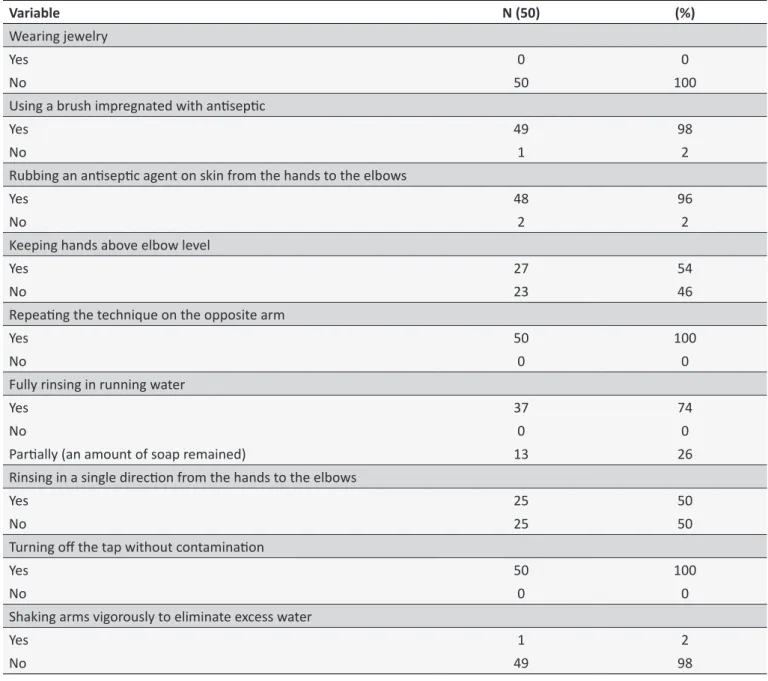
Table 1.
Characterisics of the pracice of surgical hand anisepsis in terms of ime and technique. City of Belo
Horizonte, Southeastern Brazil, 2013
Variable
N (50)
(%)
Wearing jewelry
Yes
0
0
No
50
100
Using a brush impregnated with anisepic
Yes
49
98
No
1
2
Rubbing an anisepic agent on skin from the hands to the elbows
Yes
48
96
No
2
2
Keeping hands above elbow level
Yes
27
54
No
23
46
Repeaing the technique on the opposite arm
Yes
50
100
No
0
0
Fully rinsing in running water
Yes
37
74
No
0
0
Parially (an amount of soap remained)
13
26
Rinsing in a single direcion from the hands to the elbows
Yes
25
50
No
25
50
Turning of the tap without contaminaion
Yes
50
100
No
0
0
Shaking arms vigorously to eliminate excess water
Yes
1
2
No
49
98
Of all 50 observations, only eight (16%) met the time and technique requirements (Table 1).
Antisepsis time was calculated and considered as adequate in 20 (40%) out of the 50 observations made. Additionally, 18 (36%) of them showed an adequate time of three minutes or more, in accordance with the recommendation for those performing this procedure for the irst surgery of the day (Table 2). Hand drying after surgical hand antisepsis was performed with a sterile compress in 48 (96%) observations. However, only 12 (24%) moved it from the ingertips to the elbows and 31 (62%) did not use diferent sides of the compress on distinct disinfected areas.
Glove perforation occurred in 13 surgeries (65.0%) ob
-served. The gloves used were made of natural latex from the same registered trademark. A total of 198 gloves were analyzed, of which 22 (11.1%) had perforations detected by tests after the end of surgery. Perforated gloves were used by 12 (40.0%) participants and ive of them had gloves perforated more than once in diferent surgeries. Of all perforations detected, seven (31.8%) were identiied by users.
Table 2.
Time spent on surgical hand anisepsis for the irst
surgery of the day. City of Belo Horizonte, Southeastern
Brazil, 2013
Anisepsis ime*
First surgery
Total
Yes
No
0 to 59 seconds
2
1
3
60 to 119 seconds
12
1
13
120 to 179 seconds
14
2
16
180 to 239 seconds
13
0
13
240 to 299 seconds
5
0
5
Total
46
4
50
* In accordance with ANVISA’s recommendaions, from three to ive minutes was considered to be adequate for the irst surgery, and from two to three
minutes for the subsequent ones.
The length of time of surgery when the highest number of glove perforations occurred was from 90 to 119 minutes (40.9%). Gloves worn on the left hand were the ones most frequently perforated, as shown on Table 3.
With regard to anatomical location, thumbs were most frequently afected by perforations (25%), followed by the index inger and dorsal aspect of hand (20.8% each) (Figure 1).
Of all perforations detected, 15 (68.2%) were female users, nine (41.0%) occurred in the dominant hand, 12 (54.5%) in the non-dominant hand and one (4.5%) in an ambidextrous user. It should be emphasized that three (13.6%) gloves were perforated when they were put on, but they were not replaced when this happened; instead, another glove was worn over it, resulting in double glove wearing.
The type of glove wearing used at the moment the glove was perforated was single in 68.4% and double in 31.6% of occurrences. Among those who used double glove wearing, 66.7% had only the outer glove perforated and 33.3% had both inner and outer gloves perforated at the same location.
DISCUSSION
Regarding surgical hand antisepsis, findings from the present study are in agreement with other studies8, showing the surgical team's insuicient adherence (16%) to length of time and technique to perform this procedure.
Aiming to improve such technique and length of time for surgical hand antisepsis and to guarantee its efectiveness, it is essential that the surgical team follow recommendations such as: removing jewelry before beginning the procedure; not using artiicial nails; cleaning the subungual area with a nail ile/picks
Table 3.
Characterisics of perforated gloves by length of use and hand. City of Belo Horizonte, Southeastern Brazil, 2013
Variable
N (22)
%
Length of ime of surgery when glove perforaion was detected
0 to 29 minutes
1
4.5
30 to 59 minutes
1
4.5
60 to 89 minutes
2
9.1
90 to 119 minutes
9
40.9
120 to 149 minutes
3
13.7
180 to 209 minutes
4
18.2
300 to 329 minutes
2
9.1
Hand where glove perforaion occurred
Single glove on let hand
6
27.3
Single glove on right hand
5
22.7
Inner and outer gloves on let hand concomitantly*
4
18.1
Outer glove on let hand
3
13.7
Inner glove on right hand
+3
13.7
Outer glove on right hand
1
4.5
Number of perforaions per glove
One perforaion
19
86.5
Two or more perforaions
3
13.5
* Referring to a pair of gloves that were perforated simultaneously on the same hand of user; + Gloves were perforated at the ime they were put on. Another
the spread of microorganisms in these areas and promoting bacterial colonization. Thus, hard-bristled brushes were replaced by disposable soft-bristled brushes in the market, apart from sponges that had the same efect of reducing microbial load in hands than hard-bristled ones. However, subsequently, other studies showed that the use or not of brushes/sponges during surgical hand antisepsis achieved the same result, so that its use was not required6,8,9.
Regarding the use of antiseptics, all of them used PVP-I. Although not recommended by the WHO and not being a part of the reality of the institution studied, certain surgical hand antisepsis techniques are performed with alcohol-based preparations by rubbing these products on professionals' hands
and forearms12.
The active substances in these preparations are ethanol, isopropanol and n-propanol, separately or in a combination of two of them. Alcohol's antimicrobial activity is due to its ability to denature proteins, stopping cell functions. Despite the fast antimicrobial action, there is no residual activity when applied to the skin. Adding PVP-I, chlorhexidine, octenidine or triclosan to the alcohol solution can result in residual activity6,14.
Compared to that of traditional products, the eicacy of alcohol preparations has the advantages of fast beginning of action, wide availability, reduction in damage to the skin and low
cost1,15. With regard to microbial reduction, they have achieved
equal or better results than those of traditional ones, while infection rates were found to be similar16.
During the entire process of surgical hand antisepsis, participants satisfactorily adhered to repeatedly rubbing it with the opposite arm, turning of the tap without contamination of disinfected area and not moving arms abruptly for the water to flow after rinsing. However, keeping one's hands above elbow level and rinsing them in a single direction, from the ingertips to the elbows, aiming to prevent contamination of the disinfected area with microorganisms from the non-disinfected area, did not show satisfactory adherence, based on guideline
recommendations4,6.
It is recommended that hands should be rinsed with clean water to avoid their recontamination, preferably warm water, for antiseptics to act more efectively. In certain cases, although the water comes from a reliable source, tap contamination may occur through Pseudomonas aeruginosa and other Gram-negative bacteria. Although there are no cases of outbreaks in surgical centers caused by contaminated taps in the literature, it is recommended that taps should not have aerators when aimed
at surgical antisepsis6.
Regarding hand drying, although the majority (96%) used a sterile compress and met the recommendations6, only 24% performed this by pressing it against the skin from the ingertips to the elbows and 62% did not use both sides of this compress Figure 1. Anatomical locaion of glove perforaions.
or appropriate brush under running water; paying attention to the recommended brushing1,4,6,11.
Adherence to brushing time was low (40%). Studies on the time required for the efectiveness of brushing have diferent methodologies in terms of the antiseptic assessed, application
time and outcome measured9. Thus, a standard protocol must
be established for health institutions to guide their professionals. In this sense, some guidebooks and manuals on surgical infection prevention based on scientiic evidence, as proposed by the AORN4, WHO6, and ANVISA7, contribute to the guidance of institutions by standardizing the length of time of the irst brushing from three to ive minutes and from two to three minutes for the subsequent ones. This includes the use of antiseptic solution, three milliliters in general, enough to cover hands completely.
Not wearing jewelry during surgical scrub was in agreement with the AORN4, CDC1, National Institute for Health and Clinical Excellence (NICE)11 and WHO6 recommendations. This is because studies have shown a greater colonization by microorganisms under the areas covered by such jewelry, hindering the contact of the antiseptic with these areas and consequently contributing to the reduction in the efectiveness of antisepsis. Additionally, the risk of perforations and tears in gloves is higher among jewelry wearers, apart from afecting their handling of patients in cases of emergency and causing glove adherence during the surgical procedure to be more diicult1,6.
The use of disposable sterile brushes with soft bristles impregnated with antiseptic, polyvinylpyrrolidone - iodine/PVP-I, as recommended by ANVISA7, was adopted by almost all participants (98%) adequately.
in diferent areas, thus allowing microorganisms from more colo
-nized areas to move to less colo-nized ones.
With regard to perforation rates in sterile surgical gloves, the results of the present study are in agreement with the literature. It is estimated that 18% (with a variation from 5% to 82%) of (micro) perforations/tears occur in gloves during procedures, allowing the transfer of microorganisms10 and being capable of doubling the risk of SSI9.
As observed, these perforations occurred more frequently in the dominant hand, mainly in the thumb, followed by the index inger, diferently from the results found where perforations in the index inger were more frequent, followed by the thumb. This characterization of perforations is due to surgeons handling piercing-cutting objects with the dominant hand, causing accidents in the opposite hand17.
With regard to the role played by health care workers studies have shown a higher number of glove perforations among surgeons, a fact which is in agreement with the present study18.
The longer duration of surgical procedures is associated with the increase in glove perforation rates17. The reduction in microbial contamination rates is associated with the increase in the frequency of exchange of surgical gloves. Thus, it is suggested that gloves should be replaced during long surgeries, preferably at every ninety minutes.
In addition to the more frequent exchange of gloves, the use of two gloves in each hand is recommended to maintain their physical integrity, as the outer glove acts like a protective barrier against inner glove perforations1-3,6. Double glove wearing is recommended when there is a high risk of glove perforation, such as orthopedic surgeries with an excessive use of piercing-cutting objects and bone fragments, when the consequences of contamination are disastrous such as prosthetic implants2,19. The protection the outer glove gives to the inner glove was efective in 66.7% of users who followed this recommendation.
In general, few users perceived glove perforation. Thus, aiming to improve the efectiveness of double glove wearing, the use of pairs of gloves of diferent colors has been recommended, such as bright green inner gloves and white outer gloves, thus increasing the perception of occurrence of perforations by those wearing them20.
CONCLUSION
Inadequate surgical antisepsis that does not meet the recommendations for time and technique and the concomitant
accidental and unnoticed occurrence of perforations in sterile
surgical gloves can expose the surgical wound to potentially pathogenic microorganisms capable of causing infections.
The present study showed that failures in these procedures occur frequently and they are capable of interfering with patients' safety, promoting relection on this theme in diferent health institutions, according to their realities.
Thus, aiming to minimize the occurrence of failures, the implementation of the following measures is suggested: routine training and monitoring of surgical hand antisepsis by surgical team members; the use of double glove wearing to maintain the integrity of inner gloves, thus guaranteeing their efectiveness; and the exchange of gloves at every 90 minutes of use to reduce the chance of professionals using them while perforations are not perceived.
ACKNOWLEDGEMENTS
This research was supported by the Fundação de Amparo a Pesquisa do Estado de Minas Gerais (FAPEMIG).
REFERENCES
1. Mangram AJ, Horan TC, Pearson ML, Silver LC, Jarvis WR. The Hospital Infection Control Practices Advisory Committee. Guideline for preven
-tion of surgical site infec-tion. Infect Control Hosp Epidemiol. 1999; 20(4):247-78.
2. Phillips J, O'Grady H, Baker E. Prevention of surgical site infections. Surgery. 2014; 32(9):468-71.
3. Alexander JW, Solomkin JS, Edwards MJ. Updated recommendations for control of surgical site infection. Ann Surg. 2011; 253(6):1082-93. 4. Patrick M, Van Wicklin SA. Implemeting AORN recommended practices
for hand hygiene. AORN J. 2012; 95(4):492-504.
5. Mioljevic V, Simic AP, Radenkovic D, Galun D, Palibrk I, Ostojic S et al. Acinetobacter spp. colonization and infection risk factors in surgical patients. Acta Chir Iugosl. 2011; 58(4):81-7.
6. World Health Organization. WHO guidelines on hand hygiene in health care. Geneva: WHO; 2009. 270 p.
7. Brasil. Agência Nacional de Vigilância Sanitária. Medidas de prevenção de infecção relacionada à assistência à saúde. Brasília. 2013. 87 p. 8. Tanner J. Surgical hand antisepsis: the evidence. J Perioper Pract. 2008;
17(1):330-9.
9. Widmer AF, Rotter M, Voss A, Nthumba P, Allegranzi B, Boyce J et al. Surgical hand preparation: state-of-the-art. J Hosp Infect. 2010; 74(2): 112-22.
10. Widmer AF. Surgical hand hygiene: scrub or rub? J Hosp Infect. 2013; 83(Suppl 1):S35-9.
11. National Institute for Health and Clinical Excellence. Surgical site infection: evidence update June 2013. Evidence update 43. 2013. 28 p. Acesso em: 23 de Outubro 2015. Disponível em: https://www.evidence. nhs.uk/evidence-update-43.
12. Spruce L. Back to basics: hand hygiene and surgical hand antisepsis. AORN J. 2013. 98(5):449-57.
13. Comité Européen de Normalisation. EN 455-1. Medical glove for single use. Berlin; 2000, 7 p.
14. Suchomel M, Rotter M. Ethanol in pre-surgical hand rubs: concentration and duration of application for achieving European Norm EN 12791. J Hosp Infect. 2011; 77(3):263-6.
15. Linda KM, Olson BS, Morse DJ, Duley C, Savell BK. Prospective, randomized in vivo comparison of a dual-active waterless antiseptic versus two alcohol-only waterless antiseptics for surgical hand antisepsis. Am J Infect Control. 2012; 40(2): 155-9.
17. Oliveira AC, Gama CS. Evaluation of surgical glove integrity during surgery in a Brazilian teaching hospital. Am J Infect Control. 2014; 42(10): 1093-6.
18. Beldame J, Lagrave B, Lievain L, Lefebvre B, Frebourg N, Dujardin F. Surgical glove bacterial contamination and perforation during total hip arthroplasty implantation: when gloves should be changed. Orthop Traumatol Surg Res. 2012. 98(4):432-40.
19. Guo YP, Wong PM, Li Y, Lai PP. Is double-gloving really protective? A comparison between the glove perforation rate among perioperative nurses with single and double gloves during surgery. Am J Surg. 2012; 204(2):210-5.