Characterization of Subpopulations (Clones and Subclones)
of the 21 SF Strain of
Trypanosoma cruzi
after Long Lasting
Maintenance in the Laboratory
Rozalia MF Campos, Sonia G Andrade
+Centro de Pesquisas Gonçalo Moniz - FIOCRUZ, Rua Valdemar Falcão 121, 40295-001 Salvador, BA, Brasil
Several studies have shown a clonal structure of Trypanosoma cruzi and its possible correlation with the behavioral heterogeneity of the parasite strains. In the present study, the 21 SF strain, that have been maintained in laboratory by successive passages in mice, for more than 15 years, showing a stability of biological and isoenzymic characteristics has been cloned, with the objective of establishing the characters of its clones and subclones. With the technique of isolation of a single parasite from the blood of infected mice, 5 clones and 14 subclones have been obtained. After four passages into mice, inoculum of 105 was obtained for each clone and subclone and inoculated into mice weighing 10 to 12 g. These were used for the study of the biological behavior of the clones: evolution of parasitemia, morphology of blood forms and host mortality. For isoenzymic characterization, the clones and subclones were analyzed for ALAT, ASAT, GPI and PGM enzymes. Results have shown that the 5 clones and the 14 subclones disclosed a biological behavior similar to the parental strain, with minor variability of the parasitemic profiles and also the same isoenzymic patterns. These results confirm the stability of the 21 SF strain and indicate a clonal homogeneity of its populations. This is compatible with the hypothesis that the T. cruzi strains represent an equilibrium of either homogenous or heterogeneous populations.
Keywords : Trypanosoma cruzi - strain - clones - biological characterization - zymodeme
Trypanosoma cruzi, the etiologic agent of Chagas disease, is found in nature as different popu-lations parasitizing humans, domestic animals, silvatic vertebrates or triatomines. Studies on T. cruzistrains have disclosed intraspecific behav-ioral heterogeneity identified by several param-eters (Andrade l974, l985). Clonal structure has been proposed to explain these differences (Tibayrenc et al. 1986). With the objective of clari-fying behavioral differences between T. cruzi
strains, biological and biochemical studies of para-site clones have been performed and results ob-tained suggest the occurrence of subpopulations in one same strain (Engel et al. l982, Morel et al. 1986, Araújo & Chiari l988).
The equilibrium of these populations in one strain could be responsible for the maintenance of its biological behavior although some views on the contrary have suggested changes of behavior due to local or host conditions (Araujo & Chiari 1988, Carneiro et al. 1990). The preservation of biologi-cal and biochemibiologi-cal characters of several strains after different laboratorial procedures as
+Corresponding author. Fax: +55-71-359.4320
Received 19 April 1996 Accepted 21 August 1996
cryopreservation (Castro Silva et al. 1988), pas-sages into different species of triatomine (Magalhães et al. l985, Magalhães & Andrade 1991), an the effect of chemotherapy (Castro Silva et al. 1989, Marretto & Andrade 1994), has been observed. In the present study, the 21 SF strain, that has been maintained in laboratory by succes-sive passages in mice for more than 15 years with stable biological and isoenzymic patterns has been used. This strain was cloned and subcloned with the objective of establishing the biological and biochemical behavior of its subpopulations.
MATERIALS AND METHODS
Neubauer chamber for evaluation of parasites con-centration. Dilution was performed with PBS and drops of 1µl were distributed in the wells of titra-tion plaques and examined with an inverted mi-croscope for isolation of one single parasite accord-ing to Dvorak (1985). Each well with one trypomastigote was filled with PBS. The contents was aspirated with l ml syringe and inoculated intraperitoneally into one suckling mice (5 to 6 days old). Twelve to 14 days after inoculation para-sitemia was evaluated and from each positive ani-mal, representing one clone, inoculum was indi-vidually obtained and inoculated into suckling mice. Five clones were obtained and designated as C1, C2, C3, C4 and C5. For each clone four passages were performed in the 14th day after in-oculation; in the fifth passage one group of mice weighing from 10 to 12 g was infected and studied to establish the biological behavior and isoenzy-mic characterization of the clone.
Subcloning of each clone was performed with the objective of studying a second generation. Blood was collected from one mouse for each clone group and, using the same methodology above, 14 subclones were obtained and designated as R1, R2, etc., preceeded by clone identification.
Clones and subclones were characterized ac-cording to biological and biochemical behavior. For biological characterization, 20 mice weighing from 10 to 12 g were infected with trypomastigotes from each clone and subclone, in the 4th passage in mice. Inocula were of 105 blood forms. Parasitaemia was evaluated from the 7th to the 21st day of infection by microscopic examination in 5µl of tail blood; percentages of slender and broad forms were established by counting the para-sites in Giemsa stained blood smears, in the 7th, 10thand 14thdays after infection. Cumulative mortality was evaluated during 30 days.
Isoenzymic analysis was performed in culture forms obtained for each clone and subclone, by haemoculture in Warren medium. Parasites were washed with KRT buffer solution (Romanha et al. 1979) and enzymic extracts were prepared accord-ing to Godfrey and Kilgour (1976) and stored into liquid Nitrogen as “ pearls” (Miles et al. 1977). The following isoenzymes were tested: alanine aminotransferase (ALAT) - E.C.2.6.1.2; aspartate aminotransferase (ASAT)-E.C.2.6.1.1.; glucose-phosphate isomerase (GPI) - E.C.5.3.1.9.; phos-phoglucomutase (PGM) - E.C.2.7.5.1. Electro-phoresis was performed according to Miles et al. (1980).
RESULTS
Biological behaviour - All the clones and subclones determined parasitemic profiles
charac-teristics for Type II strains and similar to the pa-rental strain (21 SF), in the infected mice. Parasitemic peaks were irregular, between 12 and 20 days after infection (Fig. 1a, c, d); the clone C5 determined the lowest levels and the latest peak (Fig. 1a) of parasitemia. However the subclones of this clone (C5) reproduced the same profile of the other clones of the 21 SF strain (Fig. 1b).
The morphological characterization have shown the predominance of slender forms at the 7th day of infection and of broad forms in the 10th and 14th days, for the 21SF strain and all its clones and subclones (Figs 2, 3).
Mortality rates were variable, the highest per-centage occurring between the 14th and 19th days after infection.
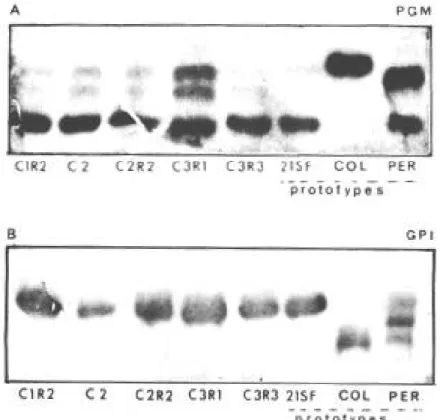
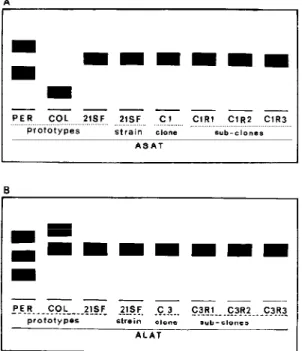
The biochemical analysis for the enzymes ALAT, ASAT, PGM and GPI of all clones and subclones have shown the eletrophoretic patterns of Z2, similar to the parental strain (Figs 4, 5).
DISCUSSION
Fig. 1: parasitemia in mice infected with the 21SF strain and derived clones and subclones. A: parasitemic peaks of the 21SF strain and clones C1, C2, C3, C4 are irregular and occurred between 12 and 20 days; the clone C5 showed a delayed peak at 21 days. B: subclones of the C5 clone reproduce the irregular parasitemic peaks between 12 and 20 days with the same variations in their levels, as observed in the parental strain an its clones. C, D: the parental strain and clones C4 and C1 with the respective subclones, showing the parasitemic pattern of Type II strains.
No. of trypomastigotes per 50 microscopic firlds, (400X) No. of trypomastigotes per 50 microscopic firlds, (400X)
No. of trypomastigotes per 50 microscopic firlds, (400X) No. of trypomastigotes per 50 microscopic firlds, (400X)
Parasitaemiasias
Fig. 3: morphological evaluation of the blood forms of the 21SF strain in comparison with the C2 clone and its subclones: the percentages of broad forms increase from the 7th to the 14th day of infection in all groups.
Fig. 4 A, B: electrophoretic patterns of isoenzymes PGM and GPI of clone C2, subclones C1R2, C2R2, C3R1, C3R3 in comparison to the parental strain (21SF), prototype of Type II (Z2) and with the Peruvian and Colombian strains, prototypes respectively of Type I (Z2b) and Type III (Z1) strains.
hypothesis, the homogeneity here disclosed for the clones and subclones of the 21SF strain, could rep-resent the presence of a “principal” clone, corre-sponding to Type II, zymodeme 2 strains. This type of strain is predominant in the Recôncavo Bahiano (Andrade 1974) and other areas of Brazil, disclos-ing an ubiquitary distribution (Andrade & Magalhães 1996). The clonal structure of T. cruzi, without recombinations, as proposed by Tibayrenc et al. (1981, 1986), can be seen in the electrophore-sis of PGM (enzyme with tri-allelic locus),
cruzi (Carrasco et al. 1996). As registered by McDaniel and Dvorak (1993) clones with the same isoenzymic and schizodeme profiles, can differ in their DNA content. In the present study, the bio-logical and isozymic homogeneity of the 5 clones and 14 subclones of the 21 SF strain seem to indi-cate that this T. cruzi strain is composed predomi-nantly by populations that are similar due to their phenotypic characteristics. This does not preclude that genomic characterization, by the analysis of the kDNA minicircles and maxicircles or the nuclear DNA could reveal new insights on the com-position of the clones and subclones in compari-son with the parental strain. These will be the fu-ture steps of the present investigation.
The histopathological studies with clinico-pathological correlations points to the importance of the biological behaviour of T. cruzi strains. This seems most useful for the investigations on the different clinical features presented by Chagas’ disease in different geographical areas, as previ-ously discussed (Andrade & Magalhães 1996). The stability of biological strain behaviour is a further argument of its potential utility for practical ap-plications.
AKNOWLEDGEMENT
To CMG Santiago for technical help in the obtainance of the clones and to Dinalva França for the development of the axenic cultures.
REFERENCES
Andrade SG 1974. Caracterização de cepas do Trypano-soma cruzi isoladas no Recôncavo Baiano (Contri-buição ao estudo da patologia geral da doença de Chagas em nosso meio).Rev Pat Trop 3: 65-121. Andrade SG 1985. Morphological and behavioral
char-acterization of Trypanosoma cruzi strains. Rev Soc Bras Med Trop 18 (Suppl): 39-46.
Andrade SG, Magalhães JB 1996. Trypanosoma cruzi strains: ubiquitary distribution in different geographi-cal areas with correlations between biodemes, zimodemes and pathology of experimental Chagas disease. Rev Soc Bras Med Trop (in press). Andrade V, Brodskyn C, Andrade SG 1983.
Correla-tion between isoenzyme patterns and biological behaviour of different strains of Trypanosoma cruzi. Trans R SocTrop Med Hyg 76: 796-799.
Araujo MS, Chiari E 1988. Caracterização biológica de clones das cepas Y, CL e MR deTrypanosoma cruzi em camundongos C3H isogênicos. Mem Inst Oswaldo Cruz 83: 175-181.
Brener Z, Chiari E, Alvarenga NJ 1974. Observations of Trypanosoma cruzi strain maintained over an 8-year period in experimentally inoculated mice. Rev Inst Med Trop São Paulo 16: 39-46.
Brenière SF, Araniki I, LeRay D, Tibayrenc M 1991 L’analyse SDS-PAGE des protéines et antigènes de surface révèle une forte hétérogénéité chez les clones naturels de Trypanosoma cruzi, corrélée à la variabilité isoenzymatique. CR Acad Sci Paris Série III 312: 449-454.
Carneiro M, Chiari E, Gonçalves AM, Pereira AAS, Morel CM, Romanha AJ 1990. Changes in the isoen-zyme and kinetoplast DNA patterns of Trypanosoma cruzi strains induced by maintenance in mice. Acta Trop 47: 35-45.
Carrasco HJ, Frame IA, Valente SA, Miles MA 1996. Genetic exchange as a possible source of genomic diversity in sylvatic populations of Trypanosoma cruzi . Am J Trop Med Hyg 54: 418-424.
Castro Silva R, Santiago CMG, Andrade SG 1988. Estudo da estabilidade dos caracteres isoenzimáticos de cepas do Trypanosoma cruzi em extratos enzimáticos estocados em nitrogênio líquido por período prolongado. Mem Inst Oswaldo Cruz83 (Supl. I): 82.
Castro Silva R, Santiago CMG, Pontes AL, Andrade SG 1989. Padrão isoenzimático da cepa Y do Try-panosoma cruzi após quimioterapia específica. Mem Inst Oswaldo Cruz84: 81-86.
Dvorak JA 1985. Single cell isolates of Trypanosoma cruzi: How and why? Rev Soc Bras Med Trop 18 (Suppl.): 29-38.
Engel JC, Dvorak JA, Segura EL, Crane JSt M 1982. Trypanosoma cruzi: biological characterization of 19 clones derived from two chagasic patients. I. Fig. 5 A: ASAT isoenzymic pattern of the 21SF strain in
Growth kinetics in liquid medium. J Protozool 29: 555-560.
Godfrey DG, Kilgour V 1976. Enzyme electrophoresis in characterizing the causative organism of gambian trypanosomiasis. Trans R Soc Trop Med Hyg 3: 219-224.
Goldberg SS, Pereira SAA 1983. Enzyme variation among clones of Trypanosoma cruzi. J Parasitol 69: 91-96.
McDaniel JP, Dvorak JA 1993. Identification, isola-tion and characterizaisola-tion of naturally occuring Try-panosoma cruzi variants. Mol Biochem Parasitol 57: 213-222.
Magalhães JB, Andrade SG 1991. Estudo do compor-tamento de cepas do Trypanosoma cruzi após passagens em diferentes espécies de triatomíneos. Rev Soc Bras Med Trop 24: 209-216.
Magalhães JB, Pontes AL, Andrade SG 1985. Compor-tamento das cepas Y e Peruana do Trypanosoma cruzi no camundongo, após passagem em diferentes meios. Mem Inst Oswaldo Cruz 80: 41-50. Marretto JPM, Andrade SG 1994. Biochemical
behav-ior of Trypanosoma cruzi strains isolated from mice submitted to specific chemotherapy. Rev Soc Bras Med Trop 27: 209-215.
Miles MA, Toyé PJ, Oswald SC, Godfrey DG 1977. The identification by isoenzyme patterns of two dis-tinct strain groups of Trypanosoma cruzi, circulat-ing independently in a rural area of Brazil. Trans R Soc Trop Med Hyg 71: 217-237.
Miles MA, Lanham SM, Souza AA, Povoa M 1980. Further enzymic characters of Trypanosoma cruzi in their evaluation for strain identification. Trans R Soc Trop Med Hyg 74: 221-237.
Montamat EE, De Luca d’Oro G, Perret B, Rivas C 1992. Characterization of Trypanosoma cruzi from Argen-tina by electrophoretic zymograms. Acta Tropica 50: 125-133.
Morel C, Chiari E, Camargo EP, Mattei DM, Romanha AJ, Simpson L 1980. Strains and clones of Trypa-nosoma cruzi can be caracterized by patterns of re-striction endonuclease products of kinetoplast DNA minicircles. Proc Natl Acad Sci 77: 6810-6814. Morel CM, Deane MP, Gonçalves AM 1986. The
com-plexity of Trypanosoma cruzi populations revealed by schizodeme analysis. Parasitol Today 2: 4-8. Postan M, Dvorak JA, McDaniel JP 1983. Studies of
Trypanosoma cruzi clones in inbred mice I - A com-parison of course of infections of C3H/HEN mice with two clones isolated on a common source. Am J Trop Med Hyg 32: 497-506.
Rocha Filho FD 1979. Estudo comparativo de cepas do T. cruzi de diferentes procedências. Aspectos antigênicos, morfológicos e histopatológicos. The-sis. Universidade Federal da Bahia, 85 pp. Romanha AJ, Silva Pereira AA, Chiari E, Kilgour V
1979. Isoenzyme patterns of cultured Trypanosoma cruzi changes after prolonged subculture. Comp Biochem Physiol 62: 139-142.
Tibayrenc M, Brenière SF 1988. Trypanosoma cruzi: major clones rather than principal zimodemes.Mem Inst Oswaldo Cruz 83: (Suppl. I): 249-255. Tibayrenc M, Brenière F, Barnabe C, Lemesre JL,
Echaclar L, Desjeux P 1985. Isozymic variability of Trypanosoma cruzi: biological and epidemiologi-cal significance. Ann Soc belge Méd Trop 65 (Suppl. 1): 59-61.
Tibayrenc M, Cariou ML, Solignac M, Carlier Y, Grassé PP 1981. Arguments génétiques contre l’existence d’une sexualité actuelle chez Trypanosoma cruzi. Implications taxinomiques. C R Acad Sci Paris Serie III 293: 207-209.