Earlier Menarche Is Associated with Lower
Insulin Sensitivity and Increased Adiposity
in Young Adult Women
Dyanne A. Wilson1, José G. B. Derraik1, Deborah L. Rowe2, Paul L. Hofman1, Wayne S. Cutfield1
*
1Liggins Institute, University of Auckland, Auckland, New Zealand,2School of Nursing, Faculty of Medical
and Health Sciences, Auckland, University of Auckland
Abstract
Objective
We aimed to assess whether age at menarche was associated with insulin sensitivity in young adult women.
Methods
We studied 54 healthy young women aged 20–30 years. Participants were grouped
accord-ing to age at menarche: Early (11.0 years; n=13), Average (>12.0 and13.0 years;
n=28), and Late (14.0 years, n=13). Primary outcome was insulin sensitivity measured
using intravenous glucose tolerance tests and Bergman’s minimal model. Body
composi-tion was assessed using whole-body dual-energy X-ray absorptiometry.
Results
Earlier menarche was associated with lower insulin sensitivity (p=0.015). There was also a continuous increase in adiposity with younger age at menarche, which was associated with increased weight (p=0.001), BMI (p=0.002), total body fat (p=0.049), and truncal fat (p=0.020). Stratified analyses showed that insulin sensitivity in Early women
(5.5 x10⁻⁴min-1(mU/l)) was lower than in Average (8.0 x10⁻⁴min-1(mU/l), p=0.021) and Late
(8.6 x10⁻⁴min-1(mU/l), p=0.033) groups. Early women (weight=66.1 kg; BMI=24.1 kg/m2)
were considerably heavier and fatter than Average (59.0 kg, p=0.004; 21.4 kg/m2, p=0.002)
and Late (57.0 kg, p=0.001; 20.8 kg/m2, p=0.0009) women.
Conclusions
Early menarche is associated with lower insulin sensitivity and increased adiposity in young adulthood, potentially increasing the risk of type 2 diabetes and the metabolic syndrome later in life.
a11111
OPEN ACCESS
Citation:Wilson DA, Derraik JGB, Rowe DL, Hofman PL, Cutfield WS (2015) Earlier Menarche Is Associated with Lower Insulin Sensitivity and Increased Adiposity in Young Adult Women. PLoS ONE 10(6): e0128427. doi:10.1371/journal. pone.0128427
Academic Editor:Marià Alemany, Faculty of Biology, SPAIN
Received:November 25, 2014
Accepted:April 27, 2015
Published:June 10, 2015
Copyright:© 2015 Wilson et al. This is an open access article distributed under the terms of the
Creative Commons Attribution License, which permits unrestricted use, distribution, and reproduction in any medium, provided the original author and source are credited.
Data Availability Statement:The clinical data cannot be made available in a public repository due to strict conditions of the ethics approval of our study. Nonetheless, anonymized and unidentifiable data would be made available to other investigators upon request. For this purpose, anyone interested should contact the senior author Prof Wayne Cutfield (w. [email protected]).
Introduction
The onset and timing of puberty in humans are not fully understood, but are dependent on nu-merous factors, including genetic variability, energy balance, brain structure, multiple neuroen-docrine pathways, and hormonal profiles. Nonetheless, it is acknowledged that successful reproduction requires suitable energy stores to support the associated physiological functions [1]. Therefore, puberty is "metabolically gated" to prevent fertility in conditions of energy insuf-ficiency [2], so that metabolic conditions and the amount of energy reserves play an important role modulating puberty timing [1,2]. Peptides from the digestive tract such as ghrelin (i.e. en-ergy intake) and adipose tissue such as leptin (i.e. enen-ergy storage) inform the central nervous system about the individual's current metabolic status [1]. These peptides are important modu-lators of the gonadotropic axis that are capable of disturbing pubertal onset or progression [1].
Leptin has been shown to provide important signals of energy sufficiency, working at the level of the hypothalamus to modulate the function of the gonadotropin-releasing hormone (GnRH) neuronal system [2,3]. There is evidence that insulin, alongside leptin, also plays a role in the modulation of GnRH neurons and reproductive development [4,5]. An experimental modelin vivohas shown that increasing insulin concentrations stimulated luteinizing hormone
secretion, while anin vitromodel showed a direct dose-dependent stimulation of GnRH
secre-tion by insulin [6]. As a result, insulin sensitivity during childhood may also be important in the initiation of and progression through puberty.
Adolescents with anorexia nervosa (who are nutritionally deficient) and those with chronic illness (who have a combination of nutritional, inflammatory, and therapeutic compromises) have delayed puberty and enhanced insulin sensitivity [7,8]. Children with constitutional delay of growth and development are also more insulin sensitive, even after controlling for adiposity [9]. In contrast, obese children have an earlier onset of puberty [10] and lower insulin sensitivi-ty [11], while children born prematurely or small-for-gestational-age (SGA) (both associated with decreased insulin sensitivity) have an increased risk of premature adrenarche and early puberty [12]. Insulin sensitivity seems to play an important physiological role during puberty, when a marked reduction in insulin sensitivity occurs coinciding with Tanner 2 stage of devel-opment [13]. This reduction in insulin sensitivity is proposed to be important to pubertal de-velopment, as it leads to increased circulation of growth factors and promotes protein (muscle) production [14].
We therefore hypothesised that the timing of puberty would affect insulin sensitivity in young adult women; i.e. early puberty would be associated with lower insulin sensitivity and late puberty with increased insulin sensitivity. Thus, we aimed to determine whether age at menarche was associated with insulin sensitivity in early adulthood.
Methods
Ethics approval
This study was approved by the Northern X Regional Ethics Committee (Ministry of Health, New Zealand). All procedures followed were in accordance with the ethical standards of the re-sponsible committees on human experimentation and with the Declaration of Helsinki. Both written and verbal informed consents were obtained from all participants.
Participants
Healthy women aged 20–30 years were recruited to this study through advertising among staff and students at University of Auckland campuses (Auckland, New Zealand). All women were childless, not pregnant, and non-smokers, had no history of drug or alcohol abuse, and had not
used oral contraceptives for the preceding 6 months. Exclusion criteria were evidence of chron-ic illness (including behavioral disorders such as attention defchron-icit hyperactivity disorder), obesi-ty (BMI30.0 kg/m2), chromosomal or syndromal diagnosis, conception by means ofin vitro
fertilization, use of medication known to influence insulin sensitivity, having first-degree rela-tives with type 2 diabetes mellitus or the metabolic syndrome, and present or past history of an eating disorder. Those born SGA, preterm (<37 weeks of gestation), or after twin pregnancy
were also excluded, as these conditions are associated with reduced insulin sensitivity. All po-tential participants were screened for type 1 diabetes antibodies, and those with the presence of islet cell antibodies [glutamic acid decarboxylase antibody (antiGAD) or islet antigen 2 anti-body (IA2)] were also excluded.
Study design
Age at menarche was established based on an individual's recall. A number of previous studies have shown that menarcheal age recall is highly correlated with the actual recorded age [15,16]. A study by Must et al. on over 400 women showed that, on average, menarcheal age recall after 30 years was only 0.08 years earlier (95% confidence interval: -0.18–0.01 years) than the actual age at menarche [16]. In comparison, the time elapsed between actual menarcheal age and our study was much shorter: 9.9 ± 2.9 years (range 3.2–19.0 years).
Apart from examining linear associations between age at menarche and study outcomes, participants were divided into three groups according to their age at menarche: Early (11.0 years), Average (>12.0 and13.0 years), and Late (14.0 years). These thresholds were cho-sen to approximate the distribution of age at menarche in the Non-Hispanic white population in the USA [17], as these data would more closely reflect New Zealand Europeans who would very likely constitute the bulk of our cohort. Thus, our Early group fell below the 10thpercentile for age at menarche (11.32 years), the Average group between the 25thand 75thpercentile (11.9–13.2 years), and the Late group above the 90thpercentile (13.78 years) [17]. Importantly, we also established a one-year gap between menarcheal age groups not only to account for po-tential recall inaccuracies, but also to ensure the group division was applicable to all ethnicities.
Clinical assessments
Assessments were carried out after a 12-hour overnight fast at the Maurice & Agnes Paykel Clinical Research Unit (Liggins Institute, University of Auckland). All women were assessed during the early follicular phase of their menstrual cycle (d5–10), as studies have suggested that there are variations in insulin sensitivity during the normal menstrual cycle [18,19].
Clinical history was obtained, including menstrual history, use of oral contraception, exer-cise history, and assessment of other risk factors for insulin resistance. A physical examination was conducted to exclude evidence of chronic illness, including checking for acanthosis nigri-cans. Ethnicity was recorded by self-report using a priority system, such that if multiple ethnic-ities were selected, the patient was assigned to a single ethnicity, following a hierarchical classification [20].
Primary outcome
administered as a bolus at 20 minutes, and further samples were drawn at 22, 23, 24, 25, 27, 30, 35, 40, 45, 50, 60, 70, 80, and 90 minutes.
Secondary outcomes
Other parameters associated with glucose homeostasis were the acute insulin response (the in-tegrated insulin levels over the first 10 minutes of the FSIGT following the initial intravenous glucose bolus), glucose effectiveness (an estimation of glucose-mediated glucose uptake), and disposition index (the product of insulin sensitivity x acute insulin response). Participants' heights were measured using a Harpenden stadiometer to the nearest 1 mm. Weight and body composition data were obtained using whole-body dual-energy X-ray absorptiometry (DXA, Lunar Prodigy 2000, General Electric, Madison, WI, USA). Parameters of interest were: total body fat, fat-free mass, and truncal fat percentages, as well as bone mineral density.
Assays
Plasma glucose was measured with a Hitachi 902 Automatic Analyzer (Hitachi Scientific In-struments, Tokyo, Japan) with an inter-assay coefficient variation of 1.8%. Plasma insulin was determined with Abbott’s IMX Microparticle Enzyme Immunoassay (Abbott, Seoul, Korea), with an inter-assay coefficient variation of 4.9%.
Statistical analyses
Stratified analyses were carried out using multiple linear regression models to assess primary and secondary outcomes. Confounding factors were controlled for in the analyses as required, depending on the outcome response of interest: for insulin sensitivity and outcomes associated with glucose homeostasis—age and total body fat percentage were included; and for body com-position—age and ethnicity. Possible associations were also investigated with menarcheal age as a continuous variable. All multivariate analyses were performed in SAS version 9.3 (SAS In-stitute Inc. Cary NC, USA). All statistical tests were two-tailed and maintained at a 5% signifi-cance level. Demographic data are presented as means ± standard deviations. Primary and secondary outcome data are presented as model-adjusted means (estimated marginal means adjusted for the confounding factors), with associated 95% confidence intervals. Parameters of glucose homeostasis were log-transformed to approximate normality. For linear associations, apart from p-values, the estimated mean change in the outcome response per year increase in age at menarche (β) is also provided.
Results
We studied a total of 54 women aged 22.5 ± 2.3 years (range 20.1–30.0 years) and with a BMI of 22 ± 3 kg/m2(range 18–29 kg/m2). There were 13 women in the Early, 28 in the Average, and 13 in Late groups, who were of similar age (22.7 ± 2.9, 22.6 ± 2.0, and 22.0 ± 2.3 years, spectively). Overall, 65% of participants were of New Zealand European ethnicity (with the re-mainder including Asians, Indians, and Pacific Islanders), and there were no statistically significant differences in ethnic composition between groups (p = 0.19).
Linear associations
increased weight (r2= 0.18;β= -2.07; p = 0.001), BMI (r2= 0.19;β= -0.73; p = 0.002), total body fat (r2= 0.07;β= -1.04; p = 0.049), and truncal fat (r2= 0.10;β= -1.74; p = 0.020).
Stratified analyses
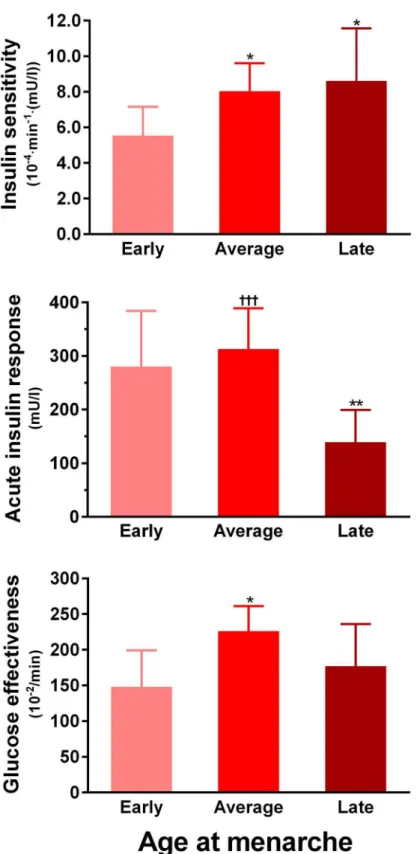
Insulin sensitivity in Early women (5.5 x10⁻⁴min-1(mU/l)) was 31% lower than in Average (8.0 x10⁻⁴min-1(mU/l), p = 0.021) and 36% lower than in Late (8.6 x10⁻⁴min-1(mU/l), p = 0.033) groups (Fig 1). The acute insulin response was higher in both Early (280 mU/l, p = 0.007) and Average (313 mU/l, p = 0.0004) groups compared to Late women (139 mU/l) (Fig 1). Early women also had lower glucose effectiveness (148 vs 226 x10-2/min, p = 0.016;Fig 1) and lower disposition index (1555 vs 2515 mg/dl, p = 0.009) than Average women, who in turn had great-er disposition index than Late women (2515 vs 1198 mg/dl, p = 0.0004). Thgreat-ere wgreat-ere howevgreat-er, no differences in fasting glucose or insulin concentrations (Table 1), which are less precise indi-ces of glucose regulation. Importantly, all observed differenindi-ces in glucose homeostasis were ad-justed for total body fat percentage and age.
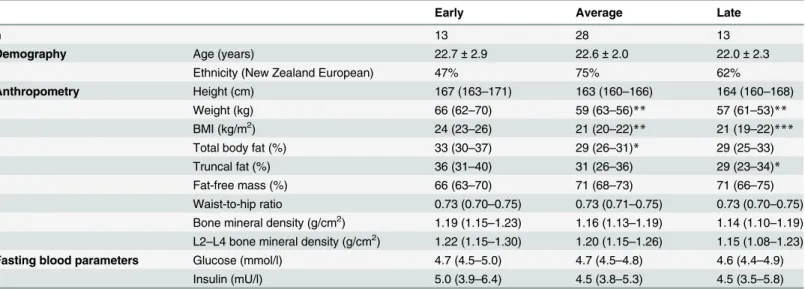
Early women were considerably heavier and of greater BMI than Average (p = 0.004 and p = 0.002, respectively) and Late (p = 0.001 and p = 0.0009, respectively) women (Table 1). Early women also had more total body fat than Average (p = 0.030) and more truncal fat than Late (p = 0.045) women (Table 1). As a result, there were considerably more Early women overweight (BMI 25.0–29.9 kg/m2, 46%) than in both Average (7%, p = 0.007) and Late (8%, p = 0.033) groups. There were however, no differences in height, waist-to-hip ratio, or bone mineral density (Table 1).
Discussion
This study shows that earlier menarche was associated with lower insulin sensitivity and higher insulin secretion. In addition, women who experienced earlier menarche were also heavier and had greater truncal adiposity. Notably, our findings on insulin sensitivity were not simply a re-sult of increased adiposity, as total body fat percentage was adjusted for in the analyses. Impor-tantly, all women were assessed during the early follicular phase of their menstrual cycle and none were on oral contraceptives for at least 6 months, in order to minimize the effects of vary-ing oestrogen levels on insulin sensitivity [22,23].
To contextualize our findings, the magnitude of the difference in insulin sensitivity between Early and Late women (41%) was twice as large as the change seen with medications used to treat diabetes in adults, such as metformin (20%). Our observations corroborate previous stud-ies showing younger menarcheal age to be associated with higher fasting insulin concentrations and increased insulin resistance as measured by HOMA-IR [24,25]. However, ours is the first study to actually measure insulin sensitivity using robust methods in association with menar-cheal age. In addition, we showed changes in glucose regulation across the menarmenar-cheal age spectrum while total body fat was accounted for in our statistical models. Importantly, lower insulin sensitivity is associated with increased risk of developing type 2 diabetes mellitus, hy-pertension, coronary heart disease, stroke, and cancer in the long-term [26]. Thus, our finding are also in accordance with population studies that showed an increased risk of pre-diabetes, diabetes [27–29], and the metabolic syndrome [30] in association with earlier age at menarche.
Fig 1. Insulin sensitivity and other parameters of glucose homeostasis according to menarcheal age groups: Early (n = 13), Average (n = 28), and Late (n = 13).Data are adjusted means from multivariate models with respective 95% confidence intervals.*p<0.05 and**p<0.01 vs Early group;†††p<0.001 vs Late group.
with earlier puberty, particularly in girls, but may also be associated with more rapid pubertal progression [33,35,36], which in turn was shown to be associated with increased adiposity in young adulthood [37]. As a result, Must et al. proposed that in reality, it is the increased adipos-ity in childhood that leads to both earlier sexual maturation and greater adiposadipos-ity in adulthood [35]. Nevertheless, the available evidence have not determined whether obesity drives earlier onset of puberty and insulin resistance, or whether insulin resistance occurs leading to obesity and earlier menarche.
The exact mechanisms regulating the timing of puberty are poorly understood. Association studies in twins suggest that 70–80% of the variation in pubertal timing may be explained by heritable factors [38]. Nonetheless, the timing of pubertal onset is likely a result of a complex interaction from a number of genetic and external factors, most of which have been discussed in depth by Parent et al. [38]. It is possible that signals associated with fat mass such as leptin and insulin-like growth factor I (IGF-I) may be involved in the regulation of pubertal onset [1,2,38].
Our findings are consistent with the existing literature indicating that insulin sensitivity or insulin levels play a role in pubertal onset [6,39]. During normal pubertal development, there is a reduction in insulin sensitivity that is mediated by increased growth hormone concentrations and a consequent increase in IGF-I levels [40]. We have also observed that pre-pubertal chil-dren with constitutional delay of growth and development were more insulin sensitive than normal children, which is consistent with our findings of a continuous association between age at menarche and insulin sensitivity [9]. In addition, support for a role for insulin sensitivity in pubertal onset has been shown by effects of an insulin sensitizer (metformin) in girls born SGA (who were insulin resistant), which delayed the onset of puberty, prolonged its duration, and reduced the proportion of fat mass [41,42]. Further, a recent study in rats has provided evi-dence that hyperinsulinaemia (a marker of insulin resistance) drives diet-induced obesity [43]. Therefore, it is possible that, in humans, greater insulin resistance/hyperinsulinaemia may lead
Table 1. Demographic data on studied women according to age at menarche.
Early Average Late
n 13 28 13
Demography Age (years) 22.7±2.9 22.6±2.0 22.0±2.3
Ethnicity (New Zealand European) 47% 75% 62%
Anthropometry Height (cm) 167 (163–171) 163 (160–166) 164 (160–168)
Weight (kg) 66 (62–70) 59 (63–56)** 57 (61–53)**
BMI (kg/m2) 24 (23–26) 21 (20–22)** 21 (19–22)***
Total body fat (%) 33 (30–37) 29 (26–31)* 29 (25–33)
Truncal fat (%) 36 (31–40) 31 (26–36) 29 (23–34)*
Fat-free mass (%) 66 (63–70) 71 (68–73) 71 (66–75)
Waist-to-hip ratio 0.73 (0.70–0.75) 0.73 (0.71–0.75) 0.73 (0.70–0.75) Bone mineral density (g/cm2) 1.19 (1.15–1.23) 1.16 (1.13–1.19) 1.14 (1.10–1.19) L2–L4 bone mineral density (g/cm2) 1.22 (1.15–1.30) 1.20 (1.15–1.26) 1.15 (1.08–1.23)
Fasting blood parameters Glucose (mmol/l) 4.7 (4.5–5.0) 4.7 (4.5–4.8) 4.6 (4.4–4.9)
Insulin (mU/l) 5.0 (3.9–6.4) 4.5 (3.8–5.3) 4.5 (3.5–5.8)
Age data are means and standard deviations; other data are adjusted means from multivariate models with respective 95% confidence intervals. *p<0.05,
**p<0.01,
***p<0.001 vs Early group.
to both increased adiposity and a premature pubertal onset. If this hypothesis is correct, it is important to understand the genetic, epigenetic, or environmental factors that are associated with these changes in insulin sensitivity in developmentally normal pre-pubertal children.
We acknowledge that our study was cross-sectional, so that it was not possible to determine whether increased adiposity led to a reduction in insulin sensitivity or vice-versa. Moreover, our stratified analyses grouped participants based on data for the USA and not New Zealand, and the relatively small number of participants in the Early and Late groups limit our ability to extrapolate our findings to the wider population. In addition, menarcheal age was obtained by participants' recall rather than actual recorded ages. However, this method is accurate [15,16], and our stratified analyses with a one-year gap between groups limited the impacts of potential recall errors.
In conclusion, our study provides direct evidence of altered insulin sensitivity in association with age at menarche, which has been previously inferred by studies using HOMA-IR
[24,25,44]. Others have suggested that women who experienced early menarche may be at an increased risk of developing type 2 diabetes and other metabolic and cardiovascular diseases later in life [27–30]. However, the association between insulin sensitivity and age at menarche does not prove causality, and will require further longitudinal studies to better define this rela-tionship. With the reduction in menarcheal age observed in recent decades throughout the world [45,46], our findings are of public health interest. Future research will need to help deter-mine whether obesity or reduced insulin sensitivity is the principal driver for earlier pubertal onset.
Author Contributions
Conceived and designed the experiments: DAW WSC PLH. Performed the experiments: DAW DLR. Analyzed the data: JGBD. Wrote the paper: JGBD WSC PLH DAW.
References
1. Martos-Moreno GÁ, Chowen JA, Argente J (2010) Metabolic signals in human puberty: Effects of over and undernutrition. Mol Cell Endocrinol 324: 70–81. doi:10.1016/j.mce.2009.12.017PMID:20026379 2. Sanchez-Garrido MA, Tena-Sempere M (2013) Metabolic control of puberty: roles of leptin and
kis-speptins. Horm Behav 64: 187–194. doi:10.1016/j.yhbeh.2013.01.014PMID:23998663
3. Cunningham MJ, Clifton DK, Steiner RA (1999) Leptin's actions on the reproductive axis: Perspectives and mechanisms. Biol Reprod 60: 216–222. PMID:9915984
4. Gamba M, Pralong FP (2006) Control of GnRH neuronal activity by metabolic factors: the role of leptin and insulin. Mol Cell Endocrinol 254–255: 133–139.
5. Bruning JC, Gautam D, Burks DJ, Gillette J, Schubert M, Orban PC, et al. (2000) Role of brain insulin receptor in control of body weight and reproduction. Science 289: 2122–2125. PMID:11000114 6. Burcelin R, Thorens B, Glauser M, Gaillard RC, Pralong FP (2003) Gonadotropin-releasing hormone
secretion from hypothalamic neurons: Stimulation by insulin and potentiation by leptin. Endocrinology 144: 4484–4491. PMID:12960084
7. Dostalova I, Smitka K, Papezova H, Kvasnickova H, Nedvidkova J (2007) Increased insulin sensitivity in patients with anorexia nervosa: the role of adipocytokines. Physiol Res 56: 587. PMID:17184143
8. Pozo J, Argente J (2002) Delayed puberty in chronic illness. Best Pract Res Clin Endocrinol Metab 16: 73–90. PMID:11987900
9. Wilson DA, Hofman PL, Miles HL, Sato TA, Billett NE, Robinson EM, et al. (2010) Enhanced insulin sensitivity in prepubertal children with constitutional delay of growth and development. J Pediatr 156: 308–312. doi:10.1016/j.jpeds.2009.08.038PMID:19892366
10. Lee JM, Appugliese D, Kaciroti N, Corwyn RF, Bradley RH, Lumeng JC (2007) Weight status in young
girls and the onset of puberty. Pediatrics 119: e624–630. PMID:17332182
12. Neville KA, Walker JL (2005) Precocious pubarche is associated with SGA, prematurity, weight gain, and obesity. Arch Dis Child 90: 258–261. PMID:15723910
13. Moran A, Jacobs DR, Steinberger J, Hong CP, Prineas R, Luepker R, et al. (1999) Insulin resistance during puberty: results from clamp studies in 357 children. Diabetes 48: 2039–2044. PMID:10512371
14. Moran A, Jacobs DR Jr., Steinberger J, Cohen P, Hong C-P, Prineas R, et al. (2002) Association be-tween the insulin resistance of puberty and the insulin-like growth factor-I/growth hormone axis. J Clin Endocrinol Metab 87: 4817–4820. PMID:12364479
15. Damon A, Bajema CJ (1974) Age at menarche: accuracy of recall after thirty-nine years. Hum Biol 46: 381–384. PMID:4426599
16. Must A, Phillips SM, Naumova EN, Blum M, Harris S, Dawson-Hughes B, et al. (2002) Recall of early menstrual history and menarcheal body size: after 30 years, how well do women remember? Am J Epi-demiol 155: 672–679. PMID:11914195
17. Chumlea WC, Schubert CM, Roche AF, Kulin HE, Lee PA, Himes JH, et al. (2003) Age at menarche and racial comparisons in US girls. Pediatrics 111: 110–113. PMID:12509562
18. Yeung EH, Zhang C, Mumford SL, Ye A, Trevisan M, Chen L, et al. (2010) Longitudinal study of insulin resistance and sex hormones over the menstrual cycle: the BioCycle Study. J Clin Endocrinol Metab 95: 5435–5442. doi:10.1210/jc.2010-0702PMID:20843950
19. Escalante Pulido JM, Alpizar Salazar M (1999) Changes in insulin sensitivity, secretion and glucose ef-fectiveness during menstrual cycle. Arch Med Res 30: 19–22. PMID:10071420
20. Douglas NM, Dockerty JD (2007) Survival by ethnicity for children diagnosed with cancer in New Zea-land during 1990–1993. J Paediatr Child Health 43: 173–177. PMID:17316192
21. Cutfield WS, Bergman RN, Menon RK, Sperling MA (1990) The modified minimal model: application to measurement of insulin sensitivity in children. J Clin Endocrinol Metab 70: 1644–1650. PMID:2189887
22. Kojima T, Lindheim SR, Duffy DM, Vijod MA, Stanczyk FZ, Lobo RA (1993) Insulin sensitivity is de-creased in normal women by doses of ethinyl estradiol used in oral contraceptives. Am J Obstet Gyne-col 169: 1540–1544. PMID:8267059
23. Godsland IF, Walton C, Felton C, Proudler A, Patel A, Wynn V (1992) Insulin resistance, secretion, and metabolism in users of oral contraceptives. J Clin Endocrinol Metab 74: 64–70. PMID:1530790 24. Chen L, Zhang C, Yeung E, Ye A, Mumford SL, Wactawski-Wende J, et al. (2011) Age at menarche
and metabolic markers for type 2 diabetes in premenopausal women: the BioCycle Study. J Clin Endo-crinol Metab 96: E1007–1012. doi:10.1210/jc.2010-2526PMID:21470999
25. Feng Y, Hong X, Wilker E, Li Z, Zhang W, Jin D, et al. (2008) Effects of age at menarche, reproductive years, and menopause on metabolic risk factors for cardiovascular diseases. Atherosclerosis 196: 590–597. PMID:17675039
26. Facchini FS, Hua N, Abbasi F, Reaven GM (2001) Insulin resistance as a predictor of age-related dis-eases. J Clin Endocrinol Metab 86: 3574–3578. PMID:11502781
27. Stockl D, Doring A, Peters A, Thorand B, Heier M, Huth C, et al. (2012) Age at menarche is associated with prediabetes and diabetes in women (aged 32–81 years) from the general population: the KORA F4 Study. Diabetologia 55: 681–688. doi:10.1007/s00125-011-2410-3PMID:22170465
28. Stockl D, Meisinger C, Peters A, Thorand B, Huth C, Heier M, et al. (2011) Age at menarche and its as-sociation with the metabolic syndrome and its components: results from the KORA F4 study. PLoS ONE 6: e26076. doi:10.1371/journal.pone.0026076PMID:22028807
29. He C, Zhang C, Hunter DJ, Hankinson SE, Buck Louis GM, Hediger ML, et al. (2010) Age at menarche
and risk of type 2 diabetes: results from 2 large prospective cohort studies. Am J Epidemiol 171: 334–
344. doi:10.1093/aje/kwp372PMID:20026580
30. Akter S, Jesmin S, Islam M, Sultana SN, Okazaki O, Hiroe M, et al. (2012) Association of age at menar-che with metabolic syndrome and its components in rural Bangladeshi women. Nutr Metab (Lond) 9: 99. doi:10.1186/1743-7075-9-99PMID:23140264
31. Garn SM, LaVelle M, Rosenberg KR, Hawthorne VM (1986) Maturational timing as a factor in female
fatness and obesity. Am J Clin Nutr 43: 879–883. PMID:3717062
32. Trikudanathan S, Pedley A, Massaro JM, Hoffmann U, Seely EW, Murabito JM, et al. (2013) Associa-tion of female reproductive factors with body composiAssocia-tion: the Framingham Heart Study. J Clin Endocri-nol Metab 98: 236–244. doi:10.1210/jc.2012-1785PMID:23093491
33. Freedman DS, Khan LK, Serdula MK, Dietz WH, Srinivasan SR, Berenson GS (2003) The relation of menarcheal age to obesity in childhood and adulthood: the Bogalusa heart study. BMC Pediatr 3: 3. PMID:12723990
35. Must A, Naumova EN, Phillips SM, Blum M, Dawson-Hughes B, Rand WM (2005) Childhood over-weight and maturational timing in the development of adult overover-weight and fatness: the Newton Girls Study and its follow-up. Pediatrics 116: 620–627. PMID:16099850
36. Buyken AE, Karaolis-Danckert N, Remer T (2009) Association of prepubertal body composition in healthy girls and boys with the timing of early and late pubertal markers. Am J Clin Nutr 89: 221–230.
doi:10.3945/ajcn.2008.26733PMID:19056586
37. van Lenthe FJ, Kemper CG, van Mechelen W (1996) Rapid maturation in adolescence results in great-er obesity in adulthood: the Amstgreat-erdam Growth and Health Study. Am J Clin Nutr 64: 18–24. PMID:
8669409
38. Parent AS, Teilmann G, Juul A, Skakkebaek NE, Toppari J, Bourguignon JP (2003) The timing of nor-mal puberty and the age limits of sexual precocity: variations around the world, secular trends, and changes after migration. Endocr Rev 24: 668–693. PMID:14570750
39. Pralong FP (2010) Insulin and NPY pathways and the control of GnRH function and puberty onset. Mol Cell Endocrinol 324: 82–86. doi:10.1016/j.mce.2010.01.037PMID:20138117
40. Hannon TS, Danadian K, Suprasongsin C, Arslanian SA (2007) Growth hormone treatment in adoles-cent males with idiopathic short stature: changes in body composition, protein, fat, and glucose metab-olism. J Clin Endocrinol Metab 92: 3033–3039. PMID:17519313
41. Ibáñez L, Lopez-Bermejo A, Diaz M, Marcos MV, de Zegher F (2011) Early metformin therapy to delay menarche and augment height in girls with precocious pubarche. Fertil Steril 95: 727–730. doi:10. 1016/j.fertnstert.2010.08.052PMID:20883985
42. Ibáñez L, Valls C, Ong K, Dunger DB, de Zegher F (2006) Metformin therapy during puberty delays men-arche, prolongs pubertal growth, and augments adult height: a randomized study in low-birth-weight girls with early-normal onset of puberty. J Clin Endocrinol Metab 91: 2068–2073. PMID:16492692
43. Mehran AE, Templeman NM, Brigidi GS, Lim GE, Chu KY, Hu X, et al. (2012) Hyperinsulinemia drives diet-induced obesity independently of brain insulin production. Cell Metab 16: 723–737. doi:10.1016/j. cmet.2012.10.019PMID:23217255
44. Kivimaki M, Lawlor DA, Smith GD, Elovainio M, Jokela M, Keltikangas-Jarvinen L, et al. (2008)
Associa-tion of age at menarche with cardiovascular risk factors, vascular structure, and funcAssocia-tion in adulthood: the Cardiovascular Risk in Young Finns study. Am J Clin Nutr 87: 1876–1882. PMID:18541580 45. Herman-Giddens ME (2007) The decline in the age of menarche in the United States: should we be
concerned? J Adolesc Health 40: 201–203. PMID:17321418