PROGRESS IN THE RURAL WATER PROGRAMS OF LATIN AMERICA’
David Donaldson, B.S.C.E., M.S.S.E., P.E.2
The proportion of rural people in Latin America with access to potable water rose dramatically during the last decade. While the unfinished task is vast, a solid foundation has been built. This article takes a detailed look at the current situation, explores a number of existing problems, and outlines several methods that offer considerable promise for the future.
Introduction
A Challenge Accepted
By signing the Charter of Punta de1 Este in 1961, the Governments of the Americas adopted the goal of supplying water and sewer- age to at least 50 per cent of their rural population by the end of that-decade. At the time they were set, these goals represented an unparalleled challenge, for only about 8 million rural dwellers (7 per cent of the total rural population) had adequate water supplies (13).
TO meet this challenge it was obvious that numerous rural water programs would have to be created and many tens of thousands of projects would have to be planned, designed, and built in order to bring water to the target population of 64 million people.
Further, it soon became evident that existing organizational concepts would have to be re- vised and that new skills would have to be sought for the revised programs. Thus the stage was set. Dostoievski might say of a similar moment, “taking a new step, uttering a new
‘Background paper presented at the Seminar on Rural Water Supply and Sanitation in Developing Countries sponsored by the International Develop- ment Research Council (Lausanne, Switzerland, 27 May-5 June 1973). Also appearing in Spanish in Boletin de la Oficina Sanitaria Panamericana, Vol. LXXVI, No. 4 (April 1974).
‘Sanitary Engineer, Pan American Health Organiza- tion.
word is what people fear most.” But the step was taken.
Achievements to Date
Examining the progress that rural water programs of the Americas have made in the last ten years, one is struck first by the magnitude of the accomplishments and the promise they hold for the future; second, by the deep and growing concern for rural areas and a parallel intensification of efforts to promote moderni- zation of rural life; and, third, by the vastness of the unfinished portion of the task.
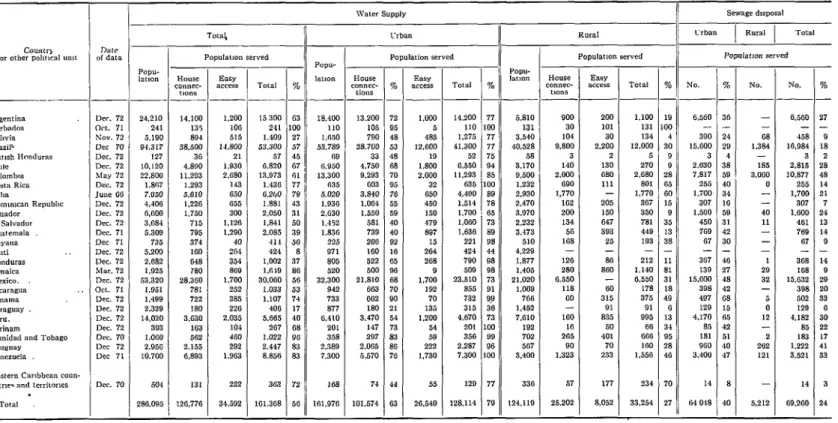
Considering the progress made, the past decade should be viewed as one of solid achievement. The best data available (11, 13) show that by the end of 1972 the countries of the region had raised the proportion of rural dwellers having a potable water supply from about 7 to 27 per cent-thus increasing the population served by a factor of about 4.7. This means that about 33 million rural inhabitants are now being served by approximately 30,000 systems that they themselves helped national programs to build.
38 PAHO BULLETIN . Vol. VZII,No. 1, 1974
each served to refine existing techniques and to increase understanding of existing problems.
It is also worth noting that those involved have had the experience of obtaining and disbursing US$73.5 million from the 24 loans that international credit agencies made in this field between January 1961 and December 1972 (see Table 1). Realizing that for each loan there are national matching funds in the amount of 40 to 60 per cent of the loan, and that the Government often contributes 20 to 30 per cent more in construction grants and an additional amount for operational funds, it has been estimated that about $400 million was invested in rural water programs between 1961 and the end of 1972. About 80 per cent of this has come from national sources.
know where to look can see that many of the programs can be traced from national/ PAHO/UNICEF demonstration efforts, through PAHO-assisted pilot programs, to full-scale na- tional rural water programs.
TABLE l-International loans and matching funds for rural water supply and sewerage systems in Latin America, January
While much remains to be done, a solid base has been laid. As in most development pro- grams, the effort to date-that of building the foundations for future efforts-is not readily apparent to the casual observer. But those who
The success achieved should not be meas- ured only by the numbers of new consumers. Concepts and approaches changed; conscious- ness of the need to speed modernization of rural life developed; and a new awareness of what could be accomplished in the rural sector emerged. Many of the first programs had very limited goals-often seeking to devlop little more than a series of individual community systems serving water from standpipes. But very quickly the success of these individual projects caused formation of national or regional pro- grams in which the people served demanded more complex solutions (such as water piped to the patios of private dwellings) and showed a willingness to pay the cost. The time needed for this transformation has varied from country to
1961-December 1972 (U.S. dollars).
Country
---- ---
Argentina.. Bolivia Chile.. Costa Rica I)ominican Republic El Salvador Guatemala..
Venezuela.
LOall --- 1905 5.000.000 1971 12.000.000 19m 1.800.000 1904 2.500.000 19GR 1300,000 1908 1.950.000 1970 4.100.000 1961 1.000.000 1964 l.OGO.OOO 1972 1.500.000 1 QGG 1.300.000 1969 1.345,ooo 1972 2.600,000 1968 600.000 1909 50,000 lQD3 1.050.000 1968 2,ooo.ooo 1967 1.1F0.000 1972 3.750.000 1964 1.650,000 1907 3.1.3.5.000 1970 2.700.000 1962 10.000,000 19G5 10.000.000
73.550.000 62.371,OOO National matching funds 5.000.000 13.000.000 1.675.000 2.500.000 1.000.000 1.050.000 2.625.000 420,000 480,000 800,000 800,000 620,000 1.320.000 400,000
- 1.380.000
Donaldson
.
RURAL WATER PROGRAMS OF LATIN AMERICA
39
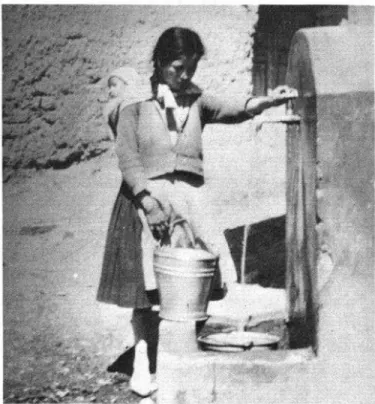
The hand pump-a key first step in the process.
country, but in nearly every case once the
initial projects were installed the improvements
inexorably evolved.
Hand pumps vs. piped connections. Here it
is interesting to note a major difference be-
tween programs in this Hemisphere and those in
other parts of the world. In many programs
outside the Americas it is argued that water
delivered from a house connection-which
im-
plies developing a program for collecting and
distributing the water and for administering the
resulting system-should be considered one of
the advanced steps in the rural water supply
process. Therefore, in many of these programs
hand pumps are the immediate goal, with any
type of piped water being a long-term objective.
While hand pumps have their place in our
programs, and many thousands have been in-
stalled in the Americas, our assessment of the
problem indicates that the best approach is that
of piped water systems developed, built, and
operated with strong local participation. We
believe that, even with the very limited human
and financial resources available, this approach
is the quickest way to give the most water to
the most people at the lowest cost.
“‘Rural water”- a dynamic process. While
most programs in the Americas started by
building systems that would supply safe water
from public fountains, experience has shown
that this was only the beginning of a process-
and that it was generally only a prelude to the
next stage, i.e., systems that pipe water into
users’ homes.
The time it takes to evolve from one stage to
the next depends on many factors-local eco-
nomic conditions, the type and intensity of
promotional efforts, awareness of health bene-
fits, etc. But the limited data available indicate
that within about eight to ten years after their
inauguration many of the early public fountain
systems became “patio connection” systems-
i.e. systems delivering piped water to single taps
in the patios of about 80 per cent of the houses
served.
Current
Goals
and Approaches
Rural Water Goals
In October 1972 the Ministers of Health of
the Americas held their Third Special Meeting
in Santiago, Chile. There, after reviewing prog-
ress to date, they developed the “Ten-Year
Health Plan for the Americas,” which contained
the goals for the 1970’s. With regard to rural
water they set the following targets:
Provide water for 50 per cent of the rural
population, or, as a minimum, reduce that
population without service by 30 per cent.3
3Pan Amkrican Health Organization. Ten-Year
40 PAHO BULLETIN . Vol. VIII, No. I, 19 74
They also indicated that the countries should
Utilize [the] techniques of “mass approach” and concepts of community self-help to provide water in rural areas and use . . . revolving funds to finance rural water supply programs4
It was pointed out that
. . . there still are many, especially in the rural areas, who lack these essential services ’ [water and sewerage] and who are equally entitled to have them. Our priority task is undoubtedly to devote special attention to those most in need, those who usually live in villages and on the outskirts of major cities. With this in view, we have established goals which we hope to achieve through the applica- tion of modern techniques, those which make it possible to speed up installations through im- proved use of domestic resources, foreign capi- tal, and, what is most essential, active com- munity participation5
“‘Rural” and ‘Rurban “Programs
In reading about the rural water supply programs of Latin America, one often finds the statement that “27 per cent of the rural population had a safe source of water at the end of 1972.” To properly understand this, one must be aware of several concepts and defini- tions. Among other things, one needs to identi- fy the types of “rural” programs in Latin America.
There has been a tendency in the past to lump several different programs under this single heading. In reality, however, there have been at least three separate and distinct types of “rural” programs, consisting of (1) com- munity well programs for dispersed popula- tions; (2) rudimentary aqueduct programs for semi-concentrated populations; and (3) more advanced aqueduct programs for villages and other concentrated populations.
Usually, in referring to a “rural water pro- gram” the writer is talking about the third category, together with some rudimentary aqueducts, but one can never be sure. Further- more, the official estimates of “rural” water
41bid., p. 51. ‘Ibid., p. 7.
coverage are often based on arbitrary numbers or definitions. (In fact, even the definitions of “rural” vary from country to country, though the most common one used in referring to water supply in Latin America is any popula- tion concentrations of 2,500 persons or less) (6). Proposed definitions. In order to avoid future problems, it is proposed that the generic name “rural water program” be dropped and that the following more descriptive names be used: (1) “individual source” program (for dispersed populations); (2) “rudimentary aque- duct” program (for semi-concentrated popula- tions); and (3) “rurban” water program (for villages and other small but concentrated popu- lations).
Rural sociologists have developed the term “rurban” by combining the words rural and urban (15). The term will be used hereafter to refer to those population centers (i.e., villages) that are located in areas where most of the people make their living from agriculture, for- estry, hunting, fishing, or any combination of these pursuits.
The three basic “rural” programs. The most basic program-an individual source program- involves developing a protected spring or pro- viding a well with a hand pump to serve a number of scattered families. Little or no formal community structure is associated with its operation, and it is usually maintained and paid for by a national program or a ministry at no cost to the user.
The second program, that of rudimentary aqueducts, utilizes a well or spring, a small storage tank, and a limited distribution system for delivery of water to public fountains and perhaps a few patio connections in order to serve a semi-concentrated population. The users of such a system pay a small sum, but depend heavily on the national program to assist them in maintenance, operation, and future expan- sion.
Donaldson
.
RURAL WATER PROGRAMS OF LATIN AMERICA 41In time public fountains grow into patio connec-
tions.
core” of at least 100 houses and the immediate
surrounding area. The system normally utilizes
a protected spring, a pumped well, or a treat-
ment plant, and delivers water to a storage
tank. Its distribution
system is designed to
supply water through “house” or “patio” con-
nections, making minimal use of public foun-
tains. A local water board-with the assistance
TABLE 2-Characteristics of different rural programs.
of the national program-operates, maintains,
and administers the system and collects water
rates. Characteristics of the three programs are
summarized in Table 2.
Clearly, each of the three programs is part of
an interrelated process. The community wells
serve to attract the surrounding people, and
with time the nearby population density grows.
When the density gets high enough, a rudimen-
tary aqueduct can be considered. In the past
the changeover from well to rudimentary aque-
duct took an average of 12-15 years, while the
next step-from public fountains to about 80
per cent patio connections-took
an average of
eight to ten years. Though this gives some idea
of what to expect, it is felt that progress from
one stage to the next could be speeded greatly
if coordinated efforts for individual sources,
rudimentary aqueducts, and rurban systems
were to replace the independent rural programs
we have often had in the past.
0 0 0
At this point a logical question is why
did
the programs start with the concentrated in-
stead of the dispersed population? The answer
is dealing with more concentrated groups pro-
Type of Program
Individual
source
Population served
Dispersed
Source
Well or protected spring
Distribution Water systems delivery
None At well only
Local organization
None
Financial recovery
None
Rudimem Semiconcen- Pumped Simple At public Little or
tary
aque-Minor, main-
trated well or fountains ly for opera- none
duct protected plus a few tion and
spring patio connec- maintenance
tions of system
Rurban Concen- Well, Complex, At patio con- Major, for
trated spring, or
Enough to serving core nections and operation,
around a
pay for oper- treatment area plus a few public
500-person
maintenance, ation, main-
plant nearby con- fountains and adminis- tenance and
core centrated areas tration of local adminis-
. system and tration of coilection of system and rates to set up a re-
42 PAHO BULLETIN . Vol. VIZI, No. I, 19 74
duces the greatest public benefits and the quickest financial returns. Thus the countries of this region have elected to concentrate their efforts in the “rurban” area while carrying out the “individual source” programs at a slower rate.
The work in this second area has been slow for many reasons. Among them are: complexity of the problem; high unit cost of benefits received; and lack of human and technical resources. But as the problem of the concen- trated population approaches a solution (in some rurban programs coverage is now up to 50 per cent of the target population) more atten- tion must be given to solving the problems of the dispersed areas.
The Rurban Water Program
Despite differences of scale and technique, the various rurban programs of the Americas have much in common. For instance, they have all been based on three fundamental concepts. These are: (1) strong and active community participation in the development, construction, administration, and financing of the local sys- tems; (2) focusing of resources on the pro- blems of concentrated instead of dispersed populations; and (3) extensive use of techni- cians to assist a limited number of professional personnel. Other common features include the criteria used to select target communities, the methods used to finance projects, the wide- spread use of “mass approach” techniques, and the use of local boards which administer and operate the systems.
Community selection criteria. The criteria for selecting target communities and scheduling the construction of systems are determined at the national or regional level after a review of existing manpower and financial constraints.
Table 3 shows the criteria used by one of the more successful programs to choose those communities that would be included in its construction program. In practice, the criteria were not applied in a rigid manner but were used as guidelines. It was later found that selections made in the “project identification” phase were adhered to about 70 per cent of the time. Failure to meet the third and fifth criteria was found to be the main reason for removing communities from the list.
Program financing. The construction cost of the system has usually been broken down as follows: (1) about 50 per cent is covered by a loan from an international agency, which is often repaid by the Central Government; (2) about 30 per cent is granted by the national and state programs; and (3) the re- maining 20 per cent is obtained from the community in the form of cash, materials, and labor during construction.
In general, the operating and administrative costs are paid by the community, together with an additional amount which can serve as a reserve or help amortize loan costs. These revenues are obtained through water rates collected by the local water board under the direction of the national program. The basic financial responsibility is thus a local one, but it is carefully watched, supervised, and coordi- nated by the national program, which carries
TABLE 3-Criteria for selection of target communities.
No. l-Communities with largest number of inhabitants (not more than 2,000) No. 2-Communities with access by road for trucks
No. 3-Communities that have expressed interest, have requested the system, and have offered financial’or other assistance for construction and operation of the proposed system
No. 4-Communities located within one of the zones of influence of the national or local development plan
Donaldson . RURAL WATER PROGRAMS OF LATIN AMERICA 43
out financial planning for the program as a whole.
Program structure. Table 4 shows a typical program structure and the major areas of responsibility at each level. Regional programs, which exist in a few countries, are usually organized as separate operations, but are tied together under the “umbrella” of the national program through common criteria, designs, and techniques.
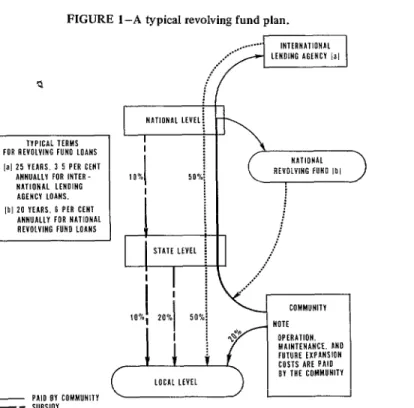
The revolving fund. In order to implement techniques which will permit low-cost solu- tions, it is necessary to establish sound long- range financing for rural water programs. The revolving fund appears to offer the best possi- bilities in this regard, because of its flexibility and its adaptability to local conditions. How- ever, it should be noted that the term “re- volving fund” has often been misused. A formal definition would be: A fund that is continually replenished as it is used, either through further appropriation or by income generated by the activity that it finances.
In terms of rural water programs, a revolving fund implies establishment of a fund on a regional or national level to finance construc- tion of individual community projects. The loaned funds are recovered by having the
benefited community repay the revolving fund. As the repayments come in they are reloaned to finance additional projects (see Figure 1). An advantage of the technique is that methods for obtaining the original financing, terms of the loans, and terms of the repayments can be adapted to local conditions. To assist the Governments of the Americas in developing this approach, a document entitled The Establish- ment and Operation of Revolving Funds (Pan American Health Organization, 1969) has been written and distributed throughout the Region.
While the style of the revolving funds used has varied from place to place in Latin America, the fact they they require a repayment scheme has tended to promote effective organization at the local level. The communities (as well as local and national officials) thus become accus- tomed to community financing of services received. This community involvement is one of the major benefits that result from establish- ment of a revolving fund.
In practice, the establishment of these funds has followed three general patterns:
1) A grant is used to obtain the initial financing; the fund is then kept in operation by relending reimbursements as they are collected. 2) The fund is created in conjunction with a
TABLE 4-Functions of various levels of a typical rural water program.
National
Regional i Local
f
Provide a financing channel for national counterpart funds, interna- tional loans, national grants, and local contributions
Develop norms and policies (technical and administrative) Supervise execution of national plan
Conduct long-range planning Coordinate construction efforts Supervise regional programs
Exercise overall financial control
Provide technical and administrative assistance Provide trainhlg
Supervise program execution
Carry out design (in case of larger countries only)
Supervise construction, operation, and administration of projects Undertake community promotion and supervision of projects Administration of system
44 PAHO BULLETIN . Vol. VIII, No. 1, 1974
national or international loan, and is then maintained by relending those community re-
imbursements that exceed the amounts needed to pay off both the loan and the loan amortiza- tion.
3) The fund is created in conjunction with a loan, and is maintained partly by national government servicing of the loan and partly by income from community reimbursements over and above the amount- needed to pay off the loan.
A recent study of conditions in Latin Ameri- ca (4) indicates that it is feasible for a rural family with an income of between $250 and $500 to pay for operation and maintenance of a typical rurban water system and for capitali- zation of at least half of the total investment. Whether or not this is done, development of new revolving funds requires the highest pos- sible degree of local community participation. Without it such funds often become little more than construction funds that “revolve” only once.
The Mass Approach to “‘Rural” Water Supply When one compares the need for “rural” water systems against what has been achieved to date, the need to increase the output of the various programs is readily apparent. To meet this challenge a technique called the mass or “systems” approach has become widely used in Latin America. Its objective has been to de- velop a coordinated and integrated “packaging” of those concepts that permit more rapid promotion, design, installation, operation, maintenance, and administration of the various projects. Because a rural program must repeat the same tasks for hundreds of villages-in some countries thousands-the development of such “standardized” techniques is essential in order to multiply the impact of limited resources.
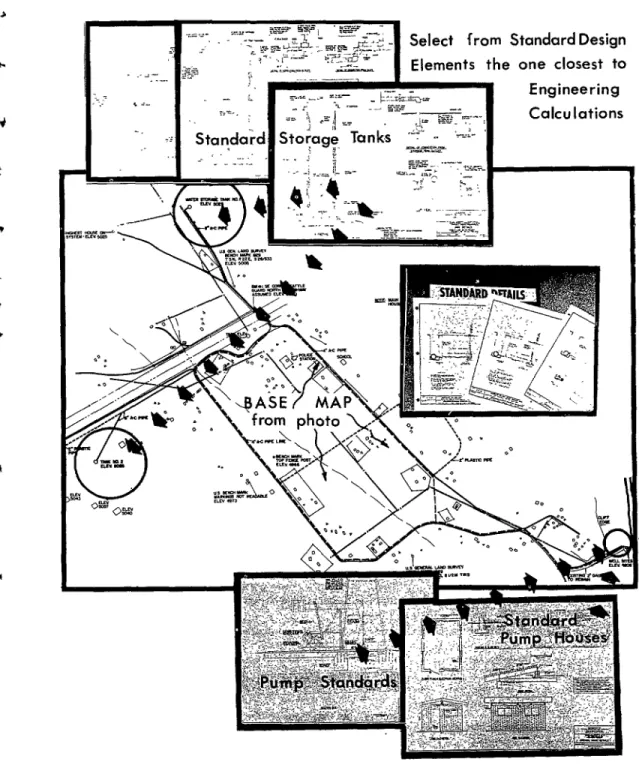
Regarding technical standardization, existing maps or aerial photos (see Figure 2) are often used to plan the project, while modular design criteria, predesigned elements, and standardized equipment lists are used in the speedy develop-
FIGURE 1 -A typical revolving fund plan.
ANNUALLY FOR INTER NATIONAL LENDING
PAID BY SUBSIOY LOAN
COMMUNITY
INTERNATIONAL LENDING AGENCY 111
AEVOLVING FUN0 Ibl
Donaldson . RURAL WATER PROGRAMS OF LATIN AMERICA 45
ment of both project equipment lists and project plans. The materials are brought to- gether in a central yard and sent to the community as a package, along with all neces- sary tools and other items not readily available at the site.
With regard to standardized personnel prac- tices, technicians train and supervise volunteer workers at the local level. These workers carry out developmental and promotional activities in accord with the carefully designed and coordi- nated guidelines of the package program. Natu- rally the design and timing of a particular project must be closely coordinated with the needs, resources, and goals of the overall program.
Experience in Latin America has shown that these “modules” and this standardization can be a powerful and practical tool when the solutions developed are constantly reviewed to see that they produce maximum benefit at minimum cost.
Some Common Misunderstandings
Measurement of coverage. Available data indicate that 79 per cent of the urban and 27 per cent of the rural population of the region had access to potable water at the end of 1972 (see Table 6). However, these estimates must be
used carefully and with full understanding of how they were derived. For example, the reported degree of rural coverage is usually based on a comparison between the reported size of the rural population served and the size of the total rural population. But most or all of the dispersed people served by wells and rudi- mentary aqueducts are often left out of the rural “population served” figure, while all the dispersed population is generally included in the “total reported population.” This situation can foster serious misunderstandings.
In checking the coverage in one country, for instance, it was found that the actual coverage of the rurban program was 50 per cent if one compared the population served against the program’s target population (the concentrated and village sector). Yet in this case the “rural” coverage reported was only 15 per cent. This problem is worrisome because it tends to cover up the success achieved by the turban pro- grams.
Patio and house connections. One often hears the term. “house connection” misused in the context of the Hemisphere’s rurban pro- grams. Having such a connection implies that water is piped to the point of use, for example to a kitchen sink, a toilet, or a shower. Therefore, each “connection” may have two or more water use points. However, many rurban
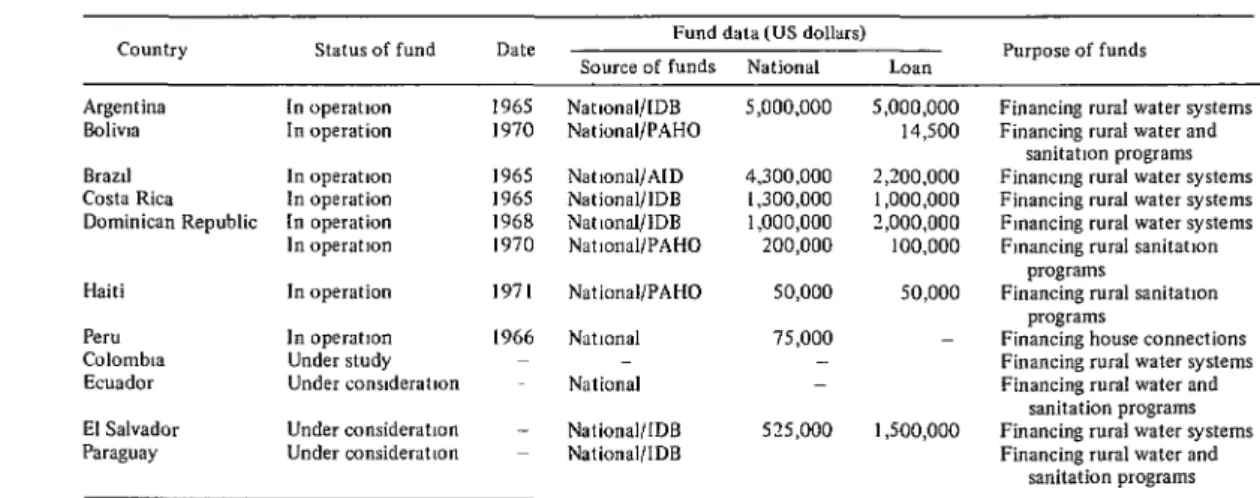
TABLE S-Status of national revolving fund programs, 1971.
Country Status of fund Date Fund data (US dollars)
Source of funds National LOXI Purpose of funds
Argentina In operation Boliwa In operation
Bra211 Costa Rica Dominican Republic
In operation In operation In operation In operation
Haiti
PertI Colombia Ecuador
El Salvador Paraguay
In operation
In operation Under study Under conslderatmn
Under consideration Under consideraton
1965 Natmnal/lDB 1970 NationaliPAHO
1965 Natlonal/AlD 1965 National/lDB 1968 Natmnal/lDB I970 Natmnal/PAHO
1971
1966
NationaI/PAHO
Natmnal
National
National/lDB National/lDB
5,000,000 5,000,000
14,500
4,300,000 2,200.000 I ,300,000 1 ,ooo,ooo 1 ,ooo,ooo 3,000,000 200,000 100,000
50,000 50,000
75,000 - -
525,000 1,500,000
Financing rural water systems Financing rural water and
sanitation programs Financmg rural water systems Financing rural water systems Fmancing rural water systems Fmancing rural sanitation
p~OgKilIlS Financing rural sanitatmn
pV3gKULlS
Financing house connections Financing rural water systems Financing rural water and
sanitation programs Financing rural water systems Financing rural water and
46 PAHO BULLETIN . Vol. VIII, No. 1, 1974
systems are designed to provide water to a single faucet in the patio-i.e., to a “patio” connection, from where it can be supplied to the point of use in a variety of ways depending on its purpose.
For example, on many occasions the author has seen a patio connection with a hose. This same hose was used to water the family garden, settle dust in the patio, and supply the shower. The connection was located just outside the kitchen window so that it could also be used in preparing meals.
With time and education, a limited number of such connections are converted to house connections. As the water consumption figure for a house connection is a good deal higher than for a patio connection (120 vs. 100 liters per person per day), it is often necessary to expand the system when many such conver- sions are made.
Current and Future Problems
Administrative vs. Technical Needs
A rurban water supply problem is more administrative than technical in nature. Too often the matter has been approached via a series of small projects requiring independent technical solutions and a large number of highly skilled and hard-to-find professional personnel. In fact, the more successful programs have shown that each individual system should be treated as part of a larger framework using mass approach techniques to construct, operate, and administer hundreds of systems. This means that all actions (technical, administrative, and financial) must be coordinated at the central level-without forgetting that each project also needs strong local participation.
It must also be recognized that several years of groundwork will be needed to develop, coordinate, and refine techniques and to train technicians before the first system is built-and
that as the program grows the techniques must be redesigned and the technicians retrained. Local Participation
All the programs of the region have actively sought the highest possible degree of local participation. In the initial promotion stages local water committees have been organized to promote the project, collect local contribu- tions, etc. Once. the project is completed the community generally elects a water board that is under the watchful eye of the national program. The board is in charge of operating and maintaining the system, collecting the rates, and undertaking minor expansions. Expe- rience has shown that strong local participation is essential if the program is to succeed. Therefore the full support of the community must be enlisted from the start.
This means that local leaders must be identi- fied and engaged in the project. Too often it has been concluded that “poorly educated” rural people lack the required skills to con- struct, operate, maintain, and administer their own water system. But it has been shown time and again that with proper guidance commu- nity leaders can make meaningful choices, motivate others, and provide the leadership required for success.
Emphasis on Low-Cost Programs
In developing the rurban programs the most common approach has been to first build those water systems which have the lowest costs. This has resulted in most of the systems having gravity supplies or wells, access by road, and a
Donaldson . RURALWATERPROGRAMSOFLATINAMERICA 47
. .__- .-. : .=
.- c 2..
‘:
.---’
~1
SelectE,eme”+s
from Standard Design+he
one
c(oses+
+o
Engineering Calculations
. ..I . .
y-1; .,”
ahoto \ _.-
48
PAHO BULLETIN
.
Vol. VIII, No. I, I974
Community members reduce construction costs by contributing
their
labor.
Public Health vs. Public Works
In most cases it was the sanitary engineers of
the Ministry of Health who were the “fathers”
of the rural water supply programs. Responding
to their ministry’s concern for rural health,
they developed programs making efficient use
of limited resources and stressing the vital need
for community
participation.
Then, in the
course of assuring this participation,
local
health center personnel (both promoters and
sanitarians) became essential links in the effort
to implement these plans.
>
Largely because financing was available
through the Inter-American Development Bank,
the rurban programs have tended to grow much
faster than the “well” or “rudimentary aque-
duct” ones. As the rurban programs have grown
(thus requiring more capital and resources) they
have tended to move out of the public health
area and into the public works sector. This shift
poses a new set of problems, including the
following:
1) As a late-comer to the public works
sector, the program must now fight hard to
obtain its share of the sector’s funds. The fact
that this means reducing someone else’s budget
or plans, together with the program’s lack of
financial experience, often makes for a difficult
transition.
2) Increasing numbers of projects tend to
pose ever-greater organizational problems for
the rurban programs. These require more per-
sonnel or new techniques, but often the man-
power and financial resources needed are very
hard to obtain. Moreover, this expansion makes
the esprit
de
corps of the original close-knit
group of workers increasingly hard to main-
tain-especially as the “original” group starts to
leave.
3) As the programs leave the health sector
they also have trouble finding substitutes fo;
the health center personnel (sanitarians and
community promoters) who had been used as
the local-level staff. And as each system settles
into a routine the nature of the assistance
changes and more administrative help is re-
quired. Therefore, new local-level staff must be
trained or brought in.
q ; - -’ 1,
TABLE &Status of water supply and sewerage system services in Latin America at the end of 1971 (population in thousands).a
T
I-T
-II-
T
Urban II Rural/I
_-
Total,
Po*“lauo” served
.-
II
20% 24.210 241 5.190 94.317 127 10.120 22.300 1m7 7.050 4.400 &GO0 3.084 5.309 735 5.200 2.882 1.925 53.320 1.951 1.499 2,329 14,020 393 1,OGO 2.956 10.700 504 28G.095
-__ - PO*“-
Hous connec-
t,ons Easy access Total ---
%
14.100 1.200 1.5300 63 18.400 135 100 241 100 110 894 515 I.409 27 l.050 38.500 14.800 53.300 57 53,789 36 21 57 45 69 4.890 1.930 0.820 67 8.950 11.203 2.080 13.973 Gl 13.300 1.293 143 1.436 77 R35 5.810 650 6.200 79 5,020 1.226 855 1.881 43 1.938 1.750 300 2.050 31 2.630 715 I.120 1.841 50 1,452 795 1,290 2.085 39 1.838 374 40 411 50 225 100 204 424 8 971 648 354 1.002 37 805 780 8G9 I$19 88 520 28.380 1.700 30,OGO 5G 32.300
781 252 1.033 53 942 722 385 1.107 74 733 180 228 400 17 877 3.G.10 2.035 5.685 40 G.410 183 104 207 68 201 5G2 400 1.022 96 3.58 2.155 292 2.447 83 2,389 6.893 1.963 8.858 83 7.300
131 232 303 34.392 101.3GS
72 50 -
188 120.77G lGl.976
I
,
I -
Population served
-I
1 L?:i
%
Popufatlo” served-
% Total
13.200 72 1.000 14.200 77 5.810 105 95 5 110 00 131 790 48 485 1.275 77 3.540 28.700 53 12.600 41.300 77 40.528 33 48 19 52 75 58 4.750 G8 1.800 6.550 94 3.170 9.293 70 2.000 11.293 85 9.500 GO3 95 32 635 00 1.232 3.840 76 050 4.490 89 2.930 1.064 55 450 1.514 78 2.470 1.550 59 150 1.700 65 3.970 581 40 479 1,OGO 73 2,232 739 40 897 1.636 89 3.473 208 92 15 221 98 510 160 16 204 124 44 4.229 522 05 268 790 98 1.877 500 96 9 509 98 1.405 21.310 G8 1.700 23.510 73 21.020 Go3 70 192 855 91 1.009 GG2 90 70 732 Q? 768 180 21 136 315 36 1.452 3.470 54 1.200 4.670 73 7.010 147 73 54 201 00 192 297 83 59 356 99 702 2.065 86 222 2,237 96 507 G.570 76 1.730 7.300 00 3,400
74 101.574
44 55 129 63 26,540 128.114
77 336 57 177 234 79 124.119 23.202 8.052 33,254
Total - % - 900 200 1.100 18
30 101 131 00 104 30 134 4 9,800 2.200 12.000 30 3 2 5 9 140 130 270 9 2.mo 680 2.080 28 090 111 801 05 1,770 - 1.770 GO 182 205 367 15 200 150 350 9 134 647 731 35 56 393 449 13 108 25 193 38 - - - - 126 80 212 11 280 360 1.140 81 6.550 - 8.550 31 118 GO 178 18 GO 315 375 49 - 91 91 G 160 835 995 13 10 50 GG 34 285 401 GGG 95 90 70 100 28 1.323 233 1.856 40 70 27 -
No. %
-
6.560 36 - - 390 24 15.600 29 3 4 2.830 38 7.817 59 255 40 1.700 34 307 18 1.500 59 450 31 709 42 87 30 - - 3G7 46 139 27 15,GOO 48 398 42 497 G8 129 15 4.170 G5 85 42 181 51 980 40 3.400 *7
14 G4018 8 40 - % - 27 - 9 18 2 23 48 14 21 7 24 13 14 9 - 14 9 29 20 33 G 30 22 17 41 33 3 24 - - < .- - _- - - - G8 1.384 - 185 3.060 0 - - 40 11 - - - 1 29 32 - 5 0 12 - 2 282 121 0.500 - 458 16.984 3 2.815 10.877 255 1.700 307 1.800 461 769 07 - 388 l68 15.832 398 502 129 4.182 85 183 1.222 3,521 - 14 5.212 09.260 - Current .wmates of populatmn and population served as received from co”ntries by the Deportment of Ensheering and Envrron-
mental sctenccs. PASB.
50
PAHO BULLETIN .Vol. VIII, No. I, I9 74
In sum, this is the critical juncture, where
today’s techniques must be scaled up to serve
tomorrow’s large-scale programs. This implies
two things: that multidisciplinary professionals
are badly needed to develop programs via which
techniques, criteria, and procedures can be
applied by technicians on a mass scale; and that
there must be thorough retraining of present
staff in techniques and skills to be used in the
future.
Use of Urban Concepts
Serious problems often result when program
designers try to “scale down” urban concepts
to fit rural situations. For example, because an
urban water system is designed to make water
instantly available in unlimited quantities, the
rural designer may try to provide the same
service in the rurban setting, thus producing an
overly large and expensive system.
Manpower Considerations
The Governments of the Americas have cited
the following factors, in order of importance, as
the major constraints on construction of water
supply systems: (1) insufficient internal fi-
nancing, (2) inappropriate administrative struc-
tures, (3) inappropriate financial frameworks,
(4) lack of trained personnel, (5) inadequate
or outmoded legal frameworks, and (6) insuf-
ficient production,of local materials.
Even though it is only fourth on the list, the
personnel problem seems especially thorny.
That is because this lack of trained manpower
implies more than a need for extra training: it
implies setting up conditions that can attract
and hold the required personnel. At their 1972
meeting in Santiago the Ministers of Health
said: “All the health personnel in these [rural]
areas merit relatively higher compensation for
their efforts” (14).
Another important consideration is that the
worker in rurban programs should be more of a
generalist than a specialist. The reason for this
is that the problems encountered involve many
social and technical disciplines. Thus, each
professional must be more closely aware of
problems in related fields and must be able to
Donaldson . RURALWATERPROGRAMSOFLRTIN~ERICA 51
build “bridges” to those problems that inter- face with his. Without this close and careful coordination, be it accomplished by “systems analysis” or by using a small central staff, the rurban water program quickly becomes chaotic. Quite aside from the generalist-specialist problem, technical plans have often been imple- mented without thinking much about the tech- nicians who will be required to make the program work. For example, we need to train pump repairmen as we install pumps, or soon we will have an additional expense instead of a water-producing device.
Another vital point is that competent and dedicated national professionals must be avail- able to carry out expanded programs. Too often past programs have depended entirely on a small, highly-motivated group of individuals. While the vision and social concern of these persons deserves great credit, large-scale pro- grams cannot effectively rest on such a narrow base. Therefore, the countries must seek to increase the number of professionals and tech- nicians that enter this field. Moreover, these persons should be “rural” experts trained in “rural” techniques, for experience has shown that experts transferred from “urban” areas tend to use inappropriate techniques that un- necessarily increase project costs.
Data Gathering
In designing water systems, good population and consumption data is often critically impor- tant. When the programs started in 196 1, “best guess” figures were used. In most cases popula- tions were expected to at least double in 20 years and consumption was estimated at rough- ly 200-250 liters per capita per day. Over the years it has been found that these figures were too high and that they caused unnecessary investments. While prediction of future popula- tion size continues to pose problems, a growing body of knowledge has emerged on which to base more realistic consumption figures.
Another problem is that, in their rush to get started, programs have frequently failed to
obtain sorely needed data on potential water sources. Thus, many of them have initiated water surveys to locate potential sites, but limited funds usually condemn these investiga- tions to be “one step” in front of construction. The result has often been hasty decisions that were expensive to correct later on.
Rurban vs. Dispersed Rural Populations In the past, priority was given to “urban” areas, leaving a backlog of need in the “rural” zones. But as the countries have realized the need for coordinated development the “rural” problems have called forth increasing amounts of attention and resources.
The approach that has been used most frequently to date utilizes existing villages as “poles of attraction,” rather than concentrating attention on the more dispersed small farms. However, as solutions are found for the rurban areas, attention must be turned to the dispersed population. In its recent “Sector Working Paper on Agriculture,” the World Bank indicated that as “developing countries become increasingly conscious of the need to provide employment opportunities and distribute incomes more equitably, greater emphasis is likely to be given projects intended to benefit small farmers and to be labor-intensive” (7). The implication is that “rural” water programs will need to develop more programs for dispersed and semi- concentrated populations.
To meet this challenge, new approaches must be developed. For just as “urban” tech- niques and approaches are of limited value in the rurban sector, it is to be expected that the rurban experience will only serve as a general guide for helping the dispersed populations. The few such “dispersed” programs now in existence are of such size that they can provide only limited data; but solutions must be found if effective “balanced” water programs are to be developed.
Future Financing
52 PAHO BULLETIN . Vol. VIII, No. I, I974
be?n highly instrumental in the growth of the Hemisphere’s rural water programs to date. But there is a need to develop additional or alter- nate financing sources and to explore new schemes. The question of self-financed projects or subsidized ones must be faced and the monetary recovery from each type of project must be realistically determined. We also need to find ways of interesting more official agen- cies (such as central banks and social security institutes) in making long-term low-interest loans.
Up to now about 50 per cent of the initial funding has been covered by international loans, about 30 per cent by government grants, and about 20 per cent by local contributions. However, the international agencies are begin- ning to require more matching money, a devel- opment which will require the programs to revise their financing sources and techniques.
In May 1972 the 25th World Health As- sembly considered the special needs of the rural sector and recommended that WHO Member States “take such steps as would lead to increased allocation of resources to rural water supplies.” The task will not be easy. For example, the World Health Organization tech- nical assistance budget for the water supply area is only $26 million, a tiny fraction of the roughly $13 billion needed for the countries to achieve the WHO goals for 1980.
Therefore, while the work of the 1960’s can serve as a guide, we must be prepared to finance new solutions. For instance, it might be desir- able for lending agencies to make loans for administrative development just as they now do for project construction,
Research
Research into a number of subjects is also needed. For example: What is the potential for making more effective use of financing schemes such as revolving funds? What exactly are the monetary costs and benefits of water supply systems? How can we reduce the cost of
expensive program elements? How can we get more accurate data on water consumption, water loss, and future population growth? What new methods-such as the use of plastic pipe, modular units, and the “mass” ap- proach-should be considered, and when?
In addition, we need to improve and/or modify many of the skills and techniques that have been developed in the 1960’s. Among other things, as programs expand into smaller communities and dispersed areas, closer atten- tion will have to be given to developing solutions which are financially acceptable to the user as well as being socially and administra- tively feasible. We will also need to improve our communications with the policy-makers and the techniques by which information is devel- oped for them, in order that they can better understand the actual costs of their decisions.
The Vital Need for Safe Rural Water
Far too many in the rural areas are still without an adequate supply of water. To help remedy this the goals of the 70’s have been set, and now we need to find the ways and means to help the people involved as they strive to receive the benefits of safe water in their homes.
To achieve this ultimate goal-delivery of safe water as near as possible to its point of use-we must keep the consumer firmly in mind. His needs are the constant value in the equation. Our efforts must be directed at finding answers to his problems and not, as has too often been the case, at satisfying our preconceived notions of what we think the problems are.
Donaldson . RURAL WATER PROGRAMS OF LATIN AMERICA 53
SUMMARY
Growing attention is being focused on rural Past programs in this Hemisphere have water supply problems in Latin America as a tended to concentrate on the village or so-called result of major progress over the past decade. “rurban” parts of the rural areas, in order to By the end of 1972 roughly 27 per cent of reach the most people in the shortest time at Latin America’s rural dwellers had access to the lowest cost. There has also been a strong
potable water. While this meant that four times trend in favor of “revolving” funds to supply as many people had safe water in 1972 as in internal financing and another trend in favor of
1961, it also meant that a great deal of a large-scale approach that uses carefully timed
additional effort would be required to meet the and coordinated community promotion “pack- new goals established by the Ministers of Health ages,” modular design techniques, and “mass of the Americas for 1980. Making this effort approach” concepts at all levels. However, great implies reviewing the kinds of rural water emphasis must still be placed on getting the systems to be installed, the administrative and extensive and enthusiastic local participation
financial structure of the overall program, and and support that has been reponsible for so
the approaches that have been adopted. much of the success achieved to date. BIBLIOGRAPHY
(I) Acurio, Guido. “Agua potable rural:Perh.” Un- published report to the Director de Sanea- miento Ambiental on the rural water program of Peru. Lima, Division de Saneamiento Rural, 1969.
(2) Argentina, Subsecretario de Recursos Hidricos, Servicio National de Agua Potable y Sanea- miento Rural de Argentina. Guia para organi- zacion y administracidn de cooperativas y de sistemas de abastecimiento de agua. Buenos Aires, 1972.
(3) Boris, Samuel B. A basic critique of foreign assistance programs in the light of Guatemala’s present water needs. In: International Confer- ence on Water for Peace. Washington, D.C., Department of State, Office of International Conferences, 1967.
(4) Davis, R. Rural Water Supply Services: Com- munity Financing. Washington, D.C., Pan American Health Organization, 1968. (Special Meeting of Ministers of Health of the Ameri- cas, Document No. REMSA/INF/ 12.) (5) Donaldson, David. El enfoque masivo. Ingenieria
(Mexico) 24: 25-34, 1970.
(6) Donaldson, David. Rural water supplies in devel- oping countries. Water Resources Bulletin 8: 391-398, 1972.
(7) International Bank for Reconstruction and De- velopment. Sector Working Paper on Agricul- ture. Washington, D.C., IBRD, 1972.
(8) Lauria, Donald T. Planning Small Water Supplies in Developing Countries. Chapel Hill, Univer- sity of North Carolina, 1972.
(9) McNamara, Robert. Address to the Board of Governors. Washington, D.C., International Bank for Reconstruction and Development, 1972.
(IO) Morfitt, Robert P. A Non-Conventional Mass Approach to Rural Village Water Projects.
Corvallis, Oregon; R. P. Morfitt and As- sociates, 1969.
(II) Pan American Health Organization. Annual Re- port of the Director, 1971. Washington, D.C.,
1972. (PAHO Official Document 116.) (12) Pan American Health Organizatron. Annual Re-
port of the Director,1972. Washington, D.C., 1973. (PAHO Official Document 124.) (13) Pan American Health Organizaton. Community
Water Supply and Sewage Disposal Programs in Latin America and Caribbean Countries. Washington, D.C., 1969. (Technical Series on Engineering and Environmental Sciencies, No. ES-5.)
(14) Pan American Health Organization. Ten-Year Health Plan for the Americas. Washington, D.C., 1973. (PAHO Official Document 118.) (15) Rose, Cecil W. Common Sense Designs for Rural Water Systems. International Conference on Water for Peace, 1967.
(16) Smith, T. Lynn. Studies of Latin American Societies. Garden City, New York; Doubleday and Company, Inc.; 1970.
(17) World Health Organization. Community Water Programme-Progress Report by the Director