The Impact of Digital in Learning Spaces:
An Analysis on the Perspective of Teachers in
Higher Education
Pedro Silva
Escola Superior de Tecnologias
de Castelo Branco, Instituto
Politécnico de Castelo Branco,
Castelo Branco, Portugal
[email protected]
Luis Borges Gouveia
Universidade Fernando
Pessoa,
Porto, Portugal
[email protected]
Abstract
The generalized use of Communication Networks and Information Technologies is nowadays a global phenomenon. It has multiple impacts on how to teach/learn and on the contexts in which this process takes place (the Learning Environments). These areas include Physical Learning places, Virtual Learning sites, Collaborative Learning Spaces, among others. These proposals provide new scenarios for the teaching/learning process, but their outlines are not well defined yet. A Learning Space requires a complex set of materials and human resources. Further and con-tinued research is significant and justified by the relevance of Higher Education Institutions.The overall objective of the present research is to understand the perceptions of the Professors in their Learning Environments. In this context it has been considered relevant to gather opinions on the needs/priorities, utility, quality and sustainability, as a result of the use of Information and Com-munication Technologies (ICT) in the teaching/learning spaces.
Keywords: Learning Spaces, Learning Environments, Higher Education, Teaching and Learning, Information and Communication Technologies (ICT).
Introduction
A multitude of systems are currently available to on-line courses. Its appreciation is related with the fact of providing the users a set of contents and functionalities in order to make easier the learning process. The success of this kind of systems has been, in the last decades, object of con-cern by investigators because of its huge sticking in academic, business and social world. The Bologna process (signed in June 1999, implies each university’s system rearrangement in order to
create the Europe of Science and knowledge.) submission, while bringing in a new reorganization of the Portu-guese higher education system, aims to encourage people to go to the university, to improve the teaching and learning quality and to encourage the Portuguese students’ mobility. The e-learning plat-forms and the virtual learning
ly in Portuguese higher education systems, almost all or even all the universities and Polytechnic Schools have in their web space an available e-learning platform to support the learning process in order to improve the training quality and to allow the creation of access terms and learning to other potential new users.
At the beginning this systems or websites were just simple stores of text contents, or books that supported classes, which were used by the student to access, read and learn. This kind of applica-tions are changing, many of these systems allow the tutors to comprise, for instance, notes, rec-ommendations, presentations, etc. These applications are becoming more sophisticated. This in-corporated learning environments offer to students and teachers a new system to communicate, learn and exchange knowledge.
The great majority of the universities have insufficient or inappropriate learning spaces; they are too small, very dark or cold, made in the wrong places, etc. These places have many deficiencies and so, they waste learning opportunities. While managing these places, the central role these is-sues have in the teaching and learning process are not taken into account by the managers. The localization, the design and the learning spaces quality of construction, in the higher education system, are a differentiation factor among institutions.
A Learning Space requires a complex set of materials and human resources. A further and contin-ued study is justified by the relevance of Higher Education Institutions. The overall objective of the present research is to understand the perceptions of the Professors in their Learning Environ-ments. In this context it has been considered relevant to gather opinions on the needs/priorities, utility, quality and sustainability, as a result of the use of Information and Communication Tech-nologies (ICT) in the teaching/learning spaces.
To find new ideas about space needs represents a significant opportunity for higher education to make learners and learning more successful [1]. So, the results obtained with this investigation focused primarily on perceptions related to Learning Environments, the needs of space, the adop-tion of ICT in learning spaces and the type of spaces used their needs and gains.
Data and Research Methods
The purpose of the perceptions of Learning Environments was to capture a set of personal experi-ences related to spaces used by teachers, particularly the “classroom", collaborative spaces, social spaces and virtual spaces. The main contribution of this study is to facilitate the creation of new Learning Environments and make a discussion of space’s organization as one of the important factors in the creation of a learning space. The main ideas and conclusions (resulting from the interviews to the teachers of Higher Education) contribute towards the need to make changes.
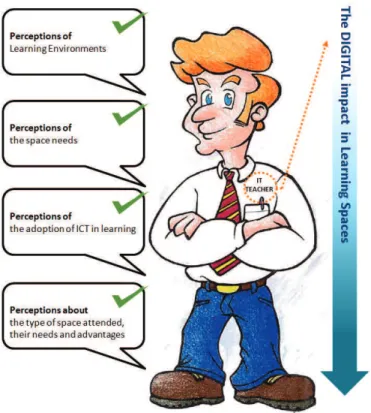
All the interviews in this study were tape-recorded with the teacher's permission, and later tran-scribed to provide accurate records for the analysis. Standard procedures were followed to main-tain the confidentiality of the interview data and the anonymity of the teachers. The interviews were structured around a list of topics (Figure 1) based on concepts presented in the existing liter-ature, including sharing preferences with regard to the type of information, the person or group with whom the information is being shared, and the purpose behind sharing.
per-Figure 1: Planning method
For the second topic (Perception on the space needs) we asked: Q2 – “What do you think about an ideal learning space?” Q3 – “If you were asked to design a learning space, what aspects would you find relevant to consider?”
On the third topic (Perception on the adoption of ICT in learning) we used: Q4 – “In your opinion what is the role of Information and Communication Technologies in the quality of learning and the interaction with the learning space.”
The fourth topic (Perception about the type of attended space, their needs and advantages) was: Q5 - Tell me how you feel about: “What do you enjoy most in this School?”; “What do you not enjoy in this School / learning space?”; “What do you think about the use of space in this school?”; “What would you like to see changed in the future?”
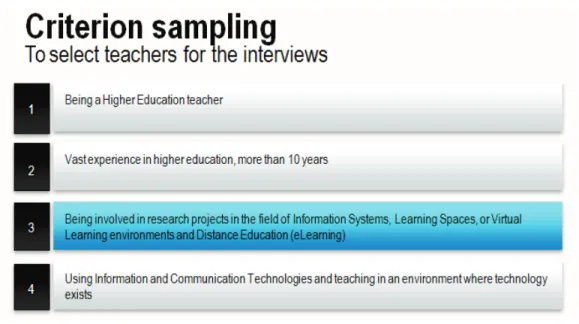
The interviews were engaged in a series of decision-making sessions regarding the number of teachers to interview and how to select them to participate in this study.
Figure 2: Criterion sampling
The interviews were face-to-face. Between the first and second interviews, almost three months passed. Based on our previous research experience, interviewing teachers, we felt a second inter-view was required to build a theory. A strong rapport was necessary to obtain trustworthy data.
The analysis of data was as follows. First the participants were assigned identification numbers. Audio-taped interviews were verbatim transcribed, checked for accuracy and edited by the first author, to ensure that the transcriptions reflected the actual interviews, by simultaneously listen-ing to the recordlisten-ings while readlisten-ing the transcriptions and maklisten-ing corrections where necessary.
Results and Discussion
This investigation suggests many positive consequences and different points of view on the Best Practices about the use of teaching/learning spaces. To structure the principal findings that have been obtained to understand the perceptions of the Professors on their Learning Environments, we will use four separated dimensions: (i) Perceptions of Learning Environments; (ii) Perception on the space needs; (iii) Perception on the adoption of ICT in learning; (iv) Perception about the type of attended space, their needs and advantages. (See Figure 3.))
Perceptions of Learning Environments
most identified and referred. All teachers stated examples from the institutions they belong to. They all used and recommended such spaces. Several examples of Managing Learning Systems applications (LMS) and Virtual Learning Environments (VLE), exploring Open Source or devel-oped by them, are refereed. They all work and provide a range of features, for teachers and stu-dents.
Figure 3: The Perceptions
One sentiment expressed with displeasure, was the fact that a better integration with the space and the classroom space is possible. “The potential of this is very limited, functioning as a repository of content”. These spaces should, besides the educational environment to support the student’s learning, also have other functions: personal tools to prepare classes, to support material, to per-form administrative tasks, to seek inper-formation and materials and to be used as an interactive-communication tool between teachers and educational partners.
Perception of the Space Needs
The main goal relating the space needs was to capture experiences about frequented learning spaces, what kinds of equipment and features should be part of. We asked respondents to charac-terize an ideal learning space and to identify aspects they think these spaces must have. Of all collected contributions there was a consensus across all participants, the models and the spaces in our higher education institutionsdo not meet the needs of students and teachers.
“There was no change in teaching and of course there was no change in the classroom. (…)”
“It is important to create a psychological comfortable atmosphere between teachers and students in order to improve physical comfort.”
“Learning in our universities is the “cod liver oil” meal. Education should be an intense and mo-tivating experience as a good meal.”
“The space organization and layout must follow that approach. The traditional classroom doesn’t reflect the current paradigms. I remember university as being an inhospitable and un-comfortable place. I often felt like running out. Therefore, this concept must change.”
“Universities must have well-equipped rooms. Space must have a minimum comfort, and luxury does not mean comfort.”
When we asked to characterize the importance of space in teaching and learning activities, all the individuals characterized space as one of the main factors influencing teaching and learning quality. The way we organize space influences the quality, the way we collaborate, interact and share knowledge.
We asked to make a projection of the Ideal Learning Space. All held that an ideal learning space needs technology, adjustable furniture, different teaching methodologies, perfect environmental conditions and motivation.
All respondents stated that the current Space is very far from the Ideal learning Space.
“This type of space does not cover teachers and students needs (…)”, “it is important to create individual spaces for each student, the existence of open spaces, smaller learning spaces, class-rooms with mobilization facilities and the creation of “activity islands(…)”
Perception on the Adoption of ICT in Learning
Information and Communication Technologies (ICT) brought to Learning Environments several improvements. We asked respondents what they think about the adoption of technologies in Learning Environments. They all use and consider themessential in the classroom, but they also mentioned several conditions that cause the inappropriate use of technologies. They also held that access, maintenance, management and integration in the classroom are important.
“The role of ICT is very important, but teachers must dominate them. More and more new tech-nologies must be part of education (...)
“Total redefinition of the learning spaces surrounded by much technologies (…)”
“The role of ICT in learning process is important but only as an extension of instrumental capa-bilities at the service of the learning process.”
On the other hand, the use of Internet, essential for search, collaboration and communication, also brings some problems. To use ICT in learning spaces we need network and permanent available technological resources that many universities don’t have.
The use of Information and Communication Technologies (ICT) in Learning Environments is limited. Institutions don’t have the necessary conditions so that they can be used as part of the individuals’ learning process.
Perception about the Type of Space Attended, Their Needs and
Advantages
Another important aspect of this study was to collect perceptions about the type of attended space. Was asked to each professor, based on their experience of teaching in a higher education institution, what they think about: (i) What he liked most in the space he attended, (ii) the less he liked, (iii) what he thought of the use of space in his school, and finally, (iv) the future perspec-tive and what he would like to see changed.
With this approach, it is our intention to collect opinions about space use practices, experience, needs and advantages. Although, many of these issues and opinions have already been answered during the interview and considered pertinent to this approach, since they focus on the general aspects of institutions and select multiple perspectives of concrete realities of different Higher Education Institutions.
The answers were quite varied, since the realities were quite different from institution to institu-tion. Some were younger and others older, but we found that in both cases the organization of space is poor and needs changes.
Difficulties in the use of space were clearly present, not only by the perceptions collected in the interviews, but also through the participant’s observation of many kinds of spaces in these institu-tions.
By the analysis of participants’ verbal and nonverbal language, it can be deduced that there is much to be done in terms of space in Higher Education. However, there were some aspects and some cases of good practices in the use of spaces that must be considered:
“(…) human relationship between people (between teachers and students), it is easy and makes a difference…”
(...) We also have an immersive environment (...) the psychological space in the university has to be a constructive space, emotionally constructive, which has to combat the toxic emotions (...) it looses energy for research and education. (…) the mental health of the institution, in a smaller scale - the mental health in the classroom.
“What pleases me most is to have space (…) and think that expansion is possible.”
“(…) most of activities have to go out of what is traditionally a classroom(…) is a social space, and the provided spaces for group work and the possibility of them being performed(…)”
“There must be a smart design with open areas where teachers and students communicate and technology (…)”
When we asked about the perspective to the future and what they would like to see changed im-portant contributes were also founded.
“The social spaces are not used much and we have few, we should have living common spaces between the various schools (…) to develop such teamwork across multidisciplinary teams, the type of work they will find in business.”
technol-Another aspect that emerged from this study has to do with the teacher's role in this new reality. It seems evident that according to these new realities it is necessary to change attitudes and practic-es in order to obtain optimization, integration and development of knowledge. However, to make that possible a change in attitude, methodologies and the way of being and teaching is needed. Consequently, space will necessarily change.
Conclusion
This study considered the perceptions of the Professors on their Learning Environments. It was primarily focused on perceptions related to Learning Environments, the needs of space, the adop-tion of ICT in learning spaces and the type of spaces used, their needs and gains. Our Intent is to complement and expand the knowledge about space use in higher education. The results confirm our central hypotheses: firstly, the importance of Space in creating high quality Learning Spaces. Secondly, we found that technology’s adoption is important but is not the only factor taken into consideration to create these spaces. Technology it’s an important point in the creation of Learn-ing Environments, but just by itself it does not brLearn-ing significant changes. Changes in design com-fort and Decoration and Cultural Change must be part of a Learning Space.
New areas, such as the collaborative learning spaces, should be considered in the
organi-zation. The changes in furniture design, comfort and decoration, how the materials are
arranged and organized, seem to influence the teaching and learning processes. They are
a fundamental part of higher education context where human beings can enhance their
learning activities.
The cultural change, social spaces and informal learning environments, seem to be a key role to a good psychological environment and motivate the participation in school activities.
To create high-technology learning, technology-rich spaces, the use of Virtual as an available tool to teaching and learning and its necessary integration with the physical, seem to be essential.
A flexible learning space enables the student to make choices and to have some control over the time and place and, sometimes, also to make choices in the content of their learning.
Therefore, the present investigation focused on the influence of space and the use of Information and Communication Technologies (ICT) in the teaching/learning spaces. It was found that the digital has changed the educational space, the concept of space and time to teach. Changes in De-sign, Furniture, Decoration, Comfort and Cultural Change are essential to create high-technology learning spaces according to the needs of teachers.
References
Aceto, S., et al. (2007). E-learning for innovation, executive summary. Helios Yearly Report. European e-Learning Observation System: Observing, Foresighting & Reporting.
Aceto, S., Delrio, C., Dondi, C., Fischer, T., Kastis, N., Klein, R., Strauss, A., & Corbin, J. (1994).
Grounded theory methodology - An overview. In N. K. Denzin and Y. S. Lincoln (Eds.), Handbook of
Fortin, M-F. (2000). O processo de investigação da concepção à realização. Décarie Éditeur, ISBN: 972838310X
Glaser, B., & Strauss, A. (1967). The discovery of grounded theory: Strategies for qualitative research. New York: Aldine Publishing Company.
Gouveia, L. (1998). Uma proposta para avaliação e diagnostico medida por computador. 1ª Conferência sobre redes de Computadores - CRC'98. Universidade de Coimbra.
Gouveia, L. (2009). A virtual environment to share knowledge: A visualisation design to support collabora-tive learning (1st ed.). USA: VDM Verlag Dr. Muller.
Gouveia, L., Borges, M., & Bairrão, M.(2007). Gestão da Informação na Biblioteca Escolar. 1. ed. Figueira da Foz: GestKnowing, 2007. v. 1. 193 p.
Hannah, G., & Hannon, C. (2007). Their space: Education for a digital generation. London: Demos, ISBN: 1841801755.
JISC. (2005). Designing spaces for effective learning, a guide to 21st century learning space design. JISC eSpaces Study, University of Birmingham.
JISC. (2006). Evaluation Report Highlights, Innovating e-Learning. 2006 JISC eSpaces Study, University of Birmingham.
JISC. (2010). E-learning and pedagogy strand. JISC eSpaces Study, University of Birmingham.
Miller H. (2004). A view of changing campus, Herman Miller inc. in www.hermanmiller.com
Miller H. (2005). Creating a culture of sustainability – how campus are taking the lead Herman Miller inc. in www.hermanmiller.com
Miller, H. (2008). Making room for collaboration. Herman Miller Inc. in www.hermanmiller.com
Novelli, G. (1997). A sala de aula como espaço de comunicação – reflexões em torno do tema, Interface. Comunicação, Saúde, Educação v1, n1.
Oblinger, D. G. (2006). Learning spaces. Washington: Educause - ISBN 0-96728553-7-2 e-book.
Richard, K., & Voloudakis, J. (2005). The future of networking education, information technology network-ing in higher education. Educause Center for Applied Research (ECAR) Study.
Silva, P. & Gouveia, L. B. (2008). ED-MEDIA 2008, Learning Space. Junho 30 -Julho 4 2008 ISBN : 1-880094-65-7
Silva, P. & Gouveia, L. B. (2010). INTERTECH’2010, A Geração Digital no Novo Mundo Empresarial”.
Março 07-10: Ilhéus, Brasil; ISBN : 978858912075-3
Strauss, A. and J. Corbin (1990). Basics of qualitative research: grounded theory procedures and tech-niques. Sage Publications.
Strauss, A., & Corbin, J. (1998). Grounded theory methodology: An overview. In N. K. Denzin & Y. S. Lincoln (Eds). Strategies of qualitative inquiry. Sage Publications.
Tinto, V. (2003). Taking student learning seriously: Rethinking the university of the future. In Charting the Course: Earl V. Pullias Lecture Series on the Future of Higher Education. 26th Annual, Fall Los Ange-les - Center for Higher Education Policy Analysis, USC Rossier School of Education.
Valenti, M. (2005). Learning space design precepts and assumptions. EDUCAUSE Review, 40(4),
Biographies
Pedro Silva is an Adjunct Professor in the Technical-Scientific Com-puting unit (UTC Informatics) of the Polytechnic Institute of Castelo Branco where he lectures in the fields of multimedia and human-computer interaction. Pedro holds a degree in Computer Science from the University Lusfona (2000) Master degree in organization and in-formation systems from the University of Evora (2005) and a Ph.D. in Information Sciences specialty in Systems and Information Technolo-gy from the University of Fernando Pessoa (2011). he shifted his re-search interests to Information Society (Information Systems and In-formation Management) new forms for education teach support (appli-cation of computer technologies in edu(appli-cation, in particular, the use digital environments and im-pact space in higher education) and human-computer interaction.
Pedro has a Web homepage at http://www.est.ipcb.pt/pessoais/psilva/
Luis Borges Gouveia is an Associate Professor at University Fernando Pessoa. He holds a PhD in Computer Science (University of Lancaster, 2002) and a Masters degree in Electronic and Computers Engineering (University of Oporto, 1995). His interests are within the impact of information society and digital use both in education and business.