w w w.jo u r n als . e l s e vie r . c o m / r e v i s t a - b r a s i l e i r a - d e - f a r m a c o g n o s i a
Original
Article
Chemical
composition
of
essential
oils
of
leaves,
flowers
and
fruits
of
Hortia
oreadica
Danillo
L.
Santos
a,
Heleno
D.
Ferreira
b,
Leonardo
L.
Borges
a,
José
R.
Paula
a,∗,
Leonice
M.F.
Tresvenzol
a,
Pierre
A.
Santos
a,
Pedro
H.
Ferri
c,
Stone
de
Sá
a,
Tatiana
S.
Fiuza
b aFaculdadedeFarmácia,UniversidadeFederaldeGoiás,Goiânia,GO,BrazilbInstitutodeCiênciasBiológicas,UniversidadeFederaldeGoiás,Goiânia,GO,Brazil cInstitutodeQuímica,UniversidadeFederaldeGoiás,Goiânia,GO,Brazil
a
r
t
i
c
l
e
i
n
f
o
Articlehistory:
Received3February2015 Accepted12August2015 Availableonline2October2015
Keywords:
Essentialoils
Hortia
Rutaceae Savannah Medicinalplants Bicyclogermacrene
a
b
s
t
r
a
c
t
HortiaoreadicaGroppo,Kallunki&Pirani,Rutaceae,knownas“para-tudo”,“quina”,and “quina-do-campo”,isusedintraditionalmedicinelocallytotreatstomachpainandfevers.Theaimsofthisstudy were:analyzethechemicalcompositionofessentialoilsfromleaves,flowersandfruitsofH.oreadica andverifytheseasonalvariationofthechemicalcomponentsofessentialoilsfromleaves.Theessential oilswereobtainedbyhydrodistillationusingaClevengertypeapparatusandanalyzedbyGC/MS.The majorcomponentsfoundinthesamplesoftheessentialoilsweretheamorpha-4,7(11)-diene(29.27% –flowers,20.26%–fruits,27.66–37.89%–leaves),bicyclogermacrene(23.28%–flowers,20.64%–fruits, 14.71%to31.37%–leaves).Thisworkrepresentsthefirststudyofthechemicalcompositionofessential oilsfromleaves,flowersandfruitsandseasonalvariationintheessentialoilsfromleavesofH.oreadica. ©2015SociedadeBrasileiradeFarmacognosia.PublishedbyElsevierEditoraLtda.Allrightsreserved.
Introduction
HortiaisaneotropicalgenusoftheRutaceaefamilywithonlyten
species,nineofthemoccurinBrazil(Groppoetal.,2010).Ingeneral, speciesofRutaceaearestronglyaromaticandhaveconsiderable importanceassourceofcitrus fruitsandas ornamentalsplants (PerveenandQaiserm,2005).Manyessentialoilsofspeciesofthis family areused in thepharmaceutical and cosmeticindustries, nutritionalsupplementsand aromatherapy(Kondoet al.,2000; MisharinaandSamusenki,2008).HortiaoreadicaGroppo,Kallunki &Piraniisashrubwithabout1mtall,well-developedunderground system,formingclonedindividuals.Theleavesaresubsessile, leath-eryandglossy;theflowershavepinkpetals(Groppoetal.,2010).
H.oreadicaispopularlyknownas“para-tudo”,“quina”,
“quina-do-campo”anditsbitterbarkisusedtotreatstomachpainand fever,asasubstituteforquininealkaloidextractedfromCinchona, Rubiaceae(Pio-Corrêa,1984).
Phytochemical studies of Hortia oreadica led to the iden-tification from dichloromethane extract of taproots: six limonoids (Severino et al., 2012), the dihydrocinnamic acid derivatives (Braga et al., 2012) and three new limonoids
∗ Correspondingauthor.
E-mail:[email protected](J.R.Paula).
(9␣-hydroxyhortiolide A, 11-hydroxyhortiolide C and 1(S *)-acetoxy-7(R*)-hydroxy-7-deoxoinchangin)(Severinoetal.,2014); and from dichloromethane extract from stems, two limonoids (9,11-dehydro-12␣-hydroxyhortiolideAand6-hydroxyhortiolide C)(Severinoetal.,2012).
Severinoetal.(2009)verifiedantimicrobialactivityofthe hex-aneextractofH.oreadicarootsandthedictamninealkaloidisolated ofthisextractagainstoralpathogensEnterococcusfaecalis(ATCC 4082),Streptococcussalivarius(ATCC25975),S.mitis(ATCC49456),
S. mutans (ATCC 25275), S. sobrinus (ATCC 33478), S. sanguinis
(ATCC10556)andLactobacilluscasei(ATCC11578).Severinoetal. (2015)demonstratedaninhibitoryeffectofthedichloromethane extractofleavesofH.oreadica(MIC31.25g/ml), indolequinazo-line(15.62g/ml)andfuroquinoline(31.25g/ml)alkaloids,and dihydrocinnamicacidderivatives(62.50g/ml)onthegrowthof
M.tuberculosis.
Theuseofessentialoilsrequiresdetailedchemical character-izationandevaluationofpossiblechangesregardingtodifferent climaticconditionsand/orgeographicaloriginsandgeneticfactors thatcanleadtotheformationofdifferentchemotypes.The princi-palpharmacologicalactivitiesoftheessentialoilsareantimicrobial, anti-inflammatoryandtheantioxidant(YunesandCechinelFilho, 2009).
Thisstudyaimedtoanalyzethechemicalcompositionof essen-tialoilsfromleaves,flowersandfruitsofH.oreadicaandverifythe
http://dx.doi.org/10.1016/j.bjp.2015.08.008
24 D.L.Santosetal./RevistaBrasileiradeFarmacognosia26(2016)23–28
seasonalvariabilityofthechemicalcomponentsofessentialoils fromleavesduring12months.
Materialandmethods
Plantmaterial
Theplantmaterial(300g)wascollectedinPirenópolis,Goiás, during12-monthperiod(15◦48′15′′S,48◦52′48′′W,atan
eleva-tionof1295mabovesealevel)andreceivedbotanicidentification byDr.HelenoDiasFerreira,oftheInstituteofBiologicalSciences, FederalUniversityofGoiás(UFG).AvoucherspecimenofHortia
oreadicaGroppo,Kallunki&Pirani,Rutaceae,hasbeendeposited
attheHerbariumofFederalUniversityofGoiás,Brazil, Conserva-tionUnitPRPPG,undercodenumberUFG-47798.Climaticdataof thecollectionperiodwereobtainedfromtheNationalInstituteof Meteorologysite(INMET,2014).
Essentialoils
Foranalysisofessentialoils,healthyleaves,flowersandfruits were collected of ten different individuals of H. oreadica. The flowerswere collectedin November and fruitsin January.The leaveswere collectedmonthly for one year.Fresh plant mate-rialwastrituratedseparatelyandsubmittedtohydrodistillation inaClevenger-type apparatusfortwohours.Attheendofeach distillationtheoilswerecollected,driedwithanhydrousNa2SO4,
measured,andtransferredtoglassflasksandkeptatatemperature of−18◦Cforfurtheranalysis.
The essential oils were analyzed using a Shimadzu GC–MS QP5050A fitted witha fused silica SBP-5 (30m×0.25mm I.D.; 0.25mfilmthickness)capillarycolumn(composedof5% phenyl-methylpolysiloxane) and temperature programmed as follow: 60–240◦C at3◦C/min,thento280◦Cat 10◦C/min,endingwith
10minat280◦C.ThecarriergaswasHeataflowrateof1.0ml/min
andthesplitmodehadaratioof1:20.Theinjectionportwasset at225◦C.SignificantquadrupoleMSoperatingparameters:
inter-facetemperature240◦C;electronimpactionizationat70eVwith
scanmassrangeof40–350m/zatasamplingrateof1.0scan/s. Con-stituentswereidentifiedbycomputersearchusingdigitallibraries ofmassspectraldata(NIST,1998)andbycomparisonoftheir reten-tionindicesandauthenticmassspectra(Adams,2007),relativeto C8–C32n-alkaneseriesinatemperature-programmedrun(VanDen DoolandKratz,1963).
PrincipalComponentAnalysis(PCA)wasappliedtoexaminethe interrelationshipsbetweenthechemicalconstituentsofthe essen-tialoilsfromflowers,fruitsandleavescollectedindifferentmonths
usingthesoftwareStatistica7(StatSoft,2004).Aclusteranalysis wasusedtostudythesimilarityofsamplesbasedonthe distribu-tionoftheconstituents,andhierarchicalclusteringwasperformed accordingtothemethodofminimumvarianceWard(Ward,1963). Tovalidatetheclusteranalysiswascarriedoutusingthecanonic discriminantanalysisandHottelingt2test.
Toverifythepossibleassociationbetweentheessentialoil com-ponentsselectedalongwithclimaticvariables(temperatureand rainfall) was used thePearson’s correlation analysis ( Callegari-Jacques,2003).
Results
Duringtheleafcollectionperiod,themonthsofhighest precip-itationofrainwereNovember/2012(289.1mm),December/2012 (202.5mm),January/2013(501mm),February/2013(231mm)and March/2013 (312.1mm), where the temperature ranged from 19 to 31◦C. The months with less precipitation of rain were
July/2012(8.6mm),August/2012(0mm),September/2012(9mm) andJuly/2013(0mm)wherethetemperaturerangedfrom14to 34◦C(Table1).
H.oreadicagrowsinthemountainrange Pireneus on
rocky-sandysoilandataltitudesintherangeof1100–1295m.Regarding theadultplantbehavior,initiallyhasthevegetativestate subse-quentlyformedgreenbudsthatwiththedevelopmenttheyacquire colorthatvariesfromlightpinktodarkpink.Theflowersproduce lotsofnectar/resinandarevisitedbyvariousinsectssuchasants,
bees(Trigonas,Apis),wasps,butterflies,grasshoppersandbeetles.
ThefloweringwasobservedfromSeptembertoDecember2012. Fruitproduction(NovemberandDecember2012)wasmuchlower thantheflowers(about580flowersperinflorescence)andranged from3to37perinflorescence.
Essentialoils
Theyieldsofessentialoilwere0.09%fortheflowers,0.12%for thefruitsandrangedfrom0.25to0.50%fortheleaves.Itwas veri-fiedthepresenceofsesquiterpenehydrocarbons(73.72%,flowers; 75.17%, fruits;81.87–95.12%, leaves); oxygenatedsesquiterpene (25.84%,flowers;17.83%,fruits;4.88–17.04%,leaves).Twentynine constituentswereidentifiedintheessential oilofflowersofH.
oreadica,beingthemajorcomponentstheamorpha-4,7-(11)-diene
(29.27%)bicyclogermacrene(23.28%)andpogostol(20.68%);thirty constituentswereidentifiedin theessential oilof thefruitand themajorcomponentswerethesameofflowers(20.26;20.64and 9.95%respectively)and␥-muurolene(9.24%);21–28constituents wereidentifiedintheessential oilsoftheleavesand themajor
Table1
ClimateinformationofcollectionperiodoftheplantmaterialofHortiaoreadica.
Station Date Numberofdays
ofrainfall
Rainfalltotal Averagemaximum
temperature(◦C)
Averageminimum
temperature(◦C)
83376 31/07/2012 2 8.6 30.9 14.3
83376 31/08/2012 0 0 31.0 15.3
83376 30/09/2012 5 9 34.4 18.3
83376 31/10/2012 8 84.4 34.5 19.7
83376 30/11/2012 22 289.1 29.4 20.0
83376 31/12/2012 20 202.5 31.2 19.4
83376 31/01/2013 28 501 28.9 19.8
83376 28/02/2013 19 231 31.4 19.2
83376 31/03/2013 23 312.1 30.6 19.9
83376 30/04/2013 10 75.5 30.4 18.7
83376 31/05/2013 3 51.2 30.8 16.2
83376 30/06/2013 7 23.9 30.1 16.3
83376 31/07/2013 0 31.0 14.6
D.L.
Santos
et
al.
/
Revista
Brasileira
de
Farmacognosia
26
(2016)
23–28
25
PercentageofchemicalconstituentsofHortiaoreadicaleaves,flowersandfruitsessentialoils.
Constituent KI Leaves Flowers Fruits
2012 2013 2012 2013
July Aug Sept Oct Nov Dec Jan Feb Mar Apr May June July Nov Jan
␦-Elemene 1331 – – – – 0.46 – – – – – – – – 0.3 0.33
␣-Cubebene 1348 – 0.23 0.17 – – – – – – 0.13 0.13 – – – –
cyclosativene 1371 0.34 0.61 0.55 0.43 0.66 0.49 0.27 0.76 0.72 0.76 0.64 0.41 0.46 0.36 0.66
␣-Yalangene 1375 3.62 8.46 6.37 3.2 2.32 3.53 4.59 5.53 4.25 5.75 5.03 4.37 5.25 2.23 4.35
-Bourbonene 1388 0.56 1.3 1.9 1.36 1.97 0.96 – 1.37 1.41 1.06 0.93 1.17 0.53 0.52 1.51
-Cubebene 1384 0.78 1.11 1.03 – 0.75 0.69 0.58 1.07 0.87 0.93 0.86 0.63 0.81 0.48 0.95
-Elemene 1390 1.38 0.89 1.08 2.84 2.28 2.16 0.97 1.43 1.74 1.51 1.31 1.59 0.71 1.38 1.92
(E)-caryophyllene 1419 3.0 2.8 2.23 1.73 1.57 1.39 3.42 3.83 1.94 1.77 1.62 3.34 1.95 2.13 1.92
-Copaene 1432 0.16 0.33 0.37 0.26 0.4 0.25 – 0.33 0.37 0.32 0.3 0.23 – – 0.32
␥-Elemene 1436 – – 0.29 – – – – – – 0.32 0.32 – – – 0.39
␣-Guaiene 1439 – – – – 0.15 0.14 – – – – 0.13 – – – –
␣-Humulene 1454 0.5 0.36 0.31 0.31 0.3 0.29 0.54 0.59 0.35 0.3 0.28 0.44 0.28 0.4 0.4
allo-Aromadendrene 1460 0.94 1.49 1.07 0.37 0.31 0.57 0.6 0.86 0.64 0.91 0.83 0.68 0.81 0.3 0.79
cis-cadina-1(6),4-diene 1463 – – – – 0.35 – – – – – – – – – –
␥-Muurolene 1479 7.23 9.14 8.41 9.12 8.7 10.61 6.26 9.22 8.57 9.92 8.75 8.82 8.16 5.21 9.24
Amorpha-4,7(11)-diene 1481 33.93 37.89 35.27 32.11 31 27.66 35.2 28.61 28.04 30.8 35.44 28.54 37.58 29.27 20.26
-Selinene 1490 0.9 0.18 0.53 1.7 2.01 1.91 0.93 1.2 1.3 1.17 1.07 1.25 0.69 1.31 1.55
trans-Muurola-4(14),5-diene 1493 0.56 0.42 0.3 – – 0.35 – – – 0.33 0.35 0.38 0.35 0.25 –
Bicyclogermacrene 1500 21.24 14.71 16.47 29.7 31.37 31.26 20.82 19.41 21.85 20.2 20.84 22.16 17.93 23.28 20.64
␣-Muurolene 1500 1.48 1.73 1.44 0.91 – – 0.84 1.63 1.1 1.39 1.23 1.39 1.4 – 1.39
Epizonarene 1501 0.47 0.31 – – – – – – – – – – – – –
␥-Pachoulene 1502 – – – – – – – – – – – – –– 2.67 –
GermacreneA 1509 1.61 1.1 1.38 2.37 3.01 2.71 1.87 1.91 1.99 1.91 1.95 2.06 1.49 0 2.11
␥-Cadinene 1513 2.27 2.1 2.1 0.78 0.47 0.94 1.34 1.9 2.12 1.39 1.26 2.75 2.22 0.91 1.61
7-epi-␣-Selinene 1522 – – – 0.15 0.21 0.19 – – – – – – – – –
␦-Cadinene 1523 – 4.4 3.12 1.82 1.34 2.23 1.77 1.98 1.74 2.16 2.38 2.81 3.09 – 1.48
Zonarene 1529 – – – – – – – – – – – – – 0.12 –
GermacreneB 1561 1.72 5 9.22 0.35 1 0.73 1.87 1.61 4.1 9.54 9.47 2.44 6.13 0.44 4.01
Spatulenol 1578 0.7 0.47 1.07 0.49 0.78 0.78 – 2.51 1.98 1.17 0.54 1.23 0.35 0.67 2.46
Globulol 1590 – – – – – – – – – – – – – 0.21 0.25
Carotol 1594 1.3 1.32 1.15 0.42 – 0.62 1.06 1.02 0.92 0.71 0.58 1.19 1.54 0.74 0.87
7-␣-Olisolongifolan- 1619 – – – – 0.9 – – 1.18 1.15 – – – – 1.71 2.14
1,10-di-epi-Cubenol 1619 0.33 0.33 0.26 – – 0.17 0.3 – 0.66 0.2 0.15 – 0.38 0.34 –
Muurola-4,10(14)-dien-1--ol – – – – – 0.5 – – – – – – – – – –
cis-Cadin-4-en-7-ol 1636 0.65 0.52 0.33 – – 0.27 0.39 0.4 0.33 0.25 0.23 0.33 0.75 0.44 0.38
␣-Muurol 1646 1.15 0.97 0.78 0.32 – 0.37 0.93 0.89 0.78 0.47 0.37 0.91 1.18 0.76 0.9
Cubenol 1648 – – – – – – – – – – – – – – –
Pogostol 1653 8.22 1.81 2.78 9.26 7.18 8.09 14.36 5.68 8.86 3.54 3.01 10.85 5.79 20.68 9.95
Occidentalolacetate 1682 – – – – – – – – – – – – – – 0.19
5-neo-Cedranol 1685 – – – – – – – – – – – – – 0.29 –
Isobicyclogermacrenal 1734 – – – – – – – – – – – – – 0.64
␣,␣-Hidroxy-amorpha-4,7(11)-diene 1776 – – – – – – – – – – – – – 0.24
Monoterpenehydrocarbons 0 0 0 0 0 0 0 0 0 0 0 0 0 0 0
Oxygenatedmonoterpenes 0 0 0 0 0 0 0 0 0 0 0 0 0 0 0
Sesquiterpenehydrocarbons 82.69 94.56 93.61 89.51 90.63 89.06 81.87 83.24 83.1 92.6 95.12 85.46 89.84 73.72 75.17
Oxygenatedsesquiterpenes 12.35 5.42 6.37 10.49 9.36 10.3 17.04 11.68 14.68 6.34 4.88 14.51 9.99 25.84 17.83
Others 0 0 0 0 0 0 0 0 0 0 0 0 0 0 0.19
Totalidentified(%) 95.4 99.98 99.98 100 99.99 99.36 98.91 94.92 97.78 98.9 100 99.97 99.83 99.56 93.19
Yield(%) 0.49 0.29 0.27 0.25 0.30 0.31 0.42 0.50 0.34 0.32 0.26 0.31 0.4 0.09 0.12
26 D.L.Santosetal./RevistaBrasileiradeFarmacognosia26(2016)23–28
July_2012 August_2012
September_2012
October_2012
November_2012 December_2012
January_2013 February_2013
March_2013 April_2013
May_2013
June_2013 July_2013
Inflorescence_November_2012 Fruit_January_2013
5 4 3 2 1 0 –1 –2 –3 –4 –5 –6
PC-1 (41.30%)a
1 0
–1
PC–1b
–5 –4 –3 –2 –1 0 1 2 3 4
PC-2 (23.10%)
a
–1
0 1
PC-2
b
<γ>-Muurolene
Bicyclogermacrene
Pogostol
<(E)>-Caryophyllene
Cluster II
Cluster I
Figure1.ScatterplotfromPCAofleaves,flowersandfruitsofHortiaoreadicasamplescollectedfromPirenópolis/GObelongingtotheclustersIandII.aAxesrefertoscores fromthesamples;bAxesrefertoscoresfromdiscriminantoilconstituentsrepresentedasvectorsfromtheorigin.
componentswereamorpha-4,7-(11)-diene(rangingfrom27.66%
to37.89%),bicyclogermacrene(14.71%to31.37%)and␥-muurolene (6.26%to10.61%)(Table2).
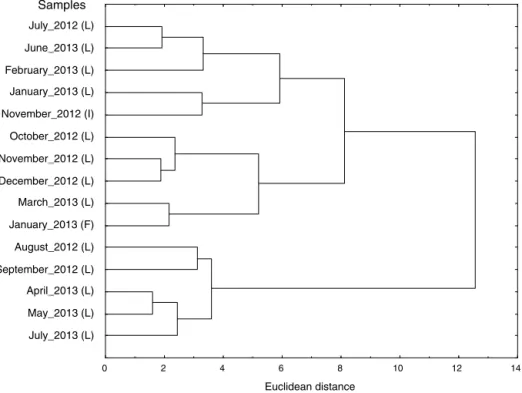
Theresultsobtainedbyanalysisof theprincipal component (PCA)and clusteranalysisshowedachemicalvariability among
theH.oreadicaoils.Fig.1showstherelativepositionofthe
sam-plesaccordingtothe2D-axisoriginatedinthePCA.Clusteranalysis
suggeststhattherearetwomain typesofoils:clusterI (essen-tialoilof leavescollectedin themonths of August,September 2012,April, May and July2013) characterizedby ␥-muurolene (8.876±0.69%)asmainconstituent;clusterII(essentialoilsfrom leavescollectedinthemonthsJuly,October,November, Decem-ber2012,January,February,MarchandJune2013;inflorescences collectedinNovember2012andfruitscollectedinJanuary2013)
14 12
10 8
6 4
2 0
Euclidean distance July_2013 (L)
May_2013 (L) April_2013 (L) September_2012 (L) August_2012 (L) January_2013 (F) March_2013 (L) December_2012 (L) November_2012 (L) October_2012 (L) November_2012 (I) January_2013 (L) February_2013 (L) June_2013 (L) July_2012 (L)
Samples
characterizedbybicyclogermacrene(24.173±4.69%)andpogostol (10.31±4.32%) as main constituent (Fig. 2). Through discrimi-nantanalysisHottelingt2 (p=0.024)wasalsoobservedthatthe
separationintotwoclustersiscorrectfor 86.7%ofthesamples. CanonicDiscriminantAnalysishasalsobeenperformedtohelp predictcluster by usingonly two predictive: ␥-muurolene and bicyclogermacreneandtherewasasignificantdifferencebetween theproposedclasses(p=0.0248).Theresultsindicated thatthe classification proposed by PCA and cluster has 80% of correct classification.
ThroughthePearsonlinear correlationanalysisit wasfound that thepogostol is present in greateramounts in the rainiest months, due to the moderate value (0.3<r<0.6) of the corre-lationcoefficient r=0.56824, significantat5%. The␣-yalangene constituentappearsinsmallerproportionsintherainiestmonths and the value of r=−0.39684 also reveals a moderate correla-tion(0.3<r<0.6).Thetemperaturepresentedaweakassociation (r<0.3)with␣-yalangeneconstituent.Therewasanegative associ-ationbetweenthepercentageof␣-yalangeneandthepercentages of bicyclogermacrene and pogostol (p<0.05) (strong negative correlation, r>0.6),the correlation coefficients were −0.79846,
−0.68858and,bothsignificantatlevelof5%)(Callegari-Jacques, 2003).The␣-yalangeneconstituentcorrelatedverystrongly pos-itivelywiththe constituentgermacrene B, withthecorrelation coefficientr=0.63209.
Discussion
Atfloweringtime,duetothecopiousproductionofnectar,it wasobservedthepresenceofvariousinsectsvisitors.Itwasfound thatthepogostolispresentingreateramountsinrainymonths.The
␣-yalangeneconstituent,unlikeappearsinsmallerproportionsin therainiestmonths.Borgesetal.(2013)notedthattherainfallis abletoinfluencebothpositivelyandnegativelyinthe concentra-tionofsesquiterpenesconstituentspresentinessentialoilsfrom
Myrciatomentosaleaves,whichisspeciesalsofoundinthe
Brazil-ianCerrado.Thetemperaturepresentedaweakassociationwith theconstituent␣-yalangene,whichindicatesthatother environ-mentalfactorsareassociatedwithchangesinconcentrationofthe substance.Therewasnocorrelationbetweenconstituentsof essen-tialoilsandtheperiodsoffloweringandfruitingforH.oreadica
species.
The constituents identified in H. oreadica essential oilfrom leaves,flowersandfruitsaresesquiterpenehydrocarbonsand oxy-genatedsesquiterpene.Amongthemajorconstituentsidentified intheessentialoilsoftheflowers,leavesandfruitsofH.oreadica, wehighlighttheamorpha-4,7(11)-dieneandbicyclogermacrene, whichchemicallydifferentiatesthisspeciesofH.brasilianathathas thenonacosane,eicosaneandguaiolasthemajorconstituentsin theessentialoilfromleaves(Magalhãesetal.,2013).The amorpha-4,7(11)-dienewasa differentialfor thisspecies,it hasnotbeen foundasmajorconstituentsinRutaceaeliterature.Moreover, bicy-clogermacrenehasalsobeenreportedasamajorconstituentof theessentialoilSpirantheraodoratissimaA.St.Hil.leaves(Chaibub etal.,2013),theaerialpartsofHaplophyllumlinifolium(L.)G.Don fil.(I ˜nigoetal.,2002),ofZanthoxylum hyemuleA.St.Hil.andof
ZanthoxylumnaranjilloGriseb(Guyetal.,2001).
Althoughtheamorpha-4,7-(11)-dieneisthemajorcompound foundinthesamplesofessentialoilsofH.oreadicaleaves,when thePCAwasgeneratedwiththiscompound,theclassificationwas notsuitable,becausethiscompoundpresentedloweigenvectorsin thefirstprincipalcomponentsaxes,whichpresenthigheramounts ofexplicabilityofthesystem.So,theamorpha-4,7-(11)-dienewas notselectedfortheclassificationoftheoilsamples.
Resultsobtainedfromdeprincipalcomponentandcluster anal-ysesshowedagreatchemicalvariabilityintheoilsofH.oeradica.
TheclusterIIischaracterizedbythebicyclogermacrene(18.0±2.5), whichisthediscriminantfactormainlyofthewetseason,besides thissubstanceispresentinfruitsamplesofH.oreadica.The pogos-tolisrelatedtotheclusterII,mainlyintheinflorescencesample andinthesampleofleavescollectedinJanuary.Thecompound
␥-muurolene(8.3±1.6)hasarelationshipwithclusterI, charac-terizedbyleavescollectedinmonthswithlowerlevelsofrainfall (dryseason).Indiscriminantanalysisthecombinationofthe com-pounds showedthat ␥-muuroleneand bicyclogermacrene were thesuitable predicted variables tothevalidation of thecluster obtained.Withthesetwoessentialoilscompoundswaspossible confirm thepercentage ofwell-classification at thelevel of 5% (p=0.0248),andthetwofunctionsretain80%oftheoverall vari-ability.
Inconclusion,thestudyoftheconstituentsoftheessentialoilsof
H.oreadicaleavesfor12monthscontributedtotheunderstanding
ofthebehaviorofchemicalconstituentsinrelationtoseasonal vari-ations.Themajorconstituentsoftheessentialoilsoftheflowers, theleavesandfruitsofH.oreadicaweretheamorpha-4,7(11)-diene andbicyclogermacrene,thefirstbeingadifferentialforthisspecies. Thisworkrepresentsthefirststudyofessentialoilsfromleaves, flowersand fruitsofH.oreadica collectedinPirenópolis, Goiás. Theknowledgegainedfromthisstudyshouldbeusefulforfurther exploitationandapplicationoftheresource.
Authors’contributions
DLS(student)contributedincollectingplantsample,running thelaboratorywork.HDFcontributedincollectingplantsample and identification,confection of herbarium.LLB contributed to thestatisticalanalyzes.JRPcontributedtobiologicaland chemi-calstudies,chromatographicanalysisandcriticalreading ofthe manuscript.LMFTcontributedtocriticalreadingofthemanuscript. PAS contributed to chemical studies. PHFcontributed to chro-matographicanalysis.SScontributedtoevaluatetheantimicrobial activity.TSFdesignedthestudy,supervisedthelaboratorywork, drafted the paper and contributed to critical reading of the manuscript. Alltheauthors haveread thefinalmanuscript and approvedthesubmissioncontributedtobiologicalstudiesrunning thelaboratorywork,analysisofthedata
Conflictsofinterest
Theauthorsdeclarenoconflictsofinterest.
References
Adams,R.P.,2007.IdentificationofEssentialOilComponentsbyGas Chromatogra-phy/MassSpectrometry,4thed.AlluredPubl.Corp,CarolStream,IL. Borges,L.L.,Alves,S.F.,Bara,M.T.,Conceic¸ão,E.C.,Ferri,P.H.,Paula,J.R.,2013.
Influ-enceofenvironmentalfactorsonthecompositionofessentialoilsfromleaves ofMyrciatomentosa(Aubl.)DC.Bol.Latinoam.CaribePlant.Med.Aromat.6, 572–580.
Braga,P.A.C.,Severino,V.G.P.,Freitas,S.D.L.,Silva,M.F.G.F.,Fernandes,J.B.,Vieira, P.C.,Pirani,J.R.,Groppo,M.,2012.DihydrocinnamicacidderivativesfromHortia speciesandtheirchemotaxonomicvalueintheRutaceae.Biochem.Syst.Ecol. 43,142–151.
Callegari-Jacques,S.M.,2003.Bioestatística:PrincípioseAplicac¸ões.EditoraArtmed SA,SãoPaulo.
Chaibub,B.A.,Oliveira,T.B.,Fiuza,T.S.,Bara,M.T.F.,Tresvenzol,L.M.F.,Paula,J.R., 2013.Composic¸ãoquímicadoóleoessencialeavaliac¸ãodaatividade antimi-crobianadoóleoessencial,extratoetanólicobrutoefrac¸ões dasfolhasde SpirantheraodoratissimaASt.-Hil.Rev.Bras.PlantasMed.15,225–229. Groppo,M.,Cruz-Barros,M.A.V.,Correa,A.M.S.,2010.Pollenmorphologyofspecies
ofHortia(Rutaceae).Rev.Bras.Bot.33,13–20.
Guy,I.,Charles,B.,Guinaudeau,H.,Fournet,A.,Ferreira,M.A.,Arias,A.R.,2001. Essen-tialoilsfromleavesoftwoParaguayanRutaceae:ZanthoxylumhyemaleA.St.Hil. andZ.naranjiloGriseb.J.Essent.Oil.Res.13,200–201.
28 D.L.Santosetal./RevistaBrasileiradeFarmacognosia26(2016)23–28
INMET,2014.InstitutoNacionaldeMeteorologia.Ministériodaagricultura,pecuária eabastecimento.
Kondo,M.,Goto,M.,Kodama,A.,Hirose,T.,2000.Fractionalextractionby supercrit-icalcarbondioxideforthedeterpenationofbergamotoil.Ind.Eng.Chem.Res. 39,4745–4748.
Magalhães,C.C.,Gasparetto,C.M.,Chedier,L.M.,Pimenta,D.S.,Alves,M.S.,Sousa,O.V., 2013.Antinociceptiveandanti-inflammatoryactivitiesofthehexaneextract fromHortiabrasilianaVand.leavesonexperimentalanimalmodels.Afr.J.Pharm. Pharmacol.7,1886–1893.
Misharina,T.A.,Samusenki,A.L.,2008.Antioxidantpropertiesofessentialoilsfrom lemon,grapefruit,coriander,cloveandtheirmixtures.Appl.Biochem.Microbiol. 45,438–442.
NIST, 1998. National Institute of Standards and Technology, PC version of theNIST/EPA/NIHMass SpectralDatabase. U.S.Department ofCommerce, Gaithersburg.
Perveen,A.,Qaiserm,M.,2005.PollenFloraofPakistan–XIV.Rutaceae.Pak.J.Bot. 37,495–501.
Pio-Corrêa,M.,1984.Dicionáriodasplantasúteisedasexóticascultivadas,Riode Janeiro.
Severino,V.G.,Braga,P.A.,Silva,M.F.,Fernandes,J.B.,Vieira,P.C.,Theodoro,J.E., Ellena,J.A.,2012.Cyclopropane-andspirolimonoidsandrelatedcompounds fromHortiaoreadica.Phytochemistry76,52–59.
Severino, V.G.P.,Freitas, S.D.L., Braga, P.A.C., Forim, M.R., Silva, M.F.G.S., Fer-nandes, J.B., Vieira, P.C., Venâncio, T., 2014. New limonoids from Hortia oreadica and unexpected coumarin from H. superba using chromatog-raphy over cleaning sephadex with sodium hypochlorite. Molecules 19, 12031–12047.
Severino,V.G.P.,Monteiro,A.F.,Silva,M.F.G.F.,Lucarini,R.R.,Martins,C.H.G.,2015. ChemicalstudyofHortiasuperba(Rutaceae)andinvestigationofthe antimy-cobacterialactivityofcrudeextractsandconstituentsisolatedfromHortia species.Quim.Nova38,42–45.
Severino,V.G.P.,Silva,M.F.G.F.,Lucarini,R.,Montanari,L.B.,Cunha,W.R.,Vinholis, A.H.C.,Martins,C.H.G.,2009.Determinationoftheantibacterialactivityofcrude extractsandcompoundsisolatedfromHortiaoreadica(Rutaceae)againstoral pathogens.Braz.J.Microbiol.40,535–540.
StatSoft,I.,2004.STATISTICA(dataanalysissoftwaresystem),7thed.
VanDenDool,H.,Kratz,P.D.,1963.Generalizationoftheretentionindexsystem includinglineartemperatureprogrammedgas–liquidpartition chromatogra-phy.J.Chromatogr.11,463–471.
Ward,J.H.,1963.Hierarchicalgroupingtooptimizeanobjectivefunction.J.Am.Stat. Assoc.58,66–103.