w ww.e l s e v i e r . c o m / l o c a t e / b j p
Original
Article
Chemical
composition
and
seasonal
variability
of
the
essential
oils
of
leaves
and
morphological
analysis
of
Hyptis
carpinifolia
Stone
de
Sá
a,
Tatiana
S.
Fiuza
b,
Leonardo
L.
Borges
c,
Heleno
D.
Ferreira
b,
Leonice
M.F.
Tresvenzol
a,
Pedro
H.
Ferri
d,
Maria
H.
Rezende
b,
José
R.
Paula
a,∗aFaculdadedeFarmácia,UniversidadeFederaldeGoiás,Goiânia,GO,Brazil
bInstitutodeCiênciasBiológicas,UniversidadeFederaldeGoiás,Goiânia,GO,Brazil
cEscoladeCiênciasMédicas,FarmacêuticaseBiomédicas,PontifíciaUniversidadeCatólicadeGoiás,Goiânia,GO,Brazil
dInstitutodeQuímica,UniversidadeFederaldeGoiás,Goiânia,GO,Brazil
a
r
t
i
c
l
e
i
n
f
o
Articlehistory:
Received25January2016 Accepted5May2016 Availableonline28June2016
Keywords:
Hyptiscarpinifolia
Sesquiterpenes Essentialoilcomposition 1,8-Cineole
a
b
s
t
r
a
c
t
HyptiscarpinifoliaBenth.,Lamiaceae,isaspeciesknownpopularlyas“rosmaninho”and“mata-pasto”, andleavesareemployedinBrazilianfolkmedicinetotreatcolds,flu,andrheumatism.Theaimofthis studywastoperformamorphologicaldescriptionofH.carpinifoliaandtoevaluatetheseasonalchemical variabilityoftheleafessentialoilsduring12months.MacroscopiccharacterizationofH.carpinifoliawas carriedoutwiththenakedeyeandwithastereoscopicmicroscope.Essentialoilswereisolatedfromleaves byhydrodistillationinClevengerapparatusandanalyzedbygaschromatography/massspectrometry. Majorcompoundswerefoundtobe1,8-cineole(39.6–61.8%),trans-cadina-1(6),4-diene(2.8–17.5%), -caryophyllene(4.4–10.0%),prenopsan-8-ol(4.2–9.6%)and-pinene(2.9–5.3%).Resultsofessentialoils compositionswereprocessedbyclusteranalysisandprincipalcomponentanalysis.Datashowedhigh variabilityintheconcentrationofthecomponents.Besides,therewasaseasonalvariabilityofchemical composition,probablyrelatedmainlytotherainfallregime.
©2016SociedadeBrasileiradeFarmacognosia.PublishedbyElsevierEditoraLtda.Thisisanopen accessarticleundertheCCBY-NC-NDlicense(http://creativecommons.org/licenses/by-nc-nd/4.0/).
Introduction
Hyptis genus, belongs to the Lamiaceae family, subfamily
Nepetoideae,tribeOcimeaeandsubtribeHyptidinae.Itisoneofthe largestandmostwidelydistributedplantgeneraintheworldwith morethan300species(Harley,1988).Itiscomposedofherbs, sub-shrubs,shrubsandmorerarelysmalltrees.Thestemsofthespecies ofthisgenusareoftensquareincross-section;theleavesareusually opposite,occasionallywhorled,simpleorrarelywithslits, petio-late,shortlypetiolateorsessileandaromatic,hairsgland-headed withessentialsoils,simple,non-glandular,usuallymulticellularor bothmulticellularandunicellular(Bordignon,1990).
Species ofthis genus are commonly usedin traditional folk medicinetotreatavarietyseveraldiseasessuchasgastrointestinal infections,cramps,painsandskininfections(Corrêa,1931).
TheessentialoilsfoundinthegenusHyptishaveagreat impor-tanceasasourceofbioactiveconstituents,especiallyduetoits
∗ Correspondingauthor.
E-mail:[email protected](J.R.Paula).
biologicalpropertiessuchasantimicrobial,cytotoxicand
insecti-cide(Kuhntetal.,1995).
HyptiscarpinifoliaBenth.,commonlyknowninBrazilas “ros-maninho”and“mata-pasto”,hasastrongrosemaryaromaandis usedinfolkmedicinetotreatcolds,flu(Silvaetal.,2000), rheuma-tism(decoctionorinfusionoftheleaves)(RodriguesandCarvalho, 2001)andforbaths(Brandãoetal.,2012).
Itisabranchedshrubupto3mhigh,glabrousleaves,sessile, elliptictooblong-ovatewithcordatebase(Epling,1949;Harley, 2012);inflorescenceslarge,interminalspikewith1–2cmin diam-eter; violetflowers; linear-lanceolatebracts amongthe flowers
(Harley,2012;Pignaletal.,2013).Xylematicraysandprismatic
crystalswerevisualizedinthecalix(RabeiandEl-Gazzar,2007). H.carpinifoliaisdistributedinBrazil(MatoGrosso,MatoGrosso doSul,Piauí,SãoPaulo,Roraima,Tocantins),Bolivia(Harley,2012)
andPeru(Mobot,2016).
Noreferenceswerefoundintheliteratureregardingthe chemi-calprofileandbiologicalactivitiesofH.carpinifolia.Thus,thisstudy aimedtoperformthemorphologicaldescriptionofH.carpinifolia andtoevaluatethechemicalconstituentsoftheessential oilof leavesanditsseasonalvariability.
http://dx.doi.org/10.1016/j.bjp.2016.05.011
Materialsandmethods
Plantmaterial
Forthemorphologicaldescription,specimensofHyptis carpini-foliaBenth.,Lamiaceae,deposited inthe herbariaof:Município Alvorada do Norte, Goiás, 02.VII. 1964, J.M. Pires 58142 (UB); NovaColina,Goiás,EstradaBelém-Brasília,5–10kmofNovaColina, 31.VII.1964,G.T.Prance&N.T.Silva58495(UB);Mineiros,Goiás, ParqueNacionaldasEmas,03.VII.1983,05.VII.1983,H.D.Ferreira 225(UFG);specimenscollectedinParqueNacionaldasEmas,in MineirosandinNovaAmérica,Goiás,Brazil,wereexamined.
Morphologicalanalysis
MacroscopiccharacterizationofH.carpinifoliawascarriedout withthenakedeyeandwithastereoscopicmicroscopeOlympus SZ-ST.
EssentialoilsisolationandGC–MSanalysis
Forisolationofessentialoils,H.carpinifolialeaveswerecollected fromtendifferentindividuals,monthly,foroneyear(2013),inthe cityofNovaAmérica/Goiás(15◦02′29.5′′Sand49◦59′0.05′′W,atan elevationof1295mabovesealevel).Plantmaterialwasidentified byDr.HelenoDiasFerreiraandavoucherspecimenwasdeposited attheHerbariumoftheFederalUniversityofGoiás,Brazil,under codeUFG43.833.
Theleavesweredriedatroomtemperatureandgroundin a knifemill.Differentbatches(100g)ofpowderedleaveswere sub-mittedtohydrodistillationinaClevenger-typeapparatusfor2h. AfterdriedoveranhydrousNa2SO4,oilswerekeptinglassvialsata temperatureof−18◦Cpriortofurtheranalysis.Theessentialoil vol-umewasmeasuredinthegraduatedtubeoftheapparatusandwas calculatedaspercentagerelativetotheinitialamountofdryplant materialusedintheextraction.Eachexperimentwasperformedin triplicate.
The essential oils were analyzed using a Shimadzu GC-MS QP5050A fitted witha fused silica SBP-5 (30m×0.25mm I.D.; 0.25mfilmthickness)capillarycolumn(composedof5% phenyl-methylpolysiloxane) and temperature programmed as follow: 60–240◦C at3◦C/min,thento280◦C at10◦C/min,ending with 10minat280◦C.Thecarriergaswasaflowrateof1ml/minandthe splitmodehadaratioof1:20.Theinjectionportwassetat225◦C. Significantquadrupolemassspectrometeroperatingparameters: interfacetemperature240◦C;electronimpactionizationat70eV withscanmassrangeof40–350m/zatasamplingrateof1scan/s. Constituents were identified by computer search using digital librariesofmassspectraldata(NIST,1998)andalsobycomparison
oftheirretentionindices(VanDenDoolandKratz,1963)relative toC8–C32n-alkanesandmassspectrawithliteraturedata(Adams,
2007).
Statisticalanalysis
PrincipalComponentAnalysis(PCA)wasappliedtoexaminethe interrelationshipsbetweenthechemicalconstituentsofthe essen-tialoilsfromleavescollectedindifferentmonthsusingthesoftware Statistica7(StatSoft,2004).Aclusteranalysiswasusedtostudythe similarityofsamplesbasedonthedistributionoftheconstituents, andhierarchicalclusteringwasperformedaccordingtothemethod ofminimumvarianceWard(Ward,1963).Tovalidatethecluster analysiswascarriedoutusingthecanonicdiscriminantanalysis (DCA).
Toverifythepossibleassociationbetweentheessentialoil com-ponentsselectedalongwithclimaticvariables(temperatureand rainfall) was used the Pearson’scorrelation analysis (
Callegari-Jacques,2003).
Results
Essentialoils
Withinthecollectionperiod,thehighestrainfallregimenswere registeredinthemonthsofOctober,NovemberandDecember.In thisperiod,themaximumtemperaturerangedfrom32to35◦C andtheminimumtemperaturerangedfrom20to22◦C.Lowest precipitationwasobservedinthemonthsofJune,July,Augustand Septemberandthemaximumtemperaturerangedfrom33to36◦C andtheminimumtemperaturerangesfrom18to22◦C(INMET,
2014)(Table1).
The loss of weight of leaves after drying was 72%. The yields of the essential oils of H. carpinifolia leaves ranged from 1.2 to2.0%. The oilsare mainly composedof oxygenated monoterpenes (40.4–62.6%), followed by sesquiterpene hydro-carbons (13.6–37.3%), oxygenated sesquiterpenes (11.2–17.1%) and monoterpene hydrocarbons (4.7–9.4%). Major compounds werefoundtobe1,8-cineole (39.6–61.8%),trans -1-cadina-(6),4-diene (2.8–17.5%), -caryophyllene (4.4–10.0%), prenopsan-8-ol (4.2–9.6%),-pinene(2.9–5.3%)(Table2,Fig.1).
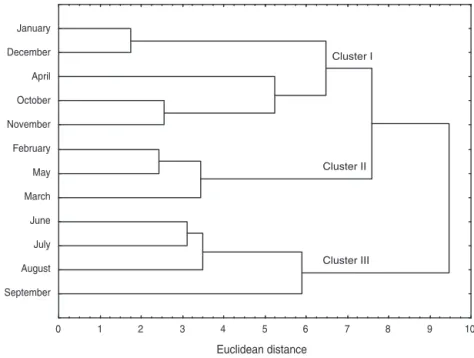
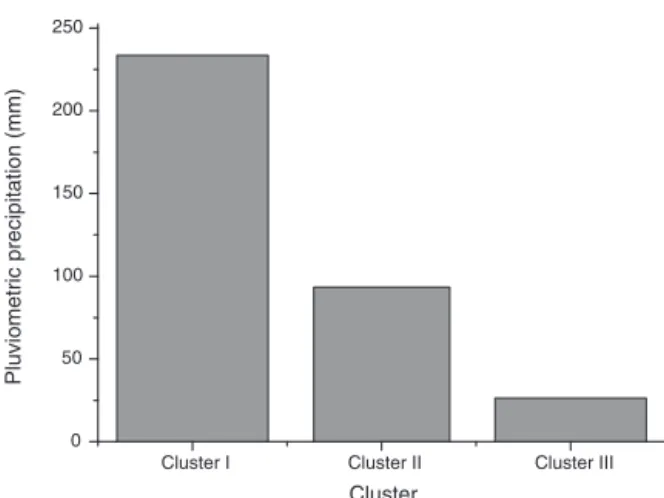
TheresultsobtainedbythePCAandclusteranalysisshoweda chemicalvariabilitywithintheH.carpinifoliaoils.Fig.2showsthe relativepositionofthe2D-axisoriginatedinthePCA.Cluster analy-sissuggeststhattherearethreegroups:clusterI(essentialoilsfrom leavescollectedinthemonthsofApril,October,Novemberand December)characterizedbypinonicacid(mean=1.05±0.21),as themaincomponentandthehighestrainfallindex(233.6±115.1); cluster II(essentialoils fromleaves collectedinthe monthsof
Table1
ClimateinformationofthecollectperiodoftheplantmaterialofHyptiscarpinifolia.
Station Date(2013) Rainfallnumberof days
Totalrainfall Maximumtemperature average
Minimumtemperature average
Relativehumidity average
83374 01/31 26 376.3 31 21 78.00
83374 02/28 19 117.1 34 21 74.75
83374 03/31 22 131 34 21 77.05
83374 04/30 6 99.4 33 21 72.26
83374 05/31 2 29.1 34 19 61.42
83374 06/30 4 8.3 33 19 64.25
83374 07/31 0 34.11 34 18 51.16
83374 08/31 0 35.78 35 19 42.39
83374 09/30 4 26.9 36 22 44.05
83374 10/31 13 114.9 35 22 65.66
83374 11/30 20 232 33 20 77.50
83374 12/31 27 315.5 32 21 80.36
Table2
PercentageofthechemicalconstituentsoftheessentialoilsfromHyptiscarpinifolialeavescollectedmonthlyinNovaAmérica,Goiásduringtheyear2013.
Constituents KI Jan Feb Mar Apr May Jun Jul Aug Sept Oct Nov Dec Tricyclene 926 1.5 1.8 1.5 1.2 1.5 1.3 0.9 1.2 1.4 1.1 1.1 1.0 6-Methyl-heptan-2-ol 965 0.4 0.4 0.3 0.2 2.2 0.2 – – – 0.1 – – Sabinene 975 1.1 1.2 1.0 0.9 1.2 1.2 0.9 1.1 1.2 1.0 1.0 0.9
-Pinene 979 4.5 5.3 4.1 3.1 4.5 4.2 2.9 4.2 5.1 3.1 3.1 3.1 1,8-Cineole 1031 55.5 51.8 43.9 39.6 47.2 52.6 47.7 57.4 61.8 48.1 51.2 54.5
␥-Terpinene 1059 0.1 0.1 – – – – 0.1 0.1 0.1 – 0.1 0.2
cis-Sabinenehydrate 1070 – – – – – – 0.1 0.1 0.1 0.2 0.2 0.1 Pinocarvone 1164 0.7 – 0.1 0.3 0.5 0.8 0.9 0.7 0.4 1.3 1.3 1.4 Terpinene-4-ol 1177 0.7 0.8 0.7 0.5 0.4 0.3 0.1 0.2 0.3 0.4 0.4 0.5
␣-Copaene 1376 3.4 3.7 4.1 4.4 3.6 3.3 3.1 2.7 2.4 3.9 3.6 3.2
-Bourbonene 1388 0.4 0.4 0.4 0.4 0.7 0.7 1.0 0.8 0.8 0.8 0.7 0.5
-Caryophyllene 1419 6.1 5.9 8.2 10.0 6.7 7.7 9.2 6.7 4.4 9.9 8.4 6.5 Pinonicacid 1442 0.7 0.7 0.9 1.3 0.9 0.8 0.8 0.6 0.4 1.2 1.0 1.0
␣-Humulene 1454 0.4 – 0.2 0.4 0.2 0.5 0.9 0.6 0.2 – 0.4 0.8
trans-Cadina-1(6),4-diene 1476 3.4 2.8 10.6 17.5 5.5 4.6 5.4 3.9 2.9 7.5 6.2 4.5
-Selinene 1490 1.1 1.1 1.2 1.0 0.9 0.9 1.1 0.8 0.7 0.9 1.0 1.0
␦-Selinene 1492 1.6 1.7 1.9 2.0 1.5 1.3 1.5 1.2 1.1 1.6 1.4 1.5
␥-Cadinene 1513 1.0 1.0 1.2 1.4 1.1 1.0 1.2 0.9 0.7 0.8 1.0 1.2
cis-Cadineneether 1553 0.3 – – – 0.3 0.4 – – 0.5 – – – Prenopsan-8-ol 1577 7.0 8.5 7.6 6.0 7.5 6.9 8.3 5.7 4.2 9.6 8.5 7.0
allo-Cedrol 1589 0.2 0.3 0.3 0.3 0.4 0.4 0.4 - 0.4 0.2 0.2 0.2
allo-Hedycaryol 1589 1.7 1.7 1.7 1.4 2.2 2.4 3.4 2.9 2.9 1.7 1.9 2.0 Rosifoliol 1600 0.5 0.8 0.6 0.4 0.7 0.5 0.6 0.4 0.3 0.7 0.6 0.5
epi-Cedrol 1619 0.8 0.8 0.6 0.7 0.1 – – – – 0.3 0.8 –
Caryophylla-4(12),8(13)-dien-5␣-ol 1640 0.3 0.5 0.3 0.2 0.5 0.4 0.5 0.3 0.3 0.3 0.2 0.3 Caryophylla-4(12),8(13)-dien-5-ol 1640 0.7 1.1 0.9 0.6 – 1.0 1.2 0.9 0.9 0.7 0.6 0.8 Pogostol 1653 0.9 1.2 1.0 0.7 1.3 0.8 1.0 0.9 0.9 0.4 0.7 0.8 Khusinol(valerianol) 1658 1.7 2.5 1.9 1.2 2.1 1.8 1.6 1.7 2.2 1.2 1.3 1.4
Monoterpenehydrocarbons 7.5 8.9 6.9 5.3 9.4 6.9 4.7 6.6 7.9 5.4 5.3 5.1 Oxygenatedmonoterpenes 56.9 52.6 44.7 40.4 48.0 53.6 48.9 58.4 62.6 50.0 53.2 56.4 Sesquiterpenehydrocarbons 17.7 16.8 28.1 37.3 20.6 20.4 23.8 17.6 13.6 25.5 22.9 19.5 Oxygenatedsesquiterpenes 13.9 17.1 13.6 11.2 14.7 14.1 16.6 12.8 12.3 14.8 14.5 12.7 Others 0.7 0.7 0.9 1.3 0.9 0.8 0.8 0.6 0.4 1.2 1.0 1.0 Totalidentified(%) 96.7 96.1 93.4 95.5 93.6 95.8 94.8 96.0 96.8 96.9 96.9 94.7 Yield(%) 1.8 2.0 2.0 1.9 2.0 1.6 1.3 1.3 1.2 1.6 1.6 1.8 KI,Kovatsretentionindex.
January, February, March and May) characterized by pogostol (1.2±0.2)andthekhusinol(2.2±0.3)as maincomponentsand rainfallindex(92.4±55.3);andclusterIII(essentialoilsfromleaves collectedinthemonthsJune,July,AugustandSeptember) char-acterizedby1,8-cineole(54.9±6.1)andthelowestrainfallindex (26.3±12.6)(Figs.3and4).Theresultsindicatedthatthe classifi-cationproposedbythePCAandHCAareinagreement.
Canonicdiscriminantanalysiswasperformedtohelptopredict thegroupingoftheclusteranalysis,andtwopredictivevariables wasemployed:pogostol(p=0.008)andrainfall(p=0.01),andthe discriminantfunctionretain92%ofwell-classificationinthe orig-inalclustersbyacross-validationapproach.
Through the correlation analysis between ␣-copaene and pinonic acid and humidity, there are a significant correlation [R=0.71 (p=0.01); R=0.60 (p=0.04), respectively], that is, the higher thehumidity thegreater theamount ␣-copaene of and pinonicacid.
Morphologicalanalysis
H.carpinifolia is a shrubup to3mhighwith glandular vil-lous branches.Leaves sessile or subsessile, blade oblong-ovate, oblongorsometimesrounded,usually3–6cmlong,2–3cmwide, adaxialsurfacesubglabrous,abaxialsurfaceglandular-pubescent ortomentose,apexroundedorsometimesacute,basesubcordate orrounded,serratemargin,reticulateandprominentveinsinthe abaxialsurface.Verticillasterscompactorslightlyseparated, pau-ciflorus,sessile,arrangedinterminalspike,bracts7–9mmlength, submembranous,ovate,lanceolate,linear-lanceolate,ciliated mar-ginwithbranchedhairs.Flowersbluesorviolet;calyxtubeofthe flower1.5–2mmlength,glandularpuberulentexternally,hirsute orifice, erectand branchedhairs, teeth subulatecalyx, unequal or subequal, about 2mm length, mature tube calyx 4–4.5mm length;corollatubewith8mmlength,slightlyglandular puberu-lentexternally,filamentofthestamenwithhairssuperiorly,3mm
10 1
23 4
7 8
9 10
11 12
13
14 15 16
17 18
19 20
21
23
22 242526 27 28
29 5 6
15 20 25 30 35
Jan
Feb Mar
Apr
May Jun Jul
Aug
Sep
Oct
Nov Dec
8 6 4 2
0 –2 –4 –6 –8
PC-1 ( 45.47%)a PC-1b
–5 –4 –3 –2 –1 0 1 2 3 4
PC-2 (18.81%)
a
PC-2
b
Pinonic acid
Rainfall
1,8-cineol
Pogostol Khusinol Cluster I
Cluster II
Cluster III
Means and standard deviation of clusters:
Rainfall Khusinol
Pinonic acid Pogostol 1,8-cineole
Cluster I 1.1 ± 0.2 1.3 ± 0.2 233.6 ± 115.0 0.7 ± 0.2 49.8 ± 6.4 Cluster II 0.8 ± 0.1 2.2 ± 0.3 92.4 ± 55.2 1.2 ± 0.2 47.6 ± 3.9 Cluster III 0.6 ± 0.2 1.8 ± 0.2 26.3 ± 12.6 0.9 ± 0.1 54.9 ± 6.1
Fig.2.ScatterplotofPCAoftheessentialoilsfromtheleavesofHyptiscarpinifoliasamplescollectedfromNovaAmérica/GObelongingtotheclusters(I,IIandIII).aAxes
referringtothescoresofsamples.bAxesreferringtoscoresofvolatilechemicalswhosediscriminantconstituentsarerepresentedbyvectors.
length; ovary glabrous, style glabrous, articulated in the ovary base,10mmlength.TheschizocarpfruitofH.carpinifoliapresents were nutlet smooth, light brown, abruptly apiculate, 1.5mm length.
Itwasfoundinthisstudythat,inGoiás,H.carpinifoliaoccurs wetlandsinthegalleryforestmargins,strictosensuCerrado.Itis foundataltitudes between164mand1295mwithan average
elevationof667m.ThefertileindividualswerecollectedfromMay toJuly.
Discussion
The major compounds of the essentials oils of H.
carpini-folia leaves were 1,8-cineole, trans-cadina-1(6),4-diene,
10 9 8 7 6 5 4 3 2 1 0
Euclidean distance September
August July June March May February November October April December January
Cluster I
Cluster II
Cluster III
Cluster III Cluster II
Cluster I 0
50 100 150 200 250
Pluviometric precipitation (mm)
Cluster
Fig.4.Correlationbetweenrainfallandclusters.
-caryophyllene, prenopsan-8-ol and -pinene. There are not dataintheliteratureonthechemicalcompositionoftheoilsof thisspecies.However,the1,8-cineolewasdescribedasoneofthe majorcompoundsoftheleavesofdifferentspeciesofthisgenus, suchas,H.crenataPohlexBenth.(Rebeloetal.,2009),H.suaveolens (L.)Poit.(Moreiraetal.,2010),H.fruticosaSalzm.exBenth.(Franco etal.,2011),H.goyazensisA.St.-Hil.exBenth.(McNeiletal.,2011) andH.martiusiiBenth.(Araújo etal.,2003;Caldasetal.,2014). -Caryophyllene have been found in the essential oils of the leavesofH.glomerataMart.exSchrank(SilvaandMoura,2011), H.martiusii(Araújoet al., 2003), H. marrubioidesEpling (Botrel
etal.,2010;Salesetal.,2009),H.spicigeraLam.,H.pectinata,H.
floribundaBriq.,H.suaveolens(McNeiletal.,2011);while-pinene hasbeenidentifiedintheleavesofH.crenata(Rebeloetal.,2009), H.suaveolens(Moreiraetal.,2010)andH.fruticosa(Francoetal.,
2011).
1,8-Cineoleisamonoterpenefoundinmanyaromaticplantsof thegenusEucalyptus,Croton,Hyptis,Pectis,RosmarinusandSalvia
(Araújoetal.,2003;Vilelaetal.,2009;Hussainetal.,2011).
Numer-ousbiologicalandpharmacologicalproprietieswereassignedto 1,8-cineole, including antimicrobial, insecticidal (Balacs, 1997), anti-allergic,anti-inflammatory(Santosand Rao,1998), hepato-protective(Santosetal.,2001),antitumoral(Motekietal.,2002)and gastrointestinalactivity(Santosetal.,2001).Thepresenceof 1,8-cineolecanalsoexplainthepopularuseoftheH.carpinifoliainflu, colds,andrheumatism.Cardiovasculareffectswerealsoassigned to1,8-cineole,in reducingtheblood pressureofbothconscious andanesthetizedratsandshowingvasorelaxanteffectsonisolated rataorta.Thisactivityseemstobedependentontheintegrityof thevascularendotheliumandoxidenitricreleasing(Lahlouetal.,
2003;Pintoetal.,2009;Santosetal.,2011).
Theobservedvariabilityofthechemicalcompositionof essen-tialoilsduringtheyear,couldbecorrelatedwithrainfall.Thisresult isinaccordancewiththereportsofGobbo-NetoandLopes(2007)
andalsoMorais(2009),whichreportedthattheproductionof
sec-ondarymetabolitesbyplantsmaybeinfluencedbyenvironmental factorssuchasseasonalityandthatthesefactorscanchangethe yieldandchemicalcompositionofessentialoils.Barrosetal.(2009)
foundthatclimateconditionscaninfluencetheenzymatic activi-tiesincertainplantspeciesandtheninfluenceinthebiosynthesis ofcertainsecondarymetabolites,includingterpeniccompounds. ExperimentswithH.suaveolensshowedinterferenceof environ-mentalfactorsonthechemical compositionofitsessential oils
(Martinsetal.,2006).Botreletal.(2010)foundthatmonoterpenes
andsesquiterpenescontentofH.marrubioides,inspring,showed verysimilarvalues,however,inwinter,themonoterpenescontent doubledinrelationtothesesquiterpenes.
H.carpinifoliawasplacedbyEpling(1949)inPolydesmida sec-tion,subsectionRigidaewithonlytwospecies:H.carpinifoliaand H.violaceaBenth.H.carpinifolia differsfromH.violaceafor hav-ingabruptlypeakednutlets,whileinH.violaceathenutletsare obtuse.H.carpinifoliahasadaxialsurfacesubglabrous,abaxial sur-faceglandular-pubescentortomentose,while,accordingwiththe sameauthor.H.violaceahasscabrouslimbonthesurfaceadaxial andalmostglabraontheabaxialsurface.
Epling(1949)describesH.carpinifoliaasashrubof3mhigh.
Theanalyzedspecimensoftheherbariaandfieldinthisstudyalso havenotfoundanyspecimenstallerthan3m.Epling(1949)also reportedforH.carpinifoliacalyxtubewith5.5–6mmlengthand corollatube6–8mmlength.Inthisstudy,thecalyxtubehassmaller length(1.5–2mm)andthecorollatubewith8mmlength.
ThefertileindividualsofH.carpinifoliawerecollectedfromMay toJulywhileinH.suaveolensthefloweringandfruitingoccursin OctobertoDecember(JelaniandPrabhakar,1991).
Thisworkcontributedfor themorphologicaldescriptionand for the knowledge on the chemical composition of essential oils of H. carpinifolia. Major compounds found in the essential oils from leaveswere 1,8-cineole, trans-1-cadina(6),4-diene,  -caryophyllene, prenopsan-8-ol,-pinene. The resultspresented hereinstronglysuggestthatthereisaseasonalvariabilityof chem-icalcompoundsrelatedtorainfall.
Authors’contributions
SScontributedincollectingplantsample,runningthe labora-torywork.TSFdraftedthepaperandcontributedtocriticalreading ofthemanuscript.HDFcontributedincollectingplantsampleand identification,confectionofherbariumandmorphological descrip-tionofthespecies.LLBcontributedtothestatisticalanalyzes.MHR contributedincollectingplantsampleandidentification.LMFT con-tributedtocriticalreadingofthemanuscript.PHFcontributedto chromatographicanalysis.JRPdesignedthestudy,supervisedthe laboratoryworkcontributedtobiological and chemicalstudies, chromatographicanalysisandcriticalreadingofthemanuscript.All theauthorshadreadthefinalmanuscriptandapprovedthe sub-missioncontributedtobiologicalstudiesrunningthelaboratory work,analysisofthedata
Conflictsofinterest
Theauthorsdeclarenoconflictsofinterest.
Acknowledgments
The authors gratefully acknowledge the financial support obtainedfromCAPES,CNPq,andFundac¸ãodeAmparoàPesquisa doEstadodeGoiás.
References
Adams,R.P.,2007.IdentificationofEssentialOilComponentsbyGas Chromatogra-phy/MassSpectrometry,4thed.AlluredPubl.Corp,CarolStream,IL.
Araújo,E.C.C.,Silveira,E.R.,Lima,M.A.S.,Neto,M.A.,DeAndrade,I.L.,Lima,M.A.A., 2003.InsecticidalactivityandchemicalcompositionofvolatileoilsfromHyptis martiusiiBenth.J.Agric.FoodChem.51,3760–3762.
Balacs,T.,1997.Cineole-richEucalyptus.Int.J.Aromather.8,15–21.
Barros,F.M.C.,Zambarda,E.O.,Heinzmann,B.M.,Mallmann,C.A.,2009.Variabilidade sazonalebiossíntesedeterpenóidespresentesnoóleoessencialdeLippiaalba (Mill.)N.E.Brown(Verbenaceae).Quim.Nova32,861–867.
Bordignon,S.A.L.,1990.OGêneroHyptisJacq.(Labiatae)noRioGrandedoSul, Botânica.UniversidadeFederaldoRioGrandedoSul,RioGrandedoSul.
Brandão,M.G.L.,Pignal,M.,Romaniuc,S.,Grael,C.F.F.,Fagg,C.W.,2012.Useful BrazilianplantslistedinthefieldbooksoftheFrenchnaturalistAugustede Saint-Hilaire(1779–1853).J.Ethnopharmacol.143,488–500.
Caldas,G.R.F.,Oliveira,A.R.S.,Araujo,A.V.,Quixabeira,D.C.A.,Silva-Neto,J.C., Costa-Silva,J.H.,Menezes,I.R.A.,Ferreira,F.,Leite,A.C.L.,Costa,J.G.M.,Wanderley,A.G., 2014.GastroprotectiveandulcerhealingeffectsofessentialoilofHyptismartiusii Benth.(Lamiaceae).PLOSONE9,1–10.
Callegari-Jacques,S.M.,2003.Bioestatística:Princípioseaplicac¸ões.EditoraArtmed S.A.,SãoPaulo.
Corrêa,M.P.,1931.DicionáriodasplantasúteisdoBrasiledasexóticascultivadas. MinistériodaAgricultura,RiodeJaneiro.
Epling,C.,1949.RevisióndelGéneroHyptis(Labiatae).Rev.DelMuseodeLaPlata. TomoVII,SecciónBotânica,153–497.
Franco,C.R.P.,Alves,P.B.,Andrade,D.M.,Jesus,H.C.R.,Silva,E.J.S.,Santos,E.A.B., Anto-niolli,A.R.,Quintans-Júnior,L.J.,2011.Essentialoilcompositionandvariability inHyptisfruticosa.Rev.Bras.Farmacogn.21,24–32.
Gobbo-Neto,L.,Lopes,N.P.,2007.Plantasmedicinais:fatoresdeinfluênciano con-teúdodemetabólitossecundários.Quim.Nova30,374–381.
Harley,R.M.,1988.EvolutionandDistributionofEriope(Labiatae)anditsRelatives inBrasil.AcademiaBrasileiradeCiências,RiodeJaneiro.
Harley,R.M.,2012.ChecklistandkeyofgeneraandspeciesoftheLamiaceaeofthe BrazilianAmazon.Rodriguésia63,129–144.
Hussain,A.I.,Anwar,F.,Nigam,P.S.,Sarker,S.D.,Moore,J.E.,Rao,J.R.,2011. Antibac-terialactivityofsomeLamiaceaeessentialoilsusingresazurinasanindicatorof cellgrowth.LWT-FoodSci.Technol.44,1199–1206.
INMET,2014.InstitutoNacionaldeMeteorologia.Ministériodaagricultura,pecuária eabastecimento.http://www.inmet.gov.br/portal/index.php?r=bdmep/bdmep
(accessedDecember2015).
Jelani,S.,Prabhakar,M.,1991.FarmacognosticstudyofleafofHyptissuaveolensL. AncientSci.LifeXI,31–37.
Kuhnt,T.M.,Probstle,A.,Rimpler,H.,Bauer,R.,Heinrich,M.,1995.Biologicaland pharmacologicalactivitiesandfurtherconstituintsofHyptisverticullata.Planta Med.61,227–232.
Lahlou,S.,Interaminense,L.F.,Leal-Cardoso,J.H.,Duarte,G.P.,2003. Antihyperten-siveeffectsoftheessentialoilofAlpiniazerumbetanditsmainconstituent, terpinen-4-ol,inDOCA-salthypertensiveconsciousrats.Fundam.Clin. Pharma-col.17,323–330.
Martins,F.T.,Santos,M.H.,Polo,M.,Barbosa,L.C.A.,2006.Variac¸ãoquímicadoóleo essencialdeHyptissuaveolens(L.)Poit.sobcondic¸õesdecultivo.Quim.Nova29, 1203–1209.
McNeil,M.,Surfacey,P.,Porter,R.,2011.EssentialoilsfromtheHyptisgenus–a review.Nat.Prod.Commun.6,1775–1796.
Mobot,2016.MissouriBotanicalGardenTropicos.http://www.tropicos.org/Name/ 17600864(accessedFebruary2016).
Morais,L.A.S.,2009.Influênciadosfatoresabióticosnacomposic¸ãoquímicados óleosessenciais.Hort.Bras.27,S4050–S4063.
Moreira,A.C.P.,Lima,E.O.,Wanderley,P.A.,Carmo,E.S.,Souza,E.L.,2010.Chemical compositionandantifungalactivityofHyptissuaveolens(L.)Poitleavesessential oilagainstAspergillusspecies.Braz.J.Microbiol.41,28–33.
Moteki,H.,Hibasami,H.,Yamada,Y.,Katsuzaki,H.,Imai,K.,Komiya,T.,2002.Specific inductionofapoptosisby1,8-cineoleintwohumanleukemiacelllines,butnot ainhumanstomachcancercellline.Oncol.Lett.9,757–760.
NIST, 1998. National Institute of Standards and Technology, PC Version of theNIST/EPA/NIH MassSpectral Database.U.S. Departmentof Commerce, Gaithersburg.
Pignal,M.,Romaniuc-Neto,S.,DeSouza,S.,Chagnoux,S.,LangeCanhos,D.A.,2013.
Saint-HilaireVirtualHerbarium:ANewUpgradeableTooltoStudyBrazilian Botany.
Pinto,N.V.,Assreuy,A.M.,Coelho-De-Souza,A.N.,Ceccatto,V.M.,Magalhães,P.J., Lahlou,S.,Leal-Cardoso,J.H.,2009.Endothelium-dependentvasorelaxanteffects oftheessentialoilfromaerialpartsofAlpiniazerumbetanditsmainconstituent 1,8-cineoleinrats.Phytomedicine16,1151–1155.
Rabei,S.,El-Gazzar,A.,2007.Computer-generatedkeystospeciesofHyptiss.l (Labi-atae).Taeckholmia27,11–39.
Rebelo,M.M.,Silva,J.K.R.,Andrade,E.H.A.,Maiav,J.G.S.,2009.Antioxidantcapacity andbiologicalactivityofessentialoilandmethanolextractofHyptiscrenata PohlexBenth.Rev.Bras.Farmacogn.19,230–235.
Rodrigues,V.E.G.,Carvalho,D.A.,2001.Levantamento etnobotânico deplantas medicinaisnodomíniodocerradonaregiãodoaltoRioGrande–MinasGerais. CiencAgrotec.25,102–123.
Sales,J.F.,Pinto,J.E.B.P.,Ferri,P.H.,Silva,F.G.,Oliveira,C.B.A.,2009.Influênciadonível deirradiâncianocrescimento,produc¸ãoecomposic¸ãoquímicadoóleoessencial dehortelã-do-campo(HyptismarrubioidesEpl.).CiêncAgrotec.30,389–396.
Santos,F.A.,Rao,V.S.N.,1998.Inflammatoryedemainducedby1,8-cineoleinthe hindpawofrats:amodelforscreeninganti-allergicandanti-inflammatory compounds.Phytomedicine5,115–119.
Santos,F.A.,Silva,R.M.,Tome,A.R.,Rao,V.S.N.,Pompeu,M.M.L.,Teixeira,M.J.,2001.
1,8-cineoleprotectsagainstliverfailureinanin-vivomurinemodelof endotox-emicshock.J.Pharm.Pharmacol.53,505–511.
Santos,M.R.V.,Moreira,F.V.,Fraga,B.P.,DeSousa,D.P.,Bonjardim,L.R., Quintans-Júnior,L.J.,2011.Cardiovasculareffectsofmonoterpenes:areview.Rev.Bras. Farmacogn.21,764–771.
Silva,A.F.,Barbosa,L.C.A.,Nascimento,E.,Casali,V.W.D.,2000.Chemicalcomposition oftheessentialoilofHyptisglomerataMart,exSchrank(Lamiaceae).J.Essent. OilRes.12,725–727.
Silva,I.C.,Moura,R.B.,2011.EspéciesdeAsteraceaeeLamiaceaeusadasnamedicina populardaregiãosudesteparaproblemasrespiratórios:Oqueasevidências científicasindicam.Rev.Fitos.6,21–28.
I.StatSoft,2004.STATISTICA(dataanalysissoftwaresystem),7thed.
VanDenDool,H.,Kratz,P.D.,1963.Generalizationoftheretentionindexsystem includinglineartemperatureprogrammedgas–liquidpartition chromatogra-phy.J.Chromatogr.11,463–471.
Vilela,G.R.,Almeida,G.S.,D’Arce,M.A.B.R.,Moraes,M.H.D.,Brito,J.O.,Silva,M.F.G.F., 2009.Activityofessentialoilanditsmajorcompound,1,8-cineole,from Eucalyp-tusglobulusLabill.,againstthestoragefungiAspergillusflavusLinkandAspergillus parasiticusSpeare.J.StoredProd.Res.45,108–111.