Rev Bras Fisioter. 2012;16(6):463-8.
ISSN 1413-3555 Rev Bras Fisioter, São Carlos, v. 16, n. 6, p. 463-8, Nov./Dec. 2012
©Revista Brasileira de Fisioterapia
S
YSTEMATICR
EVIEW463 463 Rev Bras Fisioter. 2012;16(6):463-8.
Effects of physical therapy in older women with
urinary incontinence: a systematic review
Efeitos do tratamento fisioterapêutico em mulheres idosas com incontinência
urinária: uma revisão sistemática
Vanessa S. Pereira, Adriana C. Escobar, Patricia Driusso
Abstract
Background: Urinary incontinence (UI) is one of the most common public health problems among older women.Despite conservative treatment being recommended as the first treatment option, the effects of physical therapy in older women with UI is unclear. Objective:
This study aimed to systematically review the evidence about the effects of physical therapy on urinary symptoms in older women with UI.Method: The literature search for studies evaluating conservative treatment for incontinent in elderly women was conducted on Pubmed/Medline, Lilacs, Scielo, ISI Web of Knowledge and PEDro. We selected clinical trials published in English and Portuguese after the year 2000. The methodological quality of the studies was assessed using the PEDro scale. The results were analyzed using a critical review method. Results: Six studies were reviewed in full revealing that pelvic floor muscle training was the treatment option in most studies. Five of the six selected studies were classified as having high methodological quality. There was significant improvement in urinary symptoms after treatment in five of the six selected studies. Conclusions: It was concluded that physical therapy treatment seems to be effective to decrease urinary incontinence symptoms in older women. However, the small number of studies and the use of concurrent interventions limit the conclusions on this issue.
Keywords: urinaryincontinence; rehabilitation; treatment outcome; elderly health.
Resumo
Contextualização: A incontinência urinária (IU) é um dos mais comuns problemas de saúde pública entre as mulheres idosas. Apesar de o tratamento conservador ser recomendado como a primeira opção de tratamento, os efeitos do tratamento fisioterapêutico
em mulheres idosas com IU não está esclarecido. Objetivo: Sistematizar as evidências científicas sobre os efeitos do tratamento
fisioterapêutico sobre os sintomas miccionais de mulheres idosas com IU. Método: A busca de publicações sobre os efeitos de
modalidades de tratamento fisioterapêutico em mulheres idosas com IU foi realizada nas bases de dados ISI Web of Knowlegde,
Medline/Pubmed, Lilacs, Scielo e PEDro. Foram selecionados ensaios clínicos publicados nas línguas inglesa e portuguesa após o ano de 2000. A qualidade metodológica dos estudos foi avaliada pela Escala PEDro, e a análise dos resultados dos estudos foi realizada por meio de revisão crítica dos conteúdos. Resultados: Seis estudos foram revisados na íntegra, revelando-se que os exercícios de fortalecimento da musculatura do assoalho pélvico foram o tratamento de escolha na maioria dos estudos. Cinco dos seis estudos selecionados foram classificados como de alta qualidade metodológica. Houve melhora significativa dos sintomas miccionais após
o tratamento proposto em cinco dos seis estudos selecionados. Conclusões:Conclui-se que o tratamento fisioterapêutico parece ser
efetivo para a redução dos sintomas miccionais em mulheres idosas com IU. No entanto, o pequeno número de estudos e a aplicação de técnicas em conjunto limita as conclusões sobre o tema.
Palavras-chave: incontinência urinária; reabilitação; resultado de tratamento; saúde do idoso.
Received: 11/10/2011 – Revised: 05/03/2012 – Accepted: 06/12/2012
Physical Therapy Department, Universidade Federal de São Carlos (UFSCar), São Carlos, SP, Brazil
464
Introduction
According to the International Continence Society (ICS), urinary incontinence (UI) is defined as any involuntary leak-age of urine1. It is one of the most common health problems among women of all ages, with an increase in prevalence with aging2. It is estimated that 25% to 45% of women, of different ages and throughout the world, suffer from invol-untary urine leakage, while 9% to 39% of women over 60 years of age report daily urinary leakage3. In Brazil, studies indicate that between 26.2% and 35% of post-menopausal women suffer from UI4,5. Furthermore, the leakage of urine results in severe consequences for the quality of life of the women affected, producing social, emotional and psycho-logical impacts6.
In light of the high prevalence and the economic, social and psychological consequences of UI in older women, it is necessary to determine an effective treatment for this disorder. The ICS recommends conservative treatment as the first line of treatment for incontinent women with a focus on increasing strength and correcting activating pat-ters of the pelvic floor muscles7. Pelvic floor muscles train-ing without the use of any device, as proposed by Kegel8 in 1948, was the first technique used for the strengthening and improvement of pelvic floor muscle recruitment. Currently, several techniques are employed in clinical practice aiming to improve pelvic floor muscle function, and among the most commonly used are electrical stimulation, biofeedback
and vaginal cones9.
Since older women may present pelvic loor age related changes, the efects of physical therapy on older women with UI are not clear. Authors suggest that, in older women, there may be a reduction in the integrity of the pelvic loor due to changes caused by a reduction in the dosage of female re-productive hormones and aging, such as changes in the rate of diferent types of collagen and the preferential atrophy of type II muscle ibers10-12. he presence of these changes raise doubts in regards to the real efectiveness of conservative treatment for older women with UI. herefore, this study aimed at systematically reviewing the scientiic evidence on the efects of physical therapy on urinary incontinence symp-toms in older women.
Method
We systematically reviewed clinical trials that addressed the diferent forms of physical therapy available for the treatment
of UI in older women. he literature search was performed on April 20, 2012 on the ISI Web of Knowledge, Medline/Pubmed, Lilacs, Scielo and PEDro databases. he keywords urinary in-continence and olderwomen, combined with rehabilitation or
physicaltherapy, were used as search strategies. Two blinded researchers conducted the search independently and com-pared the results.
Randomized clinical trials that were published in English and Portuguese were considered for inclusion in this review. he study content was analyzed by two evaluators and selected using the following inclusion criteria: a) participants with reported complaint of urinary leakage; b) sample composed of older women only (aged over 60 years); c) investigation of the efects of some physical therapy technique; d) studies published after the year 2000. Studies that dealt with surgical interventions were excluded.
Articles were analyzed in full using a structured form with the following items: sample, outcomes evaluated, interven-tion characteristics and treatment effects13. Methodologi-cal quality of the selected cliniMethodologi-cal trials was assessed using the14 PEDro Scale that consists of eleven questions, ten of which are summed to a final score. Each criterion is scored according to its presence or absence. Items not described in the studies are classified as “not listed” and are not scored. The final score ranges from 0 to 10 and are obtained through the sum of all positive responses. All selected studies were indexed in the PEDro database and therefore, quality scores were extracted from the database. Studies with scores equal to or greater than five were considered of high methodologi-cal quality15.
Results
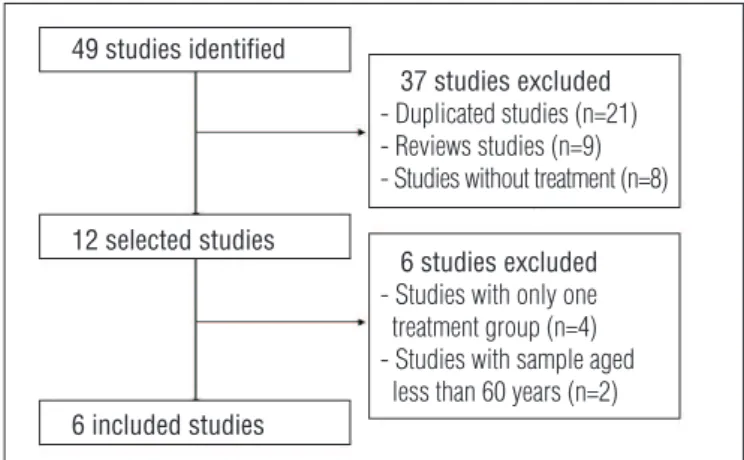
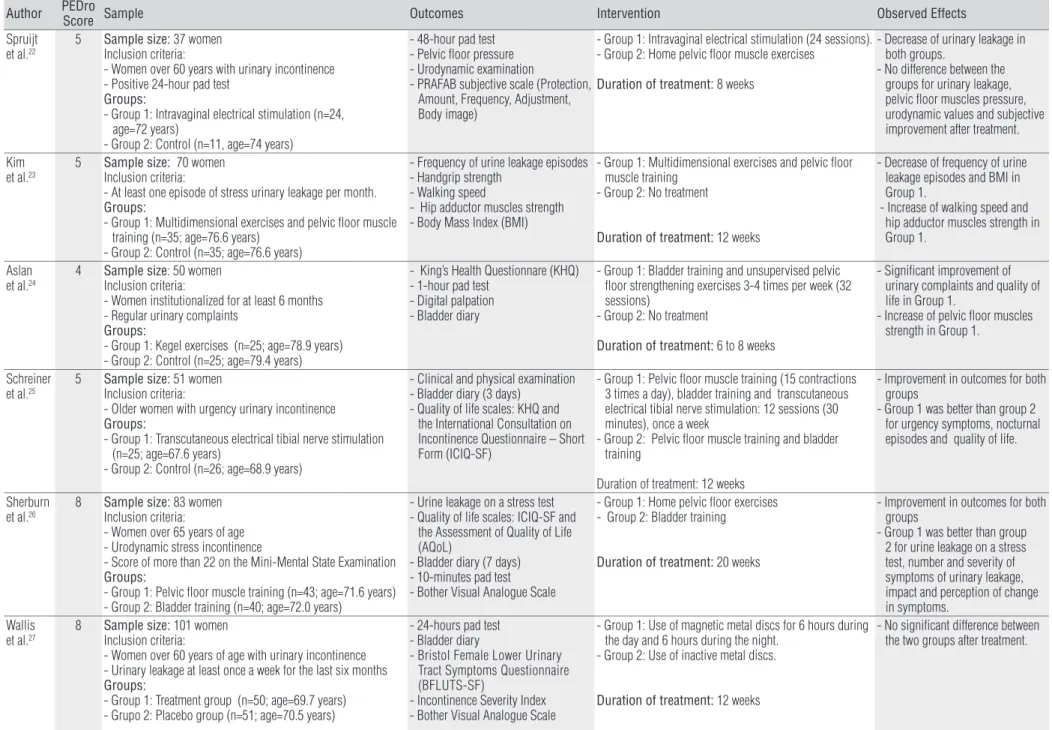
Forty nine articles were found using the described search strategy. We excluded repeated studies, literature reviews and those that did not fulill the proposed inclusion criteria. Twelve studies were selected for full text screening. Among those se-lected, four evaluated only one intervention arm16-19 and two had a sample of women starting from 55 years of age20,21 and were therefore excluded (Figure 1). hus, six studies were in-cluded in the critical appraisal stage. Table 1 shows the main characteristics of the included studies.
465 Urinary incontinence treatment in older women
Rev Bras Fisioter. 2012;16(6):463-8.
studies22,26. In two of the selected studies, the authors applied non-invasive transcutaneous electrical stimulation on the tibial nerve25 and extracorporeal magnetic stimulation27. In another study, an intervention of intravaginal electrical stimu-lation was applied in isostimu-lation22.
Three studies included women with reported com-plaints of leakage related to stress or urge22,24,27. Kim et al.23 and Sherburn et al.26 evaluated treatment effects in women with stress UI only, while Schreiner et al.25 dealt with women with urge UI alone. The sample size of the included studies ranged from 3722 to 10127. The average age varied from 67.625 to 79.424 years. The age inclusion criteria was different between the included studies. Schreiner et al.25 and Wallis et al.27 considered 60 as the minimum age for the sample. On the other hand, Spruijt et al.22, Kim et al.23, Aslan et al.24 and Sherburn et al.26 considered 65 as the min-imum age. In all of the studies, the sample was composed of community based women while Aslan et al.24 evaluated women in long term institutional care.
Outcome measures to evaluate incontinence symptoms included: the micturition diary24-27, diferent forms of pad
tests22,24,26,27 and the frequency of episodes of urinary leakage23. Other outcomes evaluated were quality of life using the King’s Health Questionnaire (KHQ)24,25, the International Consultation
on Incontinence Questionnaire – Short Form (ICQ-SF)26,27 and the indirect strength of the pelvic loor muscles22,24. A signiicant improvement in incontinence symptoms after the proposed treatment was noted in ive of the six studies selected22-26. A long term follow up between 6 months24 and 1 year23 were col-lected in three studies23,24,26. he results demonstrated that the efects were maintained over the long term.
Table 1 also shows the PEDRo scale methodological quality scores. It can be observed that, among the six studies selected, ive had a score greater than or equal to ive and therefore were considered as having high methodological quality.
Discussion
he results of this review demonstrated that regardless of the UI type and the treatment modality applied, physical therapy interventions appear to promote beneits in inconti-nent older women, as an improvement in urinary symptoms was observed in all studies except one. It is known that urinary incontinence is one of the most important and most common geriatric problems16. he high prevalence of urinary inconti-nence among older women may possibly be explained by the sum of the efects of post-menopausal hypoestrogenism and aging, which produce deleterious efects in the female uro-genital tract10. he results of this review show that, despite the presence of structural age related changes, physical therapy can promote an improvement of incontinence symptoms in older women.
Pelvic loor muscle training was the modality of choice for the majority of the studies selected. Numerous studies have evaluated the efectiveness of this type of treatment when compared to the absence of treatment for women with UI. In a recent review, Dumoulin and Hay-Smith28 evaluated the efects of pelvic loor muscle training in women with stress UI com-pared to those who remained untreated. Analysis of the eight studies selected showed that incontinent women submitted to treatment had 17 times more chance of improving or cur-ing urinary symptoms than untreated women. herefore, the strengthening of the pelvic loor muscles seems to be efective in the treatment of urinary incontinence in women.
However, for older women, this therapy is still little explored. Of the studies that addressed treatment in older women, none investigated the efects of pelvic loor muscle training applied in isolation as compared to an inactive control group. Only Kim et al.23 and Aslan et al.24 compared a group treated with pelvic loor muscle training in conjunction with multidimensional exercises and bladder training to an inactive control group. his lack of studies evaluating pelvic loor exercises in isolation makes it diicult to reach any conclusions about this type of treatment, particularly in the aged population.
Schreiner et al.25 addressed a recently proposed technique for UI treatment. he authors evaluated the efects of tradi-tional therapy in conjunction with transcutaneous electrical stimulation of the posterior tibial nerve in the treatment of older women with urge UI, achieving superior results to tra-ditional therapy in isolation. Amarenco et al.29 evaluated the acute efects of this technique on urodynamic parameters and found a reduction in hyperactivity and an increase in bladder capacity after application. he physiological efects of this treatment may be explained by the presence of posterior tibial nerve aferent ibers in the same sacral projection of the bladder innervation. In this way, the stimulation of this nerve’s
49 studies identified
12 selected studies
6 included studies
37 studies excluded - Duplicated studies (n=21) - Reviews studies (n=9) - Studies without treatment (n=8)
6 studies excluded - Studies with only one treatment group (n=4) - Studies with sample aged less than 60 years (n=2)
Figure 1. Flow chart of the search and selection of articles during the
V
anessa S. Pereira, Adriana C. Escobar
, Patricia Driusso
Rev Bras Fisioter
. 2012;16(6):463-8.
Table 1. Studies characteristics and PEDro score for the selected studies.
Author PEDro Score Sample Outcomes Intervention Observed Effects
Spruijt et al.22
5 Sample size: 37 women
Inclusion criteria:
- Women over 60 years with urinary incontinence - Positive 24-hour pad test
Groups:
- Group 1: Intravaginal electrical stimulation (n=24, age=72 years)
- Group 2: Control (n=11, age=74 years)
- 48-hour pad test - Pelvic floor pressure - Urodynamic examination
- PRAFAB subjective scale (Protection, Amount, Frequency, Adjustment, Body image)
- Group 1: Intravaginal electrical stimulation (24 sessions). - Group 2: Home pelvic floor muscle exercises
Duration of treatment: 8 weeks
- Decrease of urinary leakage in both groups.
- No difference between the groups for urinary leakage, pelvic floor muscles pressure, urodynamic values and subjective improvement after treatment.
Kim
et al.23 5 Sample size:Inclusion criteria: 70 women
- At least one episode of stress urinary leakage per month. Groups:
- Group 1: Multidimensional exercises and pelvic floor muscle training (n=35; age=76.6 years)
- Group 2: Control (n=35; age=76.6 years)
- Frequency of urine leakage episodes - Handgrip strength
- Walking speed
- Hip adductor muscles strength - Body Mass Index (BMI)
- Group 1: Multidimensional exercises and pelvic floor muscle training
- Group 2: No treatment
Duration of treatment: 12 weeks
- Decrease of frequency of urine leakage episodes and BMI in Group 1.
- Increase of walking speed and hip adductor muscles strength in Group 1.
Aslan
et al.24 4 Sample sizeInclusion criteria: : 50 women
- Women institutionalized for at least 6 months - Regular urinary complaints
Groups:
- Group 1: Kegel exercises (n=25; age=78.9 years) - Group 2: Control (n=25; age=79.4 years)
- King’s Health Questionnare (KHQ) - 1-hour pad test
- Digital palpation - Bladder diary
- Group 1: Bladder training and unsupervised pelvic floor strengthening exercises 3-4 times per week (32 sessions)
- Group 2: No treatment
Duration of treatment: 6 to 8 weeks
- Significant improvement of urinary complaints and quality of life in Group 1.
- Increase of pelvic floor muscles strength in Group 1.
Schreiner et al.25
5 Sample size: 51 women
Inclusion criteria:
- Older women with urgency urinary incontinence Groups:
- Group 1: Transcutaneous electrical tibial nerve stimulation (n=25; age=67.6 years)
- Group 2: Control (n=26; age=68.9 years)
- Clinical and physical examination - Bladder diary (3 days)
- Quality of life scales: KHQ and the International Consultation on Incontinence Questionnaire – Short Form (ICIQ-SF)
- Group 1: Pelvic floor muscle training (15 contractions 3 times a day), bladder training and transcutaneous electrical tibial nerve stimulation: 12 sessions (30 minutes), once a week
- Group 2: Pelvic floor muscle training and bladder training
Duration of treatment: 12 weeks
- Improvement in outcomes for both groups
- Group 1 was better than group 2 for urgency symptoms, nocturnal episodes and quality of life.
Sherburn et al.26
8 Sample size: 83 women
Inclusion criteria:
- Women over 65 years of age - Urodynamic stress incontinence
- Score of more than 22 on the Mini-Mental State Examination Groups:
- Group 1: Pelvic floor muscle training (n=43; age=71.6 years) - Group 2: Bladder training (n=40; age=72.0 years)
- Urine leakage on a stress test - Quality of life scales: ICIQ-SF and
the Assessment of Quality of Life (AQoL)
- Bladder diary (7 days) - 10-minutes pad test - Bother Visual Analogue Scale
- Group 1: Home pelvic floor exercises - Group 2: Bladder training
Duration of treatment: 20 weeks
- Improvement in outcomes for both groups
- Group 1 was better than group 2 for urine leakage on a stress test, number and severity of symptoms of urinary leakage, impact and perception of change in symptoms.
Wallis et al.27
8 Sample size: 101 women
Inclusion criteria:
- Women over 60 years of age with urinary incontinence - Urinary leakage at least once a week for the last six months Groups:
- Group 1: Treatment group (n=50; age=69.7 years) - Grupo 2: Placebo group (n=51; age=70.5 years)
- 24-hours pad test - Bladder diary
- Bristol Female Lower Urinary Tract Symptoms Questionnaire (BFLUTS-SF)
- Incontinence Severity Index - Bother Visual Analogue Scale
- Group 1: Use of magnetic metal discs for 6 hours during the day and 6 hours during the night.
- Group 2: Use of inactive metal discs.
Duration of treatment: 12 weeks
467 Urinary incontinence treatment in older women
Rev Bras Fisioter. 2012;16(6):463-8.
aferent ibers would produce a neuromodulation in the region, inhibiting detrusor muscle aferent ibers, thereby reducing the urge sensation29. Vandoninck et al.30 treated women with UI symptoms for 12 weeks using electrical stimulation of the pos-terior tibial nerve and found that 70% of the women reported a reduction in urinary leakage episodes. he results with respect to this technique are encouraging, although the presence of just one study with the application of this therapy in the elderly population does limit conclusions.
Another form of non-invasive treatment is extracorpo-real magnetic stimulation, based on the principle that a change in the magnetic field can induce an electron flow, which would allow for the depolarization and contraction of the pelvic floor muscles31. This technique would also be well received by older women as it is performed with-out the need to undress and withwith-out pain or discomfort. Wallis et al.27 tested the effectiveness of this technique in this population and did not find any positive results when compared to the group that received placebo treatment, demonstrating a strong influence of the placebo effect on the results. However, the sample size of the included study limits conclusions on this technique and further studies must be performed.
The long term follow up of physical therapy results is es-sential in reaching conclusions on the effectiveness of the interventions. All of the selected studies that included a long term follow-up evaluated pelvic floor muscle training. It is known that it is necessary to continue the exercises in order to maintain the benefits of pelvic floor muscle train-ing32. It is also known that adherence to post treatment exercises can be influenced by barriers, such as the lack of information and discipline, reduction of the time and will-ingness in its execution, the presence of stressful situations and the difficulty in integrating the exercises into daily life activities33. As such, it is essential to make clear to the pa-tients the importance of continuing the exercises post in-tervention in order to maintain the results after the physical therapy has ended.
In this review, it was noted that just one study evalu-ated the efects of physical therapy for UI in institutionalized older women. UI is highly prevalent in institutionalized older women, being considered one of the principal causes of institu-tionalization. he existence of co-existing diseases, functional incapacity and fragility, inluence the control of the sphincter control and the mobility to a toilette, which may justify the high prevalence of the disorder in this population34,35. he literature on the topic demonstrate the psycho-social consequences,
such as depression and isolation, and the physiological con-sequences, such as pressure ulcers, that can occur as a result of this geriatric syndrome in community dwelling women, but little is known of the consequences of this condition in institu-tionalized older women36. In spite of the diiculties, the posi-tive efects of the treatment of institutionalized older women found by Aslan et al.24 encourage the insertion of this type of UI treatment in long term care institutions.
he majority of the studies selected had high method-ological quality, which facilitates the extrapolation of results for clinical practice. Nevertheless, it should be taken into con-sideration that three studies had the minimum cut-of score. his systematic review sought to gather current and scien-tiically sound evidence to enrich clinical practice and assist professionals in determining their clinical practice. However, the small number of clinical trials speciically performed on older women highlights the need for new studies to evalu-ate the efects of diferent UI treatment modalities for older women. To reach deinitive conclusions these studies must present an appropriate sample size, the application of iso-lated techniques as a form of determining the real efective-ness of each technique, a the long term follow up in addition to a strong methodological quality.
Conclusion
Pelvic floor muscle training in isolation or in conjunc-tion with multidimensional exercises, bladder training and non-invasive transcutaneous electrical posterior tibial nerve stimulation seem to be effective techniques in the re-duction of urinary symptoms among older women with UI. However, the small number of studies and the use of con-current treatment techniques limits conclusions about the efficacy of specific interventions and therefore, new studies need to be conducted to provide a more definitive conclu-sion on the effects of physical therapy in the treatment of UI in older women.
Acknowledgements
Fundação de Amparo à Pesquisa do Estado de São Paulo
468
References
1. Abrams P, Andersson KE, Birder L, Brubaker L, Cardozo L, Chapple C, et al. Fourth International Consultation on Incontinence Recommendations of the International Scientific Committee: evaluation and treatment of urinary incontinence, pelvic organ prolapsed, and fecal incontinence. Neurourol Urodyn. 2010;29(1):213-40.
2. Temml C, Haidinger G, Schmidbauer J, Schatzl G, Madersbacher S. Urinary incontinence in both sexes: prevalence rates and impact on quality of life and sexual life. Neurourol Urodyn. 2000;19(3):259-71.
3. Buckley BS, Lapitan MCM; Epidemiology Committee of the Fourth International Consultation on Incontinence, Paris, 2008. Prevalence of urinary incontinence in men, women, and children - current evidence: findings of the Fourth International Consultation on Incontinence. Urology. 2010;76(2):265-70.
4. Tamanini JTN, Lebrão ML, Duarte YAO, Santos JLF, Laurenti R. Analysis of the prevalence of and factors associated with urinary incontinence among elderly people in the Municipality of São Paulo, Brazil: SABE Study (Health, Wellbeing and Aging). Cad Saúde Pública. 2009;25(8):1756-62.
5. Guarisi T, Pinto Neto AM, Osis MJ, Pedro AO, Paiva LHC, Faúndes A. Incontinência urinária entre mulheres climatéricas brasileiras: inquérito domiciliar. Rev Saúde Pública. 2001;35(5):428-35.
6. Dedicação AC, Haddad M, Saldanha MES, Driusso P. Comparison of quality of life for different types of female urinary incontinence. Rev Bras Fisioter. 2009;13(2):116-22.
7. Hay-Smith J, Bø K, Berghmans LC, Hendriks HJ, de Bie RS, van Waalwijk van Doorn ES. WITHDRAWN: Pelvic floor muscle training for urinary incontinence in women. Cochrane Database Syst Rev. 2007;(1):CD001407.
8. Kegel AH. Progressive resistance exercise in the functional restoration of the perineal muscles. Am J Obstet Gynecol. 1948;56(2):238-48.
9. Neumann PB, Grimmer KA, Deenadayalan Y. Pelvic floor muscle training and adjunctive therapies for the treatment of stress urinary incontinence in women: a systematic review. BMC Womens Health.2006;6:11.
10. Chen Y, Chen GD, Hu SW, Lin TL, Lin LY. Is the occurrence of storage and voiding dysfunction affected by menopausal transition or associated with the normal aging process? Menopause. 2003;10(3):203-8.
11. Gopal M, Sammel MD, Arya LA, Freeman EW, Lin H, Gracia C. Association of change in estradiol to lower urinary tract symptoms during the menopausal transition. Obstet Gynecol. 2008;112(5):1045-52.
12. Rizk DE, Fahim MA. Ageing of the female pelvic floor: towards treatment ‘a la carte’ of the ‘geripause’. Int Urogynecol J Pelvic Floor Dysfunct. 2008;19(4):455-8.
13. Ricci NA, Dias CNK, Driusso P. The use of electrothermal and phototherapeutic methods for the treatment of fibromyalgia syndrome: a systematic review. Rev Bras Fisioter. 2010;14(1):1-9.
14. Maher CG, Sherrington C, Herbert RD, Moseley AM, Elkins M. Reliability of the PEDro scale for rating quality of randomized controlled trials. Phys Ther. 2003;83(8):713-21.
15. Moseley AM, Herbert RD, Sherrington C, Maher CG. Evidence for physiotherapy practice: a survey of the Physiotherapy Evidence Database (PEDro). Aust J Physiother. 2002;48(1):43-9.
16. Padrós J, Peris T, Salvà A, Denkinger MD, Coll-Planas L. Evaluation of a urinary incontinence unit for community-dwelling older adults in Barcelona: implementation and improvement of the perceived impact on daily life, frequency and severity of urinary incontinence. Z Gerontol Geriatr. 2008;41(4):291-7.
17. Bakar Y, Cinar Özdemir O, Özengin N, Duran B. The use of extracorporeal magnetic innervation for the treatment of stress urinary incontinence in older women: a pilot study. Arch Gynecol Obstet. 2011;284(5):1163-8.
18. Simard C, Tu LM. Long-term efficacy of pelvic floor muscle rehabilitation for older women with urinary incontinence. J Obstet Gynaecol Can. 2010;32(12):1163-6.
19. Sousa JG, Ferreira VR, Oliveira RJ, Cestari CE. Avaliação da força muscular do assoalho pélvico em idosas com incontinência urinária. Fisioter Mov. 2011;24(1):39-46.
20. Burgio KL, Goode PS, Locher JL, Umlauf MG, Roth DL, Richter HE, et al. Behavioral training with and without biofeedback in the treatment of urge incontinence in older women: a randomized controlled trial. JAMA. 2002;288(18):2293-9.
21. Johnson TM 2nd, Burgio KL, Redden DT, Wright KC, Goode PS. Effects of behavioral and drug therapy on nocturia in older incontinent women. J Am Geriatr Soc. 2005;53(5):846-50.
22. Spruijt J, Vierhout M, Verstraeten R, Janssens J, Burger C. Vaginal electrical stimulation of the pelvic floor: a randomized feasibility study in urinary incontinent elderly women. Acta Obstet Gynecol Scand. 2003;82(11):1043-8.
23. Kim H, Suzuki T, Yoshida Y, Yoshida H. Effectiveness of multidimensional exercises for the treatment of stress urinary incontinence in elderly community-dwelling Japanese women: a randomized, controlled, crossover trial. J Am Geriatr Soc. 2007;55(12):1932-9.
24. Aslan E, Komurcu N, Beji NK, Yalcin O. Bladder training and Kegel exercises for women with urinary complaints living in a rest home. Gerontology. 2008;54(4):224-31.
25. Schreiner L, dos Santos TG, Knorst MR, da Silva Filho IG. Randomized trial of transcutaneous tibial nerve stimulation to treat urge urinary incontinence in older women. Int Urogynecol J. 2010;21(9):1065-70.
26. Sherburn M, Bird M, Carey M, Bø K, Galea MP. Incontinence improves in older women after intensive pelvic floor muscle training: an assessor-blinded randomized controlled trial. Neurourol Urodyn. 2011;30(3):317-24.
27. Wallis MC, Davies EA, Tahlib L, Griffiths S. Pelvic static magnetic stimulation to control urinary incontinence in older women: a randomized controlled trial. Clin Med Res. 2012;10(1):7-14.
28. Dumoulin C, Hay-Smith J. Pelvic floor muscle training versus no treatment, or inactive control treatments, for urinary incontinence in women. Cochrane Database Syst ver. 2010;(10):CD005654.
29. Amarenco G, Ismael SS, Even-Schneider A, Raibaut P, Demaille-Wlodyka S, Parratte B, et al. Urodynamic effect of acute transcutaneous posterior tibial nerve stimulation in overactive bladder. J Urol. 2003;169(6):2210-5.
30. Vandoninck V, van Balken MR, Finazzi Agró E, Petta F, Caltagirone C, Heesakkers JPFA, et al. Posterior tibial nerve stimulation in the treatment of urge incontinence. Neurourol Urodyn. 2003;22(1):17-23.
31. Olney RK, So YT, Goodin DS, Aminoff MJ. A comparison of magnetic and electrical stimulation of peripheral nerves. Muscle Nerve. 1990;13(10):957-63.
32. Bø K, Kvarstein B, Nygaard I. Lower urinary tract symptoms and pelvic floor muscle exercise adherence after 15 years. Obstet Gynecol. 2005;105(5 Pt 1):999-1005.
33. Alewijnse D, Mesters I, Metsemakers J, van den Borne B. Predictors of long-term adherence to pelvic floor muscle exercise therapy among women with urinary incontinence. Health Educ Res. 2003;18(5):511-24.
34. Offermans M, Du Moulin MF, Hamers JP, Dassen T, Halfens RJ. Prevalence of urinary incontinence and associated risk factors in nursing home residents: a systematic review. Neurourol Urodyn. 2009;28(4):288-94.
35. Coll-Planas L, Denkinger MD, Nikolaus T. Relationship of urinary incontinence and late-life disability: implications for clinical work and research in geriatrics. Z Gerontol Geriatr. 2008;41(4):283-90.