O
RIGINALA
RTICLE Revista Brasileira de FisioterapiaChallenges in recruitment, attendance and
adherence of acute stroke survivors to a
randomized trial in Brazil: a feasibility study
Desafios no recrutamento, presença e adesão ao protocolo de intervenção em
um ensaio controlado aleatorizado com sobreviventes de AVE agudo no Brasil:
um estudo de viabilidade
Aline Scianni1,2, Luci F. Teixeira-Salmela1, Louise Ada3
Abstract
Background: There is a high demand for stroke rehabilitation in the Brazilian public health system which should make undertaking clinical trials straightforward. Objectives: The aims of this study were to 1) determine the rate of recruitment of community-dwelling stroke survivors into a randomized trial of the effects of strength training in addition to task-specific gait training, 2) compare the effectiveness of various recruitment strategies on accrual rates, and 3) determine the attendance at training sessions and adherence to the intervention protocol.
Methods: Participants within six months of a stroke were screened for eligibility and invited to participate. Recruitment strategies were classified as advertisement or referral. The number of people who were screened, eligible and recruited for each strategy was recorded. Attendance at training sessions and adherence to the intervention protocol were recorded. Results: Over the first 14 months, 150 stroke survivors were screened, 10 were recruited, and 35 (23%) were eligible. Twenty-five of these patients (71%) were unable to participate with lack of transport given as the most common reason. The most successful strategy was referral via hospital-based physical therapists (50%). Overall attendance was 72% with lack of transport being the most common reason for non-attendance. Overall adherence to the protocol was 97% with feeling unwell being the most common reason for non-adherence. Conclusions: Recruitment of stroke survivors was inefficient. Lack of transport was the most common barrier to participate in and attend training sessions. Funding for transport is essential to make carrying out trials in Brazil feasible. Trial Registration ACTRN12609000803291.
Keywords: randomized controlled trial; muscle strength; stroke; walking; physical therapy.
Resumo
Contextualização: O sistema de saúde pública no Brasil apresenta uma alta demanda para a reabilitação de indivíduos após acidente vascular encefálico (AVE). Consequentemente, a condução de ensaios clínicos com essa população deveria ser simples.
Objetivos: Determinar a taxa de recrutamento de sobreviventes de AVE para ensaio controlado aleatorizado sobre os efeitos do fortalecimento muscular em adição ao treino específico de marcha; comparar a eficácia de várias estratégias de recrutamento e determinar a presença nas sessões de treinamento assim como a adesão ao protocolo de intervenção. Métodos: Sobreviventes de AVE há menos de seis meses foram triados para elegibilidade e convidados a participar do estudo. Estratégias de recrutamento foram classificadas como propagandas ou encaminhamento. O número de pessoas triadas, elegíveis e recrutadas por cada estratégia assim como presença nas sessões e adesão ao protocolo de intervenção foram registrados. Resultados: Durante 14 meses, 150 indivíduos foram triados e dez, recrutados. Trinta e cinco (23%) eram elegíveis; 25 deles (71%) eram incapazes de participar do estudo, sendo a falta de recursos para transporte a principal razão. Encaminhamento por meio de fisioterapeutas de hospitais representou a estratégia de recrutamento de maior sucesso (50%). A taxa de presença foi de 72%, e a taxa de adesão foi de 97%. A falta de transporte representou a principal razão para falta nas sessões de intervenção. Conclusões: A falta de recursos para o transporte representou a principal barreira à participação e presença. Portanto, o financiamento de transporte torna-se essencial para a condução de ensaios clínicos viáveis no Brasil. Registro de Ensaios Clínicos ACTRN12609000803291.
Palavras-chave: ensaio controlado aleatorizado; força muscular; AVE; marcha; fisioterapia.
Received: 05/10/2011 – Revised: 08/10/2011 – Accepted: 10/12/2011
1 Physical Therapy Department, Universidade Federal de Minas Gerais (UFMG), Belo Horizonte, MG, Brazil
2 Physical Therapy Department, Pontifícia Universidade Católica de Minas Gerais (PUC MG), Belo Horizonte, MG, Brazil 3 Discipline of Physiotherapy, The University of Sydney, Sydney, New South Wales, Australia
This work has been presented as a poster presentation at the Brazilian Congress of Neurofunctional Physiotherapy, which was held in Petropolis, Brazil, 26 to 28th November, 2010. The poster was
awarded a prize during this congress. As an awarded poster, its abstract is meant to be published in the Journal of Neurological Physical Therapy on the section Abstracts of Current Literature.
Correspondence to: Aline Scianni, Av. Dom José Gaspar, 500 - Coração Eucarístico, CEP 30535-901, Belo Horizonte, MG, Brasil, e-mail: [email protected]
Introduction
Recruitment is often a major problem in randomized tri-als. It has been reported that failure to reach target sample size occurs in half of all clinical trials1. One of the most important
methodological concerns in randomized trials is the recruit-ment and retention of a suicient number of participants. Fail-ure to recruit or retain enough participants to satisfy the target sample size may decrease the statistical power of the trial and lead to invalid or inconclusive results, increase the trial length and costs, or result in premature termination of the trial.
Systematic reviews examining recruitment for clinical tri-als have pointed out that time, transport, costs and procedures are barriers to participation2,3. Strategies have been suggested
to overcome these barriers, such as telephone calls, mon-etary incentives and informing the participants about group allocation2,3. After stroke, the main reasons given for diiculty
in recruitment to clinical trials include unwillingness to partic-ipate, complex protocols and eligibility criteria and trial fatigue by the investigators4,5. Additionally, stroke survivors may have
motor and cognitive disabilities that interfere with their ability to participate. After discharge from hospital, it is even more diicult, as they need to travel to the site of trial.
he aim of this study was to investigate the feasibility of running a randomized trial examining the efect of strengthen-ing exercises in community-dwellstrengthen-ing stroke survivors in Brazil. Stroke survivors who need assistance in physical activities af-ter discharge from hospital are referred for rehabilitation from a health professional from a primary care unit or a specialist physician from the public health system. Treatment is then, scheduled in one of the public system own units, or in a non-public clinic contracted by the non-public service. Since demand for rehabilitation is higher than supply, there is usually a long waiting list. For this reason, we believed that recruitment to our randomized trial would not be very diicult since it ofered im-mediate rehabilitation. he speciic research questions were: 1. What was the rate of recruitment?
2. What was the level of attendance at training sessions? 3. What was the level of adherence to the intervention
protocol?
Methods
his study was a feasibility study of a prospective random-ized trial with concealed randomization and blinded assess-ment. Stroke survivors, who were living at home and attending physical therapy outpatient clinics in the city of Belo Horizonte, MG, Brazil were recruited and randomized into either a control group (task-speciic walking training, three times per week for
10 weeks) or an experimental group (targeted strength training plus task-speciic walking training, three times per week for 10 weeks). he inclusion criteria were: i) clinical diagnoses of irst stroke, which resulted in walking deicits; ii) living at home for less than six months, after being discharged from the hospital; iii) older than 20 years of age; iv) clinical diagnoses of hemipa-resis or hemiplegia; v) ability to walk 10 meters independently, using walking aids or orthoses, if necessary, with or without su-pervision; vi) muscular weakness (≤3 on Manual Muscle Test) in at least 50% of the 12 lower limb muscles; and vii) walking speeds between 0.4 and 0.8 m/s (limited community)6. hey
were excluded if they had severe cognitive and/or language deicits or had adverse health conditions, which precluded them from participation in strength and walking training. he recruitment target for the irst 15 months of the current trial was set at 40 participants. Two staf members were engaged in the recruitment process. Informed consent was obtained from all participants.
he study was registered prior to the allocation of partici-pants by the Australian New Zealand Clinical Trials Registry-ACTRN (Registry-ACTRN12609000803291) and ethical approval was obtained from the appropriate Human Research Ethical Com-mittee (ETIC 120/09), Universidade Federal de Minas Gerais (UFMG), Belo Horizonte, MG, Brazil. he protocol of this ran-domized trial was published previously7.
Measurement of recruitment
hroughout the recruitment process, records were kept regarding the number of people screened for entry to the trial, and the source by which the person became aware of the trial. If not admitted to the trial, the reason why the person was ineligible for inclusion was recorded. Similarly, if eligible, the reason for a person declining to participate was noted.
Once recruitment for the irst 10 participants had ceased, a review of the information related to recruitment was con-ducted. he records were sorted based on the source of re-cruitment and summed to gain the total number of people screened from each source. his was then compared with the recruitment source of the participants who were actually ad-mitted to the clinical trial. Recruitment sources were classiied as advertisement or referral. Advertisement sources were from i) physical lyers distributed in public places such as churches, gyms, universities and stores; ii) electronic lyers distributed in non-governmental organizations and hospital websites. Refer-ral sources were from i) clinical neurologists working in private clinics; ii) physical therapists working in rehabilitation clinics, iii) physical therapists working in metropolitan hospitals and iv) other researchers. All sources were contacted at least once a week via telephone or e-mail. he most successful recruitment
source was determined by the total number of participants recruited to the trial from an individual source. he most ef-icient recruitment sources were deined in three ways: i) the highest number of people eligible for the trial as a proportion of those screened; ii) the highest number of people recruited as a proportion of those screened; and iii) the highest number of people recruited as a proportion of those eligible.
Measurement of attendance
According to the current trial protocol, each participant in the experimental and control group was required to participate in training, three times per week for a period of 10 weeks. he exact number of training sessions available to each cohort of participants varied slightly due the occurrence of public holi-days during the intervention periods.
hroughout the intervention phase, information regarding attendance at the training sessions was collected by the physi-cal therapist delivering the training. If a participant did not at-tend a session, the reason for non-atat-tendance was noted (when given by the participant). Once the intervention phase had ceased, the number of sessions each participant attended was added up. Participants who attended less than 50% of training sessions were classiied as “poor attenders”.
Measurement of adherence
According to the trial protocol, each participant in the experimental group was required to participate in 60 minutes of training (targeted strength training plus task-speciic walk-ing trainwalk-ing) and each participant in the control group was required to participate in 30 minutes of task-speciic walking training (task-speciic walking training).
hroughout the intervention phase, information regarding adherence to this protocol was collected by the physical thera-pist delivering the training. he number of sessions where the participant completed the full 30 minutes of walking training and the reasons for not completing the 30 minutes, were also noted. his information was used to determine: i) the number of sessions where the participant completed the full training; and ii) the reasons for not completing the full training protocol.
Results
Recruitment to trial
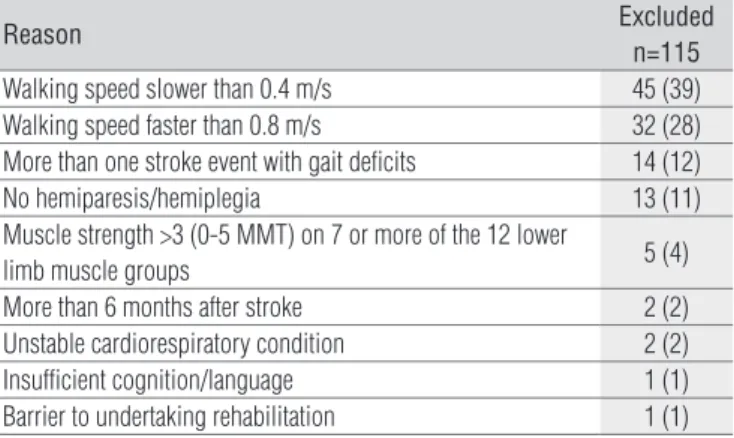
A total of 150 stroke survivors were screened for eligibility to the current trial in the period from July 2009 to October 2010. Of these, 115 (77%) were excluded because they did not meet
the inclusion criteria and the reasons for exclusion are given in Table 1. he most common reason for exclusion was that the walking speed was outside the range of 0.4-0.8 m/s. Twenty-ive (17%) stroke survivors were eligible for admission to the trial but declined to participate. he reasons for declining to par-ticipate included lack of money to pay for transport to the site of intervention (44%); other physical therapy services (once a week or month) available near home (28%); lack of interest (20%); caregiver/partner did not want to accompany the par-ticipant to the site of intervention (4%); and dislike of exercise (4%). Ten (7%) stroke survivors were both eligible to take part in the study and consented to participate. hese represented 25% of the target of 40 participants for this period.
he number of participants recruited from each source is presented in Table 2. he most successful source of recruit-ment was referral from hospital-based physical therapists with 5 (50%) participants recruited from this source. Referral was determined by the most eicient recruitment strategy. he least successful source of recruitment was advertisement. Al-though clinical neurologists referred the highest proportions of eligible participants from an individual source, this only resulted in one participant.
Attendance at training sessions
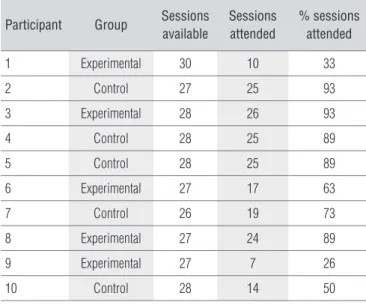
Attendance at the intervention sessions is summarized in Table 3. he overall attendance was 76% (SD 23), with the total number of sessions attended being 192 out of a possible 276 sessions. Five (50%) participants attended ≥89% of available sessions. here were two (20%) poor attenders who attended less than 50% of intervention sessions. Reasons for not attend-ing sessions are shown in Table 4. he most common reason for non-attendance at the intervention sessions was illness, followed by transport problems. he two poor attenders ac-counted for 40 (48%) of the missed intervention sessions. When these participants were excluded, the most common reason for not attending was illness.
Reason Excluded
n=115
Walking speed slower than 0.4 m/s 45 (39)
Walking speed faster than 0.8 m/s 32 (28)
More than one stroke event with gait deficits 14 (12)
No hemiparesis/hemiplegia 13 (11)
Muscle strength >3 (0-5 MMT) on 7 or more of the 12 lower
limb muscle groups 5 (4)
More than 6 months after stroke 2 (2)
Unstable cardiorespiratory condition 2 (2)
Insufficient cognition/language 1 (1)
Barrier to undertaking rehabilitation 1 (1)
Table 1. Number (%) of stroke survivors screened but excluded.
Participant Group Sessions available
Sessions attended
% sessions attended
1 Experimental 30 10 33
2 Control 27 25 93
3 Experimental 28 26 93
4 Control 28 25 89
5 Control 28 25 89
6 Experimental 27 17 63
7 Control 26 19 73
8 Experimental 27 24 89
9 Experimental 27 7 26
10 Control 28 14 50
Table 3. Attendance at intervention sessions.
Reason All participants
n=10
Excluding poor attenders n=8
Illness / sickness 30 (36) 30 (68)
Transport problems 27 (32) 7 (16)
Away (on holidays) 6 (7) 6 (14)
Caregiver problems 1 (1) 1 (2)
No reason given by
participant 20 (24) 0 (0)
Total 84 (100) 44 (100)
Table 4. Number (%) of training sessions not attended for each reason.
Reason n=10
Feeling generally unwell, pain 3 (60)
Emotional crisis 1 (20)
Fatigue 1 (20)
Total 5 (100)
Table 5. Number (%) of participants who did not complete training for
each reason.
Adherence to intervention protocol
Of the 192 sessions attended by participants, 187 (97%) ses-sions were of the complete training that was prescribed. here were ive (3%) sessions where participants did not complete the full training. Two of these sessions were not completed by experimental participants and three by control participants. he reasons for non-completion are given in Table 5. he most common reason was illness.
Discussion
his study revealed a problem of slow recruitment for this Brazilian clinical trial. One hundred and ifty stroke survivors were screened for eligibility and 10 (7%) agreed to participate. his number represents only 25% of the target of 40 participants. Low levels and slow recruitment imply longer duration of the trial. Problems with the funds intended for the original study and the possibility of low statistical power if the recruitment
target is not achieved, may compromise the results of the trial. In addition, there are further implications on the qual-ity of clinical care, since this delay means more time without the knowledge of the most efective intervention. Gul and Ali8
reported that one of the biggest mistakes in recruitment to clinical trials is the tendency for researchers to overestimate the number of available patients who meet the inclusion crite-ria (“recruitment funnel”). Evidence suggests that only 10% of subjects “survive” to the “recruitment funnel”9.
Recruitment
According to the database of the Brazilian National Health System (DATASUS)10, approximately 14,349 people with stroke
were admitted to public hospitals of the State of Minas Gerais, Brazil in a period of nine months from July 2009 to April 2010. Of these patients, 2,831 were admitted in the metropolitan area of Belo Horizonte, MG, Brazil10. Additionally, 1953 (69%) of
these stroke survivors live in Belo Horizonte, Brazil. Since the eligibility criteria included those who had a stroke within the
Source
Success Efficiency
Screened n (%)
Eligible n (%)
Recruited n (%)
Eligible n (% screened)
Recruited n (% screened)
Recruited n (% eligible)
Advertisement
Physical flyers 6 (4) 0 (0) 0 (0) 0 (0) 0 (0) 0 (0)
Electronic flyers 1 (1) 0 (0) 0 (0) 0 (0) 0 (0) 0 (0)
Referral
Clinical neurologists 1 (1) 1 (3) 1 (10) 1 (100) 1 (100) 1 (100)
Physical therapists working in rehabilitation clinics 26 (17) 8 (23) 2 (20) 8 (31) 2 (8) 2 (25)
Physical therapists working in metropolitan hospitals 113 (75) 24 (68) 5 (50) 24 (21) 5 (4) 5 (21)
Other researchers 3 (2) 2 (6) 2 (20) 2 (67) 2 (67) 2 (100)
Total 150 35 10 35 10 10
Table 2. Number (%) of participants screened, eligible and recruited for each source.
previous six months and who resided in the community of Belo Horizonte, it was originally concluded that there was a large number of stroke survivors who could be recruited.
A number of obstacles were encountered during the recruit-ment process. One was the lack of direct access to stroke survi-vors in the community. Privacy laws and the need to maintain conidentiality of patient data prevented the physical therapists based on hospitals and on physical therapy clinics providing details of potential participants. here is a growing tendency to depend on clinicians to be the connection between research-ers and research participants. However, with demands on their time (eg, supervision, administration, improvement of service quality and security), the workload of clinicians is currently high and a demand for additional assistance with recruitment for clinical trials may compromise the quality of clinical care. Since most hospitals and physical therapy clinics do not have staf available to assist in the recruitment process, recruitment eforts at these sites became extremely diicult. In an attempt to overcome this barrier, we sought to recruit participants from the community. Flyers were published on websites related to the care of stroke survivors and one researcher was responsible for coordinating the distribution of a large number of lyers to the community. Despite several attempts, advertisement was not a satisfactory recruitment strategy for this population.
Interestingly, of the 150 survivors of stroke who were screened for admission into the clinical trial, 10 (7%) agreed to participate. here is a diiculty to compare this recruitment rate with other studies11-14, since few studies reported the number of
participants screened for eligibility15-18. Recently, Cooke et al.15
reported a 10% rate of recruitment of acute stroke patients for a clinical trial investigating the eicacy of a six-week program of functional strength training on motor function of lower limbs. Unfortunately, the authors did not report the time taken to re-cruit participants as well as the strategies implemented for this task. Blanton et al.19 evaluated the aspects of recruitment and
retention of participants during a clinical trial investigating the eicacy of constraint-induced therapy in hemiplegic patients after stroke. hey screened 3,626 patients in six diferent cities in the United States of America during a period of two years. Two hundred and twenty-two patients (6%) were enrolled in the study. his recruitment rate was similar to the rate of the current study (7%), although the number of patients screened and enrolled was higher. Importantly, the participants of the cited study were reimbursed per visit for transportation, park-ing and food. his cost ranged from US$ 20.00 to US$ 50.00 per participant per session.
Once stroke survivors were identiied as eligible, a major barrier to recruitment emerged. Of the 35 stroke survivors who were eligible for the clinical trial, 11 (31%) could not partici-pate because of lack of provision of transportation to the site
of intervention. his inding is consistent with Rimmer’s, Wang and Smith20 indings on barriers to exercise after stroke.
Fifty-seven percent of the patients interviewed did not have any means of transport to an activity center. Providing transport should, therefore, increase the rate of recruitment as well as the attendance at the training sessions21. his was found to be
the case in another study with stroke survivors which provided funding for transportation, where the recruitment rate was more efective (51%) than in the present study (7%)22.
Given the barriers experienced in recruitment to this clinical trial, researchers need diferent strategies in recruiting people from the community. First, a national or state database of stroke survivors willing to participate in research could help recruitment. Researchers also need to ensure suicient funds to inance staf to carry out the recruitment. Finally, providing funding for transport should increase recruitment rates.
Attendance
his clinical trial showed a moderate rate of attendance. he data from this study has produced important information about the availability and willingness of stroke survivors to undertake exercise in Brazil. he attendance rate of 76% was lower than the rate reported by Ada et al.23 with an attendance
rate of 92%. However, in that study, participants had to attend sessions for a period of only four weeks rather than 10 weeks in the current trial.
A total of 84 sessions were not attended during this study. hirty sessions (36%) were not attended due to illness or lu symptoms. Two participants were hospitalized for a short duration (1-3 days), one due to respiratory infections (par-ticipant 4) and the other due to fall in the domestic environ-ment (participant 10). Falls are a common problem in stroke survivors. Approximately one third of these patients fall within six months of rehabilitation24. herefore, prevention of falls in
stroke survivors is critical not only to prevent injuries, but also to ensure that these patients enroll on exercise programs in the community. Participants did not attend 27 sessions (32%) due to diiculties with transportation. To increase attendance at intervention and measurement sessions, provision of transport is essential for conducting this trial.
Adherence
Adherence to the intervention protocol was 97% for all par-ticipants and 99% for parpar-ticipants in the experimental group. Obviously, once participants attended the training sessions, they were committed to exercising. Although the intervention was implemented at the individual level, it was common to treat more than one participant at the same time. his means
that there was opportunity for social interaction among par-ticipants as well as between family members, caregivers and people from the community. Physical therapists involved in implementing the intervention protocol encouraged each par-ticipant individually in an attempt to maintain adherence to the intervention protocol. hese strategies may have helped to gain the high adherence rates found in this trial.
A number of barriers were encountered during the recruit-ment for this trial. he absence of communication between university researchers and stroke survivors living in the com-munity was one barrier. Funding for transport and recruitment personnel should be considered when designing clinical trials with stroke survivors.
he results of this feasibility study served as rationale to request funds to provide participants transportation to the
References
intervention site. he government agency Conselho Nacional de Desenvolvimento Cientíico e Tecnológico (CNPq), Brasília, DF, Brazil, will fund the transportation costs to complete the ongoing trial (Process 4768902010-1 CNPq, Brazil).
Acknowledgements
Financial support was provided by the Brazilian Govern-ment funding agencies Coordenação de Aperfeiçoamento de Pessoal de Nível Superior (CAPES), Brasília, DF, Brazil, CNPq, and Fundação de Amparo a Pesquisa do Estado de Minas Gerais
FAPEMIG), Belo Horizonte, MG, Brazil. he Marina de Barros Pinheiro and Gustavo de Carvalho Machado for their assis-tance with recruitment to this trial.
1. Easterbrook PJ, Matthews DR. Fate of research studies. J R Soc Med. 1992;85(2):71-6.
2. Mapstone J, Elbourne D, Roberts I. Strategies to improve recruitment to research studies. Cochrane Database Syst Rev. 2007;(2):MR000013.
3. Marcellus L. Are we missing anything? Pursuing research on attrition. Can J Nurs Res. 2004;36(3):82-98.
4. Alexandrov AV. Slow recruitment in clinical trials: failure is not an option! Int J Stroke. 2006;1(3):160.
5. Bernhardt J, Dewey H, Thrift A, Collier J, Donnan G. A very early rehabilitation trial for stroke (AVERT): phase II safety and feasibility. Stroke. 2008;39:390-6.
6. Bowden MG, Balasubramanian CK, Behrman AL, Kautz SA. Validation of a speed-based classification system using quantitative measures of walking performance poststroke. Neurorehabil Neural Repair. 2008;22(6):672-5.
7. Scianni A, Teixeira-Salmela LF, Ada L. Effect of strengthening exercise in addition to task-specific gait training after stroke: a randomised trial. Int J Stroke. 2010;5(4):329-35.
8. Gul RB, Ali PA. Clinical trials: the challenge of recruitment and retention of participants. J Clin Nurs. 2010;19(1-2):227-33.
9. Hunninghake DB, Darby CA, Probstfield JL. Recruitment experience in clinical trials: literature summary and annotated bibliography. Control Clin Trials. 1987;8(4 Suppl):6S-30S.
10. DATASUS. Departamento de Informática do SUS. Disponível em: http://www2.datasus.gov.br/ DATASUS. 2010.
11. Stein J, Krebs HI, Frontera WR, Fasoli SE, Hughes R, Hogan N. Comparison of two techniques of robot-aided upper limb exercise training after stroke. Am J Phys Med Rehabil. 2004;83(11):720-8.
12. Sterr A, Freivogel S. Intensive training in chronic upper limb hemiparesis does not increase spasticity or synergies. Neurology. 2004;63(11):2176-7.
13. Teixeira-Salmela LF, Olney SJ, Nadeau S, Brouwer B. Muscle strengthening and physical conditioning to reduce impairment and disability in chronic stroke survivors. Arch Phys
Med Rehabil. 1999;80(10):1211-8.
14. Winchester P, Montgomery J, Bowman B, Hislop H. Effects of feedback stimulation training and cyclical electrical stimulation on knee extension in hemiparetic patients. Phys Ther. 1983;63(7):1096-103.
15. Cooke EV, Tallis RC, Clark A, Pomeroy VM. Efficacy of functional strength training on restoration of lower-limb motor function early after stroke: phase I randomized controlled trial. Neurorehabil Neural Repair. 2010;24(1):88-96.
16. Duncan P, Studenski S, Richards L, Gollub S, Lai SM, Reker D, et al. Randomized clinical trial of therapeutic exercise in subacute stroke. Stroke. 2003;34(9):2173-80.
17. Powell J, Pandyan AD, Granat M, Cameron M, Stott DJ. Electrical stimulation of wrist extensors in poststroke hemiplegia. Stroke. 1999;30:1384-9.
18. Winstein CJ, Rose DK, Tan SM, Lewthwaite R, Chui HC, Azen SP. A randomized controlled comparison of upper-extremity rehabilitation strategies in acute stroke: A pilot study of immediate and long-term outcomes. Arch Phys Med Rehabil. 2004;85(4):620-8.
19. Blanton S, Morris DM, Prettyman MG, McCulloch K, Redmond S, Light KE, et al. Lessons learned in participant recruitment and retention: the EXCITE trial. Phys Ther. 2006;86(11):1520-33.
20. Rimmer JH, Wang E, Smith D. Barriers associated with exercise and community access for individuals with stroke. J Rehabil Res Dev. 2008;45(2):315-22.
21. Damush TM, Plue L, Bakas T, Schmid A, Williams LS. Barriers and facilitators to exercise among stroke survivors. Rehabil Nurs. 2007;32(6):253-60, 262.
22. Lloyd G, Dean CM, Ada L. Issues in recruiting community-dwelling stroke survivors to clinical trials: the AMBULATE trial. Contemp Clin Trials. 2010;31(4):289-92.
23. Ada L, Dean CM, Hall JM, Bampton J, Crompton S. A treadmill and overground walking program improves walking in persons residing in the community after stroke: a placebo-controlled, randomized trial. Arch Phys Med Rehabil. 2003;84(10):1486-91.
24. Forster A, Young J. Incidence and consequences of falls due to stroke: a systematic inquiry. BMJ. 1995;311(6997):83-6.