Arq Neuropsiquiatr 2009;67(4):978-981
978
Article
CLINICAL DESCRIPTION OF HEMODIALYSIS
HEADACHE IN END-STAGE RENAL DISEASE PATIENTS
Alan Chester Feitosa de Jesus
1, Hélio Araújo Oliveira
1Marcelo Oliveira Ribeiro Paixão
2,
Thalyta Porto Fraga
2, Felipe José N. Barreto
2, Marcelo Moraes Valença
3Abstract – Background: Hemodialysis (HD)-related headaches are a common complaint of patients undergoing this procedure. Objective: To determine the frequency and clinical characteristics of headache in patients undergoing HD and to discuss their diagnostic criteria. Method: The present study assessed, in a prospective manner, a series of patients consulting at a HD center in Aracaju, Sergipe, Brazil, from November 2007 to January 2008. Only patients with HD-related headaches without previous history of primary headache were diagnosed as isolated HD headache (HDH). Results: Headache was reported by 76.1% of the patients studied. Prior to beginning dialysis, 47.9% had migraine without aura, 6.7% migraine with aura, 0.6% hemiplegic migraine, 5% episodic tension-type headache, and 2.5% migraine and tension-type headache. HDH was diagnosed in 6.7% of the patients, the most prevalent features being diffuse or temporal region location, bilateral headache, throbbing nature, and moderate severity. Seven patients with headaches between the sessions were not classified. Conclusion: While the pathophysiology of HDH is unknown, to diagnose patients with HDH or other possible HD-related headaches remains a challenge.
Key WOrDS: hemodialysis headache, end-stage renal, clinical description, diagnostic criteria.
Caracterização clínica da cefaléia da diálise em pacientes renais crônicos
Resumo – Cefaléias relacionadas ao programa de hemodiálise é uma queixa comum. Objetivo: Determinar freqüência e características clínicas das cefaléias em pacientes em regime de hemodiálise e discutir critérios diagnósticos. Método: Foi feita uma avaliação clínica prospectiva de pacientes cefalêicos em um serviço de hemodiálise em Aracaju, Sergipe, Brasil, de novembro de 2007 a janeiro de 2008. Apenas pacientes sem antecedente de cefaléia primária receberam diagnóstico de cefaléia da diálise isolada. Resultados: Cefaléia esteve presente em 76,1% dos pacientes estudados. Como antecedente de cefaléia, 47,9% tinham migrânea sem aura, 6,7% migrânea com aura, 0,6% migrânea hemiplégica, 5,5% cefaléia tensional episódica, e 2,5% associação de migrânea e cefaléia tensional. A cefaléia da diálise isolada foi diagnosticada em 6,7% dos pacientes e as localizações difusas e temporais, cefaléia bilateral, pulsátil, e intensidade moderada foram as características mais prevalentes. Conclusão: enquanto a fisiopatologia da cefaléia da diálise for desconhecida, o diagnostico da cefaléia da diálise ou de outras possíveis cefaléias relacionadas à diálise permanecerá um desafio. PAlAvrAS-CHAve: cefaléia da diálise, insuficiência renal terminal, características clínicas, critérios diagnósticos.
Sergipe Headache Unit (lICeSe), University Hospital, Federal University of Sergipe, Aracaju Se, Brazil (HU-UFS): 1Neurologist, Department of Medicine, UFS; 2Medical Student; 3Department of Neuropsychiatry, Federal University of Pernambuco, Associate Professor of Neurology and Neurosurgery. received 6 April 2009, received in inal form 10 April 2009. Accepted 3 August 2009.
Dr. Alan Chester Feitosa de Jesus – Rua Percílio da Costa Andrade 175 / 1401 - 49200-600 Aracaju SE - Brasil. E-mail: [email protected]
At present, there are more than 500 hemodialysis (HD) centers in Brazil, serving an estimated population of 70,000 patients1-2. like the general population, these
pa-tients have a high prevalence of headache, according to studies, such complaints are found in circa 70% of the pa-tients3-5. The hemodialysis headache (HDH), according to
Goksel et al. and Göksan et al., was found in 30% and 48% of the patients undergoing HD, respectively6-7.
The diagnostic criteria of HDH were established by the latest classiication of International Headache Soci-ety (ICHD II, 2004), but its pathophysiology is still not completely understood6-8. Some reports have identiied
possible factors related to HD crises of headache, such as changes in arterial pressure and in the levels of mag-nesium and sodium in the blood3,6,7,9.
Arq Neuropsiquiatr 2009;67(4)
979
Hemodialysis headache Jesus et al.
and clinical characteristics of headache in patients under-going HD in a HD center and to discuss the diagnostic cri-teria of HDH proposed by the IHS.
METHOD
This prospective and descriptive study was carried out in the Nephrology Clinic of Sergipe (ClINeSe). The patients were followed from November 2007 to January 2008. All patients with chronic renal failure included in this study had been in the HD program for at least 6 months and were regularly undergo-ing three HD sessions per week. The HD sessions usually lasted three to four hours.
We used a semi-structured questionnaire during the inter-views and the ICHD II (2004) diagnostic criteria to classify the headache.
Diagnostic criteria
(A) At least 3 attacks of acute headache fulilling criteria C and D. (B) Patient is on hemodialysis. (C) Headache develops dur-ing at least half of hemodialysis sessions. (D) Headache resolves within 72 hours after each hemodialysis session and/or ceases altogether after successful transplantation.
The frequency and clinical characteristics of headaches prior to and during the HD program were recorded by interview. The intensity of pain was quantiied using the visual Analogical Scale (vAS) score. Duration of the HD program, number of HD sessions per week, age, etiology of chronic renal failure, and other data were conirmed by accessing the patients’ medical iles. The di-alysis solution contained bicarbonate in all sessions.
This study was approved by the ethics in research Commit-tee of Federal University of Sergipe – UFS (Nº 2363.0.000.107-07). All patients enrolled in this study provided their individual written informed consent.
RESULTS
The total group of patients undergoing HD was com-posed by 238 individuals, out of which 177 satisied the inclusion criteria of having been in the HD program for 6 months or over. Those unable to supply all information required in the research protocol and those who refused to participate in the study were excluded (n=10). Four pa-tients were excluded due to death. Thus, we assessed 163 patients in this study. Ninety-six (58.9%) were men and 77
(41.1%) were women, their mean age was 46.22±14.3 years. The mean duration of chronic HD therapy was 34.4±22.8 months. eighty-one patients (49.7%) underwent HD on Mondays, Wednesdays and Fridays, and eighty-two (50.3%) on Tuesdays, Thursdays and Saturdays.
The causes of end-stage renal disease were hyperten-sive nephrosclerosis (18.4%), diabetic nephropathy (14.1%), glomerulopathy (11.7%), polycystic kidney disease (4.9%), obstructive uropathy (2.5%), nephropathy caused by drugs (1.8%), unknown etiology (44.1%) and other causes (2.5%).
Headache prior to or during the HD program was re-ported by 124 (76.1%) patients. Ninety-eight (60.1%) pa-tients had a history of headache, fulilling the criteria for migraine without aura (78 patients, 47.9%), migraine with aura (6 patients, 6.7%), hemiplegic migraine (1 patient, 0.6%) and episodic tension-type headache (9 patients, 5.5%). Four patients (2.5%) reported headaches with char-acteristics of migraine and tension-type headache. Forty-two patients (33.9%) had an improvement of at least 80% in their frequency of attacks.
Headaches related to viral or bacterial infections, as well as other types of secondary headaches, were not classiied as previous history of headache.
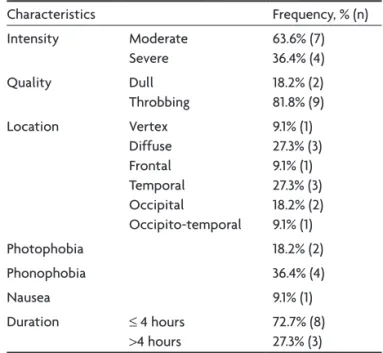
Table 1. Characteristics of HDH (n=11).
Characteristics Frequency, % (n)
Intensity Moderate
Severe
63.6% (7) 36.4% (4)
Quality Dull
Throbbing
18.2% (2) 81.8% (9)
location vertex
Diffuse Frontal Temporal Occipital
Occipito-temporal
9.1% (1) 27.3% (3) 9.1% (1) 27.3% (3) 18.2% (2) 9.1% (1)
Photophobia 18.2% (2)
Phonophobia 36.4% (4)
Nausea 9.1% (1)
Duration ≤ 4 hours
>4 hours
72.7% (8) 27.3% (3) Moderate: 3–7 in vAS score; Severe: 8–10 in vAS score.
Table 2. Characteristics of HDH (n=11).
Characteristics Frequency, % (n)
Preferential day of the attacks None
Monday or Tuesday
81.8% (9) 18.2% (2) Time elapsed between the
beginning of the dialysis session and the onset of headache
< 1 hour 1–1.9 hours 2–2.9 hours 3–4 hours
Arq Neuropsiquiatr 2009;67(4)
980
Hemodialysis headache Jesus et al.
eighty-two patients (50.3%) reported headache during the HD sessions. Seventy-six (46.6%) kept having these at-tacks during the study, and 78.7% had been having them since the start of their HD program. In 56.6% of this group, the attacks occurred in the inal hour of the session and 68.4% had no day of preference.
Of these 76 patients, 29 (38.2%) reported suffering at-tacks in at least half of the hemodialysis sessions. Of these 29 patients, 11 (37.8%) denied having had primary headache prior to the HD program. Thus, HDH was diagnosed in 11 patients interviewed (6.7%). The characteristics of the HDH found in this study are shown in Tables 1 and 2.
In the HDH group, the mean age was 48.8±11.2 years and 90.9% were men. The mean HD duration was 32.9±22.8 months.
Ten patients (90.9%) with HDH reported bilateral pain and none of them reported any symptoms that could be considered as aura. The mean duration of attacks was 3.6±3.2 hours. All patients with HDH presented headache throughout the study. Nine patients of this group (81.8%) had been presenting this headache since the start of the HD program, one patient since the third semester and another since the fourth semester. Concerning possible triggering factors, three patients associated the attacks with arterial hypertension (27.3%), one (9.1%) with loss of weight during the HD sessions and one (9.1%) reported as-sociation with both conditions.
Common analgesics, such as dipyrone and paraceta-mol, were the treatment of choice during the attacks. None of the patient reported any attempt at prophylac-tic treatment.
The seven patients who did not have headache prior to the beginning of the HD reported headache between the sessions. Five of these (71.4%) had been presenting HD-related headache since the start of the HD program, one since the third semester and another since the sixth semes-ter. Six of them also had headache during the HD, including four with a diagnosis of HDH. In this subset of patients the mean age was 52.6±6.1 years and ive were men. The char-acteristics of the pain in this group are shown in Table 3.
DISCUSSION
In our study, headache was reported by 76.1% of the patients, a result similar to those of Bana et al.3 and
An-toniazzi et al., who found a prevalence of 70% and 70.7%, respectively3-4.
As in the study of Antoniazzi et al.9, in which 67.8%
re-ported a history of headache, we also found a high fre-quency of this complaint (60.1%). According to Antoniazzi et al.10, 40.7% in this group reported a dramatic
improve-ment in their headaches after beginning HD. In our study, 33.87% in this subset obtained a decrease of at least 80% in the frequency of the attacks, excluding the attacks dur-ing the HD4.
Headaches associated with HD were also frequent, as we found in 76 patients (46.6%) who reported suffering from headache during the sessions. Antoniazzi et al.10,
af-ter evaluating 123 individuals, found 50 patients who re-ported the same complaint4.
In the general recommendation of ICHS-II, in agree-ment with what has been said by Bana et al.3, it is
pos-sible to diagnose a kind of secondary headache in a pa-tient with a history of primary headache3-8. The
diagnos-tic criteria are essentially clinical. However, as there are no clinical and objective criteria clearly deining a rela-tionship or differentiation between the attacks during the HD sessions and the primary headache. Therefore, the au-thors have decided to classify as HDH only the headaches that occurred in the patients without a history of primary headache prior to the start of the HD program.
It was observed that 18 patients who presented head-aches in at least half of the HD session, also reported a history of migraine and tensional headache. evaluating the characteristics of these headaches, it was not possible to identify any important differences with the primary ache, in order to consider the possibility of a new head-ache in their medical history. This could explain, in part, the low frequency of HDH (6.7%) in our study. According to Antoniazzi et al.9,10, 34 patients received a diagnosis of
HDH, including individuals with a history of primary
head-Table 3. Characteristics of headaches presented by subjects between the HD sessions (n=7).
Characteristics Frequency, % (n)
Intensity Moderate
Severe
71.4% (5) 28.6% (2)
Quality Dull
Throbbing
57.1% (4) 43.9% (3)
location vertex 28.6% (2)
Diffuse 28.6% (2)
Temporal 14.3% (1)
Fronto-temporal 14.3% (1)
Occipito-temporal 14.3% (1)
Photophobia 14.3% (1)
Phonophobia 42.9% (3)
Nausea 14.3% (1)
Worsened during exertion
28.6% (2)
Frequency per month ≥ 6 attacks
<6 attacks
28.6% (2) 71.4% (5)
Duration ≤ 4 hours
> 4 hours
Arq Neuropsiquiatr 2009;67(4)
981
Hemodialysis headache Jesus et al.
aches. Goksel et al.6 and Göksan et al.7 reported a higher
prevalence, even after excluding the patients with head-ache prior to the beginning of the HD program4,6,7.
When all patients with headache during the HD were assessed, 56.6% of the attacks occurred in the last hour of the sessions. A similar percentage was found by Antoniaz-zi et al.9-10 (62%). However, when only the individuals with
HDH were assessed, only 27.3% of them reported their at-tacks during that period.
Bana et al.3 have proposed that a longer interval
be-tween the sessions could be related to the incidence of headache during the HD3. As the patients have three
ses-sions per week every other day, we expected a higher in-cidence of attacks in Mondays and Tuesdays. However, in our study, the majority denied having a preferential day for headache during the HD.
like Antoniazzi et al.9,10, the present work also
ob-served patients who reported having had headache at-tacks between sessions, despite their history of no prima-ry headaches. This inding suggests a possible relationship with the HD, which could allow for classiication of such attacks as secondary headaches10.
In conclusion, the high frequency of headache during the HD sessions and the low number of studies on this frequent problem substantiate the need for further
re-search. Ultimately, it could allow for more precise diag-nostic criteria, better understanding of HDH pathophysi-ology and, inally, leading to a discussion of possible pro-phylactic treatments.
REFERENCES
1. Oliveira MB, Romão JE, Zatz J, Zatz R. End-stage renal disease in Brazil: epidemiology, prevention, and treatment. Kidney Internat 2005;68(Suppl 97):S82-S86.
2. Riella MCr. Princípios de nefrologia e distúrbios hidroeletrolíticos. 4th
Ed. Rio de Janeiro: Guanabara Koogan, 2003.
3. Bana DS, Yap AU, Graham JR. Headache during hemodialysis Head-ache 1972;12:1-14.
4. Antoniazzi AL, Bigal ME, Bordini CA, Tepper SJ, Speciali JG. Headache and hemodialysis: a Prospective study. Headache 2003;43:99-102. 5. Santos KALM, Costa-Neto J, Silva WF. Cefaléia da hemodiálise:
carac-terização clínica. Arq Neuropsiquiatr 2006;64(Suppl 1):S20.
6. Goksel BK, Torun D, Karaca S, et al. Is low blood magnesium level as-sociated with hemodialysis headache? Headache 2006;46:40-45. 7. Goksan B, Karaali-Savrun F, Ertan S, Savrun M.
Haemodialysis-relat-ed headache. Cephalalgia 2004;24:284-287.
8. The International Headache Classiication of Headache Disorders. Sec
-ond edition. The Sec-ondary Headaches. Cephalalgia 2004;24:107-114. 9. Antoniazzi AL, Bigal ME, Bordini CA, Speciali JG. Cefaléia relacionada
à hemodiálise: análise dos possíveis fatores desencadeantes e do trata-mento empregado. Arq Neuropsiquiatr 2002;60:614-618.