CINTIA RODRIGUES DE OLIVEIRA
Professor at Faculdade de Gestão e Negócios, Universidade Federal de Uberlândia, Uberlândia – MG, Brazil.
VALDIR MACHADO VALADÃO JÚNIOR
Professor at Faculdade de Gestão e Negócios, Universidade Federal de Uberlândia, Uberlândia – MG, Brazil.
RODRIGO MIRANDA
[email protected] Professor at Faculdade de Gestão e Negócios, Universidade Federal de Uberlândia, Uberlândia – MG, Brazil.
ARTICLES
Received on 6/10/2012. Approved on 10/3/2012
Evaluated by the double blind review system. Scientiic Editor: Alexandre de Pádua Carrieri
GUILTY OR INNOCENT? COMMENTS
FROM INTERNET USERS ABOUT
WHITE-COLLAR CRIME
Culpada ou inocente? Comentários de internautas sobre crimes corporativos
¿Culpable o inocente? Comentarios de internautas sobre delitos corporativos
ABSTRACT
In this paper, we analyze comments from Internet users posted in news about white-collar crime found in the national electronic press. We focused our analysis on reports about a specific type of white-collar crime, slave labor, with the objective of identifying the conceptions surrounding the subject based on a dynamic inter-textual analysis woven in its production. As a result, we observe discourse, speech and ideologies imbedded in the analyzed comments, indicating the importance of understan-ding inter-textual production about corporate action.
KEY WORDS | White-collar crime, ideology, slave labor, discourse, intertextuality.
RESUMO
Neste artigo, analisamos comentários de internautas postados em notícias sobre crimes corporativos veiculadas na imprensa eletrônica nacional. Concentramos nossa análise em reportagens sobre um tipo especíico de crime corporativo, o trabalho escravo, com o objetivo de identiicar as concepções em torno do assunto, partindo da análise da dinâmica intertextual entrelaçada na sua produção. Como resultados, evidenciamos temas discursivos, discursos e ideologias imersos nos comentários analisados, sinalizando para a importância de se compreender a produção intertextual sobre a atua-ção das corporações.
PALAVRAS-CHAVE | Crime corporativo, ideologia, trabalho escravo, discurso, intertextualidade.
RESUMEN
En este artículo, analizamos comentarios de internautas posteados en noticias sobre delitos corpo-rativos difundidos en la prensa electrónica nacional. Concentramos nuestro análisis en reportajes sobre un tipo específico de delito corporativo, el trabajo esclavo, con el objetivo de identificar las concepciones en torno del tema, partiendo del análisis de la dinámica intertextual entrelazada en su producción. Como resultados, evidenciamos temas discursivos, discursos e ideologías inmersos en los comentarios analizados, señalando para la importancia de comprenderse la producción intertex-tual sobre la actuación de las corporaciones.
PALABRAS CLAVE | Delito corporativo, ideología, trabajo esclavo, discurso, intertextualidad.
INTRODUCTION
The broadcasting of news and information in real time and in a wider scope contributes towards bringing to light issues that disturb society in general and stimulate the emergence of groups, movements and organizations (Greenpeace, Occu-py Wall Street, Corporate Crime Reporter, Source Watch, among others). These aim at monitoring and denouncing corporations and governments, in manifestations that assume increasingly bigger geographic and social proportions. Nevertheless, prac-tices of this sort have become part of our everyday activities, as-sociating corporations to an “impressive amount of devastation inlicted on human life and the environment” (PEARCE, 1993, p. 135). In face of the accusations and denunciations, corpora-tions act in diverse forms, either defending, or denying, found-ed on an ideological apparatus and using discourse that man-ufactures truths about their actions (BARLEY and KUNDA, 1992; FREITAS, 2000).
Unnever, Benson and Cullen (2008) explore the discus-sion of culpability and punishment of corporations and their agents by analyzing the evolution of regulation and criminal law focused on the corporate world in the United States. This functions as follows: a scandal of some kind is unveiled; public clamor demands government action; the latter reacts, formal-izing an accusation or creating new laws and regulations. Oth-er questions arise from this one, such as those that guide this study: How does society view white-collar crime in the news? How do readers of news broadcast in the press about the com-pany accused of criminal misconduct react? Is the comcom-pany guilty or innocent?
In the production of discourse that involves organiza-tions, news broadcast by the press becomes a fundamental el-ement, because they constitute everyday discursive practices that produce feelings about social phenomenon (FAIRCLOUGH, 1992; DJIK, 1998). In the case of news broadcast in online news-papers or web journals, readers interact, posting their com-ments, producing a text (discourse) based on other texts (dis-courses), which are always an inter-text in a chain of texts in dialogues (FAIRCLOUGH, 1992). This, the comments posted in news about corporations are discourses whose feelings are pro-duced by the social interaction of players with other texts, in-cluding ideologies, world visions and relationships of power
(DJIK, 1998; FAIRCLOUGH, 1992).
In this study, we focus our analysis on reports broadcast in domestic electronic media about a speciic type of white-col-lar crime, slave labor, with the objective of identifying the con-ceptions found surrounding this phenomenon, analyzing the in-ter-textual dynamic interwoven with its production. The choice
of this type of crime is justiied by its social and political dimen-sions and by its statistics. In 2005, the International Labor Or-ganization (INTERNATIONAL LABOUR OFFICE, 2007) estimated that nearly 12.3 million people are forced into labor around the world; the setting outlined by the NGO Free the Slaves points out that 27 million workers in the world currently live in condi-tions analogous to slave labor, generating 40 billion dollars for companies, per year (REPÓRTER BRASIL, 2012).
We have organized the text in the following manner: we irst introduce the context of ideological domain of corporations and white-collar crime; then, we introduce how we conduct the research and we describe the inter-textual approach adopted to analyze white-collar crime in comments by Internet users about slave labor; and, inally, we show the results and the inal re-marks.
CORPORATIONS, IDEOLOGY IN
CORPORATIONS AND WHITE-COLLAR
CRIME
The corporation as a mean of conducting business emerged in the 19th Century, more speciically under the American legal-in-stitutional system, when the factory system replace artisanal production. The particularities of the new production system and the quantity of capital needed to construct and operate fac-tories drove the association of capital and modiied the proper-ty mechanisms for companies, including within the legal scope. The corporation model became the standard for big capital to or-ganize its companies (CLINARD and others, 1979).
The modern form of corporation, which Peter Drucker (1993) describes as the economic and social institution that runs big business in a free enterprise system is, according to
Tragtenberg (2005, pg. 16), “a neo-capitalist ideology aimed at legitimizing the status quo as the only and the desirable one”. The majority of companies is comprised of conglomerates and, although they all have core business lines, they acquired oth-er product lines through moth-ergoth-ers and acquisitions, becoming stronger and more powerful as they protect themselves against luctuations in business and take on greater geographic, cultur-al and socicultur-al reach, while cultur-also obtaining greater proits (CLIN-ARD and others, 1979)
human spirit and the values of democracy. After all, in this pro-cess, controllers and managers (TRAGTENBERG, 2005) make use of administrative rationalization to subordinate the inter-ests and well-being of the masses.
Inspired by the Greek philosopher and sociologist Nicos Poulantzas, Motta (1981) reasons that companies, as an appa-ratus of the State, are systems with the function of reproducing the class society, just like religious, military and educational in-stitutions, which are of an economic, repressive and ideological nature. Alvesson and Deetz (2000, pg. 84) airm that Adminis-tration and organizational studies produce legitimizing and re-inforcing ideologies for social relations and speciic organiza-tional objectives. These ideologies aims at “cultural-ideological control at the work site level and provide a scientiic aura to sup-port the introduction and use of techniques for administrative domination.”
Various studies (TRAGTENBERG, 1974; 2005; MOTTA,
1981, 1992; BARLEY, MEYER, GASH, 1988; BARLEY and KUNDA, 1992; FREITAS, 2000; FARIA, 2004; among others) discuss the ideology at corporations, as well as how it is created, reproduced and transmitted. Wood Jr. and Paula (2006, pg. 94), for example, using the denomination of management culture to deine “a set of assumptions shared by organizations and which, to a great measure, are imbued in the social fabric”, point out, among other assumptions: the belief in a free market society; the vision of the individual as an auto-entrepreneur; the cult of excellence as a form of individual and collective improvement; the cult of symbols and emblematic igures, such as “catch words” (innovation, success, excellence) and “hero managers”; the belief in managerial technologies that permit reasoning organizational activities.
Barley, Meyer and Gash (1988) and Barley and Kunda (1992), when referring to the same phenomenon, airm that from 1870 to today, managerial ideologies have emerged, such as industrial improvement, scientiic administration, capitalism of well-being and human relations, systemic rationalism and or-ganizational culture, reinforcing the domain of companies in the economic, social and cultural spheres. This succession of ide-ologies, plus others (MOTTA, 1992; FREITAS, 2000; WOOD JR. and PAULA, 2006), including the very concept of corporation
(TRAGTENBERG, 2005), signiicantly inluence social life, being transmitted through messages, symbolic resources and other discursive manifestations.
Fairclough (1993) says the discourse is a political practice, since it establishes, maintains and transforms the relations of power and the collective entities in which these relations exist; however, it is also an ideological practice. The ideologies pres-ent in the discursive practices of corporations obscure the
re-lections of employees, consumers and society in general about their actions (ALVESSON; DEETZ, 2000), such as white-collar crime, which puts society at risk. White-collar crime or business crime aroused great interest in sociologists and criminologists in the 1930s and, until today, its concept is motive for contro-versy. Braithwaite and Geis (1982, pg. 294), for example, de-ine corporate crime as “conduct by a corporation or individu-als acting on behalf of a corporation, which is prescribed and punishable by law.” This is diferent from Braithwaite and Dwor-kin (1991, pg. 234), since, for these authors, white-collar crime can only be considered “violations of criminal law in which the courts have decided a irm committed a criminal act.” In the le-gal ield, the term crime is a lele-gal category, referring to a speciic conduct that institutions recognize as criminal. For social scien-tists (sociologists and criminologists), however, this deinition does not it the complexity of the term, since they are oriented towards the description of standards for these behaviors, their cause and societies attitudes in face of the crime (PAYNE, 2012).
Alexander and Cohen (1999) and Simpson and Piquero (2002) associate business crime to the company’s previous per-formance and the pressures and barriers for obtaining a supe-rior performance, being driven by structure, processes and cul-ture. Their interests, regardless of what their consequences will be, motivate the choice of conducts taken at corporations. In carrying out their functions, executives, managers and work-ers act and make decisions according to the company’s set of norms, procedures, policies and regulations, resulting in cost savings for it. Corporations do not want to assume the costs in-curred by white-collar crime (MOKHIBER, 1995). They prefer to adopt practices that harm society in general (CLINARD and oth-ers, 1979), generating collective nearsightedness (CHIKUDATE; 2009). A sociological perspective of white-collar crime thus ex-pands the understanding of criminal behavior within the ambit of corporations, which cannot be analyzed only as a personal deviation, but rather as a product of the relations between cer-tain members of the organizational systems.
locomotion due to the debt contracted with the employer or agent” (INSTITUTO OBSERVATÓRIO SOCIAL, 2004, pg. 8). Forced or slave labor is understood as that in which employers or agents resort to physical or moral coercion and the privation of employee freedom, where it is common to retain documents and to have practices of servitude based on debt contracted for consumption in work, food, clothes, tools, lodging and transportation, which conigures slavery by debt (MARTINS, 1994).
Disagreeing with the term “condition analogous to slav-ery”, because he considers it actual slavery, Martins (1994) dis-cusses one of the slave forms of labor relations found in cap-italist society, slavery by debt, as the extreme variation of salary-based labor in conditions of over exploitation of the work-er, to the point of compromising the individual’s survival. Ofer-ing a sociological understandOfer-ing of persistence and of revital-ization of slave labor in Brazil, Martins (1994, pg. 2) shows how slavery by debt, found in diferent economic activities, consti-tutes a “practice by companies whose economic logic, charac-teristically capitalist and modern, leads to the assumption that slavery would be a contradiction and an irrationality for them”.
These practices, which conigure a crime, found room to grow in face of public tolerance related to their occurrence. Historically, criminality in the streets has received greater attention on the part of governments, resulting in the adoption of public policy with more punitive control against crime. However, in relation to white-collar crime, despite the wave of scandals, proper attention was not given, resulting in a gap
(UNNEVER, BENSON, CULLEN, 2008). According to Payne (2012), the general population considers business crime as serious only when the consequences are physical, substantial and relatively immediate. Furthermore, the ambiguity of public opinion in face of illegal corporate behavior makes the law ambiguous as well.
As Snider (2000) warns about the “disappearance of white-collar crime”, dominant groups (understood as capitalist interests) and a managerial elite (understood as executives from large corporations) were competent in developing discourse, or producing a truth, about what white-collar crime would be, which is more compatible with its interests. Thus, crimes com-mitted in the name of rationality hide behind some assumed fate and, furthermore, are committed by human beings, against human beings, in the name of an entity, a corporation.
DESCRIPTION OF THE RESEARCH AND
ANALYSIS STRATEGY
Our qualitative study focuses on comments made by Internet users about news of white-collar crime broadcast on nation-al, electronic newspapers, speciically the accusations against
Zara, a company belonging to the Inditex group, of Spain, about the use of slave labor. In August 2011, the country’s main news-papers reported in an investigation operation by the Regional Labor and Employment Bureau of São Paulo, which found work-ers submitted to conditions of over exploitation of labor and slavery be debt, in that state, who were producing pieces of clothing for that international brand.
In face of the considerable number of web journals or on-line newspapers in Brazil, we decided to choose the electronic versions of two major newspapers in the state that made the ac-cusations: Folha de S. Paulo and O Estado de S. Paulo. An
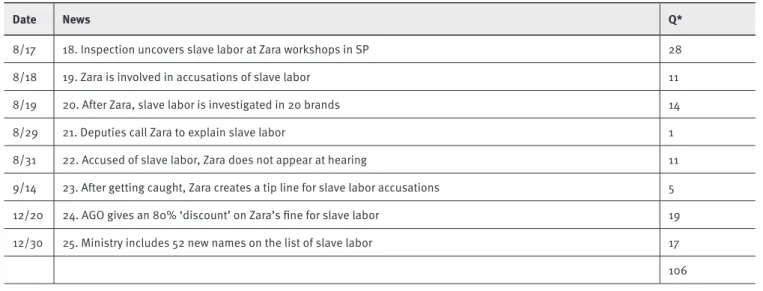
anal-ysis of their on-line versions revealed the existence of posts in the reported stories. First, we entered the expression “Zara slave labor” in the Folha.com search system. It returned 18 re-ports, 17 of which generated 715 comments from Internet users (Table 1) between August 18, 2011 and December 30, 2011. We repeated the procedure in the Estadão.com.br search system, which resulted in 20 reports, only 8 of which with posts, totaling 106 comments (Table 2). Thus, the body of research consisted of 821 comments posted by Internet users, in 25 reports, material considered suicient for our purposes.
The ields of sociology, anthropology and communica-tion have used Internet user comments (EFIMOVA and MOOR, 2005. In organizational studies, posts by Internet users are a rich source for analysis when you intend to learn heterogeneous and multifaceted opinions and conceptions about given as-pects related to organizations and management. Internet users are readers and producers of texts and, although spread about various locations, they interweave to form a network of rich and heterogeneous interactions. In the case of web journals, read-ers interact with each other, participating in the construction of a news story. According to Rheingold (1996, pg. 156), “there is no single and monolithic on-line sub-culture, but rather an ecosystem of sub-cultures, some frivolous and others serious.” Thus, we considered the Internet user the ideal author and read-er, that is, the one presupposed by the work.
The news reported in the media participates in the struction of world representations, social identities and con-struct versions of reality in accordance with given purposes
TABLE 1.
News reported on slave labor at Zara in Folha.com.br (2011)
Date News Q*
8/17
1. Zara recognizes irregular labor at 3 clothing manufacturers in SP 140
2. Internet users attack Zara after accusation of slave labor – social media 24
8/18
3. Fashion editor comments on irregular labor at Zara clothing manufacturers 21
4. Returning to Bolivia is not an option, says victim of exploitation in SP 27
5. Zara will revise supplier labor conditions in Brazil 3
6. Labor ines incurred by Zara total R$ 1 million 108
7. Six more brands will be investigated for irregular labor 160
8/19
8. Inditex, which owns Zara, shares fall 4% after accusations in SP 26
9. 35 more clothing brands will be investigated for irregular labor 74
8/28 10. Assembly will call Zara to explain degrading labor 1
8/31 11. Zara’s absence at assembly could result in CPI 7
9/15
12. Zara announces the creation of tip line 19
13. Zara awaits Attorney General’s Oice to compensate workers 5
9/21 14. President of Zara denies he knew of irregular labor in SP 17
10/15 15. Attorney General’s Oice proposes Zara pay R$ 20 thousand 39
11/30 16. Agreement fails between Zara and Attorney General’s Oice 18
12/19 17. Attorney General’s Oice stops seeking R$ 20 thousand in compensation against Zara 26
715
*Q = number of comments; Source: research data
TABLE 2.
News reported on slave labor at Zara in Estadão.com.br (2011)
Date News Q*
8/17 18. Inspection uncovers slave labor at Zara workshops in SP 28
8/18 19. Zara is involved in accusations of slave labor 11
8/19 20. After Zara, slave labor is investigated in 20 brands 14
8/29 21. Deputies call Zara to explain slave labor 1
8/31 22. Accused of slave labor, Zara does not appear at hearing 11
9/14 23. After getting caught, Zara creates a tip line for slave labor accusations 5
12/20 24. AGO gives an 80% ‘discount’ on Zara’s ine for slave labor 19
12/30 25. Ministry includes 52 new names on the list of slave labor 17
106
In this study, we adopted intertextuality, according to
Fairclough (1992), which deines it as the property texts have to consist of fragments of other texts, which can be delimited, explicitly or not, and to transform previous texts and restruc-ture existing conventions. Fairclough (1992) proposes intertex-tual analysis in two aspects: (1) manifested intertexintertex-tuality – the texts which the author used are explicit in the analyzed text; and (2) constitutive and interdiscursive intertextuality – the types of discourse that enter in its production.
In relation to manifested intertextuality, Fairclough (1992)
discusses it in ive aspects: (1) representation of discourse – that discourse reported by the author, distinguishing itself from indirect discourse by explicitly representing what the other said; (2) presuppositions – propositions made by the author of the text as established, which could have a manipulative intention or not; (3) denial – contestation of other texts, seeking to con-tradict them; (4) irony – disparity between one enounced and one echoed; and (5) meta-discourse – distancing of the author through evasive expressions, metaphors and other resources.
We add a third topic to these two: manifested ideologies, in this case, of the corporations. For Fairclough (1993), ideologies are meanings or representations of reality generated among relation-ships of power that are implicitly manifested in discursive practic-es, in all instances and social contexts, contributing towards es-tablishing, maintaining and changing social relations, and they are subjected to manifested and discursive intertextuality.
By considering the intertextual nature of selected com-ments, we try to analyze them focusing on speciic texts to which Internet users can resort (manifested intertextuality), the type of discourse (constitutive intertextuality) and, inally, the ideologies. We underscore that, given the qualitative nature of the study, we are concerned about identifying the elements of analysis, without being bogged down in quantiication.
In order to operationalize our proposal, we created a ile for each of the reports and their comments to which we attribut-ed a number for identiication in the report (for example, C1.1 re-fers to comment 1 of news report 1). Then, we analyzed the com-ments, trying to identify the elements of intertextual analysis, which we present in the next section.
INTERTEXTUALITY IN COMMENTS BY
INTERNET USERS ABOUT A TYPE OF
WHITE-COLLAR CRIME, SLAVE LABOR
In this section, we present the results in three aspects of inter-textual analysis.
Manifested intertextuality: fragments
Comments by Internet users about slave labor are comprised of fragments from other texts that dialogue with each other. These texts express the world representations of Internet users about the subject in question and, woven with other texts, form the fabric of the text that can, according to Fairclough (1993), be rec-ognized by the representation of discourse, presuppositions, meta discourse, denial and irony.
The representation of discourse is manifested several times in the analyzed comments. The A Liga program, on Rede Bandeirantes, is mentioned in various comments due to its two reports on the subject: “Hey, Pholha! You are late! ‘A LIGA’ broadcast this story yesterday, in an exclusive report, and it even covered the action by labor and internal revenue agents. What a late small newspaper!” (C39.1) and “I wonder if ‘A Liga’ had not shown the workers, would the directors of that Zara brand have recognized the irregular work at the clothing plant?” (C35.1). The Internet users resort to another text, in this case, a television program, to comment on Folha.com’s news report, in-dicating that the fact is already of their knowledge.
Besides that program, other discourses are represented. The Internet user mentions reporting that the practice of slave labor occurs in other places, as in the case of the Brazilian Tex-tile Industry Association, whose electronic address: “In Cambo-dia, workers at a shop that produces pieces for Zara passed out during their shift. The incident occurred on July 25 and it afect-ed nearly 100 factory workers. You can check it out at www.abit. com.br (C12.1) and on Rede Globo’s Jornal Nacional: “Accord-ing to yesterday’s report on Jornal Nacional, the Bolivians make twenty cents per piece sewn. That is exploitation; it is slavery!” (C.78.1), where the Internet user interprets worker exploitation as slave labor.
We also identiied a reference to Karl Marx, represented in C10.25: “And then they try to say good ol’ Marx’s precepts are outdated!”, in which an Internet user makes reference to the ex-ploitation of the worker by the capitalist as something current, contrary to other texts (not identiied) that preach that Marxist ideas are outdated.
extension of other facts in the national political scenario, using irony. Internet users comment ironically (for example): “It’s like they discovered gun powder (C1.1)”) that this should not be sur-prising to the population, because accusations of slave labor in Brazil are common.
The comments from Internet users about accusations against Zara for practicing slave labor reveal various facets, when analyzed by intertextuality (FAIRCLOUGH, 1993). The slave labor, which is the object of accusation against the company, is slavery by debt (MARTINS, 1994), a contemporary form of slav-ery, which also is a type of white-collar crime, in accordance with the vision of several authors, such as Braithwaite and Geis (1982), for which white-collar crime is a violation “punishable for law”.
In comment C3.3, the Internet user reports the discourse of an interviewed party who, while making a denial, also points out that what the party had said “is absurd”, suggesting she knows the deinition of slave labor. “Since when is paying little for a lot of work a deinition of slave labor? What the Fashion Ed-itor said is absurd,” and meta-discourse: “So, most workers in Brazil, and in other parts of the world, are slaves (maybe there are even some at Folha/UOL)!” (C3.3).
In the comments by Internet users, we have identiied several presuppositions, such as disgust for the company be-cause of what happened: “Wow… those guys (Zara) just don’t give a damn…” (C3.25) and slave labor as something common in the policies of Spanish companies, where proit is “most im-portant”.
All this talk for those Spanish [sic] is just BS. Their intent, their vision of America, was always to exploit and colonies [sic]. They are going to let things cool down until no one remembers any more (that is, corrupt a few). The policy of that country’s companies [sic] has always been to
de-spise [sic] South Americans, where the most im-portant is to make maximum proit, regardless of whomever it hurts. That gang should be told of and invited to leave the country (C20.5).
In comment C23.2, the Internet user’s presupposition concerning big fortunes is that they are won at the expense of exploiting labor and, furthermore, he recalls a crime committed recently by another company.
Behind every big fortune, there are big secrets, Dirt [sic]. Theft, dishonesty, trickery,
manipula-tion, lies, fooling, exploitation and every sort and
style of robbery and illicit enrichment [sic]. Some-times they are in collusion with justice and pub-lic authorities… Or did everyone already forget about Daslú [sic] (C23.2).
Analyzing the manifested intertextuality in the Internet user comments, we identiied explicit fragments from various other texts. The representation of discourse from associations, television and electronic news, the Bible, among others, indi-cates the Internet users express their perspective of the world, speciically in relation to a type of corporate crime, slave labor, based on other texts to which they had access; however, these are not academic texts.
By expressing their vision of the world, Internet users em-ploy irony, which, according to Fairclough (1993), occurs when there is dissonance between text meaning and the context in which it was inserted. In relation to denial, Internet users mainly contest the news when it refers to action by the State. Meta dis-course, which is characterized by own expressions, where the author is able to distinguish his own text (FAIRCLOUGH, 1993), we identiied several times when the Internet users present their conclusions.
The Internet users express their conceptions about slave labor, the main ones being: (a) multinationals exploit the work-er; (b) slave labor should be fought by the state; (c) slave labor is common in Brazil and around the world; (d) slave labor is the fruit of a long history of slavery.
Constitutive intertextuality: discursive themes
Constitutive intertextuality or interdiscursivity occurs when the author of the text resorts to others in an implicit manner. In this section, we present the recurring discursive themes in Internet user comments, observing that these are not the only ones.
Theme 1: The State, ineicient and corrupt, is to blame for the companies practicing slave labor.
This is a recurring discourse. The State is the one to blame, and not the company, because it favors these practices by regulating outsourcing. [...]
It is also common to ind comments that condemn Zara, but the crime committed by the company is produced in a net-work of agents, between companies and governments, making it hard to avoid.
Jail time for ZARA, slave fashion multinational. It probably learned from the Brazilian slave elite; jail for those corrupt entrepreneurs and corrup-tors of workers and public services. [...] Those corrupting capitalists are the sponsors of the corrupt, paying bribes to get double the amount from the STATE, generating corrupt public and pri-vate persons (C2.9).
Theme 2: The population should boycott companies that use slave labor and commit other abusive practices. In many comments, we identiied other implicit texts, such as the “con-scientious consumer” discourse.
Let’s be conscientious consumers. Do not buy anything from companies that use slave or child labor. Show your indignation. Reject those brands. Inform all your contacts. Spread this news.Let’s make our rights heard. Whoever does not act correctly must be denounced (C9.1).
Clients and consumers are called to react, boycotting the brand. The customer power discourse is also evoked: “Let’s set the example and boycott this company. We do not need to wait for formal justice. Each of us can boycott this company, which will help show how unacceptable this is. Greater justice will be having the store close its doors due to a lack of consumers. This power is in our hands.” (C2.2)
Theme 3: The companies are “social psychopaths”; their proits are so high they compensate any ine.
This topic gathers comments that agree with the idea that entrepreneurs act to serve the interests of accumulating capital, in the same sense of the arguments by Motta (1981; 1992), Tragtenberg (2005) and Morgan (1996), regarding the fact that the ines are insigniicant compared to the proits ver-iied. The corporations take on a psychopath personality in C12.14, when the Internet user employs texts on savage capi-talism, and, in C1.14, the Internet user questions whether “En-trepreneurs of the Year in Brazil” care about their employees’ work conditions.
Multinationals in general are social psycho-paths. They care very little for the social. They
use the unprotected population to achieve prof-it in whatever way possible [sic]. They lie say-ing they are not to blame, but that is just an-other symptom of their psychopathy. They also show no remorse or any other feeling in relation to damage caused the other [sic]. They are fruits of savage capitalism. They know how to use the media very well to make us believe in a false de-mocracy. Unfortunately, their false values fool many (C12.14).
See the examples of the Entrepreneurs of the Year in Brazil, who run enormous Chains, move millions of products, employ thousands of peo-ple, but they do not cut proits to improve the conditions for their employees. They pay mini-mum wages. Do they really care? (C 1.14).
Theme 4: The companies are victims: businesspersons do not know what their suppliers do, and the taxes and fees are so high it is impossible to deal with them.
For C1.1, Zara is the victim, but he does not exempt it from guilt for buying “from these companies”. “BECAUSE IT IS ZARA, THEY ARE MAKING ALL THIS NOISE. OBSERVE THAT ZARA IS A BUYER OF THESE COMPANIES, SO IT IS A VICTIM TOO. THAT DOES NOT EXEMPT IT FROM BLAME. THERE ARE WORSE THINGS” (C1.1).
Theme 5: Society is hypocritical, because slave labor is a common practice.
In many comments, the interdiscourse is that “That is not news for anyone. Inditex (Zara) is not the only one to do that” (C4.1). Slave labor is a common practice, and it can be seen by anyone who wants to open his or her eyes.
Just go to José Paulino and neighboring areas and look up at the upper loors over the stores. They are prison cells for Koreans, Chinese, Boliv-ians who in exchange for food and shelter sub-ject themselves to work that even reaches pros-titution of minors. Just go there and look. But… (C1.1).
Ideologies in corporations
To inalize our analysis, we have identiied that the inter-action between meanings and visions of the world expressed in the comments of Internet users, although not reproducing cor-porate ideologies, is used as a reinforcement to understand and explain why slave labor is a practice adopted by the companies. Among the manifested corporate ideologies, we present below the two most signiicant, which are part of the presuppositions for the “culture of management” (WOOD JR. and PAULA, 2006).
Managerial technologies, such as outsourcing, permit
rationalizing organizational activities.
The rationalization of processes permits companies greater pro-ductivity, bringing consequences (TRAGTENBERG, 1974; 2005; MOTTA, 1981; 1992; MORGAN, 1996, among others) to the work-er and society. The rationalization of corporate processes is a managerial ideology (BARLEY, MEYER, GASH, 1988; BARLEY and
KUNDA, 1992) and, as such, it is used to explain why these prac-tices (poor working conditions) persist in companies and, fur-thermore, points to its naturalization.
Today, the word of order is to exceed goals, earn more and spend as little as possible. Someone inside ZARA knew very well of these things, but since we live in a country of impunity, it is advan-tageous to continue saving on labor. Don’t worry; soon everyone will forget all this (C15.9).
All outsourcing has imbedded the potential to generate precarious work conditions. [...] The big boys get million-dollar contracts from gov-ernments to provide safety, cleaning, transpor-tation, etc. services. These big boys outsource services to false “contractors”, and these hire “slaves”, who are paid humiliating wages and given sub-par working conditions. [...] (C20.8).
Several comments, such as C20.8, give the idea that slave labor is characterized by the exploitation of workers and the work conditions unto which they are submitted.
Free market society
In the comments, we identify that the belief in a free market soci-ety is used to explain (without justifying) the company’s actions: “Incredible what economic power, with the clear consent of
pub-lic authorities, still does to the worker in the 21st Century” (C5.1),
referring to the power of corporations before the State. This pow-er is analyzed by Motta (1981), who considers it a device of the State, which has the function of reproducing the society of class-es, just like the religious, military and educational institutions.
This belief is also present in the comment C3.3, which questions the duties of the State and the transfer of its functions to the private sector: “Does that mean that now the inspection work regarding compliance with labor laws is up to the private sector too? Is that yet another public function that being trans-ferred to the private? [sic]” (C3.3).
White-collar crime is committed by corporations in the search for superior performance (ALEXANDER and COHEN, 1999;
SIMPSON and PIQUERO, 2002), producing victims such as con-sumers, workers and society in general, which incur social and
material costs stemming from these crimes (SCHRAGER and
SHORT JR, 1978). In this sense, Internet users made their com-ments regarding the motives for which this type of crime occurs, including the search for higher proits in the form of work ratio-nalization and cost reductions on the part of corporations and ineiciency, disregard and corruption on the part of the govern-ment and inspection agents. They also comgovern-ment on the fact that companies transfer costs to society, since, even though their practices result in ines and other expenses, they are still proit-able (MORGAN, 1996; MOKHIBER, 1995).
For the Internet user who posted C5.7, exploitation is part of the capitalist system and it expresses recognition of how cor-porate ideologies obscure relection:
It is all hypocrisy! Whoever heard of capitalism without exploitation? We are forced to run after all these things, without any right to defense. The brainwashing that makes us chase after all this foolishness occurs daily, without our even noticing. If today a poor person who lives with less than one dollar per day can also have an iPod, mp4, cell phone and Adidas, it is thanks to those countries called India and China. Because it makes no sense to me for someone to place a plate of food in front of me, every day, without be-ing able to taste it (C5.7).
Also regarding this issue, consumer society is referenced: “The diference in price only shows how society has become a fool in terms of consumption. [...] we are victims of our own val-ues” (C25.8) (highlights in the original).
con-tests the use of the term “slavery” to refer to the conditions de-nounced in the case.
The term “Slavery” that is being used is ridicu-lous. The workers may be irregular because they are not registered and earn poor wages, but the factory owner owns none, and if they are there, it is because they need the money from their work, even if it is a little. The doors are open and they have the freedom to work anywhere else. Now, ask them what they prefer. “Slave” labor, as they are calling it, or unemployment?
The manifestations by Internet users are divided in terms of what slave labor actually is. Several Internet users alluded to slavery by debt, which, according to Martins (1994) is a vari-ation of salaried work and, as such, re-emerges in the over ex-ploitation of the worker to the point of compromising his sur-vival. However, there are several comments that consider the worker “free to work anywhere else”, revealing a historical con-cept of slavery, where the slave was chained. This vision ham-pers and distorts the understanding of the current situation in relation to the exploitation of slave labor, where the ties are not thick chains.
In relation to slave labor as a type of white-collar crime, comments are also divided. Although we have not identiied the use of the term “white-collar” crime as a reference to slave labor, the expressions “criminal company” and “a crime like that”, “criminals”, among other terms, recall the conception of slave labor as a crime produced, in the case studied, by corpo-rations, a term also referenced in comments. Since this type of crime has not received the same attention of governments as street crime (UNNEVER, BENSON, CULLEN, 2008; PAYNE, 2012), society in general see corporate crime as something serious only when the consequences reach greater proportions.
Another facet present in the conceptions of Internet us-ers concerns the discursive practices of corporations in general
(ALVESSON and DEETZ, 2000), not limited to the case reported. Many comments reveal that the authors recognize multination-als as a business model that, by exploiting consumers, work-ers and the environment, becomes stronger and more power-ful (CLINARD and others, 1979). This business model, in the conception of many Internet users, is “neo-capitalist ideology”
(TRAGTEMBERG, 2005) that wrapped in a network of agents, cor-rupts and dominates governments and society in general. These Internet users also recognize what Wood Jr. and Paula (2006)
and Barley, Meyer and Gash (1988) call the culture of manage-ment and managerial ideologies, respectively, when referring to
the discourses of corporations as “just [...] a lot of BS” and the managerial techniques as the rationalization of work.
If, for many Internet users, discursive practices by corpo-rations are ideological, aimed at hiding the real intentions of proit, exploitation and domination, as the referenced authors
(MORGAN, 1996; MOTTA, 1981, 1992, among others) in this pa-per suggest, for other Internet users, Zara is the favorite brand and, since many companies are doing the same thing (slave labor), they prefer to remain faithful to it. This conception in-dicates how companies reach the social imaginary (FREITAS, 2000), reinforcing their domain in the economic, social and cul-tural spheres.
FINAL REMARKS ABOUT THE
CONCEPTIONS OF WHITE-COLLAR CRIME
IN COMMENTS BY INTERNET USERS:
GUILTY OR INNOCENT?
In this study, we analyze the comments by Internet users about white-collar crime, speciically in relation to accusations of slave labor against Zara. White-collar crime occurs in the context of or-ganizations and their inter-relations with society. Therefore, dis-cussing it in the ield of organizational studies expands knowl-edge of its causes, the process through which they occur and public opinion in relation to these happenings.
We go back to the title of this paper, in the attempt to outline a reply as to whether the company is guilty or innocent, as per the conceptions found in comments by Internet users. In general, the company in the case in question is guilty and a vic-tim. However, in a few comments, the Internet users have de-clared it innocent or have remained neutral, because they like the brand’s products. When they consider it guilty, they use the following explanations: the capitalist system itself; the State, due to its benevolence and ineiciency; and, in some cases, the consumers and workers, for accepting such conditions. When considered a victim, the most common explanation is that the company by using outsourced services does not have the obli-gation to inspect the work process.
because the population accepts it to happen, purchasing the company’s product and ignoring this type of fact. White-collar crime is inevitable, but at a cost that corporations do not want to assume (MOKHIBER, 1995), adopting practices like slave labor, whose cost belongs to society in general (CLINARD and others, 1979), generating what Chikudate (2009) calls collective nearsightedness, which does not associate the term crime very much to the business environment.
Many Internet users manifested the understanding of a historical concept of slave workers, where the stereotype has the slave in chains, revealing a misconception of the contempo-rary form of this phenomenon, according to Martins (1994). To-day, the employer chains the worker ofering minimal conditions for survival since his replacement entails no major cost.
This study has practical and theoretical implications. With regard to the former, results indicate, for managers and those responsible for the organizations, that society accompanies the actions, assuming positions that can lead to other movements, such as boycotts, using the great availability of on-line tools, such as social media. This study also brings contributions for managerial practice by pointing out the need for companies to implement serious and efective organizational policies for con-ducting business without putting proits over human dignity.
In relation to implications of a theoretical nature, we un-derscore that we began this study considering it a starting point for other ield work on organizational studies, since white-collar crime is an obscure territory. This study thus contributes by call-ing attention of ield researchers to the need to advance knowl-edge about white-collar crime in general, and in particular, slave labor, in relation to its antecedents and motives as well as the social-historical context in which they occur. The knowledge generated from that can clarify questions still marginalized in organizational studies, such as: Why and how do corporations become criminal? In face of that, we envision other possibili-ties that can expand this study, such as: (a) consider other types of white-collar crime for analysis; (b) establish comparisons be-tween the comments by Internet users in relation to other types of white-collar crime; and (c) create a schedule of research ies, considering the multiple approaches of organizational stud-ies, especially critical approaches.
By considering journalistic news about organizations, we point to other players in the construction of discourses about corporations, such as newspapers, which also consists of a con-tribution by this study to the ield of organizational studies, by adopting intertextual analysis. In this sense, we suggest: (a) considering news text that stimulates comments; (b) analyze the conversations between Internet users; (c) make compari-sons between comments broadcast in the diferent vehicles.
It is also necessary to underscore the limitations of re-search by using posts from Internet users as sources of rere-search. These are anonymous, heterogeneous and virtual subjects, and therefore, they could be many, taking advantage of countless options from several paths and from the ability of forming di-verse conceptions. Another limitation of a methodological na-ture refers to the impossibility of generalizing this case to other types of white-collar crime, and even other types of slave labor, like that involving child labor.
REFERENCES
ALEXANDER, C. R; COHEN, M. A. Why do corporations become criminals? Ownership, hidden actions, and crime as an agency cost. Journal of Corporate Finance, v. 5, n. 1, p. 1-34, 1999.
ALVESSON, M; DEETZ, S. Doing critical management research. London: Sage, 2000.
BARLEY, S. R; KUNDA, G. Design and devotion: surges of rational and normative ideologies of control in managerial discourse. Administrative Science Quarterly, v. 37, n. 3, p. 363-399, 1992.
BARLEY, S. R; MEYER, G. W; GASH, D. C. P. Cultures of culture: academics, practitioners and the pragmatics of normative control. Administrative Science Quarterly, v. 33, n. 1, p. 24-60, 1988.
BAUCUS, M. S; DWORKIN, T. M. What is corporate crime? It is not illegal corporate behavior. Law & Policy, v. 13, n. 3, p. 231-244, 1991.
BRAITHWAITE, J; GEIS, G. On theory and action for corporate crime control. Crime & Delinquency, v. 28, n. 2, p. 292-314, 1982.
CHIKUDATE, N. If human errors are assumed as crimes in a safety culture: a lifeworld analysis of a rail crash. Human Relations, v. 62, n. 9, p. 1267-1287, 2009.
CLINARD, M. B; YEAGER, P. C; BRISSETTE, J; PETRASHEK, D; HARRIES, E. Il-legal corporate behavior. Washington: National lnstitute of Law Enforce-ment and Criminal Justice, 1979. Disponível em: https://www.ncjrs.gov/ App/Publications/abstract.aspx?ID=57893. Acesso em 20.01.2012. DJIK, T. A. Van. Ideology: a multidisciplinary study. London: Sage, 1998.
DRUCKER, P. F. The concept of corporation. New Jersey: Transaction Pub, 1993.
EFIMOVA, L; MOOR, A. de. Beyond personal webpublishing: an exploratory study of conversational blogging practices. In: Hawaii International Conference on System Sciences, 38, 2005, Hawaii. Anais. Hawaii: 2005.
FAIRCLOUGH, N. Intertextuality in critical discourse analysis. Linguistics and Education. v. 4, n. 3-4, p. 269-293, 1992.
FAIRCLOUGH, N. Discourse and social change. Cambridge: Policy, 1993.
FARIA, J. H. de. Economia política do poder: as práticas do controle nas organizações. Curitiba: Juruá, 2004. v. 1.
FREDDO, A. C. O discurso da alienação nas organizações. RAP-Revista de Administração Pública, v. 28, n. 1, p. 24-33, 1994.
FREITAS, M. E. Contexto social e imaginário organizacional moderno.
INSTITUTO OBSERVATÓRIO SOCIAL. Trabalho escravo no Brasil. Revista Observatório Social,v. 1, n. 6, p. 1-9, 2004.
INTERNATIONAL LABOUR OFFICE. Decent work indicators: toward better statistics on forced labour and human traicking, 2007. Disponível em: http://www.ilo.org/wcmsp5/groups/public/---ed_norm/---declaration/ documents/newsitem/wcms_084005.pdf. Acesso em 20.01.2012.
LI, J. Intertextuality and national identity: discourse of national conlicts in daily newspapers in the United States and China. Discourse & Society, v. 20, n. 1, p. 85-121, 2009.
MARTINS, J. de S. A reprodução do capital na frente pioneira e o renascimento da escravidão no Brasil. Tempo Social. Revista de Sociologia da USP, v. 6, n. 1-2, p. 1-25, 1994.
MOKHIBER, R. Crimes corporativos. São Paulo: Scritta, Página Aberta, 1995.
MORGAN, G. Images of organization. London: Sage, 1996.
MOTTA, F. C. P. O poder disciplinar nas organizações formais. RAE-Revista de Administração de Empresas, v. 21, n. 4, p. 33-41, 1981. MOTTA, F. C. P. As empresas e a transmissão da ideologia. RAE-Revista de Administração de Empresas, v. 32, n. 5, p. 38-47, 1992.
PAYNE, B. K. White-collar crime: the essentials. Georgia: Sage, 2012.
PEARCE, F. Corporate rationality as corporate crime. Studies in Political Economy, v. 40, n. 1, p. 135-163, 1993.
REPÓRTER BRASIL. O que é trabalho escravo. 2012. Disponível em:
http://www.reporterbrasil.org.br/conteudo.php?id=4. Acesso em 02.01.2012.
RHEINGOLD, H. Comunidade virtual. Lisboa: Gradiva, 1996.
SCHRAGER, L. S; SHORT JR, J. F. Toward a sociology of organizational crime. Social Problems, v. 25, n. 4, p. 407-419, 1978.
SIMPSON, S. S; PIQUERO, N. L. Low self-control, organization theory, and corporate crime. Law & Society Review, v. 36, n. 3, p. 509-548, 2002.
SNIDER, L. The sociology of corporate crime: an obituary: (or: Whose knowledge claims have legs?). Theoretical Criminology, v. 4, n. 2, p. 169-206, 2000.
TRAGTENBERG, M. Administração, poder e ideologia. Campinas: Unesp, 2005.
TRAGTENBERG, M. Burocracia e ideologia. São Paulo: Ática, 1974.
UNNEVER, J. D; BENSON, M. L; CULLEN, F. T. Public support for getting tough on corporate crime: racial and political divides. Journal of Research in Crime and Delinquency, v. 45, n. 2, p. 163-190, 2008. WEBER, M. Economia e sociedade: fundamentos da sociologia compreensiva. Brasília: EdUnb, 1991.