Ar
ti
cle
J. Braz. Chem. Soc., Vol. 21, No. 1, 63-70, 2010. Printed in Brazil - ©2010 Sociedade Brasileira de Química 0103 - 5053 $6.00+0.00
*e-mail: [email protected]
Synthesis of a Novel Series of 4-Arylpiperazinyl Derivatives Linked to a
2-(Pyridin-3-yl)-1
H
-benzimidazole as New Delavirdine Analogues
David Pessoa-Mahana,*,a Andrés Núñez,a Christian Espinosa,a Jaime Mella-Raipána
and Hernán Pessoa-Mahanab
aDepartamento de Farmacia, Facultad de Química, Pontiicia Universidad Católica de Chile,
Casilla 306, Santiago 22, Chile
bDepartamento de Química Orgánica y Físico-Química, Facultad de Ciencias Químicas y
Farmacéuticas, Universidad de Chile, Casilla 233, Santiago 1, Chile
A síntese de uma série de arilpiperazinas ligadas à estrutura 2-(piridina-3-il)-1H-benzo[d] imidazol, através de um linker alquílico é relatada. Os novos derivados 1-(2-(4-arilpiperazina-1-il)alquil)-2-(piridina-3-il)-1H-benzimidazol são estruturalmente relacionados à droga anti-HIV-1 Delavirdina e pertencem à família bis(heteroaril)piperazinas (BHAPs), um conhecido grupo de inibidores da transcriptase reversa HIV-1.
The synthesis of a series of substituted arylpiperazines linked to a 2-(pyridin-3-yl)-1H-benzo[d] imidazole scaffold through an alkylic linker is reported. The novel 1-(2-(4-arylpiperazin-1-yl) alkyl)-2-(pyridin-3-yl)-1H-benzimidazole derivatives are structurally related to the anti-HIV-1 drug Delavirdine and belong to the bis(heteroaryl)piperazines family (BHAPs), a well known HIV-1 reverse transcriptase inhibitors group.
Keywords: arylpiperazinyl derivatives, benzo[d]imidazole, delavirdine analogues, alkylation
Introduction
Non nucleoside HIV-1 reverse transcriptase inhibitors (NNRTIs) such as nevirapine, have been approved for the treatment of acquired immune deiciency syndrome (AIDS).1
A major limitation of such treatment is the emergence of resistant virus with speciic mutations in the reverse transcriptase (RT) gene.Therefore, the development of new active compounds has been the focus in many laboratories.2,3
Figure 1. Common structural pattern shared by Delavirdine and the target compounds. N
N N
O
N H
HN S O
O CH3 NH
N N R
(CH2)n
Heterocycle
Bridge Bridge
DELAVIRDINE TARGET COMPOUNDS Arylpiperazine
moiety
Arylpiperazine
moiety Heterocycle
N N N
The efforts along this line led to the discovery of the bis-(heteroaryl)piperazine (BHAP) class of HIV-1 reverse transcriptase inhibitors.4,5 Delavirdine, a BHAP derivative
and irst-generation NNRTI is displayed in Figure 1.6
A variety of papers reporting the synthesis of Delavirdine analogues have been published up to the date.7,8 However,
the best of our knowledge, there is not any report about the synthesis of BHAPs containing benzimidazole as the heterocyclic framework. The main reason we adopted to use benzimidazole framework, is the well known bioisosteric equivalence of this ring, respect to 1(H)-Indole. Besides, preliminary docking studies carried out by our research group supported this bioisosteric change.
In this paper, we describe the synthesis of a new BHAP series combining two scaffolds, the 2-(pyridin-3-yl)-1H -benzo[d]imidazole and substituted 4-arylpiperazines linked by methilenic spacers. The structural similitude between Delavirdine and the target compounds is displayed in Figure 1.
Results and Discussion
The Delavirdine analogues 5(a-k) were prepared according to the retrosynthetic strategy displayed in scheme 1. We developed a general and useful synthesis of substituted 4-arylpiperazinyl ethyl (propyl) alcohol scaffolds 3(a-k), which were utilized for coupling reactions with 2-(pyridin-3-yl)-1H-benzo[d]imidazole 4 leading to the desires substituted target compounds.
The intermediate arylpiperazinyl building blocks 3(a-k) were synthesized as follows. Treatment of the appropriate substituted arylpiperazine 1 with 1-bromoethanol (1-bromopropanol) in acetone at room temperature, gave the corresponding alcohols 2(a-k) in 40-54% yield along with the ethers 6 and 7 as minority side products (Scheme 2). The alcohols were easily puriied by column chromatography, showing the characteristics hydroxyl spectral signals (IR:3590-3644 cm-1; 1H-NMR, broad singlet d
OH 2.86-3.87). The
1H-NMR
spectra displayed also the piperazine and the methylene protons at high ield (dCH2 1.70-3.87), supporting the
presence of these functions.
Reaction of the alcohols 2a-k with mesyl chloride and triethylamine in dichlorometane at 0 °C provided the respective mesylated alcohols 3a-k in moderate to good yields (Scheme 2). The mesylation was mainly deduced by their IR spectra (absence of the hydroxyl signal and presence of the two characteristic SO2 signals at 1348 and 1173 cm-1) and their 1H-NMR spectra which displayed the
singlet for the methyl group protons at d: 2.78-3.08 ppm. Interestingly, the chloroethyl arylpiperazines 3b’ and 3e’ were obtained instead of the expected mesylated products.
Scheme 1. Retrosynthetic strategy for the synthesis of 5(a-k).
Scheme 2. Synthesis of Phenylpiperazinyl alkyl methanesulphonates intermediates and side products detected as traces. Reagents and conditions. a. 1,2-Bromoethanol or 1,3-bromopropanol, acetone, triethylamine, continuous stirring, RT, 24 h; b. Methanesulfonyl chlorhide, dichloromethane, triethylamine, 0-5 ºC, continuous stirring, RT, 4 h.
N N N (CH2)n N N R N N R (CH2)n OMes N H N N 3 + 4 5 X X N
N O OH
6 7
side products (traces)
N N X
X
R (CH2)n
OH
N N X
X
R (CH2)n
OMes
a
b
3a-k
1 2a-k
NH N X X R + + X X N N O N N X X N N X X
R (CH2)n
OH
2a-k
a: R=H; n=2; X=C b: R=2-F; n=2; X=C
c: R=4-Cl; n=2; X=C d: R=4-NO2; n=2, X=C e: R=3-OMe; n=2, X=C
R R
R
Pessoa-Mahana et al. 65 Vol. 21, No. 1, 2010
A plausible mechanistic pathway (Scheme 3) probably involves the formation of an aziridinium intermediate generatedby intramolecular attack of the basic piperazinic nitrogenfollowed by an SN2 attack of the chloride anion.
Benzimidazole 4 was efficiently obtained by condensation of o-phenylenediamine 8 with 3-pyridine-carboxaldehyde in ethanol at room temperature. According to the literature,8 the generation of benzimidazole 4 may
be assumed to proceed through a three-step sequence: a) nucleophilic attack of the amino group onto the carbonylic carbon to give the imine intermediate 9, b) intramolecular cyclization of 9 to the benzimidazolydine intermediate 10, and c) aerobic oxidation to provide the benzimidazole ring 4 (Scheme 4).
Alkylation of the obtained benzimidazole moiety was readily accomplished using NaOH as the base in acetonitrile. As is shown is scheme 4, coupling of the benzimidazole anion with substituted alkyl arylpiperazines in the presence of triethylamine in acetonitrile at room temperature for 12 h, provided target compounds 5(a-k) (Table 1) in low to moderate yields. 1H-NMR analysis
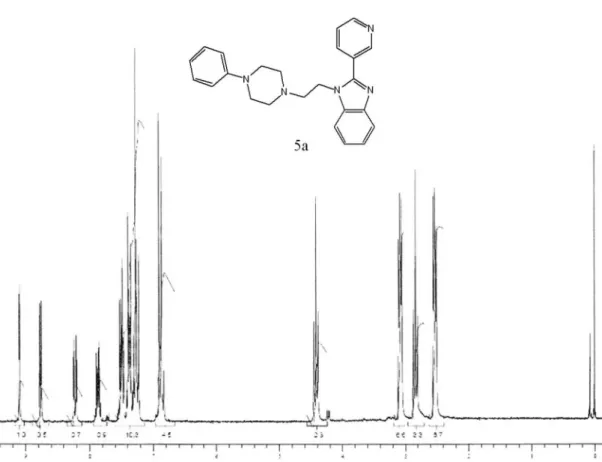
of 5a displayed the four characteristic high ield signals corresponding to the methylene protons of piperazine ring (d:3.10 and 2.50 ppm) and the linker chain (d:4.40 and
2.84 ppm), along with four aromatic doublets at low ield (d: 9.10, 8.78, 8.22 and 7.92 ppm ) typical of the pyridine ring attached to the 1H-benzimidazole system.
Scheme 3. A reasonable mechanistic proposal for the formation of chloroethyl arylpipera-zines 3e and 3b. N
N
R
3b': R= 2-F
3e': R= 3-OMe O S O O CH3 : N N R N N R Cl Cl 3
Scheme 4. Coupling of the benzimidazole moiety with substituted alkyl arylpiperazines. Reagents and conditions: a) 3-pyridincarboxaldehyde, ethanol, room temp., 48 h; b) 2-(4-phenylpiperazin-1-yl)alkl methanesulfonates or 1-(2-chloroethyl)-4-phenylpiperazines, acetonitrile, continuous stirring, RT, 12 h.
NH2 NH2 N H N N N NH2 N a o-Phenilenediamine N H H N N H 9 10 4 N N N (CH2)n N N R b 5 8
Table 1. Novel arylpiperazinil-benzimidazole derivatives obtained. Yields are expressed for pure products
N N N Linker N N X X R
Chemical Data for Compounds 5a-k
Entry Linker R X Formula Yield / %
In summary, a convenient method for the synthesis of 1-(2-(4-Arylpiperazin-1-yl)alkyl)-2-(pyridin-3-yl)-1H-benzimidazole derivatives has been provided. Further studies on the application will be reported in due course.
Experimental
All organic solvents used for the synthesis were of analytical grade. IR spectra were recorded on a Brucker Vector 22 spectrophotometer using KBr discs. 1H and 13C NMR spectra were obtained on Brucker APC-200
spectrometer using tetramethylsilane as internal reference. Column chromatography was performed on Merck silica gel 60 (70-230 mesh). Thin layer chromatography separations were performed on Merck Kiesselgel 60 (70-230 mesh). Elemental analyses were carried out on a FISONS EA 1108 CHNS-O analyzer.
Synthesis of arylpiperazinyl alcohols 2(a-k). General procedure
A mixture of the commercial 4-arylpiperazines (6 mmol) and bromoethanol (bromopropanol) (6 mmol) and triethylamine (6 mmol) was stirred for 24 h in acetone (30 mL) at room temperature. The precipitate was iltered off and the iltrate was extracted with ethyl acetate (3 × 50 mL), subsequently dried over anhydrous MgSO4 and evaporated under vacuum conditions. Column chromatography of the residue over silica gel (eluent EtOAc) afforded the corresponding alcohols. Spectral data for 2-(4-Arylpiperazin-1-yl) alcohols derivatives 2a-2c, 2e, 2g-2i and 2k were consistent with the assigned structures.10
2-[4-(4-Nitrophenyl)piperazin-1-yl]ethanol (2d)
Yellow oil (40%), IR νmax/cm-1: 3590 (OH), 1529
(NO2),1292 (NO2). 1H-NMR (CDCl
3) d 7.99 (d, 2H, J
8.1 Hz, H-3,5), 6.78 (d, 2H, J 8.9Hz, H-2,6), 3.63 (t, 2H,
J 9.8Hz, CH2-1), 3.57-2.89 (m, 5H, 2×CH2 pip., OH), 2.59-2.55 (m, 6H, 2×CH2 pip.,CH2-2). 13C-NMR (CDCl
3) d 154.7, 137.8, 2×25.8, 2 ×112.5, 59.6, 58.2, 2×52.5, 2 × 46.8. Anal. Calc. for C12H17N3O3: C, 57.36; H, 6.82; N, 16.72. Found: C, 57.70; H, 7.01; N, 16.66%.
2-(4-(Pyrazin-2-yl)piperazin-1-yl)ethanol (2f)
Yellow oil (44%), IR νmax/cm-1: 3644 (OH), 1348 (C-N); 1H-NMR (CDCl
3) d 8.39 (s, 1H, H-2), 7.97 (m, 1H, H-6),
7.49 (d, 1H, J 6.24Hz, H-5), 3.56-3.51 (m, 6H, 2×CH2 pip., CH2-1), 2.86 (1H, b.s., OH), 2.60-2.55 (m, 6H, 2×CH2 pip., CH2-2); 13C-NMR (CDCl
3) d 157.7, 130.9, 110, 65.1,
62.7, 57.8, 2×52.8, 2×46.6. Anal. Calc. for C10H16N4O: C, 57.67; H, 7.74; N, 26.90. Found: C, 57.55; H, 7.75; N, 26.82%.
3-[4-(4-Nitrophenyl)piperazin-1-yl]propan-1-ol (2j)
Yellow oil (54%), IR νmax/cm-1: 3630 (OH), 1527 (NO 2); 1H-NMR (CDCl
3) d 8.11 (d, 2H, J 11 Hz, H-3,5), 6.80
(d, 2H, J 9.4Hz, H-2,6), 3.87-3.84 (m, 3H, CH2-1, OH), 3.53-3.44 (m, 4H, 2 × CH2-pip.), 2.60 (m, 6H, 2×CH2-pip., CH2-3), 1.70 (m, 2H, CH2-2); 13C-NMR (CDCl
3) d154.7,
138.5, 2×125.9, 2×112.7, 58.3, 2×52.7, 52.4, 2×46.9, 28.7. Anal. Calc. for C13H19N3O3: C, 58.85; H, 7.22; N, 15.84; Found: C, 58.52; H, 7.34; N, 16.01%.
Synthesis of 2-(4-Arylpiperazinyl) alkyl methanesulphonate derivatives 3(a-k). General procedure
Alcohols 2a-k (2.4 mmol) were added to a solution of methanesulfonyl chloride (2.5 mmol) in dichloromethane (15 mL) and triethylamine (2.5 mmol) at 0 ºC. The mixture was maintained with stirring for 4 h and then concentrated in vacuo. Puriication of the crude by column chromatography CH2Cl2 / AcOEt (1:2) as the eluent, afforded the title compounds (3a-k) as yellow oils in moderated yields (35-50%).
2-(4-Phenylpiperazin-1-yl)ethyl methanesulphonate (3a)
(48%), IR νmax/cm-1: 1347(SO
2), 1172 (SO2);
1H-NMR
(CDCl3) d 7.30 (t, 2H, J 8.0 Hz, H-3, 5), 6.94 (m, 3H, H-2,4,6), 3.83 (t, 2H, J 7.0 Hz, CH2-1), 3.44-3.20 (m, 4H, 2×CH2 pip.), 2.98 (s, 3H, CH3), 2.89 (t, 2H, J 7.2 Hz, CH2 -2), 2.70 (t, 4H, J 5.1Hz, 2×CH2 pip.); 13C-NMR (CDCl
3) d
151.2, 2×129.3, 119.9, 2×116.1, 65.3, 59.8, 2×53.2, 2×49.4, 37.1. Anal. Calc.for C13H20N2O3S: C, 54.91; H, 7.09; N, 9.85. Found: C, 55.02; H, 7.11; N, 10.02%.
1-(2-Chloroethyl)-4-(2-luorophenyl)piperazine (3b’)
(35%), IR νmax/cm-1: 1007 (C-F), 728 (C-Cl); 1H-NMR
(CDCl3) d7.18-6.85 (m, 3H, H-3,4,5), 6.68-6.57 (m, 1H, H-6), 3.73 (t, 2H, J 13.5 Hz, CH2-1), 3.25 (t, 4H, J 9.5 Hz, 2×CH2 pip.), 2.89 (m, 6H, 2×CH2 pip.,CH2-2); 13C-NMR
(CDCl3) d 158.16 (d, 2C, JC-F 337 Hz), 151,78 , 124.6, 123.1, 122.9, 119.1, 116.4, 115.9, 59.5, 2×53.2, 2×49.7, 39.9. Anal. Calc. for C12H16ClFN2: C, 59.38; H, 6.64; N, 11.54. Found: C, 59.49; H, 6.67; N, 11.38%.
2-[4-(4-Chlorophenyl)piperazin-1-yl]ethyl methane-sulphonate (3c)
(38%), IR νmax/cm-1: 1349 (SO
2), 1173 (SO2), 933
(C-Cl); 1H-NMR (CDCl
3) d 7.30 (d, 2H, J 8.4 Hz, H-3,5),
Pessoa-Mahana et al. 67 Vol. 21, No. 1, 2010
3.52-3.37 (m, 4H, 2×CH2 pip.), 3.32-2.80 (m, 9H, 2×CH2 pip.,CH2-2, CH3); 13C-NMR (CDCl
3) d 149.3, 130.9,
2×129.4, 2×118.6, 66.2, 2×52.6, 2×49.7, 38.7, 29.7. Anal. Calc. for C13H19ClN2O3S: C, 48.97; H, 6.01; N, 8.79. Found: C, 49.05; H, 6.14; N, 8.72%.
2-[4-(4-Nitrophenyl)piperazin-1-yl]ethyl methane-sulphonate (3d)
(35%), IR νmax/cm-1: 1348 (SO
2), 1173 (SO2), 1529,1292
(NO2).; 1H-NMR (CDCl
3) d8.20 (d, 2H, J 7.9Hz, H-3,5),
6.90 (d, 2H, J 7.2 Hz, H-2,6), 3.81 (t, 2H, J 11.5Hz, CH2-1), 3.52-3.39 (m, 4H, 2×CH2 pip), 3.29-2.78 (m, 9H, 2xCH2 pip.,CH2-2, CH3); 13C-NMR (CDCl
3) d 153.8, 137.5,
2×125.8, 2×113.7, 63.4, 55.2, 2×52.6, 2×50.1, 37.9. Anal. Calc.for C13H19N3O5S: C, 47.41; H, 5.81; N, 12.76. Found: C, 47.12; H, 5.61; N, 12.59%.
1-(2-Chloroethyl)-4-(3-methoxyphenyl)piperazine (3e’)
(37%), IR νmax/cm-1: 2835 (CO-CH
3), 728 (C-Cl); 1H-NMR (CDCl
3) d7.22 (dd, 1H, J1 8.3 Hz, J2 2.6 Hz, H-5), 6.61-6.22 (m, 3H, H-4,5,6), 3.82-3.71 (m, 5H, CH2-2, OCH3), 3.60 (t, 2H, J 11.9 Hz, CH2-1), 3.38-3.20 (m, 4H, 2×CH2-pip.), 2.67 (t, 4H, J 10 Hz, 2×CH2-pip.);
13C-NMR (CDCl
3) d160.6, 152.5, 129.8, 108.9, 104.6,
102.6, 97.34, 59.7, 55.2, 2×53.1, 2×49.3, 37.9. Anal. Calc. for C14H19ClN2O: C, 61.29; H, 7.52; N, 11.00. Found: C, 60.94; H, 7.65; N, 11.32%.
2-(4-Pyrazin-2-yl-piperazin-1-yl)ethyl methanesulphonate (3f)
(37%), IR νmax/cm-1: 1347 (SO
2), 1171 (SO2);
1H-NMR
(CDCl3) d13C NMR (CDCl
3) d 8.35 (s, 1Η, Η-6), 8.08 (d,
1Η, J 8 Hz, Η-4), 6.44 (d, 1Η, J 8.5 Hz, Η-3), 4.26 (t, 2H,
J 11.0 Hz, CH2-1), 3.80 (m, 4H, 2 × CH2 pip), 3.03-2.86 (m, 5H, CH2-2, CH3), 2.63-2.48 (m, 4H, 2 × 2 × CH2 pip).
13C RMN (CDCL
3) d 162.3, 159.1, 156.5, 103.6, 53.6,
2×52.0, 2×49.8, 46.7, 42.1. Anal. Calc. for C11H18N4O3S: C, 46.14; H, 6.34; N, 19.57. Found: C, 45.94; H, 6.45; N, 19.82%.
3-[4-(3-Methoxyphenyl)piperazin-1-yl]propyl methane-sulphonate (3g)
(35%), IR νmax/cm-1: 1347 (SO
2), 1173 (SO2);
1H-NMR
(CDCl3) d 7.30 (t, 2H, J 8.4Hz, H-3,5), 6.96 (m, 3H, H-2,4,6), 4.31 (m, 2H, CH2-1), 3.2 (t, 4H, J 5 Hz, 2×CH2 -pip.), 2.90 (s, 3H, CH3), 2.63-2.43 (m, 6H, 2×CH2-pip., CH2-3), 2.10-1.90 (m, 2H, CH2-2); 13C-NMR (CDCl
3) d
160.6, 151.1, 129.5, 119.7, 116, 68.5, 55.0, 53.9, 2×53.1, 2×48.9, 37.8, 26.9. Anal. Calc. for C14H22N2O3S: C, 56.35; H, 7.43; N, 9.39; O. Found: C, 56.47; H, 7.76; N, 9.12%.
3-[4-(2-Fluorophenyl)piperazin-1-yl]propyl methane-sulphonate (3h)
(50%), IR νmax/cm-1: 1348 (SO
2), 1170 (SO2), 1010
(C-F); 1H-NMR (CDCl
3) d 7.28-6.87 (m, 4H, H-3,4,5,6),
3.82 (t, 2H, J 10.2 Hz, CH2-1), 3.47 (m, 4H, 2×CH2-pip.), 3.36-2.92 (m, 9H, 2×CH2-pip., CH2-3, CH3), 2.12-1.90 (m, 2H, CH2-2); 13C-NMR (CDCl
3) d158.10 (d, 2C, JC-F
318 Hz), 153.10, 137.5, 124.4, 118.9, 116.2, 115.9, 68.4, 62.4, 59.4, 53.9, 2×53.2, 2×45.5, 39.7, 26.7. Anal. Calc. for C14H21FN2O3S:C, 53.15; H, 6.69; N, 8.85. Found: C, 52.73; H, 6.66; N, 8.24%.
3-[4-(4-Chlorophenyl)piperazin-1-yl]propyl methane-sulphonate (3i)
(50%), IR νmax/cm-1: 1350 (SO
2), 1178 (SO2), 938 (C-Cl); 1H-NMR (CDCl
3) d 7.41 (d, 2H, J 12.3 Hz, H-3,5), 6.94 (d,
2H, J 8.8 Hz, H-2,6), 3.71 (t, 2H, J 5.8 Hz,CH2-1), 3.50 (m, 4H, 2×CH2-pip), 3.36-2.92 (m, 6H, 2×CH2-pip., CH2-3), 2.87 (s, 3H, CH3), 2.25-2.00 (m, 2H, CH2-2); 13C-NMR (CDCl
3) d
147.9, 2×129.4, 126.9, 2×118.5, 66.9, 2×52.1, 2×46.8, 41.6, 39.6, 26.5. Anal. Calc. for C14H21ClN2O3S: C, 50.52; H, 6.36; N, 8.42. Found C14H21ClN2O3S: C, 49.97; H, 6.72; N, 8.14%.
3-[4-(4-Nitrophenyl)piperazin-1-yl]propyl methane-sulphonate (3j)
(46%), IR νmax/cm-1: 1351 (SO
2), 1173 (SO2);
1H-NMR
(CDCl3) d8.11 (d, 2H, J 6.5 Hz, H-3,5), 6.80 (d, 2H, J 9.5 Hz, H-2,6), 4.28 (t, 2H, J 6.2 Hz, H-1), 3.65-3.43 (m, 4H, 2×CH2-pip), 3.32-2.92 (m, 6H, 2×CH2-pip., CH2-2), 2.88 (s, 3H, CH3), 2.26 (t, 2H, J 6.6 Hz, H-2); 13C-NMR (CDCl
3) d 150.8, 137.9, 2×125.9, 2×112.7, 68.12, 2×52.6, 2×46.9, 37.5, 29.7. Anal. Calc. for C14H21N3O5S: C, 48.97; H, 6.16; N, 12.24. Found: C, 49.14; H, 6.28; N, 12.09%.
3-[4-(3-Methoxyphenyl)piperazin-1-yl]propyl methane-sulphonate (3k)
(37%), IR νmax/cm-1: 1349 (SO
2), 1170 (SO2), 2835
(C-H); 1H-NMR (CDCl
3) d7.22 (dd, 1H, J1 8.2 Hz, J2 2.86 Hz, H-5), 6.61-6.21 (m, 3H, H-4,5,6), 4.30 (t, 2H, J 6.3 Hz, H-1), 3.82 (d, 3H, J 9.6 Hz, H-2), 3.75 (s, 3H, OCH3), 3.25 (t, 4H, J 9.8 Hz, 2×CH2-pip.), 2.9-2.5 (m, 6H, CH2-pip, CH2-3), 2.18 (t, 2H, J 6.7 Hz, H-2); 13C-NMR(CDCl
3) d
160.4, 148.2, 129.8, 108.9, 104.6, 102.6, 68.3, 55.2, 53.9, 2×53.1, 2×48.9, 37.3, 26.4. Anal. Calc. for C15H24N2O4S: C, 54.86; H, 7.37; N, 8.53. Found: C, 54.49; H, 7.65; N, 8.24%.
Synthesis of 1-[2-(4-Arylpiperazin-1-il)alkyl]-2-(pyridin-3-yl)-1H-benzimidazoles 5a-k. General procedures
for 2 hours. The benzimidazole anion afforded was added to a solution of the corresponding arylpiperazinyl alkyl methanesulphonate derivatives 3 (0.70 mmol) in acetonitrile (12 mL). The mixture was stirred at room temperature for 12 hours and concentrated in vacuo. Puriication of the crude by column chromatography with dichloromethane as the eluent afforded the target compounds 5a-k as yellow oils.
1-[2-(4-Phenylpiperazin-1-yl)ethyl]-2-pyridin-3-yl-1H-benzimidazole (5a)
(45%), IR νmax/cm-1: 2885 (C-H), 1338 (C-N). 1H-NMR
(CDCl3) d 9.10 (d, 1H, J 2.1 Hz, H-2 pyr.), 8.78 (d, 1H, J
4.9 Hz, H-4 pyr.), 8.22 (d, 1H, J 7.9 Hz, H-6 pyr.), 7.92 (d, 1H, J 8.5 Hz, H-5-pyr.), 7.53-7.14 (m, 6H, Ar), 6.85 (m, 3H, H-2,4,6), 4.40 (t, 2H, J 6.5 Hz, CH2-1), 3.10 (t, 4H, J
4.9 Hz, 2×CH2-pip.), 2.84 (t, 2H, J 6.5 Hz, CH2-2), 2.50 (t, 4H, J 5.1 Hz, 2×CH2 pip.). 13C-NMR (CDCL
3) d 151.3,
150.7, 149.9, 143.3, 137.2, 135.6, 2×129.1, 2×123.6, 123.4, 2×120.3, 119.9, 2×116.1, 110.2, 57.2, 2×53.6, 2×48.9, 42.9. Anal. Calc. for C24H25N5: C, 75.17; H, 6.57; N, 18.26. Found: C, 75.36; H, 6.42; N, 18.22%.
1-{2-[4-(2-Fluorophenyl)piperazin-1-yl]ethyl}-2-pyridin-3-yl-1H-benzimidazole (5b)
(21%), IR νmax/cm-1: 1321 (C-N), 1007 (C-F); 1H-NMR
(CDCl3) d9.10 (d, 1H, J 1.4Hz, H-2 pyr.), 8.78 (d, 1H, J
4.8 Hz, H-4 pyr.), 8.24 (d, 1H, J 7.9 Hz, H-6 pyr.), 7.92 (d, 1H, J 7.8 Hz, H-5-pyr.), 7.62-7.21 (m, 6H, Ar), 7.12-6.85 (m, 2H, H-4,6), 4.40 (t, 2H, J 6.5 Hz, CH2-1), 2.97 (t, 4H,
J 4.9 Hz, 2×CH2-pip.), 2.84 (t, 2H, J 6.5 Hz, CH2-2), 2.50 (m, 4H, J 4.9 Hz, 2×CH2 pip.). 13C-NMR (CDCl
3) d158.10
(d, 2C, JC-F 318 Hz), 153.10, 151.1, 150.7, 149.9, 143.2, 137.2, 135.6, 124.5, 124.4, 123.6, 123.4, 122.9, 122.7, 122.5, 120.2, 118.9, 116.3, 115.9, 110.2, 57.2, 2×53.7, 2×50.3. Anal. Calc. for C24H24FN5: C, 71.80; H, 6.03; N, 17.44. Found: C, 72.14; H, 6.14; N, 17.62%.
1-{2-[4-(4-Chlorophenyl)piperazin-1-yl]ethyl}-2-pyridin-3-yl-1H-benzimidazole(5c)
(35%), IR νmax/cm-1: 1317 (C-N), 933 (C-Cl); 1H-NMR
(CDCl3) d: 9.11 (d, 1H, J 2.1Hz, H-2 pyr.), 8.78 (d, 1H, J
4.9 Hz, H-4-pyr.), 8.25 (d, 1H, J 7.9 Hz, H-6 pyr.), 7.91 (d, 1H J 7.1 Hz, H-5-pyr.), 7.54-7.16 (m, 6H Ar) 7.11-6.87 (m, 2H, H-2,6) 4.41 (t, 2H, J 6.4 Hz, CH2-1), 3.10 (t, 4H, J 5 Hz, 2×CH2-pip.), 2.88 (t, 2H, J 12 Hz, CH2-2), 2.56 (t, 4H,
J 9.8 Hz, 2×CH2-pip.). 13C-NMR (CDCl
3) d 151.7, 150.8,
147.2, 137.2, 134.4, 132.5, 2×128.9, 124,4 123.6, 123.5, 123.4, 122.9, 120.3, 2×117.3, 110.2, 58.2, 57.1, 2×53.5, 2×48.9, 42.9. Anal. Calc. for C24H22ClN5:C, 68.97; H, 5.79; N, 16.76. Found: C, 69.02; H, 5.62; N, 17.00%.
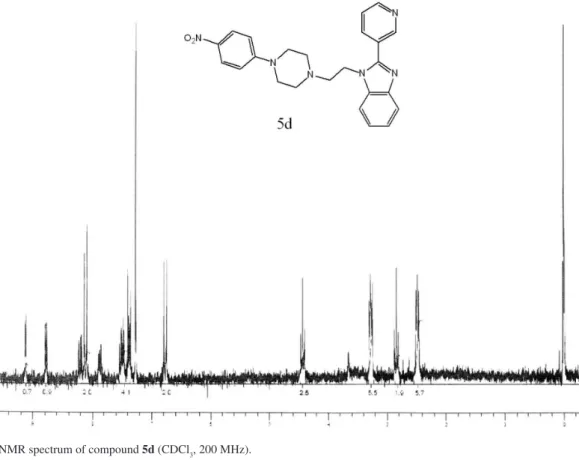
1-{2-[4-(4-Nitrophenyl)piperazin-1-yl]ethyl}-2-pyridin-3-yl-1H-benzimidazole(5d)
(46%), IR νmax/cm-1: 1529 (NO
2),1292 (NO2), 1324
(C-N); 1H-NMR(CDCl
3) d9.10 (d, 1H, J 1.5 Hz, H-2 pyr.),
8.78 (d, 1H, J 4.8 Hz, H-4 pyr.), 8.23 (m, 1H, H-6 pyr.), 8.12 (d, 1H, J 6.5 Hz, H-3,5), 7.91 (d, 1H J 7.1 Hz, H-5-pyr.), 7.69-7.36 (m, 5H, Ar), 6.89 (d, 2H, J 9.5 Hz, H-2,6), 4.40 (t, 2H, J 12.6 Hz, CH2-1), 3.15 (t, 4H, J 10.2 Hz, 2×CH2 -pip.), 2.85 (t, 2H, J 12.6 Hz, CH2-2), 2.50 (t, 4H, J 10.1 Hz, 2×CH2 pip.). 13C-NMR (CDCl
3) d154.6, 150.7, 149.9,
147.5, 137.2, 134.2, 130.8, 2×125.9, 124.7, 123.6, 123.4, 122.9, 120.4, 2×112.8, 110.1, 58.4, 57,3 2×53.1, 2×47.9, 39.8. Anal. Calc. for C24H24N6O2: C, 67.27; H, 5.65; N, 19.61. Found: C, 66.93; H, 5.42; N, 19.42%.
1-{2-[4-(3-Methoxyphenyl)piperazin-1-yl]ethyl}-2-pyridin-3-yl-1H-benzimidazole (5e)
(20%), IR νmax/cm-1: 2883 (C-H), 1313 (C-N); 1H-NMR
(CDCl3) d9.10 (d, 1H, J 2.1 Hz, H-2 pyr.), 8.78 (d, 1H, J
4.9 Hz, H-4 pyr.), 8.22 (d, 1H, J 7.9 Hz, H-6 pyr.), 7.92 (d, 1H J 7.1Hz, H-5-pyr.), 7.62-7.12 (m, 5H, Ar), 6.61-6.21 (m, 3H, H-4,5,6), 4.40 (t, 2H, J 6.6 Hz, CH2-1), 3.86 (s, 3H, OCH3), 3.15 (t, 4H, J 5.0 Hz, 2×CH2-pip.), 2.84 (t, 2H, J 13 Hz, CH2-2), 2.58 (t, 4H, J 5.1 Hz, 2×CH2 pip.). 13C-NMR
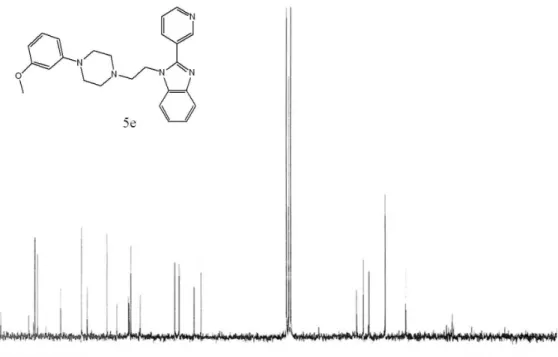
(CDCl3) d160.6, 152.4, 150.7, 149.9, 147.2, 143.2, 137.2, 135.6, 129.8, 127.3, 123.6, 123.4, 122.9, 120.3, 110.2, 108.9, 104.5, 102.6, 57.2, 55.2, 2×53.6, 2×48.9, 42.9. Anal. Calc. for C25H27N5O: C, 72.61; H, 6.58; N, 16.94. Found: C, 72.76; H, 6.23; N, 16.82%.
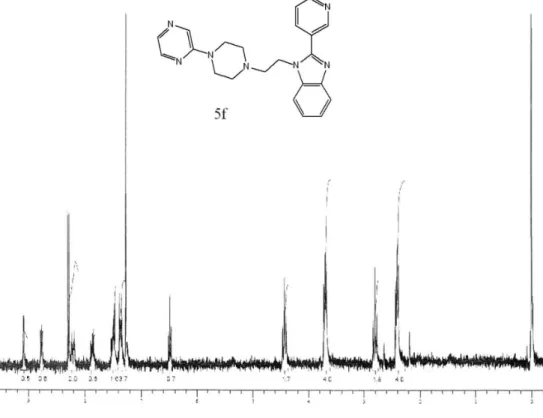
1-(2-(4-(Pyrazin-2-yl)piperazin-1-yl)ethyl)-2-(pyridin-3-yl)-1H-benzo[d]imidazole (5f)
(38%), IR νmax/cm-1: 2856 (C-H), 1311 (C-N); 1H-NMR
(CDCl3) d 9.10 (d, 1H, J 2.1 Hz, H-2 pyr.), 8.78 (d, 1H, J
4.8 Hz, H-4 pyr.), 8.36-8.21 (m, 2H, H-2 pyr., H-6 pyr.), 7.91 (d, 1H, J 9.0 Hz, H-5-pyr.), 7.76-7.31 (m, 5H, Ar), 6.50 (t, 1H, J 4.1 Hz, H-6), 4.42 (t, 2H, J 6.6 Hz, CH2-1), 3.17 (t, 4H, J 4.9 Hz, 2×CH2-pip.), 2.83 (t, 2H, J 6.4 Hz, CH2-2), 2.49 (t, 4H, J 5 Hz, 2×CH2 pip.). 13C-NMR (CDCl
3) d 162.3, 157.7, 156.2, 150.7, 149.9, 147.5, 143.3, 137.1, 135.6, 129.8, 127.5, 123.4, 122.9, 120.3, 110.7, 110.0, 57.3, 2×53.4, 2×48.4, 42.8. Anal. Calc. for C22H23N7: C, 68.55; H, 6.01; N, 25.44. Found: C, 68.36; H, 6.26; N, 25.23%.
1-[3-(4-Phenylpiperazin-1-yl)propyl]-2-pyridin-3-yl-1H-benzimidazole (5g)
(48%), IR νmax/cm-1: 2875 (C-H), 1306 (C-N); 1H-NMR
(CDCl3) d 9.10 (d, 1H, J 2.2 Hz, H-2 pyr.), 8.78 (d, 1H,
Pessoa-Mahana et al. 69 Vol. 21, No. 1, 2010
(m, 3H, H-2,4,6), 4.40 (t, 2H, J 7.8 Hz, CH2-1), 3.16 (t, 4H, J 9.8 Hz, 2×CH2-pip.), 2.50 (t, 4H, J 9.9 Hz, 2×CH2 pip.), 2.37 (t, 2H, J 6.6 Hz, CH2-3), 1.91 (m, 2H, CH2-2).
13C-NMR (CDCl
3) d 151.1, 150.7, 150.4, 149.7, 147.6,
143.1, 136.9, 135.7, 134.4, 2×129.4, 127.6, 123.6, 123.1, 122.9, 120.1, 119.8, 2×116.1, 54.6, 2×53.1, 2×49,7, 29.8. Anal. Calc. for C25H27N5: C, 75.54; H, 6.85; N, 17.62. Found: C, 75.31; H, 6.90; N, 17.79%.
1-{3-[4-(2-Fluorophenyl)piperazin-1-yl]propyl}-2-pyridin-3-yl-1H-benzimidazole (5h)
(28%), IR νmax/cm-1: 1225 (C-N), 1007 (C-F); 1H-NMR(CDCl
3) d 9.10 (d, 1H, J 3Hz, H-2 pyr.), 8.80 (d,
1H, J 6.6 Hz, H-4 pyr.), 8.23 (d, 1H, J 7.9 Hz, H-6 pyr.), 7.91 (d, 1H, J 5.3 Hz, H-5-pyr.), 7.61-7.21 (m, 6H, Ar), 7.12-6.86 (m, 2H, Ar), 4.41 (t, 2H, J 7.1 Hz, H CH2-1), 3.20 (t, 4H, J 4.5 Hz, CH2-2×CH2-pip.), 2.50 (t, 4H, J 4.9 Hz, 2×CH2 pip.), 2.36 (t, 2H, J 6.7 Hz, CH2-3), 1.97 (t, 2H, J
13.8 Hz, CH2-2). 13C-NMR (CDCl
3) d158.10 (d, 2C, JC-F
318 Hz), 153.10, 150.7, 147.4, 143.1, 139.1, 136.9, 135.7, 134.4, 127.1, 124.5, 123.9, 123.3, 122.9, 120.1, 118.9, 116.3, 116.9, 115.9, 110.4, 54.7, 2×53.2, 2×50,4, 50.4, 29.9. Anal. Calc. for C25H26FN5: C, 72.27; H, 6.31; N, 16.85. Found: C, 71.99; H, 6.67; N, 16.49%.
1-{3-[4-(4-Chlorophenyl)piperazin-1-yl]propyl}-2-pyridin-3-yl-1H-benzimidazole (5i)
(38%), IR νmax/cm-1: 1227 (C-N), 933 (C-Cl); 1H-NMR
(CDCl3) d 9.10 (d, 1H, J 2.5 Hz, H-2 pyr.), 8.78 (d, 1H,
J 4.8 Hz, H-4 pyr.), 8.22 (d,1H, J 8.0 Hz, H-6 pyr.), 7.90 (d, 1H J 7.4 Hz, H-5-pyr.), 7.52-7.14 (m, 6H, Ar), 7.11-6.87 (m, 2H, H-2,6), 4.41 (m, 2H, H CH2-1), 3.15 (m, 4H, CH2-2×CH2-pip.), 2.48 (m, 4H, 2×CH2 pip.), 2.32 (m, 2H, CH2-3), 2.0 (m, 2H, CH2-2). 13C-NMR (CDCl
3) d 151.6,
150.8, 147.3, 137.1, 134.5, 132.7, 2×129.0, 127.5, 124,2 123.6, 123.5, 123.3, 122.9, 120.3, 2x118.3, 110.2, 58.4, 57.1, 2×53.7, 2×49.1, 29.7. Anal. Calc. for:C25H26ClN5: C, 69.51; H, 6.07; N, 16.21. Found: C, 69.27; H, 6.14; N,15.99%.
1-{3-[4-(4-Nitrophenyl)piperazin-1-yl]propyl}-2-pyridin-3-yl-1H-benzimidazole (5j)
(24%), IR νmax/cm-1: 1530 (NO
2), 1296 (NO2).
1H-NMR
(CDCl3) d 9.10 (d, 1H, J 1.5 Hz, d, H-2 pyr.), 8.78 (d, 1H,
J 4.9 Hz, H-4 pyr.), 8.22 (m, 1H, H-6 pyr.), 8.13 (d, 1H, J
6.7 Hz, H-3,5), 7.90 (d, 1H, J 6.9 Hz, H-5-pyr.), 7.68-7.36 (m, 5H, Ar), 6.89 (d, 2H, J 9.4 Hz, H-2,6), 4.40 (t, 2H, J
7.1 Hz, CH2-1), 3.23 (t, 4H, J 5.0 Hz, 2×CH2-pip.), 2.48 (t, 4H, J 5.2 Hz, 2×CH2 pip.), 2.35 (t, 2H, J 6.3 Hz, CH2-3), 2.10 (bs, 2H, J 6.8 Hz, CH2-2). 13C-NMR (CDCl
3) d154.6,
150.7, 149.9, 147.5, 137.2, 136.7, 134.2, 130.8, 2×125.9,
124.7, 123.6, 123.4, 122.9, 120.4, 2×112.8, 110.1, 58.4, 57,3 2×53.1, 2×47.9, 22.8. Anal. Calc. for C25H26N6O2: C, 67.86; H, 5.92; N, 18.99. Found: C, 68.14; H, 5.69; N, 19.23% .
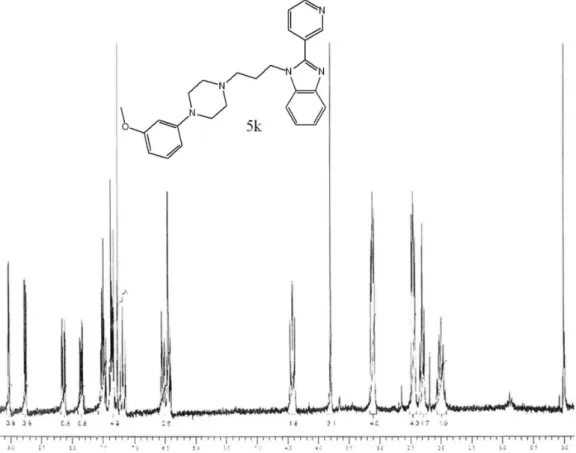
1-{3-[4-(3-Methoxyphenyl)piperazin-1-yl]propyl}-2-pyridin-3-yl-1H-benzimidazole (5k)
(33%), IR νmax/cm-1: 2835 (C-H), 1315 (C-N); 1H-NMR
(CDCl3) d 9.10 (d, 1H, J 2.19 Hz, H-2 pyr.), 8.78 (d, 1H, J
4.9 Hz, H-4 pyr.), 8.21 (d, 1H, J 7.9 Hz, H-6 pyr.), 7.91 (d, 1H, J 5.5 Hz, H-5-pyr.), 7.63-7.13 (m, 5H, Ar), 6.61-6.24 (m, 3H, H-4,5,6), 4.40 (t, 2H, J 7.3 Hz, H CH2-1), 3.86 (s, 3H, OCH3), 3.17 (t, 4H, J 5.0 Hz, 2×CH2-pip.), 2.50 (t, 4H,
J 5 Hz, 2×CH2 pip.), 2.36 (t, 2H, J 6.5 Hz, CH2-3), 2.0 (b.s., 2H, J 13.8 Hz, CH2-2). 13C-NMR (CDCl
3) d160.8, 152.3,
150.7, 150.0, 147.2, 143.3, 137.1, 136.6, 135.6, 129.8, 127.3, 123.6, 123.3, 122.9, 120.3, 110.4, 109.0, 104.6, 102.6, 57.3, 55.2, 2×53.6, 2×48.9, 22.9. Anal. Calc. for C26H29N5O: C, 73.04; H, 6.84; N, 16.38. Found: C, 72.89; H, 6.98; N, 16.78%.
Acknowledgments
This work was supported by VRAID (grant No. 01/2008).
Supplementary Information
Supplementary data are available free of charge at http:// jbcs.sbq.org.br, as PDF ile.
References
1. Basavapathruni, A.; Anderson, K. S.; Curr. Pharm. Des. 2006,
12, 1857.
2. De Clercq, E.; Expert Opin. Emerg. Drug. 2005, 10, 241. 3. Persaud, D.; Gallant, J. E.; Hopkins HIV Rep. 2004, 16, 5. 4. Romero, D. L.; Morge, R. A.; Biles, C.; Berrios-Pena, N.;
May, P. D.; Palmer, J. R.; Johnson, P. D.; Smith, H. W.; Busso, M.; Cheng-Keat, T.; Voorman, R. L.; Reusser, F.; Althaus, I. W.; Downey, K. M.; So, A. G.; Resnick, L.; Tarpley, W. G.; Aristoff, P. A.; J. Med. Chem. 1994, 37, 999. 5. Hajos, G.; Riedl, Z.; Molnar, J.; Szabo, D.; Drugs of the Future
2000, 25, 47.
6. Esnouf, R. M.; Ren, J.; Hopkins, A. L.; Ross, C. K.; Jones, E. Y.; Stammers, D. K.; Stuart, D. I.; Proc. Natl. Acad. Sci. U. S. A. 1997, 94, 3984.
8. Pinna, G.; Loriga, G.; Murineddu, G.; Grella, G.; Mura, M.; Vargiu, L.; Murgioni, C.; La Colla, P.; Chem. Pharm. Bull. 2001,
40, 1406.
9. Valderrama, J. A.; Pessoa-Mahana, H.; Sarrás, G.; Tapia, R.;
Heterocycles 2001, 51, 2193.
10. (Comp. 2a) Hudkins, R. L.; Mailman, R. B.; DeHaven-Hudkins, D. L.; J. Med. Chem.1996, 37, 1964; (Comp. 2b) Konkel, M.; Wetzel, J. M.; Noble, S.; Gluchowski, C.; Craig, D. A.; PCT
Int. Appl. 972000, CODEN: PIXXD2 WO 2000004012 A1
20000127; (Comp. 2c) Pollard, C. B.; Wicker, T. H., Jr.; J. Am.
Chem. Soc. 1954, 76, 1853; (Comp. 2h) Kanno, T.; Gaino, M.;
Yamamura, M.; Ishida, R.; Shintomi, K.; Eur. Pat. Appl.89
1981, CODEN: EPXXDW EP 34284 A2 19810826; (Comps. 2g, 2i, 2k) Felfoldi, K.; Molnar, A.; Apjok, J.; Czombos, J.; Notheisz, F.; Karpati, E.; Acta Physica et Chemica 1982, 28, 225.
Received: February 5, 2009
Su
pp
le
m
enta
ry
Inf
or
m
ati
on
J. Braz. Chem. Soc., Vol. 21, No. 1, S1-S9, 2010. Printed in Brazil - ©2010 Sociedade Brasileira de Química 0103 - 5053 $6.00+0.00
*e-mail: [email protected]
Synthesis of a Novel Series of 4-Arylpiperazinyl Derivatives Linked to a
2-(Pyridin-3-yl)-1
H
-benzimidazole as New Delavirdine Analogues
David Pessoa-Mahana,*,a Andrés Núñez,a Christian Espinosa,a Jaime Mella-Raipána
and Hernán Pessoa-Mahanab
aDepartamento de Farmacia, Facultad de Química, Pontiicia Universidad Católica de Chile,
Casilla 306, Santiago 22, Chile
bDepartamento de Química Orgánica y Físico-Química, Facultad de Ciencias Químicas y
Farmacéuticas, Universidad de Chile, Casilla 233, Santiago 1, Chile
Figure S1. 1H NMR spectrum of compound 5a (CDCl
Figure S2. 1H NMR spectrum of compound 5b (CDCl
3, 200 MHz).
Figure S3. 1H NMR spectrum of compound 5c (CDCl
Pessoa-Mahana et al. S3 Vol. 21, No. 1, 2010
Figure S4. 1H NMR spectrum of compound 5d (CDCl
3, 200 MHz).
Figure S5. 1H NMR spectrum of compound 5e (CDCl
Figure S6. 1H NMR spectrum of compound 5f (CDCl
3, 200 MHz).
Figure S7. 1H NMR spectrum of compound 5g (CDCl
Pessoa-Mahana et al. S5 Vol. 21, No. 1, 2010
Figure S9. 1H NMR spectrum of compound 5j (CDCl
3, 200 MHz).
Figure S8. 1H NMR spectrum of compound 5h (CDCl
Figure S10. 1H NMR spectrum of compound 5k (CDCl
3, 200 MHz).
Figure S11. 13C NMR spectrum of compound 5a (CDCl
Pessoa-Mahana et al. S7 Vol. 21, No. 1, 2010
Figure S13. 13C NMR spectrum of compound 5f (CDCl
3, 50 MHz).
Figure S12. 13C NMR spectrum of compound 5e (CDCl
Figure S14. 13C NMR spectrum of compound 5g (CDCl
3, 50 MHz).
Figure S15. 13C NMR spectrum of compound 5h (CDCl
Pessoa-Mahana et al. S9 Vol. 21, No. 1, 2010
Figure S16. 13C NMR spectrum of compound 5j (CDCl