ABSTRACT
BRAFmutation has recently emerged as a potential prognostic marker for papillary thyroid carcinoma (PTC) due to several studies suggesting that it may condition the development of tumors with aggressive behavior. A study of the phenotypes of thy-roid follicular cell lines and transgenic mice characterized by targeted expression of BRAFmutation indicates that, at variance with RET/PTCrearrangement, it induces or facilitates genomic instability and higher invasiveness and eventually deeper tumor de-differentiation and more significant suppression of apoptosis. An analysis of dif-ferential gene expression of PTCs harboring BRAFmutation versus PTCs character-ized by other genetic alterations shows an important impairment of the expression of genes related to intra-thyroidal iodine metabolism machinery, up-regulation of Glut-1 mRNA, methylation-induced gene silencing of tumor suppressor genes and up-reg-ulation of pro-angiogenetic proteins such as VEGF. Correlation of BRAFmutation with PTC clinico-pathological features yields controversial results, with several stud-ies showing the association with unfavourable clinico-pathological qualitstud-ies, while others do not confirm the findings. This review will summarize the studies in favor of or in contrast with a role of BRAFmutation as a prognostic marker in PTC. We will also indicate what information we still need in order to routinely introduce this indi-cator in clinical practice. (Arq Bras Endocrinol Metab 2007;51/5:736-747)
Keywords: BRAFmutation; Papillary thyroid carcinoma; Prognostic stratification; Prognostic marker; Iodine metabolism; 131I ablative treatment
RESUMO
Prognóstico Clínico no CPT com Mutações BRAF.
Mutações no BRAFsurgiram recentemente como potenciais marcadores prognós-ticos do carcinoma papílifero de tiróide (CPT) graças a vários estudos que su-gerem que ele possa condicionar o desenvolvimento de tumores com comporta-mento agressivo. Um estudo do fenótipo das células de linhagem folicular de tiróide em camundongos transgênicos caracterizados pela expressão direcionada de mutações BRAF, indicam, à semelhança dos rearranjos RET/PTC, que ele induz ou facilita a instabilidade genômica, a alta invasividade e, por fim, uma profunda desdiferenciação tumoral com supressão mais significativa da apoptose. Uma análise da expressão gênica diferencial do CPT associado com mutações BRAF versus o CPT caracterizado por outras alterações gênicas mostra uma redução importante da expressão dos genes relacionados com a maquinaria do metabo-lismo do iodo intratiroideano, aumento da regulação do mRNA do Glut-1, silenci-amento gênico induzido por metilação dos genes supressores tumorais e aumen-to da regulação das proteínas pró-angiogênicas, como a VEGF. A correlação da mutação BRAFcom os achados clínico-patológicos do CPT mostra resultados con-troversos, com vários estudos indicando associação com parâmetros clínico-patológicos desfavoráveis e outros não confirmando esses achados. Esta revisão sumariza os estudos a favor ou não do papel da mutação BRAFcomo um mar-cador prognóstico no CPT. Indicaremos, também, quais informações são ainda necessárias para a introdução rotineira deste indicador na prática clínica. (Arq Bras Endocrinol Metab 2007;51/5:736-747)
Descritores: Mutação BRAF; Carcinoma papilífero de tireóide; Estratificação prognóstica; Marcador prognóstico; Metabolismo de iodo; Terapia ablativa com 131I
revisão
EFISIOPUXEDDU SONIAMORETTI
Department of Internal Medicine and Center for Thyroid Proteomic and Genomic
Research (EP, SM), University of Perugia; Regional Oncology Referral Center (EP), “Santa Maria della Misericordia”
Hospital, Perugia, Italy.
T
HYROID CANCER IS THEmost common malignancy of the endocrine system, representing approxi-mately 1% of all malignancies in Western countries (1). Among human cancers, which combined together have shown a decrease in incidence over the last few years, thyroid cancer has the most rapidly increasing incidence rates in women, and the second most rapid in men, with an annual percentage change of approxi-mately 5%, making it the sixth most common cancer in women, similar to melanoma of the skin or ovarian cancer (2). Papillary thyroid carcinoma (PTC) is the most frequent thyroid cancer histotype, accounting alone for more than 80% of malignant neoplasms of the gland (1).The overall survival rate at 10 years for PTC patients is very good, exceeding 90–95% (3). Howev-er, 5–20% of patients will experience local or regional recurrences, and up to 10% will have distant metastases (3). Ultimately, some patients diagnosed at late stage and presenting with advanced disease are not curable. Indeed, effective therapies for patients with invasive or metastatic thyroid cancer, if the disease is not surgical-ly resectable and does not concentrate radio-iodine, are still lacking (1).
In order to optimize management of affected patients, either as to extent of initial treatment or as to intensity of follow-up, a preliminary prognostic strati-fication is very useful. Until now, the prognostic indi-cators of recurrent disease and of death were the patient’s age at diagnosis, the histologic features and extent of the tumor and the completeness of initial treatment (4-11).
Based on these clinical parameters, several stag-ing systems for thyroid carcinoma were developed, among which the tumor-node-metastasis (TNM) sys-tem is the most widely used (12). The TNM syssys-tems allow us to stratify patients fairly well for the risk of death, but are less powerful to assess the risk of recur-rence. Indeed, the latter does not depend only on tumor extent and on a rough age subdivision (more or less 45 years), but also on additional predisposing fac-tors such as very young age (< than 16 years) (13,14), some histological variants (such as the tall- or colum-nar-cell variants, the diffuse sclerosing variant, or poorly differentiated carcinomas) (15-17), clear signs of vascular invasion, incomplete surgery or lack of radioiodine uptake (18-24).
All these clinical and pathological factors are well-recognized risk factors for tumor recurrences in PTC cohorts. However, they are not precise as regards an individual patient’s likelihood of tumor recurrence. Moreover, complete risk evaluation based on current
pathological and clinical criteria is not possible until the initial treatment (surgery plus eventual 131I
abla-tion) has been performed and the complete character-istics of the tumor become known.
Thus, in order to improve clinical management of PTC patients additional prognostic indicators are needed. Ideally, they should aid in increasing the cer-tainty of the recurrence risk of each PTC patient and should allow an efficient stratification of the risk before initial treatment. These indicators should also guide the extent of the first surgery, the strength of addi-tional treatments (131I ablation and TSH suppression)
and the intensity of follow-up.
A major effort to improve the panel of thyroid cancer prognostic indicators has entailed the use of mol-ecular profiling to characterize tumors (25). Such mole-cular studies of thyroid tumors began with single or rel-atively small groups of potentially prognostic markers and have progressed to micro-array analyses of thou-sands of genes in large numbers of tissue samples (25).
At the present time, one of the most promising achievements in this field is the recognition of BRAF
mutation as a potential prognostic marker for PTC (26). This review will focus on the clinical prognosis
of BRAF-mutated PTC, summarizing the recent
advances regarding the definition of the prognostic role of BRAFmutation in papillary thyroid carcinoma.
BRAF MUTATIONS IN PTC
RAF is a serine/threonine kinase, which, after activa-tion by RAS-GTP, triggers sequential phosphorylaactiva-tion and activation of MEK and ERK (27). Three func-tional RAF isoforms have been described in humans, A-RAF, B-RAF or BRAF and C-RAF (also termed c-Raf-1). Among these, BRAF, with its gene located on chromosome 7, is the most potent activator of the MAPK pathway (28). Very recently, larscale
ge-nomic screens have detected mutations of BRAF in
66% of malignant melanomas and at a lower frequen-cy in colorectal and ovarian cancers (29).
The importance of BRAFmutation also in thy-roid cancer was revealed by several studies, which showed the frequent occurrence of this genetic alter-ation in PTC, with a prevalence ranging from 29 to 83% (mean 44%) (26). A unique somatic T1799A transversion in exon 15, resulting in a V600E amino acid substitution (BRAFV600E), has been detected in
found in one follicular variant of PTC (31), a deletion of 3 nucleotides between codons 600 and 601 result-ing in the VK600-1E mutation found in 3 PTC metastatic lymph-nodes (32) and a solid variant of PTC (33), an insertion of 3 nucleotides at position 599 resulting in the V599Ins mutation, detected in a classic variant of PTC (34), and a gene rearrangement
AKAP9-BRAF described in 4 radiation-associated PTCs (35). All these mutations have been shown, or are thought, to destabilize BRAF kinase inactive con-formation and to induce an oncogenic constitutive activation of the enzyme (35-37).
BRAF mutations occur more frequently than
other known PTC genetic alterations such as RET
(8–33% of PTC) and NTRK1rearrangements (5–15% of
PTC) and RASpoint mutations (0–21% of PTC) (26).
Interestingly, when these mutations have been simulta-neously searched for, they have been shown to be mutu-ally exclusive, accounting together for an initiating genetic event in about 70% of PTCs (34,38-40). These data, indicating self-sufficiency of each genetic alteration in follicular cell transformation, represent genetic evi-dence for the constitutive activation of the RET/PTC-RAS-BRAF signaling pathway in PTC (38) and for a key role of the MAP kinase cascade activation in the trans-formation of thyroid follicular cells, as confirmed by in vitrostudies on thyroid cell lines (41,42).
The demonstration that thyroid-targeted BRAFV600E transgenic mice develop thyroid tumors
with PTC features (43) and the frequent detection of
BRAF mutations in papillary microcarcinomas
(20–52%) (30,44-47), thought to be early precursors of PTC, have been interpreted as evidence for an ini-tiator role of BRAFmutations in PTC.
BRAFmutations are present not only in PTC,
but to a smaller extent also in poorly differentiated and anaplastic thyroid carcinoma, especially when a well-differentiated PTC component containing the same mutation is detectable (44,48-52).
In conclusion, BRAFmutation appears to play a very prominent role in PTC tumor genesis. This per-ception prompted numerous studies aimed at
disclos-ing the phenotype induced by BRAFmutation in
roid follicular cells and more generally in papillary thy-roid carcinomas.
IN VITROSTUDIES ON THE BIOLOGICAL EFFECTS OF BRAF CONSTITUTIVE ACTIVATION IN THE THYROID
The study of the biological effects elicited by BRAF constitutive activation in the thyroid was approached
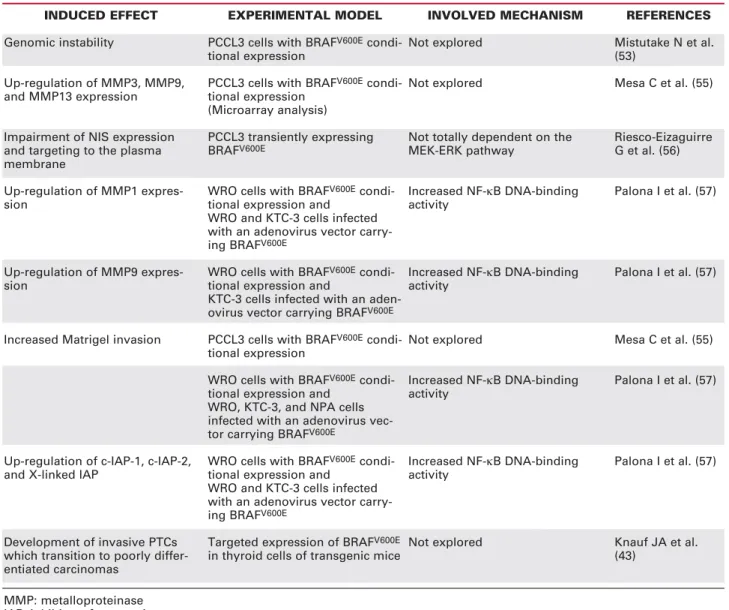
in two ways: either by studying the phenotypic and genomic changes induced by the expression of BRAFV600Ein thyroid cell lines and in the thyroids of
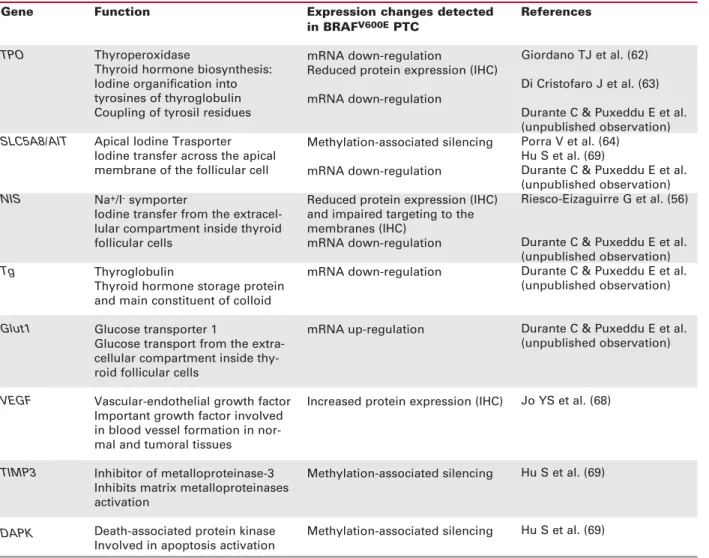
transgenic mice (table 1), or by analyzing differential gene expression in human PTC samples characterized
by BRAF mutation versus normal thyroid tissue or
PTC samples harboring different genetic alterations (table 2).
Conditional expression of BRAFV600E in the
well-differentiated rat thyroid cell line PCCL3 was shown to induce de-differentiation and to confer little growth advantage because of concomitant activation of DNA synthesis and apoptosis (53). Interestingly, these effects were similar to those elicited by the induction of RET/PTC expression in the same cell
model (54). However, BRAFV600E, in contrast to
RET/PTC, was also shown to facilitate the acquisition of secondary genetic events through induction of genomic instability (53). Similarly, comparison of the expression profiles of PCCL3 cells characterized by
the conditional expression of BRAFV600E, RET/
PTC3, or RET/PTC3 with small interfering RNA-mediated knockdown of BRAF, showed the existence of a gene cluster commonly regulated by RET/PTC3 and BRAFV600Eand two gene clusters specifically
acti-vated by each of the two oncoproteins (55). BRAF-induced gene cluster included matrix metallopro-teinase 3 (MMP3), MMP9 and MMP13. Accordingly,
conditional expression of BRAFV600E was associated
with markedly increased invasion into Matrigel, while conditional expression of RET/PTC did not activate this phenomenon (55). Very recently, the transient
expression of BRAFV600E in PCCL3 cells was also
shown to sharply impair both Na+/I-symporter (NIS)
expression and targeting to the plasma membrane, indicating loss of differentiation and predicting deficit of NIS-mediated 131I uptake (56). Interestingly, this
impairment was not totally dependent on the
MEK-ERK pathway. Finally, acute BRAFV600E
over-expres-sion in thyroid cancer cells was shown to increase
nuclear factor κB (NF-κB) DNA-binding activity,
resulting in up-regulation of anti-apoptotic proteins c-IAP-1, c-IAP-2, and X-linked inhibitor of apoptosis, up-regulation of MMP1 and MMP9 and cell invasion into Matrigel (57). In summary, these data indicate
that the expression of BRAFmutation compared with
the development of invasive PTCs, which transitioned to poorly differentiated carcinomas (43), while RET/PTC1 and RET/PTC3 thyroid-targeted trans-genic mice developed only differentiated tumors which did not show loss of differentiation unless crossed with p53-/-animals (58-61).
Microarray studies conducted on human PTC
samples, genotyped for BRAFV600E point mutation,
RET/PTC1and RET/PTC3rearrangement and point
mutations of KRAS, HRAS and NRAS allowed
detection of distinct expression profiles for the BRAF,
RET/PTCand RASgene mutation groups (62). Dif-ferences were so specific that by using the 20 most sig-nificantly regulated genes in each subset, these simple
classifiers were able to classify correctly the mutational status of all the tumors. These findings clearly indicate that mutational status is the principal determinant of gene expression variation within these tumors, pre-dicting differences in phenotype and therapy-respon-siveness between PTC genetic subsets. Accordingly, this study allowed the detection of a significant reduc-tion of the TPOgene expression specifically in PTCs
harboring the BRAF mutation, which was also
con-firmed at the protein level by immunohistochemistry. A similar result was also reported by another group
that confirmed lower total TPO mRNA expression in
PTCs bearing BRAFmutations in contrast with those
not characterized by the genetic alteration, although
MMP: metalloproteinase IAP: inhibitor of apoptosis
INDUCED EFFECT Genomic instability
Up-regulation of MMP3, MMP9, and MMP13 expression
Impairment of NIS expression and targeting to the plasma membrane
Up-regulation of MMP1 expres-sion
Up-regulation of MMP9 expres-sion
Increased Matrigel invasion
Up-regulation of c-IAP-1, c-IAP-2, and X-linked IAP
Development of invasive PTCs which transition to poorly differ-entiated carcinomas
EXPERIMENTAL MODEL PCCL3 cells with BRAFV600E condi-tional expression
PCCL3 cells with BRAFV600E condi-tional expression
(Microarray analysis)
PCCL3 transiently expressing BRAFV600E
WRO cells with BRAFV600E condi-tional expression and
WRO and KTC-3 cells infected with an adenovirus vector carry-ing BRAFV600E
WRO cells with BRAFV600E condi-tional expression and
KTC-3 cells infected with an aden-ovirus vector carrying BRAFV600E
PCCL3 cells with BRAFV600E condi-tional expression
WRO cells with BRAFV600E condi-tional expression and
WRO, KTC-3, and NPA cells infected with an adenovirus vec-tor carrying BRAFV600E
WRO cells with BRAFV600E condi-tional expression and
WRO and KTC-3 cells infected with an adenovirus vector carry-ing BRAFV600E
Targeted expression of BRAFV600E in thyroid cells of transgenic mice
INVOLVED MECHANISM Not explored
Not explored
Not totally dependent on the MEK-ERK pathway
Increased NF-κB DNA-binding activity
Increased NF-κB DNA-binding activity
Not explored
Increased NF-κB DNA-binding activity
Increased NF-κB DNA-binding activity
Not explored
REFERENCES Mistutake N et al. (53)
Mesa C et al. (55)
Riesco-Eizaguirre G et al. (56)
Palona I et al. (57)
Palona I et al. (57)
Mesa C et al. (55)
Palona I et al. (57)
Palona I et al. (57)
Knauf JA et al. (43)
in this case the difference was not statistically signifi-cant (63). Because thyroperoxidase plays a pivotal role in iodine organification during thyroid hormone syn-thesis, these results suggest that BRAFmutant tumors should display a lower iodine retention capacity.
Similarly, another study showed a statistically significant relationship between the
methylation-asso-ciated silencing of the SLC5A8 gene, coding for an
apical iodine transporter (AIT), important to ensure a passive transfer of the halogen across the apical mem-brane of the follicular cell, and the T1799A point
mutation of the BRAF gene in conventional PTCs
(64). Moreover, a recent immunohistochemical study reported a significantly low NIS expression and
impaired targeting to the membranes in BRAF
muta-tion-positive samples (56). Because NIS plays a pivotal role in thyroid iodine uptake, this finding suggests impairment of iodine transport from the extra-cellular
compartment to the cytoplasm of the follicular cell in
BRAFmutant tumors.
Very recently, our group examined the expres-sion of a panel of thyroid differentiation markers, including NIS, AIT-B, thyroglobulin (Tg), TPO, TSH receptor (TSH-R), the transcription factor PAX8, and glucose transporter type 1 (Glut1), in 38
PTCs harboring BRAF mutation, and 28 PTCs with
wild-type BRAF(Durante C, Puxeddu E, Filetti S and Russo D, unpublished observation). Whereas mRNA levels of all thyroid-specific genes examined, except TSH-R, were reduced in PTCs versus normal thyroid tissues, BRAFmutation-positive tumors presented sig-nificantly lower mRNA expression levels of NIS,
AIT-B, Tg, and TPO than BRAF-wild type ones. On the
contrary, the two groups presented similar levels of TSH-R and PAX8 mRNA expression. Moreover, Glut-1 transcript levels were increased in all PTCs, and
IHC: Immunohistochemistry.
Table 2.Differential gene expression correlated to BRAFmutation in PTC tissue samples. Gene
TPO
SLC5A8/AIT
NIS
Tg
Glut1
VEGF
TIMP3
DAPK
Function
Thyroperoxidase
Thyroid hormone biosynthesis: Iodine organification into tyrosines of thyroglobulin Coupling of tyrosil residues
Apical Iodine Trasporter Iodine transfer across the apical membrane of the follicular cell
Na+/I-symporter
Iodine transfer from the extracel-lular compartment inside thyroid follicular cells
Thyroglobulin
Thyroid hormone storage protein and main constituent of colloid
Glucose transporter 1
Glucose transport from the extra-cellular compartment inside thy-roid follicular cells
Vascular-endothelial growth factor Important growth factor involved in blood vessel formation in nor-mal and tumoral tissues
Inhibitor of metalloproteinase-3 Inhibits matrix metalloproteinases activation
Death-associated protein kinase Involved in apoptosis activation
Expression changes detected in BRAFV600EPTC
mRNA down-regulation
Reduced protein expression (IHC)
mRNA down-regulation
Methylation-associated silencing
mRNA down-regulation
Reduced protein expression (IHC) and impaired targeting to the membranes (IHC)
mRNA down-regulation
mRNA down-regulation
mRNA up-regulation
Increased protein expression (IHC)
Methylation-associated silencing
Methylation-associated silencing
References
Giordano TJ et al. (62)
Di Cristofaro J et al. (63)
Durante C & Puxeddu E et al. (unpublished observation) Porra V et al. (64)
Hu S et al. (69)
Durante C & Puxeddu E et al. (unpublished observation) Riesco-Eizaguirre G et al. (56)
Durante C & Puxeddu E et al. (unpublished observation) Durante C & Puxeddu E et al. (unpublished observation)
Durante C & Puxeddu E et al. (unpublished observation)
Jo YS et al. (68)
Hu S et al. (69)
additional significant increases were noted in BRAF -mutation positive tumors compared to the BRAF-wild type counterpart.
In the first instance, the gene expression results reported so far account for a significant impairment of
intra-thyroidal iodine metabolism in BRAF mutant
tumors, suggesting that this subset of PTC is charac-terized by a lower responsiveness to radioiodine ther-apy due to defects in iodine uptake and retention. Sec-ondly, the up-regulation of the glucose transporter Glut-1, indicative of an increased glucose metabolism,
predicts visualization of BRAF mutant tumors and
their metastases by F-18-fluordeoxyglucose (18-FDG) positron emission tomography (PET). Intriguingly, these findings recapitulate the typical clinical features of less differentiated and more aggressive PTCs, which lose iodine responsiveness but gain 18-FDG metabo-lization capacity (65-67).
Finally, two further studies still in favor of the
more aggressive biology of BRAF mutant PTCs
deserve to be mentioned. The first reports a significant up-regulation of vascular endothelial growth factor
(VEGF) in BRAF mutation positive PTCs compared
with BRAF-wild type PTCs, and its strong positive
correlation to larger tumor size and extra-thyroidal invasion and more advanced tumor stage (68). The latter analyzed promoter methylation-induced gene silencing of several recently identified tumor suppres-sor genes, including those for tissue inhibitor of met-alloproteinase-3 (TIMP3), the above-mentioned SLC5A8/AIT, death-associated protein kinase (DAPK) and retinoic acid receptor β2 (RARβ2), in
BRAF mutation-positive and -negative PTC tumor
samples (69). Methylation of TIMP3, SLC5A8/AIT
and DAPK was significantly associated with BRAF
mutation and with several aggressive features of PTC, including extra-thyroidal invasion, lymph node metas-tasis, multifocality and advanced tumor stage. The authors concluded that their data suggest that aber-rant methylation and consequent silencing of the stud-ied tumor suppressor genes may be an important step
in BRAF mutation-promoted tumorigenesis and
aggressiveness of PTC.
In conclusion, all the presented data clearly indicate that expression of BRAFmutation is associat-ed with induction of a more aggressive phenotype of transformed follicular cells when compared to other genetic alterations. Thus, it is conceivable that also at
the clinical level the presence of BRAF mutation
might be strongly associated with unfavorable clinico-pathological features and outcomes. Surprisingly, this was not always the case in the series analyzed so far.
CONTROVERSIES ON BRAFMUTATION PROGNOSTIC VALUE IN PTC
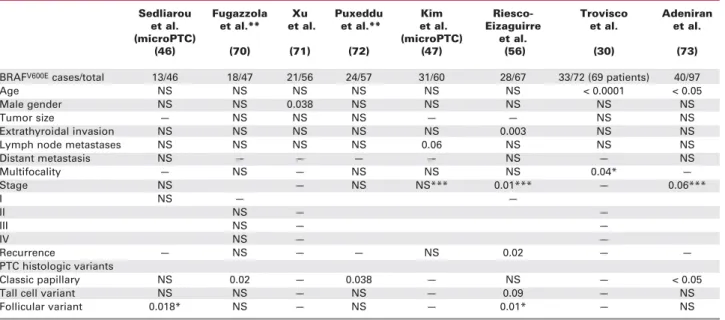
In the last four years we have seen the publication of at least sixteen studies which correlated BRAF muta-tion with PTC clinical features predictive of recur-rence/persistence or death, including age, gender, tumor size, extra-thyroidal invasion, lymph node metastases, distant metastases, multifocality, and stage and/or with pathological characteristics, including his-tologic variants of PTC (30,44-48,56,68,70-77). Six of these studies also correlated BRAF mutation with disease recurrence (47,56,70,75-77), while two specif-ically analyzed PTC microcarcinoma series (46,47). Moreover, during the same period the literature was enriched with three studies specifically analyzing
BRAF mutation prevalence in PTC lymph node
metastases (32,78,79), with three studies exploring
BRAFmutation prevalence in anaplastic thyroid carci-nomas (50-52), and with five studies searching for the prevalence of BRAFmutation in radiation-induced or sporadic PTC of young subjects (80-84).
Table 3 summarizes the findings of the sixteen studies correlating BRAFmutation with PTC clinico-pathological features.
In detail, four studies found a statistically signif-icant association ofBRAFmutation with an older age at the time of diagnosis of PTC (30,44,73,77). Of note, three of these studies included one hundred patients or more. In agreement, very recently at least
five papers have reported a low prevalence ofBRAF
mutation in PTCs diagnosed in childhood (80-84). The inter-studies discrepancy may be related to het-erogeneity in age distribution of patients in the differ-ent cohorts. In detail, inclusion of pediatric PTC or of a young adult population, whose tumors are less
fre-quently positive for BRAF mutation, or of older
patients, whose PTC are eventually more frequently positive for the genetic alteration, may contribute to increasing the divergences of ages between the BRAF
mutation positive and negative groups allowing the studies to reach statistically significant differences. Although older age is an unfavorable prognostic factor
(85), a relationship between BRAF mutation, older
age, and higher clinical aggressiveness still needs to be established.
Two studies correlated BRAF mutation with
Tumor size was detected as being significantly
increased in BRAF mutation-positive PTCs in two
studies (68,75) and significantly reduced in a third one (76). In all the other studies no statistically significant
difference was detected between BRAF
mutation-pos-itive and -negative tumors. The conclusion may be that BRAF mutation does not significantly influence tumor growth. However, considering other findings
possibly correlating BRAF mutation with higher
aggressiveness or invasiveness, the conclusion may be
broader: BRAF mutation does not favor tumor
growth, but under the same growth conditions may induce earlier activation of tumor invasiveness.
In agreement with the latter statement, three studies detected a significant correlation between
BRAF mutation and extrathyroidal invasion (44,
Table 3.Findings of the studies correlating BRAFmutation with PTC clinicopathological features.
Sedliarou Fugazzola Xu Puxeddu Kim Riesco- Trovisco Adeniran et al. et al.** et al. et al.** et al. Eizaguirre et al. et al. (microPTC) (microPTC) et al.
(46) (70) (71) (72) (47) (56) (30) (73)
BRAFV600Ecases/total 13/46 18/47 21/56 24/57 31/60 28/67 33/72 (69 patients) 40/97
Age NS NS NS NS NS NS < 0.0001 < 0.05
Male gender NS NS 0.038 NS NS NS NS NS
Tumor size — NS NS NS — — NS NS
Extrathyroidal invasion NS NS NS NS NS 0.003 NS NS
Lymph node metastases NS NS NS NS 0.06 NS NS NS
Distant metastasis NS — — — — NS — NS
Multifocality — NS — NS NS NS 0.04* —
Stage NS — NS NS*** 0.01*** — 0.06***
I NS — —
II NS — —
III NS — —
IV NS — —
Recurrence — NS — — NS 0.02 — —
PTC histologic variants
Classic papillary NS 0.02 — 0.038 — NS — < 0.05
Tall cell variant NS NS — NS — 0.09 — NS
Follicular variant 0.018* NS — NS — 0.01* — NS
Table 3. Continuation.
Nikiforova Liu Trovisco Namba Jo Kim Xing Fugazzola & et al. (44) et al. (74) et al. (45) et al. (48) et al. (68) et al. (75) et al. (76) Puxeddu
et al. (77)
BRAFV600Ecases/total 38/104 49/105 45/124 38/126 102/161 149/203 107/219 99/260
Age < 0.0001 NS — NS NS NS NS 0.01
Male gender NS NS — NS NS 0.006 NS NS
Tumor size NS NS — NS 0.01 0.006 0.09* NS
Extrathyroidal invasion 0.03 NS — NS 0.08 0.062 < 0.001 NS
Lymph node metastases NS NS — NS NS NS 0.001 NS
Distant metastasis NS NS — 0.033 NS — — NS
Multifocality — NS — — — NS NS NS
Stage NS — 0.049 NS NS*** 0.002***
I 0.003* — NS
II NS — NS
III 0.0006 — NS
IV 0.03 — NS
Recurrence — — — — — 0.037 0.004 NS
PTC histologic variants
Classic papillary 0.0004 NS — — — — < 0.001 0.0001
Tall cell variant 0.002 NS NS — — — < 0.001 NS
Follicular variant < 0.0001* NS < 0.0001* — — — < 0.001* 0.0007*
* In favour of BRAFWT subgroup; **The patients from the two studies were pooled with others in the study by Fugazzola & Puxeddu et al; *** I+II vs III+IV
56,76), and two others found a correlation very close to statistical significance (68,75). Of note, four of these studies had the largest case collection of the series. The remaining studies were unable to detect this association, including an Italian multicenter one, which enrolled 260 patients (77).
A significant correlation between BRAF muta-tion and lymph node metastases was pinpointed only by one study (76). Another study, conducted on a small microcarcinoma cohort, found a correlation close to sta-tistical significance (47). However, at least three other recently published papers support the possibility that
BRAFmutations, either clonally present in the primary tumor or de novoformed in the metastatic cells, play a pivotal role in papillary thyroid carcinoma cells seeding at the level of lymph nodes (32,78,79). In detail, two of these studies showed a significantly higher prevalence of
lymph node metastases in BRAF mutation-positive
tumors (78,79), while all three produced proof of
pos-sible de novo BRAFmutation formation in PTC lymph
node metastatic cells.
Only one study found a weak statistically signif-icant correlation between BRAFmutation and distant metastases (p= 0.033) (48). In part this lack of corre-lation may be related to the low number of patients presenting with distant metastases in each study. Thus, the findings obtained so far should be considered inconclusive.
A correlation between BRAF mutation and
more advanced stage of the disease was clearly detectable in four studies (44,56,48,76) and was close to statistical significance in a fifth (73). Four of these studies included about one hundred or more patients. However, two of the three studies including more than two hundred patients, one from Korea (75) and one from Italy (77), were unable to confirm the cor-relation, although in the case of the Asian study this could be due to the selection of only low-risk cases.
Among the six studies that analyzed the
corre-lation between BRAF mutation and recurrence
(47,56,70,75-77), three documented this association (56,75,76). Three of the six studies included less than 70 cases (47,56,70). Among the three studies includ-ing a higher number of patients, only the North Amer-ican (76) and the Korean (75) were characterized by the finding, while the multicenter Italian study (77) was not able to show any statistically significant
differ-ence in recurrdiffer-ence rate between BRAFmutation
pos-itive and negative tumors. Interestingly, as mentioned above, the Korean study included only low-risk patients with conventional PTC. However, only in the North American study did the detected statistically
significant correlation between BRAF mutation and
recurrence at univariate analysis remain significant on multivariate analysis, after adjusting for conventional clinico-pathological predictors of recurrence. More-over, in this study BRAF mutation was also an inde-pendent predictor of recurrence in patients with stage I/II disease. Median follow-up periods were respec-tively 15 months for the North American study, 88 months for the Korean study and 72 months for the Italian study. Thus, the high recurrence rate of BRAF
mutation-positive PTC in the North American study may be ascribed to a high rate of early relapses of per-sistent disease. In this study, a sub-analysis of twenty recurrent PTC patients showed that recurrent disease was more extensive and needed more aggressive treat-ment (surgical and external radiation therapies) in the
BRAF mutation-positive patients than in the BRAF
mutation-negative ones. In addition to radioiodine treatment, nine of 13 (69%) recurrent patients with
BRAFmutation needed at least one additional surgery and/or external radiation therapy, whereas only one of seven (14%) recurrent patients without the mutation needed additional surgery and no radiotherapy. More-over, seven of thirteen (54%) patients in the BRAF mutation-positive group versus none of seven (0%) in the BRAF mutation-negative group lacked 131I avidity
in their foci of recurrent tumor. Interestingly, these findings are confirmed by the third recent study from
Spain, which detected a correlation between BRAF
mutation and recurrence on a smaller group of patients over a follow-up period of 36 months (56). Also in this study, the frequencies of recurrences with
negative 131I whole body scan were higher in the
BRAF mutation-positive group (6/9, 66%) than in
the BRAF-mutation negative group (1/3, 33%), pre-dicting a worse outcome and indicating a less differen-tiated state in the BRAF mutation-positive PTC. All these clinical findings are consistent with the above-mentioned gene expression data (see previous sec-tion), which consistently indicate a depression of the intra-thyroidal iodine metabolism machinery in BRAF
mutation-positive PTC.
association between BRAFmutation and the tall cell variant histology (44,56,76). Thus, it clearly appears
that mutation of BRAF drives the development of
PTCs with a pure papillary or tall cell papillary pheno-type. The tall cell variant of PTC is considered by many authors more aggressive and less differentiated than the other histological variants of the tumor (17,18). The specific association of a BRAFK601E and
BRAFG474R mutations with the follicular variant of
PTC recently described by one group (30) has not been confirmed by any other study so far.
BRAFmutation was also detected in a signifi-cant subset of undifferentiated thyroid carcinomas (44,48-52) and in one study in 2 out of 16 poorly dif-ferentiated thyroid tumors (44). In most of these stud-ies a noteworthy part of the BRAF mutation-positive undifferentiated or poorly differentiated thyroid carci-nomas had a recognizable papillary well-differentiated background component. Where both components were tested simultaneously for the mutation, a 100%
concordance of the BRAFprofile was shown.
These findings demonstrate that progression from papillary thyroid carcinoma to poorly differentiated and anaplastic carcinoma may be favored in many tumors by constitutive activation of BRAF. Moreover, together with the evidence that BRAF mutation also occurs in microcarcinomas (30,44-47), they suggest that this mutation, being an early event and probably insufficient alone for the fully aggressive phenotype, may predispose the tumor cell to acquisition of additional genetic alter-ations, which in turn activate more aggressive pathways and lead to de-differentiation. As seen in the previous section, biological evidence from thyroid cell line (53,56) and transgenic mice experiments (43) support these conclusions. It is noteworthy that a recent study showed that one subset of anaplastic thyroid carcinomas
are derived from BRAFmutation positive PTC due to
the gain of a p53 mutation (52). RET/PTC rearrange-ment seems to behave differently and to define a subset of papillary thyroid carcinomas lacking evidence of pro-gression to poorly differentiated or undifferentiated tumor phenotype (52,86).
CONCLUSIONS AND FUTURE DIRECTIONS
The perception coming from the described biological
and clinical studies is that BRAF mutation is an
adverse prognostic indicator for PTC. However, its routine clinical application for prognostic stratification is hampered by the discrepant data coming from the correlation studies summarized in the previous section
and by the paucity of robust supporting clinical evi-dence. Indeed, only the study by Xing et al. (76) is characterized by the identification of a statistically sig-nificant correlation, which consistently holds at multi-variate analysis.
These discrepancies might be due either to the heterogeneity of the histological variants of PTC or to the age group analyzed or to the small number of stud-ied cases or to genetic differences of the considered pop-ulations. However, another explanation should also be taken into account: the possibility that the conflict of the data is related to an important difference in the extent of disease at the moment the patients entered the studies, namely the moment of initial treatment. Geo-graphical differences in the timelines of thyroid cancer diagnosis may play an important role in this. Indeed, countries characterized by an easily accessible and free health care system, by awareness of thyroid disease due to diffusion of endemic goiter, and by intense use of thyroid ultrasonography may have a higher number of incidental early thyroid carcinoma diagnoses. In this context PTCs may not have fully expressed their aggres-sive potential and may receive a more complete initial surgical treatment so that the clinical measurement of the higher biological aggressiveness of BRAF mutation-positive cancers may not be possible, at least in the short term (maybe in the long term it will). The situation might be different in countries where the most fre-quently detected tumors are those which are recognized because they are clinically evident. These cases may re-present cancers which have developed their aggressive potential and that may be less amenable to radical surgery, and, if characterized by BRAF mutation, less responsive to radioiodine.
Well-designed prospective multicenter studies are needed in order to definitively clarify the role of
BRAFmutation as a useful clinical indicator of PTC
aggressiveness. Preliminary evaluation of the necessary statistical power and data analysis separating clinically relevant tumors from incidental ones will be important issues. If these studies confirm BRAFeffectiveness in prognostic stratification of PTC patients, it is conceiv-able that in the future preoperative genotyping of thy-roid fine needle aspirates (FNA) could alter the surgi-cal approach and radioiodine treatment modalities, perhaps by mandating more aggressive lymph node dissection and by inducing the use of higher doses of
131I in BRAF mutation-positive PTC. Moreover, a
BRAFgenotype may condition a more intense
In conclusion, BRAF mutation might become a novel informative prognostic marker, which can readi-ly be detected in FNA cytological material and has the potential to improve risk stratification and recurrence prediction in patients affected by PTC, thus leading to better informed decisions about initial and long-term management. However, appropriately designed stud-ies aimed at definitively verifying this possibility still need to be initiated.
ACKNOWLEDGMENTS
This work was supported by the “Fondazione Cassa di Risparmio di Perugia” and “Associazione Italiana per la Ricerca sul Cancro”, which partially supported the research work in our laboratory.
We wish to thank Dr. Flavia Barbi and Dr. Maria Tavano for their precious collaboration.
We intended to cite all the significant studies in this field, but apologize for the possible, unintended omission of any relevant references.
REFERENCES
1. Sherman SI. Thyroid carcinoma. Lancet 2003;361:501-11. 2. Surveillance Research Program CSB Surveillance,
Epidemiol-ogy and End Results (SEER) Program, November 2003 (Edn). National Cancer Institute, 2004.
3. Mazzaferri EL. Thyroid carcinoma: papillary and follicular. In: Mazzaferri EL, Samaan N (eds). Endocrine tumors. Cam-bridge: Blackwell Scientific, 1993. pp. 278-333.
4. Mazzaferri EL, Jhiang SM. Long-term impact of initial surgical and medical therapy on papillary and follicular thyroid can-cer. Am J Med 1994;97:418-28.
5. Hay ID, Bergstralh EJ, Goellner JR, Ebersold JR, Grant CS. Predicting outcome in papillary thyroid carcinoma: develop-ment of a reliable prognostic scoring system in a cohort of 1779 patients surgically treated at one institution during 1940 through 1989. Surgery 1993;114 1050-7.
6. Hay ID, Thompson GB, Grant CS, Bergstralh EJ, Dvorak CE, Gorman CA, et al. Papillary thyroid carcinoma managed at the Mayo Clinic during six decades (1940–1999): temporal trends in initial therapy and long-term outcome in 2444 con-secutively treated patients. World J Surg 2002;8:879-85. 7. Byar DP, Green SB, Dor P, Williams ED, Colon J, van Gilse
HA, et al. A prognostic index for thyroid carcinoma. A study of the E.O.R.T.C. Thyroid Cancer Cooperative Group. Eur J Cancer 1979;15:1033-41.
8. Tenvall J, Biorklund A, Moller T, Ranstam J, Akerman M. Is the EORTC prognostic index of thyroid cancer valid in differ-entiated thyroid carcinoma? Retrospective multivariate analysis of differentiated thyroid carcinoma with long follow-up. Cancer 1986;57:1405-14.
9. Shaha AR, Loree TR, Shah JP. Prognostic factors and risk group analysis in follicular carcinoma of the thyroid. Surgery 1995;118:1131-6.
10. Sherman SI, Brierley JD, Sperling M, Ain KB, Bigos ST, Coop-er DS, et al. Prospective multicentCoop-er study of thyroid carcino-ma treatment: initial analysis of staging and outcome. National Thyroid Cancer Treatment Cooperative Study Reg-istry Group. Cancer 1998;83:1012-21.
11. Links TP, van Tol KM, Jager PL, Plukker JThM, Piers DA, Boezen HM, et al. Life expectancy in differentiated thyroid cancer: a novel approach to survival analysis. Endocr Relat Cancer 2005;12:272-80.
12. Greene FL, Page DL, Fleming ID, Fritz AG, Balch CM, Haller DG, et al. American Joint Committee on Cancer 2002 AJCC cancer staging manual. New York/Berlin/Heidel-berg: Springer-Verlag, 2002.
13. Schlumberger M, De Vathaire F, Travagli JP, Vassal G, Lemerle J, Parmentier C, et al. Differentiated thyroid carcino-ma in childhood: long-term follow-up of 72 patients. J Clin Endocrinol Metab 1987;65:1088-94.
14. Vassilopoulou-Sellin R, Klein MJ, Smith TH, Samaan NA, Frankenthaler RA, Goepfert H, et al. Pulmonary metastases in children and young adults with differentiated thyroid cancer.
Cancer 1993;71:1348-52.
15. Sakamoto A, Kasai N, Sugano H. Poorly differentiated carcino-ma of the thyroid. A clinicopathologic entity for a high-risk group of papillary and follicular carcinomas. Cancer 1983;52:1849-55. 16. Wenig BM, Thompson LD, Adair CF, Shmookler B, Heffess CS. Thyroid papillary carcinoma of columnar cell type: a clin-icopathologic study of 16 cases. Cancer 1998;82:740-53. 17. Prendiville S, Burman KD, Ringel MD, Shmookler BM, Deeb
ZE, Wolfe K, et al. Tall cell variant: an aggressive form of pap-illary thyroid carcinoma. Otolaryngol Head Neck Surg 2000;122:352-7.
18. Akslen LA, LiVolsi VA. Prognostic significance of histologic grading compared with subclassification of papillary thyroid carcinoma. Cancer 2000;88:1902-8.
19. Tubiana M, Schlumberger M, Rougier P, Laplanche A, Ben-hamou E, Gardet P, et al. Long-term results and prognostic factors in patients with differentiated thyroid carcinoma.
Cancer 1985;55:794-804.
20. Toubeau M, Touzery C, Arveux P, Chaplain G, Vaillant G, Berriolo A, et al. Predictive value for disease progression of serum thyroglobulin levels measured in the postoperative period and after 131Iablation therapy in patients with differ-entiated thyroid cancer. J Nucl Med 2004;45:988-94. 21. Schlumberger M, Berg G, Cohen O, Duntas L, Jamar F,
Jarz-ab B, et al. Follow-up of low-risk patients with differentiated thyroid carcinoma: a European perspective. Eur J Endocrinol 2004;150:105-12.
22. Rouxel A, Hejblum G, Bernier MO, Boelle PY, Menegaux F, Mansour G, et al. Prognostic factors associated with the sur-vival of patients developing loco-regional recurrences of dif-ferentiated thyroid carcinomas. J Clin Endocrinol Metab 2004;89:5362-8.
23. Cailleux AF, Baudin E, Travagli JP, Ricard M, Schlumberger M. Is diagnostic iodine-131 scanning useful after total thyroid ablation for differentiated thyroid cancer? J Clin Endocrinol Metab 2000;85:175-8.
24. Bachelot A, Cailleux AF, Klain M, Baudin E, Ricard M, Bellon N, et al. Relationship between tumor burden and serum roglobulin level in patients with papillary and follicular thy-roid carcinoma. Thyroid 2002;12:707-11.
25. Weber F, Eng C. Gene-expression profiling in differentiated thyroid cancer — a viable strategy for the practice of genom-ic medgenom-icine? Future Oncol 2005;1:497-510.
26. Xing M. BRAF mutation in thyroid cancer. Endocr Relat Cancer 2005;12:245-62.
27. Kolch W. Meaningful relationships: the regulation of the Ras/Raf/MEK/ERK pathway by protein interactions. Biochem J 2000;351 Pt 2:289-305.
28. Mercer KE, Pritchard CA. Raf proteins and cancer: B-Raf is identified as a mutational target. Biochim Biophys Acta 2003;1653:25-40.
29. Davies H, Bignell GR, Cox C, Stephens P, Edkins S, Clegg S, et al. Mutations of the BRAF gene in human cancer. Nature 2002;417:949-54.
31. Castro P, Rebocho AP, Soares RJ, Magalhães J, Roque L, Tro-visco V, et al. PAX8-PPARγ rearrangement is frequently detected in the follicular variant of papillary thyroid carcino-ma. J Clin Endocrinol Metab 2006;91:213-20.
32. Oler G, Ebina KN, Michaluart P Jr, Kimura ET, Cerutti J. Investi-gation of BRAF mutation in a series of papillary thyroid carcino-ma and carcino-matched-lymph node metastasis reveals a new muta-tion in metastasis. Clin Endocrinol (Oxf) 2005;62:509-11. 33. Trovisco V, Soares P, Soares R, Magalhães J, Sa-Couto P,
Sobrinho-Simões M. A new BRAF gene mutation detected in a case of a solid variant of papillary thyroid carcinoma. Hum Pathol 2005;36:694-7.
34. Carta C, Moretti S, Passeri L, Barbi F, Avenia N, Cavaliere A, et al. Genotyping of an Italian papillary thyroid carcinoma cohort revealed high prevalence of BRAF mutations, absence of RAS mutations and allowed the detection of a new muta-tion of BRAF oncoprotein (BRAF(V599lns)). Clin Endocrinol (Oxf) 2006;64:105-9.
35. Ciampi R, Knauf JA, Kerler R, Gandhi M, Zhu Z, Nikiforova MN, et al. Oncogenic AKAP9-BRAF fusion is a novel mecha-nism of MAPK pathway activation in thyroid cancer. J Clin Inves 2005;115:94-101.
36. Wan PT, Garnett MJ, Roe SM, Lee S, Niculescu-Duvaz D, Good VM, et al; Cancer Genome Project. Mechanism of acti-vation of the RAF-ERK signaling pathway by oncogenic muta-tions of B-RAF. Cell 2004;116:855-67.
37. Moretti S, Macchiarulo A, De Falco V, Avenia N, Barbi F, Carta C, et al. Biochemical and molecular characterization of the novel BRAF(V599Ins) mutation detected in a classic papillary thyroid carcinoma. Oncogene 2006;25:4235-40.
38. Kimura ET, Nikiforova MN, Zhu Z, Knauf JA, Nikiforov YE, Fagin JA. High prevalence of BRAF mutations in thyroid can-cer: genetic evidence for constitutive activation of the RET/PTC-RAS-BRAF signaling pathway in papillary thyroid carcinoma. Cancer Res 2003;63:1454-7.
39. Soares P, Trovisco V, Rocha AS, Lima J, Castro P, Preto A, et al. BRAF mutations and RET/PTC rearrangements are alterna-tive events in the etiopathogenesis of PTC. Oncogene 2003;22:4578-80.
40. Frattini M, Ferrario C, Bressan P, Balestra D, De Cecco L, Mon-dellini P, et al. Alternative mutations of BRAF, RET and NTRK1 are associated with similar but distinct gene expression pat-terns in papillary thyroid cancer. Oncogene 2004;23:7436-40. 41. Melillo RM, Castellone MD, Guarino V, De Falco V, Cirafici AM, Salvatore G, et al. The RET/PTC-RAS-BRAF linear signal-ing cascade mediates the motile and mitogenic phenotype of thyroid cancer cells. J Clin Invest 2005;115:1068-81. 42. Mitsutake N, Miyagishi M, Mitsutake S, Akeno N, Mesa C Jr,
Knauf JA, et al. BRAF mediates RET/PTC-induced mitogen-acti-vated protein kinase activation in thyroid cells: functional sup-port for requirement of the RET/PTC-RAS-BRAF pathway in pap-illary thyroid carcinogenesis. Endocrinology 2006;147:1014-9. 43. Knauf JA, Ma X, Smith EP, Zhang L, Mitsutake N, Liao XH, et al. Targeted expression of BRAFV600E in thyroid cells of transgenic mice results in papillary thyroid cancers that undergo dedifferentiation. Cancer Res 2005;65:4238-45. 44. Nikiforova MN, Kimura ET, Gandhi M, Biddinger PW, Knauf
JA, Basolo F, et al. BRAF mutations in thyroid tumors are restricted to papillary carcinomas and anaplastic or poorly differentiated carcinomas arising from papillary carcinomas.
J Clin Endocrinol Metab 2003;88:5399-404.
45. Trovisco V, Vieira de Castro I, Soares P, Maximo V, Silva P, Magalhães J, et al. BRAF mutations are associated with some histological types of papillary thyroid carcinoma. J Pathol 2004;202:247-51.
46. Sedliarou I, Saenko V, Lantsov D, Rogounovitch T, Namba H, Abrosimov A, et al. The BRAFT1796A transversion is a preva-lent mutational event in human thyroid microcarcinoma. Int J Oncol 2004;25:1729-35.
47. Kim TY, Kim WB, Song JY, Rhee YS, Gong G, Cho YM, et al. The BRAF mutation is not associated with poor prognostic factors in Korean patients with conventional papillary thyroid microcarcinoma. Clin Endocrinol (Oxf) 2005;63:588-93.
48. Namba H, Nakashima M, Hayashi T, Hayashida N, Maeda S, Rogounovitch TI, et al. Clinical implication of hot spot BRAF mutation, V599E, in papillary thyroid cancers. J Clin Endocrinol Metab 2003;88:4393-7.
49. Xing M, Vasko V, Tallini G, Larin A, Wu G, Udelsman R, et al. BRAF T1796A transversion mutation in various thyroid neo-plasms. J Clin Endocrinol Metab 2004;89:1365-8. 50. Soares P, Trovisco V, Rocha AS, Feijão T, Rebocho AP,
Fon-seca E, et al. BRAF mutations typical of papillary thyroid car-cinoma are more frequently detected in undifferentiated than in insular and insular-like poorly differentiated carcinomas.
Virchows Arch 2004;444:572-6.
51. Begum S, Rosenbaum E, Henrique R, Cohen Y, Sidransky D, Westra WH. BRAF mutations in anaplastic thyroid carcinoma: implications for tumor origin, diagnosis and treatment. Mod Pathol 2004;17:1359-63.
52. Quiros RM, Ding HG, Gattuso P, Prinz RA, Xu X. Evidence that one subset of anaplastic thyroid carcinomas are derived from papillary carcinomas due to BRAF and p53 mutations. Can-cer 2005;103:2261-8.
53. Mitsutake N, Knauf JA, Mitsutake S, Mesa C Jr, Zhang L, Fagin JA. Conditional BRAFV600Eexpression induces DNA synthesis,
apoptosis, dedifferentiation, and chromosomal instability in thyroid PCCL3 cells. Cancer Res 2005;65:2465-73.
54. Wang J, Knauf JA, Basu S, Puxeddu E, Kuroda H, Santoro M, et al. Conditional expression of RET/PTC induces a weak oncogenic drive in thyroid PCCL3 cells and inhibits thy-rotropin action at multiple levels. Mol Endocrinol 2003;17:1425-36.
55. Mesa C Jr, Mirza M, Mitsutake N, Sartor M, Medvedovic M, Tomlinson C, et al. Conditional activation of RET/PTC3 and BRAFV600Ein thyroid cells is associated with gene expression
profiles that predict a preferential role of BRAF in extracellu-lar matrix remodeling. Cancer Res 2006;66:6521-9. 56. Riesco-Eizaguirre G, Gutierrez-Martinez P, Garcia-Cabezas
MA, Nistal M, Santisteban P. The oncogene BRAFV600Eis
asso-ciated with a high risk of recurrence and less differentiated papillary thyroid carcinoma due to the impairment of Na+/I-targeting to the membrane. Endocr Relat Cancer 2006;13:257-69.
57. Palona I, Namba H, Mitsutake N, Starenki D, Podtcheko A, Sedliarou I, et al. BRAFV600Epromotes invasiveness of thyroid
cancer cells through nuclear factor κB activation.
Endocrinology 2006;147:5699-707.
58. Powell DJ Jr, Russell J, Nibu K, Li G, Rhee E, Liao M, et al. The RET/PTC3 oncogene: metastatic solid-type papillary carcino-mas in murine thyroids. Cancer Res 1998;58:5523-8. 59. Jhiang SM, Sagartz JE, Tong Q, Parker-Thornburg J, Capen
CC, Cho JY, et al. Targeted expression of the ret/PTC1 onco-gene induces papillary thyroid carcinomas. Endocrinology 1996;137:375-8.
60. La Perle KM, Jhiang SM, Capen CC. Loss of p53 promotes anaplasia and local invasion in ret/PTC1-induced thyroid car-cinomas. Am J Pathol 2000;157:671-7.
61. Powell Jr DJ, Russell JP, Li G, Kuo BA, Fidanza V, Huebner K, et al. Altered gene expression in immunogenic poorly differ-entiated thyroid carcinomas from RET/PTC3p53-/- mice.
Oncogene 2001;20:3235-46.
62. Giordano TJ, Kuick R, Thomas DG, Misek DE, Vinco M, Sanders D, et al. Molecular classification of papillary thyroid carcinoma: distinct BRAF, RAS, and RET/PTC mutation-spe-cific gene expression profiles discovered by DNA microarray analysis. Oncogene 2005;24:6646-56.
63. Di Cristofaro J, Silvy M, Lanteaume A, Marcy M, Carayon P, De Micco C. Expression of tpo mRNA in thyroid tumors: quantitative PCR analysis and correlation with alterations of ret, Braf, ras and pax8 genes. Endocr Relat Cancer 2006;13:485-95.
65. Wang W, Macapinlac H, Larson SM, Yeh SD, Akhurst T, Finn RD, et al. 18F-2-fluoro-2-deoxy-D-glucose positron emission
tomography localizes residual thyroid cancer in patients with negative diagnostic 131I whole body scans and elevated
serum thyroglobulin levels. J Clin Endocrinol Metab 1999;84:2291-302.
66. Helal BO, Merlet P, Toubert ME, Franc B, Schvartz C, Gauthi-er-Koelesnikov H, et al. Clinical impact of 18F-FDG PET in
thy-roid carcinoma patients with elevated thyroglobulin levels and negative 131I scanning results after therapy. J Nucl Med
2001;42:1464-9.
67. Nahas Z, Goldenberg D, Fakhry C, Ewertz M, Zeiger M, Laden-son PW, et al. The role of positron emission tomography/ computed tomography in the management of recurrent pap-illary thyroid carcinoma. Laryngoscope 2005;115:237-43. 68. Jo YS, Li S, Song JH, Kwon KH, Lee JC, Rha SY, et al.
Influ-ence of the BRAFV600Emutation on expression of vascular
endothelial growth factor in papillary thyroid cancer. J Clin Endocrinol Metab 2006;91:3667-70.
69. Hu S, Liu D, Tufano RP, Carson KA, Rosenbaum E, Cohen Y, et al. Association of aberrant methylation of tumor suppres-sor genes with tumor aggressiveness and BRAF mutation in papillary thyroid cancer. Int J Cancer 2006;119:2322-9. 70. Fugazzola L, Mannavola D, Cirello V, Vannucchi G, Muzza M,
Vicentini L, et al. BRAF mutations in an Italian cohort of thy-roid cancers. Clin Endocrinol (Oxf) 2004;61:239-43. 71. Xu X, Quiros RM, Gattuso P, Ain KB, Prinz RA. High
preva-lence of BRAF gene mutation in papillary thyroid carcinomas and thyroid tumor cell lines. Cancer Res 2003;63:4561-7. 72. Puxeddu E, Moretti S, Elisei R, Romei C, Pascucci R, Martinelli
M, et al. BRAFV599Emutation is the leading genetic event in
adult sporadic papillary thyroid carcinomas. J Clin Endocrinol Metab 2004;89:2414-20.
73. Adeniran AJ, Zhu Z, Gandhi M, Steward DL, Fidler JP, Gior-dano TJ, et al. Correlation between genetic alterations and microscopic features, clinical manifestations, and prognostic characteristics of thyroid papillary carcinomas. Am J Surg Pathol 2006;30:216-22.
74. Liu RT, Chen YJ, Chou FF, Li CL, Wu WL, Tsai PC, et al. No correlation between BRAFV600Emutation and
clinicopatholog-ical features of papillary thyroid carcinomas in Taiwan. Clin Endocrinol (Oxf) 2005;63:461-6.
75. Kim TY, Kim WB, Rhee YS, Song JY, Kim JM, Gong G, et al. The BRAF mutation is useful for prediction of clinical recur-rence in low-risk patients with conventional papillary thyroid carcinoma. Clin Endocrinol (Oxf) 2006;65:364-8.
76. Xing M, Westra WH, Tufano RP, Cohen Y, Rosenbaum E, Rho-den KJ, et al. BRAF mutation predicts a poorer clinical prog-nosis for papillary thyroid cancer. J Clin Endocrinol Metab 2005;90:6373-9.
77. Fugazzola L, Puxeddu E, Avenia N, Romei C, Cirello V, Cava-liere A, et al. Correlation between B-RAFV600Emutation and
clinico-pathologic parameters in papillary thyroid carcinoma: data from a multicentric Italian study and review of the liter-ature. Endocr Relat Cancer 2006;13:455-64.
78. Vasko V, Hu S, Wu G, Xing JC, Larin A, Savchenko V, et al. High prevalence and possible de novo formation of BRAF mutation in metastasized papillary thyroid cancer in lymph nodes. J Clin Endocrinol Metab 2005;90:5265-9. 79. Kim J, Giuliano AE, Turner RR, Gaffney RE, Umetani N,
Kita-go M, et al. Lymphatic mapping establishes the role of BRAF gene mutation in papillary thyroid carcinoma. Ann Surg 2006;244:799-804.
80. Kumagai A, Namba H, Saenko VA, Ashizawa K, Ohtsuru A, Ito M, et al. Low frequency of BRAFT1796Amutations in childhood
thyroid carcinomas. J Clin Endocrinol Metab 2004; 89:4280-4.
81. Lima J, Trovisco V, Soares P, Maximo V, Magalhães J, Sal-vatore G, et al. BRAF mutations are not a major event in post-Chernobyl childhood thyroid carcinomas. J Clin Endocrinol Metab 2004;89:4267-71.
82. Penko K, Livezey J, Fenton C, Patel A, Nicholson D, Flora M, et al. BRAF mutations are uncommon in papillary thyroid cancer of young patients. Thyroid 2005;15:320-5.
83. Powell N, Jeremiah S, Morishita M, Dudley E, Bethel J, Bog-danova T, et al. Frequency of BRAFT1796Amutation in papillary
thyroid carcinoma relates to age of patient at diagnosis and not to radiation exposure. J Pathol 2005;205:558-64. 84. Rosenbaum E, Hosler G, Zahurak M, Cohen Y, Sidransky D,
Westra WH. Mutational activation of BRAF is not a major event in sporadic childhood papillary thyroid carcinoma.
Mod Pathol 2005;18:898-902.
85. Mazzaferri EL, Kloos RT. Clinical review 128: Current approaches to primary therapy for papillary and follicular thy-roid cancer. J Clin Endocrinol Metab 2001;86:1447-63. 86. Tallini G, Santoro M, Helie M, Carlomagno F, Salvatore G,
Chiappetta G, et al. RET/PTC oncogene activation defines a subset of papillary thyroid carcinomas lacking evidence of progression to poorly differentiated or undifferentiated tumor phenotypes. Clin Cancer Res 1998;4:287-94.
Address for correspondence:
Efisio Puxeddu
Dipartimento di Medicina Interna Sezione MISEM
Via Enrico dal Pozzo 06126 Perugia, Italy Fax: (39-075) 573-0855