56 Brazilian Journal of Physics, vol. 37, no. 1, March, 2007
Investigating the Tetraquark Structure of the New Mesons
M. Nielsen1, F. S. Navarra1, and M. E. Bracco2
1Instituto de F´ısica, Universidade de S˜ao Paulo, C.P. 66318, 05389-970 S˜ao Paulo, SP, Brazil 2Instituto de F´ısica, Universidade do Estado do Rio de Janeiro,
Rua S˜ao Francisco Xavier 524, 20550-900 Rio de Janeiro, RJ, Brazil
Received on 29 September, 2006
Using the QCD sum rule approach we investigate the vertex associated with the decayD0(0+)→D+π−,
where the scalar meson D0(0+)is considered as a four-quark state(cd)(u¯d). Although our results for the¯ mass and partial decay width are smaller than the mass and the total decay width of the broad scalar meson D∗0
0 (2308)reported by BELLE Collaboration, we can not discard the possibility that the BELLE’s resonance
can be interpreted as the four-quark state studied here.
Keywords: QCD sum rules; Four-quark states; Scalar mesons
The recent observations of the very narrow resonances D+sJ(2317) by BaBar [1], D+sJ(2460) by CLEO [2], and X(3872)by BELLE [3], all of them with masses below quark model predictions, have stimulated a renewed interest in the spectroscopy of open charm and charmonium states. Due to their narrowness and small masses, these new mesons were considered as good candidates for four-quark states by many authors [4]. The idea of mesons as four-quark states is not new. Indeed, even Gell-Mann in his first work about quarks had mentioned that mesons could be made out of(qq¯),(qqq¯q¯) etc. [5]. The best known example of applying the idea of four-quark states for mesons is for the light scalar mesons (the isoscalarsσ(500), f0(980), the isodubletκ(800)and the isovectora0(980)) [6, 7]. In a four-quark scenario, the mass degeneracy of f0(980)anda0(980)is natural, the mass hier-archy pattern of the nonet is understandable, and it is easy to explain whyσandκare broader than f0(980)anda0(980).
In refs. [8, 9] the method of QCD sum rules (QCDSR) [10– 12] was used to study the two-point functions for the mesons D+sJ(2317)andX(3872)considering them as four-quark states in a diquark-antidiquark configuration. The results obtained for their masses are given in Table I.
Comparing the results in Table I with the resonance masses given by:D+sJ(2317)andX(3872), we see that it is possible to reproduce the experimental value of the masses using a four-quark representation for these states.
The study of the three-point functions related to the decay widthsD+sJ(2317)→D+sπ0andX(3872)→Jψπ+π−, using the diquark-antidiquark configuration forDsJandX, was done
in refs. [13, 14]. The results obtained for their partial decay widths are given in Table II.
From Table II we see that the partial decay width obtained in ref. [13], supposing that the mesonsD+sJ(2317)is a four-quark state, is consistent with the experimental upper limit. However, in the case of the mesonX(3872), the partial decay width obtained in ref. [14] is much bigger than the
experimen-TABLE I: Numerical results for the resonance masses
resonance DsJ X
mass (GeV) 2.32±0.13 3.93±0.15
TABLE II: Numerical results for the resonance decay widths
decay D+sJ→D+sπ0 X→J/ψπ+π− Γ(MeV) (6±2)×10−3 50±15
Γexptot (MeV) <5 <2.3
tal upper limit to the total width.
In ref. [14] some arguments were presented to reduce the value of this decay width, by imposing that the initial four-quark state needs to have a non-trivial color structure. In this case, its partial decay width can be reduced to Γ(X → J/ψπ+π−)) = (0.7±0.2) MeV. However, that procedure may appear somewhat unjustified and, therefore, more study is needed until one can arrive at a definitive conclusion about the structure of the mesonX(3872).
In ref. [8], besides the four-quark state(cq)(s¯q¯) represent-ing the mesonD+sJ(2317), it was also studied the configura-tion(cq)(u¯d¯)associated with a possible scalar meson that we will call D(0+)(the 0+ stands for JP). The mass obtained for this state is:mD(0+)= (2.22±0.21)MeV, in a very good agreement with the prediction made in ref. [15] for theD(0+)
scalar meson:mD(0+)= (2.215±0.002)MeV. This value was obtained in ref. [15] by supposing that the meson D(0+)is the chiral partner of the mesonD, with the same mass dif-ference as the chiral pair D+sJ(2317)−Ds. The authors of
ref. [15] have also evaluated the decay widthsD+sJ →D+s π0 and D(0+)→Dπ± obtaining: Γ(D+sJ →D+sπ0) =21.5G2
A
keV andΓ(D(0+)→Dπ±) =326G2AMeV, where they expect GA∼1.
Here, we extend the calculation done in refs. [8, 13] to study the vertex associated with the decayD0(0+)→D+π−. The QCDSR calculation for the vertex,D0(0+)D+π−, centers around the three-point function given by
Tµ(p,p′,q) = Z
M. Nielsen, F. S. Navarra, and M. E. Bracco 57
[8]:
j0=εabcεdec£(daTCγ5cb)(u¯dγ5Cd¯eT) ¤
, (2)
wherea, b, c, ...are colour indices andCis the charge con-jugation matrix. In Eq. (1), p=p′+qand the interpolating fields for theπ−andD+mesons are given by:
j5µ=u¯aγµγ5da, jD=id¯aγ5ca. (3)
The calculation of the phenomenological side proceeds by inserting intermediate states forD,πandD(0+), and by using the definitions: h0|j5µ|π(q)i=iqµFπ, h0|jD|D(p′)i=
m2DfD
mc , h0|j0|D(0+)(p)i=λ0. We obtain the following relation:
Tµphen(p,p′,q) = λ0m 2
DfDFπgD(0+)Dπ/mc (p2−m2
D(0+))(p′
2
−m2D)(q2−m2 π)
qµ
+continuum contribution, (4) where the coupling constant,gD(0+)Dπ, is defined by the on-mass-shell matrix element:hDπ|D(0+)i=gD(0+)Dπ. The
con-tinuum contribution in Eq.(4) contains the contributions of all possible excited states.
In the case of the light scalar mesons, considered as diquark-antidiquark states, the study of their vertices func-tions using the QCD sum rule approach at the pion pole [11, 12, 16], was done in ref.[17]. It was shown that the de-cay widths determined from the QCD sum rule calculation are consistent with existing experimental data. Here, we fol-low refs. [13, 17] and work at the pion pole. The main rea-son for working at the pion pole is that one does not have to deal with the complications associated with the extrapola-tion of the form factor [18]. The pion pole method consists in neglecting the pion mass in the denominator of Eq. (4) and working atq2=0. In the OPE side one singles out the leading terms in the operator product expansion of Eq.(1) that match the 1/q2term. Since we are working atq2=0, we take the limitp2=p′2and we apply a single Borel transformation to p2,p′2→M2. In the phenomenological side, in the structure qµwe get [13]:
Tphen(M2) =λ0m 2
DfDFπgD(0+)Dπ mc(m2D(0+)−m2D)
µ
e−m2D/M2−e−m
2
D(0+)/M 2
+A e−s0/M2+
Z ∞
u0
ρcc(u)e−u/M 2
du, (5)
where A andρcc(u) stands for the pole-continuum transitions and pure continuum contributions, with s0 andu0 being the
continuum thresholds forD(0+)andDrespectively. For simplicity, one assumes that the pure continuum contribution to the spectral density,ρcc(u), is given by the result obtained in the OPE side. Therefore, one uses the ansatz: ρcc(u) =ρOPE(u). In
Eq.(5),Ais a parameter which, together withgD(0+)Dπ, has to be determined by the sum rule.
In the OPE side we single out the leading terms proportional toqµ/q2. Transferring the pure continuum contribution to the
OPE side, the sum rule for the coupling constant, up to dimension 7, is given by:
C
µ
e−m2D/M2−e−m
2
D(0+)/M 2
+A e−s0/M2=2hqq¯ i "
1 24π2
Z u0
m2
c
du e−u/M2u
µ
1−m 2
c
u
¶2
−mchqq¯ i
6 e
−m2
c/M2
#
, (6)
with
C= λ0m 2
DfDFπ mc(m2D(0+)−m2D)
gD(0+)Dπ. (7) In the numerical analysis of the sum rules, the values used for the meson masses, quark masses and condensates are: mD(0+) =2.2 GeV, mD =1.87 GeV, mc =1.2 GeV, hqq¯ i=−(0.23)3GeV3. For the meson decay constants we use Fπ =
√
2 93 MeV and fD =0.20 GeV [19]. We use
u0=6 GeV2 and for the current meson coupling, λ0, we are going to use the result obtained from the two-point func-tion in ref. [8]. Considering 2.6≤√s0≤2.8 GeV we get
λ0= (3.3±0.3)×10−3GeV5.
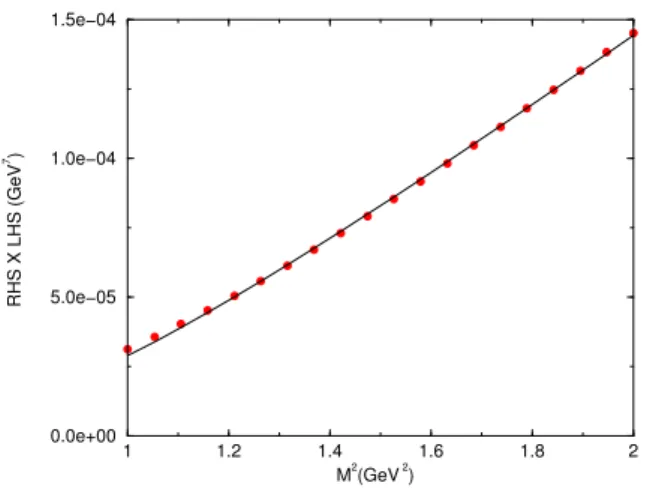
In Fig. 1 we show, through the dots, the right-hand side (RHS) of Eq.(6) as a function of the Borel mass. We use
the same Borel window as defined in ref.[8]. To deter-mine gD(0+)Dπ we fit the QCDSR results with the analyti-cal expression in the left-hand side (LHS) of Eq.(6). Us-ing √s0 =2.7 GeV we get: C =1.25×10⁻³ GeV7 and A=1.47×10⁻³GeV7. Using the definition ofCin Eq.(7) and
λ0=3.3×10⁻³GeV5(the value obtained for√s0=2.7 GeV) we get gD(0+)Dπ =6.94 GeV. Allowing s0 to vary in the interval 2.6≤√s0≤2.8 GeV, the corresponding variation obtained for the coupling constant is 5 GeV≤gD(0+)Dπ ≤ 7.5 GeV.
The coupling constant,gD(0+)Dπ, is related to the partial de-cay width through the relation:
58 Brazilian Journal of Physics, vol. 37, no. 1, March, 2007
1 1.2 1.4 1.6 1.8 2
M2 (GeV 2
) 0.0e+00
5.0e−05 1.0e−04 1.5e−04
RHS X LHS (GeV
7)
FIG. 1: Dots: the RHS of Eq.(6), as a function of the Borel mass. The solid line gives the fit of the QCDSR results through the LHS of Eq.(6).
= 1
16πm3D(0+)
g2D(0+)Dπ
q λ(m2
D(0+),m2D,m2π), (8)
whereλ(a,b,c) =a2+b2+c2−2ab−2ac−2bc. Allowing s0to vary in the range discussed above we get:
Γ(D0(0+)→D+π−) = (120±20)MeV. (9) In Table III we show the partial decay width obtained in ref. [15], in ref. [13] and here for different decays. From the
results in Table III we see that if one usesGA=0.6, the result
presented here and the result in ref. [13] are consistent with the results presented in ref. [15] for both decays.
Table III:Numerical results for the resonance partial decay widths
from different approaches
decay ref. [15] ref. [13] this work D+sJ→D+sπ0 21.5G2AkeV (6±2)keV
D0(0+)→D+π− 326G2
AMeV 120±20 MeV
It is important to notice that the BELLE Collaboration [20] has reported the observation of a rather broad scalar meson D∗0
0 (2308)in the decay modeD∗00(2308)→D+π−with a to-tal widthΓ∼270 MeV. Although both, the mass and the total decay width reported in [20], are bigger than the values found for the mesonD(0+)studied here, we can not discard the possibility that the BELLE’s resonance can be interpreted as a four-quark state.
We have presented a QCD sum rule study of the ver-tex function associated with the strong decay D0(0+)→ D+π−, where the scalar D(0+) meson was considered as diquark-antidiquark state. We get for the partial decay width:
Γ(D0(0+)→D+π−) = (120±20)MeV.
Acknowledgements
This work has been supported by CNPq and FAPESP.
[1] BABAR Coll., B. Auberet al., Phys. Rev. Lett. 90, 242001 (2003); Phys. Rev. D69, 031101 (2004).
[2] CLEO Coll., D. Bessonet al., Phys. Rev. D68, 032002 (2003). [3] BELLE Coll., S.-L. Choiet al., Phys. Rev. Lett.91, 262001
(2003).
[4] for a review see E. S. Swanson, Phys. Rept.429, 243 (2006). [5] M. Gell-Mann, Phys. Lett.8, 214 (1964).
[6] R. L. Jaffe, Phys. Rev. D15, 267, 281 (1977); D17, 1444 (1978).
[7] for a review see F.E. Close and N.A. T ¨ornqvist, J. Phys. G28, R249 (2002).
[8] M. E. Bracco, A. Lozea, R. D. Matheus, F. S. Navarra, and M. Nielsen, Phys. Lett. B624, 217 (2005).
[9] R. Matheus, S. Narison, M. Nielsen, and J.-M. Richard, hep-ph/0608297.
[10] M. A. Shifman, A. I. and Vainshtein, and V. I. Zakharov, Nucl. Phys., B147, 385 (1979).
[11] L. J. Reinders, H. Rubinstein, and S. Yazaky, Phys. Rep.127, 1 (1985).
[12] S. Narison,QCD spectral sum rules , World Sci. Lect. Notes Phys.26, 1;QCD as a theory of hadrons, Cambridge Monogr. Part. Phys. Nucl. Phys. Cosmol. 17, 1-778 (2002) [hep-h/0205006].
[13] M. Nielsen, Phys. Lett. B634, 35 (2006).
[14] F. S. Navarra and M. Nielsen, Phys. Lett. B639, 272 (2006). [15] W. A. Bardeen, E. J. Eichten, C. T. Hill, Phys. Rev. D68,
054024 (2003).
[16] S. Narison, Phys. Lett. B175, 88 (1986); S. Narison and R. Tarrach, Phys. Lett. B125, 217 (1983).
[17] T. V. Brito, F. S. Navarra, M. Nielsen, and M. E. Bracco, Phys. Lett. B608, 69 (2005).
[18] R. S. Marques de Carvalho, F. S. Navarra, M. Nielsen, E. Fer-reira, and H. G. Dosch, Phys. Rev. D60, 034009 (1999). [19] CLEO Coll., M. Artuso et al., Phys. Rev. Lett. 95, 251801
(2005).