Carolina Novaes CarvalhoI,II Ines DouradoIII
Ana Luiza BierrenbachIV
I Departamento de Apoio à Gestão da Vigilância em Saúde. Secretaria de Vigilância em Saúde. Ministério da Saúde. Brasília, DF, Brasil
II Programa de Pós-Graduação em Saúde Coletiva. Instituto de Saúde Coletiva (ISC). Universidade Federal da Bahia (UFBA). Salvador, BA, Brasil
III ISC-UFBA. Salvador, BA, Brasil IV Tuberculosis Monitoring and Evaluation
Unit. STOP TB Department. Organização Mundial da Saúde. Genebra, Suíça Correspondence:
Carolina Novaes Carvalho
Departamento de Apoio à Gestão da Vigilância em Saúde – DAGVS
Secretaria de Vigilância em Saúde – SVS Ministério da Saúde
Esplanada dos Ministérios – Bloco G Edifício sede – Sala 110 – Asa Sul 70058-900 Brasília, DF, Brasil E-mail: [email protected] Received: 6/6//2010
Approved: 11/14/2010
Article available from: www.scielo.br/rsp
Underreporting of the
tuberculosis and AIDS
comorbidity: an application of
the linkage method
ABSTRACT
OBJECTIVE: To analyze the underreporting of the tuberculosis (TB) and AIDS comorbidity.
METHODS: Surveillance study using records from the Notifi able Diseases Information System – Tuberculosis and AIDS in Brazil from 2000 to 2005. Records of TB without information on the presence of Aids were considered to be underreporting of the comorbidity when paired off with AIDS records in which the year of diagnosis of AIDS was the same or previous to the year of reporting of TB, as well as records from the same patient whose previous records had this information. An indicator was created: recognized TB-AIDS comorbidity, based on the TB records that had information on the presence of AIDS.
RESULTS: The underreporting of TB-AIDS was 17.7%. This percentage varied between states. The incorporation of the underreported records into the previously recognized ones increased the proportion of TB-AIDS in Brazil from 6.9% to 8.4%. The highest proportions of underreporting were noted in Acre (Northern), Alagoas, Maranhão and Piauí (Northeastern) (more than 35% each) and the lowest in São Paulo (Southeastern) and Goiás (Central-western) (around 10% each).
CONCLUSIONS: The underreporting of the TB-AIDS comorbidity found in Brazil will probably trigger modifi cations in the surveillance system in order to provide information for the national programs.
DESCRIPTORS: Underregistration. HIV Infections. Acquired Immunodefi ciency Syndrome. Tuberculosis. Comorbidity. Registries Disease Notifi cation. Matched-Pair Analysis.
INTRODUCTION
Underreporting of a health condition whose reporting is compulsory occurs when a case is not reported to the information system, or when it occurs outside the established period.9 Wrong estimates of the magnitude of diseases
may derive from this, which negatively affects the planning of prevention and control strategies and may lead to under allocation of actions and resources.11
contribute to the underreporting of cases.3,a In addition,
patients or their relatives sometimes request secrecy in relation to the diagnosis of diseases like tuberculosis (TB) and AIDS, even though they know it is a necessary information for offi cial purposes.9
The coinfection by the TB bacillus and the human immunodeficiency virus (HIV), and their mutual interference in the evolution of TB and AIDS, have demanded the strengthening of the surveillance network in Brazil. The Programa Nacional de Controle da TB
(PNCT – National Program for TB Control) and the program directed at sexually transmissible diseases (STD/AIDS) started to establish joint epidemiological surveillance strategies in 2004 and made obligatory the offer of the HIV test for new TB cases, with the need of the patient’s consent to testing. However, the magnitude of the association between these two diseases may not be apparent if comorbidity cases are not reported.1
The aim of the study was to analyze the underreporting of the TB-AIDS comorbidity in Brazil.
METHODS
Surveillance study with data from Sistema de Informação de Agravos de Notifi cação de Tuberculose
(SINAN-TB – National Information System for Tuberculosis Notifi cation) from 2000 to 2005 and from the AIDS national database from 1980 to 2005. This database results from the consolidation of information systems such as: Sistema de Informação de Agravos de Notificação de Aids (SINAN-AIDS – National Information System for AIDS Notifi cation), Sistema de Controle de Exames Laboratoriais (SISCEL – Laboratory Tests Control System), Sistema de Controle Logístico de Medicamentos (SICLOM – System for Logistic Control of Medicines), Sistema de Informação de Mortalidade (SIM – Mortality Information System).7
The SINAN-TB database was extracted in February 2007 and the AIDS national database in April 2007. Both underwent data quality analysis for the recognition, classifi cation and removal of duplicate records (presence of more than one record of the same patient) by means of probabilistic linkage, as described in the literature.2,10
The depuration process applied to SINAN-TB respected the structural logic of SINAN, according to which records of patients in the fi rst treatment episode or in subsequent treatment episodes (retreatments due to return after default or relapse after cure) should be maintained. Records of the same patient in one treat-ment episode, but coming from different healthcare
a Glatt R. Análise da qualidade da base de dados de aids do Sistema de Informação de Agravos de Notifi cação (Sinan) [Master’s dissertation]. Rio de Janeiro: Escola Nacional de Saúde Pública da Fiocruz; 2004.
b Centers for Disease Control and Prevention. Link Plus Program. Atalanta; 2007[cited 2010 Feb 09]. Available from http://www.cdc.gov/ cancer/npcr/tools/registryplus/lp_tech_info.htm
units were linked (transfers). Records of the same patient in different treatment episodes were maintained in the database, chronologically ordered by date of diag-nosis, report and treatment onset. For the linkage with SINAN-AIDS, the fi rst record of each patient was used. In the structural logic of the AIDS national database, each patient should have only one record. This database had 419,795 records, each referring to one patient. Of this total, 99,276 (23.7%) had died before 2000 (current situation/date of death) and were not used for the linkage. The linkage between databases was performed in two consecutive cycles, the second to enhance linkage sensi-tivity. The fi rst cycle had three stages: pre-processing of the database, probabilistic linkage and identifi cation of true matching pairs. In pre-processing, the databases underwent reformatting of the variables: date of report; date of diagnosis; date of birth; and corrections in the variables: patient’s name; patient’s mother’s name. Besides, the most common non-discriminatory addresses were removed, like those of the penitentiary system, and any mentions referring to the patient not having a home or that it was unknown (homeless, street dweller, etc.). In the probabilistic linkage, the following variables were used: patient’s name, mother’s name, and date of birth. The sex variable was used to divide the databases into smaller blocks and increase linkage speed. The probabilities used in the linkage were extracted by indirect method. The identifi cation of linked records was performed by the program Link Plus,b which calculates
the probability of agreement and disagreement of the variables selected for linkage. The higher the score, the higher the probability that the linked pair refer to the same individual. The value three was empirically defi ned as the cutoff point, above which the program should list the linked pairs. True matching pairs were the ones in which both records belonged to the same individual, confi rmed by manual depuration. To achieve this, information on age was also considered, as well as federative unit, municipality of residence, street and number. When in doubt, we decided on the conservative alternative of not considering the linked records as true matching pairs. Manual revision was carried out on pairs with scores from three to 13.5. Those with scores from 13.5 to 23.5 (the highest value found) were considered true matching pairs without manual revision.
Sex remained as the blocking variable and the cutoff point was altered to 0.1. After a new manual depuration, the true matching pairs were tagged in the original databases of SINAN-TB and AIDS.
The comorbidity records identified in SINAN-TB belonged to four types:
• type 1 – fi rst or only record of each patient linked to a record of the AIDS national database; • type 2 – patients with multiple records, with the fi rst
linked to a record of the AIDS national database. In case of linkage between one record of SINAN-TB and the AIDS database, all records of the same patient were considered linked. If the year of TB report was previous to the year of AIDS diagnosis, the record would not be considered TB-AIDS because, in 2000, pulmonary TB (the most prevalent form of the disease) was not considered an AIDS defi ning condition in the CDC Modifi ed criterion;12
thus, these records might characterize a coinfection condition and not a comorbidity;
• type 3 - health conditions associated with AIDS not linked to the AIDS national database, i.e., which were not type 1 or 2. This variable should be fi lled with one of the mutually exclusive values: AIDS, alcoholism, mental disease, diabetes and others; • type 4 – without information on AIDS associated
health condition, not found by means of linkage with the AIDS national database, but with informa-tion on AIDS associated health condiinforma-tion in one of the previous records of the same patient.
The identifi ed TB-AIDS records (sum of type 1 to 4 records) were classifi ed into two conditions: a) recog-nized comorbidity, in which the information that the patient had AIDS was fi lled in the variable associated health conditions, and b) underreporting of the comor-bidity, in which the information that the patient had AIDS was not fi lled for this variable.
Possible associations were analyzed between recog-nized comorbidity or underreporting and sex, age group, type of admission (new case, relapse, return after default and transfer), clinical form (pulmonary, extrapulmonary, pulmonary + extrapulmonary), HIV status (positive, negative, ongoing, not performed or without information), sputum bacilloscopy (positive, negative, not performed) and treatment outcome (cure, default, death, transfer or multiresistant TB). The chi-square test was employed to evaluate statistically signifi cant differences between levels of these variables. The completeness of the variables HIV and associated health conditions was also analyzed.
The results obtained in the linkage were made available to health professionals involved in epidemiological surveillance actions. Individuals’ identifi cation data used in the linkage were not disclosed, ensuring the secrecy and confi dentiality of this information. The statistical program Stata 9.0 was utilized in the pre-processing of the database, in the manual depuration of the pairs, in the tagging of the true matching pairs in the original databases and in the analysis.
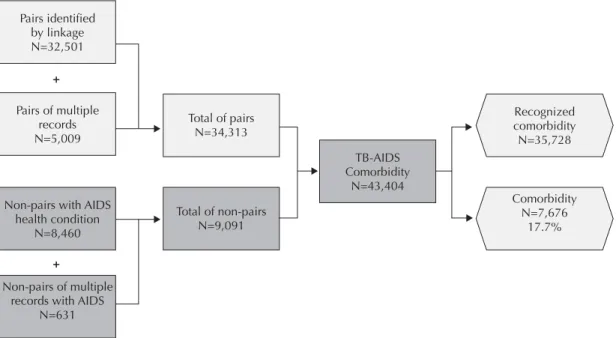
Figure 1. Classifi cation of records of SINAN-TBa according to TB-AIDS comorbidity. Brazil, 2000-2005. Pairs identified
by linkage N=32,501
+
+
Non-pairs with AIDS health condition
N=8,460
Non-pairs of multiple records with AIDS
N=631
Total of pairs N=34,313
TB-AIDS Comorbidity
N=43,404
Recognized comorbidity N=35,728
Comorbidity N=7,676
17.7% Total of non-pairs
N=9,091 Pairs of multiple
records N=5,009
a SINAN-TB: Sistema de Informação de Agravos de Notifi cação de Tuberculose (National Information System for Tuberculosis
RESULTS
In the study, 99,262 linked records were identifi ed, 32,501 classifi ed as true matching pairs (type 1). A total of 5,009 type 2 comorbidity records were found, followed by 8,460 type 3 records and 631 type 4 records. Of 43,404 comorbidity records in the sum of the four types, 35,728 (82.3%) were of comorbidity with information of AIDS associated health condition, and 7,676 (17.7%) were underreporting recognized by linkage (16.2%) or because they were multiple records of patients with information of AIDS associated health condition in a previous record (1.5%) (Figure 1). A total of 8,804 records was identifi ed in the AIDS national database from 2000 to 2005 that presented TB at the moment of the diagnosis, but not linked to records of SINAN-TB and, consequently, not consi-dered comorbidity cases.
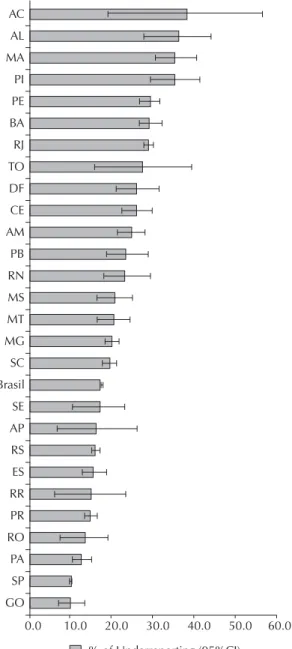
The proportion of underreporting was gradually reduced throughout the studied period, with a mean of 17.7% in the entire period. The proportion of recognized comorbidity was 6.9% and rose to 8.4% (a 21.4% increase; Table 1). The highest underreporting proportions were observed in Acre, Alagoas, Maranhão and Piauí (more than 35% each) and the lowest in São Paulo and Goiás (around 10% each) (Figure 2). Records of recognized comorbidity and underreporting had distinct characteristics for all the studied variables. The underreporting records presented more advanced age, predominance of new cases, of the pulmonary clinical form, of positive sputum bacilloscopy, of nega-tive HIV test result and of default as outcome. These differences were more remarkable for HIV status and clinical form of TB: while the records of recognized comorbidity presented 93.9% (and not 100%) of HIV-positive result and 58.6% of pulmonary clinical form, the comorbidity underreporting records presented 58.3% of HIV-positive and 70.3% of pulmonary clinical form (Table 2).
Although the proportion of records without information on associated health conditions decreased throughout the period, it still represented the majority of records in 2005 (74.8%). The proportion of records without infor-mation on HIV status also decreased over the studied period, reaching 64% in 2005 (Table 3).
DISCUSSION
This study estimated 17.7% of underreporting of the TB-AIDS comorbidity, a phenomenon that has already been described for TB-AIDS and other diseases.3,7,9,c
Reporting reliable number of patients with TB-AIDS is essential for the adequate planning of control measures and to provide effi cient care for the patient. In addition, a very serious matter would be characterized if TB cases
c Elkhoury ANSM. Avaliação dos registros de Morbimortalidade da Leishmaniose Visceral em Sistema de informações do SUS [tese de doutorado] Salvador: Instituto de Saúde Coletiva da UFBA;2005.
Source: Sinan/ CGDT/ DEVEP/ SVS/ MS
AC: Acre; AL: Alagoas; MA: Maranhão; PI: Piauí; PE: Pernambuco; BA: Bahia; RJ: Rio de Janeiro; TO: Tocantins; DF: Distrito Federal; CE: Ceará; AM: Amazonas; PB: Paraíba; RN: Rio Grande do Norte; MS: Mato Grosso do Sul; MT: Mato Grosso; MG: Minas Gerais; SC: Santa Catarina; SE: Sergipe; AP: Amapá; RS: Rio Grande do Sul; ES: Espírito Santo; RR: Roraima; PR: Paraná; RO: Rondônia; PA: Pará; SP: São Paulo; GO: Goiás.
Figura 2. Proportion and confi dence interval of the under-reporting of the TB-AIDS comorbidity by federation unit. Brazil, 2000-2005.
AC
AL
MA
PI
PE
BA
RJ
TO
DF
CE
AM
PB
RN
MS
MT
MG
SC
Brasil
SE
AP
RS
ES
RR
PR
RO
PA
SP
GO
% of Underreporting (95%CI)
with AIDS might not have been identifi ed by PNCT for patients whose records lacked the comorbidity information. The information on the presence of the comorbidity is fundamental to inform the follow-up of the patients, since the natural history of TB is modifi ed by AIDS, with increase in recurrence, as well as its clinical presentation, treatment duration and tolerance and resistance against the available drugs.6,8,d
To increase the completeness of the health conditions associated with AIDS, it is important to increase the completeness of the HIV status variable. The health professionals that follow the case up and the ones who fi ll in the follow-up card of SINAN-TB must pay attention to fi ll in the health conditions associated with AIDS in the records of HIV-positive patients. It is necessary not only to ensure the performance of the test for all those who consent to it, but also to ensure that the results are entered into the information systems as soon as they are available. The lower the proportion of patients with TB tested for HIV and HIV-positive patients reported in SINAN-TB, the higher the uncer-tainty about the real prevalence of HIV among TB patients. According to SINAN-TB data, the prevalence of HIV would be 8.2% in 2005, below the 14% that had been estimated by the World Health Organization (WHO) for Brazil for the same year.e
PNCT is responsible for feedbacking the analyses of notifi cation data to the health professionals that follow up cases and fi ll in the reports so that they understand the importance of fi lling in the records adequately and feel motivated to improve the quality of the collected
data. Furthermore, it is essential that these professionals are instructed in topics of TB epidemiology that are important to the execution of their work. For example, they should be warned that, although patients with extra-pulmonary TB have higher risk of having the TB-AIDS comorbidity,4 those with pulmonary TB may also present
it, and therefore the comorbidity information should be reported both to the extrapulmonary and to the pulmo-nary forms, which was not happening properly. The modifi cation of the variable “associated health conditions” was identified as one of the necessary measures to improve the data entry process. Given the structure of the variable, it was possible to inform the presence of only one health condition at a time. This modifi cation has already been incorporated into the last versions of SINAN-TB, in which each comorbidity is now registered in a specifi c fi eld, marked with the values that indicate its presence, absence or lack of information.f
The main measure to prevent the underreporting of the comorbidity in SINAN-TB would be to enhance collaboration between the control programs, as recommended by the WHO.d Information exchange
between the two programs should occur routinely in all administrative levels to ensure knowledge of the comorbidity condition and early access to measures of prevention and treatment.
The probabilistic linkage between the databases of SINAN-TB and the AIDS national database may contribute to improve the quality of their data. The underreporting of TB-AIDS per federation unit
Table 1. Records of SINAN-TB according to the TB-AIDS comorbidity by year of reporting. Brazil. 2000-2005.
Year TB records
Recognized
comorbiditya Underreporting of comorbidityb Total comorbidityIncrease in
N n % n % n % %
2000 81,478 5,042 6.2 1,446 22.3 6,488 8.0 28.7
2001 82,844 5,248 6.3 1,486 22.1 6,734 8.1 28.3
2002 88,082 6,192 7.0 1,288 17.2 7,480 8.5 20.8
2003 89,657 6,298 7.0 1,215 16.2 7,513 8.4 19.3
2004 88,297 6,487 7.3 1,140 14.9 7,627 8.6 17.6
2005 87,619 6,461 7.4 1,101 14.6 7,562 8.6 17.0
Total 517,977 35,728 6.9 7,676 17.7 43.404 8.4 21.5 SINAN-TB: Sistema de Informação de Agravos de Notifi cação de Tuberculose (National Information System for Tuberculosis Notifi cation)
a Recognized comorbidity: tuberculosis records with aids associated health condition
b Underreporting of comorbidity: tuberculosis records without the information on aids associated health condition identifi ed
by the study
d World Health Organization. Interim policy on collaborative TB/HIV activities. Geneva; 2004[cited 2010 Mar 06]. Available from: http:// whqlibdoc.who.int/hq/2004/WHO_HTM_TB_2004.330_eng.pdf
e Joint United Nations Programme on HIV/Aids. Report on the global AIDS epidemic: Executive Summary. 2006. UNAIDS/06.20E. Geneva; 2006. [cited 2010 Mar 06]. Available from: http://data.unaids.org/pub/GlobalReport/2006/2006_gr-executivesummary_en.pdf
presented here can be compared to that of places that introduce the measures proposed here to prevent this underreporting. Periodicity and the administrative level responsible for the linkage should be defi ned taking into account the burden of both diseases and the availability and local capacity of human resources, in view of the fact that this activity demands time and relatively skilled work. The comorbidity condition described by the linkage at any level must be imme-diately transferred to the healthcare units responsible for the follow-up and reporting of the cases.
In relation to the limitations of the study, false records of comorbidity underreporting may have been iden-tifi ed if linked records were erroneously considered as being of the same patient. This situation is impro-bable given the rigorous manual depuration that was performed. Problems in the quality of the information of the variables selected to the linkage or limitations intrinsic to the Link Plus program may have compro-mised the identifi cation of records of comorbidity underreporting. There is no gold standard that allows ascertaining the sensitivity of this program. These
Table 2. Sociodemographic and clinical variables according to recognized comorbidity and underreporting. Brazil, 2000-2005.
Variables Recognized comorbidity Underreporting of comorbidity p
n = 35,728 % n = 7,676 %
Sex
Male 25,333 70.9 5,681 74.0
< 0.001
Female 10,395 29.1 1,995 26.0
Age group (years)
< 13 822 2.3 122 1.6
< 0.001
≥ 13 34,906 97.7 7,554 98.4
Type of admission
New case 27,088 75.8 5,738 74.7
< 0.001
Relapse after cure 3,166 8.9 592 7.7
Re-admission after abandonment 4,740 13.3 1,109 14.5
Transfer 697 1.9 127 1.7
No information 37 0.1 110 1.4
Clinical form of TB
Pulmonary 20,951 58.6 5,395 70.3
< 0.001
Extrapulmonary 10,109 28.3 1,645 21.4
Pulmonary + extrapulmonary 4,668 13.1 546 7.1
No information 0 0.0 90 1.2
HIV Status
Positive 33,537 93.9 4,475 58.3
< 0.001
Negative 214 0.6 383 5.0
Ongoing 493 1.4 978 12.7
Not performed 1,432 4.0 1,595 20.8
No information 52 0.1 245 3.2
Sputum bacilloscopy
Positive 11,487 32.2 3,041 39.6
< 0.001
Negative 11,563 32.4 2,082 27.1
Not performed 12,678 35.4 2,466 32.1
No information 0 0.0 87 1.1
Closing situationa
Cure 15,408 43.1 3,320 43.3
< 0.001
Abandonment 5,910 16.5 1,372 17.9
Death 7,675 21.5 1,334 17.4
Transfer 2,933 8.2 721 9.4
Multi-resistant TB 29 0.1 9 0.1
No information 3,773 10.6 920 11.9
Source: Sinan/ CGDT/ DEVEP/ SVS/ MS
reasons may explain at least part of the 8,804 records in the AIDS national bank from 2000 to 2005 with TB when AIDS was diagnosed that were not linked to SINAN-TB. Another possibility is the non-existence of records corresponding to the AIDS national database in SINAN-TB, which would denote underreporting not only of the comorbidity condition, but also of the reporting of the TB case. This amount was not added to the total comorbidity records to avoid duplication of cases, which would happen if the correspondents records of SINAN-TB also indicated AIDS. However, if added, the comorbidity proportion of the total TB records would rise from 6.9% to 10.1%, and the under-reporting from 17.7% to 38%. The real proportion of comorbidity underreporting should be understood within this interval.
Another possible limitation of the study would be the
non-utilization of the capture-recapture method, which, in theory, would estimate the total of TB-AIDS cases in Brazil beyond those contained in the studied databases. We chose not to use this method due to the absence of a third source of TB-AIDS data. The use of more than two data sources is essential so that these studies are consi-dered valid. Without this, it is impossible to ascertain and control for independence between sources, which is one of its fundamental premises.5
The underreporting of the TB-AIDS comorbidity in Brazil will probably trigger modifi cations in the surveillance system of these health conditions that offer information to national programs. This information is essential to enhance the quality of the system regarding the development of activities of data collection and analysis, besides greater incentive to and valuation of the health professionals.
Table 3. Non-fi lling of the associated health conditions and HIV variables. Brazil, 2000-2005.
Year TB records No information on associated health condition
a No information on HIVb
n n % n %
2000 81,478 76,124 93.4 60,395 74.1
2001 82,844 75,892 91.6 61,013 73.6
2002 88,082 74,601 84.7 62,600 71.1
2003 89,657 70,197 78.3 62,029 69.2
2004 88,297 66,816 75.7 58,644 66.4
2005 87,619 65,558 74.8 56,055 64.0
Total 517,977 429,188 82.9 360,736 69.6
1. Balogun MA, Wall PG, Noone A. Undernotifi cation of tuberculosis in patients with AIDS. Int J STD AIDS. 1996;7(1):58-60. DOI:10.1258/0956462961917087
2. Bierrenbach AL, Stevens AP, Gomes ABF, Noronha EF, Glatt R, Carvalho CN, et al. Efeito da remoção de notifi cações repetidas sobre a incidência de tuberculose no Brasil. Rev Saude Publica. 2007;41Suppl 1:67-76. DOI:10.1590/S0034-89102007000800010
3. Ferreira VMB, Portela MC, Vasconcellos MTL. Fatores associados à subnotifi cação de pacientes com Aids no Rio de Janeiro, RJ, 1996. Rev Saude Publica. 2000;34(2):170-7. DOI:10.1590/S0034-89102000000200011
4. Getahun H, Harrington M, O’Brien R, Nunn P. Diagnosis of smear-negative pulmonary tuberculosis in people with HIV infection or Aids in resource-constrained settings: informing urgent policy changes. Lancet. 2007;369(9578):2042-9 DOI:10.1016/S0140-6736(07)60284-0
5. Hook EB, Regal RR. Capture-recapture methods in epidemiology: methods and limitations. Epidemiol Rev. 1995;17(2):243-64.
6. Lima MM, Belluomini M, Almeida MMMB, Arantes GR. Co-infecção HIV/ tuberculose: necessidade de uma vigilância mais efetiva. Rev Saude
Publica. 1997;31(3):217-20. DOI:10.1590/S0034-89101997000300001
7. Lucena FDF, Fonseca MGP, Sousa AIA, Coeli CM. O Relacionamentode bancos de dados na implementação da vigilância da Aids. Relacionamento de dados e vigilância da Aids. Cad Saude Colet. 2006;14(2):305-12.
8. Maher D, Raviglione M. Global epidemiology of tuberculosis. Clin Chest Med. 2005;26(2):167-82. DOI:10.1016/j.ccm.2005.02.009
9. Oliveira MTDC, Barreira D, Santos LCO, Latorre MRDO. A subnotifi cação de casos de Aids em municípios brasileiros selecionados: uma aplicação do método de captura-recaptura. Bol Epidemiol AIDS. 2004;18(1):7-11.
10. Pascom ARP, Lucena FDF, Medeiros MGF. Metodologia de revisão da base de dados do sistema de notifi cação de casos de aids - SINAN-Aids. Bol Epidemiol AIDST. 2004;1:42-5.
11. Pillaye J, Clarke A. An evaluation of completeness of tuberculosis notifi cation in the United Kingdom. BMC Public Health. 2003;3:31. DOI:10.1186/1471-2458-3-31
12. Programa Nacional de DST e Aids. Nova defi nição de caso de aids em adultos e crianças - 2004. Bol Epidemiol AIDS. 2004;1(17):1-52.
REFERENCES
This study is based on the Master’s dissertation of Carvalho CN, submitted to the Programa de Pós-Graduação em Saúde Pública do Instituto de Saúde in 2008.