Leonardo Lemos de Souza
Juvenal Soares Dias da Costa
Programa de Pós-Graduação em Saúde Coletiva. Universidade do Vale do Rio dos Sinos. São Leopoldo, RS, Brasil
Correspondence:
Juvenal Soares Dias da Costa Universidade do Vale do Rio dos Sinos Av. Unisinos, 950
Cristo Rei
93022-000 São Leopoldo, RS, Brasil E-mail: [email protected] Received: 5/11/2010 Approved: 2/28/2011
Article available from: www.scielo.br/rsp
Hospitalization for primary
care-sensitive conditions in
regional health districts in
Southern Brazil
ABSTRACT
OBJECTIVE: To compare rates of hospitalization for primary care-sensitive conditions in the major municipalities of regional health districts.
METHODS: An ecological study was carried out with both male and female subjects aged 20 to 59 years in the major municipalities of regional health districts in the state of Rio Grande do Sul, Southern Brazil, between 1995 and 2007. Hospitalization data were obtained from the database of the Brazilian Health Care System (DATASUS). Rates by Poisson regression with robust variance were analyzed. Rates for each municipality were compared to those of the remainder of the Rio Grande do Sul state excluding the major municipalities of each district.
RESULTS: There was a reduction in the rates of hospitalization for primary care-sensitive conditions in all municipalities, with the exception of Porto Alegre (1.01) and Osório (1.02). Among larger municipalities, the greatest reductions were observed in Santa Maria (0.92) and Pelotas (0.93). Rates in medium-sized municipalities showed a decrease towards the end of the study period. Among small municipalities, only Lajeado and Frederico Westphalen showed rates lower than those of the rest of the state in 2007. The highest rates were found in the smallest municipalities.
CONCLUSIONS: There was a trend towards a reduction in hospitalizations in almost all municipalities, possibly due to the expansion of primary health care that took place even prior to the implementation of the Family Health Program and changes in management. The high rates of hospitalization in small municipalities suggest that hospitalization for primary care-sensitive conditions may be a means of justifying an idle supply of hospital beds.
DESCRIPTORS: Hospitalization, trends. Quality Indicators, Health Care. Primary Health Care. Health Services. Ecological Studies.
INTRODUCTION
Hospitalizations for primary care-sensitive conditions (HPCSC) were proposed as an indicator of effectiveness by Bilings et al4 in the United States in the 1990’s.
HPCSC monitoring can be useful when evaluating health care management. These conditions can also provide a useful indicator of the quality of access
to,10,11,18,19 and of the performance of7,13,24 the primary
health care system, providing evidence of the effective-ness of health-related initiatives.9,16,21
The Plano Nacional de Saúde/Pacto pela Saúde (Brazilian National Health Plan/Pact for Health) requires municipalities to establish advanced manage-ment strategies, which in turn generates a need for mechanisms to monitor the performance of health care services and the overall health of the population. These management strategies need to incorporate the concepts of regionalization and hierarchic organization of health care services in order to facilitate access and achieve greater equity. Primary health care, when qualifi ed and effective, serves as a basis for the entire health care system, and contributes substantially to the quality of life of a population.15,22
In the state of Rio Grande do Sul, Southern Brazil, the health care system is organized into regional health districts, whose major municipalities provide services of greater complexity. Macro-regions are composed of neighboring communities organized according to criteria of regionalization, hierarchical level, and complexity of the services provided.
The objective of the present study was to compare the occurrence of HPCSCs in the major municipalities of the regional health districts of the state of Rio Grande do Sul, as a means of evaluating the effectiveness of primary health care.
METHODS
We carried out an ecological study of male and female subjects, aged 20 to 59 years, living in the major municipalities of each of the regional health districts of the state of Rio Grande do Sul between 1995 and 2007. Rio Grande do Sul has 19 health districts: Porto Alegre (1,360,590 inhabitants), with two districts; Pelotas (323,158 inhabitants); Erechim (90,347 inhabitants); Santa Maria (243,611 inhabitants), Santo Ângelo (76,745 inhabitants); Caxias do Sul (360,419 inhabit-ants); Santa Cruz do Sul (107,632 inhabitinhabit-ants); Passo Fundo (168,458 inhabitants); Santa Rosa (85,016 inhabitants); Bagé (118,767 inhabitants); Palmeira das Missões (38,192 inhabitants); Cachoeira do Sul (87,873 inhabitants); Lajeado (64,133 inhabitants); Cruz Alta (71,254 inhabitants); Ijuí (78,461 inhabitants); Alegrete (84,338 inhabitants); Osório (36,131 inhabitants), and Frederico Westphalen (26,759 inhabitants).
Data on hospital admissions were obtained from the DATASUS website (Brazilian Nation Health Care System’s Information Database’s Morbidity and
Epidemiological Information/Hospital Information System). This included number of hospitalizations according to place of residence, age group, and chapter of the International Classifi cation of Diseases, 9th (ICD-9) and 10th (ICD-10) Revisions, as well as
population data (required for the calculation of rates), according to age group and sex, beginning in 1979. Diseases classifi ed as PCSC were selected by expert committees and have been used in other studies of the effectiveness of primary health care:3,5,23
• Diabetes mellitus, codes 181 (ICD-9) and E10-E14 (ICD-10); cardiac insuffi ciency, codes 428 (ICD-9) and I50 (ICD-10); systemic arterial hypertension, codes 401 (ICD-9) and I10/I11 (ICD-10); chronic obstructive pulmonary disease (COPD), defi ned as chronic bronchitis and unspecifi ed bronchitis, emphysema or asthma (490-493) in ICD-9 and as bronchitis, emphysema, and other COPD (J40-J43) and asthma (J45) in ICD-10); pneumonia: codes 480-486 (ICD-9) and J18(ICD-10); and immuno-preventable diseases (comprising poliomyelitis, diphtheria, tetanus, whooping cough, and measles), with the following codes: whooping cough, 033 (ICD-9) and A37 (ICD-10); diphtheria, 032 (ICD-9) and A36 (ICD-10); tetanus, 037 (ICD-9) and A35 (ICD-10); measles, 055 (ICD-9) and B05 (ICD-10); poliomyelitis, 045 (ICD-9) and A80 (ICD-10). DATASUS data used ICD-9 codes from 1995 to 1997 and ICD-10 codes from 1998 onwards.
Data are presented according to municipality. Municipalities were classifi ed as large (above 115,000 inhabitants), medium (from 75,000 to 115,000 inhabit-ants), and small (up to 75,000 inhabitants). Such divi-sion was done in order to better visualize the temporal characteristics of the major municipalities in each health district in terms of the diseases studied, and in order to maintain balance between the three different groups. We used Excel® spreadsheets to calculate the number
of admissions per condition and the population of each municipality in the period.
a Rosenberg D. Trend Analysis and Interpretation. Key Concepts and Methods for Maternal and Child Health Professionals. Maryland: Division of Science, Education and Analysis Maternal and Child Health Information Center; 1997.
HPCSC rates were analyzed by Poisson regression with robust variation,a using Stata v.9.0 software (Stata Corp,
College Station, United States). The Poisson regression coeffi cient shows the variation in the rates for each municipality between different years.
The present research project was approved by the Research Ethics Committee of Universidade do Vale do Rio dos Sinos, resolution number 053/2007 of 23 August 2007.
RESULTS
Practically all municipalities showed a reduction in rates of hospitalization for the causes under inves-tigation, leading to descending curves which were confi rmed by Poisson regression.
In large municipalities, the greatest declining trend was observed in Santa Maria, followed by Pelotas. The municipality of Porto Alegre was the only one in the “large” category that did not show a decrease in rates. HPCSC rates decreased in all six municipalities in the “medium” category. The greatest decline was observed in the city of Ijuí, followed by Alegrete. With the excep-tion of Osório, rates declined in all municipalities in the “small” category according to Poisson regression. The greatest reductions were seen in Lajeado and Palmeira das Missões (Table 1).
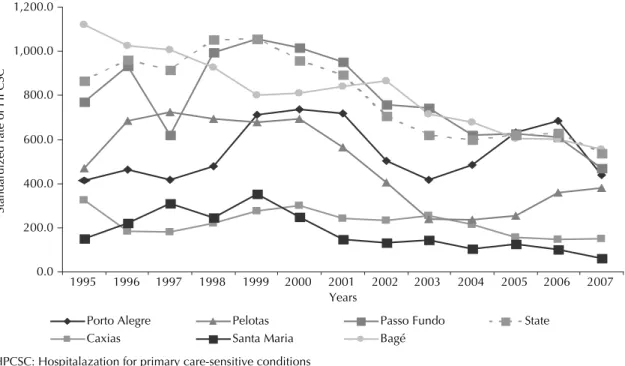
HPCSC rates in the major municipalities of each regional health district classifi ed as “large” were similar to those of the rest of the state, with the exception of Santa Maria and Caxias do Sul, where rates were 20% and 50% lower, respectively. In 2007, with the exception of Bagé, all rates were lower than those of the rest of the state. Rates in Pelotas, Santa Maria, Caxias do Sul, and, until 2004, Porto Alegre, remained constantly lower than those of the rest of the state of Rio Grande do Sul (Figure 1). Cities in the “medium” category showed lower rates of HPCSC in comparison to the beginning of the period. There was a trend towards an increase in rates between 1996 and 1999, with a subsequent decrease after this period. HPCSC rates followed a declining pattern among medium municipalities, with well-defined infl ection points: 2001 in Santa Cruz, 1998 in Erechim, 2004 in Cachoeira do Sul, 1998 in Alegrete, 1997 in Ijuí, and 1999 in Santo Ângelo. The lowest rates were found in Ijuí, Erechim, and Cachoeira do Sul. Rates in medium municipalities were lower than those of the rest of the state, with the exception of Santo Ângelo, beginning in 2002 (Figure 2).
Between 1995 and 1999, there was an increase in HPCSC rates in municipalities in the “small” category. In this period, the lowest rates were detected in Osório
and Frederico Westphalen. From 2000 onwards, rates in small municipalities decreased. The municipality of Lajeado showed the smallest rates from 2001 onwards, followed by Frederico Westphalen. Lajeado and Frederico Westphalen showed rates lower than those of the rest of the state. Santa Rosa maintained the lowest rates between 1996 and 2002, and had rates similar to those of the rest of the state at the end of the period. The HPCSC rate in Palmeira das Missões was roughly 50% higher than that of the rest of the state (Figure 3). Rates in small municipalities were higher than those of large and medium municipalities at the end of the period.
DISCUSSION
There was a declining trend in HPCSC rates in all municipalities with the exception of Porto Alegre and Osório. This decrease coincided with the years immediately after the implementation of the Programa de Saúde da Família (PSF – Family Health Program) by the Federal Government, created in 1994 by the Ministry of Health. This program increased resources for health care and became an alternative for reorga-nization of the primary care structure. The majority
Table 1. Standardized hospitalizations for primary care-sensitive causes in the major municipalities of each regional health district. State of Rio Grande do Sul, Southern Brazil, 1995 to 2007.
Municipality Coeffi cient 95%CI p-value Porto Alegre 1.01 1.01;1.02 <0.001 Caxias do Sul 0.96 0.96;0.97 <0.001
Pelotas 0.93 0.92;0.93 <0.001
Santa Maria 0.92 0.91;0.93 <0.001
Passo Fundo 0.96 0.96;0.97 <0.001
Bagé 0.95 0.94;0.95 <0.001
Santa Cruz 0.95 0.95;0.96 <0.001
Erechim 0.97 0.96;0.97 <0.001
Cachoeira 0.96 0.96;0.97 <0.001
Alegrete 0.93 0.93;0.94 <0.001
Ijuí 0.91 0.90;0.91 <0.001
Santo Ângelo 0.95 0.95;0.96 <0.001
Cruz Alta 0.97 0.96;0.97 <0.001
Santa Rosa 0.96 0.96;0.97 <0.001
Lajeado 0.91 0.90;0.91 <0.001
Palmeira das Missões 0.94 0.94;0.95 <0.001
Osório 1.02 1.02;1.03 <0.001
of municipalities began to show a relatively steady decrease in HPCSC rates between 1997 and 2000. This suggests a delay between the implementation of PSF and the stabilization of health care conditions that allowed the decrease in hospitalizations by the causes under study to be detected.
The decrease in these municipalities was not accidental, and can be explained by the complexity of the measures implemented with the changes generated by the health care programs and management models adopted in the state. Reductions in the supply of hospital beds by the National Health Care System or the migration
Figure 1. Standardized hospitalization rate for primary care-sensitive conditions in large municipalities per 100,000 inhabitants (men and women) aged 20 to 59 years. State of Rio Grande do Sul, Southern Brazil, 1995-2007.
0.0 200.0 400.0 600.0 800.0 1,000.0 1,200.0
1995 1996 1997 1998 1999 2000 2001 2002 2003 2004 2005 2006 2007 Years
Standardized rate of HPCSC
HPCSC: Hospitalazation for primary care-sensitive conditions Porto Alegre
Caxias
Pelotas Santa Maria
Passo Fundo Bagé
State
Figure 2. Standardized hospitalization rate for primary care-sensitive conditions in medium municipalities per 100,000 inha-bitants (men and women) aged 20 to 59 years. State of Rio Grande do Sul, Southern Brazil, 1995-2007.
0.0 200.0 400.0 600.0 800.0 1,000.0 1,200.0 1,400.0 1,600.0
1995 1996 1997 1998 1999 2000 2001 2002 2003 2004 2005 2006 2007 Years
Standardized rate of HPCSC
Santa Cruz Erechim
Cachoeira Alegrete
Ijuí
Santo Ângelo
State
of patients to other cities as a result of disease or of the need for more constant treatment in specialized centers may have contributed towards the decrease in the number of admissions in these municipalities. The full implementation of the system, which began in three large, two medium, and one small municipality between 1998 and 2000, may have had an effect on the structure of primary health care in these municipalities. In the remaining municipalities in this study, even in those where the system was not fully implemented, there was a strong tendency towards reduction in HPCSC rates. This suggests that the health care system had expanded its resources for primary care even before the PSF and changes in management.12
The phrase “preventable hospitalization” is preferred over “undue hospitalization,” since the condition that led to hospitalization would be amenable to control at a lower level of care. When hospitalizations for PCSC occur, the health care system is allocating fi nancial resources to something preventable in detriment of equity. From the perspective of Social Ethics, a health policy that is more attentive to the needs of users is required.
The declining trend in HPSCS rates in practically all small cities suggests greater effectiveness of primary health care, which contributed to the reduction in preventable hospitalizations. On the other hand, small municipalities had higher rates of hospitalization when compared to large and medium municipalities. The increased effectiveness of primary health care would reduce the need for a supply of hospital beds, leading to a consequent excess in supply. Although hospitaliza-tions decreased, they remained higher in small cities
– that is, beds may have been occupied by patients with primary care-sensitive conditions as a means of meeting idle supply. According to Roemer’s law, a health care system has the ability to generate it’s own demand, even in saturated markets.20 Thus, a municipality with
an excess supply of beds would tend to recommend hospitalization even for causes amenable to treatment in primary care in order to justify an idle supply of hospital beds.13 This would occur especially in small
municipalities, since in larger cities there is a demand for high-complexity care that occupies beds not used for primary care-sensitive conditions.
In well-organized societies, there must be universal access to high-quality medical services. Universal health care supply does not ensure the effectiveness of access.15 Access to health care systems is easier
in settings with well-established primary care.23
An analysis of the quality of primary health care is essential for managers to make correct decisions and implement adequate health measures.14 More complex
epidemiological tools are prohibitive for evaluations in the context of health care management both due to the time required and the complexity of analytical studies. In this sense, monitoring health conditions based on secondary data, as done in the present study, can provide information in a relatively fast, simple, and easily accessible manner.
The Ministry of Health, through Statute no. 221 of 17 April 2008, established a list of primary care-sensitive conditions, proposing their use as an instrument for evaluating primary care and/or the use of hospital care. The list elaborated by the Ministry of Health is
Figure 3. Standardized hospitalization rate for primary care-sensitive conditions in small municipalities per 100,000 inhabitants (men and women) aged 20 to 59 years. State of Rio Grande do Sul, Southern Brazil, 1995-2007.
0.0 200.0 400.0 600.0 800.0 1,000.0 1,200.0 1,400.0 1,600.0 1,800.0
1995 1996 1997 1998 1999 2000 2001 2002 2003 2004 2005 2006 2007 Years
Standardized rate of HPCSC
Cruz Alta Santa Rosa
Lajeado Palmeira
Osório Frederico W.
State
more inclusive than the one used in the present study; however, all diseases included in the present analysis are also included in the Ministry’s list.
The present study has limitations, such as potential classifi cation errors at the source of data (DATASUS). We obtained only a single cause of hospitalization, even though hospitalizations may occur due to several causes, including non-sensitive conditions. There may also be detection issues related to under-reporting of health conditions in the database.6 However, the data
available in DATASUS allow for an eve growing number of studies, and potential problems with
classi-fi cation and under-reporting tend to decrease. Auditing tools are being used in an increasingly systematic manner, and include interviews with system users in order to identify divergences in diagnosis. The development of studies and analyses using these data should contribute towards its progressive improvement, perhaps to the same level of precision currently avail-able for the mortality registry.
The unit of analysis is the hospital admission, rather than the individual. Thus, multiple admissions due to a same condition may lead to overestimation of the dimension of the problem.6,24 Excess admissions of a same person,
which cannot be distinguished in the current study, tend to be more closely related to the quality of health care than to individual characteristics, leading to a bias that cannot be controlled for using the present design.
In ecological studies, it is not possible to make indi-vidual inferences due to the ecological fallacy. However, given that the unit of analysis in the present study is the municipality, and our objective was to determine exactly the trends in terms of HPCSC rates in these municipali-ties, we did not attempt to extrapolate these results to the individual level, therefore avoiding such bias.
The present study used data from DATASUS pertaining to individuals living in the municipalities investigated. The effectiveness that is analyzed is specifi c to the primary health care of the municipality. Therefore, tech-nically, we excluded the possibility of individuals from neighboring municipalities or of their metropolitan areas being counted as a HPCSC in a city other than their municipality of residency, an inclusion that would be inappropriate for the current analysis.
1. Altman D, Machin D, Bryant T, Gardner M. Statistics with confi dence. Bristol: BMJ Books; 2000.
2. Bermúdez-Tamayo C, Márquez-Calderón S, Rodríguez del Aguila M, Perea-Milla L, Ortiz E. CaracterIsticas organizativas de la atencion primaria y hospitalizacion por los principales ambulatory care sensitive
conditions. Aten Primaria. 2004;33(6):305-11. DOI:10.1157/13059762
3. Billings J, Anderson GM, Neuman LS. Recent fi ndings on preventable hospitalizations. Health Aff (Millwood).
1996;15(3):239-49. DOI:10.1377/hlthaff.15.3.239 4. Billings J, Zeitel L, Lukomnik J, Carey TS, Blank
AE, Newman L. Impact of socioeconomic status on hospital use in New York City. Health Aff (Millwood).
1993;12(1):162-73. DOI:10.1377/hlthaff.12.1.162 5. Bindman A, Grumbach K, Osmond D, Komarony M,
Vranizan K, Lurie N, et al. Preventable hospitalizations and access to health care. JAMA. 1995; 274(4):305-11. DOI:10.1001/jama.274.4.305
6. Bittencourt S, Camacho L, Leal M. O sistema de informação hospitalar e sua aplicação na saúde coletiva. Cad Saude Publica. 2006;22(1):19-30. DOI:10.1590/S0102-311X2006000100003 7. Caminal Homar J, Morales Espinoza M, Sánchez
Ruiz E, Cubells Larrosa MJ, Bustins Poblet M. Hospitalizaciones prevenibles mediante una atención primaria oportuna y efectiva. Aten Primaria.
2003;31(1):6-17.
8. Caminal J, Starfi eld B, Sánchez E, Casanova C, Morales M. The role of primary care in preventing ambulatory care sensitive conditions. Eur J Public Health. 2004;14(3):246-51. DOI:10.1093/eurpub/14.3.246
9. Caminal J, Mundet X, Ponsà J, Sánchez E, Casanova C. Hospitalizations due to ambulatory care sensitive conditions: selection of diagnostic codes for Spain.
Gac Sanit. 2001;15(2):128-41.
10. Correa-Velez I, Ansari Z, Sundararajan V, Brown K, Gifford S. A six-year descriptive analysis of hospitalizations for ambulatory care sensitive conditions among people born in refugee-source countries. Popul Health Metr. 2007;3:5-9.
11. Dias da Costa J, Victora C, Barros F, Halpern R, Horta B, Manzolli P. Assitência médica materno-infantil em duas coortes de base populacional no Sul do Brasil: tendências e diferenciais. Cad Saude Publica.
1996;12(Suppl. 2):59-66. DOI:10.1590/S0102-311X1996000500009
12. Facchini L, Piccini RX, Tomasi E, Thumé E, Silveira DS, Siqueira FV, et al. Desempenho do PSF no sul e no nordeste do Brasil: avaliação institucional e epidemiológica da atenção básica à saúde. Cien Saude
Coletiva. 2006;11(3):669-81.
DOI:10.1590/S1413-81232006000300015
13. Gérvas J, Homar J. Las hospitalizaciones por
Ambulatory Care Sensitive Conditions (ACSC) desde el punto de vista del médico de atención primaria. Rev
Esp Salud Publica. 2007;81(1):7-13. DOI:10.1590/
S1135-57272007000100002
14. Hartz ZMA, Felisberto E, Silvia LMV. Meta-avaliação da atenção básica em saúde: teoria e prática. Rio de Janeiro: Editora Fiocruz; 2008.
15. Marmot M. Health in an unequal world. Lancet.
2006;368(9552):2081-94. DOI:10.1016/S0140-6736(06)69746-8
16. Nedel FB, Facchini LA, Martín-Mateo M, Vieira LAS, Thumé E. Programa Saúde da Família e condições à atenção primária, Bagé (RS). Rev Saude
Pública. 2008;42(6):1041-52.
DOI:10.1590/S0034-89102008000600010
17. Paes NA. Avaliação da cobertura dos registros de óbitos dos Estados brasileiros em 2000. Rev Saude
Publica. 2005;39(6):882-90. DOI:
10.1590/S0034-89102005000600003
18. Pirani M, Schifano P, Agabiti N, Davoli M, Caranci N, Perucci C. Ospedalizzazione potenzialmente evitabile nella città di Bologna, 1997-2000: andamento temporale e differenze per livello di reddito. Epidemiol
Prev. 2006;30(3):169-77.
19. Rizza P, Bianco A, Pavia M, Angelillo I. Preventable hospitalization and access to primary health care in an area of Southern Italy. BMC Health Serv Res.
2007;7:134. DOI:10.1186/1472-6963-7-134 20. Roemer MI. Bed supply and hospital utilization: a
natural experiment. Hospitals. 1961;35:36-42. 21. Saha S, Solotaroff R, Oster A, Bindman A. Are
preventable hospitalizations sensitive to changes in access to primary care? The case of the Oregon Health Plan. Med Care. 2007;45(8):712-9. DOI:10.1097/ MLR.0b013e318053717c
22. Starfi eld B, Shi L, Macinko J. Contribution of primary care to health systems and health. Milbank Q. 2005;83(3):457-502. DOI:10.1111/j.1468-0009.2005.00409.x
23. Weissman JS, Gatsonis C, Epstein AM. Rates of avoidable hospitalizations by insurance status in Massachusetts and Maryland.
JAMA. 1992;268(17):2388-94. DOI:10.1001/ jama.268.17.2388
24. Yuen E. Severity of illness and ambulatory care-sensitive conditions. Med Care Res Rev.
2004;61(3):376-91. DOI:10.1177/1077558704266853
REFERENCES
Article based on the masters dissertation of Souza LL, presented to the Programa de Pós-Graduação em Saúde Coletiva da Universidade do Vale do Rio dos Sinos in 2009.