Eloisa Israel de Macedo
Luciane Cruz Lopes
Silvio Barberato-Filho
Programa de Pós-Graduação em Ciências Farmacêuticas. Universidade de Sorocaba. Sorocaba, SP, Brasil
Correspondence: Silvio Barberato-Filho Universidade de Sorocaba R. Rosa Maldonado Archila, 323 Jardim Vila Inglesa
18108-610 Sorocaba, SP, Brasil E-mail: [email protected] Received: 9/2/2010
Approved: 2/22/2011
Article available from: www.scielo.br/rsp
A technical analysis of medicines
request-related decision making
in Brazilian courts
ABSTRACT
OBJECTIVE: To analyze judicial requests for medications that are covered by the pharmaceutical assistance components of the Sistema Único de Saúde (SUS – Brazilian Unifi ed Health System).
METHODS: We analyzed 81 judicial requests for medications in the State of São Paulo between 2005 and 2009. The details of these cases were obtained electronically from the Court of Justice of the State of São Paulo. Directives that regulate pharmaceutical assistance were consulted to identify judicially requested medications that are covered by the SUS. To assess the level of evidence supporting the use of these medications to treat the clinical indications described, we consulted the Thomson Micromedex® database.
RESULTS: The number of individual medications requested in each case ranged from 1 to 7; in total, 77 different pharmaceuticals agents were identifi ed. Of the medications requested, 14.3% should have been available through SUS primary care, 19.5% were classifi ed under the exceptionally dispensed medications component of the SUS, and 66.2% were not on any offi cial list. Medications of the exceptionally dispensed medications component showed better clinical evidence when indicated for the treatment of medical conditions covered by the Clinical Protocols and Therapeutic Guidelines of Brazil’s Ministry of Health.
CONCLUSIONS: The judicial process has been used to ensure access to medications that are covered by the SUS and to request access to those that are not covered. Our assessment of the level of available evidence reinforces the need for technical analysis in the decision-making process in cases of judicially requested medications.
DESCRIPTORS: Judicial Decisions. Pharmaceutical services. Brazilian Unifi ed Health System. National Drug Policy. Equity in Access. Right to health. Rational use of medicines.
INTRODUCTION
The right to health means that the State guarantees dignifi ed living conditions and universal and equal access to programs and services for the promotion, protection, and restoration of health at all levels. In Brazil, this guarantee applies to all of the inhabitants and enables the full development of human beings as individuals.a
In contemporary societies, the recognition of the right to health has been the subject of controversies involving politicians, lawyers, social scientists,
economists, and health professionals. In particular, the effectiveness of legal arguments regarding social rights and externalities that cannot be internalized in the evaluation of health as an economic good are frequently discussed.b
In Brazil, Articles 6 and 196 to 200 of the Federal Constitution state that the right to health is a social right to be guaranteed by policies that promote and ensure universal and equal access to programs and services for the promotion, protection, and restoration of the health of citizens. The recognition of health as a right has two important practical implications: 1) the ethical and legal responsibilities of the government to formulate and implement policies that ensure people’s access to health care services and 2) the ability of citizens to individually or collectively make legal requests for the fulfi llment of this obligation by the state.8
The government has the responsibility to offer the population medications that are the safest (i.e., known to cause no harm), most effi cacious (i.e., effective in promoting the desired result), most practical (i.e., effec-tive when used by people in non-clinical settings), and most cost-effective (i.e., having the desired effect and the lowest cost among the available alternatives) options.11
One of the largest challenges facing health managers is legal actions that are aimed at obtaining products, treatments and/or health procedures; frequently, such legal actions request goods that are not provided by the Sistema Único de Saúde (SUS – Brazilian Unifi ed Health System).2 According to Vieira10 (2009), the
percentage of total spending by the Ministry of Health dedicated to medical expenditures rose from 5.4% in 2002 to 10.7% in 2007. The State of São Paulo spent R$ 1.2 billion on medications in 2006.2 Nonetheless,
according to the Ministry of Health, more than R$ 500 million was spent in 2007 at the federal, state, and municipal levels to meet judicial demands.c
When a medication is provided due to a court order, there is no assessment of whether it is the best treat-ment in terms of the cost/benefi t ratio, whether the patient truly needs the medication requested, whether it can be replaced by another treatment provided by the SUS pharmaceutical programs, or even whether provision of this medication breaks a fundamental law or principle of the health care system. The court order is simply followed.1
The judiciary needs to evolve by incorporating the polit-ical factors that constitute the right to health, as public administrators have to progress in the formulation and implementation of health policies in Brazil. The health administration must also improve the provision of services because citizens are often deprived of proper medical and pharmaceutical care due to the health administration not providing clear information on the formal path that must be taken to obtain medications or treatments from the SUS.6 According to the Federal
Supreme Court there is need to rescale judicialization so that judicial intervention does not occur only because of the omission of public policies aimed at protecting the right to health but also due to a failure to observe the current policies.d Although judicial orders for the
supply of medications create diffi culties for the SUS, judicial power can serve to expand activities and health services and to revise existing policies.5
Thus, the objective of this study was to analyze judicial requests for medications covered by the pharmaceutical services components of the SUS.
METHODS
This was a descriptive epidemiological study using qualitative data that were obtained from 2005 to 2009. All information regarding legal actions involving medications was obtained from the database of the Court of Justice of the State of São Paulo (CJ-SP), in Southeastern Brazil; online access to this information is public and freely accessible. The database search was performed from March to April 2009.
The units of analysis in this study were legal actions fi led against state entities (either state or municipal) requesting a supply of medications. The sample consisted of the fi rst fi ve cases identifi ed in the munic-ipal headquarters of each of the 17 Regional Health Departments (administrative divisions of the Health Secretariat of the State of São Paulo). The cases used in this study met the following inclusion criteria: a) the medications requested and the applicant’s medical condition were identifi ed; b) the case had been ruled on trial court, with the decision in favor of the applicant; and c) the records provided access to the complete proceedings. When the proceedings of the municipal headquarters were not available in the CJ-SP database, the search was extended to other municipalities in the same catchment area.
b Dallari SG. Direito sanitário. In: Brasil. Ministério da Saúde. Secretaria de Gestão do Trabalho e da Educação na Saúde. Departamento de Gestão da Educação na Saúde. Direito sanitário e saúde pública. Brasília: Ministério da Saúde, 2003. p.39-61.
c Jungmann M. Ministério da Saúde classifi ca de “epidêmico” volume de ações judiciais contra o SUS. Brasília; 2007[cited 2009 Sep 10]. Available from: http://www.aids.gov.br/es/node/6713
d Conselho Nacional de Secretários de Saúde. Nota Técnica no. 8 de 28 de abril de 2010. Decisão do STF sobre os recursos interpostos pelo Poder Público nas ações: Suspensões de Tutela (STA) 175, 211 e 278; Suspensões de Segurança 3724, 2944, 2361, 3345 e 3355; Suspensão de Liminar (SL) 47. Brasília; 2010[cited 2010 Aug 10]. Available from: http://www.conass.org.br/arquivos/fi le/nt_08_decisao%20do%20stf%20 sobre%20os%20recursos%20interpostos%20pelo%20poder%20publico.pdf
To identify judicial requests for medications that are covered by SUS programs, we consulted Ministerial Directive (Portaria) 3,237 of December 24, 2007,e
which defi ned the reference list of the basic component of pharmaceutical services; Ministerial Directive 2,577, of October 27, 2006,f which approved the component
of exceptionally dispensed medications (CEDM); and Ministerial Directive 106 of January 22, 2009,g which
amended Annex II of Ministerial Directive 2,577 of October 27, 2006. The website of the Ministry of Health was used to identify the medicines specifi ed in the strategic component. Directives (Portarias) 2,981h
and 2,982i, both issued on November 26, 2009, were not
considered in this analysis because the data collected are based on a period when the legal provisions mentioned above were still in place. In this report, we use the term “component of exceptionally dispensed medications” (CEDM), which was amended by Directive 2,981 to “specialized component of pharmaceutical services”.
The Relação Nacional de Medicamentos Essenciais (RENAME – National List of Essential Medicines)j
and the website of the Health Secretariat of the State of São Paulo (Secretaria Estadual de Saúde de São Paulo – SES-SP) were consulted to verify that the medical conditions listed in the proceedings coincided with the indications provided by the SUS.k
The medications specifi ed in the CEDM were evaluated with regard to the degree to which they were recom-mended for the medical conditions listed in the legal proceedings, according to information available in the Thomson Micromedex® database. The same database
was used to determine whether drugs that were not covered by the SUS were suffi ciently validated by clinical evidence to justify their indication for the treatment of the medical conditions listed in the legal proceedings.3
RESULTS
In total, we analyzed 81 legal actions. In the area covered by the Regional Department of Health Registry, one proceeding met the inclusion criteria. The cases examined requested 128 medications with 77 different active components. The most frequently requested phar-maceuticals were the following: teriparatide (9.9%), clopidogrel (8.6%) insulin glargine (8.6%), rituximab
(8.6%), infl iximab (7.4%), bevacizumab (3.7%) insulin aspart (3.7%), and sunitinib (3.7%).
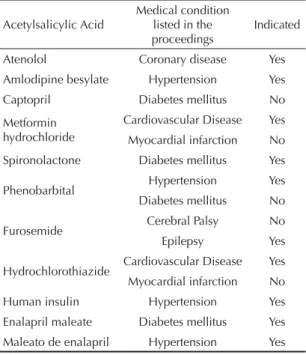
Of the medications requested through the courts, 33.8% were included in national policies for supply by the SUS, 14.3% were provided by the primary care component (Table 1), and 19.5% were included in the CEDM (Table 2).
In the case of medications included in the basic component of pharmaceutical care, most of the medical conditions listed in the case proceedings corresponded to NLEM indications. Moreover, of the 16 medical conditions listed in cases requesting medications included in the CEDM, 81.3% were not included among the indications of the medications requested, according to the Clinical Protocols and Therapeutic Guidelines (CPTG) of the Ministry of Health.
Table 3 presents an analysis of the degrees of recom-mendation of CEDM medication requests separated
Table 1. Medicines included in the basic component of pharmaceutical services that were requested in lawsuits, the respective medical conditions listed in the proceedings, and the indications provided by the 2008 National List of Essential Medicines. State of São Paulo, Southeastern Brazil, 2005-2009.
Acetylsalicylic Acid Medical condition listed in the proceedings
Indicated
Atenolol Coronary disease Yes Amlodipine besylate Hypertension Yes Captopril Diabetes mellitus No Metformin
hydrochloride
Cardiovascular Disease Yes Myocardial infarction No Spironolactone Diabetes mellitus Yes
Phenobarbital Hypertension Yes Diabetes mellitus No
Furosemide Cerebral Palsy No Epilepsy Yes
Hydrochlorothiazide Cardiovascular Disease Yes Myocardial infarction No Human insulin Hypertension Yes Enalapril maleate Diabetes mellitus Yes Maleato de enalapril Hypertension Yes Source: The Court of Justice of the State of São Paulo
f Ministério da Saúde. Portaria nº 2.577, de 27 de outubro de 2006. Aprova o componente de medicamentos de dispensação excepcional.
Diario Ofi cial Uniao. 13 nov 2006;Seção1:44.
g Ministério da Saúde. Portaria nº 106, de 22 de janeiro de 2009. Altera o Anexo II da Portaria nº 2.577 de 27 de outubro de 2006, que aprova o componente de medicamentos de dispensação excepcional. Diario Ofi cial Uniao. 23 jan 2009;Seção1:40.
h Ministério da Saúde. Portaria nº 2.981, de 26 de novembro de 2009. Aprova o componente especializado da assistência farmacêutica.
Diario Ofi cial Uniao. 30 nov 2009;Seção1:725.
i Ministério da Saúde. Portaria nº 2.982, de 26 de novembro de 2009. Aprova as normas de execução e de fi nanciamento da assistência farmacêutica na atenção básica. Diario Ofi cial Uniao. 30 nov 2009;Seção1:771.
j Ministério da Saúde. Secretaria de Ciência, Tecnologia e Insumos Estratégicos. Departamento de Assistência farmacêutica e Insumos Estratégicos. Relação nacional de medicamentos essenciais. 6. ed. Brasília; 2009.
into two groups: indications included and not included in the CPTG. It also shows the degrees of recom-mendation of medications not provided by the SUS for the medical conditions listed in the proceedings. Medications for which there was insuffi cient informa-tion regarding the degree of recommendainforma-tion for the medical conditions listed in the proceedings were not included in the analysis.
The recommendations for fi ve CEDM medications prescribed to treat fi ve different medical conditions covered in their respective protocols were supported by the literature. An analysis of the degree of recom-mendation of the seven CEDM medications requested
to treat medical conditions not covered in the proto-cols showed that three of the medications were not recommended for the medical conditions referred to in court proceedings, and three were recommended in some cases.
Nearly two thirds of the drugs requested by the courts were not included in the offi cial lists for free supply by the SUS.
DISCUSSION
Approximately one third of the medications that were judicially requested were included in the SUS list for free supply. Other studies have found similarly high proportions of such cases.1,7,9,l,m,n,o The highest percentage
(69.2%) of requests for medications covered by the SUS
Table 2. Exceptionally dispensed medications requested in lawsuits, medical conditions listed in the legal proceedings and the indications considered. State of São Paulo, Southeastern Brazil, 2005-2009.
Medication Medical condition listed in the proceedings
Indicated by the CEDM Cyproterone acetate Prostate cancer No Glatiramer acetate Multiple Sclerosis Yes Peginterferon alfa-2a Hepatitis C Yes Atorvastatin Hypertension No
Azathioprine polyneuropathyInfl ammatory No
Budesonide Chronic obstructive pulmonary disease No Cyclosporine Atopic dermatitis No
Etanercept Ankylosing spondylitis No Rheumatoid arthritis Yes
Formoterol Chronic obstructive pulmonary disease Yes
Human immunoglobulin
Multifocal motor
neuropathy No Infl iximab Psoriasis No
Mesalazine Diffuse nonspecifi c proctitis No
Olanzapine Bipolar disorder No Ribavirin Hepatitis C Yes Cardiovascular Disease No Myocardial infarction No Simvastatin Angioplasty No CEDM: Component of exceptionally dispensed medicines Source: The Court of Justice of the State of São Paulo
l Borges DCL. Uma análise das ações judiciais para o fornecimento de medicamentos no âmbito do SUS: o caso do estado do Rio de Janeiro no ano de 2005 [master’s dissertation]. Rio de Janeiro: Escola Nacional de Saúde Pública Sérgio Arouca da Fiocruz; 2007.
m Pereira JR. Análise das demandas judiciais solicitando medicamentos encaminhados a diretoria de assistência farmacêutica da Secretaria de Estado da Saúde de Santa Catarina nos anos de 2003 e 2004 [master’s dissertation]. Florianópolis: Universidade Federal de Santa Catarina; 2006.
n Romero LC. Judicialização das políticas de assistência farmacêutica: o caso do Distrito Federal. Brasília: Consultoria Legislativa do Senado Federal; 2008[cited 2009 Oct 12]. Available from: http://www.senado.gov.br/Agencia/todasNoticias.aspx
o Sant´Ana JMB. Essencialidade e assistência farmacêutica: um estudo exploratório das demandas judiciais individuais para o acesso a medicamentos no Estado do Rio de Janeiro [master’s dissertation]. Rio de Janeiro: Escola Nacional de Saúde Pública Sergio Arouca da Fiocruz; 2009.
Table 3. The degree of recommendation of exceptionally dispensed medications and medications not covered by the health system, according to the medical conditions listed in the legal proceedings. State of São Paulo, Southeastern Brazil, 2005-2009.
Degree of recommendation n % CEDM-approved medications (n = 12)
Degree of recommendation on the indication provided in the CEDM
Recommended 2 16.7 Recommended in most cases 3 25.0 Recommended only in some cases 0 0.0 Not recommended 0 0.0 Degree of recommendation without indication under the CEDM
Recommended 0 0.0 Recommended in most cases 1 8.3 Recommended only in some cases 3 25.0 Not recommended 3 25.0 Medications not covered by the SUS (n = 37)
Degree of recommendation of the medical condition mentioned in the legal proceedings
Recommended 2 5.4 Recommended in most cases 26 70.3 Recommended only in some cases 8 21.6 Not recommended 1 2.7 Source: The Court of Justice of the State of São Paulo; Klasco3 (2009)
was observed by Messeder et al7 (2005), followed by
Borgesk (2007) (52%) and Sant’Anan (2009) (50%), all in
the State of Rio de Janeiro (Southeastern Brazil). Vieira & Zucchi9 (2007) found a percentage of 62% in the São
Paulo municipality, whereas Chieffi & Barata1 (2009)
found 23% in the same city. Romerom (2008) stated
that 47.2% of the medications requested in the Federal District were part of the 2002 NLEM. In Santa Catarina (Southern Brazil), this rate was 37.8%, according to Pereiral (2006). These percentages, though disparate,
reveal that appeals to the courts are not restricted to medications that are not provided by the SUS.
The present study identifi ed requests for 11 medica-tions covered by the primary care component of the SUS. When they are available in health units, the dispensation of these medications requires only a prescription. According to Vieira & Zucchi9 (2007),
the solicitation to the courts for drugs covered by SUS programs suggests either fl aws in ensuring the avail-ability of these medications or ignorance, of both the prescriber and the applicant, regarding the availability of these medications. Thus, these fi ndings support the hypothesis of defi ciencies in the management of phar-maceutical policies.
The lack of medications in health facilities, due to problems with selecting, planning, purchasing, inven-tory control, storage, distribution, or the dispensation of medications by unqualifi ed workers, legitimizes the judicial process as a mechanism for access to rights provided by the Constitution, particularly when access to these medications is guaranteed by specifi c public policies, such as the pharmaceutical care policy.
Researchers have found a demand for CEDM medica-tions in previous studies.1,7,9,o In this study, requests
for CEDM medications accounted for 19.5% of the tested sample, a percentage larger than that identifi ed by Chieffi & Barata1 (2009) in the São Paulo
munici-pality (13%). The bureaucratization of pharmaceutical services and centralized dispensation hinders access to exceptionally dispensed medications, particularly for populations living in more socially vulnerable munici-palities. Requests for medications unsubstantiated by diagnosis and the therapeutic indications detailed by the CPTG, non-standardized concentrations or pharma-ceutical formulations, medications supplied in limited quantities, outdated clinical protocols, therapeutic approaches supported by suffi cient scientifi c evidence but not yet incorporated into SUS programs, and even diffi culty in interpreting these clinical protocols due to their academic characteristics, all have contributed to increasing the number of judicial requests.p
CEDM medications were requested for the treatment of 16 different medical conditions. Five drugs were requested for the treatment of medical conditions specifi ed in the CPTG. The degree of recommendation described in the literature supported the use of these medications for these indications. These facts suggest that even when medications are covered by the SUS and prescribed according to clinical protocols, other factors infl uence the legal demands for access.
Seven drugs with the same active component were requested for the treatment of medical conditions that were not supported by clinical protocols. In three cases, there was no evidence of benefi t to justify the prescribing and use of the drugs. According to the precepts of rational pharmaceutical use, the dismissal of such appeals would be more benefi cial for the patients than granting them access to the requested medications. In three other cases, the medications requested were not recommended for most patients. In such rulings, there was insuffi cient information available to analyze the needs of the patients, though the judges could request medical examinations before making their decisions. One of the medications (etanercept, which is used to treat ankylosing spondylitis), which was requested for an indication not included in the applicable protocol, could be used by most patients, according to the degree of recommendation described in the literature. In cases like this, it is the clinical protocol itself that should be reviewed. We were unable to identify the degree of recommendation for four of the requested drugs (ator-vastatin, azathioprine, intravenous immunoglobulin, and simvastatin); however, the use of these medications may have been related to associated medical conditions that were not mentioned in the proceedings.
Chieffi & Barata1 (2009) found that in legal actions,
standard medications for use in certain medical condi-tions were often prescribed for situacondi-tions not covered in the protocols. A systematic review that assessed the effectiveness of medications marketed for the treatment of osteoporosis has alerted public health authorities to the need for new clinical protocols for the appropriate treatment of osteoporosis.q Pereiram (2006) noted the
importance of evaluating and incorporating into the offi cial lists non-covered medications that represent important treatment options, but are accessible only by judicial means. He also stressed the need to simplify access to medications that are covered by the SUS and to periodically review those that are provided.
The lists of medications covered by SUS are limited to the fi rst line of care and typically do not include alternative options for cases in which in there are contraindications for the prescribed pharmaceuticals,
p Lamb L. Os desafi os do enfrentamento das ações judiciais de medicamentos. Rio de Janeiro: Fiocruz; 2008[cited 2009 Oct 10]. Available from: http://chagas2.redefi ocruz.fi ocruz.br/drupalsesdec/?q=node/92
such as cases of drug interactions in elderly patients taking multiple medications. This type of demand can be signifi cantly reduced through improved training in pharmaceutical care services, enabling them to assess the individual needs of each patient, and by providing formal mechanisms in health management for accom-modating claims based on the rational use of medica-tions not covered by the SUS.
Of the medications requested through the courts, 66.2% were not part of the offi cial lists for free prescription through the SUS. Pereiram (2006) identifi ed
medica-tions without SUS funding in 59% of the judicial cases evaluated. Chieffi & Barata1 (2009) showed that 77%
of medications requested through the courts were not covered by SUS pharmaceutical assistance programs.
The high frequency of judicial requests for non-covered drugs may be related to the lack of therapeutic alternatives offered by the SUS because the lists are restrictive and frequently do not offer choices. The pressure placed on prescribers by the pharmaceutical industry, aimed at generating demand for particular drugs, may represent another problem, as highlighted by Chieffi & Barata2 (2010). The concept of essential
medicines, which guides the inclusion of medications in the SUS, also contributes to the use of the judicial process as a mechanism for access to non-covered medications. This concept was created in response to the need for improved access, quality, equity, and effi ciency of health systems; it is not a static concept and should be adapted to our growing knowledge of medications and treatments.r
Contrary to the expectation that the growing number of legal actions would make medications of dubious effectiveness available to users, this study revealed that only 2.7% of the drugs requested were not recommended for the indication listed in the proceed-ings. Moreover, 5.4% of the drugs requested were characterized by a high degree of recommendation for the medical conditions listed, leaving no doubt of their therapeutic value. For most requests, the careful assessment of the specifi c therapeutic needs of each patient was explicit, with the fi ndings that 70.3% of drugs are recommended for most (but not all) patients, and 21.6% are recommended for some (but not most) patients with the medical condition listed.
These fi ndings further justify the importance of incor-porating technical analysis in the decision-making process regarding medication requests through the courts. The grounds for each request must be identi-fi ed. This analysis must be supported by knowledge
of the following items: public health policies, the list of drugs covered by the SUS, restrictions on the use of such drugs in specifi c patient populations and in patients with specialized needs, the evidence-based clinical indications of medications, and any alternative treatments available through the SUS. Furthermore, whenever appropriate, recommendations should be made to the judiciary to request reviews by experts who are free from confl icts of interest.
Judicialization should not represent a path of access to medications. However, demands made through the courts are understandable when the expected supply required by public policy is not guaranteed, or when treatment coverage for a certain medical condition is not attended by the pharmaceutical policies of the SUS.
According to Vieira & Zucchi11 (2009), legal actions
can be grouped into two categories: justified and unjustifi ed. Despite controversies surrounding the distinction between these two categories, requests for medications included in the SUS lists for public supply can be considered justifi ed when access is blocked due to management problems in the pharmaceutical services or restrictive and outdated protocols and even when the request is for medications not covered by the SUS, but that possess good evidence of benefi t and represent an important alternative indication in case the approved drugs cannot be used.
Some requests are inaccurately classifi ed as justifi ed; these including the following: requests for medica-tions that lack proper documentation with the National Health Surveillance Agency, requests for drugs not covered by the SUS to treat medical conditions for which alternative treatments are covered that are at least as effective as the requested drug and without contraindications for the patient, and requests for medications prescribed for medical conditions that are not recommended in the scientifi c literature. Lopes et al4 (2010) found that between 2006 and 2007, at least
R$6.8 million was spent by the Health Secretariat of the State of São Paulo to meet court orders for the supply of antineoplastic drugs for indications that were not supported by medical evidence.
As a result of a public hearing held by the Federal Supreme Court in 2009, the National Council of Justice recommended to the courts that magistrates be provided with technical support (both medical and pharmaceu-tical). This support would help the magistrates make value judgments regarding the assessment of clinical issues for decision-making on requests for health services through the courts.s
r Santos MRC. Rename: o processo de revisão e atualização. In: Ministério da Saúde. Relação nacional de medicamentos essenciais. 4. ed. Brasília; 2007.
The reorganization of pharmaceutical services to ensure the availability and supply of medications included in government policies is a responsibility of the managers of the SUS. This problem must be handled in a timely manner, and with intersectoral focus, by a team of professionals who are qualifi ed to evaluate
the clinical indications of the requested medications. Such evaluations must be made based on the best avail-able evidence, according to the unique needs of each patient and identifying any safe and effective alterna-tives covered by the SUS, which would avoid justifi ed demands that result in legal actions.
1. Chieffi AL, Barata RB. Judicialização da política pública de assistência farmacêutica e equidade. Cad Saude Publica; 2009;25(8):1839-49. DOI:10.1590/ S0102-311X2009000800020
2. Chieffi AL, Barata RB. Ações judiciais: estratégia da indústria farmacêutica para introdução de novos medicamentos. Rev Saude Publica. 2010; 44(3):421-9. DOI:10.1590/S0034-89102010000300005
3. Klasco RK, editor. Drugdex System. Thomson Micromedex. Greenwood Village: Thomson; 2010. 4. Lopes LC, Barberato-Filho S, Costa AC,
Osorio-de-Castro CGS. Uso racional de medicamentos antineoplásicos e ações judiciais no Estado de São Paulo. Rev Saude Publica. 2010;44(4):620-8. DOI:10.1590/S0034-89102010000400005 5. Machado FRS. Contribuições ao debate da
judicialização da saúde no Brasil. Rev Direito Sanitário.2008;9(2):73-91.
6. Marques BS. Judicialização do direito à saúde. Rev Direito Sanitário. 2008;9(2):65-72.
7. Messeder AM, Osorio-de-Castro CGS, Luiza VL. Mandados judiciais como ferramenta para garantia do acesso a medicamentos no setor público: a experiência do Estado do Rio de Janeiro, Brasil. Cad
Saude Publica. 2005;21(2): 525-34. DOI:10.1590/ S0102-311X2005000200019
8. Pepe VLE, Ventura M, Sant’ana JMB, Figueiredo TA, Souza VR, Simas L, et al. Caracterização de demandas judiciais de fornecimento de medicamentos “essenciais” no Estado do Rio de Janeiro, Brasil. Cad Saude Publica. 2010;26(3):461-71. DOI:10.1590/ S0102-311X2010000300004
9. Vieira FS, Zucchi P. Distorções causadas pelas ações judiciais à política de medicamentos no Brasil. Rev Saude Publica. 2007;41(2):214-22. DOI:10.1590/ S0034-89102007000200007
10. Vieira FS. Qualifi cação dos serviços farmacêuticos no Brasil: aspectos inconclusos da agenda do Sistema Único de Saúde. Rev Panam Salud Publica. 2008;24(2): 91-100. DOI:10.1590/S1020-49892008000800003
11. Vieira FS, Zucchi P. Demandas judiciais e assistência terapêutica no Sistema Único de Saúde. Rev Assoc Med Bras. 2009;55(6):672-83.
12. Vieira FS. Gasto do Ministério da Saúde com medicamentos: tendência dos programas de 2002 a 2007. Rev Saude Publica. 2009;43(4):674-81. DOI:10.1590/S0034-89102009005000041
REFERENCES