1
Universidade Norte do Paraná. Faculdade de Educação Física do Norte do Paraná. Departamento de Educação Física. R. Marselha, 183, Pq. Res. João Piza, 86041-150, Londrina, PR, Brasil. Correspondência para/ Correspondence: FLC PINA. E-mail: <[email protected]>.
2
Centro Universitário Luterano de Palmas. Departamento de Educação Física. Palmas, TO, Brasil 3
Universidade Estadual de Londrina. Centro de Ciências da Saúde. Departamento de Patologia, Análises Clínicas e Toxicológicas. Londrina, PR, Brasil.
4
Universidade Estadual de Londrina. Centro de Educação Física e Esporte. Departamento de Educação Física. Londrina, PR, Brasil.
5
Universidade de São Paulo. Faculdade de Ciências Farmacêuticas. Departamento de Alimentos e Nutrição Experimental. São Paulo, SP, Brasil.
Conjugated linoleic acid supplementation
does not maximize motor performance and
abdominal and trunk fat loss induced by
aerobic training in overweight women
Suplementação de ácido linoléico conjugado não
maximiza o desempenho motor e a perda de gordura
de tronco e abdominal induzida pelo treinamento
aeróbio em mulheres com excesso de peso
Fábio Luiz Cheche PINA1
Alex Silva RIBEIRO1
Soraya Rodrigues DODERO2
Décio Sabbatini BARBOSA3
Edilson Serpeloni CYRINO4
Julio TIRAPEGUI5
A B S T R A C T
Objective
To analyze the effect of eight weeks of conjugated linoleic acid supplementation on physical performance, and trunk and abdominal fat in overweight women submitted to an aerobic training program.
Methods
Twenty-eight overweight women (body mass index ≥25 kg/m2) were divided randomly and double-blindly to
times a week, duration=30 min/session, intensity=80% of maximum heart rate). Conjugated linoleic acid (3.2 g) and placebo (4.0 g) supplements were consumed daily (four capsules) for eight weeks. Maximum speed and time to exhaustion were determined in incremental treadmill test. Trunk fat was estimated by dual-energy X-Ray absorptiometry. Waist circumference was used as indicator of abdominal fat.
Results
Main effect of time (p<0.05) showed increased maximum speed (conjugated linoleic acid=+6.3% vs. placebo=+7.5%) and time to exhaustion (conjugated linoleic acid=+7.1% vs. placebo=+8.6%) in the incremental treadmill test, with no differences between the groups (p>0.05). Similarly, significant reductions (p<0.05) in trunk fat (conjugated linoleic acid=-1.7% vs. placebo=-1.5%) and abdominal fat (conjugated linoleic acid=-4.7% vs. placebo=-4.0%) were found after eight weeks of intervention, with no differences between the groups (p>0.05).
Conclusion
The results of this study suggest that conjugated linoleic acid supplementation does not maximize motor performance, and loss of body and abdominal fat induced by aerobic training in overweight women.
Keywords: Body Fat. Dietary supplements. Exercise Performance. Running.
R E S U M O
Objetivo
Analisar o efeito de oito semanas de suplementação de ácido linoleico conjugado sobre o desempenho físico, a gordura de tronco e abdominal em mulheres com excesso de peso submetidas a um programa de treinamento aeróbio.
Métodos
Vinte e oito mulheres com excesso de peso (índice de massa corporal ≥ 25 kg/m2) foram separadas aleatoriamente por meio de um delineamento duplo cego para receber suplementação de ácido linoleico ou placebo associado a um programa de exercícios aeróbios (frequência = três sessões semanais, duração=30 min/sessão, intensida-de=80% da frequência cardíaca máxima). A suplementação de ácido linoleico (3,2 g) ou de placebo (4,0 g) foi consumida diariamente (quatro cápsulas), durante oito semanas. As variáveis velocidade máxima atingida e tempo de permanência até a exaustão foram determinadas em teste incremental em esteira. A gordura de tronco foi estimada por absortometria radiológica de dupla energia. A circunferência de cintura foi utilizada como indicador de gordura abdominal.
Resultados
Efeito principal do tempo (p<0,05) revelou aumento da velocidade máxima atingida (suplementação de ácido
linoleico=+6,3% versus placebo=+7,5%) e tempo de duração até a exaustão (suplementação de ácido
linoleico=+7,1% versus placebo=+8,6%) em teste incremental em esteira, sem diferenças entre os grupos (p>0,05). De forma similar, uma redução significante (p<0,05) na gordura relativa de tronco (suplementa-ção de ácido linoleico=-1,7% versus placebo=-1,5%) e na gordura abdominal (suplementa(suplementa-ção de ácido linoleico=-4,7% versus placebo=-4,0%) foi encontrada após oito semanas de intervenção, sem diferenças entre os grupos (p>0,05).
Conclusão
Os resultados do presente estudo sugerem que a suplementação de ácido linoleico não maximiza o desempenho motor e a redução da gordura de tronco e abdominal induzida pelo treinamento aeróbio em mulheres com excesso de peso.
Palavras-chave: Gordura Corporal. Suplementos dietéticos. Desempenho Físico. Corrida.
I N T R O D U C T I O N
Excess body fat in the central region of the body, especially on the abdomen, is closely
physical activity by practicing aerobic exercises and controlling eating habits are two strategies frequently used to try to revert this process. Additionally, the intake of some specific nutritional supplements seems to be a very attractive nonpharmaceutical alternative to reduce body fat3.
In this sense, Conjugated Linoleic Acid (CLA), a polyunsaturated fatty acid present in animal origin foods such as ruminants’ meat, milk, and dairy products, is a supplement that can help to improve bone formation4 and the immune,
anti-inflammatory, anticarcinogenic, and antiatherogenic responses5, and to reduce body
fat6. Its action seems to be associated with higher
hormone-sensitive lipase activity and consequently, lipolysis in adipocytes and higher oxidation of fatty acids, both in skeletal muscle and in fat tissue because of higher carnitine palmitoyltransferase activity7.
Conjugated linoleic acid effects associated with physical activity on body mass and fat deposits have been reported in animal studies, indicating lower gain of body mass in growing animals8, lower amount of body fat, and gains in
fat-free mass7. On the other hand, humans studies
have published controversial results, with positive9,10
or not11,12 responses to CLA supplementation.
Thus, well controlled studies that attempt to analyze the possible effects of CLA supplementation, especially in overweight humans, can greatly contribute to the decision of whether to use or not this substance in the treatment of overweight/obesity. In addition to the practice of aerobic exercises, we believe that the administration of CLA supplements can maximize response to training, with positive repercussion mainly on the fat deposited in the trunk and abdomen.
Therefore, the purpose of this study was to analyze the effect of an eight-week supplementation of CLA on the physical performance, trunk fat, and abdominal fat of overweight women submitted to an aerobic training program.
M E T H O D S
A randomized, double-blind, placebo-controlled clinical trial was conducted for ten weeks. The participants were divided randomly, double-blindly, and in a balanced manner into two groups, CLA and placebo, and submitted to eight weeks of aerobic training on a treadmill for three 30-minute sessions a week on alternated days. Information about the anthropometric measurements, food records, and incremental treadmill stress test until exhaustion were collected on weeks 1 (before training) and 10 (after training). The participants underwent aerobic training and took CLA or placebo from week two to nine.
After the initial recruitment by placing ads in the local media, 34 university students were selected to participate in the present study. The inclusion criteria were: 1) age between 18 and 30 years; 2) body mass index ≥25 kg/m2 (being
categorized as overweight or obese); 3) nonsmoker; 4) not practicing regular physical activity ≥ twice a week; 5) not having used nutritional supplements related to lipid metabolism in the six months before the study; 6) not having been diagnosed with metabolic disorders or chronic-degenerative diseases; 7) not taking pharmaceuticals to reduce body fat; 8) not having been submitted to diets to reduce body mass in the six months before the study.
Body mass was measured by a digital scale of the brand Urano, model PS 180A (Urano Indústria de Balanças e Equipamentos Eletrônicos Ltda, Canoas, Rio Grande do Sul, Brazil) with accuracy of 0.1 kg, and height was measured by a wooden stadiometer with graduation of 0.1 cm. Body Mass Index (BMI) was calculated by dividing the body mass (kg) by the square of the height (m2). Based on their BMI, the participants were
classified as overweight, obesity grade I, or obesity grade II according to the internationally established cut-off points13. Waist Circumference
(WC) was used as an indicator of abdominal fat. Waist Circumference was measured by a metal inelastic tape measure of the brand Sanny (American Medical do Brasil, São Bernardo do Campo, São Paulo, Brazil) with graduation of 0.1 cm at the midpoint between the iliac crest and lowest rib. The participants were then categorized as low risk, moderate risk, and high risk based on the WC cut-off points established internationally14.
Dual-Energy X-Ray Absorptiometry (DEXA) assessed the relative trunk fat. The measurements were made by the device Lunar, model GE Lunar Prodigy Primo (GEMedical Systems, Madison, WI, United States) and analyzed by the software that accompanies the device (version 4.7e). The participants were positioned in the scanning area of the device allowing the sagittal line of this area to coincide with the center of some anatomical points, such as the skull, column, pelvis, and legs. The participants were scanned wearing nothing but light clothing. All metal objects that could affect the measurements were also removed. The software separated the limbs from the trunk and head by standard lines generated by the device. These lines were adjusted by a specialized technician by using specific anatomic points determined by the manufacturer. For the study purposes, relative left and right trunk fat values were used to determine specifically the relative trunk fat (trunk fat mass x 100/trunk mass). To analyze the reproducibility and reliability of the measurements produced by the device, DEXA tests were conducted before the study with a
sample consisting of eight study participants (~30% of the sample selected randomly), which resulted in an Intraclass Correlation Coefficient (ICC) >0.98 and a Coefficient of Variation (CV) of 2.9% for body fat.
Information related to eating habits was collected by a three-day food record (two weekdays and one weekend day) by two experienced dietitians before and after the intervention. The participants were instructed not to change their eating habits during the study. Standard cooking units were used for estimating the amount of foods and beverages consumed. Energy and macronutrient intakes were determined by the nutritional assessment software Virtual Nutri, version 1.0 (Keeple, Rio de Janeiro, RJ, Brazil). Water intake was ad libitum.
Before the training, at the end of the fifth week of training, and after the training ended, the participants underwent an incremental treadmill test on the treadmill Imbrasport 10200 ATL (Imbramed, Porto Alegre, Rio Grande do Sul, Brazil) to determine initial training intensity, readjust intensity, and analyze the effect of the intervention, respectively. The test was always on a flat treadmill deck and started at a speed of 4 km/h, with increments of 0.5 km/h at every minute until voluntary exhaustion. Heart rate during each test was recorded at every five seconds by a heart rate monitor (Polar S810i, Polar Electro OY, Finland) to determine maximum heart rate (HRMax). Maximum speed (km/h) and time to exhaustion (min) were also recorded.
The aerobic training program was performed on a treadmill during three sessions a week on alternated days for eight weeks. Before the beginning of each training session, the participants warmed up on the treadmill for three minutes at 4.0 km/h. Next, they ran for 30 minutes at 80% of their HRmax, being monitored individually by the heart rate monitor mentioned above15.
randomly and in a balanced manner into two groups (CLA=17 vs. PLC=17). The CLA group took 3.2 g/day of CLA (mixture of CLA isomers, predominantly the isomers cis-9, trans-11-50% and trans-10, cis-12-80%), while the PLC group took 4.0 g/day of olive oil. The amounts of CLA and PLC differ because of their different densities. This allowed the substances to be in very similar capsules, which could not be distinguished by the participants. Each participant took four capsules a day, two after lunch and two after dinner. Olive oil was chosen as placebo because its energy content, color, and consistency are similar to those of CLA. The supplements were manipulated and capsuled by a specialized laboratory from the Department of Food Science and Technology of the local university. The participants were also asked to write down any side effects or difficulties related to the supplements.
The Shapiro Wilk test analyzed data distribution. The Mauchly test analyzed the sphericity of the normal data. Two-way repeated measures Analysis of Variance (ANOVA) compared the CLA and PLC groups before and after the intervention. The Bonferroni post hoc test
identified the specific differences in variables whose F exceeded the established statistical significance (p<0.05). Intragroup effect size was given by subtracting the pre-training mean from the post-training mean and dividing the difference by the group’s standard deviation16. Effect sizes
≤0.2 were classified as small; effect sizes ≥0.3 and
≤0.7 were considered moderate; and effect sizes
≥0.8 were considered large. The data were treated by the software Statistica for Windows, version 8.0 (StatSoft Inc., Tulsa, OK, USA).
R E S U L T S
Six participants did not complete the eight study weeks; five could not continue because they had no time to participate in the training sessions (they had to start trainee programs at their universities or found a job) and health problems unrelated to the treatment and/or supplementation. Only one participant dropped out of the study because of stomach pains after taking the capsules (group CLA), although there was no evidence of chronic gastritis in the pre-intervention anamnesis. Hence, 28 patients finished the study (CLA, n=15;
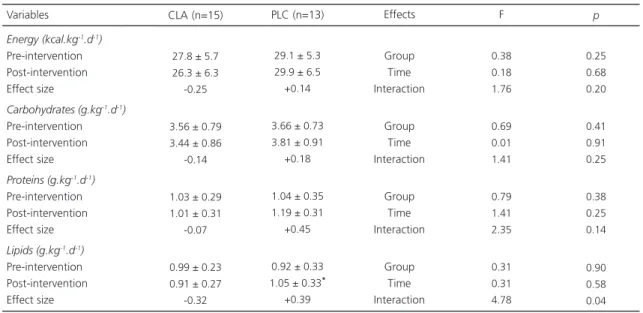
Table 1. Energy and macronutrient intakes of overweight and obese women before and after an eight-week intervention consisting
of aerobic training and Conjugated Linoleic Acid (CLA) or Placebo (PLC, olive oil) supplementation.
Energy (kcal.kg-1.d-1)
Pre-intervention Post-intervention Effect size
Carbohydrates (g.kg-1.d-1)
Pre-intervention Post-intervention Effect size
Proteins (g.kg-1.d-1)
Pre-intervention Post-intervention Effect size
Lipids (g.kg-1.d-1)
Pre-intervention Post-intervention Effect size Variables
27.8 ± 5.7 26.3 ± 6.3 -0.25
3.56 ± 0.79 3.44 ± 0.86
-0.14
1.03 ± 0.29 1.01 ± 0.31
-0.07
0.99 ± 0.23 0.91 ± 0.27
-0.32
29.1 ± 5.3 29.9 ± 6.5 +0.14
3.66 ± 0.73 3.81 ± 0.91
+0.18
1.04 ± 0.35 1.19 ± 0.31
+0.45
0.92 ± 0.33 1.05 ± 0.33*
+0.39 Group Time Interaction Group Time Interaction Group Time Interaction Group Time Interaction 0.38 0.18 1.76 0.69 0.01 1.41 0.79 1.41 2.35 0.31 0.31 4.78 0.25 0.68 0.20 0.41 0.91 0.25 0.38 0.25 0.14 0.90 0.58 0.04
CLA (n=15) PLC (n=13) Effects F p
23.1±2.7 years; 79.1±7.6 kg; 165.6±6.7 cm vs. PLC, n=13; 23.2±2.6 years; 81.7±8.5 kg; 164.9±5.2 cm).
Table 1 shows the energy and macronutrient intakes before and after the intervention. No interaction of group vs. time or main effect of time or group occurred (p>0.05) for energy, carbohydrate, and protein intakes when the CLA and PLC groups were compared. The only interaction group vs. time (p<0.05) occurred for lipid intake, but only the PLC group increased intake over time (+14.1%; p<0.05), with moderate effect size (+0.39).
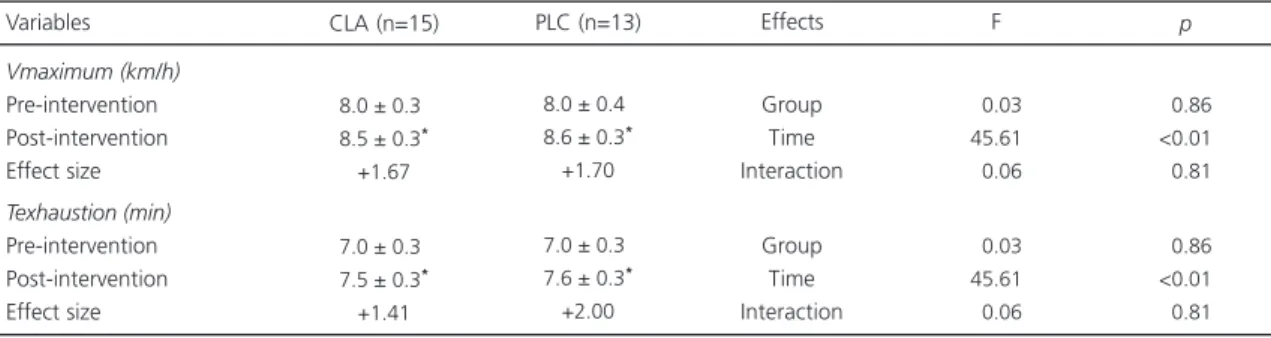
Table 2 shows the performance of the CLA and PLC participants in the treadmill test before and after the intervention. Main effect of time (p<0.05) occurred for increased maximum speed in the incremental test (CLA=+6.3% vs. PLC=+7.5%) and time to exhaustion (CLA=+7.1% vs. PLC=+8.6%), with no differences between the groups (p>0.05). The effect size was considered large both for maximum speed in the incremental test (CLA=+1.67 vs. PLC=+1.70) and time to exhaustion (CLA=+1.41 vs. PLC=+2.00). The greatest gain in training speed occurred during the first four weeks of the intervention, both in the combined analysis of both groups (+6.5%) and in single-group analysis (CLA=+6.9% vs. PLC=+5.3%). The maximum heart rate remained relatively stable during the eight weeks of training in the CLA group (196±6 bpm vs. 194±5 bpm;
p>0.05), which did not differ significantly (p>0.05) from the PLC group (192±7 bpm vs. 196±7 bpm; p>0.05).
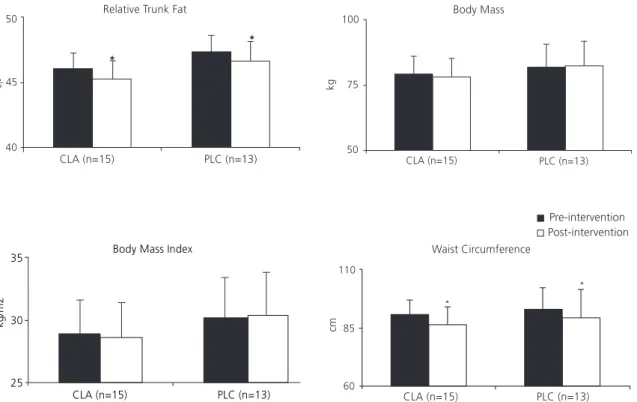
Figure 1 shows the changes in relative trunk fat, body mass, BMI, and WC of the participants of the CLA and PLC groups before and after the intervention. Main effect of time (p<0.01) was found for the variables relative trunk fat and WC, which decreased significantly during the intervention (p<0.05) for trunk fat (CLA=37.7±3.6 kg vs. 36.9±3.5 kg e PLC=40.4±4.2 kg vs. 40.1±4.6 kg) and WC (CLA=-4.7% vs. PLC=-4.0%), but the groups did not differ significantly (p>0.05). No interaction between group vs. time or main effect of time or group (p>0.05) occurred for body mass and BMI in intra- and intergroup comparisons.
Table 3 shows BMI and WC categorizations by group (CLA and PLC) before and after the intervention. No participant in either group experienced a change in BMI category (overweight, obesity grade I, and obesity grade II). Nonetheless, the WC of three participants in the CLA group changed from moderate or high risk to low risk (3/15=20%), and the WC of four participants in the PLC group changed from moderate or high risk to low risk (4/13=31%).
According to the participants’ notes of the side effects or difficulties related to the supplements, the reported symptoms regarded the gastrointestinal tract, such as stomach ache
Table 2. Motor performance indicators for maximum treadmill test in overweight and obese women before and after an eight-week
intervention consisting of aerobic training and Conjugated Linoleic Acid (CLA) or Placebo (PLC, olive oil) supplementation.
Vmaximum (km/h)
Pre-intervention Post-intervention Effect size
Texhaustion (min)
Pre-intervention Post-intervention Effect size Variables
8.0 ± 0.3*
8.5 ± 0.3*
+1.67
7.0 ± 0.3*
7.5 ± 0.3*
+1.41
8.0 ± 0.4*
8.6 ± 0.3*
+1.70
7.0 ± 0.3*
7.6 ± 0.3*
+2.00
Group Time Interaction
Group Time Interaction
00.03
45.61
00.06
00.03
45.61
00.06
<0.86 <0.01 <0.81
<0.86 <0.01 <0.81
CLA (n=15) PLC (n=13) Effects F p
Note: *p<0.05 vs. pre-intervention. Vmaximum = maximum speed during the incremental test. Texhaustion = time to exhaustion in the incremental
Figure 1. Changes in relative trunk fat, body mass, body mass index, and waist circumference in overweight and obese women before and after an eight-week intervention consisting of aerobic training and Conjugated Linoleic Acid (CLA, n=15) or placebo (PLC, n=13, olive oil) supplementation. The values are expressed as means ± standard deviation. *p<0.05 vs. pre-intervention.
No group vs. time interaction was found (p>0.05). Main effect of time was found for relative trunk fat and waist circumference (p<0.01).
Table 3. Clinical behavior of Body Mass Index (BMI) and Waist Circumference (WC) in overweight and obese women before and
after an eight-week intervention consisting of aerobic training and Conjugated Linoleic Acid (CLA) or Placebo (PLC, olive oil) supplementation.
BMI
Overweight Obesity grade I Obesity grade II
WC
Low risk Moderate risk High risk
10 (66.7) 05 (33.3) 00 (00.0)
00 (00.0) 05 (33.3) 10 (66.7)
Pre-intervention Post-intervention 10 (66.7) 05 (33.3) 00 (00.0)
03 (20.0) 04 (26.7) 08 (53.3) CLA (n=15)
07 (53.8) 05 (38.5) 01 (07.7)
00 (00.0) 03 (23.1) 10 (76.9)
Pre-intervention Post-intervention
08 (61.5) 04 (30.8) 01 (07.7)
04 (30.8) 03 (23.1) 06 (46.2) PLC (n=13)
Note: Overweight=25.0 to 29.9 kg/m2. Obesity grade I=30.0 to 34.9 kg/m2. Obesity grade II=35.0 to 39.9 kg/m2. Low risk=≤80 cm. Moderate
risk=80.1 to 87.9 cm. High risk=≥88 cm. The values are expressed as absolute and relative frequencies (percentage).
and burning (CLA, n=1), and more frequent bowel movements (CLA, n=3 and PLC, n=1), but the symptoms were classified as mild by the participants.
D I S C U S S I O N
BMI, body mass, or WC; 2) the aerobic training program increased the participants’ maximum velocity in the incremental treadmill test and time to exhaustion, regardless of CLA supplementation; 3) both the relative trunk fat and WC reduced after the intervention period with aerobic training, regardless of CLA supplementation. Therefore, CLA supplementation did not maximize responses induced by eight weeks of aerobic training on the variables trunk fat, WC, and motor performance indicators.
The study results corroborate other studies that investigated the effect of CLA supplementation associated with other modalities of physical exercise17,18, indicating that CLA does not seem
to add to the changes promoted by exercise for the reduction of body fat, particularly in humans. On the other hand, some animal studies have found positive changes on body fat when CLA and physical exercise are combined4,19.
Many factors may be related to the inconsistency of the human and animal study results20. For example, animal studies have used
higher CLA doses per kilogram of body weight than human studies. Additionally, the methods used for estimating body composition in animals are more reliable than those normally used in humans. Moreover, one cannot discard possible differences between animal and human lipid metabolism. Finally, in human studies the diet is only monitored on specific study occasions by instruments with well-known limitations (24-hour dietary recalls, food frequency questionnaires, food records, etc.) while animal studies allow more rigorous control20. Thus, animal study results
must be analyzed with some caution and not necessarily extrapolated to humans.
The nutritional supplement CLA has been used to reduce body fat and/or improve metabolic health21. The main theoretical suppositions that
support its use are those that report that CLA is a polyunsaturated fatty acid that can increase lipolysis, reduce lipogenesis, and change the gene expression of proteins that regulate energy metabolism22. Given that the fat transported
during the practice of predominantly aerobic
physical exercises from adipose tissue to muscles is an important source of energy, our hypothesis was that CLA supplementation could reduce trunk fat, especially in the abdomen, and improve performance in aerobic activities. However, this hypothesis ended up being refuted by our study, although it had been partly confirmed by an animal study4.
In human studies, the absence of consensus in the literature may stem from: 1) different study populations, 2) use of different exercise modalities (aerobic vs. anaerobic), 3) different intervention durations, 4) absence of systematized monitoring of physical exercise programs, 5) use of different supplement and isomer dosages, 6) combining CLA with other fatty acids, and 7) uncontrolled eating. These differences greatly hinder study comparison. In addition, CLA action seems to differ between overweight17,18 and normal weight individuals23-25.
Therefore, it is important to point out that the study sample consisted exclusively of overweight/ obese women, and excess weight is a multifactorial phenomenon characterized by significant metabolic and/or behavioral changes, which consequently, are hard to control26.
An important factor to be considered when choosing the CLA supplement is its isomeric proportions. There are 56 position and geometric linoleic acid isomers, but only two have identified health functions (cis-9, trans-11 and trans-10, cis-12). Thus, according to the chemical structure, each isomer has a specific function, that is, while the cis-9, trans-11 isomer has mainly an anticarcinogenic function27, the trans-10, cis-12
isomer acts on lipid metabolism and body adiposity6,10. Additionally, the trans-10, cis-12
isomer seems to be more capable of inhibiting lipid accumulation during differentiation and have higher apoptotic potential than the cis-9, trans-11 isomer28. The present study used the
following proportion of CLA isomers: cis-9, trans-11 - 50% and trans-10, cis-12 - 80%.
deserves emphasis in this study because high daily macronutrient intake may lead to body mass and fat gains. The study results indicate that most of the participants’ eating habits remained unchanged during the experimental period, except for lipid intake, which increased significantly between the beginning and end of the experiment in the PLC group. Hence, although some studies have found lower energy intake associated with the use of CLA supplements12,29
possibly because of higher levels of leptin, a hormone responsible for satiety, the energy intake of the CLA group remained unchanged. The participants’ leptin was not measured to confirm or reject this hypothesis.
The study exercise protocol followed the standardization recommended by the American College of Sports Medicine15. Therefore, as
expected, the study findings show that aerobic training efficiently reduced the relative trunk fat and specifically, abdominal fat, and improved motor performance, as both the speed reached in the incremental test and the time to exhaustion increased in both study groups. These findings corroborate those found in normal weight women submitted to six weeks of aerobic training combined with CLA or placebo supplementation24.
In the said24 and present studies, body fat changes
were not maximized by conjugated linoleic acid.
Trunk fat in the study participants was estimated by DEXA, considered a highly reliable and reproducible method for assessing body composition30, and unlike most methods used
currently, it allows analyzing the composition of different body components separately (upper limbs, lower limbs, and trunk)30. Nevertheless, as
WC has been internationally recognized as a valuable tool for predicting cardiovascular diseases and the metabolic syndrome, it is considered a good indicator of abdominal adiposity or more specifically, visceral fat. This fact seems to have been relatively confirmed herein since a moderate positive correlation (r=0.54 and p<0.05) was found between the changes in trunk fat (estimated by DEXA) and abdominal fat (given
by WC). Aerobic training, regardless of CLA supplementation, resulted in better clinical parameters associated with trunk and abdominal adiposity in approximately 25% of the study participants.
Another aspect that deserves attention was the discomfort associated with CLA supplementation reported by the participants. Five participants reported gastric discomfort during the intervention, and one dropped out of the study because of stomach ache after taking CLA. Although CLA supplementation in the study dose apparently does not pose a health risk19, the
participants’ reports raise concern about CLA supplementation. Other studies9,23 have already
reported CLA-related side effects, generally related to the gastrointestinal tract. The most frequently reported side effects were indigestion, heartburn, reflux, flatulence, nausea, diarrhea, bloating, constipation, loss of appetite, and itchy face9,23. Therefore, future studies with longer
intervention periods should try to analyze the effects of CLA supplementation on health indicators. The side effects described by the study participants were experienced during the eight-week CLA supplementation period.
The main practical application of this study is that overweight and obese women may improve their clinical status and physical performance, and reduce their trunk/abdominal fat by engaging in aerobic training without the need of CLA supplementation.
C O N C L U S I O N
The results of the present study suggest that CLA supplementation does not maximize motor performance and loss of trunk and abdominal fat induced by aerobic training in overweight and obese women.
A C K N O W L E D G M E N T S
We thank the Conselho Nacional de Desen-volvimento Científico e Tecnológico for the research productivity grants (ES CYRINO and J TIRAPEGUI) and Coordenação de Aperfeiçoamento de Pessoal de Nível Superior for the master’s grant (SR Dodero) and doctoral grant (AS Ribeiro). Additionally, we would especially like to thank the dietitians Paulo Sugihara Júnior, Rodrigo dos Reis Fernandes, and Michele Caroline de Costa Trindade and the physical education teacher Danilo Rodrigues Pereira da Silva, who contributed to the food record analyses and physical education program, and made suggestions for the final version of the manuscript.
C O N T R I B U T O R S
FLC PINA, AS RIBEIRO and SR DODERO were the intellectual mentors of the study. ES CYRINO and J TIRAPEGUI supervised the study. SR DODERO and DS BARBOSA helped to conceive the study and collect data. FLC PINA, AS RIBEIRO, and SR DODERO identified the studies that supported the manuscript’s contextualization/discussion. FLC PINA, AS RIBEIRO, and SR DODERO tabulated and/or analyzed the data. All authors contributed to data interpretation, first draft, and final review of the manuscript.
R E F E R E N C E S
1. Silva EA, Flexa F, Zanella MT. Impact of abdominal fat and insulin resistance on arterial hypertension
in non-obese women. Arq Bras Endocrinol Metab. 2009; 53(3):340-3. http://dx.doi.org/10.1590/S0 004-27302009000300007
2. Oliveira LPM, Assis AMO, Silva MCM, Santana MLP, Santos NS, Pinheiro SMC, et al. Factors associated with overweight and abdominal fat in adults in Salvador, Bahia State, Brazil. Cad Saúde Pública. 2009; 25(3):570-82. http://dx.doi.org/10.1590/S0 102-311X2009000300012
3. Fogelholm M. Dairy products, meat and sports performance. Sports Med. 2003; 33(8):615-31. http://dx.doi.org/10.2165/00007256-200333080-0 0006
4. Banu J, Bhattacharya A, Rahman M, O’Shea M, Fernandes G. Effects of conjugated linoleic acid and exercise on bone mass in young male Balb/C mice. Lipids Health Dis. 2006; 5:7. http://dx.doi.org/10.11 86/1476-511X-5-7
5. Bhattacharya A, Banu J, Rahman M, Causey J, Fernandes G. Biological effects of conjugated linoleic acids in health and disease. J Nutr Biochem. 2006; 17(12):789-810. http://dx.doi.org/10.1016/ j.jnutbio.2006.02.009
6. Watras AC, Buchholz AC, Close RN, Zhang Z, Schoeller DA. The role of conjugated linoleic acid in reducing body fat and preventing holiday weight gain. Int J Obes. 2007; 31(3):481-7. http://dx.doi. org/10.1038/sj.ijo.0803437
7. Park Y, Karen JA, Liu W, Storkson JM, Cook ME, Pariza MW. Effect of conjugated linoleic acid on body composition in mice. Lipids. 1997; 32(8):853-8. http://dx.doi.org/10.1007/s11745-997-0109-x 8. Bhattacharya A, Rahman MM, Sun D, Lawrence R,
Mejia W, McCarter R, et al. The combination of dietary conjugated linoleic acid and treadmill exercise lowers gain in body fat mass and enhances lean body mass in high fat-fed male balb/c mice1. J Nutr. 2005; 135(5):1124-30.
9. Blankson H, Stakkestad JA, Fagertun H, Thom E, Wadstein J, Gudmundsen O. Conjugated linoleic acid reduces body fat mass in overweight and obese humans. J Nutr. 2000; 130(12):2943-8.
10. Risérus U, Vessby B, Arnlöv J, Basu S. Effects of cis--9, trans-11 conjugated linoleic acid supplementation on insulin sensitivy, lipid peroxidation, and proinflammatory markers in obese men. Am J Clin Nutr. 2004; 80(2):279-83.
11. Nazare JA, Perriere AB, Bonnet F, Desage M, Peyrat J, Maitrepierre C, et al. Daily intake of conjugated linoleic acid enriched yoghurts: Effects on energy metabolism and adipose tissue gene expression in healthy subjects. Br J Nutr. 2007; 97(2):273-80. http://dx.doi.org/10.1017/S0007114507191911 12. Malpuech-Brugere C, Venne WPHGV, Mensink RP,
mass in overweight humans. Obes Res. 2004; 12(4):591-8. http://dx.doi.org/10.1038/oby.2004. 68
13. Associação Brasileira para o Estudo da Obesidade e da Síndrome Metabólica. Diretrizes brasileiras de obesidade 2009/2010. 3ª ed. Itapevi: AC Farma-cêutica; 2009.
14. Lohman TG, Roche AF, Martorell R. Anthropometric standardization reference manual. Champaign: Human Kinetics; 1988.
15. American College of Sports Medicine. Position Stand: Quantity and quality of exercise for developing and maintaining cardiorespiratory, musculoskeletal, and neuromotor fitness in apparently healthy adults: Guidance for prescribing exercise. Med Sci Sports Exerc. 2011; 43(7):1334-59. http://dx.doi.org/10.1249/MSS.0b013e318213fefb 16. Cohen J. A power primer. Psychol Bull. 1992;
112(1):155-9.
17. Diaz ML, Watkins BA, Li Y, Anderson RA, Campbell WW. Chromium picolinate and conjugated linoleic acid do not synergistically influence diet- and exercise-induced changes in body composition and health indexes in overweight women. J Nutr Biochem. 2008; 19(1):61-8. http://dx.doi.org/10. 1016/j.jnutbio.2007.01.006
18. Adams RE, Hsueh A, Alford B, King C, Mo H, Wildman R. Conjugated linoleic acid supplementation does not reduce visceral adipose tissue in middle-aged men engmiddle-aged in a resistance-training program. J Int Soc Sports Nutr. 2006; 13(3):28-36. http://dx.doi.org/10.1186/1550-2783-3-2-28 19. Aquino Junior AE, Dourado GKZS, Duarte FO,
Duarte ACGO, Sene-Fiorese M. Efeito da suplemen-tação com ácido linoléico conjugado e do treina-mento em natação sobre a composição corporal e os parâmetros bioquímicos de ratos Wistar em cres-cimento. Rev Nutr. 2009; 22(4):493-502. http://dx. doi.org/10.1590/S1415-52732009 000400005 20. Plourde M, Jew S, Cunnane SC, Jones PJ.
Conjugated linoleic acids: Why the discrepancy between animal and human studies? Nutr Rev. 2008; 66(7):415-21. http://dx.doi.org/10.1111/j. 1753-4887.2008.00051.x
21. Jeukendrup AE, Aldred S. Fat supplementation, health, and endurance performance. Nutrition. 2004; 20(7-8):678-88. http://dx.doi.org/10.1016/ j.nut.2004.04.018
22. Herrmann J, Rubin D, Häsler R, Helwig U, Pfeuffer M, Auinger A, et al. Isomer-specific effects of CLA
on gene expression in human adipose tissue depending on PPARgamma2 P12A polymorphism: A double blind, randomized, controlled cross-over study. Lipids Health Dis. 2009; 18;8:35. http://dx. doi.org/10.1186/1476-511X-8-35
23. Pinkoski C, Chilibeck PD, Candow DG, Esliger D, Ewaschuk JB, Facci M, et al. The effects of conjugated linoleic acid supplementation during resistance training. Med Sci Sports Exerc. 2006; 38(2):339-48. http://dx.doi.org/10.1249/01.mss. 0000183860.42853.15
24. Colakoglu S, Colakoglu M, Taneli F, Cetinoz F, Turkmen M. Cumulative effects of conjugated linoleic acid and exercise on endurance development, body composition, serum leptin and insulin levels. J Sports Med Phys Fitness. 2006; 46(4):570-7. 25. Tarnopolsky M, Zimmer A, Paikin J, Safdar A, Aboud
A, Pearce E, et al. Creatine monohydrate and conjugated linoleic acid improve strength and body composition following resistance exercise in older adults. PLOS One. 2007; 2(10):e991. http://dx.doi. org/10.1371/journal.pone.0000991
26. Souza CL, Oliveira MRM. Factors related to the energetic metabolism in obesity. J Brazilian Soc Food Nutr. 2010; 35(2):145-64.
27. Pariza MW, Park Y, Cook ME. The biologically active isomers of conjugated linoleic acid. Prog Lipid Res. 2001; 40(4):283-98. http://dx.doi.org/10.1016/S0 163-7827(01)00008-X
28. Fischer-Posovszky P, Kukulus V, Zulet MA, Debatin KM, Wabitsch M. Conjugated linoleic acid promote human fat cell apoptosis. Horm Metab Res. 2007; 39(3):186-91. http://dx.doi.org/10.1055/s-2007-97 0416
29. Gaullier JM, Halse J, Hoye K, Kristiansen K, Fagertun H, Vik H, et al. Supplementation with conjugated linoleic acid for 24 months is well tolerated by and reduces body fat mass in healthy, overweight humans. J Nutr. 2005; 135(4):778-84.
30. Kim MK, Tanaka K, Kim MJ, Matuso T, Endo T, Tomita T, et al. Comparison of epicardial, abdominal and regional fat compartments in response to weight loss. Nutr Metab Cardiovasc Dis. 2009; 19(11):760-6. http://dx.doi.org/10.1016/j.numecd. 2009.01.010