Systematic review of surgical gowns in
the control of contamination/surgical
site infection
**Extracted from the thesis “Revisão sistemática sobre o uso de aventais cirúrgicos conforme o material de confecção no controle da contaminação/infecção do sítio cirúrgico”, School of Nursing, University of São Paulo, 2007. 1 Nurse of the Continuous Education program of the Municipal Public Worker Hospital. Specialist in Surgical and Material Center. Masters in Nursing. São Paulo, SP, Brazil. [email protected] 2 Free Lecturer of the Medical-Surgical Nursing
C
RITICAL
R
EVIEW
REVISÃO SISTEMÁTICA SOBRE AVENTAIS CIRÚRGICOS NO CONTROLE DA CONTAMINAÇÃO/INFECÇÃO DO SÍTIO CIRÚRGICO
REVISIÓN SISTEMÁTICA SOBRE DELANTALES QUIRÚRGICOS EN EL CONTROL DE LA CONTAMINACIÓN/INFECCIÓN DEL LOCAL QUIRÚRGICO
RESUMO
O avental cirúrgico é confeccionado com materiais de tecido e não-tecido. O estudo teve como objetivo verificar se há evidên-cias científicas, pela revisão sistemática, que fundamentem a prática do uso de aven-tais em cirurgias, conforme seu material de confecção. Consideraram-se estudos bási-cos de intervenção, que investigaram a con-taminação e ou a infecção do sítio cirúrgi-co cirúrgi-com uso de aventais cirúrgicirúrgi-cos reutilizá-veis e ou de uso-único, utilizando como população pessoas submetidas a cirurgias, em situações reais ou simuladas, em qual-quer período, sem limitação de idioma. Para localizar os estudos, utilizou-se estra-tégia de busca nas bases de dados eletrô-nicas. Constata-se, com isso, dificuldade de isolar o objeto de intervenção de outros inúmeros fatores que podem interferir nos desfechos, em estudos desta natureza. Dois estudos (E1, E2) obtiveram forte evidência de recomendação, concluindo pela não di-ferença de contaminação e infecção do sí-tio cirúrgico entre aventais e campos de tecido e não-tecido.
DESCRITORES
Infecção da ferida operatória. Roupa de proteção.
Controle de infecções.
Juliane Cristina Burgatti1, Rúbia Aparecida Lacerda2
ABSTRACT
Surgical scrubs are made with both fabric and non-fabric material. The study aimed to observe whether there is scientific evi-dence, according to the systematic review, that supports the practice of wearing scrubs in surgeries, according to the material they are made of. Basic intervention studies were considered, which investigated con-tamination and/or infection of the surgical site with the use of either reusable or single-use surgical scrubs, using people sub-mitted to surgeries as the study population, either in real or simulated situations, at any period, without any language limitations. The strategy of searching electronic data-bases was used to find studies. With this, difficulties in isolating the object of inter-vention from countless other factors that can interfere in the outcomes were identi-fied in studies of this type. Two studies (E1 and E2) showed strong evidence for the recommendation. In conclusion, there is no difference in contamination and infection of the surgical site between fabric and non-fabric scrubs.
KEY WORDS
Surgical wound infection. Protective clothing. Infection control.
RESUMEN
El delantal quirúrgico confeccionado con materiales de tejido y no-tejido. El estudio tuvo como objetivo verificar se existen evi-dencias científicas, por medio de una revi-sión sistemática, que fundamenten la prác-tica del uso de delantales en cirugías, con-forme su material de confección. Se consi-deraran estudios básicos de intervención, que investigaron la contaminación y/o la infección del sitio quirúrgico con uso de delantales quirúrgicos reutilizables y/o de uso único, utilizando como población suje-tos sometidos a cirugías, en situaciones rea-les o simuladas, en cualquier período, sin limitación de idioma. Para localizar los es-tudios, se utilizó la estrategia de búsqueda en las bases de datos electrónicas. Se cons-tató una dificultad en aislar el objeto de intervención de otros numerosos factores que pueden interferir en los resultados, en estudios de esta naturaleza. Dos estudios (E1, E2) obtuvieron una fuerte evidencia de recomendación, concluyendo por no dife-renciar la contaminación e infección del si-tio quirúrgico entre delantales e indumen-taria quirúrgica de tejido y no-tejido.
DESCRIPTORES
Infección de herida operatoria. Ropa de protección.
INTRODUCTION
Despite technological advances in the surgical center area and greater knowledge on hospital infection risk fac-tors, for the last decades, surgical site infection (SSI) rates remain high. Many SSI prevention measures are recom-mended. Most acknowledged are the Guidelines for the Pre-vention of Surgical Site Infection of the Centers for Disease Control and Prevention of the United States (CDC), pub-lished in 1999. Intrinsic and extrinsic factors are considered. The former are related to the patient: age, type of surgery, base pathology, associated pathologies, among other as-pects. The latter refer to assistance procedures: surgery technique, pre-surgery preparation, environment, surgical attire and antibiotic prophylaxis, among others(1).
Among the extrinsic factors, surgical attire stands out, composed of cap, mask, sterilized glove, safety glasses, shoe cover, private uniform, sterilized drapes and gowns. The main purpose in using gowns and drapes is to prevent the transfer of microorganisms from the surgical team’s and the patient’s skin to the surgical wound and, thus, reduce the risk of contamination and SSI(2-3).
Regarding the occurrence of SSI, there is no agreement in literature about the use of reusable or single-use surgical gowns. Thus, a systematic review was performed to seek scientific evidence on surgical wound con-tamination or occurrence of SSI with the use of spun-laced non-woven or fabric surgical gowns, during surgeries.
OBJECTIVE
Verify the existence of evidence that will scientifically base the use of gowns in surgeries, according to their ma-terial and manufacturing process.
METHOD
Study Format
This systematic review of scientific literature was devel-oped according to the recommendations proposed by the Cochrane Collaboration, a non-fprofit international or-ganization responsible for preparing, maintaining and guar-anteeing access to systematic reviews in the health area(4).
Study Question
The study question is the first step in a systematic re-view and works as a compass towards the appropriate di-rection, in this case, the answer(4). The following question
was elaborated: What is the efficiency of surgical gowns, according to the material they are made of, in surgical site
Inclusion and exclusion criteria
Based on the study question, only basic intervention studies that investigated the contamination and or surgical site infection with the use of reusable and or disposable surgical gowns were considered in this systematic review, using people submitted to real or simulated surgeries as the population. Therefore, primary laboratory studies (mi-crobial barrier analysis), secondary studies, publications re-lated to letters to the reader, duplicates and replicates, edi-torials, comments and opinions, literature analyses with-out systematic review with or withwith-out meta analysis were excluded. Also, any period was considered, without lan-guage limitations.
Sample
Sources for the literature search
Initially, the searches were oriented by the electronic databases considered by international evidence-based prac-tice centers (PubMed/MEDLINE, EMBASE, COCHRANE, CINAHL, LILACS), references of the included studies and manual search in the Sociedade Brasileira de Enfermeiros de Centro Cirúrgico e Centro de Material (SOBECC) Magazine.
Search strategies in electronic databases
The electronic databases, such as MeSH (Medical Subject Headings Section) of PubMed/MEDLINE, includes 22995 descrip-tors, while DeCS (Health Science Descriptors), used by BIREME, is based on 26851 descrip-tors. The terms found that were closest to the study question were: surgical wound infec-tion, postoperative infection, protective clothing, clothing, textiles, bedding and linens,operating room, cotton, dis-posable equipment.
For non-indexed descriptors, the terms in the scientific article itself were used, as they were found: single-use cloth-ing and reusable clothing, woven clothing, non-woven cloth-ing, staff clothing, surgical wound contamination, surgical site infection, surgical gowns, operative gowns, disposable gowns, garments,operating room personnel, drapes. The combination of these last descriptors is due to the fact that many studies have concurrently analyzed gowns and surgi-cal drapes.
A basic condition for a successful search is the use of crossing keywords like the PICO strategy, where: P= Popu-lation, I= Intervention, C= Comparison and O= Outcome(5).
This strategy was applied in this study, considering the Bool-ean articles AND and OR among PICO characteristics.
Study Selection
The studies were searched by the first reviewer of this
The main purpose in using gowns and drapes is to prevent
the transfer of microorganisms from the surgical team’s and the patient’s skin to the
were evaluated by their titles and abstracts. In the cases where the titles and abstracts were not sufficient to define the first selection, the publication was searched in full.
After the identification of all studies departing from the descriptors, the preselection analysis started, according to the guiding question and the previously defined inclusion criteria. This phase was performed separately by two re-viewers - the author of this investigation and her advisor, who independently extracted the data.
Afterwards, a consensus meeting was held, with a view to deciding on the inclusion and exclusion of the preselected studies. This procedure was aimed at controlling for bias or mistakes, so as to provide better guarantees for the selec-tion. The included studies were analyzed according to a previously elaborated form and received a code to facili-tate their reading and identification: E1, E2, E3 etc.
Data analysis
An instrument for data extraction was elaborated. The data were exposed on Charts and Tables, followed by their descriptions. Tables were presented with absolute and rela-tive figures.
RESULTS AND DISCUSSION
This evidence was based on the search and analysis, through a systematic review, of already performed basic research, totaling 12 publications, found in electronic da-tabases, mainly in PubMed/MEDLINE. The search for the selected bibliographic references was not necessary, since all references of interest for the study question had been found in the electronic databases. No study was found through manual search.
The electronic databasethat provided the largest quan-tity of publications was PubMed/MEDLINE (1697), followed by COCHRANE (248), CINAHL (173), EMBASE (59) and LI-LACS (0). Studies were repeated in the different databases. Thus, 20 studies were preselected, which served the inclu-sion criteria. After the full reading of these 20 articles by the first reviewer, 08 were excluded, composing a sample of 12 studies.
The data presented in Chart 1 (Annex) show a panoramic synthesis of all included studies, as well as the assessment of their quality through two scales: Jadad Scale(6) and the
level of evidence of the Oxford Center of Evidence-based Medicine, adapted(7). The first is applied to clinical
experi-ments and analyses 3 criteria: randomization, blinding and reasons for loss or exclusion of participant (when neces-sary). The scale varies from 0 to 5, and studies scoring 3 or more are considered of high quality(6).
In the other scale, the classification of studies is based on evidence levels of studies from the Oxford Center of Evidence-based Medicine, associated to the variable risk control for SSI(7).
Although the specific component of this reviewer’s analysis is the surgical gown, only one study (E5) has solely used it as an intervention object. The others have mainly correlated with surgical drapes (E1, E2, E3, E6, E7, E9, E10, and E11).
Another question is related to the type of manufactur-ing material of gowns and other surgical attire components investigated. There was no coincidence among the analyzed studies, in other words, there was no use of the same ma-terial, neither for fabric groups nor non-woven fabrics. Moreover, the type of material was not always described in detail. Sometimes, the commercial name was omitted on some non-woven fabrics and sometimes the composi-tion of the fabrics was not detailed. Regarding the fabric, the threads varied or, sometimes, they were not even de-scribed. Lastly, none of the analyzed studies considered reuse frequency, that is, the number of times fabric gowns were reprocessed.
It is acknowledged that there is attrition and progres-sive loss of the barrier capacity of fabric materials accord-ing to the number of reprocessaccord-ing procedures. In one study(8), the effect of washing on barrier properties of five
reusable fabric surgical gowns was analyzed at baseline, twenty-five and fifty washes. As a result, it was stated that, the more washes, the more fabric attrition, reducing its abil-ity to repel liquids and prevent microbial passage, except for one type of fabric that did not increase its bacterial per-meability after washes(8).
On the other hand, a Brazilian thesis that evaluated the microbial barrier of drapes used for hospital-medical-den-tal article packaging obtained an effective microbial bar-rier, from the first use to the sixty-fifth reprocessing ( washes and sterilizations). The fabric on these drapes was doubled and composed of 100% cotton, serge T1, in compliance with standards by the Brazilian Association of Technical Stan-dards (ABNT), for packaging of goods. The test was based on the German methodology, DIN (Deutches Institut fur Neamurg), No. 58.953-part 6, used for packaging microbial barrier testing. The test procedure consisted in instilling 100 μl of Staphylococcus aureus bacterial suspension ATCC(5)
No. 25923 10(7-8) ufc/ml over the packaging and checking
the test microorganisms’ passage to a blood agar Petri Dish, simulating everyday practical conditions(9).
It is evident that more porous materials, mainly fabrics, constitute less efficient barriers, mainly under humid con-ditions. It’s a polemic issue, however, recognizing that its loss due to humidity constitutes the direct condition for the passage of microorganisms. A water molecule is much smaller than most known bacteria. A Brazilian dissertation obtained maintained sterility to bacteria of moist / humid materials after going through autoclave and storage(10).
repre-sent SSI risk factors in surgeries, besides the presence of microorganisms. Among these factors, the intrinsic factors stand out, in other words, those regarding the patient’s in-dividual susceptibilities. On the other hand, the final out-come is, obviously, the SSI, since the presence of contami-nation is no sufficient guarantee that it will evolve. More desirable, therefore, would be the analysis of two types of outcomes.
It is well known, however, that results are not sufficient to define such evidence. The quality of the developed stud-ies should be acknowledged according to the proposal of this systematic review. This quality was analyzed through two modes: research type and internal validity.
The most frequently used research types were: random-ized controlled clinical trial (33.3%), corresponding to studies E1, E2, E5, E8. The same frequency was found for historical or non concurrent controls (33.3%) in studies E3, E6, E7, and E11. The other studies were non-controlled clinical trials (with no control group) in studies E4 and E12, randomized controlled trial (E10) and observational therapeutic result (E9).
After systematic reviews of clinical trials with meta-analysis, randomized controlled clinical trials are consid-ered the best research type by the main evidence-based practice centers and guidelines on clinical recommenda-tions. Therefore, regarding the classification, studies E1, E2, E5 and E8 are considered of better quality than the others.
Even in the best types of research, systematic selec-tion, conducselec-tion, detection and segmentation errors may occur, determining bias in results and inferences. These biases interfere with the internal validity in the studies. According to the Cochrane Collaboration Handbook, they refer to: a) significant differences in the comparison groups (selection biases), in which randomization is used to pre-vent this type of error; b) equal care or the same expo-sure to all other factors, and also interventions of interest (conduction biases), in which masking is used to avoid this type of error; c) losses and exclusion of people included in the study (segmentation biases), which should be ex-plained; d) verifying mode of outcomes (detection or di-agnosis biases). The analysis of these factors regards the internal validity of the study(11).
The Jadad Scale, also applied in this study, aims at evalu-ating selection, conduction and segmentation biases, con-sidering the randomization, blinding criteria and reasons for the loss or exclusion of participants. Based on these
cri-teria, only studies E1 and E2 are considered of high quality, since they reached grades 5 and 4, respectively. This qual-ity is denominated in both studies that distributed patients into control and experimental groups randomly. Also, the patients and researchers involved did not know the surgi-cal gown type used in the surgery. Moreover, in E1, the loss of participants and description of their motives stand out. The other studies scored less than 3(6).
According to the other resource used to evaluate in this study, which associated the risk variable control for SSI with evidence adapted levels from the Oxford Center of Evidence-based Medicine(7), most of them were
classi-fied in evidence B category, in other words, moderate, varying from B2- (E3, E4, E6, E7, E10, E11, E12) to B3- (E9). Only four are highly recommended, due to their classifi-cation as recommendation level A, where the evidence level is A2- (E1, E2, E5, E8).
Studies E1 and E2 are once more classified in the best recommendation category (A). Studies E5 and E8 are also included in the best evidence level (A2-).
Considering the results of the best four studies, E1, E2, E5 and E8, which analyzed surgical wound contamination, they did not present significant difference between the use of fabric and non-woven material. And studies E1 and E2, which analyzed SSI, did not present any significant differ-ence in occurrdiffer-ence either between the use of the confec-tioned material of fabric and non-woven.
It is recommended that studies of this nature, besides using the gold standard research design considered by clini-cal epidemiology (randomized cliniclini-cal trial), should extract samples, previously to randomization, permitting patient groups as similar as possible when regarding risk variables. Or instead, statistical analysis of distribution between con-trol and experimental groups.
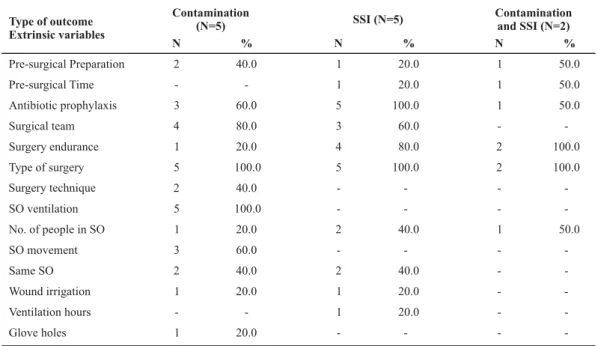
The extrinsic and intrinsic variables analyzed by the in-cluded studies are in Table 1 and 2.
Table 1 - Extrinsic risk factor frequency controlled by the included studies for systematic review, according to outcomes - São Paulo - 2007
Type of outcome Extrinsic variables
Pre-surgical Preparation Pre-surgical Time Antibiotic prophylaxis Surgical team Surgery endurance Type of surgery Surgery technique SO ventilation No. of people in SO SO movement Same SO Wound irrigation Ventilation hours Glove holes
Contamination (N=5)
N %
2 40.0
-
-3 60.0
4 80.0
1 20.0
5 100.0
2 40.0
5 100.0
1 20.0
3 60.0
2 40.0
1 20.0
-
-1 20.0
SSI (N=5)
N %
1 20.0
1 20.0
5 100.0
3 60.0
4 80.0
5 100.0
-
--
-2 40.0
-
-2 40.0
1 20.0
1 20.0
-
-Contamination and SSI (N=2)
N %
1 50.0
1 50.0
1 50.0
-
-2 100.0
2 100.0
-
--
-1 50.0
-
--
--
--
--
-As for the surgery type, although the distribution was controlled between groups and they were from the same specialty, they were not always the same, nor was the con-tamination potential. Different types of surgeries, even though from the same specialty, determine different dura-tions and conduction and can cause permeability variadura-tions
of microbiological barriers and microbial contamination load. Yet, surgeries of the same type and similar duration, but performed in locations with resident microbiota, be-come, as we all know, the main source of wound contami-nation and SSI(2), making the isolated value of the
interven-tion object difficult to establish.
Table 2 - Intrinsic risk factor frequency distribution controlled in the included studies for systematic review, according to outcomes
-São Paulo - 2007
Pre-existing diseases - - 1 20.0 1 50.0
Age 1 20.0 4 80.0 1 50.0
Sex 1 20.0 3 60.0 2 100.0
Smoker - - 1 20.0 -
-Nutritional status - - - - 1 50.0
BMI* - - 1 20.0 -
-ASA** - - - - 1 50.0
Type of outcome Extrinsic variables
Contamination (N=5)
N %
SSI (N=5)
N %
SSI+ Contamination (N=2)
N %
*BMI: Body Mass Index
** ASA: Patient’s evaluation for SSI risk
As shown in Table 2, few studies controlled for the intrin-sic variables, related to the individual susceptibilities to develop SSI. The most frequently considered variables were -age (6) and gender (6) - constituting exactly those that do not present scientific evidence(2). Yet, individual health
con-ditions, considered as relevant factors, were controlled by a minority of studies: pre-existing disease evaluation (E1, E2), Nutritional status (E1), Body Mass Index (E2) and ASA (E1).
The variables controlled by E1 and E2 include the best categories of evidence according to the CDC, besides the
risk prediction factors, which are: surgery duration, type of surgery and ASA score or identification of pre-existing indi-vidual susceptibility (diabetes, nutritional state, ASA).
CONCLUSION
non-difference in contamination and/ or surgical site in-fection between fabrics and non-woven. Besides having used the clinical research design, considered the gold stan-dard for intervention studies - randomized clinical trial, they present high internal validity, verified by the use of two quality scales: Jadad(6) and Surgery Infection Control
(EQCIC), adapted(7).
The non similarity of intervention format and variable control between the analyzed studies did not permit meta-analysis.
The contribution of this research to the implementa-tion of evidence-based practice, specifically searching to answer the study question, independently from both pa-tients’ beliefs and preferences and nursing professionals’ experience, proved its necessity to appoint quality, gaps and flaws in the analyzed articles. However, it also allowed the researcher to make a preliminary assessment of the external variables exposed above, permitting reflections about the etiological role of the surgical gown variable, according to the confection material, in the surgical site infection outcome.
REFERENCES
1. Mangram AJ, Horan TC, Pearson ML, Silver LC, Jarvis WR. Guideline for prevention of surgical site infection, 1999. Infect Control Hosp Epidemiol. 1999;20(4):250-78.
2. Lacerda RA. Controle de infecção em centro cirúrgico: fatos, mitos e controvérsias. São Paulo: Atheneu; 2003. Infecção do sítio cirúrgico; p. 69-84.
3. Rabhae GN, Ribeiro Filho N, Fernandes AT. Infecção do sítio cirúrgico. In: Fernandes AT, Fernandes MO, Ribeiro Filho N, editores. Infecção hospitalar e suas interfaces na área da saú-de. São Paulo: Atheneu; 2000. p. 479-505.
4. Castro AA, Saconato H, Guidugli F, Clark OAC. Curso de revi-são sistemática e metanálise [texto na Internet]. São Paulo: LED-DIS/UNIFESP; 2002. [citado 2007 ago. 20]. Disponível em: http:/ /www.virtual.epm.br/cursos/metanalise.
5. Nobre MRC, Bernardo WM, Jatene FB. A prática clínica basea-da em evidências: parte III – avaliação crítica basea-das informações de pesquisas clínicas. Rev Assoc Med Bras. 2004;50(2):221-8.
6. Jadad AR, Moore A, Carroll D, Jenkinson C, Reynolds DJ, Gavaghan, et al. Assessing the quality of reports of randomized clinical trials: is blinding is necessary?Control Clin Trials. 1996;17 (1):1-12.
7. Nobre MRC, Bernardo WM. Busca de evidências em fontes de informação científica. In: Prática clínica baseada em evidênci-as. São Paulo: Elsevier; 2006. p. 43-57.
8. Leonas KK. Effect of laundering on the barrier properties of reusable surgical gowns fabrics. Am J Infect Control. 1998;26 (5):495-501.
9. Rodrigues E. Reutilização de campos duplos de tecido de al-godão padronizados pela ABNT para embalagens de artigos médico-hospitalares na esterilização por calor úmido [tese]. São Paulo: Escola de Enfermagem, Universidade de São Pau-lo; 2000.
10. Morya GA. Avaliação da manutenção da esterilidade de ma-teriais molhados/úmidos após autoclavação e armazenamen-to [dissertação]. São Paulo: Escola de Enfermagem, Universi-dade de São Paulo; 2005.
ANNEX
Chart 1 - Panoramic Synthesis of the studies included in the systematic review, as for their range, investigation method, result and
quality evaluation by Scales of Surgical Infection Control (QSSIC) and JADAD Clinical Experiments - São Paulo - 2007
E Range Method Result
Microbial contamination of surgical wound and SSI in elective clean surgeries and or holding low contamination potential, with the use of cotton fabric (180 tread/polyester ) and polyester x non-woven polyester mixture drapes and gowns. Both cases were thickened in the front and on the forearms (270 tread/polyester )
2
2
Controlled randomized clinical trial.
No significant difference in positive culture and SSI rates.
QSSIC: A2-JADAD: 04
SSI in coronary artery surgeries with the use of fabric x non-woven (both material type were not discriminated) drapes and gowns
Controlled randomized clinical trial.
No significant SSI difference.
QSSIC: A2-JADAD: 05
SSI in clean, contaminated clean and contaminated surgeries, performed in two hospitals, using cotton fabric muslin (280 tread/polyester2 - Hospital A and 140 tread/polyester2 - Hospital B) x non-woven spun-bonded olefin drapes and surgical gowns
Historical or
non-concurrent control.
The SSI rate with the use of disposable gown was 2.27%, against 6.41% with the reusable gown; therefore a significant difference. The SSI rate in clean surgeries was 1.98% when using disposable gowns versus 4.42% with the use of reprocessed gowns. In clean contaminated surgeries, the surgical infection rate was of 1.98% with the use of disposable versus 10.89% with the use of reprocessed materials.
QSSIC:
B2-JADAD: non-classifiable
Air and surgical wound microbial contamination in idiopathic scoliosis correction surgery, divided into 5 phases:
1) conventional ventilation + cotton private uniform + cotton drapes and gowns + disposable masks and caps. 2) Conventional ventilation + cotton private uniform + viscose drapes and gowns with internal polyamide layer thickened in the front and on the sleeves, disposable masks and caps.
2) Conventional ventilation, polypropylene private uniform; viscose drapes and gowns with internal polyamide layer thickened in the front and on the sleeves, disposable masks and caps.
4) ultra-clean ventilation, cotton private uniform and cotton drapes, helmet system gowns, helmet masks and caps with exhaustion system.
5) Ultra-clean ventilation, cotton private uniform, disposable viscose drapes and gowns with internal polyamide layer thickened on the sleeves and front, helmet exhaustion system caps + masks.
Non-controlled clinical
trial. No contamination variation in periods 1 and 2in which the ventilation and the private uniform were conventional, where only the surgical drapes and gowns were made of cotton in period 1 and disposable in period 2. Less contamination was registered in periods 3, 4 and 5, when compared to periods 1 and 2. Conflict of interests.
QSSIC:
B2-JADAD: non-classifiable
Air and surgical wound microbial contamination in primary knee substitution surgery with the use of Body Exhaust Suit system gown, De Puy® gown and UCA ventilation x spun-laced Rotecno (Dunfermline®) system gown and the same ventilation system.
Controlled randomized
clinical trial. With no significant microbial contaminationdifference in the surgical wound.
QSSIC: A2-JADAD: 02
SSI in clean and contaminated clean surgeries with the use of cotton fabric (280 tread/polyester 2) surgical gowns and drapes x spun-laced non-woven materials, over alternate periods.
Historical or
non-concurrent control. SSI significantly lower with the use of non-woven materials in clean and contaminated clean surgeries with the use of spun-laced disposable versus cotton materials.
QSSIC:
B2-JADAD: non-classifiable
Surgical wound contamination by albumin micro spheres in orthopedic surgeries with the use of fabric X non-woven Barrier® drapes and gowns
Historical or
non-concurrent control. Micro spheres recovery in all wounds with theuse of fabric material and its proportional increase to surgery duration and non-recovery with the use of non-woven materials.
QSSIC: B2-1
2
3
4
5
6
E
Wound and SO air microbial contamination in open and elective coronary artery surgery with the use of
conventional cotton x non-woven private uniforms, drapes and gowns (polypropylene private uniforms and Mönlyke® gowns thickened with plastic film on the front and sleeves and impermeable laminated plastic drapes with edge stickers).
Controlled randomized clinical trial.
No significant difference in bacterial growth in the surgical wound.
QSSIC: A2-JADAD: 01 8
SSI in general animal (cats and dogs) surgeries between muslin 140 tread/polyester 2 cotton drapes and gowns x spun-laced polypropylene non-woven.
Observational therapeutic results.
No significant difference in SSI between cotton barrier versus disposable materials.
QSSIC:
B3-JADAD: non-classifiable 9
Non-randomized controlled clinical trial. Surgical wound microbial contamination and SSI in clean,
contaminated clean, contaminated and dirty surgeries with the use of FABRIC 450® non-woven fabric x cotton fabric drapes and gowns.
10 No significant difference of SSI in brief (less
than 100 minutes) and medium surgeries (100 to 200 minutes). In Long lasting interventions (more than 200 minutes), there was no occurrence of SSI with the use of TNT FABRIC 450® versus 33.3% of SSI with the use of cotton. Microbial contamination was present in 16% of the interventions with the use of disposable versus 24% with the use of cotton.
QSSIC:
B2-JADAD: non-classifiable
Historical or
non-concurrent control. SSI in clean, contaminated clean, contaminated and dirty
surgeries with the use of disposable versus textile drapes and gowns.
11 No significant difference of SSI due to the
low number of surgeries (according to the authors).
QSSIC:
B2-JADAD: non-classifiable
Non-controlled clinical trial.
Surgical wound, air and the patient's skin microbial contamination in hip substitution surgeries with the use of Barrier 450® non-woven versus cotton private uniforms and gowns.
12 No significant difference
of surgical wound microbial contamination with the use of non-woven Barrier 450® versus cotton private uniforms and gowns.
QSSIC:
B2-JADAD: non-classifiable