Mortar modiied with sulfonated polystyrene produced
from waste plastic cups
Argamassa modiicada com poliestireno sulfonado
produzido a partir de copos plásticos descartados
a Federal University of Uberlândia, College of Civil Engineering, Uberlândia, MG, Brazil; b Federal University of Uberlândia, Institute of Chemistry, Uberlândia, MG, Brazil; c Federal University of Uberlândia, College of Integrated Sciences, Ituiutaba, MG, Brazil.
L. A. C. MOTTA a
J. G. VIEIRA a
T. H. OMENA a
F. A. C. FARIA b
G. RODRIGUES FILHO b
R. M. N. ASSUNÇÃO c
Abstract
Resumo
In this work, we studied the addition of sulfonated polystyrene produced from waste plastic cups as an admixture for mortars. Mortars were ana-lyzed with polystyrene content of 0.0; 0.2; 0.6; 1.0 and 1.4% in relation to the cement mass. The inluence of polystyrene on the mortars’ properties was evaluated by the consistency index, water retention, water absorption, porosity, elasticity modulus, compressive strength, lexural strength, bond tensile strength and microscopy. The increase in the sulfonated polystyrene content decreased the elasticity modulus of the mortar and, despite higher porosity, there was a reduction of water absorption by capillarity. In relation to mortar without admixture, the modiied mortar showed an increase in water retention and consistency index, and a large increase in lexural strength and bond tensile strength. The signiicant increase of bond tensile strength (214% with admixture 1%) highlights the potential of the produced material as an adhesive mortar.
Keywords: modiied mortar, polymeric admixture, sulfonated polystyrene, recycling.
Neste trabalho estudou-se a adição do poliestireno sulfonado produzido a partir de copos plásticos descartados como aditivo para argamassas. Foram analisadas argamassas com os teores de poliestireno de 0,0; 0,2; 0,6; 1,0 e 1,4% em relação à massa de cimento. A inluência da adi -ção do poliestireno sulfonado nas propriedades das argamassas foi avaliada através dos ensaios de índice de consistência, reten-ção de água, absorção de água, índice de vazios, módulo de elasticidade, resistência à compressão, resistência à tração na lexão, resistência potencial de aderência à tração e microscopia. O aumento no teor de poliestireno sulfonado reduziu o módulo de elasticidade da argamassa e, apesar da elevação da porosidade, houve uma redução da absorção de água por capilaridade. Em relação à argamassa sem aditivo, a argamassa modi-icada apresentou aumento na retenção de água e no índice de consistência, além de um grande aumento na resistência à tração na lexão e na resistência potencial de aderência à tração. O aumento signiicativo da resistência potencial de aderência à tração (214% com 1% de aditivo) destaca o potencial do material produzido como argamassa adesiva.
1. Introduction
Recycling of materials has become a worthy ield of research, de -velopment and application of resources, since there is an environ-mental and economic interest in the removal of discarded materials from the environment, avoiding the consumption of non-renewable raw material. In this sense, the search for viable routes for the use of materials, either in their original chemical form or by their
chemi-cal transformation, has been studied aiming to ind a market for
their application [1].
Recycling is seen as an alternative in trying to remove from the en-vironment the waste produced daily by our society. In Brazil, about 54.38 million tons per year of municipal solid waste are produced [2]. However, a survey by the IPEA (Institute of Applied Economic Research) in the 2012 showed that, despite the waste collection being carried out in almost 90% of Brazilian municipalities, selec-tive collection - collecting material to be recycled - takes place in barely 15% of the municipalities [2]. This solid waste largely con-sists of disposable plastic packaging, which is mainly fabricated of polyethylene terephthalate - PET; polyethylene - PE; polyvinyl chloride - PVC; polypropylene - PP and polystyrene - PS [3,4]. The consumption of PS plastic cups represents a considerable portion of municipal solid waste generated by humanity: its use and dis-posal must be rethought, aiming at sustainable consumption [5]. The construction industry is a sector of society that is currently grow-ing rapidly. In Brazil, the rise is directly linked to economic growth
and also to incentive programs ofered by the current government to reduce the housing deicit. The construction processes related
to this sector are responsible for a large proportion of urban
pollu-tion that afects the whole environment; however, this is also one of
the sectors where part of the waste generated by social activities can be reused or incorporated in the construction process [6]. For example, research shows that sugarcane bagasse can be added
in the production of cementitious composites, both in the form of i -bers [7,8], ashes [9–11], and cellulose derivatives, such as cellulose sulfoacetate [12] and methylcellulose [13–15]. These additions are intended to improve both the physical and chemical properties of the composites, as well as reducing environmental pollution generated by waste. Therefore, to contribute to sustainability, it is essential to increase the practice of research, in order to minimize the impact generated by urban waste from human activities.
The mortars have curing and adhesion properties obtained by mixing binder, ine aggregate and water. Admixtures could be em-ployed to improve some of the characteristics both in the fresh and hardened states. In preparing a quality mortar, one should think of producing it to obtain the best performance and durability, tak-ing into account properties such as plasticity, cohesion in the fresh state, adhesion in the hardened state, cracking resistance, me-chanical strength and resilience, among others.
The mortar must have adequate adhesion to the material to be applied. Adhesion is a property that is directly related to the me-chanical performance inluenced by the surface condition of the substrate on which it is applied, correct dosage and quality of materials, water retention capacity, thickness of the coating etc. Admixtures, which are largely soluble polymers or redispersible in water, allow the mortar to have better water retention capacity and greater plasticity in the fresh state, as well as improved mechanical properties [16,17].
A very common pathology regarding the use of mortars is the de-tachment of ceramic plates used in the cladding of buildings, where there is a large volume of waste generation along with an increase in the cost and consumption of new materials, where mortars with bet-ter performance would reduce many of the environmental impacts. Polystyrene (PS) has, in general, good mechanical, thermal and elec-trical resistance and low density. Due to these properties, it is used to produce disposable materials such as cups, food trays and plastic bags [18]. Some commercial plasticizer admixtures or superplasticiz-ers incorporated into concrete and mortar have the presence of the
sulfonate group, chemically modiied group, responsible for the strong
interactions with cement particles. Furthermore, the sulfonate group increases the solubility of the polymer in water, resulting in better dis-persion and homogeneity of the cement paste [19–21].
Polystyrene can be recycled for the production of new materials. In a previous work, the PS obtained from discarded cups and food trays was used for the production of ion-exchange membranes [5], in the water treatment as an auxiliary agent of coagulation, loc-culation and lotation for water and wastewater treatment [1,18], and as an admixture to concrete with excellent results, such as increased workability and water reduction, being classiied as a superplasticizer admixture [19–21].
The objective of this study was to examine the application of sulfo-nated polystyrene, obtained from discarded plastic cups, as an ad-mixture in mortars. Initially, the application for studied mortars was not deined, which could subsequently be targeted on the basis of the results obtained. To evaluate the inluence of the admixture on the mortar properties, we determined the consistency index and water retention of mortars in the fresh state. In the hardened state, we evaluated the water absorption, porosity, elasticity modulus, compressive strength, lexural strength, bond tensile strength and microscopy.
2. Experimental
For the mortar composition, we used Initial High Strength Portland cement (CPV-ARI), which is a cement-free mineral addition, sand, and water in the ratio 1:4:0.84 by mass. The amount of water was chosen to achieve a 260 ± 5 mm consistency index, according to ABNT NBR 13276: 2005 [22], allowing higher workability of mortar and ease of application, for the various possible uses of the mortar. We studied 05 mortars with 0, 0.2, 0.6, 1.0 and 1.4% Sulfonated Polystyrene (SPS) on the cement mass, called A0, A0.2, A0.6, A1.0 and A1.4, respectively.
2.1 Production of sulfonated polystyrene (SPS)
The sulfonated polystyrene (SPS) was produced from the sulfona-tion of polystyrene plastic cups discarded post-consumer, as per already deined procedures in previous research carried out by our group [19–21]. The sulfonation was carried out with concentrated sulfuric acid (H2SO4 98%) and silver sulfate (Ag2SO4) as a cata-lyzer. After sulfonation, the material was precipitated with water at 5 °C in an ice bath. A material with a rubbery aspect and high water solubility was produced.
2.2 Preparation of the mortars
For the preparation of the mixture, we used a mechanical mixer in which water, cement, sand and the admixture were added in this order, by mixing at low speed for 30 s; this was followed by a rest period of 90 s, then blending at high speed for 60 s (ABNT NBR 13276: 2005) [22].
2.3 Testing of mortars in the fresh state
In the Consistency Index (CI) essay, fresh mortar is placed in a cone-shaped receptacle on the consistency table. After removing the mold, the table underwent 30 strokes in approximately 30 s, which caused the spreading of the mortar. Two orthogonal diameters were measured, and the value of the consistency index is the arithmetic mean of the measurements (ABNT NBR 13276:2005) [22].
For the Water Retention test, we applied a vacuum of 51 mm Hg in the fresh mortar for 15 min. From the mass diference of the mortar before and after the suction, it was possible to measure the water retention content (ABNT NBR 13277: 2005) [23].
2.4 Testing of mortar in the hardened state
To evaluate the properties of the mortar in the hardened state, we molded cylindrical specimens (5 cm x 10 cm), prismatic specimens (4 cm x 4 cm x 16 cm), and prepared molds on standard substrates for determining the bond tensile strength. The number of speci-mens for each test followed the recommendations of the respec-tive standards adopted. The specimens were cured immersed in water for 28 days, and the molds for the adhesion test (Figure 1) were cured in air.
For determination of the lexural and the compressive strength, the cylindrical specimens were previously capped with sulfur and test-ed for compression, at 28 days of age in the EMIC universal testing machine, model DL 60000, with load cell of 10 kN. The loading rate was 0.25 ± 0.05 MPa/s (ABNT NBR 7215:1996) [24]. The number of specimens tested was 04 for each mortar.
The prismatic specimens were tested at three points bending, at 28 days of age in the INSTRON universal testing machine, model 5982, with load cell of 5 kN. The load was applied at a rate of 50 ± 10 N/s (ABNT NBR 13279:2005) [25]. Six specimens of each mortar were tested.
The elasticity modulus was determined in 03 cylindrical specimens by mortar, at the age of 28 days in an EMIC universal testing ma-chine, model DL 60000, with load cell of 10 kN. The deformation was measured with strain gauges (ABNT NBR 8522:2008) [26]. The properties of water absorption by immersion were determined for 02 cylindrical specimens. The samples were placed in an oven at temperature of 105 ± 5 °C for 72 h and then weighed. Subse-quently, they were immersed in water at 23 ± 2 °C and maintained at this condition for 72 h. After this saturation step, the samples were placed in a container with water and brought to boiling for a period of 5 h, then were cooled at 23 ± 2 °C, and the mass of the saturated samples was determined (ABNT NBR 9778:2005) [27]. The water absorption was calculated as a percentage relative to the dry mass of the specimen.
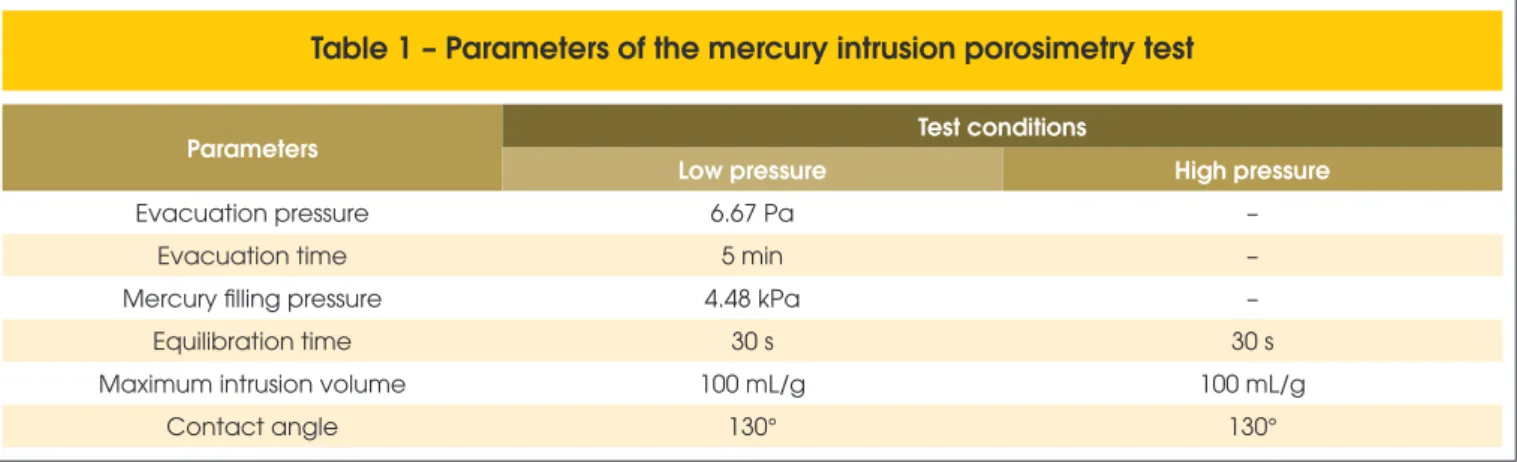
The porosity and the pore size distribution were determined by the mercury intrusion porosimetry (MIP) test. Two samples for each mortar of approximately 1 g were previously oven dried at a tem-perature of 100 ± 5 °C up to constant mass. The tests were realized in a Micromeritics AutoPore III high-pressure mercury intrusion po-rosimeter, with a maximum pressure of 476 MPa. Each sample was tested twice following the test parameters listed in Table 1. To determine the water absorption by capillarity, we tested 03 cylin-drical specimens at 28 days of age. The masses of the specimens were determined, and these were then dried in an oven at 105 ± 5 °C to constant mass. Then, they were cooled to temperature 23 ± 2 °C and weighed. The specimens were immersed in water; their masses were determined after 3, 6, 24, 48 and 72 h, counted from their placement in contact with water. The water absorption by cap-illarity is expressed in g/cm2 and is calculated by dividing the mass
increase by the cross-sectional area of the specimen surface in contact with the water (ABNT NBR 9779:1995) [28].
The mortars were applied to standard concrete rectangular sub-strate (45 cm width, 120 cm length and 5 cm thickness) for adhe-sion determination (ABNT NBR 14082: 2005) [29]. The application of the mortar on the substrate was standardized with the launch of approximately 20 cm height, and the thickness was ixed at 1 cm (Figure 1).
The bond tensile strength test was carried out according to the Brazilian norm ABNT NBR 15258: 2005 [30], which speciies that the mortar must be placed onto a substrate, and that after normal curing (i.e. 28 days), the test should be carried out by measuring the strength applied to take the mortar of the substrate.
The mortars were also characterized by Scanning Electron
Micros-Table 1 – Parameters of the mercury intrusion porosimetry test
Parameters Test conditions
Low pressure High pressure
Evacuation pressure 6.67 Pa –
Evacuation time 5 min –
Mercury filling pressure 4.48 kPa –
Equilibration time 30 s 30 s
Maximum intrusion volume 100 mL/g 100 mL/g
copy (SEM). The samples were taken from fractured section of the specimens tested to bending, and were oven dried at 100 ºC. Then, the samples were coated in gold. Images were obtained by secondary electrons in a Carl Zeiss EVO MA10 scanning electron microscope.
3. Results and discussion
3.1 Production of sulfonated polystyrene (SPS)
The degree of sulfonation of Sulfonated Polystyrene obtained was
58–63%. The solution of prepared sulfonated polystyrene present-ed a density of 1.16 g mL-1 at 27 °C, determined by pycnometry.
3.2 Evaluation of fresh mortars
The SPS admixture was dissolved in sodium hydroxide solution in order to neutralize it, where the volume of water used in the solution is only required for the polymer dispersion, the absence of free water that can act on the dispersion of the cement particles. Therefore, we chose not to consider the volume of admixture to the water/cement ratio of mixtures. From Figure 2, there was con-sistent index growth with the increase of admixture SPS quantity,
A
B
C
Figure 1 – (a) Standard concrete substrate and mold for mortar application,
(b) cure of the mortars applied for standard substrate and (c) mortar after adhesion test
reaching approximately 20% of increase to levels above 1%. Even when there was an increase in admixture content of 1–1.4%, there was no increase in luidity, showing that the admixture had already reached the optimum content, and that the increase luidity of the mixture is purely attributed to admixture action, and not the water present in its solution.
Note that the water/cement ratio has not changed; the increase in the consistency index is because the anionic long-chain mol-ecules of the sulfonated polystyrene admixture became adsorbed on the surface of the cement particles that are efectively dispersed in water, as reported by Assunção et al. [19] and Royer et al. [20]. It was also observed that the mortar with SPS addition provided a cohesive aspect and more luid than the reference mortar, as can be seen in Figure 3.
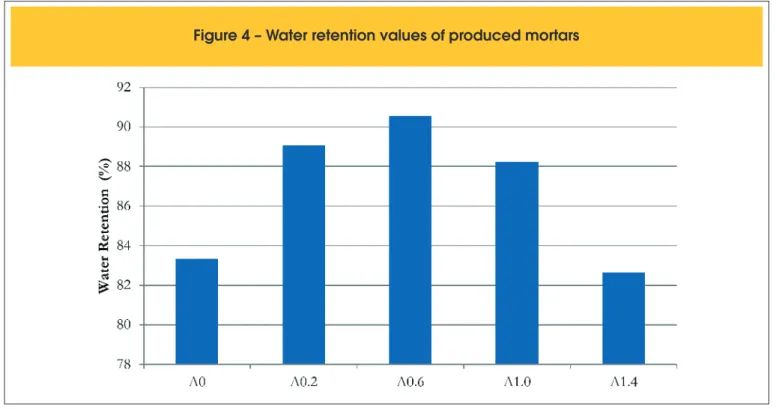
It can be seen from Figure 4 that the additions of 0.2%, 0.6% and 1.0% of polymeric admixture resulted in increased of water reten-tion relative to the reference mortar, with an optimum level of 0.6%.
The improved dispersion of the cement particles by the action of the admixture also promotes greater water adsorption to the sur-face of the cement grains, so that the water is retained. However, for higher polymer contents, the luidity of the water-cement sys-tem increases leaving part of free water, causing a decrease in water retention, as can be observed for the A1.4 mortar.
3.3 Evaluation of mortars in the hardened state
From Figure 5, it can be seen that there was a progressive in-crease in the porosity of the mortars with admixture content relative to the reference, reaching a 19% increase for A1.4. This increase in void content was accompanied by an increase in absorption above 50%, regardless of admixture content. It is known that one of the efects of the application of surfactant admixtures in cement mixtures is air void entrainment [31]. As a result of the increase in void content in the modiied mortars, the bulk density decreased,
Figure 3 – Mortar spreading after the test of consistency index:
(a) reference mortar, (b) mortar with 0.6% SPS and (c) mortar with 1.0% SPS
A
B
C
256 mm 285 mm
307 mm
although this was less pronounced variation, reaching a maximum reduction of 3% to mortar with 1.4% of admixture.
Figure 6 shows the mortar pore size distribution obtained by mer-cury intrusion porosimetry. There was a reduction in the number of pores with dimensions in the range of 102–105 nm with the
pres-ence of the admixture, probably by illing these voids with the poly-mer, as observed on microscopic images. However, in the range of
pores above 105 nm, there was a signiicant increase in the volume
of pores in the modiied mortars, especially for the highest levels of admixture, e.g. A1.4. This pore size range corresponds exactly to the pores entrained by surfactant admixtures [31].
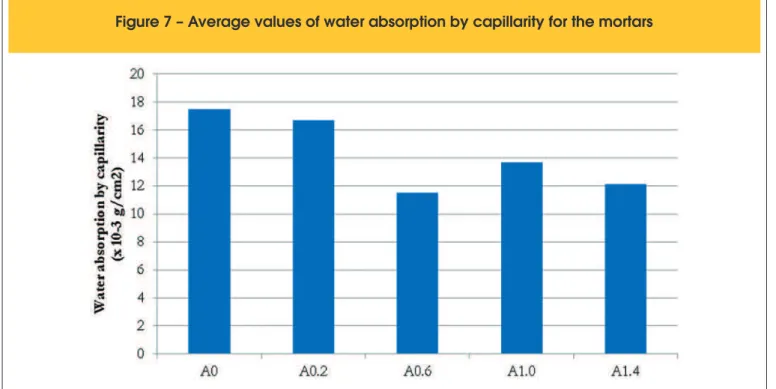
Water absorption by capillarity is related to the permeability of mortar. In Figure 7, a reduction of absorption by capillarity was observed for all mortars with the addition of the polymer,
Figure 5 – Results of water absorption, porosity and bulk density for the mortars
decreasing by 34% to the level of 0.6% admixture. Despite the elevation of porosity of the modiied mortars, the polymer pres-ence reduced the permeability, possibly explained by non-in-terconnected pores, and also by the formation of polymeric ilm in the microstructure of the mortars [17,32], as can be seen in the micrographs.
From Figure 8, there was a reduction in compressive strength with
the incorporation of the polymer; however, this reduction was not signiicant, as could be expected considering the large increase of porosity of the modiied mortars. The A0.2 mortar showed an increase in compressive strength, demonstrating that the polymer improves the mechanical properties, even in small dosages. For higher levels of polymer like mortars A1.0 and A1.4, the reduction in compressive strength was not signiicant. This may be a result of
Figure 7 – Average values of water absorption by capillarity for the mortars
the greater resistance from mortars to microcracking by the action of polymeric ilms formed, as emphasized by Ohama [17].
The use of sulfonated polystyrene led to a decreased elasticity modulus compared to the reference mortar. The maximum reduc-tion was approximately 8% for the mortar with highest polymer content (1.4%). However, this reduction can be advantageous for applications where it is subjected to large deformations, which could cause cracking of the mortar. Thus, a modiied mortar sub-mitted to a particular deformation will be under lower tension one without SPS.
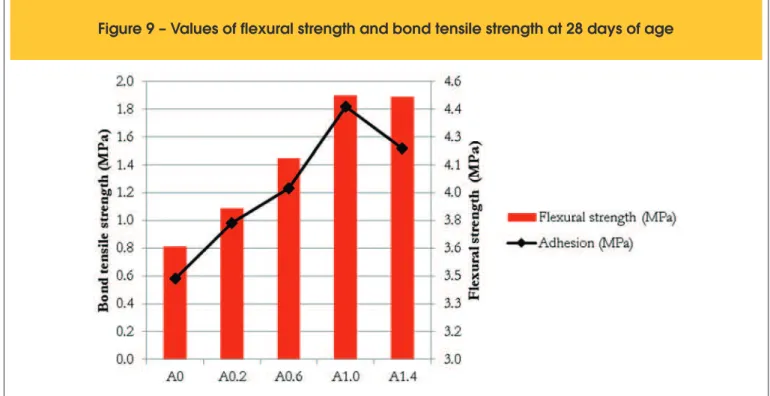
Note in Figure 9 that the tensile strength increased in bending with levels of the SPS, indicating an optimum range of dosage of 1% the admixture.
There was an increase in the tensile strength in bending for all lev-els of admixture, reaching 23.72% for the A1.0 mortar. Therefore, even with low levels of SPS, the presence of polymer in the mortar appears to form a ilm on the microstructure of the paste, which tends to improve its tensile strength, as pointed out by Ohama [17], Assunção et al. [19] and Royer et al. [20].
There was an increase of bond tensile strength for all mortars modiied with SPS. Still, as observed in the tensile strength in bending, the largest content was 1%. It should be noted that the increase was 69% even for low levels of 0.2% admixture, reach-ing a 214% increase for mortar A1.0 relative to the reference mortar (A0). This stronger physical bond between the modiied mortar and the substrate makes it a good adhesive mortar for the settlement of ceramic tiles, for example, where the resistance of adhesion should be high.
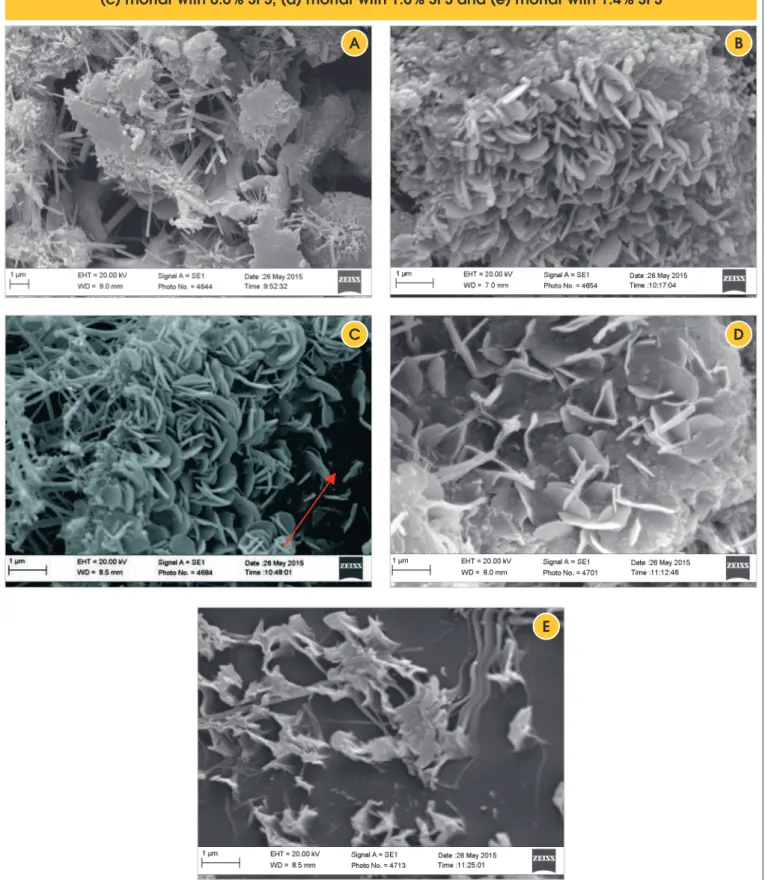
Figure 10 presents SEM images of the mortars. The micrograph of Figure 10a, at a magniication of 15000x, shows the micro -structure of the mortar with the presence of hydrated cementitious compounds such as calcium silicate hydrate. Figures 10b–10e, with magniications of 30000x, show the structure formed by the
polymer in the mortars modiied with SPS. It can be seen in the micrographs the deposition of sulfonated polystyrene in the form of lamellae, and the presence of polymeric ilm (SPS) on the mi-crostructure of the modiied mortars. As the admixture content in-creased, modiication in the microstructure of the polymeric ilm was observed in the mortars, from a lamellar structure to the more continuous polymeric ilm [33], as shown in Figures 10c–10e. In Figure 10c, it is possible to identify both types of polymer struc-tures: lamellar structures in the center of the micrograph and con-tinuous ilm to the right, indicated by the arrow.
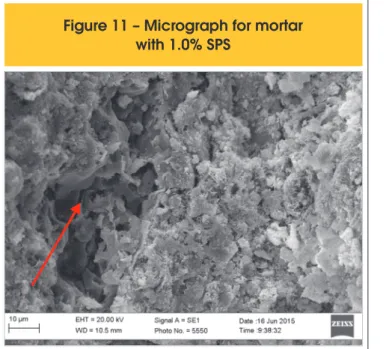
In the micrograph of Figure 11, at a magniication of 2500x, the presence of polymeric ilm on pores was observed, which may have contributed to the improvement of this mortar’s tensile prop-erties (A1.0), where the microcracks in the modiied mortar under stress are bridged by the polymeric ilms or membranes formed. This prevented crack propagation and, simultaneously, a strong cement hydrate-aggregate bond is developed [34].
4. Conclusions
Sulfonated polystyrene produced from discarded plastic cups pre-sented excellent results as an admixture for mortars, improving properties both in fresh and hardened states. There was an increase of mortar luidity with the incorporation of the admixture, reaching 20% with 1.4% of SPS. Water retention was also improved relative to the reference mortar until the level of 1.0% admixture.
In the hardened state, the admixture incorporation resulted in a signiicant increase of mortar porosity. However, this increase caused no reduction of the same order of the compressive strength and elasticity modulus. This was because the presence of poly-meric ilm improved the resistance of mortars to microcracking, thus overcoming the negative inluence of porosity on mechanical properties. This was especially evident in the tensile properties,
A
C
D
B
E
where the mortar modiied with polymer showed an increase of about 24% in tensile strength, and above 200% of the adhesion re-sistance of the mortar with 1% admixture, relative to the reference. Another advantage observed in mortar modiied with polymer was the reduction of water absorption by capillarity, showing the efect of the polymeric ilm in promoting the discontinuity of the formed pores. The exceptional increase of bond tensile strength of the modiied mortar makes it a good adhesive mortar for applications where hesive strength should be high. One should still emphasize the ad-vantage of the sulfonated polystyrene admixture being produced from discarded plastic cups, preventing the disposal of PS in the environment. Furthermore, the production and application of bet-ter-performance mortars in the cladding of buildings, reducing the detachment of the cladding, a fairly common pathology, promotes higher sustainability of the construction.
5. Acknowledgments
The authors acknowledge CAPES for the inancial support and for providing the periodical portal (www.periodicos.capes.gov.br). Vieira thanks CAPES for a Post-Doctoral scholarship. The authors also acknowledge the Laboratory of Microstructure and Ecoei-ciency of Building Materials of the Escola Politécnica University of São Paulo for the porosity tests.
6. References
[1] RODRIGUES FILHO, G; ASSUNÇÃO, R.M.N; MARQUES, F.C.A.; CORRENTE, N.G.; MEIRELES, C.S. Síntese de po-liestireno sulfonado para aplicações no tratamento de água produzido a partir de copos e bandejas descartadas de poli-estireno. Química Nova, v.31, n.8, 2008; p.2004-2008. [2] ASSOCIAÇÃO BRASILEIRA DA INDÚSTRIA DO
PLÁSTI-CO (ABIPLAST) - Peril 2013 Indústria brasileira de transfor-mação de material plástico, 2013.
[3] YOSHIGA, A.; TOFFOLI, S.M.; WIEBECK, H. Estudo do Composto PVC Reciclado/CaCO3 em Pastas Vinílicas. Polímeros: Ciência e Tecnologia, v.14, n.3, 2004; p.134-141. [4] MATOS, T.F.L.; SCHALCH, V. Composição dos Resíduos
Poliméricos, Pós-consumo, Gerados no Município de São Carlos, SP. Polímeros: Ciência e Tecnologia, v.17, n.4, 2007; p.346-51.
[5] BRANDÃO, L.R. Síntese e Caracterização de Membranas de Troca Iônica a partir de Copos e Pratos de Poliestireno Descartado. Uberlândia, 2004. Dissertação (Mestrado), Uni-versidade Federal de Uberlândia.
[6] SAVASTANO JR, H. Sistemas de cobertura para con-struções de baixo custo: uso de ibras vegetais e de outros resíduos agroindustriais. In: Rocha, J.C.; John, V.M., editors. Utilização de resíduos na construção habitacional, Rio de Janeiro: Finep; 2003, p. 94-123.
[7] ONÉSIPPE, C.; PASSE-COUTRIN, N.; TORO, F.; DELV-ASTO, S.; BILBA. K.; ARSÈNE, M.A. Sugarcane bagasse i-bres reinforced cement composites: Thermal considerations. Composites Part A, v. 41, n.4, 2010; p.549-556.
[8] BILBA, K.; ARSÈNE, M.A.; OUENSANGA, A. Sugarcane bagasse ibre reinforced cement composites. Part I. Inlu-ence of the botanical components of bagasse on the setting of bagasse/cement composite. Cement and Concrete Com-posites, v.25, n.1, 2003; p.91-96.
[9] SOUZA, A.E.; TEIXEIRA, S.R.; SANTOS, G.T.A.; COSTA, F.B.; LONGO, E. Reuse of sugarcane bagasse ash (SCBA) to produce ceramic materials. Journal of Environmental Management, v.92, n.10, 2011; p.2774-2780.
[10] FARIA, K.C.P.; GURGEL, R.F.; HOLANDA, J.N.F. Recycling of sugarcane bagasse ash waste in the production of clay bricks. Journal of Environmental Management, v.101, 2012; p.07-12.
[11] FRÍAS, M.; VILLAR, E.; SAVASTANO JR, H. Brazilian sugar cane bagasse ashes from the cogeneration industry as ac-tive pozzolans for cement manufacture. Cement and Con-crete Composites, v.33, n.4, 2011; p.490-496.
[12] NASCIMENTO, B.; RODRIGUES FILHO, G.; FRIGONI, E.S.; SOARES, H.M.; MEIRELES, C.S.; CERQUEIRA, D.A.; VALENTE, A.J.M.; CARVALHO, R.A.; ASSUNÇÃO, R.M.N.; MOTTA, L.A.C. Application of cellulose sulfoacetate ob-tained from sugarcane bagasse as additive in mortars. Jour-nal of Applied Polymer Science, v.124, n.1, 2012; p.510-517. [13] VIEIRA, J.G.; OLIVEIRA, G.C.; RODRIGUES FILHO, G.;
ASSUNÇÃO, R.M.N.; MEIRELES, C.S.; CERQUEIRA, D.A.; SILVA, W.G.; MOTTA, L.A.C. Production, characterization and evaluation of methylcellulose from sugarcane bagasse for applications as viscosity enhancing admixture for cement based material. Carbohydrate Polymers, v.78, n.4, 2009; p.779-783.
[14] OLIVEIRA, G.C.; RODRIGUES FILHO, G.; VIEIRA, J.G.; ASSUNÇÃO, R.M.N.; MEIRELES, C.S.; CERQUEIRA, D.A.; OLIVEIRA, R.J.; SILVA, W.G.; MOTTA, L.A.C. Synthesis and application of methylcellulose extracted from waste newspa-per in CPV-ARI Portland cement mortars. Journal of Applied Polymer Science, v.118, n.3, 2010; p.1380-1385.
[15] CRUZ, S.F.; VIEIRA, J.G.; RODRIGUES FILHO, G.; MEIRE-LES, C.S.; FARIA, F.A.C.; GOMIDE, D.D.; PASQUINI, D.; ASSUNÇÃO, R.M.N.; MOTTA, L.A.C. Synthesis and
characterization of methylcellulose from cellulose extracted from mango seeds for use as a mortar additive. Polímeros: Ciência e Tecnologia, v.22, n.1, 2012; p.80-87.
[16] SILVA, D.A.; MONTEIRO, P.J.M. The inluence of polymers on the hydration of portland cement phases analyzed by soft X-ray transmission microscopy. Cement and Concrete Re-search, v.36, n.8, 2006; p.1501-1507.
[17] OHAMA, Y. Polymer-based Admixtures. Cement and Con-crete Composites, v.20, n.2-3, 1998; p.189-212.
[18] LANDIM, A.S.; RODRIGUES FILHO, G.; ASSUNÇÃO, R.M.N. Use of polystyrene sulfonated produced from waste plastic cups as an auxiliary agent of coagulation, locculation and lotation for water and wastewater treatment in Munici-pal Department of Water and Wastewater in Uberlândia-MG, Brazil. Polymer Bulletin, v.58, n.2, 2007; p. 457-463. [19] ASSUNÇÃO, R.M.N.; ROYER, B.; OLIVEIRA, J.S.;
RO-DRIGUES FILHO, G.; MOTTA, L.A.C. Synthesis, Character-ization, and Application of the Sodium Poly(styrenesulfonate) Produced from Waste Polystyrene Cups as an Admixture in Concrete. Journal of Applied Polymer Science, v.96, n.5, 2005; p. 1534-1538.
[20] ROYER, B.; ASSUNÇÃO, R.M.N.; RODRIGUES FILHO, G.; MOTTA, L.A.C. Efeito da aplicação do poliestireno sulfonado (PSSNa) como aditivo em argamassas e concretos de ci-mento Portland CPV32. Polímeros: Ciência e Tecnologia, v.15, n.1, 2005; p.63-67.
[21] ASSUNÇÃO, R.M.N.; RODRIGUES FILHO, G.; ROYER, B.; OLIVEIRA, J.S.; MOTTA, L.A.C. Produção de poliestireno sulfonato de sódio (PSSNa) a partir de copos plásticos de poliestireno (PS) para a aplicação como aditivo superplas-tiicante em concretos de cimento. PI 0504109-0, 2005. [22] NBR 13276: 2005. Argamassa para assentamento e
reves-timento de paredes e tetos - Preparo da mistura e determi-nação do índice de consistência. Associação Brasileira de Normas Técnicas, 2005.
[23] NBR 13277: 2005. Argamassa para assentamento e reves-timento de paredes e tetos - Determinação da retenção de água. Associação Brasileira de Normas Técnicas, 2005. [24] NBR 7215: 1996. Cimento Portland - Determinação da
re-sistência à compressão. Associação Brasileira de Normas Técnicas, 1996.
[25] NBR 13279: 2005. Argamassa para assentamento e reves-timento de paredes e tetos - Determinação da resistência à tração na lexão e à compressão. Associação Brasileira de Normas Técnicas, 2005.
[26] NBR 8522: 2008. Concreto - Determinação dos módulos es-táticos de elasticidade e de deformação e da curva de tensão-deformação. Associação Brasileira de Normas Técnicas, 2008. [27] NBR 9778: 2005. Argamassa e concreto endurecidos - De-terminação da absorção de água, índice de vazios e mas-sa especíica. Associação Brasileira de Normas Técnicas, 2005.
[28] NBR 9779: 2012. Argamassa e concreto endurecidos - De-terminação da absorção de água por capilaridade. Associa-ção Brasileira de Normas Técnicas, 2012.
[29] NBR 14082: 2005. Argamassa colante industrializada para assentamento de placas cerâmicas - Execução do substra-to-padrão e aplicação de argamassa para ensaios. Associa-ção Brasileira de Normas Técnicas, 2005.
[30] NBR 15258: 2005. Argamassa para assentamento e reves-timento de paredes e tetos - Determinação da resistência potencial de aderência à tração. Associação Brasileira de Normas Técnicas, 2005.
[31] MEHTA, P.K.; MONTEIRO, P.J.M. Concreto: Estrutura, Pro-priedades e Materiais, São Paulo: Pini, 3ed, 1994, 674 p. [32] AFRIDI, M.U.K.; OHAMA, Y.; DEMURAB, K.; IQBAL, M.Z.
Development of polymer ilms by the coalescence of poly -mer particles in powdered and aqueous poly-mer-modiied mortars. Cement and Concrete Research, v.33, n.11, 2003; p.1715-1721.
[33] AMIANTI, M.; BOTARO, V.R. Concreto impregnado com polímero (CIP): uso e aplicação do EPS reciclado para redução da permeabilidade de superfícies de concreto. Re-vista Matéria, v.13, n.4, 2008; p.664-673.