PHB/Bentonite Compounds. Efect of Clay Modiication and Thermal Aging on Properties
Tatiara G. Almeidaa*, Anna Rafaela M. Costaa, Renate M. R. Wellenb, Eduardo L. Canedoa,c,
Laura H. Carvalhoa
Received: August 02, 2016; Revised: April 12, 2017; Accepted: July 12, 2017
Poly(3-hydroxybutyrate) (PHB) was compounded with three diferent Bentonite clays: natural, puriied by ultrasound/sonicated and organically modiied with hexadecyltrimethylammonium bromide. PHB/Bentonite masterbatches with 30% clay were prepared in a laboratory internal mixer and letdown with pure matrix to 1% and 3% w/w clay. Test samples were injection molded and characterized by x-ray difraction (XRD), diferential scanning calorimetry (DSC), infrared spectroscopy (FTIR) and scanning electron microscopy (SEM). Increase in Bentonite hydrophobic character was evinced by FTIR for organoclays. XRD of composites showed increase in clay interlayer distance and peak broadening, suggesting formation of intercalated nanocomposites. DSC showed increase in crystallinity and crystallization rate for compounds, especially for PHB/organoclay formulations. Thermal aging was conducted by exposing specimens at 115ºC for up to 120 hours, and mechanical properties were measured according to ASTM standards. Elastic modulus increased and impact strength decreased with time and clay content; clay puriication had little efect on the tensile properties. Tensile strength of thermal aged samples showed little variation, except for the organoclay nanocomposites, for which it signiicantly decreased with exposure time. SEM images displayed a whitened honeycomb structure and detachment of PHB/Bentonite layers which may be connected to cold crystallization and degradation processes taking place during thermal aging.
Keywords: PHB, Bentonite, Nanocomposites, Organophilization, Thermal Aging.
*e-mail: [email protected]
1. Introduction
Nowadays there is a growing interest in developing bio-based polymers and innovative process technologies
that can reduce the dependence on fossil fuel and move to a sustainable materials basis. So far, the most promising nanoscale illers are layered silicate clays such as montmorillonite. Bio-nanocomposites open an opportunity for new, high performance, light weight green nanocomposite materials
to replace conventional non-biodegradable petroleum-based
plastic materials.1-4
Polyhydroxyalcanoates, made from natural resources
by low-impact biotechnological processes, are among the biodegradable polymers being widely investigated as
alternative materials. Recent studies focus on PHB,
poly(3-hydroxy butyrate), a semi-crystalline polyester obtained by bacterial action upon sugars, with properties similar to many synthetic commodity polymers and processed by
standard industrial methods. PHB is biocompatible, fully compostable, and quickly degrades under normal landill conditions to water and carbon dioxide.3,5-7
Bentonite is natural clay whose main component is the mineral montmorillonite; Bentonites are a valuable
mineral class for industrial applications because of their high cation exchange capacity and surface area. However,
pristine Bentonites contain many impurities, including clay and non-clay minerals as well as organic matter, that may
interfere with their cation exchange capacity as well as with nanodispersion of the load in the polymer matrices, in their natural form, Bentonites are hydrophilic, which may render them very diicult to disperse in a hydrophobic polymer matrix. Bentonite puriication prior to compounding may
somewhat improve the situation, and sonication seems to be a suitable method as it was proven to not only reduce
clay particle size but also remove organic matter and some accessory minerals, that may hinder organophilization and expansion from the suspension11. Previous works have shown clay organophilization, a procedure where interlayer
inorganic cations are replaced by organic quaternary ammonium cations, to increase the clay interlayer distance and diminish its hydrophilic character leading to better
dispersed intercalated clay/polymer systems and, in some cases, to exfoliated systems.7-11
aUniversidade Federal de Campina Grande, R. Aprígio Veloso, 882, Universitário,
Campina Grande, PB, Brazil
bUniversidade Federal da Paraíba, Cidade Universitária, Castelo Branco III, João Pessoa, PB, Brazil
cInstituto de Tecnologia de Pernambuco, Av. Prof. Luís Freire, 700, Cidade Universitária,
The present work aims to compare the structure and properties of PHB/Bentonite compounds prepared with natural (AN), ultrasound-puriied (AP), and puriied and organophilized (AO) clay; Bentonite was added to PHB as an efort to improve its performance. The compounds were characterized by infrared spectroscopy (FTIR), X-ray difraction (XRD), diferential scanning calorimetry (DSC) and scanning electronic microscopy (SEM). The work also objectives to investigate the inluence of AN, AP and AO with 1% and 3% clay levels in the mechanical behavior as well as the impact behavior of PHB compounds performed during a thermal aging study.
2. Experimental
2.1 Materials
The polymer resin used was poly(3-hydoxybutyrate) (PHB), actually a random copolymer with approximately 4% of 3-hydoxyvalerate units, supplied by PHB Industrial SA (Brazil). The clay was sodium Bentonite clay Brasgel grade,
from Bentonit União Nordeste (Campina Grande, Brazil), with density 2.6 g/cm3 and 0.92 meq/g cation exchange capacity. The salt used was hexadecyltrimethylammonium bromide (cetremide) pursached from Vetec.
2.2 Methods
2.2.1 Puriication and organophilization of bentonite
clay
The sodium Bentonite “natural” clay (AN), was screened (#200 mesh screen) and dispersed in water at 2% w/w with vigorous agitation; it was sonicated with a Crisofolis ultra-sound bath for 30 min, iltered, dried and re-screened (#200 mesh), to obtain the puriied clay (AP).
Puriied clay thus obtained was organophilized with
hexadecyltrimethylammonium bromide (cetremide) salt using a standard procedure developed in our laboratory and described elsewhere11 to obtain the organoclay used in the present work (AO).
2.2.2 Compounding
Masterbatches with 30% clay (natural, puriied, puriied
organoclay) were compounded in a laboratory internal mixer
Haake Rheomix 3000 with high intensity rotors, operating at 150°C, 60 rpm for 7 minutes. The concentrates were diluted to inal clay concentration of 1% w/w and 3% w/w with neat PHB in a corotating twin-screw extruder Imacon DCR 30:40 operating at 150 rpm and 35 kg/h, with barrel temperature set at 160ºC.
Test specimens for tensile (ASTM D 638) and impact (ASTM D 256) tests were injection molded in a Romi Pratica 130T equipment, with extruder barrel temperature set at 155/185ºC and mold temperature at 35ºC.
2.2.3 Characterization
The compounds were characterized by infrared spectroscopy (FTIR) in an Avatar TM 360 Nicolet instrument in the region of 4000-650 cm-1; by X-ray difraction (XRD) in a Shimadzu XRD-6000 instrument in the region of 2-30º (2θ) and by diferential scanning calorimetry (DSC) in a TA Instruments DSC Q-20 using a three-stage temperature program: heating from ambient temperature (25ºC) to 200°C, cooling to 25°C and reheating to 200ºC under nitrogen atmosphere at a heating/ cooling/reheating rate of 10ºC/min with 5 mg samples.
Aging was conducted in an air circulation oven at 115ºC
on tensile and impact specimens and their tensile properties
as a function of thermal exposure times of 0, 24, 72 and 120 hours were measured. Mechanical properties were measured according to ASTM standards. Tensile tests were conducted
in a Lloyd LR 10K universal testing machine operating at 5
mm/min rate of elongation, and impact testing was carried out in a CEAST Resil-5.5 impact machine operating with a 2.75J pendulum on notched specimens in Izod coniguration.
3. Results and Discussion
3.1 Infrared spectroscopy
Figure 1 shows the FTIR spectra of the natural (AN), puriied (AP) and puriied organophilic (AO) clays used to prepare PHB/Bentonite compounds. The spectra of all samples are very similar. The peaks in the 3700-3200
cm-1 region are attributed to vibrations of hydroxyl groups present in Bentonite and to adsorbed/intercalated water. The intensity of these peaks decreased with clay puriication and particularly with clay puriication and organophilization, indicating that the chemical modiication reduced the clay hydrophilic character. The peaks 660, 1450 and 1100-800
cm-1 regions are typical of Bentonite clays and attributed to Si-O-Si, Si-OH and Al-O-Si bonds. The organoclay shows weak peaks at 2920 and 2860 cm-1 associated with asymmetric and symmetric axial deformations of CH3 and CH2 groups, respectively, attributed to the ammonium salt used to chemically modify the clay. The organophilization
process diminished the clay hydrophilic character, probably improving clay dispersion in PHB matrix, so lower levels
of segregation are expected for the system PHB/AO.12-14. 3.1.1 X-Ray difraction
X-ray difratograms of clays and PHB compounds investigated in this work are shown in Figures 2 and 3 and
the interlayer basal distance, d001 is presented in Table 1.
From Figure 2 is evidenced that quartz contaminant
was nearly completely removed and that clay structure
Figure 1. FTIR spectra of natural (AN), puriied (AP) and puriied/ organophillized (AO) Bentonite clays.
Figure 2. X-Ray difratograms of natural (AN) and puriied (AP) clays over a wider range of 2θ.
Figure 3. X-Ray difractograms of natural (AN), puriied (AP) and puriied/organophilic (AO) Bentonite clays (left) and, for PHB compounds with 1% of these clays (right).
Table 1. Basal distance d001 of the Bentonites and PHB compounds
Sample 2θ(°) d001(nm)
Natural clay (AN) 6.9 1.28
Puriied clay (AP) 7.2 1.23
Puriied organoclay (AO) 4.1 2.16
PHB1%AN 5.6 1.55
PHB1%AP 5.4 1.50
PHB1% AO 4.5 1.95
The data in Figure 3 and Table 1 also show that the basal distances of the natural and puriied clay were nearly equivalent and that organophilization was successful as the basal distance increased from around 1.2 nm to 2.16 nm, indicating that the organic cation was incorporated within the clay galleries. The basal spacing of the PHB/clay compounds were higher than those of the natural and puriied clays, indicating that PHB chains also penetrated the clay structure. The decrease in the basal distance of the organoclay in the hybrid (1.95 nm
vs 2.16 nm for the organoclay alone) indicates partial clay structure collapse which can be attributed to a tendency to
form clay agglomerates or to partial degradation of the organic modiier during processing. Similar behavior was observed for this same organoclay incorporated in PET and PE.11-14 3.1.2 Diferential scanning calorimetry
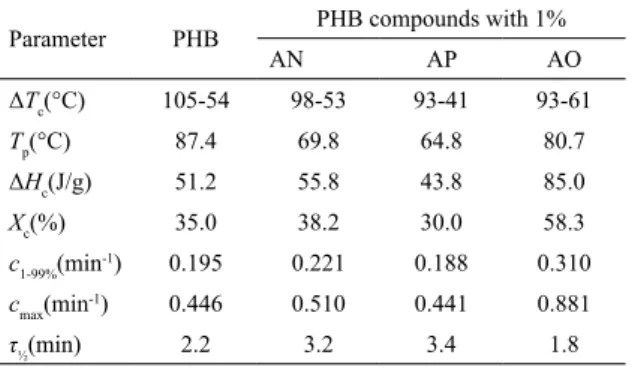
DSC data for PHB and PHB/Bentonite compounds are shown in Figure 4, Tables 2, 3 and 4 for the three stage temperature program described in the experimental section. All DSC data were tabulated and Table 2 deines the parameters whose numerical values are reported in Tables 3 and 4.
Figure 4. DSC scans for a three stage temperature program of Neat PHB and PHB/Bentonite compounds. a) irst heating, b) irst cooling and c) second heating.
Table 2. Deinition of crystallization/melting parameters reported in Tables 3 and 4
ΔT Crystallization/melting temperature interval (1-99%) Tp Peak crystallization/melting temperature
Tm Full (99.9%) melting temperature
ΔH Speciic heat of crystallization/melting Xc Mass (absolute) crystallinity
c1-99% Average rate of crystallization/melting (1-99%)
cmax Maximum rate of crystallization/melting (atTp) τ½ Half crystallization/melting time (0-50%)
Table 3. Selected crystallization parameters, PHB and PHB/ Bentonite compounds.
Parameter PHB PHB compounds with 1%
AN AP AO
ΔTc(°C) 105-54 98-53 93-41 93-61
Tp(°C) 87.4 69.8 64.8 80.7
ΔHc(J/g) 51.2 55.8 43.8 85.0
Xc(%) 35.0 38.2 30.0 58.3
c1-99%(min-1) 0.195 0.221 0.188 0.310
cmax(min-1) 0.446 0.510 0.441 0.881
τ½(min) 2.2 3.2 3.4 1.8
Table 4. Selected melting parameters of the second melting stage of PHB and PHB/Bentonite compounds.
Parameter PHB PHB compounds with 1%
AN AP AO
ΔTm(°C) 132-176 140-174 141-175 141-173
Tp(°C) 172.8 175.3 171.9 168.5
Tm(°C) 176.8 175.3 176.1 175.0
ΔHm(J/g) 66.4 73.8 62.4 103.9
Xc(%) 45.5 50.6 42.8 71.2
c1-99%(min-1) 0.225 0.291 0.293 0.305
cmax(min
-1) 0.739 0.853 0.992 0.860
τ½(min) 176 174 175 173
AP) or a double peak (PHB and PHB/AO). Melting double peaks may be associated with crystals having diferent thermal stabilities, crystal perfection or crystallite sizes, polymorphism, and re-crystallization taking place during fusion.15-21
Regarding the melt crystallization, a single peak was observed for all systems and that of PHB/AO compound was narrower and more intense, suggesting a more uniform crystallite size. It is believed that this evidence may be linked
to the ammonium cations leading to PHB degradation,
breaking the macromolecules and, contributing to a higher degree of crystallinity.4,13
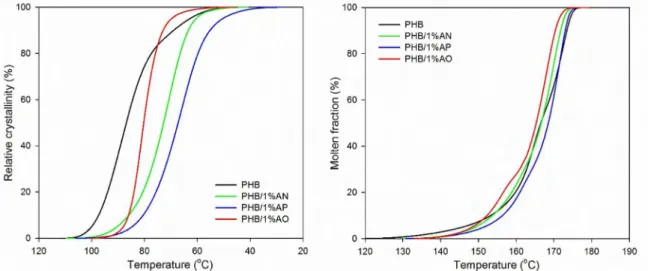
These curves are better analyzed by observing the melting and crystallization rates of PHB and, PHB/clays as shown in Figure 5 and Table 4. The data indicate that the second melting temperatures and rates for all systems under investigation are similar and fairly independent of clay addition or modiication. The melt crystallization behavior, though, is diferent. The crystallization rate for PHB is a little lower than those of PHB/clay compounds; fairly independent of clay puriication and higher for the system with puriied organoclay. Reports from literature state that Bentonite clays may nucleate or slow down polymer crystallization. Results obtained in the present work suggest that the puriied organoclay is well
dispersed in PHB matrix and that this ordered arrangement
leads to narrower peak and faster crystallization rates. The data also show that the degree of crystallinity of the PHB/ AO system was higher than any of the other compounds investigated here (Table 3).22-23
3.1.3 Thermal aging and mechanical properties Tensile properties for PHB and PHB/Bentonite compounds are shown in Figures 6 and 7; impact results are plotted in Figure 8; tables with all obtained data are in Supplementary Information. Thermal aging data indicate that although the
modulus tends to increase and elongation at break to decrease
with clay content, both these properties were relatively
Figure 5. Relative crystallinity (left) and molten fraction (right) as a function of temperature for PHB and PHB/Bentonite compounds.
Figure 6. Efect of thermal aging at 115ºC for indicated times on the tensile modulus of PHB and PHB compounds with natural (a), puriied (b) and, puriied/organophilized Bentonite (c).
This behavior was expected and is associated with the
higher modulus displayed by the Bentonites and possibly
to better clay dispersion and/or clay/polymer adhesion for the compound containing the puriied organoclay.
The inluence of clay puriication on tensile and impact strengths was minimal. However, clay organophilization
signiicantly reduced the impact strength of the systems investigated, indicating that PHB/AO systems could not
dissipate energy as well as the compounds prepared with
Figure 7. Efect of thermal aging at 115ºC for indicated times on the tensile strength of PHB and PHB compounds with natural (a), puriied (b) and, puriied/organophilized Bentonite (c).
Figure 8. Efect of thermal aging at 115ºC for indicated times on the impact strength of PHB and PHB compounds with natural, puriied and, puriied/organophilized Bentonite.
of PHB/AO systems was smaller than those of the other compounds the results seem to indicate that better clay/
polymer adhesion was obtained with the nonorganophilic
illed systems. Results observed in the present contribution for the organoclay compounds are similar to those obtained by Romo-Uribe et al24 where the organophilization also did not contribute for the improvement of layered silicate/ acrylate nanocomposites properties.
Regarding the efect of thermal aging at 115°C for up to 120h on the tensile properties and impact strength of PHB and PHB/Bentonite compounds, the data indicate that, within experimental error, except for the increase in elongation at break, the modulus and tensile strength of the matrix were nearly unafected by thermal exposure for the time and temperature adopted. Since elongation at break did clearly change, this is taken as an indication that the matrix is being afected by thermal exposure. Since tensile modulus and tensile strength were little afected, it is believed that structural changes do occur (higher crystallization vs
chain scission).
The tensile properties of PHB/Bentonite compounds,
although displaying similar behavior compared with respect
to the matrix, were slightly afected by thermal exposure. The PHB/clay systems increase in modulus and decrease in tensile strength and elongation at break with increasing thermal exposure times. These changes were more signiicant with
higher clay contents and longer exposure times, particularly
with the systems compounded with the organoclay. In the latter, the properties of the compounds exposed for 120h could not be determined as the samples became too fragile and would rupture during handling.
Figure 9. SEM images of fractured surfaces of PHB/1%AO before (left) and after (right) thermal aging at 115ºC for 120 hours. Magniication of 1000x
Figure 10. SEM images of fractured surfaces of PHB/1%AP before (left) and after (right) thermal aging at 115ºC for 120 hours. Magniication of 1000x
compounds. It is believed that the organic cation is partially degraded during processing, leading to the formation of free radicals which, in turn, may attack the polymer backbone, decreasing its molecular weight. If matrix degradation is
not excessive, initially an increase in polymer crystallinity
can take place, as shown in Tables 3 and 4 for materials not thermally aged. It is believed that after thermal aging a
decrease in thermal stability and molecular weight reduction
may have contributed for the lower mechanical properties and also conducted to the detachment of PHB/AO layers as shown in SEM images in Figure 9.
3.1.4 Scanning electron microscopy
Figures 9 and 10 present SEM images for PHB/1%AO and PHB/1%AP compounds, respectively, acquired before and after thermal aging at 115ºC for 120 hours. Before aging (Figure 10) Bentonite agglomerates, pores and fragile fracture are observed; after thermal aging a whitened honeycomb structure is observed which may be originated from a more
crystalline structure developed under propitious conditions
for the cold crystallization phenomenon and degradation
may also have taken place. In Figure 10, before thermal
aging, Bentonite particles appear well dispersed in PHB
matrix; after thermal aging detachment of PHB/Bentonite layers is notorious and may have resulted from degradation
due lower thermal stability and must have contributed to
the lowest values of mechanical properties observed in Figures 7, 8 and 10.13-14.
4. Conclusions
FTIR and XRD data show that Bentonite organophilization was successful as shown by a 68% increase in clay basal (d001)
distance. DSC data indicated that while PHB/clay compound crystallization was fairly independent of clay puriication; clay organophilization led to higher crystallization rates and higher degree of crystallinity for the PHB/Bentonite compounds. The nature and concentration of Bentonite clay afect the
physical properties during thermal aging; the compounds
become more rigid and weaker with aging, especially the
ones containing organoclay, which presented the lowest
properly the mechanical properties of PHB compounds, whitened honeycomb structure and detachment of PHB/ Bentonite layers are phenomena observed after thermal aging for PHB/AP and PHB/AO systems what promoted tensile behavior falling down.
5. Acknowledgements
The authors thank Bentonit União Nordeste and PHB Industrial for supplying clay and polymer, respectively, and CNPq and FACEPE for the inancial support.
6. References
1. Bucci DZ, Tavares LBB, Sell I. PHB packaging for the storage of food products. Polymer Testing. 2005;24(5):564-571. 2. Reddy CSK, Ghai R, Rashmi, Kalia VC. Polyhydroxyalkanoates:
an overview. Bioresource Technology. 2003;87(2):137-146. 3. Falcone DMB, Agnelli JAM, Faria LIL. Panorama setorial e
perspectivas na área de polímeros biodegradáveis. Polímeros. 2007;17(1):5-9.
4. Rhim JW, Park HM, Ha CS. Bio-nanocomposites for food packaging applications. Progress in Polymer Science. 2013;38(10-11):1629-1652.
5. Bucci DZ, Tavares LBB, Sell I. Biodegradation and physical evaluation of PHB packaging. Polymer Testing. 2007;26(7):908-915. 6. Harding KG, Dennis JS, von Blottnitz H, Harrison STL.
Environmental analysis of plastic production processes: Comparing petroleum-based polypropylene and polyethylene with biologically-based poly-ß-hydroxybutyric acid using life cycle analysis. Journal of Biotechnology. 2007;130(1):57-66.
7. Paul DR, Robeson LM. Polymer nanotechnology: Nanocomposites. Polymer. 2008;49(15):3187-3204.
8. Bhattacharya SN, Kamal MR, Gupta RK. Polymer Nanocomposites - Theory and Practice. Munich: Carl Hanser; 2007. 9. Utracki LA, Broughton B, González-Rojano N, Carvalho LH,
Achete CA. Clays for polymeric nanocomposites. Polymer Engineering & Science. 2011;51(3):559-572.
10. Almeida TG. Preparação e propriedades de compósitos de
poli(3-hidroxibutirato) e argila: efeito da modiicação e teor
de carga. [Dissertation]. Campina Grande: Federal University of Campina Grande; 2015
11. Silva SML, Araújo PER, Ferreira KM, Canedo EL, Carvalho LH, Raposo CMO. Efect of clay/water ratio during bentonite clay organophilization on the characteristics of the organobentonites and its polypropylene nanocomposites. Polymer Engineering & Science. 2009;49(9):1696-1702.
12. Silva EM, Coutinho MGF, Costa RB, Carvalho LH, Canedo EL. Efect of loading level and clay puriication on the structure and
water vapor permeability of LLDPE/bentonite nanocomposites. Polímeros. 2013;23(1):108-114.
13. Ray SS, Okamoto M. Polymer/layered silicate nanocomposites: a review from preparation to processing. Progress in Polymer Science. 2003;28(11):1539-1641.
14. Bikiaris D. Can nanoparticles really enhance thermal stability of polymers? Part II: An overview on thermal decomposition of polycondensation polymers. Thermochimica Acta. 2011;523(1-2):25-45.
15. Chen X, Hou G, Chen Y, Yang K, Dong Y, Zhou H. Efect of molecular weight on crystallization, melting behavior and morphology of poly(trimethylene terephalate). Polymer Testing. 2007;26(2):144-153.
16. Papageorgiou GZ, Panayiotou C. Crystallization and melting of biodegradable poly(propylene suberate). Thermochimica Acta. 2011;523(1-2):187-199.
17. Furushima Y, Nakada M, Takahashi H, Ishikiriyama K. Study of melting and crystallization behavior of polyacrylonitrile using ultrafast diferential scanning calorimetry. Polymer. 2014;55(13):3075-3081.
18. Owen AJ, Heinzel J, Škrbić Ž, Divjaković V. Crystallization and melting behaviour of PHB and PHB/HV copolymer. Polymer. 1992;33(7):1563-1567.
19. Gunaratne LMWK, Shanks RA. Multiple melting behaviour of poly(3-hydroxybutyrate-co-hydroxyvalerate) using step-scan DSC. European Polymer Journal. 2005;41(12):2980-2988. 20. Toda A, Tomita C, Hikosaka M, Saruyama Y. Melting of
polymer crystals observed by temperature modulated d.s.c. and its kinetic modelling. Polymer. 1998;39(21):5093-5104. 21. Wellen RMR, Canedo EL, Rabello MS. Melting and crystallization
of poly(3-hydroxybutyrate)/carbon black compounds. Efect of heating and cooling cycles on phase transition. Journal of Materials Research. 2015;30(21):3211-3226.
22. D'Amico DA, Manfredi LB, Cyras VP. Crystallization behavior of poly(3-hydroxybutyrate) nanocomposites based on modiied clays: Efect of organic modiiers. Thermochimica Acta. 2012;544:47-53.
23. Fornes TD, Paul DR. Crystallization behavior of nylon 6 nanocomposites. Polymer. 2003;44(14):3945-3961. 24. Romo-Uribe A, Santiago-Santiago K, Zavala-Padilla G,
Reyes-Mayer A, Calixto-Rodrigues M, Arcos-Casarrubias JA, et al. Waterborne layered silicate/acrylate nanocomposites by in-situ emulsion polymerization: Thermal and mechanical reinforcement. Progress in Organic Coatings. 2016;101:59-70.
Supplementary material