128
ORIGINAL ARTICLE
Sociedade Brasileira para o Estudo da Dor c
Rev Dor. São Paulo, 2012 apr-jun;13(2):128-31
Prevalence of chronic pain in a Basic Health Unit of a middle-sized city*
Prevalência de dor crônica em uma Unidade Básica de Saúde de cidade de médio porte
Luiz Fernando Ruviaro
1, Lidiane Isabel Filippin
2* Received from the Basic Health Unit Dr. Roberto Binato. Santa Maria, RS.
SUMMARY
BACKGROUND AND OBJECTIVES:Pain is a
mul-tifactorial phenomenon and one of the most frequent symptoms reported during medical visits. This study aimed at evaluating the prevalence of chronic pain among users of a Basic Health Unit (BHU) of the city of Santa Maria, RS.
METHOD:This is a transversal study evaluating indi-viduals of both genders, above 18 years of age, who were
in the waiting room of BHU. Identiication data, generic
quality of life questionnaire (SF-12), functional capacity scale for chronic pain patients and visual analog scale (VAS) were applied.
RESULTS: From all respondents, 37.8% had chronic
pain, mean age was 46.3 ± 16.4 years with predomi-nance of females (87%). Chronic pain intensity evalu-ated by VAS was 7.38 ± 2.16.
CONCLUSION:In spite of the small sample size of this study, it is important to develop preventive strategies aim-ing at well-beaim-ing and quality of life of chronic pain patients. Keywords: Chronic pain, Primary health attention, Quality of life.
RESUMO
JUSTIFICATIVA E OBJETIVOS: A dor é um
fenô-meno multifatorial e um dos sintomas mais frequente nas
1. Physical Therapy Student, Franciscan University Center (UNIFRA). Santa Maria, RS, Brazil.
2. Professor of the Franciscan University Center (UNIFRA); Doctor in Medical Sciences, Federal University of Rio Grande do Sul (UFRGS). Porto Alegre, RS, Brazil.
Correspondence to: Lidiane Filippin Rua Silva Jardim, 1175 97010-491 Porto Alegre, RS. Phone: (51) 8444-8701 E-mail: [email protected]
consultas médicas. O objetivo deste estudo foi avaliar a prevalência de dor crônica nos usuários de uma Unidade Básica de Saúde (UBS) na cidade de Santa Maria, RS. MÉTODO: Estudo de caráter transversal em que foram avaliados indivíduos de ambos os sexos, maiores de 18 anos que se encontravam na sala de espera da UBS.
Dados de identiicação, questionário genérico de quali -dade de vida (SF-12), escala de capaci-dade funcional em pacientes com dor crônica e a escala analógica visual (EAV) foram aplicados.
RESULTADOS: 37,8% dos indivíduos entrevistados
possuíam dor crônica, a média de idade foi de 46,3 ± 16,4 anos, com predominância feminina (87%). Nos in-divíduos portadores de dor crônica a intensidade da dor, avaliada pela EAV foi de 7,38 ± 2,16.
CONCLUSÃO: Apesar da pequena população do es
-tudo, é importante traçar estratégias preventivas visando
o bem estar e a qualidade de vida dos pacientes.
Descritores: Atenção primária a saúde, Dor crônica, Qualidade de vida.
INTRODUCTION
Pain has been a major human concern since the dawn of humanity. It is a red lag informing people about some biological change. It is a multifactorial phenomenon where tissue injury, emotional, socio-cultural and en-vironmental aspects unify them1,2. Its manifestation is
different and unique for each individual because each one has an individual perception about pain. In addition, pain is associated to physical and psychic factors3.
Pain is a symptom and one of the most frequent reasons for looking for medical aid4. It is estimated than 80%
of the world population look for the health system due to this morbidity5. In Brazil, it is estimated that chronic
Prevalence of chronic pain in a Basic Health Unit of a middle-sized city
Rev Dor. São Paulo, 2012 apr-jun;13(2):128-31
129
leaves, early retirement, labor indemnities and low pro-ductivity, being considered a public health problem6-8.
In January 2000, the Joint Commission on Accreditation of Healthcare Organizations (JCAHO) has published
a standard describing pain as the ifth vital sign. So, it
should always be evaluated and recorded together with other vital signs so that necessary adjustments are made to the treatment. Pain complaint should always be val-ued and respected due to the discomfort it brings9,10.
Pain management policy, be it with its own control, be it by providing palliative care, is a major example of universality and transversality of interdisciplinary activities in the public health area. Assistance to pain-ful patients is complex, requiring both knowledge and skill from the assistance team to adequately notice and manage pain11
So, pain control is an imperative public health prac-tice, especially in basic health care, due to the demand for health services and to the unfavorable social im-pact on quality of life of chronic pain patients12. It is
important to stress that the lack of adequate diagnosis and treatment during the acute phase may favor pain chronicity and worsen clinical presentation13. So, this
study aimed at investigating the prevalence of chronic pain and its impact on quality of life of users of a basic health unit.
METHOD
This is a transversal study focused on users of the Family Health Strategy Dr. Roberto Binato, in the city of Santa Maria – RS. Its coverage area is a population of approxi-mately 13 thousand inhabitants. We have interviewed individuals who were in the waiting room for medical or dental assistance. Individuals of both genders, with more than 18 years of age were included, and pregnant women, people with neuropsychiatric diseases and neo-plasias were excluded. All participants have signed the free and informed consent term (FICT). Our research has investigated the prevalence of chronic pain in these users, having as tools the personal data questionnaire, the generic quality of life questionnaire (SF-12), the functional capacity scale for chronic pain patients and the visual analog scale (VAS).
SPSS 15.0 software was used for data analysis. Symmet-ric data were presented in mean and standard deviation. Asymmetric data were expressed in median and percen-tiles (p25 and p75).
This study was approved by the Research Ethics Commit-tee, Franciscan University Center under n. 210.2011.2.
RESULTS
Participated in this study 45 individuals. Sample
identi-ication data are shown in table 1. Chronic pain preva -lence in this study was 37.8% and mean pain intensity by VAS was 7.38 ± 2.16 (Table 1).
Table 1 – Demographics
Variables
Age (years)l 46.37 ± 16.47
Gender Female 86.66% Marital status
Single 24.44% Married 53.33% Divorced 8.88% Widow 13.33% Profession
Housewife 42.22% Retired 15.55% Free lance 6.66% Dress maker 4.44% Housemaid 8.88% Others 22.2%
l Data in mean and standard deviation. Other variables presented in percentages.
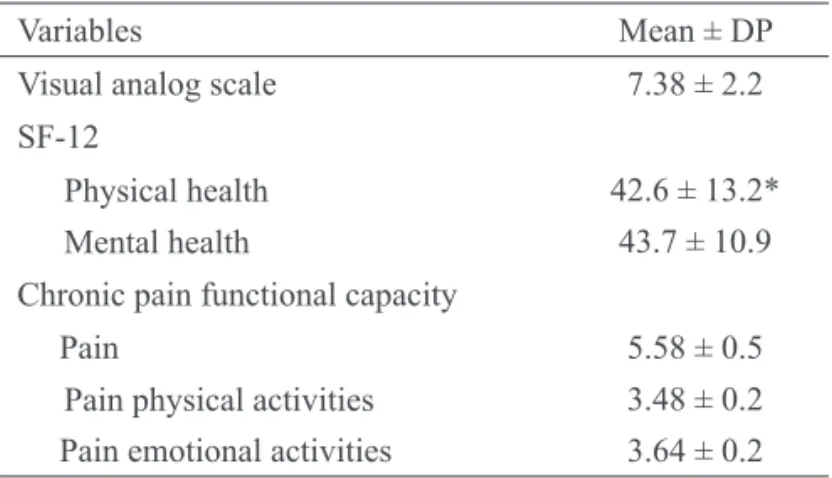
SF-12 questionnaire was applied to all respondents. Physical health of individuals with no chronic pain was 48.8 ± 10.6. Mental health domain evaluation has shown values of 45.7 ± 12.1. Physical health refers to functional capacity which considers physical aspects, pain and gen-eral health status of SF-12 questionnaire, while mental health refers to mental health contemplating emotional aspects, social aspects and vitality of the same question-naire14. Table 2 shows general data about quality of life
and prevalence of pain of chronic pain respondents.
Table 2 – Data related to pain, quality of life and functional capacity of chronic pain patients.
Variables Mean ± DP
Visual analog scale 7.38 ± 2.2 SF-12
Physical health 42.6 ± 13.2*
Mental health 43.7 ± 10.9
Chronic pain functional capacity
Pain 5.58 ± 0.5
Pain physical activities 3.48 ± 0.2
Pain emotional activities 3.64 ± 0.2
Ruviaro and Filippin
Rev Dor. São Paulo, 2012 apr-jun;13(2):128-31
130
DISCUSSION
Pain is a symptom frequently referred by patients in pri-mary health care. Pain is an alert symptom, common to several diseases with negative impact in health-related quality of life. So, diagnosis and treatment in primary health care is important, so that pain does not reach more complex health care levels15.
Even being a direct expression of departure from a healthy condition, pain and functional incapacity are overlooked elements by the basic health care in Brazil
since they are not speciically recorded by basic health
units (BHU). This is in contrast with one responsibility of the basic care strategy in Brazil, which is to maintain a proactive position when facing population’s health-disease problems16.
In our study, 37.8% of respondents had chronic pain. Mean age was 46.3 ± 16.4, with female predominance (87%). In chronic pain individuals, pain intensity by VAS was 7.38 ± 2.16. The high VAS score indicates rel-atively severe pain and the large number of individuals with this daily complaint may orient basic care services to this part of the population, since there is a strong as-sociation between pain and low working capacity17.
Pain incidence is increasing due to new lifestyles, longer life expectancy and environmental changes. In addition to generating physical and emotional stress, it is the reason for high economic and social expendi-tures for society. Data from the National Institute of Social Security (INSS), from 2007, show that 20% of
beneits granted due to medical leave were aimed at
chronic pain patients18
A study carried out from January 2004 to January 2008 has shown that the mean cost for a chronic pain patient is R$ 127.00 per month (varying between R$ 5.00 and R$ 780.00) being these amounts spent only with medica-tions19. A study was carried out in the city of Sorocaba
with chronic pain patients treated by the three health care levels and has observed a major chronic pain demand in basic health care units20.
Our study has evaluated quality of life by the SF-12 questionnaire. This is a summarized version of the 36 questionnaire with 12 items encompassing eight SF-36 dimensions. It has two domain areas: physical health and mental health. Respondents have shown values be-low the cutoff point for such questionnaire (42.6 ± 13.2) suggesting a poorer quality of physical life as compared to individuals without chronic pain (p < 0.05). However,
there has been no signiicant difference in mental health.
Maybe with a larger sample this could have been shown.
Added to the quality of life questionnaire, we have also evaluated functional capacity of chronic pain patients. This scale has three dimensions: pain intensity, interfer-ence with functional and emotional activities.
The population evaluated presented moderate pain (5.6 ± 0.47) and interference both with functional and emo-tional activities (3.48 ± 0.21 and 3.64 ± 0.18, respec-tively). A study21 on the impact of chronic pain on
qual-ity of life has shown that it has a negative impact on quality of life of up to two thirds of patients, especially on the ability to exercise, to practice sports, to perform daily life activities, as well as to perform labor activities. A different study22 evaluating functional capacity by the
Older American Resources and Services (OARS) scale, validated for the Portuguese language, with 111 elderly people with chronic pain and living in the area of a BHU in the city of Londrina, PR, has observed interference, especially with sleep, mood and leisure, that is, chronic pain has negative impact on patients’ functional capac-ity, especially to perform daily activities, and may limit or even lead to functional incapacity.
In spite of the small sample size, it is important to stress that preventive strategic measures are needed to promote well being and quality of life of chronic pain patients.
CONCLUSION
Chronic pain directly affects function and quality of life of patients and, due to its high prevalence, there is the need for further BHU professionals attention to treat it
eficiently.
REFERENCES
1. Castro M, Kraychete D, Daltro C, et al. Comorbid anxiety and depression disorders in patients with chronic pain. Arq Neuro-Psiquiatr 2009;67(4):982-5.
2. Basbaum AI, Batista DM, Scherrer G, et al. Cellular and molecular mechanisms of pain. Cell 2009;139(2):267-84. 3. Rocha APC, Kraychete DC, Lemonica L, et al. Dor:
Aspectos Atuais da Sensibilização Periférica e Central.
Rev Bras Anestesiol 2007;57(1):94-105.
4. Holtz VV, Stechman J. Epidemiologia da dor em
pacientes de Curitiba e região metropolitana. Rev Dor
2008;9(2):1217-24.
5. Kerns R, Otis J, Rosenberg R, et al. Veterans’ reports of pain and associations with ratings of health, healthrisk behaviors, affective distress, and use of the healthcare system. JRRD 2003;40(5):371-80.
Prevalence of chronic pain in a Basic Health Unit of a middle-sized city
Rev Dor. São Paulo, 2012 apr-jun;13(2):128-31
131
com dor crônica atendido em um ambulatório de dor de uma grande cidade do sul do Brasil. Rev Dor 2011;12(4):297-300.
7. Dellaroza MSG, Pimenta CAM, Matsuo T.
Prevalên-cia e caracterização da dor crônica em idosos não institu -cionalizados. Cad Saúde Pública 2007;23(5):1151-60. 8. Sá K, Baptista AF, Matos MA, et al. Prevalência de
dor crônica e fatores associados na população de Salva -dor, Bahia. Rev Saúde Pública 2009;43(4):622-30.
9. Luppen LS, Sampaio FH, Standñik CMB. Satisfação dos pacientes com a implantação do conceito dor o quin -to sinal vital, no controle da dor pós-operatória. Rev Dor 2011;12(1):29-34.
10. Sloman R, Wruble AW, Rosen G, et al. Determina-tion of clinically meaningful levels of pain reducDetermina-tion in patients experiencing acute postoperative pain. Pain Manag Nurs 2006;7(4):153-8.
11. Leite F, Gomes JO. Dor crônica em um
ambu-latório universitário de isioterapia. Rev Ciênc Méd
2006;15(3):211-21.
12. Cordeiro Q, Khouri Ml, Ota D, et al. Lombalgia e cefaléia como aspectos importantes da dor crônica na
atenção primária à saúde em uma comunidade da região
amazônica brasileira. Acta Fisiatr 2008;15(2):101-5. 13. Brennan F, Carr DB, Cousins M. Pain manage-ment: a fundamental human right. Rev Pain Med 2007;105(1):205-21.
14. Chamlian TR, Melo ACO. Avaliação funcional em
pacientes amputados de membros inferiores. Acta Fisiatr 2008;15(1):49-58.
15. Dal Ponte ST, Machado A, Dutra APG, et al. Dor
como queixa principal no serviço de Pronto-Atendimen
-to do Hospital Municipal de São Pedro do Sul- RS. Rev
Dor 2008;9(4):1345-9.
16. Brasil. Ministério da Saúde. Secretaria de Atenção à Saúde. Departamento de Atenção Básica. Política na
-cional de atenção básica / Ministério da Saúde, Secre
-taria de Atenção à Saúde, Departamento de Atenção à
Saúde. – Brasília: Ministério da Saúde, v. 4, 2006. 17. Mata MS, Costa, FA, Souza, TO, et al. Dor e
fun-cionalidade na atenção básica à saúde. Rev Ciênc Saúde
Coletiva 2011;16(1):221-30.
18. Sousa JB. Poderia a atividade física induzir analge-sia em pacientes com dor crônica? Rev Bras Med Esp 2009;15(2):145-50.
19. Vlainich R, Zucchi P, Issy AM, et al. Avaliação
do custo do medicamento para tratamento ambulato-rial de pacientes com dor crônica. Rev Bras Anestesiol 2010;60(4):399-405.
20. Martinez JE, Macedo AC, Pinheiro DFC, et al.
Per-il clínico e demográico dos pacientes com dor mus -culoesquelética crônica acompanhada nos três níveis de atendimento de saúde de Sorocaba. Acta Fisiatr 2004;11(2):67-71.
21. Brasil VV, Zatta LT, Cordeiro JABL, et al. Qualidade de vida de portadores de dores crônicas em tratamento com acupuntura. Rev Elet Enf 2008;10(2):383-94. 22. Trelha CS, Panazzolo D, Dellaroza MSG, et al. Capacidade funcional de idosos com dor crônica resi-dentes na comunidade. Rev Bras Geriatr Gerontol 2008;2(2):59-64.
Submitted in February 18, 2012.