770
( HANDI CAPPED) CAREGI VER: THE SOCI AL REPRESENTATI ONS
OF FAMI LY MEMBERS ABOUT THE CAREGI VI NG PROCESS
1Gisele Regina de Azev edo2 Ver a Lúcia Conceição de Gouv eia Sant os3
Azev edo GR, Sant os VLCG. ( Handicapped) Car egiv er : t he social r epr esent at ions of fam ily m em ber s about t he car egiv ing pr ocess. Rev Lat ino- am Enfer m agem 2 0 0 6 set em br o- out ubr o; 1 4 ( 5 ) : 7 7 0 - 8 0 .
This study aim ed to analyze what looking after physically disabled persons with spinal cord injury by traum a m eans to their caregivers and fam ily m em bers. The analysis of the testim ony of eight caregivers, obtained in open int erviews, which was m et hodologically based on t he Social Represent at ions Theory ( SR) , point ed out t wo m ain rout es: coping w it h t he suffering process in care pract ice and t he t roubled w at ers t hat perm eat e t his suffering pr ocess. These t w o r out es, char act er ized as SR Cent r al Cor e and Per ipher al Syst em , r espect ively, consist ed of them es like the way of looking at im pairm ent, affectivity, religiosity, social-econom ical changes and (lack of) technical and institutional support. The results show a handicapped caregiver dedicated to look after som eone who is physically disabled, considered incapacitated, and who leads his or her chores with distress and privations, based on guilt and religiosit y, support ed by am biguous affect ion and affect ed by det eriorat ing social- econom ical changes and ( lack of) technical and institutional support to practice an activity that im plies so m any peculiarities. The transform ation alternatives of these caregivers’ daily life principally lead to a sym biosis of disability with the patient - to live for the physically disabled - or yet, for a few, a sketch to restart personal life projects - to live with the physically disabled.
DESCRI PTORS: rehabilit at ion nursing; disabled persons; spinal cord inj uries; social psychology
CUI DA-DOR ( D) EFI CI ENTE: LAS REPRESENTACI ONES
SOCI ALES DE FAMI LI ARES ACERCA DEL PROCESO DE CUI DAR
La finalidad de este estudio fue evaluar los significados del cuidar para cuidadores/ fam iliares que com parten el cuidado dom iciliar de m inusválidos físicos por lesión m edular traum ática. Utilizando com o referencial m etodológico la t eoría de las Represent aciones Sociales ( RS) , el análisis de las ent revist as abiert as, realizadas a ocho cuidadores, apuntó dos ejes conductores de los significados: el proceso de sufrim iento vivido por las personas en la práctica del cuidar y el de las aguas turbulentas que atraviesan este sufrim iento. Estos ejes, caracterizados com o Núcleo Central y Sistem a Periférico de las RS, respectivam ente, fueron com puestos de tem as com o la óptica que se tiene de la m inusvalía, la afectividad, la religiosidad, los cam bios socio-económ icos y (la falta de) soporte técnico-institucional. Los resultados revelan un cuidador incapacitado volcado al cuidar de una persona tam bién incapacitada, tenida com o inválida, y este cuidar realizado con m ucho sufrim iento y privaciones, fundam entado en la culpabilidad y en la religiosidad, sostenido por una am bigüedad afectiva y m arcado por extenuantes cam bios socio-económ icos y falta de apoyo técnico-institucional, para una práctica que supone tantas especificidades. Las alternativas de transform ación del cotidiano de esos cuidadores señalan, principalm ente, para una sim biosis de invalidez con el otro - el vivir por el m inusválido - o aún para unos pocos, un boceto de retom ada de los proyectos personales de vida - el vivir con el m inusválido.
DESCRI PTORES: enfer m er ía en r ehabilit ación; per sonas con discapacidad; t r aum at ism os de la m edula espinal; psicología social
CUI DA-DOR ( D) EFI CI ENTE: AS REPRESENTAÇÕES SOCI AI S
DE FAMI LI ARES ACERCA DO PROCESSO DE CUI DAR
Este estudo objetivou analisar os significados do cuidar para cuidadores/ fam iliares que com partilham o cuidado dom iciliar de pessoas com deficiências físicas, por lesão m edular traum ática. Tendo com o referencial m etodológico a teoria das Representações Sociais ( RS) , a análise dos discursos obtidos por m eio de entrevistas abertas, realizadas junto a oito cuidadores, apontou dois eixos condutores dos significados: o processo de sofrim ento vivido pelos sujeitos na prática do cuidar e as águas turbulentas que perm eiam sofrim ento. Esses eixos, caracterizados com o Núcleo Central e Sistem a Periférico das RS, respectivam ente, com puseram -se de tem as com o a visão da deficiência, a afetividade, a religiosidade, as m udanças socioeconôm icas e a ( falta de) suporte técnico- institucional. Os resultados desvelam um cuida-dor (d)eficiente, voltado para o cuidar de um a pessoa tam bém com deficiência, tida com o inválida, e esse cuidar realizado com m uito sofrim ento e privações, alicerçado na culpa e na religiosidade, suportado por am bigüidade afetiva e m arcado por desgastantes m udanças socioeconôm icas e falta de suporte técnico-institucional, para um a prática que pr essupõe t ant as especificidades. As alt er nat iv as de t r ansfor m ações do cot idiano desses cuidador es sinalizam , principalm ente, para um a sim biose de invalidez com o outro - o viver pela pessoa com deficiência - ou, ainda, para poucos, um esboço de retom ada dos projetos pessoais de vida - o viver com a pessoa com deficiência.
DESCRI TORES: enferm agem em reabilit ação; pessoas port adoras de deficiência; t raum at ism os da m edula espinhal; psicologia social
1
Art icle ext ract ed from t he Mast er’s Thesis; 2 RN, Ent erost om al Therapist , Assist ant Professor Pont ifícia Universidade Cat ólica de São Paulo, Doct oral St udent in Nursing, e- m ail: [email protected] .br; 3 RN, PhD, Ent erost om al Therapist , Facult y. Nursing College at Universit y of São Paulo
Rev Lat ino- am Enferm agem 2006 set em bro- out ubro; 14( 5) : 770- 80 w w w .eer p.usp.br / r lae Art igo Original
I NTRODUCTI ON
D
uring nursing visit s at t he Out pat ient Clinicof t he Sorocaba Conj unt o Hospit alar ( SCH) , involving
ph y sically disabled per son s w it h Spin al Cor d I n j u r y
( SCI ) , m ainly aim ed at urinary- int est inal reeducat ion,
m ai n t en an ce o f sk i n i n t eg r i t y, r eco v er y o f sex u al
act i v i t y an d p r ev en t i o n o f d ef o r m i t i es, w e m o st l y
r eceiv ed t hese client s in t he com pany of t heir hom e
car egiv er s, w h o w er e fr equ en t ly fam ily m em ber s.
Th ese car e session s h appen w eek ly, alw ay s
in a pr iv at e r oom , in t he pr esence of car egiv er and
p a t i e n t , w h i l e t h e p a t i e n t i s t a k i n g p a r t i n t h e
r e h a b i l i t a t i o n p r o g r a m a t t h e a b o v e m e n t i o n e d
inst it ut ion, t hat is, bet w een 12 and 24 m ont hs. The
r elax ed clim at e, f r eq u en t ly est ab lish ed as a r esu lt
of t he fam iliar it y t hat char act er izes such an ex t ensiv e
p r of ession al r elat ion , allow s m om en t s of t ech n ical
adv ice t o t ur n int o r eal r elief sessions, dur ing w hich
t h e p a i n a n d su f f e r i n g t h a t a f f e ct t h e a t t e n d e d
f a m i l i e s a r e e x p o s e d . T h i s s u f f e r i n g m a i n l y
ch ar act er izes cases of SCI b ecau se of t h e v i olen t
and abr upt w ay it happens and inv ades pat ient s’ and
f a m i l i e s ’ l i v e s , i n c r e a s i n g p o t e n t i a l l o s s e s a n d
c o n t r i b u t i n g t o g r e a t e r e m o t i o n a l i n t e n s i t y i n
r eest ab lish ed r elat ion s.
Car eg iv er s’ m ost com m on r ep or t s r ef er t o
feelings of im pot ence t owards such a dist ressing fut ure
and incom pet ence t o perform specific and exhaust ing
t ask s, d ir ect ed at a “ n ew ” r elat iv e w h o, each d ay,
r e v e a l s h i m - / h e r s e l f s t r a n g e r i n t h e h o m e
environm ent ; bot h involved in a desolat ing crisis aft er
t h e p a s s a g e o f t h e h u r r i c a n e t h a t d i s o r g a n i z e d
ev er y on e’s lif e.
I n v i e w o f p e o p l e a f f l i c t e d b y s o m a n y
disar r angem ent s, alt hough or ient at ion and follow - up
of p at ien t s sin ce t h e ear ly p ost - t r au m a st ag e ar e
fundam ent al, w hich facilit at e sat isfact or y adapt at ion
t o d ai l y act i v i t i es, k n o w l ed g e a b o u t t h e r el a t i o n s
e st a b l i sh e d , d e v e l o p e d a n d r e o r g a n i ze d b e t w e e n
c a r e g i v e r a n d p a t i e n t i s a l s o e s s e n t i a l . I n
underst anding t he appoint ed inquiries, m ore beneficial
r esult s can be obt ained in t he r ehabilit at ion pr ogr am
or ganized at t he SCH.
Thus, t his st udy aim s t o underst and t he social
r epr esen t at ion s of car e f or t h ese car egiv er s, w h ich
w ill cer t ainly suppor t a m or e adequat e and effect iv e
n u r si n g ca r e , n o t o n l y f o r p a t i e n t s b u t a l so f o r
car egiv er s, cont r ibut ing t o a successful r ehabilit at ion
and, consequent ly, im pr ov ed qualit y of life for t hese
clien t s.
THEORETI CAL FRAMEW ORK
S p i n a l c o r d i n j u r y i s d e f i n e d a s a n y
a g g r e s s i o n t o t h e s p i n a l c o r d t h a t c a n l e a d t o
neur ological dam age, r elat ed t o t he m ot or, sensit iv e,
visceral, sexual and t rophic funct ions, and caused by
t raum a due t o car accident , firearm inj ury, diving int o
sh allow w at er s an d f allin g f r om h eigh t s, or also by
n o n - t r a u m a t i c ca u se s, su ch a s t u m o r s, i n f e ct i o n
p r o c e s s e s , v a s c u l a r c h a n g e s , m a l f o r m a t i o n s ,
d e g e n e r a t i v e o r co m p r e ssi v e p r o ce sse s. I n t h i s
u n iv er se, lit er at u r e clear ly in d icat es, in Br azil an d
a b r o a d , t h e i m p o r t a n c e o f t r a u m a s r e l a t e d t o
incr eased ur ban v iolence( 1 ).
Ch r o n i c p h y s i c a l m a n i f e s t a t i o n s o f S CI
include ur inar y and anal dy sfunct ions of neur ological
o r d er, r esp i r at o r y f ai l u r e, er ect i l e an d ej acu l at o r y
d y sf u n ct i o n , o r t h o st a t i c h y p o t e n si o n , a u t o n o m i c
d y s r e f l e x i a , r e f l e x i v e s p i n a l c o r d h y p e r a c t i v i t y,
a n h y d r o si s a n d / o r h y p e r h y d r o si s, b e si d e s o t h e r
m ot or an d sen sit iv e ch an ges w h ich , af f ect m obilit y
an d in d ep en d en ce in d aily act iv it ies. Th e acq u ir ed
deficiencies ar e associat ed w it h a sit uat ion of liv ing
deat h, creat ing a m ourning process about t he losses,
w h i c h e x a c t l y i n v o l v e i m m o b i l i t y, d e p e n d e n c e ,
isolat ion, uncer t aint ies and pain( 2).
The profile of possible physical com plicat ions
der iv ing fr om SCI out lines anot her equiv alent pr ofile
of pr oblem s, dem on st r at ed by sign ifican t dist an cin g
an d social isolat ion cau sed by con st r ain t , r ej ect ion ,
self d eg r ad at ion , d am ag e t o self est eem an d self
-concept( 3 ).
However, t his problem cert ainly does not only
affect pat ient s wit h SCI , but also t heir fam ily, i.e. “ ot her
sign ifican t per son s”. Som e au t h or s( 4 - 5 ) m en t ion t h at
t h e f am ily also ex p er ien ces a m en t al st at e of loss
and deat h and, t o allow t hem t o receive t he “ act ual”
r elat iv e, t hey need t o ex per ience m our ning ov er t he
“ lost ” one; and t hat t his pr ocess can be ex per ienced
in sim u lt an eou s an d coin cid in g p h ases or n ot . Th e
v isu alizat ion of a p er son w it h SCI , w it h all of t h e
co n se q u e n ce s m e n t i o n e d h e r e , r a i se s r e f l e ct i o n s
about concept s lik e phy sical disabilit y * .
772
Com plex it y of car egiv ing - t he car e
Aft er t he hospit alizat ion phase of SCI pat ient s,
d u r in g w h ich t h e h ealt h t eam ’s car e p r ior it ies ar e
r est r ict ed t o t r eat ing t he consequences of t he spinal
inj ury, respirat ory failure, changes in t act ile sensit ivit y,
m u s c l e a t o n y, t e n d o n a n d c u t a n e o u s a r e f l e x i a ,
par alyt ic vasodilat at ion, anhydr osis, ur inar y ar eflexia,
au t on om ic dy sr eflex ia, in t est in al at ony, er ect ile an d
e j a cu l a t o r y d y sf u n ct i o n a n d a m e n o r r h e a - w h i ch
ch ar act er ize t h e sp in al sh ock p h ase( 4 ) - t h e f am ily
m ai n l y i n v est s i n t h ese p at i en t s’ h o m e car e. Th e
ph y sical aspect s of t h is car egiv in g at h om e in v olv e
sp eci f i c an d co m p l ex act i v i t i es, su ch as ad eq u at e
p o s i t i o n i n g a n d t r a n s f e r r i n g , u r i n a r y - i n t e s t i n a l
r e e d u c a t i o n , c a r e t o m a i n t a i n s k i n i n t e g r i t y,
p r e v e n t i o n a n d t r e a t m e n t o f p r e s s u r e u l c e r s ,
m ain t ain in g r esp ir at or y an d v en t ilat or y cap acit y in
q u a d r i p l e g i c p e r so n s a n d se x u a l r e a d a p t a t i o n o f
client s and par t ner s.
The need for t his care com es about at a rat her
d if f icu lt t im e, g en er ally m ar k ed b y t h e m em or y of
recent violence t hat dragged t he individual int o a new
and unk now n sit uat ion, w hich r equir es coping based
o n p e r s o n a l a n d s o c i a l c h a r a c t e r i s t i c s t h a t a r e
p e r m e a t e d b y t h e sy m b o l s, p e r sp e ct i v e s, g r o u p
r ef er en ces an d p ast ex p er ien ces in t h e in d iv id u al’s
life st ory( 6). The aut hor present s client s who survived
t raum a and ex per ience a new r ealit y, w hich inv olves
a r e d i m e n si o n i n g o f l i m i t a t i o n s a n d p o ssi b i l i t i e s,
cor r esponding t o t he com plex ex per ience of an adult
w ho is faced w it h t he obligat or y r elear ning and new
ar t iculat ion of new w ay s of being/ doing.
This sam e m andat or y ex per ience also r efer s
t o p eo p l e i n t h at p at i en t ’s w o r l d o f r el at i o n sh i p s,
par t icu lar ly w it h car egiv er s, im posin g t h e ch allen ge
of a new order on bot h: social insert ion( 6).
This or der const it ut es an ex t r em ely difficult
and painful process, t o t he ext ent t hat bot h persons,
i.e. t he physically disabled pat ient and t he car egiver,
will be involved in a web of conflict ing feelings, facing
t he perform ance of t asks t hat were unknown t o t heir
r ealit y unt il t hen, and w hich r equir e physical/ m ent al/
social/ int ellect ual/ financial resources t hey oft en do not
hav e at t heir disposal.
I n hum an hist ory, care is relat ed t o survival,
is r eflect ed in healt h and, consequent ly, in qualit y of
life( 7). Som e expert s( 8) derive t he word care from Lat in
- cur a, w hose ancient for m - coer a - w as used in a
con t ex t of lov e an d f r ien dsh ip r elat ion s, ex pr essin g
at t it udes of care, devot ion, concern and unrest about
t h e lov ed on e or est eem ed ob j ect . Ot h er sch olar s
consider it originat es from t he word cogit are- cogit at us
and it s wrong versions coyedar, coidar, cuidar, which
m e a n t h e sa m e a s cu r a: co g i t a t e , t h i n k , d i r e ct
a t t e n t i o n , sh o w i n t e r e st , d i scl o se a n a t t i t u d e o f
dev ot ion and concer n. The associat ion bet w een bot h
o r i g i n s r ev ea l s t h e m ea n i n g o f ca r e a s d ev o t i o n ,
willingness, diligence, zeal, at t ent ion, good t reat m ent ,
and arises t o t he ext ent of t he care- needing subj ect ’s
im por t ance for t he ot her - t he car egiv er. Ther efor e,
du e t o it s ow n n at u r e, car e in clu des t w o basic an d
closely connect ed m eanings. The first , t his at t it ude of
devot ion, willingness and at t ent ion t o t he ot her person,
and t he second, t he concern and unrest , because t he
car egiv er feels inv olv ed and affect iv ely connect ed t o
t h e o t h er. Th u s, t h e et i o l o g y o f t h e w o r d al r ead y
r ev eals a conflict .
Moreov er, care is a way of being in t he world,
a w ay of ex ist ing and co- ex ist ing, of being pr esent ,
of navigat ing t hrough realit y and relat ing t o everyt hing
in t he word( 8).
Th e Car eg iv er
This reveals t hat all care im plies t he exist ence
of a caregiver, t hat is, a person delivering care form al
o r i n f o r m a l l y. Fo r m a l ca r e g i v e r s a r e sp e ci f i ca l l y
t r a i n ed f o r ca r e d el i v er y a n d a r e g en er a l l y p a i d :
n u r ses, n u r sin g au x iliar ies an d t ech n ician s, h ealt h
edu cat or s. I n f or m al car egiv er s, on t h e ot h er h an d,
ar e p eop le w h o st ar t t o d eliv er car e an d lear n , in
pr act ice - t r ial an d er r or - t h e best w ay of h elpin g
people in need( 9).
Ot h e r c a r e c o n c e p t s r e f e r t o t h e
ch ar act er i st i cs of t h e d el i v er ed car e. Th e p r i m ar y
ca r e g i v e r d i r e ct l y a ssu m e s r e sp o n si b i l i t y f o r t h e
n e ce ssa r y b a si c ca r e ; se co n d a r y ca r e g i v e r s a r e
id en t if ied as peop le w h o deliv er occasion al car e or
c a r e t h a t i s c o n s i d e r e d l e s s i m p o r t a n t f o r t h e
in div idu al’s r ecov er y( 9 ).
While t he for m al car egiv er st r uct ur e is w
ell-defined t hrough professional t raining and inst it ut ional
affiliat ion, inform al caregivers need t o be “ ident ified”,
w h i ch i s n o t a l w a y s e a sy. Th e r e a r e so m e r u l e s
i n h e r e n t i n f a m i l y d y n a m i cs t o d e f i n e t h e m a i n
car eg i v er( 9 ). Gen d er, f am i l y r el at i o n , p h y si cal an d
a f f e c t i v e p r o x i m i t y a r e i m p o r t a n t v a r i a b l e s t o
det er m ine w ho w ill assum e t he car egiv ing r ole. This
analysis, de per si, presupposes t hat t he caregiver is ( Handicapped) Caregiver: t he social...
Azevedo GR, Sant os VLCG.
a fam ily m em ber or, at t he least , a kinsm an. Act ually,
how ev er, t he cr it er ion t hat is generally copied is t he
av ailab ilit y t o car r y ou t t h ese t ask s, g iv in g r ise t o
dom est ic ar r an gem en t s, in f u n ct ion of pr of ession al,
school and religious act ivit ies t hat best accom m odat e
t he sit uat ion.
Once t he hom e/ infor m al car egiv er has been
est ablished, ( s) he has t o be defined as a social subj ect
w ho absor bs bot h popular and scient ific k now ledge
-t r a n sm i -t -t ed b y p r o f essi o n a l s’ d i sco u r se - b esi d es
sy st em s of socially shar ed v alues and beliefs w hich,
t oget her, const it ut e his/ her im aginar y t hink ing about
fam ily care. This t hinking is loaded wit h cult ural t rait s
of t he social group t he caregiver lives in( 9).
Th u s, so ci a l r e p r e se n t a t i o n s/ m e a n i n g s o f
care, in com binat ion wit h t he urgent need t o t ake care
of t he fam ily m em ber and t he lack or deficiency of a
form al support net work, st art t o det erm ine t he choice
of t he car egiv er, w hose t ask s depend on t he t y pe of
m or bidit y and dependence lev el of t he car e r eceiver.
Th at per son is also con f r on t ed w it h t h e f ear of n ot
t ak ing car e adequat ely, besides t he need t o r edefine
life pr oj ect s and per sonal and social r elat ions( 9).
I n p r i n ci p l e , w e ca n d e d u ce p o si t i v e a n d
n e g a t i v e m e a n i n g s i n v o l v e d i n ca r e g i v e r - p a t i e n t
r el a t i o n s, d u e t o t h e ch a r a ct er i st i cs o f p h y si ca l l y
d i sa b l e d p e r so n s a n d t h e r a n g e o f so ci a l m a r k s
im print ed in t his care. However, in t his st udy, we aim
t o u n v eil t h e m ean in gs an d r epr esen t at ion s of car e
for caregivers of physically disabled persons wit h SCI ,
w it h a v iew t o cont r ibut ing t o t he educat iv e r ole of
t h e m u lt id iscip lin ar y t eam , m ain ly n u r ses, in t h eir
a c t i v i t i e s t h a t i n v o l v e t h i s b i n o m i a l : c a r e g i v e r
-ph y sically disabled per son .
METHODOLOGI CAL PROCEDURES
I n defining t he st udy obj ect , w e det er m ined
t hat t he qualit at ive m et hod, in t he fram ework of Social
Rep r esen t at ion s ( SR) w ou ld m ost ad eq u at ely allow
us t o underst and t he m eanings of care for physically
d i sa b l e d p e r so n s w i t h SCI , f r o m t h e ca r e g i v e r ’ s
p er sp ect iv e.
I n Classical Psychology, r epr esent ing m eans
an act iv e pr ocess t hat im plies r econst r uct ing w hat is
g iv en b y a con t ex t of v alu es, r eact ion s, r u les an d
associat ions, in which t he ext erior exist ence is m arked
by indiv idual and social psy chism . Repr esent at ion is
t he inst ance bet ween percept ion and t he concept and
it s im age charact er, t he concr et e m ent al cont ent s of
an act of t hinking t hat sym bolically rest ores som et hing
absent . I t w as M o sco v ici w ho proposed an int erface
bet w een indiv idual and collect iv e phenom ena, w it hin
a psychosocial approach using SR, as a way of t hinking
subj ect iv it y in Social Sciences( 10).
Wit h a view t o get t ing t o know som e aspect s
of t he cont ex t s in w hich t he st udy subj ect s liv e and
con sid er in g t h e f act t h at p ov er t y, w or k con d it ion s,
housing, cust om s and healt h fact or s int er vene in t he
st at e of w ell- being( 11), w e pr esent som e infor m at ion
t h at h elps t o u n v eil aspect s in t h is scen ar io. Th ese
people - car egiv er s of pat ient s w it h t r aum at ic spinal
cor d in j u r y w h o r eceiv ed car e at t h e Reh abilit at ion
Out pat ient Clinic of t he Sorocaba Conj unt o Hospit alar
- w er e t h e cases an aly zed in t h is st u d y, m ain ly in
v iew of t he obser v ed ex haust iv e im pact in t he liv es
of fam ilies at t ended at t he SCH, besides t he relevance
of t r au m a epidem iology in t h e Br azilian spin al cor d
inj ur y scenar io( 1 ).
Th e p r o j e ct w a s su b m i t t e d t o t h e Et h i cs
Com m it t ee at t he Medical Science Cent er of PUC/ SP
an d appr ov ed t oget h er w it h t h e Fr ee an d I n f or m ed
Con sen t Ter m ( FI CT) .
I nt er v iew s t ook place in Sor ocaba- SP, at t he
out pat ient clinic, in t he room where care was delivered,
e x c e p t f o r o n e c a r e g i v e r, w h o r e q u e s t e d t o b e
in t er v iew ed at h om e becau se sh e cou ld n ot r em ain
a b s e n t f o r a l o n g t i m e . B e f o r e t h e i n t e r v i e w s ,
car egiv er s r eceiv ed in f or m at ion abou t t h e r esear ch
p r oced u r es an d ob j ect iv es. Af t er t h ey ag r eed an d
sign ed t h e FI CT, t h e in t er v iew s st ar t ed in a pr ivat e
en v i r o n m en t , g u ar an t eei n g t h at su b j ect s’ i d en t i t y
w ould be k ept anony m ous.
Th e ob t ain ed d iscou r se w as t ap e- r ecor d ed
and lat er t r anscr ibed, aft er t he car egiv er s’ appr ov al.
Recor ding is quit e a significant inst r um ent in st udies
u si n g d i sco u r se f o r d a t a co l l ect i o n , w h i ch p er m i t
r esear cher s t o r eliv e t he m om ent s w hen st at em ent s
w er e pr oduced, w it h all of t heir peculiar it ies. Besides
t he cent ral guiding quest ion, “ What does it m ean for
you t o t ake care of...?” , we also used som e secondary
in qu ir ies du r in g t h e car egiv er s’ discou r se, aim ed at
guiding t hem ar ound t he cent r al t hem e.
The use of language as a way t o obt ain dat a
i s a f u n d a m e n t a l o p t i o n i n t h e m e t h o d o l o g i c a l
fr am ew or k , since it int er m ediat es bet w een t he w or ld
an d ou r selv es, t o t h e ex t en t t h at it allow s f or t h e
e l a b o r a t i o n o f SR, a s t h e p e r so n a l m e a n i n g w e
774
Recorded and t ranscribed discourse was lat er
su b m i t t ed t o co n t en t an al y si s t h r o u g h ex h au st i v e
r ead in g an d list en in g t o t h e t ap es, w it h a v iew t o
ident ify ing r ecur r ing t hem es and cont r adict ions t hat
sp o n t a n e o u sl y e m e r g e d , t h e l i n g u i st i c st y l e w i t h
m e t a p h o r s , a f f i r m a t i o n s t h r o u g h d e n i a l s a n d
om issions, t he m ost used ver bal for m s and even t he
m ean in g of gr am m at ical er r or s.
Th is in it ial an d r ep eat ed an aly sis aim ed t o
d e t e ct t h e Ce n t r a l Nu cl e u s a n d e l e m e n t s o f t h e
peripheral SR syst em , as Jean Claude Abric proposed
in 1976, in his Theor y about t he Cent r al Nucleus of
SR( 1 3 ). Th e Ce n t r a l N u c l e u s Th e o r y o f S o c i a l
Re p r e s e n t a t i o n s i s b a s e d o n t h e a s s e r t i o n t h a t
represent at ion is organized around a cent ral nucleus,
accom panied by a peripheral syst em( 13). According t o
t h e a u t h o r, t h e Ce n t r a l N u c l e u s d e t e r m i n e s i t s
m ean in g, st abilit y an d in t er n al or gan izat ion . I t is a
subset of t he represent at ion, consist ing of one or m ore
e l e m e n t s a n d w h o se a b se n ce w o u l d d e st r o y t h e
represent at ion or grant it a t ot ally different m eaning.
I t is collect ed t o t he gr oup’s collect iv e m em or y and
h ist or y, d ef in in g it s h om og en eit y an d w it h st an d in g
changes; it is t he fruit of hist orical, sym bolic and social
d et er m in ism s; it con st it u t es it s ab st r act p ar t . Th e
Peripheral Syst em , on t he ot her hand, is t he concret e
part and allows for t he adapt at ion of t he represent at ion
t o d i f f er en t so ci a l co n t ex t s, i n co n t a ct w i t h d a i l y
cont ingencies. I t per m it s t he int egr at ion of subj ect s’
individual experiences and hist ories, support ing group
h et er ogen eit y an d con t r adict ion s.
DI VI N G I N TO HOME CARE: THE PROCESS
OF SUFFERI NG I N TROUBLED W ATERS
Eight caregivers part icipat ed, seven of whom
w er e w om en, i. e. one sist er and sev en w iv es, w hile
t he only m an was t he pat ient ’s husband. Average age
w as 31 y ear s, r anging fr om 21 t o 46 y ear s, and all
part icipant s were m arried. Educat ion levels were low,
w it h one illit erat e car egiver, six w ho has not finished
b a si c e d u ca t i o n a n d o n e w h o f i n i sh e d se co n d a r y
educat ion. Two part icipant s worked, only one of whom
was form ally regist ered in t he labor and social securit y
syst em . All fam ilies lived on t wo m inim um wages per
per son at m ost .
I n t h e st u d y, w e f o u n d t h a t t h e ce n t r a l
n u cl e u s o f SR a b o u t ca r e f o r ca r e g i v e r s o f SCI
pat ient s w as t he pr ocess of suffer ing - w hich subj ect s
div e int o w hen t hey ar e confr ont ed w it h t he sudden
c a r e p r o c e s s - i n v o l v e d i n a p e r i p h e r a l s y s t e m
ch ar act er i zed b y t r o u b l ed w at er s - i n w h i ch t h ey
st r u g g l e a n d st a r t co p i n g . Th e su f f er i n g p r o cess, con st it u t ed b y t h e car eg iv er ’s v iew of t h e p h y sical disabilit y, by t he r ole of r eligiosit y in his/ her life and
by t h e in f lu en ce of af f ect ion in h is/ h er r elat ion s, is
i m m er sed i n t u r b u l en t w a t er s, w h i ch i n v o l v e t h e
socioeconom ic changes im posed by t he ev ent of t he
d i sa b i l i t y a n d t h e (l a ck o f ) t ech n i ca l - i n st i t u t i o n a l
suppor t, w hich int er fer e in t he car e pr ocess. Table 1
pr esent s t he elem ent s or const it uent t hem es of t he
cent r al nucleus and per ipher al sy st em of SR, as w ell
as t h eir su b- t h em es.
Tab l e 1 - Th em es an d Su b - t h em es of t h e Cen t r al
Nucleus and Peripheral Syst em of S.R. for Caregivers
of Phy sically Disabled Per sons w it h S. C. I .
s e m e h
T Sub-themes
f o s s e c o r P l a r t n e C ( g n i r e f f u S ) s u e l c u N l a c i s y h P f o w e i V y t il i b a s i D , e c n e d n e p e d , y t i d il a v n I , n o i t a z il i t n a f n i , e c n e t e p m o c n i e g n a h c , t l o v e r , y t il i b i s n o p s e r , y t u d . s e l o r l a i c o s n i n o i t c e f f
A Biasedfeeilngs(love/hate, , g n i r e f f u s / y o j , n o i s s e r p e d / a i r o h p u e l a c i s y h p , ) n o i t c e j e r / e c n a t p e c c a , n o i t s u a h x e l a n o i t o m e d n a , y t i t n e d i f o s s o l , e c n e t o p m i . r a e f , y t i r u c e s n i y t i s o i g il e
R Guilt,atonement,divine , n i a g r a b , n o i t a c i d e d , t n e m h s i n u p . h t i a f s r e t a W d e l b u o r T ) m e t s y S l a r e h p i r e P ( c i m o n o c e o i c o S s e g n a h c d n a r e w o p g n i s a h c r u p f o s s o L l a i c n a n i f g n i m u s s a , s d o o g y l i m a f d n a s t c il f n o c , s n e d r u b , y c a v i r p f o s s o l , s t n e m e g n a r r a s u t a t s l a i c o s , e r u s i e l d e s a e r c e d . r e v i g e r a c s a -l a c i n h c e t ) f o k c a L ( t r o p p u s l a n o i t u t i t s n i f o l e v e l , s c i t c a t r o r r e d n a l a i r T d n a e r u t a n , e c n e d n e p e d . s k s a t f o y t i x e l p m o c
Th e an aly sis of car egiv er s’ discou r se sh ow s
t hat t he guiding line of nar r at iv es point ed t ow ar ds a
difficult daily r ealit y, loaded w it h suffer ing and pain,
per m eat ed by biased feelings and det er m ining m any
affect iv e con flict s.
We will now look at the Central Nucleus, called
process of suffering here, and dive into its deepest part.
Div ing int o car egiv er s’ pr ocess of suffer ing
The process of suffering is anchored in a view
o f d i sab i l i t y g u i d ed b y n eg at i v e r ep r esen t at i o n s /
act ion s, in a st ig m at ized p er cep t ion , w h ich can b e
observed at different t im es when t he disabled person
i s a s s o c i a t e d w i t h t h e s t e r e o t y p e o f i n v a l i d i t y ,
in com pet en ce an d depen den ce. ( Handicapped) Caregiver: t he social...
Azevedo GR, Sant os VLCG.
The st igm a, defined as a scar, as som et hing
t h a t m a r k s , c l e a r l y i n d i c a t e s t h e p r o c e s s o f
disqu alif y in g t h e in div idu al. Th is “ look ” places h im /
her in t he w or ld of t he ex cluded, seen as “ any body
who is rej ect ed from our m at erial or sym bolic m arket s
an d f r om ou r v alu es”( 1 4 ). Th e n at u r alizat ion of t h e
ex clu sion ph en om en on an d t h e r ole of st igm a - as
t here are values and represent at ions of t he world t hat
end up excluding people - serve t o express t he nat ure
of t h e in cid en ce of m ech an ism s t h at p r om ot e t h e
r e p r o d u ct i v e cy cl e o f e x cl u si o n , r e p r e se n t e d b y
accept ance at social level as w ell as by t he excluded
per son( 15).
...( t hen I t old him like t his) : I ’m never going t o t hrow
at you t hat I have an invalid husband, I won’t do t hat ... I w ant
you t o be happy, like you were before and now, but it ’s not because
t his happened t o you, t his accident t o you, t hat I ’m gonna say
t hat you are an invalid m an, an unhappy m an, no...
I n t h eir r esear ch , som e au t h or s( 3 , 5 ) con fir m
t h e v iew of disabled people as u seless, in v alid an d
in cap ab le of self - car e. I n t h e car e r elat ion , t h ese
m eanings disclose an ident ificat ion of disabled people
w i t h t h e f e e l i n g o f h e l p l e ssn e ss ch a r a ct e r i st i c o f
ch ildh ood. Hen ce, it is n o lon ger abou t car e f or an
adult , but for a child or, even m ore significant , for an
adult t urned int o a child. A child out side his/ her t im e
and place, who lost , or alm ost , his/ her aut onom y. And
w ho suffer s.
Th u s, disabled h u sban ds t u r n in t o ch ildr en ,
son s an d si b l i n g s, w h i l e car eg i v i n g w i v es b ecom e
m o t h e r s , o l d e r s i s t e r s a n d / o r m a n a g e r s a n d
businesswom en, in an evident change of social roles.
The r epr esent at ions about t he incapacit y giv e a new
m e a n i n g t o t h e r e l a t i o n s b e t w e e n ca r e g i v e r a n d
h an d icap p ed p er son , as t h ey f or m / d ef or m v alu es,
at t it udes, affect ion and power relat ions, which support
r elat ion sh ip s.
...he was a person like, for m e he was ... you know? A
m an. Now I don’t know if I ’m t aking care of m y husband or a
child.
I n t he car egiv er s’ per spect iv e, t he suffer ing
t hat perm eat es t he care process is influenced by t he
per cept ion of t he ot her per son’s suffer ing, for w hom
dependence - a st rong m ark of disabilit y - by m aking
h i m / h e r i n ca p a b l e o f a ssu m i n g h i s/ h e r o w n l i f e ,
cr eat es feelings of aggr essiv eness and r ev olt.
That ’s what I t hink, I t hink t hat I ( if I were disabled) ,
I would also want t o do t hings I couldn’t , I would t hink about t he
way t oday and yest erday, I would wish t oday were like yest erday,
I wouldn’t want t o rem ain seat ed, inst ead of running, so I t hink
t hat , at t hat t im e, when people st art t o t hink like t hat , a lot of
t hings go on in your head, t hat ’s w hen revolt com es, t hat ’s w hen
nervousness com es, w hen anguish com es, I t hink t hat ’s w here
it st art s...
Th is n ew look - ev en if u n w an t ed - of t h e
o t h e r / d i s a b l e d a l s o r e v e a l s v a l u e s a n c h o r e d i n
hist or ical, sy m bolic and cult ur al det er m inat ion, such
as t he sense of dut y and r esponsibilit y, accor ding t o
w hich it is ex act ly how one should act t ow ar ds people
w h o n eed u s, esp ecially w h en t h ey ar e in sid e ou r
ow n hom e, our ow n fam ily. Once again, t he issue of
w om en as r esp on si b l e f or t h e ch i l d com es u p , as
t ak in g a m at er n al r ole d er iv in g f r om in f an t ilizat ion
and t he conflict s and cont r adict ions pr oduced by t his
l o o k .
I t hink t hat , you have t o, I lived well wit h him for t en
years, I have t o liver wit h him t ill t he end of m y life, wit h him t he
w ay he is, you know ? Or t his w ay or w orse. But I have t o...
I n a n a l y z i n g t h e p r o c e s s o f s u f f e r i n g
car egiv er s of disabled per sons w it h SCI go t hr ough,
w e n e e d t o a t t e m p t t o u n d e r st a n d t h e a f f e ct i o n
involved in t hese relat ions. When assessing t he fam ily
im pact of disabilit y, t he am biguit y of feelings is point ed
ou t( 5 ), com par in g it w it h Her cu les’ figh t again st t h e
h i n d Cer y n ei a* , w h i ch h ad b r on ze cl og s an d g ol d
horns. She was gigant ic and ext rem ely delicat e in all
of her gest ures. The associat ion bet ween very st rong
ext rem es of feelings, such as love/ hat e, j oy/ suffering,
e u p h o r i a / d e p r e s s i o n , a c c e p t a n c e / r e j e c t i o n i s a
co n st a n t i n ca r e g i v e r s’ d i sco u r se a n d e v i d e n ce s
difficult ies t hey ov er cam e or m ax im ized, at differ ent
t im es in car e.
I love him j ust t he sam e... and... he was a person, like,
for m e he was... you know ? A m an... What can I do? Change him
all t he t im e, all t he t im e at hom e, m y husband, all t he t im e, all t he
t im e, you know? Som et im es I don’t want t o... I don’t wanna be
close t o him all t he t im e, like t hat . To t ell you t he t rut h, it ’s fear,
of one day arriving and abusing... of abusing... and not want ing
anym or e, w ant ing t o get out . I don’t even w anna t hink, but
som et im es... For him t o leave a lit t le..., a lit t le... for m e t o live...
you know? When I leave hom e j ust for a while, I already m iss
him . And when I ’m changing him all t he t im e, I don’t want t o... I
wanna leave a lit t le... for him t o leave. I don’t , I st ay at hom e, but
I ’m already afraid t hat one day, I will abuse, and I don’t want
t hat , I don’t w anna do t hat ( crying a lot ) . That ’s enough, t hat ’s
enough...
776
I n t he light of som e st udies and st art ing from
t he pr em ise t hat any new , unk now n sit uat ion ent ails
bias, t he aut hor( 5) affir m s t hat failing t o ov er com e it
configures t he passage from a crit ical sit uat ion t o an
act ual crisis. This lack of success can be due bot h t o
t he individual’s im possibilit y t o get or ganized in view
of a new condit ion, and t o t he im possibilit y t o m odify
or dest r u ct u r e an old sit u at ion t h at n ow bear s n ew
ch ar act er ist ics.
Th e am biv alen ce of t h e car egiv er ’s feelin gs
is a relevant piece of inform at ion( 9), frequent ly present
a n d i n h e r e n t t o t h e c a r e t a s k , j u s t i f i e d b y t h e
count er point of phy sical and em ot ional ex haust ion
-“ being on t he lim it ” - and sat isfact ion about doing one’s
d u t y.
I get confused, t hen, for m e, I hardly have any t im e at
all, it ’s m ore t han t hat , it ’s t aking care of him , I get up at seven
in t he m orning, I st ay, I m ake breakfast , I give him breakfast in
bed, t hat ’s w hat I do...
Ah, one day you feel nervous, you know, ‘cause seeing
a sit uat ion like t hat , it ’s hard, you know? The kids, everyt hing.
You feel nervous...
Despit e t he pr esence of t hese cont r adict or y
feelings t hat r at ify t he cr isis, one m ay say t hat car e
is support ed by affect ion, em phasizing t hat , of course,
t he qualit y of t he preexist ing affect ive bond det erm ines
t h e elabor at ion of h ow t h is car e is r epr esen t ed f or
car egiv er s an d pat ien t s.
I n com binat ion w it h ph y sical an d em ot ion al
ex haust ion, w hen cont r ol and pow er ar e desper at ely
n eed ed or w an t ed , t h e ex p er ien ce of im p ot en ce
-w hich enhances t he fact of “ being on t he lim it ” and
revolt - has revealed t o be one of t he m ost dest ruct ive
st at es of m ind known in hum anit y( 3).
Last Sat urday, I cried so m uch because I don’t have a
gift t o cure her pain... Then I get really revolt ed. Som et im es I ’m
gonna t ake care of her and I t hink about how life can be so...
This dest ruct ive im pot ence cont ribut es t o t he
c a r e g i v e r ’ s l o s s o f i d e n t i t y, i n p r o v o k i n g
t r an sfor m at ion s in daily life an d social r oles an d t o
t h e e x t e n t t h a t i t m a r k s t h e b o d y - s o u l i t s e l f ,
represent ed by a not ion of incapacit y t o perm anent ly
adapt . This loss is fundam ent al t o recover or give up
per son al pr oj ect s.
The annulm ent of personal desires, including
on e’s ow n sex u alit y, can be iden t if ied in discou r se,
badly disgu ised as an accept an ce of dest iny, again
char act er izing t he bias life it self has becom e.
Som et im es it ’s. . . su f f ocat in g. . . it ’s n ot easy , n o. . .
som et im es you t hink like: How long is t his gonna last ? How long
do we have t o bear it , m ainly I , I ’m a person, t hat I don’t own...
you know? I don’t t alk t o m any people, even you don’t see m e
t alking, t his t hing of friendship is not t here, I don’t have one
friend I t ake hom e t o t alk.
“ Being on t he lim it ” im plies t aking int o account
t h e f ear t h at ex p r essi n g o n e’s o w n em o t i o n s can
i n c r e a s e t h e d i s a b l e d p e r s o n ’ s s t r e s s , m a k i n g
car egiv er s su ppr ess t h eir cat h ar t ic n eeds, af r aid of
being t he t rigger t hat delays t he rehabilit at ion process.
Ot h er r el ev a n t a sp ect s a r e t h e i n secu r i t y
about t he v iolence t he fam ily has liv ed and t he fear
of new losses, or of not t aking care adequat ely, which
aggr av at e t he suffer ing ev en m or e.
What am I gonna do on m y ow n? Then, m y God, how
am I going t o do t hat ( t o t ake care) ? Oh, m y Jesus!
Bein g t h e cou n t r y w it h t h e lar gest cat h olic
populat ion in t he world, Brazil has an infinit e repert oire
o f r el i g i o n s r ead i l y o f f er i n g t h em sel v es t o ad ep t s
w a n t i n g i m m e d i a t e a n d si m p l e a n sw e r s t o t h e i r
co n st r a i n t s i n l i f e , a n d su p e r n a t u r a l so l u t i o n s t o
problem s considered beyond t he reach of int ervent ions
by professionals and inst it ut ions t hat deal wit h t hings
in t his world( 16).
When w e t alk about losses and guilt, in t he
religious cont ext of west ern cult ures, conflict s and bias
also appear. The feeling of guilt r elat ed t o t he cause
of t he r elat ive’s disabilit y is pr esent in all r epor t s.
I t hink I was in default during t he accident . I found
m yself sleeping, I woke up and I didn’t st op. I feel guilt y, not
even God can t ake t hat feeling away...
Th u s, t h e car eg iv er s’ d iscou r se con t ain s a
st r ong feeling of guilt about t he disabilit y w hich, in
co m b i n a t i o n w i t h t h e b e l i e f t h a t o n e sh o u l d n o t
abandon a disabled per son - t he feeling of dut y and
responsibilit y - det erm ines a care t hat can appear as
set t ling account s, a call for t he at onem ent of guilt
-under st ood as a sin - for ancient feelings t hat w er e
r e d i sco v e r e d a n d r e co n st r u ct e d o n t h e b a si s o f
m em or y( 9 ).
Th e id ea con st an t ly ex p r essed as “ b ear in g
t he cross t hat God gave you” leads t o t he quest ion of
div in e pu n ish m en t, as bot h, cr im e and punishm ent ,
r epr esent t he r isk one incur s by not com ply ing w it h
God’s r equir em ent s( 1 7 ).
I have a daught er w it h an, w it h anot her girl, she’s
gonna be t en t oday... And we weren’t m eant t o st ay t oget her...
Som et im es, I even t hink, like t hat , about som et hing st upid, you
know? God is charging m e for t hat . Because ... I m ade t he girl
pass t hrough a very big hum iliat ion, you know? God is charging
m e because I ’m going t o pass t hrough great difficult y in life t o
( Handicapped) Caregiver: t he social... Azevedo GR, VLC Gouveia Sant os.
pay for m y m ist ake here. That ’s anot her saying: what goes around,
com es around.
I t sh ou ld be obser v ed t h at t h e m ot iv at ion s
t h e car eg iv er s p r esen t ar e b ased on a b elief t h at
leg it im izes t h is sy m b olic u n iv er se: “ it is in g iv in g
t h at w e r eceiv e”, as w ell as t h e pract ice of m ak in g
p r om ises, a r elig iou s ch ar act er ist ic of t h e Br azilian
p e o p l e : p r o m i s e s a r e p a i d f o r w i t h p r a y e r s ,
p ilg r im ag es, p en it en ce, of f er in g s, sacr if ices, f r u it s
of t h e lan d, an im als, m on ey, accor din g t o dif f er en t
r eligions. Thus, t he r equest s God at t ends t o confir m
an d co n cr et i ze t h e b ar g ai n an d n o u r i sh f ai t h an d
h op e. Th is f ait h of t en ap p ear s as su p p or t t o f ace
d i f f i c u l t i e s a n d s u f f e r i n g , o f f e r i n g s t r e n g t h t o
o v er co m e t h em .
...she had t he accident , t he severit y of t he inj ury, very
high, and... I believe t hat He list ened t o m e when I asked t hat He
wouldn’t t ake her away from m e, t hat He would let m e t ake care of
her in any possible way. That He would allow her t o st ay in t he
world, even... t he way I knew she would becom e, I would t ake
care of her...
As t he goal of all r epr esent at ions is t o t ur n
som et hing not fam iliar, or non- fam iliar it y it self int o,
int o som et hing fam iliar, caregivers are now m ot ivat ed
b y t h e m o b i l i z i n g c u r r e n t o f n o n f a m i l i a r i t y
-r ep-r esent ed by specific, sudden and unexpect ed ca-r e
for a physically disabled relat ive - facing t he need t o
find a way t hat guides t hem , and t he safe m argins t o
anchor t hem in t his t ur bulent sea. At t his m om ent ,
SR t h eor y pr ov ides an u n der st an din g of on e of t h e
m ech an ism s t o legit im ize t h is car e: dedicat ion an d
effort t o t ake good care, aim ed at t he bargain t o cure
t h e disabilit y an d/ or ach iev e em ot ion al su st ain m en t
for a daily r ealit y t hat is so afflict iv e t hat , alt hough
dist urbing, it im poses t he obligat ion t o reconst ruct , in
t he at t em pt t o r egulat e t he har m ony of m ind it self.
All st at em ent s indicat e t he guiding pr esence of God
in m an’s dest iny.
This anchorage is dynam ic and m obile, which
is ch ar act er ist ic of SR: as lon g as disabled per son s
ar e beings dest it ut e of t heir ow n w ill and incapable,
in t he caregivers’ view, and as long as t he lat t er feel
guilt y about t he sit uat ion t hat cr eat ed t he disabilit y,
c a r e w i l l b e m a r k e d b y e f f o r t a n d d e d i c a t i o n ,
p e r m e a t e d b y a f f e c t i o n , s u s t a i n e d b y f a i t h a n d
rewarded by God t hrough t he sust ainm ent of suffering
an d t h r ou g h t h e slow ly ob t ain ed p r ocesses in t h e
r ehabilit at ion pr ocess, t hank s t o t he ex cellent car e:
h y gien e, f ood, decu bit u s ch an ges, w ou n d dr essin g,
m ed icat ion , ex er cises an d so m an y ot h er s; a car e
t h at w ill p r ov id e f or t h e at on em en t of g u ilt , as it
in v olv es so m u ch su f f er in g( 3 , 5 , 9 , 1 4 - 1 9 ). Wh at cer t ain ly
d o e s n o t o c c u r i s a n i m m e d i a t e p r o c e s s o f
t r a n s f o r m a t i o n i n t h e c a r e g i v e r / c a r e - d e p e n d e n t
r elat iv e r elat ion s, b u t a p r og r essiv e p er cep t ion of
oneself and t he ot her in t he way each of t hem present s
h im / h er self “ h er e an d n ow ”( 9 ). “ Th is n ew ot h er ” is
r eaffir m ed by t he r ecognit ion of “ t his new ot her ” by
t he ot her person, in a process of elaborat ing and giving
a new m eaning t o care, guided by t he t ransform at ion
o f s o m e t h i n g n o t f a m i l i a r i n t o f a m i l i a r, w h i c h
c h a r a c t e r i z e s t h e d y n a m i c s i t s e l f o f t h e s e
r ep r esen t at ion s.
Thus, t he car egiv er discer ns t he m ar gins of
t h e se t u r b u l e n t w a t e r s w h i l e st r u g g l i n g w i t h t h e
so ci o eco n o m i c ch an g es an d t h e l ack o f t ech n i cal
-i n st -i t u t -i o n a l su p p o r t , w h -i ch a r e e l e m e n t s o f t h e
Per ipher al Sy st em of SR and ar e descr ibed below .
Walk ing along t he m ar gins of t r oubled w at er s
Bein g - in - t h e- car eg iv er w or ld of a d isab led
relat ive im plies living wit h ot her daily t ransform at ions,
b e s i d e s t h e o n e s w e a l r e a d y d i s c u s s e d . B y
t hem selves, t hat is, w it hout considering t he disabilit y
a n d t h e s u f f e r i n g , t h e s e c a u s e c o n f u s i o n a n d
pr iv at ion s. Th ese t r an sf or m at ion s, ch ar act er ized as
s o c i o e c o n o m i c c h a n g e s h e r e , r e p r e s e n t t h e
concr et eness of differ ent losses inv olv ed in ex clusiv e
dedicat ion t o car e, one of t he r oles of t he Per ipher al
Syst em of SR. Thus, t he fam ily is pressured t o assum e
financial bur dens, w it h differ ent r eact ions, r eflect ing in new fam ily ar r angem ent s or conflict s.
Th e c a r e g i v e r s ’ d i s c o u r s e r e v e a l s t h e i r
depen den ce on r elat iv es an d f r ien ds, in a m ean in g
t hat r epr oduces t hat of t he disabled per son.
...And it has t o be m e, you know? Because his fam ily
rej ect ed him , t wo m ont hs ago, when t here was a problem wit h
t he boy ( son of t he caregiver and t he disabled person) , I t old him
t o ask eight y reais for his ( t he disabled person’s) fat her t o help,
his parent s, t hey haven’t com e t o our hom e unt il now, and t hey
neit her gave any response, t he only t hing t hey said was t hat
t hey were building a house and t hat t hey couldn’t com e now, and
t hen t hey said t hey would send a m essage, t hey didn’t , so, t hat ’s
som et hing, it ’s only m e and him ...
I n t h i s se n se , t h e n e e d f o r a ca r e g i v e r ’ s
pr esence by t he side of t he disabled per son r esult s
in a loss of pr iv acy an d of leisu r e m om en t s, w h ich
con t r ibu t e t o m en t al disor gan izat ion an d cr isis ov er
778
What I put int o m y head is t hat I w ant t o t ak e good
car e of him , I w ant t o t ak e good car e of m y daught er , I becom e
lik e t hat , k ind of ner v ous, because m ost of t he t im e I spend
w it h him , I w ant t o spend som e t im e w it h m y daught er and I
can’t , y ou k now ? Today I don’t hav e t hat t im e any m or e, y ou
k now ? So, I m iss t hat a lot , because, it ’s har d, y ou k now ? Tim e
goes by and I t ak e car e of him t he w hole day , st ay by his side,
do w hat I lik e t o do w hen possible, and it ’s lik e t hat I lead m y
life.
I n l i n e w i t h t h e b i a s p e r m e a t i n g t h e s e
r epr esent at ions, t he posit iv e m eaning of car e in t he
car egiv er s’ liv es st ands out since, at t he sam e t im e
as t h e p er f o r m an ce o f su ch h ar d t ask s co n su m es
t h em , dedicat ion t o car e gr an t s t h em v isibilit y an d
so ci a l st a t u s t o w a r d s f r i e n d s, r e l a t i v e s a n d t h e
pr ofessional t eam , w hich w or k as a feedback t o t he
car egiv er ’s in t er v en t ion s.
However, t his st at us inside t he fam ily can give
rise t o new conflict s, repeat ing t he so oft en m ent ioned
b ias.
...Dr. Valdenísio t hinks he has done bet t er and, t he
ot her day, Dr. Valdenísio t old him like t his, he saw t hat we are
get t ing bet t er, but he t old m e, like t hat , not t o m e, t o ot her people
who were wit h him , t hat if it weren’t for m e, he ( ...) wouldn’t be
where he is t oday, he said like t his: That ’s right , he has t o be
grat eful for t he wife he has, ot herwise, he wouldn’t be where he
is t oday.
Recent adv ances in t he st r uct ur ing of public
healt h ser v ices, w hich m ay pr ov ide t echnical suppor t
for hom e care in t he fut ure, do not exist yet for m ost
relat ives who are confront ed wit h t he cont inuit y of t he
rehabilit at ion process at hom e. Hence, what we det ect
in discourse is t he lack of decoders for t his specialt y’s
r ei f i ed u n i v er se, m ak i n g t h em f ace t h e ch al l en g e
t hrough t he t act ics of t rial and error( 18- 19).
...on Friday I t ook and arranged t he chair for him , we
t ried t o put him in t he chair, I t ook him t o t he bat hroom and
everyt hing, I washed him , it was so m uch bet t er t o wash him in
t he chair t han in t he bed, so I washed him and everyt hing, I t ook
him t o bed, I changed his diaper, I put on t he oil where his
bot t om was red and everyt hing, t hen he even said t hat t he chair,
in t he bat hroom it ’s a kind of vase, you know, when he sit s, so he
m anaged t o do his needs bet t er, he even m anaged t o urinat e
alone, like t hat , t rying hard, you know? So, it ’s m uch easier t o
t ake care of him now t han it was, it ’s m uch bet t er...
Alt hough in m any cases, disabled persons are
phy sically capable of r ealizing differ ent t ask s, as t he
dependence level is relat ed t o t he SCI charact erist ics,
such as level and degree of inj ury, t he caregiver oft en
ends up assum ing an ov er load t hat j eopar dizes bot h
persons’ independence process, in view of int ervening
m ent al, affect ive, cult ural and social aspect s, such as
m aternalism , disagreem ents, crises, etc. The nature and
com plexit y of t asks t o be perform ed are quit e varied
and not alw ay s r elat ed t o t he est ablished pr ognosis,
solely based on physiological changes( 18- 19).
W el l , i n t h e b eg i n n i n g , i t w a s, w el l , p r a ct i ca l l y
everyt hing, because he didn’t sit , he couldn’t m ove his hands,
you had t o feed him , you had t o wash him ent irely, one person
alone couldn’t wash him , he faint ed, you had t o t ake him , and it
was everyt hing, you had t o do everyt hing, like one of t hese four
or five- m ont h- old babies…
Th e c a r e g i v e r t a k e s u p h i s / h e r r o l e b y
delivering care, t here is no previous knowledge about
h ow t o pr oceed, w h et h er by t h e lack of k n ow ledge
an d su ppor t of f er ed b y societ y, or b y t h e f act t h at
car eg iv er / p at ien t r elat ion s ar e load ed w it h sh ar ed
hist or ies( 9 ).
I t sh ou ld b e h ig h lig h t ed h er e t h at t h e t w o
pr oposed st r uct ur es - Cent r al Nucleus and Per ipher al
Sy st em - ar e m obile, w h ich is ch ar act er ist ic of SR,
int ercept ing one anot her at different t im es, m it igat ing/
reinforcing t he process of suffering, in such a repeat ed
and char act er ist ic am biguit y.
Sailing t he seas of car e
We s h o u l d n o w t r y t o u n d e r s t a n d t h e
alt er nat ives subj ect s in t his st udy found t o solve t he
e q u a t i o n s p r o p o se d b y t h e e x p e r i e n ce o f su ch a
difficult daily realit y. The process of suffering present ed
possibilit ies t o t r ansfor m t he subj ect s’ daily life, w ho
let t hem selv es t ak e ov er t he st eer ing w heel and sail
som et im es t ur bulent , som et im es quiet w at er s.
Th e d eep est in v est m en t m ar k ed t h eir ow n
body - soul, r epr esent ed by a not ion of incapacit y for
p e r m a n e n t a d j u s t m e n t , m o b i l i z i n g f e e l i n g s o f
im pot ence, clust ering in caregivers t heir disabled side,
of incapacit y, finit eness and incom plet eness. I n t his
p e r s p e c t i v e , b y a t t r i b u t i n g a m e a n i n g t o t h e i r
int ervent ion, caregivers give a concret e nat ure t o t he
sy m bolically sh ar ed disabilit y.
Usin g t h e con st r u ct ion elabor at ed by som e
aut hor s( 20) and, in v iew of discour se analy sis in t his
st udy, we see a ( handicapped) caregiver, who lives in
a ch a n g i n g sy m b i o si s w i t h t h e d i sa b l e d p e r so n ,
concealing represent at ions of him - / herself and m ixing
rej ect ion and guilt wit h m ovem ent s in react ion t o t he
assim ilat ion of t his superposit ion, which subm it s bot h ( Handicapped) Caregiver: t he social...
Azevedo GR, VLC Gouveia Sant os.
persons t o t he sam e order of disabilit y, in a m ove t o
“ t urn t o one’s inside”, charact erist ic of living wit h t he
disabled per son.
On t he ot her hand, t her e is a sm aller gr oup
w h i c h , w i t h g r e a t d i f f i c u l t y , h a s a t t e m p t e d t o
elab or at e t h e cr isis sit u at ion w e m en t ion , w h et h er
b y a cce p t i n g f a i l u r e o r b y d e n o u n ci n g d i f f i cu l t y,
a l t h o u g h s t i l l w i t h o u t a n y l a r g e r s k e t c h e s o f
r e o r g a n i z a t i o n a n d r e l e a r n i n g . T h i s f r a g i l e
p er sp ect iv e lead s t o t h e b elief t h at t h e car eg iv er ’s
focus of per sonal r ealizat ions is r educed t o t he figur e
o f t h e d i sa b l e d p e r so n , st a r t i n g t o l i v e w i t h t h e
disabled per son t he ent ir e plur alit y of m eanings and
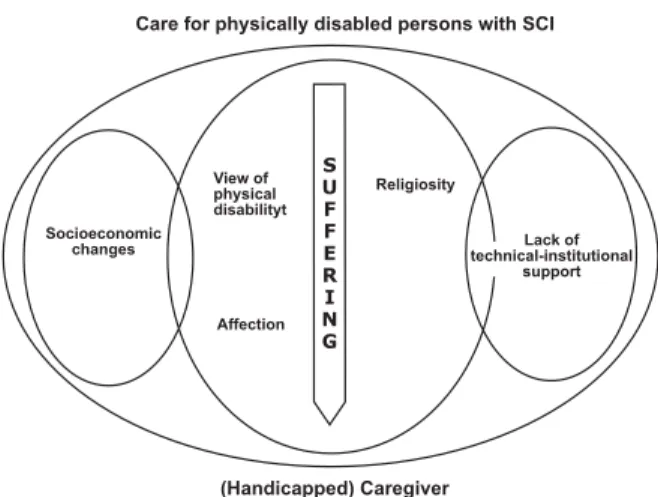
r ep r esen t at ion s t h is r elat ion can ou t lin e. Fig u r e 1
s h o w s t h e r e p r e s e n t a t i o n a l s c h e m e o f c a r e
a c c o r d i n g t o c a r e g i v e r s o f p h y s i c a l l y d i s a b l e d
p at ien t s w it h SCI .
FI NAL CONSI DERATI ONS
Ref l ect i o n s ab o u t t h e d i st i n ct i v e su f f er i n g
process in specific care for patients with SCI and som e
perspectives to overcom e it im pose the priority need to
prepare professionals and m aterial resources, as a way
of pr oviding t echnical- inst it ut ional suppor t , pr efer ably
linked up with public policies aim ed at attending to such
com plex dem ands in t he caregiver- physically disabled
per son binom ial, consider ing all m ent al, cult ur al and
social part icularit ies present ed here.
Alt hough t his st udy does not m ake any claim
on covering the im m ense range of possible experiences
in h om e car e f or ph y sically disabled per son s, t h eir
assessm ent in the light of Social Representations allowed
the authors to m obilize feelings and em otions contained
in a web of rat ional behaviors elaborat ed during t heir
pr ofessional pr act ice, consider ing t hat , oft en, in t he
cont inuit y of t he hom e r ehabilit at ion pr ocess, nur ses
act ually share t he suffering of subj ect s: caregivers and
physically disabled persons.
Thus, t hese r esult s aim t o cont r ibut e w it h a
v i e w t o l e t t i n g n o t o n l y n u r s e s , b u t a l l h e a l t h
p r of ession als w h o d eal w it h SCI p at ien t s an d t h eir
car eg iv er s, t o f ace t h e ch allen g e of r eceiv in g t h is
su f f er in g , ex p r essin g g est u r es of su p p or t , p at ien ce
and dedicat ion, in a com plex and int ense way of hum an
social life. This is pr obably t he har dest t ask , as it is
not ex pect ed and r equir es t he use of r esour ces t he
academ y does not provide. On t he ot her hand, it can
also be t he m ost rewarding t ask, t o t he ext ent t hat it
allows for t he new elaborat ion of professional pract ice,
leading t o t he conquest of a personalized care, as t he
r oad t ow ar ds t r ue car e.
Care for physically disabled persons with SCI
Socioeconomic changes
View of physical disabilityt
Affection
Religiosity
Lack of technical-institutional
support
(Handicapped) Caregiver
Living by the disabled person / Living with the disabled person
S U F F E R I N G
Figu r e 1 - Repr esen t at ion of car e f or car egiv er s of
phy sically disabled per sons w it h spinal cor d inj ur y
REFERENCES
1 . Bar r os TEP, Tar icco MA, Oliv eira RP, Gr eve JMA, San t os LCR, Napoli MMM. Est udo epidem iológico de pacient es com t r a u m a t i sm o d a co l u n a v e r t e b r a l e d é f i ci t n e u r o l ó g i co , i n t er n ad os n o I n st i t u t o d e Or t op ed i a e Tr au m at ol og i a d o Hosp it al d as Clín icas d a Facu ld ad e d e Med icin a USP. Rev Hosp Clín Fac Med Un iv São Pau lo 1 9 9 0 ; 4 5 : 1 2 3 - 6 . 2 . Kov ács MJ. Def iciên cia ad q u ir id a e q u alid ad e d e v id a -p o ssi b i l i d a d es d e i n t er v en çã o -p si co l ó g i ca . I n : Beck er E, Masi n i EAFS, Pi n t o EB, Am ar al LA, Ko v ács MJ, Am i r al i an MLTM. Def iciên cia: alt er n at iv as de in t er v en ção. São Pau lo: Casa d o Psicólog o; 1 9 9 7 . p . 9 5 - 1 2 5 .
3 . Vash CL. En f r en t an d o a d ef iciên cia: a m an if est ação, a psicologia, a r eabilit ação. São Pau lo( SP) : Pion eir a; 1 9 8 8 . 4 . Far o ACM. Assi st ên ci a ao b i n ô m i o p aci en t e/ f am íl i a n a sit uação de lesão t raum át ica da m edula espinhal. Rev Lat ino-am Enfer m agem 1 9 9 8 out ubr o; 6 ( 4 ) : 6 7 - 7 3 .
5 . Am ar al LA. Conhecendo a deficiência ( em com panhia de Hér cules) . São Paulo: Robe; 1 9 9 5 .
6 . S a n t o s LCR. Re - d i m e n s i o n a n d o l i m i t a ç õ e s e p ossib ilid ad es: a t r aj et ór ia d a p essoa com lesão m ed u lar t r au m át ica. [ Tese] São Pau lo: Escola de En fer m agem USP; 2 0 0 0 .
7. Colliér e MF. I nv isible car e and inv isible w om en as healt h car e- p r ov id er s. I n t J Nu r s St u d 1 9 8 6 ; 2 3 : 9 5 - 1 1 2 .
8. Boff L. Saber cuidar : ét ica do hum ano - com paix ão pela t er r a. 2. ed. Pet r ópolis ( RJ) : Vozes; 1999.
9. Karsch UMS. Envelhecim ent o com dependência: revelando cu idador es. São Pau lo ( SP) : EDUC; 1 9 9 8 .
780
11. Moscov ici S. La psy chanaly se, son im age et son public. Par is ( FR) : Pr esses Un iv er sit air es de Fr an ce; 1 9 7 6 . 1 2 . Lan e STM. Lin g u ag em , p en sam en t o e r ep r esen t ações sociais. I n: Lane STM, Codo W, organizador. Psicologia social: o hom em em m ovim ent o. São Paulo ( SP) : Brasiliense; 1984. p . 3 2 - 9 .
1 3 . Ab r i c JC. Je u x , co n f l i t s e t r e p r é se n t a t i o n s so ci a l e s [ t hèse] . Mar seille ( FR) : Univ er sit é de Pr ov ence, 1 9 7 6 . 1 4 . Xi b e r r a s M. Le s t h é o r i e s d e l ’ e x cl u si o n . Pa r i s ( FR) : Mer id ien s Klin ck sieck ; 1 9 9 3 .
15. Wanderley MB. Reflet indo sobre a noção de exclusão. I n: S a w a i a B B , o r g a n i z a d o r. A s a r t i m a n h a s d a e x c l u s ã o . Pet r ópolis ( RJ) : Vozes; 1 9 9 9 .
1 6 . Pr a n d i R. Re l i g i ã o , b i o g r a f i a e co n v e r sã o : e sco l h a s r eligiosas e m udanças de r eligião. Folha de São Paulo 1999 Dez 26; Cader no especial “ Busca da fé”.
17. Guareschi PA. “ Sem dinheiro não há salvação” : ancorando o bem e o m al ent r e os neopent ecost ais. I n: Guar eschi PA, Jov ch elov it ch S, or g an izad or es. Tex t os em r ep r esen t ações sociais. Pet r ópolis ( RJ) : Vozes; 1 9 9 7 .
18. Faro ACM. Cuidar do lesado m edular em casa: a vivência singular do cuidador fam iliar [ t ese] . São Paulo ( SP) : Escola de Enfer m agem da USP; 1999.
19. Sport ello EF. Caract erização das form as de vida e t rabalho d a s c u i d a d o r a s f a m i l i a r e s d o p r o g r a m a d e a s s i s t ê n c i a dom iciliár ia do Hospit al Univer sit ár io da Univer sidade de São Paulo [ disser t ação] . São Paulo ( SP) : Escola de Enfer m agem d a USP; 2 0 0 3 .
Recebido em : 17.2.2004 Aprovado em : 3.7.2006
( Handicapped) Caregiver: t he social... Azevedo GR, VLC Gouveia Sant os.