THE USE OF DIRECT REPORTED SPEECH BY A PERSON
WITH APHASIA TO CONSTRUCT A NARRATIVE
O uso do discurso reportado direto por uma pessoa com afasia na
construção de uma narrativa
Lívia Miranda de Oliveira (1), Mônika Miranda de Oliveira (2)
(1) Federal University of Sergipe, São Cristóvão, SE, Brazil.
(2) Federal University of Sergipe, São Cristóvão, SE, Brazil. Sponsor: CNPq
Conlict of interest: non-existent
an aphasic disorder), to a more severe impairment, in which there is a failure to produce any linguistic
sign 2.
Impairments on the expressive aspects of language may show a telegrammatic speech (i.e., with a predominance of nouns and verbs of action, shortage of adjectives, adverbs and prepositions, giving the speech a telegraphic style). There are global standards for the characterization of this type of speech which refer to the following charac
-teristics: non-luent and laborious speech, impov
-erishment of the available syntactic structures, incorrectly constructed sentences and phrases (from the point of view of traditional grammar), laws in the construction of phrases or sentences, incorrect morphology and omission of morphological elements 3.
Considering the linguistic changes that occur in
people with aphasia, there is no way to overlook
the fact that, when participants in an interaction are people with aphasia, some peculiarities emerge in the discursive exchanges, among them, there are those that reinforce the hypothesis that language is
INTRODUCTION
Aphasia is a disorder in the processes of meaning production, in which changes occur in one of the language levels, with repercussions in other levels, in the discursive functioning, and it is caused by brain damage resulting from cerebral vascular accident (CVA), traumatic brain injury (TBI), tumor, among other neurological disorders 1. With respect
to the impairments of the expressive aspects of language, in other words, to changes in oral production (which is relevant to this article), they can range from a mild impairment in which the speech is marked only by anomia (i.e. dificulty to ind words, possibly due to the dificulty to access the lexicon or to retrieve information relating to it, which consti
-tutes the most prominent linguistic manifestation of ABSTRACT
Purpose: to investigate the use of the reported speech by a person with aphasia in a narrative about
stroke. Methods: qualitative perspective of analysis based on interactional approaches in linguistics
it was used the data generation method called focus group for seek to understand who the participant of this study, an aphasic women, structure your narrative. It was analyzed a video recorded narrative told in a group interaction. For this, the data was transcribed. Results: data analysis showed that the
aphasia does not made the participant unable to construct a narrative with all canonical structural elements. Furthermore, the use of reported speech by participant as a resource to deal with the deicit made an engaging narrative and showed people with aphasia may be able to construct narrative in
a skilled way. Conclusions: this study provides an interface between health and human sciences,
speciically between Speech-language Therapy and Linguistic. The results of investigations are considered innovative and relevant once analyze the use of reported speech from a perspective that conceives the language like a social, interactional and cultural construction.
Considering that “taking an information uttered by someone in a given situation and repeating it in another situation is an active conversational move that fundamentally transforms the nature of the utterance” 10 is to be more apt to realize that
the speaker who reports the speech of the other does not assume a passive attitude, being, in Goffmanian terms, a mere livener of the words of the other, but rather, he/she is an active participant that, by reporting the speech of the other, becomes responsible for it although he/she is not its author. In addition to these considerations about the reported speech, many scholars share the view that in a narrative, the enlivenment of a previous speech turns the story more vivid and appellative 10-12. Thus,
in a story, when the narrator uses reported speech, livening up those which would be the words of the other, he/she frames his/her story as a drama and
involves the listeners in the interpretation of this
drama. In other words, the reported speech is seen as a strategy of involvement in the narration.
With regard to oral narratives, the linguistic material analyzed in this study, the Labovian model for understanding its structure is extremely relevant to this study, since it is a unique and indispensable seminal contribution to narrative studies 13. Labov
and Waletzky 14 were pioneers in the study of
oral narratives, designing the narrative as an oral
technique of recapitulation of past experiences. The authors described the general structure of oral narratives from the study of narratives of personal experience elicited in interview situations. By observing the structure of these narratives, they observed the presence of i) free clauses, which are those that can move along the narrative sequence without altering the semantic interpretation of the story, since they are not conined to any temporal juncture, and which serve to orientate the listener
in relation to the characters, the place, the time and the situation of the story, and of ii) narrative clauses,
which are composed of a verb in the simple past, show temporal juncture and, if displaced in the narrative sequence, they change the temporal order of the event, changing therefore the semantic interpretation of the story. In the structure of oral narratives, then, there are two types of clause: free clauses and narrative clauses, and the main body of the narrative clauses usually comprises a series of
events ordered in an action of complication.
Besides orientation and complication, a
narrative, even before its resolution, must present evaluation in order to have meaning (the reason for being told). The evaluation may or may not stop
the complicatingaction to present the point of view
of the narrator about the narrated event, and when
the evaluation stops the complicating action, it is
a form of joint action 4, since people with aphasia
often fail to construct their utterances alone or, at other times, they construct unintelligible utterances that need repair from the other person in the inter
-action. In addition, participants who interact with people with aphasia need to be more tolerant, giving them a longer time to produce their utterances, i.e., they should maximize the turns of speech of these individuals. This maximization of turns in conversa
-tions of people with aphasia is clearly in contrast to the organization of common conversations and their preference for turn minimization, which calls for the cooperation of those who interact with these individuals 5.
If aphasia affects certain language structures and uses, in turn, the aphasic individual seeks other ways/arrangements to mean/associate, i.e., he/she creates alternative processes of meaning production 1. Thus, people with aphasia have
an option, a strategic choice to speak this or that way – trying to produce complete sentences, being subjected to agrammatism, or adapting them to their utterances, to their ‘impediment’, thus producing a shorter sentence (telegraphic style) –, and the context (e.g. formal or informal) 3 can be considered
the decisive factor for this choice. Many scholars argue that the telegraph style showed by people with aphasia is an adaptation to the language deicit, and therefore they consider that these individuals get around their problems in formulating elaborate expressions (e.g., such as complex sentences) by simplifying their messages, in such a way that they can be processed by the impaired syntactic component (according to the authors) 3-6.
In line with this way of understanding the linguistic manifestations of people with aphasia, this article considers the use of direct reported speech by the study participant as a strategy of simpliication and adaptation, commonly used by people with
aphasia 7,8 in order to deal with the construction of
Laura is a patient in the neurology outpatient clinic of the University Hospital of the Federal University of Juiz de Fora, and with the permis
-sions by the director of the hospital and the head neurologist of the sector (both permissions regis
-tered in statements authorizing the research with the university hospital patients), she was invited by the irst author of this article (Lívia) to participate in the (non-clinical) Masters research, entitled “The co-construction of identities in face-to-face interac
-tions between people with and without expressive aphasia”, approved by the CEP-UFJF under the number 024/2007 and developed in this institution, and that gave rise to this article. After accepting the invitation, she signed the Informed Consent Form (ICF) and began to participate in weekly meetings to generate data for the research in question. Because it is not a clinical research, Laura was not subjected to an anamnesis or even to phonoaudiological assessments and the diagnosis of aphasia was established by the neurology staff at the abovemen
-tioned hospital and recorded in the chart to which the irst author of this article had access with the purpose of selecting participants for her research.
The corpus of such masters research, from which the narrative analyzed here was extracted, was generated in 2007 and consists of approximately 15 hours of video recordings (in a properly equipped laboratory of research, belonging to the Institute of Human Sciences at UFJF, with documented autho
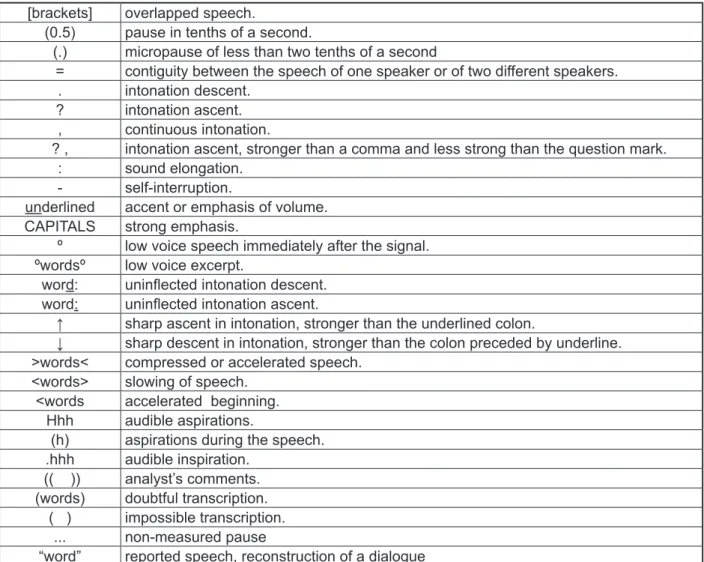
-rization by the director of the institute) of face-to-face conversations involving people with and without aphasia, transcribed according to the conventions of transcription proposed by Gail Jefferson in 2002, with some adaptations (5-8) , which are in Figure
1, at the end of the article. One of the narratives
that are part of this corpus was then selected to be
analyzed in this study from a qualitative research perspective and anchored in a perspective that its into the theoretical and methodological framework of interactional approaches in Linguistics.
The conversation from which the narrative that will be analyzed here was extracted consists of the irst recording made for the research, and it is a presentation dynamics of the participants in which each one tells their story of CVA, since the criteria used to include the participants in the research group was the fact that they were affected by CVA and that their aphasia diagnosis was recorded in their medical records at the neurology outpatient clinic in which they are patients. It is worth noting that the data analysis will not have statistical intervention, given that, since data were collected through the use of Focus-Group Methodology, they have a qualitative nature. The topic of the conversation followed by resolution. Therefore, in a very simple
way, the resolution of the narrative deals with the
portion of the narrative sequence that follows the evaluation. If the evaluation is the last element, then the resolution will coincide with the evaluation.
In some narratives, after the resolution there is the coda; however, this is optional, consisting of a
functional device for returning the oral perspective to the present, providing a time and topic transition of the world of the story to the interaction in which this story is being told. In summary, a narrative can be seen as serial answers to the following questions: what is the story about? (abstract), who
participates, when, of what, where? (orientation),
what happened? (complication), so what? (evalu-ation), resulted in what? (resolution) 12,15,16. Such
elements will guide the analyses performed in this study, which seek to investigate the use of direct reported speech by a person with aphasia when he/ she constructs a narrative about CVA.
METHODS
This study’s theoretical assumptions provide elements for the qualitative analysis performed here, which, based on a constructionist and interpretative perspective of language, investigates a narrative about CVA, in order to understand the uses of the direct reported speech by a person with aphasia in the construction of his/her story.
The method of generating the data of this study can be deined as a focus-group interview which, in turn, consists of a qualitative research method in which ‘a research technique that collects data through a group interaction on a topic determined by the researcher “17 is applied.
The language material under analysis is a narrative that was performed during a face-to-face interaction in the focus group which included: Lívia (irst author of this article and Phonoaudiologist)
and three women with aphasia, identiied by pseud
-onyms Carla, Laura and Tereza , which were 55, 37 and 45 years old, respectively, at the time of data
generation (2007).
reported speech presented herein are also essential in analyzing the use of this type of speech in interac
-tional speech situations.
Based on the Labovian postulates about the general structure of the narrative, which segments the narrative into four components – ‘orientation’, ‘complication’, ‘evaluation’ and ‘resolution’ – and two optional devices of story initiation and completion
(abstract and coda, respectively), clippings of
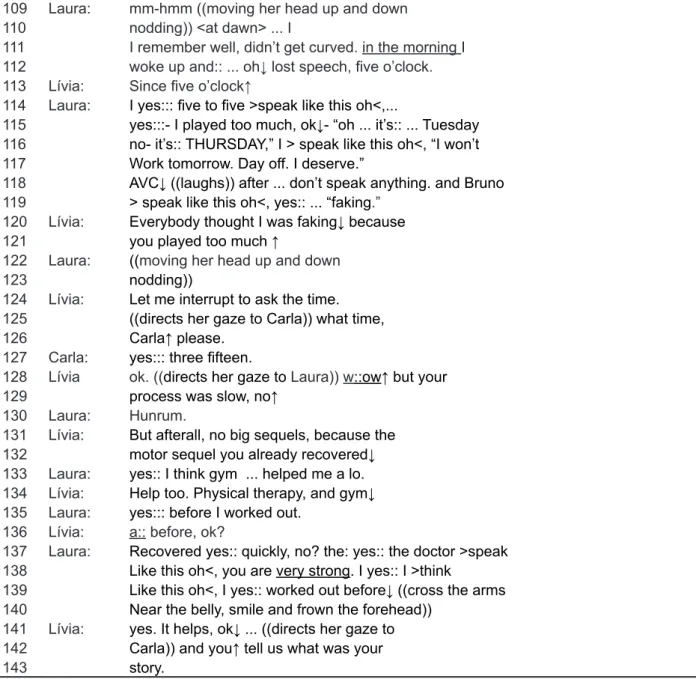
Laura’s CVA story, which is in full in Figure 2 at the end of the article, will be introduced. The conver
-sation that contains the narrative under investigation was cut to facilitate the analysis, and the irst excerpt will be presented and discussed below.
that triggered the narrative performed by Laura was amnesia after CVA.
RESULTS
In order to perform an analysis that reveals nuances of the use of direct reported speech in the construction of a narrative, in view of the narrator’s impairment on the ability of structuring utterances, the abovementioned Labovian fundamentals about oral narratives are taken as basis, since the aim of this study is to investigate the structuring of the narrative. The contributions by Tannen 10 on
Excerpt 1: orientation
01 Lívia: ((directs her gaze to Carla and Tereza))you all
02 had a memory loss right after the CVA, you didn’t
03 remember anything, did you?
04 Carla: [((moves her head up and down
05 nodding))
06 Tereza: [[((moves her head up and down
07 nodding))
08 Lívia: ((directs her gaze to Laura)) you too, Laura?
09 Laura: no. I <remember> everything
10 Lívia: at the time of the CVA, right after you had the CVA.
11 Laura: no. ((moves her head to the right and to the left
12 denying))
13 Lívia: ((directs her gaze to Tereza))
14 Tereza: no. no↓ nothing, nothing. I didn’t remember
15 Lívia: ((directs her gaze to Carla and then to
16 Tereza))the two of you? you didn’t remember anything, then?
17 Carla: no.
18 Tereza: Nothing.
19 Lívia: ((directs her gaze to Laura))so you remembered ↑
20 Laura: mm-hmm.
21 Lívia: Did you get to remember everything soon after the CVA?
22 Laura: mm-hmm.=
23 Lívia: = how was it?=
24 Laura: = oh, I umm:: ive o’clock <I had CVA >. I (.)
25 working,= ((directs her gaze to Carla and
26 Tereza who were having a parallel conversation))
27 Lívia: ((directs her gaze to Carla and Tereza)) =girls, her
28 story is different,=
29 Carla: [((stays silent and looks to Laura))
30 Tereza: [((stays silent and looks to Laura))
31 Laura: =working, eh? ive o’clock umm: umm:=
32 Lívia: =the::, in the industry you were working for?
place in which the scene was happening. Therefore, she (Lívia) proposes a complement (“in the industry you were working for?”), which is accepted in the next turn (“mm-hmm “), cooperating with Laura in the construction of the orientation of her story. After Laura accepts Lívia’s offer, she begins the narration of the event itself, constructing the complication of her narrative, which will be presented for analysis at the excerpt below.
In the segment above, we can see that Laura, in line 24, by saying “ive o’clock <I had AVC> I (.) working,” orientates the listeners regarding i) the time in which the CVA event happened, ii ) the protagonist of the narrated event and iii) the scene
(i.e. what was happening), as well as she presents
a brief abstract of the story she will tell. However, Lívia, in the role of recipient of the story, in line 32, shows that the orientation provided by Laura needed to be complemented with an orientation about the
Excerpt 2: ‘complication’ combined with ‘evaluations’
33 Laura: mm-hmm. listen up... umm:: I umm:: ... stood up and ... the
34 head hurt↓ I umm:: >sat down again< ... and ... ive
35 minutes later I stood up again. I almost fell.
36 Lídia ... held me, “Laura↑ joke is this?”
37 ... joked a lot. “Joke?” “Joke yeah::
38 ... Laura↑” I ... didn’t speak ... and the arm hurt
39 too much and::: =
40 Lívia: =was there a tingle?
41 Laura: mm-hmm. and: ... my arm and:: ... my mouth
42 tur-ned purple. Zenilda >said like this < ...
43 “Laura not joking↓” she umm:::- “call the
44 ambulance.” I ... oh, in the morning- >no<, at <lunch>,
It is possible to identify, in the fragment of the narrative presented above, the irst sequence of actions in the past: i) “I stood up”, ii) “I sat down again”, iii) “I stood up again” iv) “I almost fell”, v) “Lydia ... held me “; vi)” “Laura ↑ joke is this?” “(action: question; paraphrase: Lydia asked me what joke was that I was doing), vii)” “Joke?” “(action: answer; paraphrase: I answered Lydia, questioning if she thought it was a joke) and viii) “” Joke yeah ... :: Laura ↑ “” (action: question, paraphrase: and she replied saying that she thought it was a joke.). The irst actions (i to iii) are connected through junctures that relect their temporal ordering (i → ii: “and”, and ii → iii: “and ... ive minutes later”). Then, it is observed that the utterances composing the complicating action (the narrative itself) were constructed sometimes through verbs in the simple past, sometimes through the use of direct reported speech, which shows that, despite her language limitations, Laura tells her story, using the direct reported speech as an alternative resource for the construction of meaning. It can be considered that, in these moments, the sequencing of actions occurred through the intonation contour of the completion of each turn of action, as she does not use temporal junctures.
In the passage that extends from action i to action viii, it is observed that Laura stops ‘complication’ twice in order to make evaluations (“head hurt”, line 34; and “joked a lot”, line 37). Laura also makes a series of evaluations after the complicating action viii (“I ... did not speak”; “and the arm hurt too much,”
“... my arm and:: ... my mouth tur-ned purple”), with
the cooperation of Lívia (“was there a tingle?”) in the construction of the ‘evaluations’, extending from line 38 to 42. Laura’s evaluations stop, in a second moment, the ‘complication’, because in lines 42-44 she shows other two complicating actions: ix) Zenilda’s utterance (“Zenilda> said like this <...” Laura not joking””) and x) the order of Zenilda (“”call the ambulance. “”).
Excerpt 3: Flashback – ‘orientation’
41 Laura: mm-hmm. and: ... my arm and:: ... my mouth
42 tur-ned purple. Zenilda > said like this < ...
43 “Laura not joking↓ she umm:::- call the
44 ambulance.” I ... oh, in the morning- >no<, at <lunch>, 45 I said Zenilda like this, ... “I rolling the tongue”.
45 ... umm:: at lunch. “I rolling the tongue, eh?”
In line 44, there is a lashback through which Laura re-orientates the listeners in relation to the trajectory of the CVA story. In the fragment of story previously told, Laura presented the ‘orientation’ in an abstract, referencing the time when the CVA happened and the main character (in this case, herself). In the fragment above, Laura does not use
an abstract to introduce her story and she orientates the listeners only in relation to the moment in which CVA symptoms started (“oh, in the morning-> no <,
at <lunch>”). From there, she starts the presentation of the sequence of narrative clauses which are discussed below.
Excerpt 4: Flashback – ‘complication’ and ‘evaluation’
45 I said Zenilda like this, ... “I rolling the tongue”.
45 ... umm:: at lunch. “I rolling the tongue, eh?”
46 and: Zenilda umm umm::::: “stupid joke Laura↑”
47 I, I >like this<... “I think umm:: I ... stroke.” umm::
48 Zenilda >didn’t believe<↓ <my tongue
49 rolling>. in the end, I worked as usual. ive o’clock
50 and:: sharp ... I turned off the machine, eh↓ and ...
51 I stood up and ... I came back again... in the chair eh↓
52 Then I stood up, ... I almost fell. ... Lídia held
53 me ... and::: ... the arm hurt and:: ...
54 Carla: not fainted?
55 Laura: no.
56 Lívia: no↑ but did you faint at some point?
57 Laura: no↓
58 Lívia: Then, did you go to the hospital because of the arm?
59 Laura: ((moves her head up and down
60 nodding)) I, I >said like this<
61 “look.” ((holding and showing the right arm))
62 “look.” umm:: Maria do Carmo ... boss–Bruno
63 > said like this <... “pretending.”
64 Lívia: is it because you used to joke?
function (“at lunch”, line 45; “ive o’clock, and::
sharp”, lines 49-50), which, due to the fact that they are interspersed with the complicating action, they also have evaluation function, as well as multi-coordinated clauses with evaluation function (“Zenilda > didn’t believe <”, line 48; “<my tongue rolling>”, lines 48-49; and “the arm hurt”, line 53). Moreover, it can be noted that Carla (line 54) and Lívia (56 and 58) interrupt Laura’s narration with clariication requests, which act as a help for Laura on building up her story, since their utterances bring to the scene, to the context of the narrative, relevant details not mentioned by Laura. Some turns after Carla and Lívia engaged in the co-construction of the story, Laura briely stops the narrative in order to insert some comments that work as evaluations, as can be seen in the next excerpt.
In the segment above, Laura introduces and
sorts the following events: i) telling Zenilda that
her tongue was rolling (“I said Zenilda like this ... “I rolling the tongue””); ii) repetition of the statement (““I rolling the tongue, eh?””); iii) Zenilda’s comment regarding her statement (“”stupid joke Laura↑””); iv) telling Zenilda her point of view (““I think umm:: I ... stroke””); v) “I worked as usual”; vi) “I turned off the machine”; vii) “I stood up”; viii) “I came back again... in the chair”; ix) “I stood up”; x) “I almost fell”; xi) “Lydia held me”; x) reaction to the CVA event (“I > said like this < “look.”); and xi) bosses’ comments about her reaction (“Maria do Carmo ... boss – Bruno > said like this < ... “pretending.”). Again, the direct reported speech becomes predominantly present in
the design of the narrative.
In this ‘complication’, between the narrative clauses, there are free clauses with orientation
Excerpt 5: ‘evaluation’
66 Lívia: he said you were pretending?
67 Laura: mm-hmm. Bruno and Maria do Carmo ... boss↓ ...
68 too bad↑ umm: ... the oscar. I win the oscar, eh↑
69 ((opening both semi-lexed arms and turning
70 her palms up)) pretending, eh↑
71 ((keeping the previous gesture)) I umm::: ...
In this segment of the narrative, there is the suspension of the narration itself, i.e., of the compli
-cating actions, in order to insert comments in which Laura evaluates both her employers, based on the attitude they had regarding the CVA event, and the
interpretation they gave to her situation (“Bruno and Maria do Carmo … boss↓ ... too bad↑ umm: ... the
oscar. I win the oscar, eh↑ pretending, eh↑”). Then,
Excerpt 6: ‘complication’ combined with ‘resolution’
72 ambulance, Zenilda called, and ... ambulance
73 came↓ then, my blood pressure, isn’t high,
74 umm::: ... 16 over 8,
75 Lívia: was your CVA ischemic?
76 Laura: mm-hmm. mm-hmm.
. . .
85 Laura: and after ... after I umm:: arrived I, look↑
86 eh? –bulance took me and:: ... umm:: under the tongue,
87 ((pointing her inger under the tongue)) the
88 medicine, ... umm:: ... “half an hour, ... you stand up
89 ... in the chair, umm::: leave.” my daughter- my
90 friend umm:: was. Maria do Carmo umm:: called daughter
91 and:: the neighbor, eh:, ... umm::: told, eh↓ I – Luana
92 me- I looked Luana, “look↑ look↑” ((holding and
93 showing the right arm)) ... the mother arrived ... and
94 polyclinic,... didn’t ind everything. umm:: I umm::
95 “look↑” ((holding and showing the right arm)).
96 Lívia: did you only say look?
97 Laura: ((moves her head up and down
98 nodding)) hurting a lot ... the arm,
99 mother <realized> CVA↓
100 Lívia: it was your mother, right?
101 Laura: mm-hmm ((moving her head up and down
102 nodding)) ... later, later umm::
103 dawn, ... in the chair, ... umm:: the se::rum ... in
104 the chair↓ later ... umm:: ... at dawn the:: ... the::
105 umm: nurse >said like this< “a vacant bed”
106 umm: ... we took↓ ... I and::: ... then I slept ...
107 and I woke up completely curved.
108 Lívia: yours was gradual, right↑
109 Laura: mm-hmm ((moving her head up and down
110 nodding)) <at dawn> ... I
111 I remember well, didn’t get curved. in the morning I
112 woke up and:: ... oh↓ lost speech, ive o’clock.
Laura, in line 72, continues to present and sort the events: xii) “ambulance Zenilda called”; xiii) “ambulance came”; xiv) “-bulance took me”; xv) “under the tongue the medicine”; xvi ) order directed at her (“” half an hour ... you stand up ... in the chair and ::: leave. “”); xvii) “mother arrived ... and polyclinic”; xviii) shows her arm to her mother (“”look ↑” “); xix)” dawn, ... in the chair, ... umm:: the se::rum
... in the chair “; xx)”nurse> said like this <”a vacant
bed” “; xxi)” we took “; xxii)” I slept “and xxiii)” I woke up completely curved. “ Again, in the course of the ‘complication’, we can see multi-coordinate clauses with evaluation function, which briely stop
complication (“my blood pressure, isn’t high, umm::: ... 16 over 8,” lines 73-74; “didn’t ind everything”, line 94, “ hurting a lot ... the arm, mother <realized> CVA”, lines 98-99), and free clauses with orientation function (“polyclinic”, line 94; “dawn” , line 103; “at dawn”, line 104), as well as the recurrent use of direct reported speech.
with the demands of the ongoing construction; on the other hand, we cannot overlook the fact that the use of reported speech created an effect of dramati
-zation of the CVA story, authenticating and validating Laura’s narrative, while involving the participants of the interaction by creating the effect of approaching
the listener to the narrated event 10-12-14. After all, in
storytelling, the reported speech allows the narrator to show his/her experiences to the listener as if such experiences were before his/her eyes (eyes of the
listener) 10.
In the course of the complicating action, i.e., in the body of the narrative, Laura intersperses the narration itself with her point of view when making various evaluations (through external mechanisms, internal devices and information that orientate the listener about the narrated event) that give reason for being to the story, which shows Laura’s ability to construct a narrative that meets the evaluative function, which is essential to stories of personal experience. The evaluations are always present in Laura’s narrative up to its completion, which occurred through the presentation of the resolution, by Laura, and the coda, proposed by Lívia.
As noted, the participants Lívia and Carla have actively engaged in the co-construction of Laura’s narrative at relevant moments in order to sustain intersubjectivity, which has enabled the meaning construction process to continue until the end of the narrative. However, the attitude of Lívia and Carla must not be interpreted at all as a signal of Laura’s narrative incompetence, because conver
-sational partners are expected to cooperate with the construction of stories, regardless of whether or not the narrator shows language deicit. Although Laura’s dificulty to express herself was relevant in the construction of meaning, the alignment of Laura in accepting (and enforcing) the contributions from the listeners of the story shows her pragmatic and social competence as a participant in an interac
-tional situation, therefore, her recognition of the “rules” that govern social interaction.
Finally, except for the coda, which is considered optional, Laura’s narrative showed all components of a narrative (abstract, orientation, complication, evaluation and resolution), ordered linearly as expected, and conigured itself as a typical Labovian narrative. In other words, as it was observed, Laura skillfully fulilled the referential and evaluative functions which are essential to any narrative of personal experience. Laura’s impaired syntactic structure of speech was not a hindrance to the intel
-ligibility of her narrative, and it did not prevent the temporal ordering of the narrative clauses, and all the shortage present in her speech did not impair the orientation and evaluative function of the free carries an evaluation “completely curved”, or rather,
the result in Laura’s story is presented in the form of evaluation.
As noted, Laura does not perform the ‘coda’ in her narrative. Lívia, in line 108, by saying “yours was gradual, right↑”, proposes a ‘coda’ that is accepted by Laura, ending the CVA story. Thus, Lívia’s question works as a ‘coda’, so as to drive Laura to the closure of her story and to bring the listeners back to the hereandnow of the ongoing interaction.
DISCUSSION
Since the beginning of her narrative, the participant in this study, Laura, reveals her ability to narrate by showing that she recognizes that a story begins with a contextualization of the situation being narrated, i.e., with the presentation of information that orientate the listeners of the story about the time and place in which the narrated event happened, and about the characters in the story. Laura also makes use of the abstract that, as a boot device for stories, its very well in the sequential context in which it was used. Such usage reveals the recognition by Laura of social “rules” for startup stories. Even if the “rule” in question is not of compulsory use, its use does not cease to indicate that the narrator knows how stories tend to begin.
In the narration itself, Laura constructs narrative clauses with the verb in the simple past, sequentially interconnected by temporal junctures, which again reveals the recognition by Laura about the “rules” of storytelling. In addition, at the times when Laura’s language deicit becomes relevant, she resorts to direct reported speech to form some of the narrative clauses, which, as mentioned, is recognized as a strategy to deal with the language deicit, demon
-strating the ability to make use of alternative resources for the construction of meaning, as well as the appropriate choice of the resource, since the interaction’s intersubjectivity was sustained.
It is important, therefore, to take into account that the use of direct reported speech while an adaptive strategy used by Laura provided interactional beneits because, through it, Laura has continued
to take on the role of narrator and to tell her story.
Notwithstanding the reported speech worked as an adaptative and simpliication strategy in Laura’s narrative, it is an ubiquitous phenomenon in the narration of past events, although the frequency of its use is generally not as high as in Laura’s narrative, which is predominantly constructed through this type of speech.
dynamics of storytelling, but rather, they allow people with aphasia to project themselves as narrators and to conquer the right to narrate, as well as to skillfully make their narratives.
CONCLUSION
Since the purpose of this article was to turn our gaze towards the structure of the narrative, in order to unveil its organization, taking into consideration the use of direct reported speech, it was possible to see that, even through poorly structured utterances from the syntactic point of view (with changes in the order of constituents, shortage of auxiliary verbs and pronouns, inadequate use of prepositions, lack of interrogative and relative pronouns, verbs inadequately conjugated, use of direct reported speech in face of dificulties in structuring the utter
-ances, among others), it is possible that a narrative fulills both referential and evaluative functions, revealing the narrative ability of the participant, who
has aphasia.
The strategy used by the participant in this study to deal with the language deicit – the use of reported speech – is considered productive, since i) it achieves the communicative purpose of the participant and ii) it promotes mutual understanding between the participants of the ongoing interaction. Thus, through this strategy, the participant achieves interactional beneits resulting from such use.
Therefore, the results of the investigations performed in this study are considered innovative and relevant, since that, turning our gaze towards the discursive constructions of a person with aphasia, it is proposed to understand, in detail, the use of reported speech by a person with aphasia from a constructionist perspective of language, which, in turn, sees language as a social, cultural and interac
-tional construction. In other words, the perspective adopted here is dedicated to understanding what the individual does with (and through) language, basing on the sociocultural and interactional principles and rules governing the discursive constructions of the individual. Examining the speech from this [social constructionist] perspective implies analyzing how the participants involved in the construction of meaning act in the world through language and, therefore, how they construct themselves and how they construct their social reality 24.
clauses, once she used the direct reported speech to say something that, otherwise, would not be possible for her to say. The structure of Laura’s narrative, hence, revealed her ability to narrate.
By resorting to the reported speech as a strategy to deal with her language deicit, she ends up enhancing/intensifying the representation of her experience. Based on this concept, the reported speech in Laura’s narrative has two effects: the compensation of the language deicit and the intensiication of the experience. Therefore, it is interesting to look at the effects caused by such construction and not at Laura’s intention by applying it in her narrative, since the intention is subjective, whereas the effects are evidential.
Finally, it is expected that this study provides important implications for the phonoaudiological practice, as it invites professional phonoaudiologists to seek to understand the productions of people with aphasia not as a deicit/deviation from the “norm”, but rather, as constructions/strategies that can bring communicative beneits and that, therefore, should not be inhibited, given their productive character. Thus, it is also considered that the indings of this study corroborate the current phonoaudiological studies, derived from researches developed in national scope, that share this vision that does not overlook the discursive aspects in the investigation and in the reconstruction of the language of people
with aphasia 18-19 –1-20-21. Then, we hold the idea that it
is up to the phonoaudiologist to know the language of his/her aphasic patient, allowing him/her to manifest it spontaneously in his/her contextualized discursive practices with the aim of identifying the effectiveness of the aphasic patient’s new construc
-tions in order to judge whether the aphasic and his/ her interlocutors in fact beneit from the strategies he/she (the aphasic) uses to deal with the language deicit, in other words, whether the strategies are productive to the process of meaning production (interactional construction of meaning). Thus, the phonoaudiologist will be more apt to recognize which strategies operate as barriers and which of them operate as bridges in the process of recon
-struction of language in cases of aphasia.
Lastly, this study adds itself to those of phono
-audiological literature that demonstrate that impair
-ments of expressive abilities do not imply impaired ability to narrate 19-22-23, since strategies can be
developed to deal with these impairments in order to enable the construction of meaning. Such strat
[brackets] overlapped speech.
(0.5) pause in tenths of a second.
(.) micropause of less than two tenths of a second
= contiguity between the speech of one speaker or of two different speakers.
. intonation descent.
? intonation ascent.
, continuous intonation.
? , intonation ascent, stronger than a comma and less strong than the question mark.
: sound elongation.
- self-interruption.
underlined accent or emphasis of volume.
CAPITALS strong emphasis.
º low voice speech immediately after the signal.
ºwordsº low voice excerpt.
word: uninlected intonation descent.
word: uninlected intonation ascent.
↑ sharp ascent in intonation, stronger than the underlined colon.
↓ sharp descent in intonation, stronger than the colon preceded by underline.
>words< compressed or accelerated speech.
<words> slowing of speech.
<words accelerated beginning.
Hhh audible aspirations.
(h) aspirations during the speech.
.hhh audible inspiration.
(( )) analyst’s comments.
(words) doubtful transcription.
( ) impossible transcription.
... non-measured pause
“word” reported speech, reconstruction of a dialogue
Conventions developed by Gail Jefferson and published in Sacks, Schegloff and Jefferson (1974), the last two symbols were sugges -ted by Schifrin (1987) and Tannen (1989).
01 Lívia: ((directs her gaze to Carla and Tereza))you all
02 had a memory loss right after the CVA, you didn’t
03 remember anything, did you?
04 Carla: [((moves her head up and down
05 nodding))
06 Tereza: [[((moves her head up and down
07 nodding))
08 Lívia: ((directs her gaze to Laura)) you too, Laura?
09 Laura: no. I <remember> everything
10 Lívia: at the time of the CVA, right after you had the CVA.
11 Laura: no. ((moves her head to the right and to the left
12 denying))
13 Lívia: ((directs her gaze to Tereza))
14 Tereza: no. no↓ nothing, nothing. I didn’t remember
15 Lívia: ((directs her gaze to Carla and then to
16 Tereza))the two of you? you didn’t remember anything, then?
17 Carla: no.
18 Tereza: Nothing.
19 Lívia: ((directs her gaze to Laura))so you remembered ↑
20 Laura: mm-hmm.
21 Lívia: Did you get to remember everything soon after the CVA?
22 Laura: mm-hmm.=
23 Lívia: = how was it?=
24 Laura: = oh, I umm:: ive o’clock <I had CVA >. I (.)
25 working,= ((directs her gaze to Carla and
26 Tereza who were having a parallel conversation))
27 Lívia: ((directs her gaze to Carla and Tereza)) =girls, her
28 story is different,=
29 Carla: [((stays silent and looks to Laura))
30 Tereza: [((stays silent and looks to Laura))
31 Laura: =working, eh? ive o’clock umm: umm:=
32 Lívia: =the::, in the industry you were working for?
33 Laura: mm-hmm. listen up... umm:: I umm:: ... stood up and ... the
34 head hurt↓ I umm:: >sat down again< ... and ... ive
35 minutes later I stood up again. I almost fell.
36 Lídia ... held me, “Laura↑ joke is this?”
37 ... joked a lot. “Joke?” “Joke yeah::
38 ... Laura↑” I ... didn’t speak ... and the arm hurt
39 too much and::: =
40 Lívia: =was there a tingle?
41 Laura: mm-hmm. and: ... my arm and:: ... my mouth
42 tur-ned purple. Zenilda >said like this < ...
43 “Laura not joking↓” she umm:::- “call the
44 ambulance.” I ... oh, in the morning- >no<, at <lunch>, 45 I said Zenilda like this, ... “I rolling the tongue”.
45 ... umm:: at lunch. “I rolling the tongue, eh?”
46 and: Zenilda umm umm::::: “stupid joke Laura↑”
47 I, I >like this<... “I think umm:: I ... stroke.” umm::
48 Zenilda >didn’t believe<↓ <my tongue
49 rolling>. in the end, I worked as usual. ive o’clock
50 and:: sharp ... I turned off the machine, eh↓ and ...
52 Then I stood up, ... I almost fell. ... Lídia held
53 me ... and::: ... the arm hurt and:: ...
54 Carla: not fainted?
55 Laura: no.
56 Lívia: no↑ but did you faint at some point?
57 Laura: no↓
58 Lívia: Then, did you go to the hospital because of the arm?
59 Laura: ((moves her head up and down
60 nodding)) I, I >said like this<
61 “look.” ((holding and showing the right arm))
62 “look.” umm:: Maria do Carmo ... boss–Bruno
63 > said like this <... “pretending.”
64 Lívia: is it because you used to joke?
65 Laura: no. pretending.
66 Lívia: he said you were pretending?
67 Laura: mm-hmm. Bruno and Maria do Carmo ... boss↓ ...
68 too bad↑ umm: ... the oscar. I win the oscar, eh↑
69 ((opening both semi-lexed arms and turning
70 her palms up)) pretending, eh↑
71 ((keeping the previous gesture)) I umm::: ...
72 ambulance, Zenilda called, and ... ambulance
73 came↓ then, my blood pressure, isn’t high,
74 umm::: ... 16 over 8,
75 Lívia: was your CVA ischemic?
76 Laura: mm-hmm. mm-hmm.
. . .
85 Laura: and after ... after I umm:: arrived I, look↑
86 eh? –bulance took me and:: ... umm:: under the tongue,
87 ((pointing her inger under the tongue)) the
88 medicine, ... umm:: ... “half an hour, ... you stand up
89 ... in the chair, umm::: leave.” my daughter- my
90 friend umm:: was. Maria do Carmo umm:: called daughter
91 and:: the neighbor, eh:, ... umm::: told, eh↓ I - Luana
92 me- I looked Luana, “look↑ look↑” ((holding and
93 showing the right arm)) ... the mother arrived ... and
94 polyclinic,... didn’t ind everything. umm:: I umm::
95 “look↑” ((holding and showing the right arm)).
96 Lívia: did you only say look?
97 Laura: ((moves her head up and down
98 nodding)) hurting a lot ... the arm,
99 mother <realized> CVA↓
100 Lívia: it was your mother, right?
101 Laura: mm-hmm ((moving her head up and down
102 nodding)) ... later, later umm::
103 dawn, ... in the chair, ... umm:: the se::rum ... in
104 the chair↓ later ... umm:: ... at dawn the:: ... the::
105 umm: nurse >said like this< “a vacant bed”
106 umm: ... we took↓ ... I and::: ... then I slept ...
107 and I woke up completely curved.
109 Laura: mm-hmm ((moving her head up and down
110 nodding)) <at dawn> ... I
111 I remember well, didn’t get curved. in the morning I
112 woke up and:: ... oh↓ lost speech, ive o’clock.
113 Lívia: Since ive o’clock↑
114 Laura: I yes::: ive to ive >speak like this oh<,...
115 yes:::- I played too much, ok↓- “oh ... it’s:: ... Tuesday
116 no- it’s:: THURSDAY,” I > speak like this oh<, “I won’t
117 Work tomorrow. Day off. I deserve.”
118 AVC↓ ((laughs)) after ... don’t speak anything. and Bruno
119 > speak like this oh<, yes:: ... “faking.”
120 Lívia: Everybody thought I was faking↓ because
121 you played too much ↑
122 Laura: ((moving her head up and down
123 nodding))
124 Lívia: Let me interrupt to ask the time.
125 ((directs her gaze to Carla)) what time,
126 Carla↑ please.
127 Carla: yes::: three ifteen.
128 Lívia ok. ((directs her gaze to Laura)) w::ow↑ but your
129 process was slow, no↑
130 Laura: Hunrum.
131 Lívia: But afterall, no big sequels, because the
132 motor sequel you already recovered↓
133 Laura: yes:: I think gym ... helped me a lo.
134 Lívia: Help too. Physical therapy, and gym↓
135 Laura: yes::: before I worked out.
136 Lívia: a:: before, ok?
137 Laura: Recovered yes:: quickly, no? the: yes:: the doctor >speak
138 Like this oh<, you are very strong. I yes:: I >think
139 Like this oh<, I yes:: worked out before↓ ((cross the arms
140 Near the belly, smile and frown the forehead))
141 Lívia: yes. It helps, ok↓ ... ((directs her gaze to
142 Carla)) and you↑ tell us what was your
143 story.
Speech, Language, and Hearing Research.
2005;48:137-56.
8. Penn C. Compensation and language recovery in the chronic aphasic patient. Aphasiology.
1987;1:235-45.
9. Cunha DAC. Do discurso citado à circulação dos discursos: a reformulação bakhtiniana de uma noção gramatical. Matraga. 2008;15(22):129-44. 10. Tannen D. On Talking voice that is so sweet: constructing dialogue in conversation. In: Tannen D. Talking voices. Repetition, dialogue and imagery in conversational discourse. Cambridge: Cambridge
University Press. 1989; p. 98-133.
11. Schely-Newman E. Deining Success, Deining Failure: Functions of Reported Talk. Research on language and social interaction. 2009;42(3):191-209. 12. Oliveira LM, BASTOS L C. Uma história de AVC: a construção do sofrimento por uma pessoa com afasia. Veredas. 2011;15(1):120-35.
13. Bastos LC. Diante do sofrimento do outro: narrativas de proissionais de saúde em reuniões de trabalho. Calidoscópio. 2008;6:76-85.
14. Labov W, Waletzky J. Narrative Analysis: oral versions of personal experience. In: Helm J. Essays on the verbal and visual arts. Seattle: University of
Washington Press, 1967; p. 12-44.
15.Bastos LC. Contando estórias em contextos espontâneos e institucionais: uma introdução ao estudo da narrativa. Calidoscópio. 2005;3(2):74-87.
REFERENCES
1. Coudry MIH, Neurolinguística Discursiva: afasia como tradução. Estudos da Língua(gem).
2008;6(2):7-36.
2. Mac-Kay APMG, Assencio-Ferreira VJ, Ferri-Ferreira TMS. Afasias e Demências: Avaliação e Tratamento Fonoaudiológico. 1ª ed. São Paulo:
Editora Santos; 2003.
3. Heechen C, Schegloff E. Aphasic agrammatism as interactional artifact and achievement. In: Goodwin C. Conversation and brain damage. New York: Oxford University Press; 2003. p. 231-82. 4. Clark H. O uso da linguagem. In: Garcez PM. Cadernos de tradução. 2000; 9: 49-74.
5. Wilkinson R, Beeke S, Maxim J. Formulating actions and events with limited linguistic resources: enactment and iconicity in agrammatic aphasic talk. Research on Language & Social Interaction.
2010;43(1):57-84.
6. Lanini AG, Oliveira MM, Vieira AT. A utilização da prosódia por uma pessoa com afasia como um recurso para lidar com o déicit linguístico. Revista Gatilho. 2010; 10(1):1-21.
7. Hengst JA, Frame SR, Neuman-Stritzel T, Gannaway R. using others’ words: conversational use of reported speech by individuals with aphasia and their communication partners. Journal of
RESUMO
Objetivo: investigar o uso do discurso reportado direto por uma pessoa com afasia ao construir uma narrativa sobre acidente vascular cerebral (AVC). Métodos: assumindo uma perspectiva qualitativa de análise, que se fundamenta em abordagens interacionais em linguística, e utilizando o método de geração de dados denominado grupo focal, busca-se compreender a estruturação da narrativa da participante deste estudo, que consiste em uma pessoa que apresenta afasia, construída ao longo da conversa que emergiu em uma interação face a face em grupo gravada em vídeo e transcrita para investigação. Resultados: a análise dos dados revelou que i) o fato de a narradora apresentar afasia não a impossibilitou de construir uma narrativa que apresentasse todos os elementos estruturais de narrativas canônicas, e ii) o uso do discurso reportado direto, mesmo funcionando como uma estraté
-gia para lidar com o déicit linguístico, garantindo a inteligibilidade da narrativa, criou esperados efei
-tos na narração (envolvimento, validação, autenticação, entre outros). Além disso, tal análise nos per
-mite advogar que pessoas com afasia, não obstante o comprometimento linguístico que apresentam, podem se valer de estratégias adaptativas para construir narrativas de modo habilidoso, cumprindo com as funções referencial e avaliativa das narrativas. Conclusões: este estudo propicia uma inter
-face entre as ciências da saúde e as ciências humanas, mais especiicamente entre a Fonoaudiologia e a Linguística. Os resultados das investigações são considerados inovadores e relevantes, uma vez que convida o leitor a repensar a tese de que pessoas com afasia são incompetentes em suas práti
-cas com (e através de) a linguagem.
não-afásicos, ou quando uma mão lava a outra. Cadernos de Estudos Linguísticos. 2006;48:105-14. 21. Mansur LL. Terapia de Afásicos. Desaios do Novo Século. In: Limongi SCO. Fonoaudiologia, Informação para Formação. Procedimentos Terapêuticos em Linguagem. Rio de Janeiro: Guanabara Koogan; 2003. p. 91-101.
22. Pacheco MC, Pinto RCN. Aspectos discursivos da narrativa de um sujeito afásico luente. Estudos Linguísticos. 2010;39(2):568-77.
23. Brandão FM, Pinto RCN. O gênero narrativo nas afasias luentes: um estudo de caso. Língua, Literatura e Ensino. 2008;3:69-78.
24.Tilio R. Discurso e Linguagem: uma perspectiva social. Revista Eletrônica do Instituto de Humanidades. 2008;7(25):99-123.
16. Oliveira LM, Bastos LC. Aspectos da dinâmica interacional da narração de histórias por pessoas com afasia. Calidoscópio. (no prelo).
17. Morgan, D. L. Focus group interviewing. In: Dans J. F. Gubrium & J. A. Holstein (Eds.), Handbook of interview research. Thousand Oaks, CA : Sage;
2002. p. 141-59.
18. Ortiz KZ. Distúrbios Neurológicos Adquiridos. Linguagem e Cognição. 2ª ed. São Paulo: Manole;
2010.
19. Albuquerque AG, Costa MLG, Sena EFC, Luz LMS. Análise da produção de sentidos em narrativas de afásicos participantes de grupo de convivência.
Rev. CEFAC. 2010;12(1):51-6.
20. Morato EM. Gestão do tópico e relevância conversacional na interação entre afásicos e
Received on: April 03, 2012 Accepted on: August 14, 2012
Mailing address:
Lívia Miranda de Oliveira
Cidade Universitária Professor José Aloísio de Campos
Avenida Marechal Rondon, s/n Jardim Rosa Elze – São Cristóvão/SE
CEP 49100-000