2013 Jan.-Feb.;21(1):450-8 www.eerp.usp.br/rlae
Corresponding Author:
Juliana Rizzo Gnatta
Universidade de São Paulo. Hospital Universitário Av. Prof. Lineu Prestes, 2565
Cidade Universitária
CEP: 05508-000, São Paulo, SP, Brasil E-mail: [email protected]
Atypical mycobacterias associated to acupuncuture: an
integrative review
Juliana Rizzo Gnatta
1Leonice Fumiko Sato Kurebayashi
2Maria Júlia Paes da Silva
3Aim: to evaluate evidence concerning sources or mechanisms of infection transmission of
atypical mycobacteria associated with acupuncture, and the species causing infections. Method:
research was performed in December 2011 in the databases of LILACS, MEDLINE, EMBASE,
OvidSP and the Cochrane Library, without restrictions regarding publication date, study type or
language. Results: of the 16 publications, only one identified the contamination source: diluted
glutaraldehyde solution used to clean equipment. Three established likely sources: towels, hot
packs or boiling tank water, and the reuse of reprocessed needles. Four indicated possible sources:
contaminated needles, reuse of personal needles, patient’s skin colonized by mycobacteria and
reuse of needles at different sites in the same patient. Eight of the studies did not mention the
sources. Conclusion: among 295 cases, M. abscessus was the pathological agent in over 96%.
Well-established control practices for infection prevention should be implemented and adapted
for complementary and alternative medicine.
Descriptors: Mycobacterium; Nontuberculous Mycobacteria; Acupuncture; Complementary
Therapies; Infection Control; Nursing.
Introduction
Acupuncture has been practiced for thousands of years
in the East and has also increased considerably in the
West(1). This practice has been used to treat digestive(2),
psychosomatic, menstrual, allergy, alcohol and
drugs rehabilitation problems(3). It is considered a
complementary health therapy (CHT) that makes use
of an invasive intervention and for this reason some
concern is necessary in relation to skin antisepsis. The
future of acupuncture in the West largely depends on the
safety and eficacy of the treatment. The acupuncturist is
responsible for the non-contamination of procedures and
for preventing outbreaks when practicing the technique.
In this regard, this study highlights the infections caused
by nontuberculous mycobacteria, also denominated
atypical mycobacteria(4), which are implicated as possible
infectious agents in acupuncture procedures.
Bacteria of the genus Mycobacterium are aerobic,
immotile, non-encapsulated bacilli, which do not
sporulate and contain a high lipid content, mainly in the
cells wall, making permeability dificult for dye solutions,
water or microbicidal agents(5). There are approximately
50 species of mycobacterium that have been identiied
as causing disease in humans, however the incidence of
speciic diseases caused by atypical mycobacteria has
increased with the advent of the HIV/AIDS and the use
of immunosuppressive therapies(6).
These infections can be included under the
category of infections related to healthcare (IRHC) and
nurses should consider this issue and discuss security
measures for invasive procedures. In Brazil, nurses are
also required to perform CHTs, including acupuncture,
under speciic regulating legislation, which also
establishes the complementary therapies as an specialty
and/or professional qualiications of nursing, after a
specialization course with a workload of 360 hours has
been completed(7).
The Brazilian Nursing Ethics Code, in article 17(8),
states that it is the nurse’s ethical and moral obligation
to only assume a responsibility when being capable of
performing it safely for oneself and for the client, aiming
for the maximum beneits and minimum risk. The nurse
also has an important role regarding infection control,
as established by the professional law practice(9) and
the national legislation, which requires the presence of
at least one nurse on the Infection Control Commission of
hospitals(10).
The integrative review consists in an exhaustive
systematic search of the scientiic literature aiming to
produce an overview of complex concepts, theories or
relevant health problems from existing studies(11). It is
a research methodology recommended by
Evidence-Based Practice (EBP), which indicates that the best
scientiic evidence produced by studies should be applied
during the decision making process, linking the clinical
practice to quality care(12). Thus, this study proposes an
integrative review of literature to assess the association
of atypical mycobacterial infections with acupuncture.
A review of this subject was considered due to
the relevance CHT has assumed worldwide, especially
acupuncture, as well as due to a warning about
the occurrence of IRHC by mycobacteria, allowing
acupuncturists to improve the practice with less risk to
clients and to contribute to reduce costs to the health
system. Importantly, the damage related to the
self-esteem, as well as the psychological and physical impacts
on the patient, such as pain and suffering caused by the
treatment of mycobacterial infection are immeasurable
to individuals. This study aimed to evaluate evidence
in the scientiic literature on the major sources or
mechanisms of infections transmission caused by
atypical mycobacteria associated with the acupuncture
procedure and to determine the main species causing
infections.
Methods
The method used was an integrative review of
literature and the following methodologies were deined:
establishment of the research question and objectives,
literature studies search, sample selection, analysis
of the included studies, discussion of the results,
presentation of the results and inally, the summarization
of knowledge through an integrative review(12).
The question studied was: “What are the
main sources or mechanisms involved in infection
transmission associated with acupuncture caused by
atypical mycobacteria and what are the main species
causing infection?”
This review was performed in December 2011
with indexed descriptors (“Mycobacterium OR
Mycobacteria, Atypical OR Mycobacterium Infections OR
Mycobacterium Infections, Atypical” AND “Acupuncture
OR Acupuncture Therapy OR Acupuncture, Ear”) in the
databases of LILACS (Latin American and Caribbean
Health Sciences) via BIREME, MEDLINE (Medical
Literature Analysis and Retrieval System on-line) via
PubMed, EMBASE, OvidSP and in databases available
Rev. Latino-Am. Enfermagem 2013 Jan.-Feb.;21(1):450-8.
without restrictions regarding publication date, nature
of study or language. References cited in the articles
were analyzed to identify publications not found by the
electronic search strategy.
Any type of publication was included which
reported infections caused by atypical mycobacteria
after acupuncture with needles had been performed.
Publications regarding infections associated to
mesotherapy procedures were excluded, as were expert
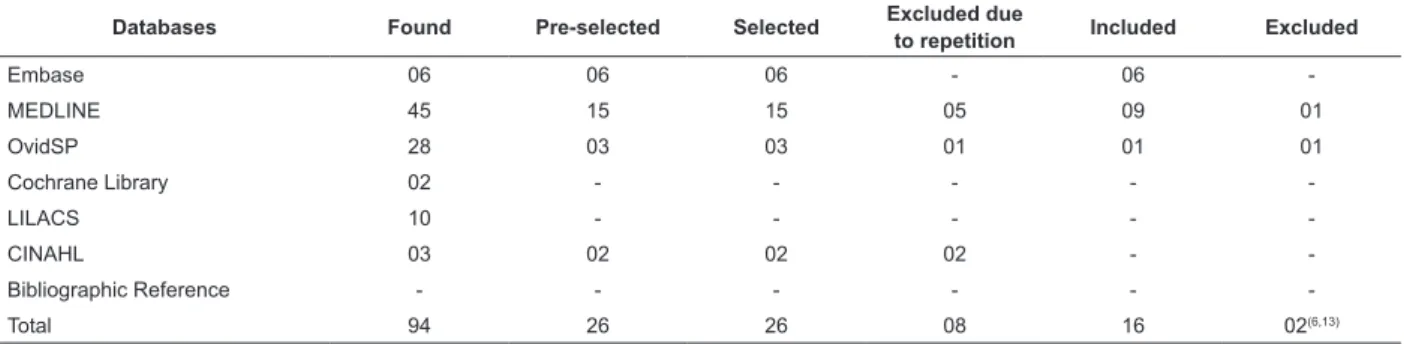
opinions or editorials. The inal sample consisted of 16
publications (Table 1), which were analyzed in full. As
shown in Table 1, two publications(6,13) were excluded
due to the exclusion criteria. To perform the data
collection a validated instrument(14) was used that was
adapted to allow the production of a summary table of
the publications included (Figure 1).
Table 1 - Selection of publications from databases and references of other publications according to the criteria
established for inclusion of studies in this integrative review. Brazil, 2011
Databases Found Pre-selected Selected Excluded due
to repetition Included Excluded
Embase 06 06 06 - 06
-MEDLINE 45 15 15 05 09 01
OvidSP 28 03 03 01 01 01
Cochrane Library 02 - - - -
-LILACS 10 - - - -
-CINAHL 03 02 02 02 -
-Bibliographic Reference - - -
-Total 94 26 26 08 16 02(6,13)
Results
The 16 publications included in this review were from
international journals of the medical area and the earliest
was published in 2001. Among the studies included in this
review, six (37.5%) were published in area of dermatology
(P3; P4; P6; P8; P9; P13), ive (31,2%) in journals of
infection (P7; P11; P12; P14; P15), two in general medical
journals (P1; P5), two in clinical microbiology periodicals
(P2; P10) and one in the orthopedics area (P16). The
majority of the studies, about 50.0%, were from South
Korea (8 publications), followed by China and Spain,
with two publications in each country. Portugal, Canada,
Venezuela and Brazil presented one publication per country.
As can be seen in Figure 1, the predominant study
design was the case report. Although there are ten
publications of this type, P1 and P2 refer to the same
case of atypical mycobacterial infection. The second most
frequent type of study was reports of outbreaks, which
were presented in three publications, although P6 and
P7 refer to the same outbreak caused by Mycobacterium
abscessus that occurred in a clinic. There was only one
case-control study (P13) and one observational study
(P10 and P11 refer to the same patients).
The evidence levels of the publications are presented
according to study design(15). There were three studies
that have evidence level 4 (Figure 1): a case-control
design (P12) and two publications that refer to the same
observational study (P10 and P11). Thirteen publications
showed evidence level 6, with reports of outbreaks (P6;
P7 – for the same outbreak; and P8) or case reports (P1;
P2; P3; P4; P5; P9; P13; P14; P15; P16).
Study Country / Year
Type of
Study Subjects Mycobacteria Source Recommendations / Conclusions
P1(16) P2(3)
China, 2001-P1 2002-P2
Case report (both)
One woman (79 years) and 3 men (62, 72 and 21 years – the latter being immunosuppressed)
M. chelonae (2) M. nonchoro-mogenicum (2)
Not cited
Hand hygiene of the professional with alcoholic CHX* or PVPI† / wash
patients with soap and water if necessary / antisepsis of the skin with alcohol 75% and wait 60 seconds
P3(17) Spain,
2003 Case report
One woman, 58 years, immunocompetent
M. chelonae
Possible: contaminated needles
No recommendations
P4(18) Portugal,
2003 Case report
One woman, 41
years old M. fortuitum
Reuse of needles in the same client
Caution in relation to potential contamination
*CHX: chlorhexidine; †PVPI: povidone-iodine; ‡DM: Diabetes mellitus
Figure 1 - Characteristics of the studies included in this review according to country, year of publication, type of study,
number of affected subjects, species of mycobacteria, infection source and recommendations by authors. Brazil, 2011
Study Country / Year
Type of
Study Subjects Mycobacteria Source Recommendations / Conclusions
P5(19) Spain,
2004 Case report
One woman, 71
years M. chelonae Not cited
Atypical mycobacterial infections associated to acupuncture shown to be an emerging problem, which should be included in differential diagnosis of skin infections associated with acupuncture procedures
P6(20) P7(1) South Korea, 2005-P6 2006-P7 Outbreak report (both)
40 patients with an mean age of 43 years, being 7 men and 33 women
M. abscessus
Hot packs or towels for hot packs or boiling tank water
Hand hygiene of professionals with alcohol CHX or PVPI / “sterilization” of the skin with alcohol or PVPI / “sterilization” of equipment and environment / guidelines and education
P8(21) Canada, 2006
Outbreak report
32 subjects (2 men, 30 women, mean age: 49 years, none immunosuppressed). 5 suspected, 6 confirmed and 21 probable cases M. abscessus Reuse of needles that were improperly disinfected in glutaraldehyde diluted with tap water
It is important to appropriate the practice of infection control and the sterilization of materials in health services, including in services that practice alternative and complementary therapies P9(22) South Korea, 2009 Case report
One woman, 59 years, history of pulmonary tuberculosis (resolved)
M. abscessus Not cited
Includes atypical mycobacteria in differential diagnosis of cases with the occurrence of multiple nodules associated to acupuncture
P10(23) P11(24) South Korea, 2009-P10 2011-P11 Observational study
About 100 cases of which only 52 participated in the study
M. abscessus Not cited
Only related to antibiotic: moxifloxacin + clarithromycin combination resulted in more rapid resolution of the skin lesions compared with clarithromycin + amikacin P12(25) South Korea, 2010 Outbreak report and Case-control
Reported: 109 cases / Case-control study: 70 cases and 106 controls
M. abscessus Diluted glutaraldehyde solution prepared months before and used to disinfect equipment
Preparation of the skin with ethanol waiting for the drying time recommended by the literature / adequate management during dilution of glutaraldehyde P13(26) South Korea, 2010 Case report
Three cases: two women (52 and 65 years) and one man (62 years + DM‡)
M. abscessus M. fortuitum M. avium complex
Not cited
Suspected atypical mycobacterial infections in cases of persistent and/ or skin lesions resistant to treatment, especially in immunocompromised
P14(27) Venezuela
2010 Case report
One woman, 23
years old M. fortuitum
Possible: contaminated needles
Quaternary ammonium is a disinfectant widely used in Venezuela for skin antisepsis and disinfection of instrumentals. This solution can be a possible transmission source of atypical mycobacteria causing infections
P15(28) Brazil,
2011 Case report
One transplanted man, 59 years old
M. haemophilus Possible: patient´s skin colonized or infected by mycobacteria and reuse of needles at different sites in the same patient / contaminated needles
There are failures in the practice of infection control by acupuncturists / use of disposable needles is indicated / potential risks of acupuncture should be recognized, especially in immunocompromised patients
P16(29) South Korea, 2011
Case report One woman, 56
years old M. abscessus Not cited
Rev. Latino-Am. Enfermagem 2013 Jan.-Feb.;21(1):450-8.
Among the 295 cases of patients who developed
atypical mycobacterial infections associated with
acupuncture a predominant proportion of the female
sex was reported (83.0%, 162 women), not including
the 100 cases from P10 and P11. These last two studies
reported the occurrence of 100 mycobacteriosis cases,
however, data only from the 52 patients who received
the antimicrobial therapy, were described. In P10 and
P11 the female sex was also predominant (84.6%).
The mean age was 43 years in P6 and P7 (which
refer to the same outbreak); in P8 and P12 the mean
was 49 years; and the mean age of the subjects in the
other studies, except P10 and P11, was approximately
55 years. In P10 and P11 the mean age of the 52
patients was 50 years.
All the cases described in Figure 1 were
successfully cured after treatment with the appropriate
antibiotics. Mycobacterium abscessus was responsible
for 96.0% of the infections. M. chelonae, M. fortuitum
and M. nonchoromogenicum caused four, three and
two infections, respectively. M. avium complex and
M. haemophilus were each identiied in one case of
mycobacterial infection associated with acupuncture.
Only one of the 16 publications (7.1%) identiied the
outbreak source: M. abscessus was found in a dilute
solution of glutaraldehyde, which was prepared several
months before and was used to clean equipment (P12).
Probably, during the disinfection process, the solution
contaminated electrodes used for interferential current
and low-frequency therapies. The authors suspected that
the mycobacteria, which were present in the contaminated
solution, may have originated from the tap.
Three publications indicated sources such as
towels for hot packs, hot towels or water boiling tank
(P6/P7 - refer to the same outbreak); reuse of needles
improperly disinfected with glutaraldehyde diluted in tap
water among different patients (P8).
Another four publications mentioned possible
sources of mycobacteria as: contaminated needles (P3;
P14); reused needles that were brought by the client
for each acupuncture session (P4); the patient’s skin
being colonized or a pre-existent subcutaneous infection
caused by mycobacteria and the reuse of needles in
different locations in the same patient, in this case, the
contaminated needles spread the mycobacteria to other
sites or reused needles were contaminated from an
unknown environmental reservoir (P15). The remaining
eight publications (P1; P2; P5; P9; P10; P11; P13; P16)
did not mention the sources for atypical mycobacterial
infections associated with acupuncture procedures.
Article P2 included four cases of atypical
mycobacterial infection associated with acupuncture,
between 1999 and 2000, in which the patients were
hospitalized and includes the case of a single patient
who was described in P1 (a 79 year old woman). In
these two reports the possible contamination sources
are not investigated and the conditions of the clinic in
which the sessions of acupuncture were performed are
not described. Article P2 also shows that two species of
mycobacteria incubated in 75% alcohol survived for up
to 45 seconds, thus the authors indicated antisepsis of
skin for at least 60 seconds.
Article P3 reports that the acupuncturist did not
help in identifying the possible infection source, as he
did not want to cooperate with the case. The authors
only mention that one likely contamination source
could have been through needles contaminated by M.
chelonae. In addition, this study claims to be the irst
to report an infection case by this bacterium associated
with acupuncture, however, the references found P1 and
P2 to be earlier than 2003.
Article P4 reports that the needles used in the
acupuncture therapy were brought by the patient and
were for personal use. However the needles were
re-used in the same patient and this was probably the
cause of the infection.
Articles P5 and P9 reported a case of infection with
M. chelonae and M. abscessus, respectively, and warn
that mycobacterial should be included in the differential
diagnosis of skin infections associated with acupuncture
procedures.
Articles P6 and P7 reported the occurrence of
the same outbreak of M. abscessus in 40 patients
submitted to acupuncture in an Oriental medicine
clinic. All 35 environmental samples taken to check the
possible outbreak source were negative. However, local
authorities found that one month before the investigation
took place; the clinic had changed the towels and hot
water bottles, and sterilized the equipment used to heat
the water in which the towels were soaked and which
was also used to ill the bags. After these measures
no further cases of infection with M. abscessus were
reported. It was therefore inferred that the skin of the
patients had been infected with mycobacteria before or
after acupuncture, during therapy with bags of hot water
used in the complementary therapy session. Another
hypothesis would be contamination of needles by any
possible contact with contaminated tap water.
Article P8 reports that there was an outbreak of
different clinics, where one acupuncturist attended 168
clients. Interviews with the patients and therapist found
that the needles were reprocessed in a glutaraldehyde
solution although, as this disinfectant solution was no
longer available for analysis, it was not possible to
assess the presence of mycobacteria.
Articles P10 and P11 reported the same outbreak
with approximately 100 subjects affected, 52 participated
in an intervention study to compare the association of
clarithromycin + amikacin with that of moxiloxacin +
clarithromycin. The second combination presented a
signiicantly shorter duration of treatment than the irst
solution. The cause of the outbreak was not mentioned.
In another outbreak report, article P12 described
a case-control study. It identiied as risk factors the
duration of acupuncture treatment, the number of needles
inserted, the use of interferential therapy or low-frequency
equipment and the application of hot water packs.
A retrospective study (P13) investigated the
clinical and microbiological characteristics of several
skin infections caused by atypical mycobacteria which
were treated at a hospital between 1995 and 2008.
Three of the 29 cases analyzed were due to acupuncture
procedures, however, there was no mention of the
infection source.
Article P14 did not identify the outbreak source,
though the authors refer to contaminated needles used
in the acupuncture procedure as a possible source. In
a literature review the authors found seven articles,
corresponding to P1, P2, P3, P6, P7, P8 and P12 of this
integrative review. The authors mention that, although
they do not have any proof, they believe that the
widespread use of quaternary ammonium disinfectant
for the “sterilization” of instruments is a possible risk
factor for infections caused by mycobacteria.
The patient described in P15 reported that
antisepsis of the skin was not carried out prior to the
procedure and that the needles were reused several
times in different places in the body, which led the
authors to establish possible routes of M. haemophilum
which caused the infection.
Article P16 reported a case of M. abscessus after the
patient receive three consecutive days of acupuncture on
the bilateral knees. This woman presented no evidence
of other diseases.
Discussion
Acupuncture is considered a safe procedure in
general(25). However, in the last decade, reports
of infection transmission have increased considerably,
including those of atypical mycobacteria(6). Only 16
publications were found in the scientiic literature
related to the proposed theme, even without setting
limits on publication date, type of study or language.
This raises two questions: a) Is there underreporting of
cases of mycobacterial infections in Eastern and Western
countries? b) Do cases of atypical mycobacterial infection
go underreported in the literature due to the fact that
methods for microorganism identiication became more
accurate after the year 2000?
Although this review was mainly composed of
studies with low levels of evidence, it is important
to emphasize that cases and even outbreaks (P6;
P7; P8) of atypical mycobacterial infections are
happening. Females were predominant in the
development of mycobacterial infections perhaps because
they constitute the majority of acupuncture patients.
The infections were caused by six species of atypical
mycobacteria, three of them, species M. abscessus,
M. chelonae and M. fortuitum, are classiied as rapid
growth(4). These microorganisms were responsible for
about 98.6% of the infections included in this review
and are commonly found in treated water, soil and the
environment(5), which demonstrates a direct relationship
with the identiied, probable or possible infection
sources, in the studies described.
Of the 16 publications included in this integrative
review only one (6.2%) identiied the deinite source of
the outbreak: M. abscessus (P12). Three publications
(P6; P7; P8) established the probable sources and two of
them reported the same outbreak (P6 and P7). In another
three articles the possible sources of mycobacteria
were described (P3; P4; P14). The eight remaining
publications (P1; P2; P5; P9; P10; P11; P13; P16),
corresponding to 50.0% of the studies, did not mention
anything about the sources that may have caused the
cases of atypical mycobacterial infections associated
with acupuncture procedures. This indicates that there
are failings in the investigation process of outbreaks
or in the clinical conduct of the treatment, not only in
clinics where alternative or complementary therapies
are practiced but also in conventional medical services
that screen and treat patients who develop infection.
In addition these potential sources are associated with
failures during the process of disinfecting instruments,
inadequate preparation of disinfectants, not performing
antisepsis of the skin and/or hand hygiene.
A routine that should be strengthened for
Rev. Latino-Am. Enfermagem 2013 Jan.-Feb.;21(1):450-8.
disposable needles. This procedure is recommended by
the Food and Drug Administration (FDA)(30). Although this
practice is being recommended, even in a guideline(31)
developed precisely for infection control in acupuncture,
the reuse of needles after sterilization is still allowed.
The guideline(31) mentions the need for and types of
sterilization, nevertheless does not specify which one
should be indicated nor how to apply the methods. The
use of personal needles is also not indicated, as the
material does not undergo to any type of reprocessing
that ensures sterility. Also, there is no control of the
storage once the patient is responsible for the needles.
This indicates the need for a revision(3), elaborating a
new guideline for infection control and prevention in
acupuncture as established by regulators and through
recommended infection control and prevention practices.
Some basic concepts concerning infection
prevention, such as disinfection, sterilization and
antisepsis, are still unclear, even for professionals
working with healthcare. Articles P5 and P6 propose
that sterilization of the environmental and patient’s
skin be performed, in other words, materials
completely unfeasible to sterilize. Article P14 refers
to the “sterilization” of instruments performed using
quaternary ammonium disinfectant, however, this
solution is suitable only for low-level disinfection. It is
worth noting that this type of disinfection is indicated for
items or surfaces that only come into contact with intact
skin(32). Moreover, low-level disinfection has no action on
Mycobacterium tuberculosis(32) and, probably, on other
bacilli from the same genus. Therefore the use of sterile
needles for acupuncture is more appropriate.
Proposals such as hand hygiene with alcoholic
chlorhexidine or povidone-iodine (PVPI) are unnecessary.
Acupuncture can be compared with recommendations
for intravascular insertion catheters described by the
Centers for Disease Control and Prevention of the U.S.A.
i.e., simple hand hygiene with soap and water or alcohol
gel hand sanitizer before performing the procedure
(Category 1A), aseptic technique ensuring the sterility
of the material (Category 1A) and skin antisepsis with
alcohol solution (Category 1A)(33). The indication of
Category 1A means that all these procedures are strongly
recommended for implementation and supported by
well-designed experimental, clinical, or epidemiologic
studies(33). Thus, antisepsis should be appropriately
performed with an alcohol solution and the time required
for antiseptic agent action taken into account, as is
recommended by Category 1A(33). Especially considering
that one of the studies included in this review found that
some species of atypical mycobacteria can survive for
up to 45 seconds in contact with alcohol(3). These safety
measures associated with the use of sterile disposable
needles are suficient for the puncture to be performed
safely by a professional, preventing mycobacterial
infection outbreaks related to this procedure.
Thus, the importance is emphasized of guidance for
students that are doing alternative and complementary
therapy courses and for acupuncture practitioners in
their workplaces. Regarding nurses, it is expected that
the experience of infection control practice in hospitals
can contribute to a safe acupuncture practice. The
presence of an infection control specialist nurses has
been universally seen as an essential measure for
infection control programs to be effective(34), which
can also be applied to establishments that practice
complementary medicine.
It is emphasized that the studies included in
this review (P1 - P16) isolated and identiied the
Mycobacterium microorganism from different sources,
however, no molecular research was carried out in order
to conirm the clonal origin. This type of investigation can be explored in the case of new outbreaks, conirming
the clonal origin of the bacteria and contributing to the
advancement of knowledge of this subject.
It is important to emphasize the role of the nurse
as educator in infection prevention and control and their
possible role as technical managers in the IRHC control
program and clinics which perform CHTs, as well as in
institutions which work with complementary medicine.
Therefore, the nursing professional acupuncturist, with
a solid training in infection control, can take part in
the prevention and control of IRHC in complementary
health practices. Furthermore, it is important to study
not only the most effective and appropriate antibiotic
therapy for the treatment of mycobacteria, but also to
investigate the probable infection sources when cases of
mycobacteria associated with acupuncture are detected.
Conclusion
There are several cases and outbreaks reported in
the literature about infection by atypical mycobacteria
associated with acupuncture procedures, especially
those of rapid growth, however, the majority of
publications did not refer to the infection source. Only
one study identiied a diluted glutaraldehyde solution
prepared several months before the use that was
applied to clean the equipment as the deinite infection
sources, such as objects or utensils and contaminated
needles, reuse of personal needles, reuse of needles
on various sites in the same patient and also the reuse
of needles, which were disinfected in glutaraldehyde
diluted incorrectly in tap water, on different patients.
M. abscessus was the microorganism responsible for
the majority of infections. Well-established control and
infection prevention practices, which are recommended
by regulators, should be implemented and adapted by
nurses for complementary and alternative medicine.
References
1. Song JY, Sohn JW, Jeong HW, Cheong HJ, Kim WJ,
Kim MJ. An outbreak of post-acupuncture cutaneous
infection due to Mycobacterium abscessus. BMC Infect
Dis. 2006;6:6.
2. Lyn Patrick. Gastroesophageal reflux disease (GERD):
a review of conventional and alternative treatments. Alt
Med Rev. 2011;16(2):116-33.
3. Woo PC, Leung KW, Wong SS, Chong KT, Cheung EY,
Yuen KY. Relatively alcohol-resistant mycobacteria are
emerging pathogens in patients receiving acupuncture
treatment. J Clin Microbiol. 2002;40:1219-24.
4. Runyon EH. Anonymous mycobacteria in pulmonary
disease. Med Clin North Am. 1959;43(1):273-90.
5. Fontana RT. The Mycobacterias of rapid growth and
the hospital infection: a public health problem. REBEn.
2008;61(3):371-6.
6. Woo PC, Lin AW, Lau SK, Yuen KY. Acupuncture
transmitted infections. BMJ [periódico na Internet]. 2010
[acesso 27 maio 2012];18:340:c1268. Disponível em:
http://www.bmj.com/content/340/bmj.c1268.extract
7. Resolução COFEN 197/1997 (BR). Estabelece e
reconhece as Terapias Alternativas como especialidade
e/ou qualificação do profissional de Enfermagem. 1997.
[acesso 18 abr 2012]. Disponível em: http://site.
portalcofen.gov.br/node/4253
8. Resolução COFEN n. 240/2000 (BR). Aprova o Código
de Ética dos Profissionais de Enfermagem e dá outras
providências. In: Conselho Regional de Enfermagem
de São Paulo (COREN-SP). Documentos básicos de
enfermagem: enfermeiros, técnicos e auxiliares. São
Paulo; 2001:277-89.
9. Lei n. 7.498, de 25 de junho de 1986 (BR). Dispõe
sobre a regulamentação do exercício da enfermagem
e dá outras providências. In: Conselho Regional de
Enfermagem de São Paulo (COREN-SP). Documentos
básicos de enfermagem: enfermeiros, técnicos e
auxiliares. São Paulo; 2001. p. 6-41.
10. Portaria nº 2616/MS/GM, de 12 de maio de 1998
(BR). Diário Oficial da União [periódico na Internet].
12 maio 1998. [acesso 18 abr 2012]. Disponível em:
http://www.anvisa.gov.br/legis/portarias/2616_98.htm
11. Whittemore R, Knafl K. The integrative review:
updated methodology. J Adv Nurs. 2005;52(5):546-53.
12. Mendes KDS, Silveira RCCP, Galvão CM. Integrative
literature review: a research method to incorporate
evidence in health care and nursing. Texto Contexto
Enferm. 2008;17(4):758-64.
13. Carbonne A, Brossier F, Arnaud I, Bougmiza I,
Cambau E, Meningaud JP, et al. Non-tuberculous
mycobacterial infections related to cosmetic and medical
procedures and acupuncture [abstract]. In: European
Society of Clinical Microbiology and Infectiotius
Diseases; Abstracts de 20th European Congress of
Clinical Microbiology and Infectious Diseases; 2010
Apr 10-13; Vienna, Austria. United Kingdom (Oxford):
Blackwell Publishing; 2010. S63.
14. Ursi ES, Galvão CM. Perioperative prevention of skin
injury: an integrative literature review. Rev. Latino-Am.
Enfermagem. 2006;14(1):124-31.
15. Melnyk BM, Fineout-Overholt E. Making the case
for evidence-based practice. In: Melnyk BM,
Fineout-Overholt E. Evidence based practice in nursing &
healthcare. A guide to best practice. 2nd ed. Philadelphia:
Lippincot Williams & Wilkins; 2011. p. 3-24.
16. Woo PC, Li JH, Tang W, Yuen K. Acupuncture
mycobacteriosis. N Engl J Med. 2001;345:842-3.
17. Ara M, de Santamaría CS, Zaballos P, Yus C, Lezcano
MA. Mycobacterium chelonae infection with multiple
cutaneous lesions after treatment with acupuncture. Int
J Dermatol. 2003;42(8):642-4.
18. Cordeiro MR, Mascarenhas R, Reis JP, Tellechea O,
Figueiredo A. Mycobacterial infection after acupunture.
JEADV. 2003;17 Suppl 3:186.
19. Gomez de la Torre R. Hidalgo Garcia F. Milla Crespo
A. Fernandez Bustamante J. Cutaneous infection by
Mycobacterium chelonae after treatment with acupuncture
[letter]. Med Clin (Barc). 2004;122(16):636.
20. Ryu HJ, Kim WJ, Oh CH, Song HJ. Iatrogenic
Mycobacterium abscessus infection associated with
acupuncture: clinical manifestations and its treatment.
Int J Dermatol. 2005;44(10):846-50.
21. Tang P, Walsh S, Murray C, Alterman C, Varia M,
Broukhanski G, et al. Outbreak of acupuncture-associated
cutaneous Mycobacterium abscessus infections. J Cutan
Med Surg. 2006;10(4):166-9.
22. Cho HJ, Lee DY, Lee JH, Yang JM, Lee ES. A case
Rev. Latino-Am. Enfermagem 2013 Jan.-Feb.;21(1):450-8.
multiple acupunctures [letter]. Clin Exp Dermatol.
2010;35(4):444-5.
23. Park DW, Kim MJ, Choi WS, Heo YS, Son SW, Yoon YK,
et al. Clarithromycin and amikacin versus clarithromycin
and moxifloxacin as the treatment for post-acupuncture
cutaneous infection due to Mycobacterium abscessus:
prospective observation study. Clin Microbiol Infect.
2009;15 Suppl 4:S395.
24. Choi WS, Kim MJ, Park DW, Son SW, Yoon YK, Song
T, et al. Clarithromycin and amikacin vs. Clarithromycin
and moxifloxacin for the treatment of post-acupuncture
cutaneous infections due to Mycobacterium abscessus:
a prospective observational study. Clin Microbiol Infect.
2011;17(7):1084-90.
25. Koh SJ, Song T, Choi JW, Lee JY, Song MK, Sung HY,
et al. An outbreak of skin and soft tissue infection caused
by Mycobacterium abscessus following acupuncture.
Clin Microbiol Infect. 2010;16(7):895-901.
26. Lee WJ, Kang SM, Sung H, Won CH, Chang SE, Lee
MW. Non-tuberculous mycobacterial infections of the
skin: A retrospective study of 29 cases. J Dermatol.
2010;37(11):965-72.
27. Guevara-Patiño A, Sandoval de Mora M, Farreras
A, Rivera-Olivero I, Fermin D, de Waard JH. Soft tissue
infection due to Mycobacterium fortuitum following
acupuncture: a case report and review of the literature.
J Infect Dev Ctries. 2010;4(8):521-5.
28. Castro-Silva AN, Freire AO, Grinbaum RS, Elmor de Araújo MR, Abensur H, Araújo MR, et al. Cutaneous
Mycobacterium haemophilum infection in a kidney
transplant recipient after acupuncture treatment.
Transpl Infect Dis. 2011;13(1):33-7.
29. Kim HS, Park IH, Seo SH, Han I, Cho HS. Multifocal
infection of Mycobacterium other than tuberculosis
mimicking a soft tissue tumor of the extremity.
Orthopedics. 2011;34(12):e952-5.
30. Caspi O, Baranovitch O. When science meets
medical tradition: what is needed for a dialogue on
integrative medicine? J Altern Complement Med.
2009;15(5):579-83.
31. Australian Acupuncture Association Limited. Infection
control guidelines for acupuncture. Queensland,
Australia: Australian Acupuncture and Chinese Medicine
Association; 1997.
32. Rutala WA, Shafer KM. General information on
cleaning, disinfection and sterilization. In: Olmsted RN,
editor. APIC infection control and applied epidemiology:
principles and practice. St. Louis: Mosby; 1996. p. 1-17.
33. Centers for Disease Control and Prevention.
Guideline for the prevention of intravascular
catheter-related infections. MMWR. 2002;51(RR-10):1-29.
34. Quattrin R, Pecile A, Conzut L, Majori S, Brusaferro
S, GISIO Group. Infection control nurse: a national
survey. J Nurs Manag. 2004;12(5):375-80.