Advances in Mechanical Engineering 2016, Vol. 8(3) 1–8
ÓThe Author(s) 2016 DOI: 10.1177/1687814016641902 aime.sagepub.com
Emotional reactions of different
interface formats: Comparing digital
and traditional board games
Yu-Min Fang, Kuen-Meau Chen and Yi-Jhen Huang
Abstract
Some games provide both traditional board games and digital versions at the same time in the market. Why the rise of virtual games has not forced traditional physical board games to disappear? Do traditional physical games evoke different emotional reactions and interpersonal relationships? This article explored the subjects’ preferences toward traditional and digital versions of the same game and investigated social interaction while playing games. Based on Norman’s three emotional design levels—visceral, behavioral, and reflective levels—this study examined players’ satisfaction degree. This study also applied Positive and Negative Affect Schedule to measure subjects’ emotional reactions. Monopoly and Jenga games were selected as stimuli. A total of 77 subjects received tests of three different interface formats (physical, desk-top, and tablet) and then filled out the questionnaire. The findings successfully evidenced the significant differences between digital and traditional board games. The statistical results indicated that satisfaction degrees of digital games declined in visceral, behavioral, and reflective levels. Traditional games not only evoked users’ stronger emotional reac-tions but also received higher preferences. Traditional games could improve interpersonal relareac-tionships as well.
Keywords
Interface design, digital games, satisfaction degree, emotional response, social interaction
Date received: 26 August 2015; accepted: 8 March 2016
Academic Editor: Teen-Hang Meen
Introduction
With the vigorous development of technology, modern gaming industries arise. New digital products are con-tinuously launched and replaced the old ones. However, not all games follow this way. Nowadays, some popular and long-lasting games are sold in differ-ent versions of interface formats. Currdiffer-ently, their digi-tal desktop and tablet computer games, as well as traditional physical board games, exist at the same time in the market. There should be some reasons that the rise of virtual games does not force traditional physical board games to disappear. Which game formats evoke stronger emotional responses and gain higher players’ satisfaction degree? Do physical games improve inter-personal relationships as some experts claim? Is it
possible that following factors be the reasons: players’ satisfaction degree, emotional response, and social interaction?
Various studies confirmed that virtual games evoke a variety of emotional reactions.1,2These reactions may affect players’ preferences and selections of games. In addition, Norman3proposed the concept of three emo-tional design levels: visceral, behavioral, and reflective
Department of Industrial Design, National United University, Miao-Li, Taiwan
Corresponding author:
Yu-Min Fang, Department of Industrial Design, National United University, No. 1, Lien-Da, Kung-Ching Li, Miao-Li, Taiwan, 36003, R.O.C. Email: [email protected]
levels. Norman’s theory focused mostly on the physical product design. Relatively little research applied his theory to study the interface issue. Based on Norman’s three design levels, this research tried to discover play-ers’ satisfaction degrees toward traditional and digital games and analyzed the relationship between interface formats, personal background, and emotion.
According to above literature and experts’ opinions, we assume that there are significant differences between digital and traditional board games. The objective of this study is (1) to examine emotional satisfaction degree of visceral, behavioral, and reflective level in tra-ditional and digital interface formats; (2) to study users’ different positive and negative affect toward traditional and digital games; (3) to explore the subjects’ operation preferences toward traditional and digital games; and (4) to investigate social interaction while playing games with different interface formats.
Literature review
Game influence
The core experience of entertainment is enjoyment.4 Recent studies suggested that the enjoyment obtained in the digital game playing comes from (1) the joy of consciousness;1(2) anxiety, excitement, and relaxation; and (3) achievement, control, and self-efficacy.2 The sense of accomplishment, achieved by the mission accomplished during the game, is the important source of happiness.
Computer games create enjoyment, excitement, and fantasy to meet players’ needs and thus players obtain emotional relief. Although players can obtain the posi-tive experience by accomplishing the tasks in the digital game, they may suffer frustration from failure of chal-lenging tasks.5
Mood management theory, proposed by Zillmann, indicated the impact of media and users on mental cog-nition. This theory focused on the interaction between the media and users from the perspective of individual differences and mental recognition states.6,7 Mood management theory can be referred to game playing: players attempt to avoid negative frustration and search for a positive response from games.
Digital games are a ubiquitous part of almost all adolescents’ lives.8Players can immerse themselves in a game and feel crisis sense similar to the emotion in real life while facing the challenge of dangerous tasks.9 At this moment, players must take the initiative to over-come difficulties. Conflicts and setbacks might occur while players try to communicate with team members; players need to improve their skills of communication and cooperate with other players to accomplish tasks.8,10 In this sense, gamers are problem-solving experts and collaborators.11
Norman’s emotional design theory
Emotion refers to the brain’s reaction to external sti-muli. Moreover, emotion is also a complex and con-scious reaction in perception, thought, and feeling of an individual that could lead to value judgment.12,13 In
Emotional Design, DA Norman3proposed the concept
of three emotional design levels: (1) visceral level: appearance, (2) behavioral level: fun and utility of use, and (3) reflective level: self-image, personal satisfaction, and memories. Visceral design represents the human instinct for beauty and also the way for people to receive emotional messages. The visceral design is the impact generated by the first sight of a product, which is from the appearance feelings. Behavioral level is the practicality, functionality, effectiveness, and availabil-ity. Reflective level is associated with accumulated per-sonal experience in life, including attributes of intimacy, self-image, sympathetic responses, and satisfaction. The reflective level also reflects users’ cognitive perspective, which varies from individual culture, experience, and education. Norman’s concept of three dimensions is suitable for studying the thinking of users and exploring various aspects, including visual stimulation, usability, and emotion.14,15
The Positive and Negative Affect Schedule
To measure subjects’ emotional reactions, this study applied Positive and Negative Affect Schedule (PANAS), proposed by Watson et al.16 PANAS com-prises two mood scales: one that measures positive affect and the other that measures negative affect. Used as a psychometric scale, the PANAS can show relations between positive and negative affect with personality stats and traits.17The reasons and advantages for using PANAS in this study are listed as follows: (1) PANAS is a brief and useful tool for the screening positive and negative affect in adolescents and young adult’s popu-lations18 and (2) the scales are shown to be internally consistent, largely uncorrelated, and stable across dif-ferent time frames.18,19
The questions of PANAS include 10 items for mea-suring positive affect and 10 items for meamea-suring nega-tive affect. Participants are required to respond to a test using a 5-point scale that ranges from very slightly or not at all (1) to extremely (5).
Research methods
Subjects
A total of 77 subjects were involved in this study. The subjects were randomly divided into two groups, con-sisting of 43 subjects for Monopoly (game) group and 34 subjects for Jenga (game) group. The subjects were students of the National United University, and the age range was from 18 to 25. From the total number of sub-jects, 30 were females (70%) and 13 were males (30%) in Monopoly (game) group and 17 were females (50%) and 17 were males (50%) in Jenga group. All subjects had experience with computer games.
Materials
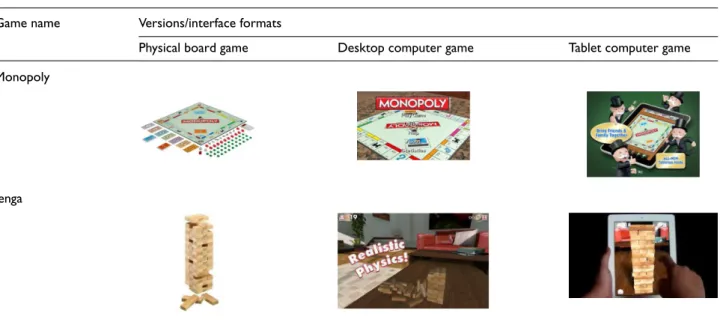
Since this study compared three different interface for-mats of the same game, qualified stimuli should be well-known and long-lasting games; the traditional physical versions and digital versions (for desktop and tablet computer) are sold at the same time. After dis-cussing with experts, Monopoly and Jenga games were selected. Monopoly, dating from 1903 and offering 43 languages, has sold 275 million packages in 111 coun-tries. Jenga has sold 50 million packages as well. For the popularity, it will be easy to find experienced sub-jects without the language barrier. Table 1 illustrates three stimuli groups, namely, traditional board game, desktop computer game, and tablet PC game. Three to four subjects were distributed as a group and given directions to play games. All subjects experienced three different versions of one game for 15 min each. After 45 min of playing experiments, subjects were asked to fill out the questionnaires.
Evaluation tools
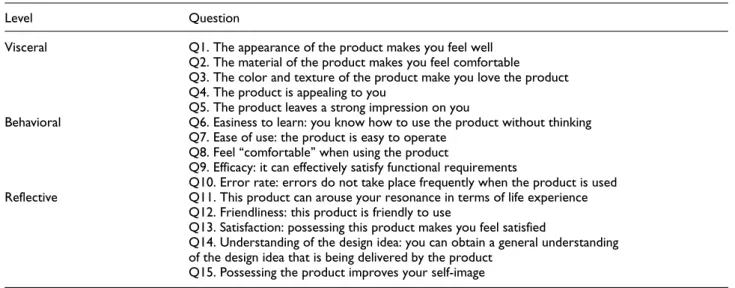
This questionnaire consisted of subjects’ background, the satisfaction of three design levels, PANAS mood scale, preferences, and social interaction (see Table 2). The satisfaction of three design levels refers to emo-tional satisfaction and acceptance degree of Norman’s three design levels, including visceral, behavioral, and reflective levels. The question groups were (1) the visc-eral level, including appearance, material, color, tex-ture, attraction, and deep impression; (2) the behavioral level, including easiness to learn, ease of use, pleasure, efficacy, and error rate; and (3) the reflective level, including resonance with life experi-ence, friendliness, sense of satisfaction, understanding of the design idea, and improvement of self-image. Table 3 illustrates the detailed question groups of three design levels.
PANAS mood scale was applied to measure subjects’ emotional reactions toward different interface formats. PANAS consists of 20 questions and applies 5-point Likert scale: 1 means strongly disagree and 5 represents highly agree. The question groups were (1) the positive emotions: interested, excited, proud, enthusiastic, alert, strong, attentive, active, inspired, and determined and (2) negative emotions: upset, distressed, guilty, nervous, hostile, irritable, ashamed, scared, jittery, and afraid. Preference indicates preference degrees of interface for-mats after subjects experienced game playing. Social interaction refers to the degree of sense of interpersonal relationships with friends while playing a game. The questions included friendship improvement, creation for common topics, and interaction with friends.
Table 1. Stimuli groups of physical board game, digital desktop game, and tablet computer game.
Game name Versions/interface formats
Physical board game Desktop computer game Tablet computer game
Monopoly
Analysis and results
The profile and characteristics of the subjects were investigated as follows: 73% of the subjects played digi-tal games fewer than 2 h in a week, 22% between 2 and 4 h, and 5% more than 4 h. Totally, 42% of the subjects were acquainted with the touch screen controls of digi-tal games, 31% were familiar with the traditional board games, and 39% of the subjects played these two games only for special occasions with friends and family.
Analysis of variance (ANOVA) was performed and post hoc comparisons were made to determine the sig-nificance, using Scheffe’s procedure (p\0.05). The
experimental result is described as follows.
Satisfaction of three design levels
This study applied 5-point Likert scale to examine emo-tional satisfaction and acceptance degree of visceral, behavioral, and reflective levels. Figure 1 compares satisfaction degree among traditional, desktop, and tablet interface formats. The statistic result showed that all levels of satisfaction degrees were significantly
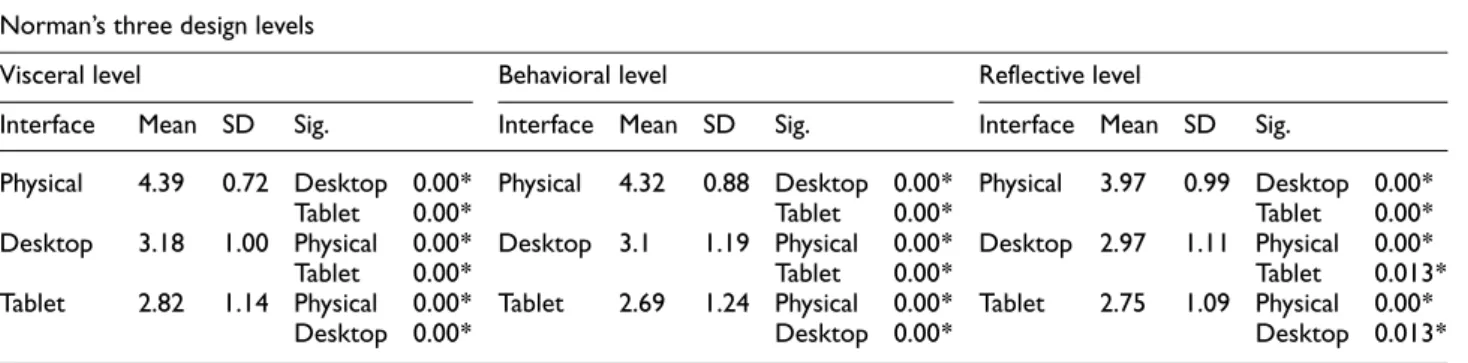
different (p = 0.000) in these interface formats. In the comparison of the satisfaction degree of visceral level, the sequence was traditional games (4.39, standard deviation (SD) = 0.72).desktop (3.18, SD = 1.00). tablet (2.28, SD = 1.14). In the comparison of beha-vioral level: traditional (4.32, SD = 0.88).desktop (3.10, SD = 1.19).tablet (2.69, SD = 1.24). In the comparison of reflective level: traditional games (3.97,
Table 2. Contents of the questionnaire.
Question groups Numbers of questions
Descriptions
Subjects’ basic data 7 Gender, age, and other background information Game experience 6 Game experience and frequency of game playing Satisfaction of three design levels 15 Emotional satisfaction and acceptance degree of visceral,
behavioral, and reflective level
PANAS mood scale 20 The Scale of Positive and Negative Affect
Preference 2 Preference of interface formats after game experience Social interaction 3 Sense of interpersonal relationships with friends while playing
game
Table 3. The question groups of three design levels (visceral, behavioral, and reflective).
Level Question
Visceral Q1. The appearance of the product makes you feel well Q2. The material of the product makes you feel comfortable Q3. The color and texture of the product make you love the product Q4. The product is appealing to you
Q5. The product leaves a strong impression on you
Behavioral Q6. Easiness to learn: you know how to use the product without thinking Q7. Ease of use: the product is easy to operate
Q8. Feel ‘‘comfortable’’ when using the product
Q9. Efficacy: it can effectively satisfy functional requirements
Q10. Error rate: errors do not take place frequently when the product is used Reflective Q11. This product can arouse your resonance in terms of life experience
Q12. Friendliness: this product is friendly to use
Q13. Satisfaction: possessing this product makes you feel satisfied
Q14. Understanding of the design idea: you can obtain a general understanding of the design idea that is being delivered by the product
Q15. Possessing the product improves your self-image
SD = 0.99).desktop (2.97, SD = 1.11).tablet (2.75, SD = 1.09).
Post hoc comparisons using Scheffe’s procedure showed that, in Norman’s three design levels, three interface formats reached significant differences (p\0.05) (see Table 4). The visceral, behavioral, and
reflective levels of each digital computer games decline significantly in satisfaction degrees when comparing with a traditional board game. Furthermore, players even show negative satisfaction toward tablet computer versions.
In the comparison of three interfaces at the visceral level, physical board game significantly triggered the highest visceral preference in attraction, form, texture, color, and impression attributes (p\0.05).
Furthermore, players even showed negative satisfaction toward tablet computer versions in all attributes except impression item. This result indicated that tangible sense of traditional board game did increase the satis-faction and acceptance degree of visceral level.
In the comparison of three interfaces at the beha-vioral level, the physical game gained significantly higher satisfaction degree than the digital ones in com-fort, ease of operation, easy understanding, error rate, and user demand accomplished attributes (p\0.05).
This result indicated that the sense of the touchable reality of traditional board game might help users understand the game without learning.
In the comparison of three interfaces at the reflective level, the physical game also gained significantly higher satisfaction degree than the digital ones in attributes of -self-image enhancement, sympathetic responses, satis-faction, concept understanding, and intimacy (p\0.05). Reflective level reflects accumulated
per-sonal life. Subjects’ familiarity with traditional board games might result in higher satisfaction in reflective level.
Users’ reactions of positive and negative emotions
This study applied PANAS to measure subjects’ emo-tional reactions toward different interface formats.
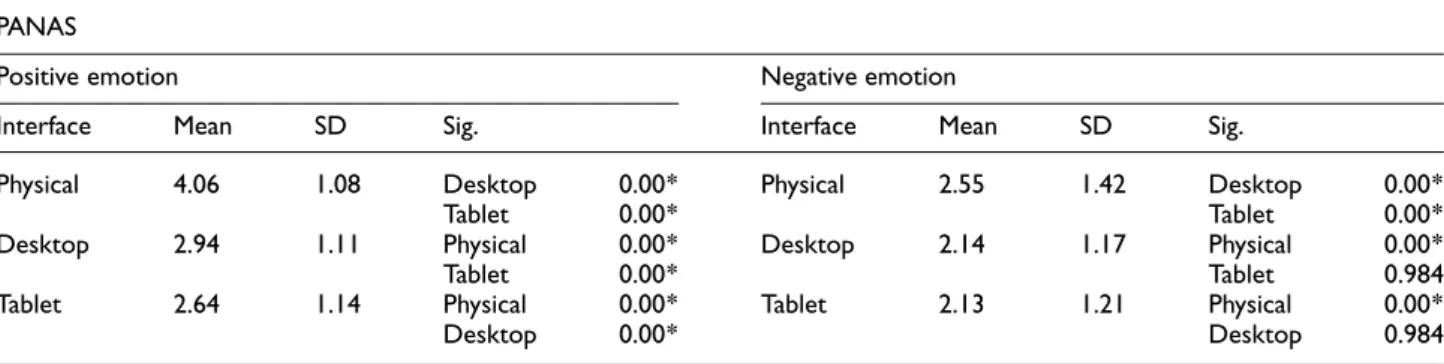
Figure 2 illustrates the comparison of PANAS mood scale between three interface formats. The statistic result of ANOVA showed significant differences (p = 0.000) among three interface formats while comparing the posi-tive and negaposi-tive emotions. The sequence of posiposi-tive affect is traditional game (4.06, SD = 1.08).desktop (2.94, SD = 1.11).tablet (2.64, SD = 1.14) and nega-tive affect is traditional (2.55, SD = 1.42).desktop (2.14, SD = 1.17).tablet (2.13, SD = 1.21).
Post hoc comparisons using Scheffe’s procedure con-firmed that traditional physical games evoked higher emotional reactions, both in positive and negative emo-tions (p\0.05) (see Table 5). However, in negative
emotion, no significant differences were found between desktop and tablet computer games.
Regarding the detailed questions of PANAS, tradi-tional physical games evoked highest positive emotions in the fun, excitement, sense of achievement, passion, strength, and dashing. Traditional physical games also evoked highest negative emotions in upset, distressed, guilty, nervous, hostile, irritable, ashamed, scared, jit-tery, and afraid.
Personal preferences and social interaction
The statistic results indicated that personal preferences were significantly different (p = 0.000) among physical,
Table 4. Statistic result of satisfaction degree in three design levels between three interface formats (units = points, 1–5).
Norman’s three design levels
Visceral level Behavioral level Reflective level
Interface Mean SD Sig. Interface Mean SD Sig. Interface Mean SD Sig.
Physical 4.39 0.72 Desktop 0.00* Physical 4.32 0.88 Desktop 0.00* Physical 3.97 0.99 Desktop 0.00* Tablet 0.00* Tablet 0.00* Tablet 0.00* Desktop 3.18 1.00 Physical 0.00* Desktop 3.1 1.19 Physical 0.00* Desktop 2.97 1.11 Physical 0.00* Tablet 0.00* Tablet 0.00* Tablet 0.013* Tablet 2.82 1.14 Physical 0.00* Tablet 2.69 1.24 Physical 0.00* Tablet 2.75 1.09 Physical 0.00*
Desktop 0.00* Desktop 0.00* Desktop 0.013*
SD: standard deviation.
*p
\0.05.
desktop, and tablet computer interface formats. Figure 3 illustrates the comparison of players’ prefer-ence for three interface formats. The sequprefer-ence is tradi-tional game (4.54, SD = 0.92).desktop (2.65, SD = 1.28).tablet (2.14, SD = 1.10).
Post hoc comparisons using Scheffe’s procedure con-firms that traditional physical games gain highest users’ preferences of interface formats after experiencing the games (p\0.05) (see Table 6).
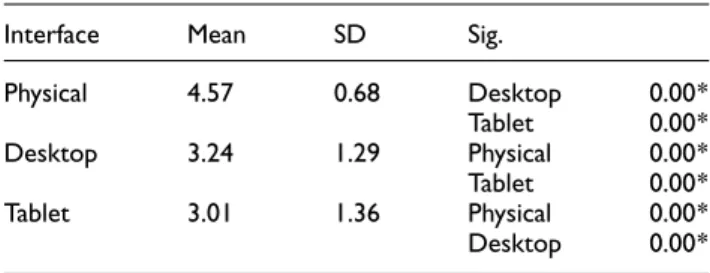
The statistic results show that social interaction was significantly different (p = 0.00) between three interface formats in the questions of improving friends’ relations, creating common topics, and interactive communica-tion. Figure 4 illustrates the comparison of social inter-action between three interface formats. The sequence is traditional game (4.57, SD = 0.68).desktop (3.24, SD = 1.29).tablet (3.01, SD = 1.36).
Post hoc comparisons using Scheffe’s procedure con-firm that traditional physical games create the highest sense of social interaction with friends while playing the game (p\0.05) (see Table 7).
Chen and Schnabel20and Moghaddam et al.21 men-tioned that digital games have created new types of interaction and intuitive operation. The digital games
should take advantages of the new technology such as multi-touch or movement gestures and so on. According to above results, physical games are superior to digital games in all aspects. These findings do not match with the literature in some parts. The reason might be the stimuli selection. The original physical versions of Monopoly and Jenga were successful. Launching their digital versions is only the revisions of the classic games, and it is not easy to make further breakthroughs.
Table 5. Statistic result of PANAS between three interface formats (units = points, 1–5).
PANAS
Positive emotion Negative emotion
Interface Mean SD Sig. Interface Mean SD Sig.
Physical 4.06 1.08 Desktop 0.00* Physical 2.55 1.42 Desktop 0.00*
Tablet 0.00* Tablet 0.00*
Desktop 2.94 1.11 Physical 0.00* Desktop 2.14 1.17 Physical 0.00*
Tablet 0.00* Tablet 0.984
Tablet 2.64 1.14 Physical 0.00* Tablet 2.13 1.21 Physical 0.00*
Desktop 0.00* Desktop 0.984
PANAS: Positive and Negative Affect Schedule; SD: standard deviation.
*p
\0.05.
Table 6. Statistic result of players’ preference for three interface formats (units = points, 1–5).
Interface Mean SD Sig.
Physical 4.54 0.92 Desktop 0.00* Tablet 0.00* Desktop 2.65 1.28 Physical 0.00* Tablet 0.00* Tablet 2.14 1.10 Physical 0.00* Desktop 0.00*
SD: standard deviation.
*p
\0.05. Figure 3. Comparison of players’ preference for three
interface formats (units = points, 1–5).
Conclusion
In this study, subjects’ satisfaction degrees, emotional response, and social interaction toward different inter-face formats of the same game were compared. This study successfully evidenced the different significance between digital and traditional board games. The sta-tistic results indicated that satisfaction degree of digital computer games declined in visceral, behavioral, and reflective levels when compared with traditional board games. The appearance of the traditional board game could impress people at the first sight and reduced errors in operation. Players can feel intimacy, vivid imagery, sympathetic responses, and satisfaction while playing the board game. These results explain the rea-sons why the rise of virtual games has not forced tradi-tional physical board games to disappear.
The results also concluded that traditional games not only evoked users’ stronger emotional reactions, both positive and negative, but also received higher prefer-ences. Regarding social interaction, traditional games could improve interpersonal relationships. New digital games could not replace the sense of social interaction created by traditional physical games.
However, the different interface formats of the same game were compared in this study, qualified stimuli should be popular games, and could provide physical and digital versions at the same time. Limited to this criteria, the new and innovative games released in recent years were excluded; stimuli selection might affect results. Recent literature suggested that the advantages of digital games are innovative interaction and intuitive operation.20,21 Some popular games, uti-lizing these benefits (e.g. intuitive gesture operation with multi-touch panel), deserve further investigations. Designing a new game should take full advantages of its distinguishing attributes of interface formats. These conclusions are hoped to provide useful design guide-lines to designers and inspire them to utilize knowledge of users’ emotional reactions to design innovative inter-faces for new games.
Declaration of conflicting interests
The author(s) declared no potential conflicts of interest with respect to the research, authorship, and/or publication of this article.
Funding
The author(s) disclosed receipt of the following financial sup-port for the research, authorship, and/or publication of this article: The authors thank the Ministry of Science and Technology of the Republic of China for the financial sup-port under grant number MOST 104-2410-H-239-008.
References
1. Boyle EA, Connolly TM, Hainey T, et al. Engagement in digital entertainment games: a systematic review.Comput Hum Behav2012; 28: 771–780.
2. Vordererv P, Klimmt C and Ritterfeld U. Enjoyment: at the heart of media entertainment. Commun Theor2004; 14: 388–408.
3. Norman D. Emotional design. New York: Basic Books, 2005.
4. Ritterfeld U and Weber R.Video games for entertainment and education. Mahwah, NJ: Lawrence Erlbaum, 2006. 5. Alexiou A, Schippers M and Oshri I. Positive psychology
and digital games: the role of emotions and psychological flow in serious games development. Psychology2012; 3: 1243–1247.
6. Zillmann D. Mood management: using entertainment to full advantage. In: Donohew L, Sypher HE and Higgins ET (eds) Communication, social cognition, and affect. Mahwah, NJ: Lawrence Erlbaum, 1988, pp.147–171. 7. Zillmann D and Bryant J. Affect, mood, and emotion as
determinants of selective exposure. In: Zillmann D and Bryant J (eds)Selective exposure to communication. New York: Routledge, 1985, pp.158–203.
8. Granic I, Lobel A and Engels RC. The benefits of play-ing video games.Am Psychol2014; 69: 66–78.
9. Grodal T. Video game and the pleasures of control. In: Zillmann D and Vorderer P (eds) Media entertainment: the psychology of its appeal. New York: Routledge, 2000, pp.197–213.
10. Prensky M.From digital natives to digital wisdom: hopeful essays for 21st century learning. Thousand Oaks, CA: Corwin Press, 2012.
11. McGonigal J.Reality is broken: why games make us better and how they can change the world. New York: Penguin Press, 2011.
12. Desmet P. A multilayered model of product emotions.
Des J2003; 6: 4–13.
13. Goldie P.The emotions: a philosophical exploration. New York: Oxford University Press, 2000.
14. Fang YM, Chen KM and Hsu CW. The study on the cor-relation between emotional design and emotion—taking the conditioning process of lemonade for example. In:
The fourth international conference on digital information and communication technology and its applications, Bang-kok, 6–8 May 2014, pp.435–439. New York: IEEE.
Table 7. Statistic result of social interaction for three interface formats (units = points, 1–5).
Interface Mean SD Sig.
Physical 4.57 0.68 Desktop 0.00* Tablet 0.00* Desktop 3.24 1.29 Physical 0.00* Tablet 0.00* Tablet 3.01 1.36 Physical 0.00* Desktop 0.00*
SD: standard deviation.
*p
15. Teng CK and Chuang MC. The emotional arousal applied model of form association in conceptual design.J Des2008; 13: 81–98.
16. Watson D, Clark LA and Tellegen A. Development and validation of brief measures of positive and negative affect: the PANAS Scales.J Pers Soc Psychol1988; 54: 1063–1070.
17. Ridder DD, Fournier M and Bensing J. Does optimism affect symptom report in chronic disease? What are its consequences for self-care behaviour and physical func-tioning?J Psychosom Res2004; 56: 341–350.
18. Ortun˜o-Sierra J, Santare´n-Rosell M, Albe´niz AP, et al. Dimensional structure of the Spanish version of the Posi-tive and Negative Affect Schedule (PANAS) in
adolescents and young adults.Psychol Assessment2015; 27: e1–e9.
19. Mathiak KA, Klasen M, Weber R, et al. Reward system and temporal pole contributions to affective evaluation during a first person shooter video game.BMC Neurosci
2011; 12: 1471–2202.
20. Chen RI and Schnabel MA. Multi-touch—the future of design interaction. In: Leclercq P, Heylighen A and Mar-tin G (eds)CAAD futures 2011: designing together. Lie`ge: Universite´ de Lie`ge, 2011, pp.557–571.