JSCS–4783 542.913:615.281
Original scientific paper
Synthesis, structural characterization and antimicrobial
evaluation of some novel piperidin-4-one oxime esters
K. GOKULA KRISHNAN, R. SIVAKUMAR and V. THANIKACHALAM* Department of Chemistry, Annamalai University, Annamalainagar 608 002,
Tamil Nadu, India
(Received 13 November 2014, revised 25 January, accepted 16 April 2015) Abstract: Fifteen novel biologically active piperidin-4-one oxime esters 8–22 were synthesized in good yields. These compounds were prepared in reactions of carboxylic acids, in situ activated using POCl3 and pyridine, with piperidin- -4-one oximes. The structures of the title compounds were elucidated based on FTIR, NMR (1D and 2D) and mass spectral analyses. Single crystal XRD studies of compounds 12 and 20 provided further unambiguous evidence for the proposed structure. All the synthesized compounds were tested for their in vitro antibacterial and antifungal activities. Many of these derivatives exhibited good activity against Bacillus subtilis, Pseudomonas aeruginosa, Escherichia coli, Trichoderma viride and Aspergillus flavus.
Keywords: piperidin-4-one oxime; aromatic acid; mixed anhydride; gauche interaction; conformation; single crystal XRD.
INTRODUCTION
Substituted piperidines and their analogues are basic structural units in num-erous naturally occurring alkaloids and drug candidates. A search of piperidines and their derivatives revealed thousands of references to this simple ring system in medicinal and clinical research.1 In particular, chiral centers at C2 and/or C6 of the piperidine ring were found to be essential for a defined activity, such as CNS,2 anti-HIV,3 anti-proliferative,4 anti-cancer,5 anti-inflammatory6 and anti-oxidant7 activities. Furthermore, the piperidine ring serves as a building block in synthetic and medicinal chemistry as more complex alkaloids include acridone and morphine, which themselves exhibit biological activities.8
Oximes9 and their derivatives represent an important class of organic mole-cules that attract the interest of both synthetic and medicinal chemists. Oxime esters have showed great potential in biologically active molecules, such as RBPP9 inhibitors,10 anti-proliferative11 and anti-convulsant12 agents, and in
agrochemical13 industries. In addition, oxime esters, such as OXE-1 and OXE-2, were employed as photoinitiators,14 as they meet the specific requirements desired for color filter displays in LCDs. Recently, oxime esters were reported to exhibit DNA-cleaving15 ability in a process triggered by UV light.
The formation of the ester is a simple dehydration process, which can be easily catalyzed by strong acids. Previously, numerous methods were docum-ented for the synthesis of esters via direct coupling of a carboxylic acid with an
alcohol, often involving the use of stoichiometric activators and coupling reagents.16 In addition, several reports describe the synthesis of esters in good yields using coupling reagents such as dicyclohexylcarbodiimide/4-(N,N
-dimethyl-amino)pyridine (DCC/DMAP),17 diethyl azodicarboxylate/triphenylphosphine (DEAD/Ph3P),18N,N-dimethyl phosphoramidic dichloride19 and diethyl
chloro-phosphate.20 However, some drawbacks still remain due to the formation of byproducts, difficulties in handling and long reaction times. Consequently, a practical and efficient synthesis of oxime esters in good yields under mild con-ditions is still needed. In this context, an attempt was made with phosphorus oxy-chloride (POCl3),21 which is a commercially available and relatively inexpensive superior reagent, and affects carboxylic group activation under mild conditions with excellent yields of the products.
Herein, the synthesis and structural characterization are reported of some novel 3-alkyl-2,6-diphenylpiperidin-4-one oxime esters 8–22 through carboxylic acids 7a–e, in situ-activated using POCl3 and pyridine as base as well as solvent,
with 3-alkyl-2,6-diphenylpiperidin-4-one oximes 4–6 in good yields (Scheme 1). The key compounds, 3-alkyl-2,6-diphenylpiperidin-4-ones22 1–3 and their oxi-mes9,234–6 were prepared using literature methods.
EXPERIMENTAL
All the purchased reagents and solvents were of reagent grade and used without further purification. Completion of reactions was monitored by TLC on silica gel-coated aluminum sheets (Type 60 GF254). The melting points were measured in open capillaries and are uncor-rected. The FTIR spectra were recorded on Avatar-300 FTIR spectrometer in KBr disks. The NMR (1D and 2D) spectra were recorded on a Bruker 400 MHz spectrometer. The chemical shift values are reported in ppm from TMS.
The analytical and spectral data of the synthesized compounds are given in the Sup-plementary material to this paper.
General procedure for the synthesis of piperidin-4-one oxime esters (8–22)
A mixture of 3-methyl-2,6-diphenylpiperidin-4-one oxime (0.700 g, 2.5 mmol) and ben-zoic acid (0.335 g, 2.75 mmol) in dry pyridine (5 mL) was stirred at room temperature (29 °C), POCl3 (0.25 mL, 2.75 mmol) was added dropwise to the mixture and stirring was con-tinued for 15 min. The progress of the reaction was monitored by TLC. After completion of the reaction, the crude product was neutralized with dilute nitric acid and the desired product was regenerated with sodium bicarbonate solution. The crude product was then recrystallized from ethanol to obtain the pure piperidin-4-one oxime ester 8 in good yield (0.6 g, 86 %). The above general method was adopted for the synthesis of compounds 9–22 of this series.
RESULTS AND DISCUSSION
Chemistry
In the present investigation, first the reaction of 3-methyl-2,6-diphenyl pipe-ridin-4-one oxime (4, 1 equiv.) and benzoic acid (7a, 1.1 equiv.) in pyridine as base as well as solvent was studied using various reagents (1.1 equiv.) to exam-ine the feasibility of the reaction. As shown in Table I, a trace amount of product was formed with PCl5, while moderate yields were obtained with SOCl2 and DCC. Finally, POCl3 gave the corresponding 3-methyl-2,6-diphenyl piperidin-4- -one oxime ester 8 in good yield.
TABLE I. Formation of oxime ester from oxime with benzoic acid utilizing various reagents Entry Substrate (equiv.) Reagent (equiv.) Time, min Yielda, %
1 PhCOOH (1.1) PCl5 (1.1) 120 Trace
2 PhCOOH (1.1) SOCl2 (1.1) 80 60
3 PhCOOH (1.1) DCC (1.1) 90 45
4 PhCOOH (1.1) POCl3 (1.1) 15 86
a Isolated yield
TABLE II. Optimization of reaction conditions with varying amounts of POCl3
Entry Substrate (equiv.) POCl3 (equiv.) Time, min Yielda, %
1 PhCOOH (1.1) 0.5 30 trace
2 PhCOOH (1.1) 1.1 15 86
3 PhCOOH (1.1) 1.5 25 80
4 PhCOOH (1.1) 2.0 20 69
aIsolated yield
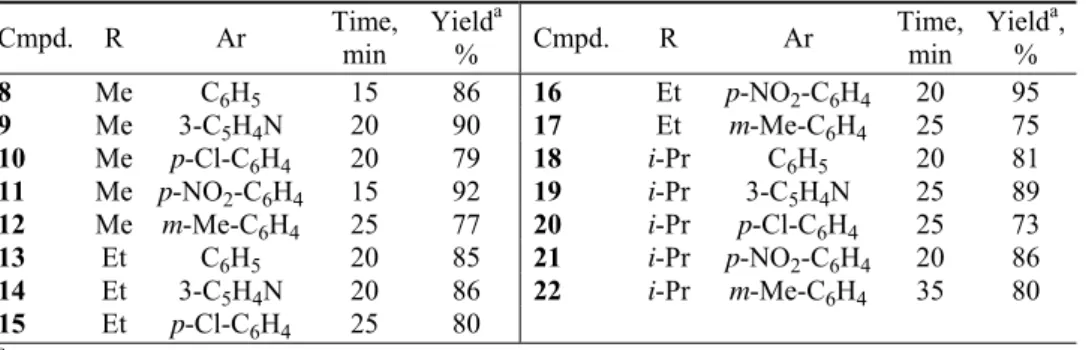
To study the scope and limitation of this protocol, POCl3 and pyridine were used with wide ranges of aromatic/heteroaromatic acids and piperidin-4-one oxi-mes. These methodologies resulted in good yield of products with short reaction times for all the substrates (Table III). The purity of products was high after a single recrystallization; extraction steps and chromatographic separation are thus avoided. The final products were well characterized using FTIR, NMR (1D and 2D) and mass spectrometry. The structures of compounds 12 and 20 were fully established by single crystal XRD analysis.
TABLE III. Substrate scope for piperidin-4-one oxime esters using POCl3/pyridine
Cmpd. R Ar Time, min Yield% a Cmpd. R Ar Time, min Yield% a,
8 Me C6H5 15 86 16 Et p-NO2-C6H4 20 95
9 Me 3-C5H4N 20 90 17 Et m-Me-C6H4 25 75
10 Me p-Cl-C6H4 20 79 18 i-Pr C6H5 20 81
11 Me p-NO2-C6H4 15 92 19 i-Pr 3-C5H4N 25 89
12 Me m-Me-C6H4 25 77 20 i-Pr p-Cl-C6H4 25 73
13 Et C6H5 20 85 21 i-Pr p-NO2-C6H4 20 86
14 Et 3-C5H4N 20 86 22 i-Pr m-Me-C6H4 35 80
15 Et p-Cl-C6H4 25 80 aIsolated yield
FTIR spectral analysis
In general, compounds containing carbonyl group show absorption in the region of 1600–1750 cm–1. In all the compounds 8–22, a strong band appeared in the double bond region of the spectra at 1739–1752 cm–1, which confirmed the formation of oxime ester (C=O). The imino group (C=N) in the piperidine ring gave a band at 1641–1607 cm–1. A collection of bands observed in the region of 3272–3446 cm–1 and 2797–3087 cm–1 are due to the presence of a secondary amine (N–H) and aromatic and aliphatic C–H stretching.
NMR spectral analysis
ring of the O-benzoyl group. Of these two sets of signals, one doublet that
appeared in the downfield region at 8.03 ppm corresponded to the deshielded
ortho H-atoms belonging to the O-benzoyl group. The remaining protons of Ph
groups and the O-benzoyl group collectively gave a multiplet at 7.29–7.57 ppm.
A doublet appeared in the upfield region of 1.07 ppm (J = 6.4 Hz) with a strong
correlation in HSQC with the 11.84 ppm peak and a weak correlation with the 44.86 ppm; the signal at 1.07 ppm is due to Me(C3). A broad singlet appeared at 2.00 ppm, that showed no correlation in HSQC, was unambiguously assigned as the NH proton. In the downfield region, there are three doublets at 3.95, 3.66 and 3.56 ppm. Of these three signals, the two doublets at 3.95 (J = 11.6 Hz) and 3.66
ppm (J = 10 Hz) show strong correlation with 60.94 and 69.02 ppm signals and
weak correlation with the 44.36 ppm signal. Obviously, these two signals are due to H2ax and H6ax (benzylic) protons. The latter doublet at 3.56 ppm (J = 13.6 Hz)
shows strong correlation with 36.48 ppm signal, which is cross peak with the triplet center at 2.30 ppm, which confirmed that 3.56 and 2.30 ppm are due to H5eq and H5ax protons attached at the C5 carbon. A multiplet appearing at 2.67 ppm showed a strong correlation with the 44.36 ppm signal and a weak correl-ation with the 69.02 ppm signal, which confirmed the signal be assigned to the H3ax proton.
Akin to compound 8, the chemical shift and coupling constant of C3 methyl, ethyl, isopropyl substituted analogous compounds 9–22 were assigned accord-ingly. Unlike compound 8, in compounds 13–22, the H2ax proton is deshielded by 0.14 ppm for the ethyl- and 0.38 ppm for the isopropyl-substituted com-pounds. Thee deviations indicate that the piperidine ring is flattened or distorted about the C2–C3 bond to decrease the gauche interaction. This interaction
oper-ates through space irrespective of the equatorial ethyl/isopropyl group at the C3 carbon and the phenyl group at the C2 carbon with an H2ax proton.
In the 13C-NMR spectrum of compound 8, the aromatic C-atoms appeared in the region of 126.9–129.6 ppm. The signals due to three ipso C-atoms were
obs-erved at 133.2, 142.0 and 143.0 ppm, respectively. Of these three signals, the one appearing at 133.25 ppm is due to an ipso carbon of the O-benzoyl group and the
rest are due to ipso carbons attached to C2 and C6 carbons of piperidine ring. The
imino carbon (C4) and O-benzoyl carbonyl carbon appear in the downfield
region at 164.22 and 169.51 ppm, respectively. In the upfield region, the methyl group attached to the C3 carbon was observed at 11.84 ppm and piperidine ring carbons C2, C3, C5 and C6 appeared at 69.02, 44.36, 36.48, and 60.94 ppm, respectively.
Conformational analysis
Com-pound 8 exhibited a large coupling constant J6ax,5ax (11.6 Hz) about the C5–C6
bond and about the C2–C3 bond (10 Hz) revealing the equatorial dispositions of the aryl rings at C2 and C6, and the alkyl group at C3. Thus, the synthesized compound 8 existed in a normal chair conformation with equatorial orientation of the Ph ring and Me(C3) substituents. The coupling constant about C2–C3 bond (J2ax,3ax) were considerably lower than that about the C5–C6 bond (J6ax,5ax), due
to the gauche interaction between the Ph group and the alkyl group of C2 and C3.
Hence, the piperidine ring is flattened/distorted about the C2–C3 bond and hence the lower magnitude of J2ax,3ax relative to J6ax,5ax. The chemical shift difference
between the C5 carbon (33.88 ppm) and C3 carbon (49.51 ppm) arises due to A1,3 interactions between the N–O and C5–H bonds. Thus, the C5 carbon signal was more shielded compared to C3 carbon. It was concluded that O-benzoyl
group was syn to the C5 carbon.
Single crystal XRD analysis of compounds 12 and 20
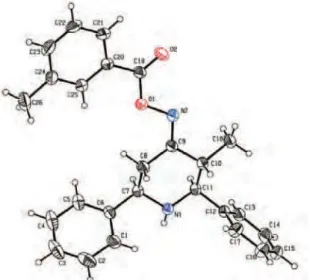
The crystal data and refinement parameters for compounds 1224 and 20 are summarized in Table S-I of the Supplementary material. The ORTEP view of compounds 12 and 20 are shown in Figs. 1 and 2, respectively. In compound 12, the piperidine ring (N1/C7–C11) adopts a chair conformation (the N1 and C9 atoms deviate from the best plane of C7/C8 and C10/C11 by 54.9(2)° and –47.7(2)°, respectively) with an equatorial orientation of the Ph rings and Me group substituted on the heterocyclic. The C–C=N bond angles are different (C8–C9=N2 = 126.54(19)° and C10–C9=N2 = 117.50(18)°) and the dihedral angle between the atoms C10–C9=N2–O1 is –177.16(19)°, showing that the molecule exists as the E-isomer.
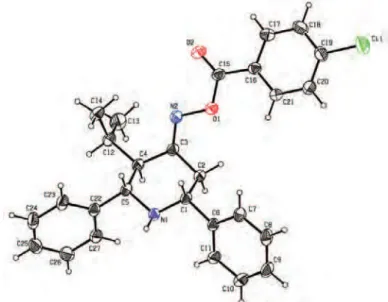
Fig. 2. The ORTEP view of compound 20 showing 50 % probability displacement ellipsoids.
In compound 20, the piperidine ring (N1/C1–C5) also exists in a chair con-formation with the ring atoms N1 and C3 deviating from the best plane of C1/C2 and C4/C5 by 66.77 and –62.22°, respectively. The Ph rings and the isopropyl group substituted on the heterocyclic ring are equatorially orientated. The bond angles of the C–C=N are different (C2–C3=N2 is 126.45° and C4–C3=N2 is 118.97°) and the molecule is found to exist in E-isomeric form as evidenced by
the C2–C3=N2–O1 dihedral angle of 179.08°.
Antimicrobial screening
All the synthesized compounds 8–22 were screened for their in vitro
anti-microbial activity in nutrient broth (NB) for bacteria and Sabouraud dextrose broth (SDB) for fungi by the twofold serial dilution method. A standard procedure was adopted for the preparation of all test samples.25 The minimum inhibitory concentration (MIC) values of the synthesized compounds 8–22
against bacterial strains viz. Bacillus subtilis, Staphylococcus aureus,
Pseudo-monas aeruginosa and Escherichia coli are compared with the those of
ampi-cillin in Table IV and against fungal strains viz. Penicillimchrysogenum,
Tricho-dermaviride, Aspergillusniger and A.flavus are compared with those of
ampho-tericin-B in Table V.
Antibacterial activity
All the synthesized piperidin-4-one oxime esters exhibited a wide range of in
vitro antibacterial activity from the highest concentration (200 µg mL–1) to the
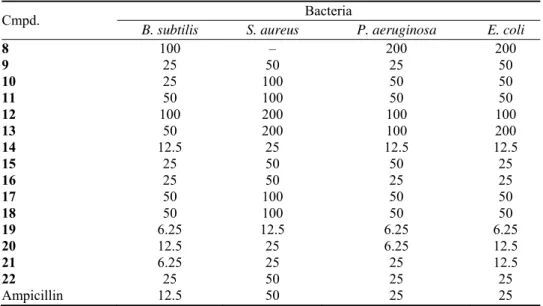
TABLE IV. Antibacterial activity (MIC / µg mL-1) of compounds 8–22; –: no inhibition at
200 µg mL-1
Cmpd. Bacteria
B. subtilis S. aureus P. aeruginosa E. coli
8 100 – 200 200
9 25 50 25 50
10 25 100 50 50
11 50 100 50 50
12 100 200 100 100
13 50 200 100 200
14 12.5 25 12.5 12.5
15 25 50 50 25
16 25 50 25 25
17 50 100 50 50
18 50 100 50 50
19 6.25 12.5 6.25 6.25
20 12.5 25 6.25 12.5
21 6.25 25 25 12.5
22 25 50 25 25
Ampicillin 12.5 50 25 25
TABLE V. Antifungal activity (MIC / µg mL-1) of compounds 8–22; – no inhibition at 200
µg mL-1
Cmpd. Fungi
P. chrysogenum T. viride A. niger A. flavus
8 – 200 – –
9 200 100 100 200
10 200 200 200 200
11 – – 200 200
12 – 200 – 200
13 200 100 100 100
14 50 50 50 25
15 100 50 50 50
16 100 100 50 25
17 100 100 100 50
18 50 25 50 50
19 25 12.5 12.5 12.5
20 25 12.5 25 25
21 50 25 25 25
22 50 25 25 25
Amphotericin B 25 25 50 50
failed to inhibit the growth of S. aureus at the highest concentration (200 µg mL–1).
Compounds 9–11 recorded moderate activity against S. aureus (100 µg mL–1)
and improved activity against B. subtilis, P. aeruginosa and E. coli. However,
and E. coli at 200 µg mL–1. On introducing an ethyl and/or isopropyl group at the
3rd position of the piperidine ring instead of a methyl group and replacing of
O-benzoyl group in the oxime part of all the compounds registered better activity
against all the strains. Several authors also documented that the 3-ethyl and/or 3-isopropyl substituted piperidin-4-one oxime derivatives exhibited outstanding antibacterial and antifungal activities.26,27 The 3-ethyl substituted oxime esters
13–17 showed better activity against all the tested organisms compared to com-pounds 8–12. Among these compounds, 14 registered greater activity (12.5–25 µg mL–1) against all the tested organisms and compounds 15 and 16 recorded good activity against B. subtilis and E. coli at 25 µg mL–1. Compound 17 showed
moderate activity against B. subtilis, P. aeruginosa and E. coli at 50 µg mL–1 and
compound 13 did not show any significant activity against S. aureus and E. coli
even at the highest concentration (200 µg mL–1). The presence of an isopropyl group at the 3rd position in compounds 18–22 showed better activity with MIC values of 6.25–12.5 µg mL–1 when compared with the other substituents (methyl or ethyl). Especially compound 19 registered greater activity against all the tested strains at lower concentrations (6.25–12.5 µg mL–1) and compounds 20 and 21 also registered better activity (12.5–50.0 µg mL–1) against all the tested organ-isms compared with 18 and 22 (25–100 µg mL–1). From the above observations, it is obvious that the nicotinoyl-substituted oxime esters 14 and 19 recorded excellent activity among the substituted oxime esters. The chloro- and nitro-sub-stituted oximes esters 15, 16, 20 and 21 also registered good activity.
Antifungal activity
The synthesized compounds 8–22 were also screened for their in vitro
anti-fungal activity against the tested organisms. Compounds 8 and 12 showed no significant inhibition of P. chrysogenum, A. niger and A. flavus even at the
high-est concentration of 200 µg mL–1, nor did compound 11 against P. chrysogenum
and T. viride. Compounds 9, 10 and 13 showed weak activity against A. flavus
and P. chrysogenum at 200 µg mL–1. Replacement of the methyl group by ethyl
and/or isopropyl led to significant activity against all the tested organisms. Com-pound 14 registered better activity against T. viride, P. chrysogenum and A. niger
at 50 µg mL–1 and compound 15 also showed better activity against T. viride, A.
flavus and A. niger. Compounds 16 and 17 exhibited moderate activity against P.
chrysogenum, T. viride with MIC value of 100 µg mL–1. Compound 18 showed
good activity against P. chrysogenum, A. flavus and A. niger and improved
acti-vity against T. viride at 25 µg mL–1. Introduction of nicotinoyl and/or an
elec-tron-withdrawing group (chloro or nitro) at the oxime part increased the activity of compounds 19 and 20 against T. viride, A. niger and A. flavus at 12.5–25 µg
resulted in greater activity against all the tested organisms (12.5–50 µg mL–1), when compared with the other compounds.
CONCLUSIONS
In summary, the POCl3 and pyridine system was described as an in situ
activating agent for direct piperidin-4-one oxime ester formation in the reaction between aromatic acids and piperidin-4-one oximes. The present method is prac-tically efficient, involves shorter reaction times, simple purification procedures and is economic for the synthesis of piperidin-4-one oxime esters. From XRD crystallographic results, it was shown that the piperidine rings of compounds 12
and 20 adopt chair confirmations with equatorial orientation of the aryl groups. Based on the antimicrobial studies, it was proved that piperidin-4-one oxime esters show better activities against standard strains than ampicillin and ampho-tericin-B. In particular, nicotinoyl oximes 14 and 19 showed excellent antibac-terial as well as antifungal activities in comparison with the other oxime esters.
SUPPLEMENTARY MATERIAL
Analytical and spectral data of the synthesized compounds and the crystal data and structural refinement of compounds 12 and 20 are available electronically from http:// //www.shd.org.rs/JSCS/, or from the corresponding author on request.
И З В О Д
СИНТЕЗА, СТРУКТУРНАКАРАКТЕРИЗАЦИЈАИИСПИТИВАЊЕАНТИМИКРОБНЕ
АКТИВНОСТИНОВИХЕСТАРАПИПЕРИДИН-4-ОН-ОКСИМА
K. GOKULA KRISHNAN, R. SIVAKUMAR и V. THANIKACHALAM
Department of Chemistry, Annamalai University, Annamalainagar 608 002, Tamil Nadu, India
Синтетисанојепетнаестнових, биолошкиактивних, естарапиперидин-4-он-оксима
естара 8–22удобромприносу. Једињењасудобијенареакцијомнепосредноприпрем
-љенихалканоил-хлорида, добијенихизодговарајућихкарбоксилнихкиселина и POCl3,
сапиперидин-4-oн-оксимима. Структурадобијенихдериватаутврђенаје FTIR, NMR (1D
и 2D) и масеном спектралном анализом. Структура деривата недвосмислено је
потврђена XRD анализом монокристала једињења 12 и 20. Испитана је in vitro
антибактеријска иантифунгалнаактивностсвихсинтетисаних деривата. Значајанброј
ових једињењапоказуједобруактивностпремаBacillus subtilis, Pseudomonas aeruginosa,
Escherichia coli, Trichoderma virideиAspergillus flavus.
(Примљено 13. новембра 2014, ревидирано 25. јануара, прихваћено 16. априла 2015)
REFERENCES
2. S. O. Thorberg, S. Berg, J. Lundstrom, B. Pettersson, A. Wijkstrom, D. Sanchez, P. Lindberg, J. L. G. Nilsson, J. Med. Chem.30 (1987) 2008
3. G. Xu, A. Kannan, T. L. Hartman, H. Wargo, K. Watson, J. A. Turpin, R. W. Buckheit Jr., A. A. Johnson, Y. Pommier, M. Cushman, Bioorg. Med. Chem. 10 (2002) 2807 4. P. Lagisetty, P. Vilekar, K. Sahoo, S. Anant, V. Awasthi, Bioorg. Med. Chem. 18 (2010)
6109
5. D. Cheng, S. Valente, S. Castellano, G. Sbardella, R. D. Santo, R. Costi, M. T. Bedford, A. Mai, J. Med. Chem. 54 (2011) 4928
6. A. M. Katsori, M. Chatzopoulou, K. Dimas, C. Kontogiorgis, A. Patsilinakos, T. Trangas, D. Hadjipavlou-Litina, Eur. J. Med. Chem.46 (2011) 2722
7. S. T. Harini, H. V. Kumar, J. Rangaswamy, N. Naik, Bioorg. Med. Chem. Lett. 22 (2012) 7588
8. J. P. Michael, Nat. Prod. Rep. 5 (2003) 476
9. a) D. J. Lauffer, M. R. Pavia, H. Tecle, A. J. Thomas, European Patent 445,731, A1 (1991); b) I. Damljanovic, M. Vukicevic, R. D. Vukicevic, Monatsh. Chem. 137 (2006) 301; c) P. Politzer, J. S. Murray, The Chemistry of Hydroxylamines, Oximes and Hydroxamic Acids, Wiley, Chichester, 2009
10. D. A. Bachovchin, M. R. Wolfe, K. Masuda, S. J. Brown, T. P. Spicer, V. Fernandez-Vega, P. Chase, P. S. Hodder, H. Rosen, B. F. Cravatt, Bioorg. Med. Chem. Lett. 20 (2010) 2254
11. G. Surkau, K. J. Bohm, K. Muller, H. Prinz, Eur. J. Med. Chem. 45 (2010) 3354
12. A. Karakurt, M. A. Alagoz, B. Sayoglu, U. Calis, S. Dalkara, Eur. J. Med. Chem. 57 (2012) 275
13. X. H. Liu, L. Pan, C. X. Tan, J. Q. Weng, B. L. Wang, Z. M. Li, Pest. Biochem. Physiol.
101 (2011) 143
14. K. Kunimoto, J. Tanabe, H. Kura, H. Oka, M. Ohwa, US Patent 7 189 489 B2 (2007) 15. R. R. Hwu, S. C. Tsay, S. C. Hong, M. H. Hsu, C. F. Liu, S. S. P. Chou, Bioconjugate
Chem. 24 (2013) 1778
16. J. Otera, J. Nishikido, Esterification: Methods, Reactions and Applications, 2nd ed., Wiley-VCH, Weinheim, 2010
17. B. Neises, W. Steglich, Angew.Chem. Int. Ed. Engl. 17 (1978) 522 18. O. Mitsunobu, M. Eguchi, Bull. Chem. Soc. Jpn. 44 (1971) 3427 19. A. K. Adak, Synlett (2004) 1651
20. J. McNulty, R. Vemula, V. Krishnamoorthy, A. Robertson, Tetrahedron68 (2012) 5415 21. F. Effenberger, G. Konig, H. Klenk, Angew. Chem., Int. Ed. Engl.17 (1978) 695
22. a) C. R. Noller, V. Baliah, J. Am. Chem. Soc. 70 (1948) 3853; b) K. Gokula Krishnan, R. Sivakumar, V. Thanikachalam, Can. Chem. Trans. 2 (2014) 353
23. a) K. Pandiarajan, R. T. Sabapathy Mohan, M. U. Hasan, Magn. Reson. Chem. 24 (1986) 312; b) E. Abele, R. Abele, O. Dzenitis, E. Lukevics, Chem. Heterocycl. Compd. (N.Y., NY, U.S.) 39 (2003) 3
24. V. Kathiravan, K. Gokula Krishnan, T. Mohandas, V. Thanikachalam, P. Sakthivel, Acta Crystallogr., E 70 (2014) o883
25. M. L. Dhar, M. M. Dhar, B. N. Dhawan, B. N. Mehrotra, C. Ray, Indian J. Exp. Biol. 6 (1968) 232
26. P. Parthiban, S. Balasubramanian, G. Aridoss, S. Kabilan, Med. Chem. Res. 14 (2005) 523
27. P. Parthiban, G. Aridoss, P. Rathika, V. Ramkumar, S. Kabilan, Bioorg. Med. Chem. Lett.