PAPERS
health
global
Rachel McKinnon
Harry Campbell
Centre for Population Health Sciences and Global Health Academy,
University of Edinburgh, Scotland, UK
Correspondence to:
Prof. Harry Campbell
Centre for Population Health Sciences University of Edinburgh
Teviot Place Edinburgh EH89AG Scotland, UK
Systematic review of birth cohort studies
in South East Asia and Eastern Mediterranean
regions
Background
Few longitudinal studies of children have taken place
in the developing world, despite child mortality being concentrated
there. This review summarises the methodologies and main
out-comes of longitudinal studies of pre-school children (0 to 59 months)
in the World Health Organization’s South East Asia (SEA) and
East-ern Mediterranean (EM) Regions.
Methods
A systematic search of literature using pre-deined criteria
revealed 7863 papers. After application of quality criteria, 120
stud-ies were selected for analysis.
Results
The search revealed 83 studies in the SEA region and 37 in
the EM region, of which 92 were community-based and 8
facility-based. Objectives were diverse but topics included growth (n = 49
studies), mortality (n = 28), nutrition (n = 24), and infectious diseases
(n = 33). Only 12 studies focused on non-communicable diseases.
Duration ranged from 7 to 384 months. Measurements included
an-thropometric (n = 56 studies), socioeconomic (n = 50) and biological
sampling (n = 25), but only one study was DNA-based.
Conclusion
Biobanks have emerged as the most successful approach
to generating knowledge about disease causes and mechanisms. Little
of this is possible to undertake in the in SEA or EM regions, however.
Further longitudinal studies of young children with DNA sampling
should be set up to better understand determinants of diseases in
low-income countries.
VIEWPOINTS PAPERS
are still of greatest concern (including acute respiratory
in-fections, diarrhoea, malaria, HIV/AIDS, tuberculosis and
maternal tetanus), followed by neonatal issues (including
birth asphyxia or preterm birth) (2,9,10). Further birth
co-hort studies may better establish the determinants of such
diseases and inform health expenditures. Understanding the
epidemiology of those diseases has important policy
impli-cations. There has been some concern within the scientiic
community for example, toward the movements against a
HiB-vaccine programme in India (11).
A birth cohort study with genetic samples could
consider-ably advance the understanding of the inluence of genetics
and epigenetics on disease burden, particularly in
develop-ing countries. This is because the natural selection imposed
by infectious diseases through child mortality has been
shaping the human genome for hundreds of thousands of
years (12). Large biobanks have emerged as the most
suc-cessful way of harnessing the new health research
technol-ogies available and generating new knowledge about disease
causes and mechanisms.
Moreover, storage of samples may
enable testing of future hypotheses, although the screening
of biobanks for research purposes does not need to be
hy-pothesis-driven, and the whole of the genome may be
screened in search for genetic associations. There has been
a surge in global interest towards birth cohort studies in
re-cent years, as shown by the trend in global publications
(
Figure 1
). It is essential however that this interest be
di-rected toward those in greatest need in the future, thus
re-ducing inequalities in global health research.
The aims of the present paper were:
1. to produce a systematic review of birth cohort
stud-ies from the World Health Organisation’s South East
Asia (SEA) and Eastern Mediterranean (EM) regions;
2. to examine the methodology, data collected from,
and strengths / weaknesses of these studies and
3. to offer recommendations on the feasibility and
sus-tainability of this area of research based on the
ind-ings of this review and in the context of the current
literature.
METHODS
Search strategy
An initial scoping exercise was conducted to identify key
words and MeSH headings, and the inal search terms
agreed with a librarian. Systematic searches were run across
the following electronic databases via Ovid (
Figure 1
):
Medline (1950-onwards) on 30 July 2010 and Embase
(1980-onwards) on 7 July 2010.
Speciic countries were those identiied by the World Bank
list of economies (July 2011) as being lower or middle
in-come countries. There were no additional limitations
placed on publication date, type or language.
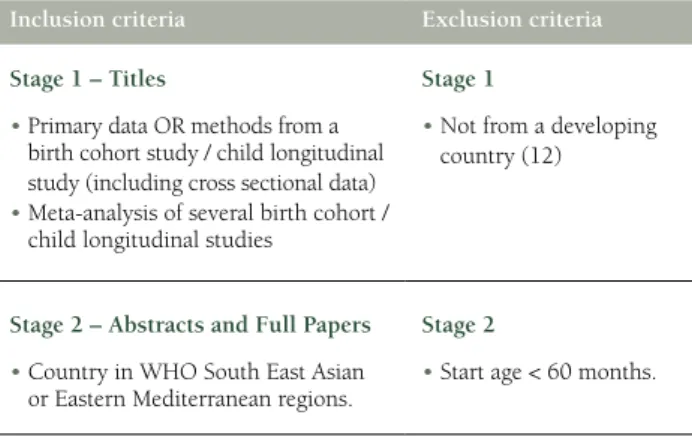
Inclusion and exclusion criteria
All titles, abstracts, then full papers were screened for
rel-evance.
Data extraction
Data were extracted from abstracts and entered into
Mi-crosoft Excel sheets. Where more than one paper refered
to a single study, the irst chronologically published paper
Figure 1
Global number of publications per year when ‘birth*co-hort*’ was used as a search term in ISI Web of Knowledge data-base on 27 September 2010; no language or other restrictions.
Figure 2
Summary of the literature search. SEAR – South East Asian Region, EMR – Eastern Mediterranean Region of the World Health Organisation (WHO).Medline
n = 5992 n = 4869EMbase
Duplicates reMoved Reviewof
literature n = 7863
Titlesandabstracts screenedfor relevancy
application ofspecificinclusion
criteria (step 2)
excluded n = 876
excluded n = 198
liMitedtocountriesin wHo sEaRorEMR
biologicalsaMples noTtaken
n = 95
biologicalsaMples taken n = 25 n = 120
step 1
REASONS FOR EXCLUSION
Duplicate
VIEWPOINTSPAPERS
Table 2
Inclusion stepsInclusion criteria Exclusion criteria
Stage 1 – Titles
• Primary data OR methods from a
birth cohort study / child longitudinal study (including cross sectional data)
• Meta-analysis of several birth cohort /
child longitudinal studies
Stage 1
• Not from a developing
country (12)
Stage 2 – Abstracts and Full Papers
• Country in WHO South East Asian
or Eastern Mediterranean regions.
Stage 2
• Start age < 60 months.
Table 1
Search strategy for Medline and Embase*Birth Cohort / Longitudinal Study 1. Longitudinal Studies/
2. (birth* adj3 longitudinal).ti,ab. 3. (birth* adj3 cohort*).ti,ab. 4. (pregnan* adj3 cohort*).ti,ab. 5. famil* cohort*.ti,ab. 6. cohort* survey*.ti,ab. 7. panel stud*.ti,ab. 8. panel survey*.ti,ab.
AND
Developing Country 1. Developing Countries/ 2. low income countr*.tw. 3. middle income countr*.tw.
4. (low adj2 middle income countr*).tw.
5. africa/ or africa, northern/ or algeria/ or egypt/ or libya/ or morocco/ or tunisia/ or “africa south of the sahara”/ or africa, central/ or cameroon/ or central african republic/ or chad/ or congo/ or “democratic republic of the congo”/ or equatorial guinea/ or gabon/ or africa, eastern/ or burundi/ or djibouti/ or eritrea/ or ethiopia/ or kenya/ or rwanda/ or somalia/ or sudan/ or tanzania/ or uganda/ or africa, southern/ or angola/ or botswana/ or lesotho/ or malawi/ or mozambique/ or namibia/ or south africa/ or swaziland/ or zambia/ or zimbabwe/ or africa, western/ or benin/ or burkina faso/ or cape verde/ or cote d’ivoire/ or gambia/ or ghana/ or guinea/ or guinea-bissau/ or liberia/ or mali/ or mauritania/ or niger/ or nigeria/ or senegal/ or sierra leone/ or togo/ or “antigua and barbuda”/ or cuba/ or dominica/ or dominican republic/ or grenada/ or guadeloupe/ or haiti/ or jamaica/ or “saint kitts and nevis”/ or saint lucia/ or “saint vincent and the grenadines”/ or central america/ or belize/ or costa rica/ or el salvador/ or guatemala/ or honduras/ or nicaragua/ or panama/ or panama canal zone/ or mexico/ or argentina/ or bolivia/ or brazil/ or chile/ or colombia/ or ecuador/ or guyana/ or paraguay/ or peru/ or suriname/ or uruguay/ or venezuela/ or asia, central/ or kazakhstan/ or kyrgyzstan/ or tajikistan/ or turkmenistan/ or uzbekistan/ or cambodia/ or east timor/ or indonesia/ or laos/ or malaysia/ or myanmar/ or philippines/ or thailand/ or vietnam/ or asia, western/ or bangladesh/ or bhutan/ or india/ or sikkim/ or afghanistan/ or iran/ or iraq/ or jordan/ or lebanon/ or syria/ or turkey/ or yemen/ or nepal/ or paki-stan/ or sri lanka/ or exp china/ or exp japan/ or korea/ or “democratic people’s republic of korea”/ or “republic of korea”/ or mongolia/ or albania/ or lithuania/ or bosnia-herzegovina/ or bulgaria/ or byelarus/ or “macedonia (republic)”/ or moldova/ or montenegro/ or romania/ or russia/ or serbia/ or ukraine/ or yugoslavia/ or exp transcaucasia/ or armenia/ or azerbaijan/ or “georgia (republic)”/ or comoros/ or madagascar/ or mauritius/ or sey-chelles/ or iji/ or papua new guinea/ or vanuatu/ or palau/ or samoa/ or tonga/
*Within a box, all terms were combined with Boolean operator OR.
was entered into the database and any additional data from
other paper(s) inputed into relevant cells. Noted study
characteristics include: country, city/state, urban/rural, year
of start, recruitment strategy, start number, start age,
pro-portion of population, speciic population characteristics,
measurements and observations, measurement frequency,
family inclusion, end age, duration, attrition, study aims,
funding.
Data analysis
Measurements were categorized into anthropometric,
so-cioeconomic, and biological samples / measurements. Study
aims and/or outcomes were characterised into topics. These
included infectious diseases (respiratory tract infections
(RTIs), diarrhoea, other), non-communicable diseases,
nu-trition, growth, socioeconomic factors, and mortality. Some
studies were relevant to ≥1 topic. To provide an overview
of studies, data types were counted. Where possible,
sum-mations and calculations were done with Excel formulae to
minimise human error. A specialist programme (StatPlanet
MapMaker, developed by Frank van Cappelle, 2011; http://
www.sacmeq.org/statplanet) was used to display the
geo-graphical spread of studies.
RESULTS
Study characteristics
We analyzed 120 studies. There were only a small number
of papers being published each year on birth cohort
stud-ies in the SEA or EM regions (with a maximum of 10 in
total) and little change in trend in the past 20 years (
Figure
3
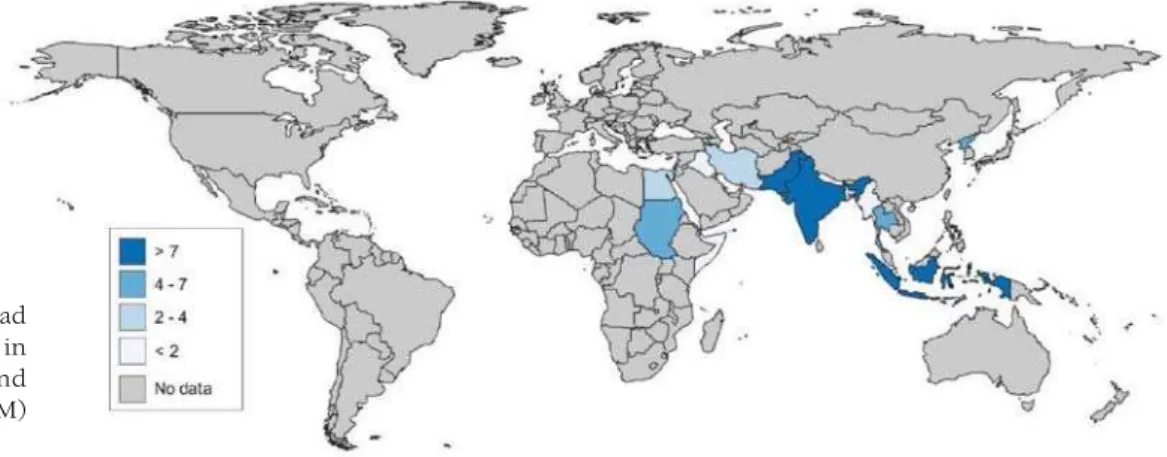
). In total, there were more than twice the number of
stud-ies in the SEA region (n = 83) compared to the EM region
(n = 37) and these are most concentrated in India and
Ban-gladesh and in Pakistan, respectively (
Figure 4
).
VIEWPOINTS PAPERS
The number of children enrolled ranged from 22 (13) to
5 711 337 (14). The latter were recruited retrospectively in
Korea using nationally linked birth and death certiicates,
but made no active measurements. The largest prospective
study was a cohort of 3729 in rural Bangladesh followed
from birth for 36 months to examine the effect of birth
spacing on mortality (15). In most studies (58), subjects
were <3 months of age at the start, with many studies
re-cruiting mothers during pregnancy. A number of the
stud-ies presented recruited older children (
Table 3,
Supple-mentary Web Table 1
). Studies tended to be of short
duration (12–24 months), but at least three of them
fol-lowed up their subjects for >60 months. The Mysore
Par-thenon cohort (16), in which maternal serum folate, B12
and homocysteine concentrations were measured during
pregnancy and child cognition (measured at 9 years) was
a positive example. An even better established cohort is a
New-Delhi cohort contacted at mean 32 years, with birth
weight and adult glucose metabolism examined (17). Most
studies tended to record socioeconomic measurements.
These included parental age, education and occupation,
and often indicators of household wealth (including
monthly income, land size, possession of animals, and
pos-Table 3
Characteristics of all studies in South East Asia (SEA)
and Eastern Mediterranean (EM) regions (n = 120)
CharaCteristiC Whosea Whoemr e(% mrorsea of 120)
Year Pre 1980 1 1 2 (1.7)
1980–1989 9 5 14 (11.7)
1990–1999 31 16 47 (39.2)
2000–2010 42 15 57 (47.5)
Number of subjects at start
< 100 4 2 6 (4.2)
100–499 25 6 31 (25.8)
500–999 13 5 18 (15.0)
≥ 1000 22 11 33 (27.5)
No data* 19 13 32 (26.7)
Max age at start
(months) <00–3 285 241 29 (24.2)29 (24.2)
3–6 0 0 0 (0.0)
6–12 1 0 1 (0.0)
12–59 14 1 15 (12.5)
No data* 35 11 46 (38.3)
Duration of follow up (months)
<12 1 0 1 (0.8)
12– 24 16 13 29 (24.2)
25–60 15 3 18 (15.0)
>60 3 0 3 (2.5)
No data* 48 21 69 (57.5)
Measurements / Samples (≥1 possible per study)
Anthropometric 40 16 56 (46.7)
Socioeconomic 28 22 50 (41.7)
Biological 17 8 25 (20.8)
DNA 0 1 1 (0.0)
Family in-cluded*
Yes 11 7 18 (15.0)
No 40 13 53 (44.2)
No data* 32 17 49 (40.8)
Setting Community-based 65 27 92 (76.6)
Facility-based 5 3 8 (6.6)
No data 13 7 20 (16.7)
Topic
(≥1 possible per study)
Growth 31 18 49 (40.8)
Nutrition 21 3 24 (20.0)
Infectious diseases 24 9 33 (27.5)
Non-communicable diseases
6 6 12 (10.0)
Socioeconomic effects 13 7 20 (16.7)
Mortality 25 3 28 (23.3)
*Some papers did not include data searched for. Moreover, some full papers (n=22) were not obtained and details not presented in abstract.
Figure 3
Number of studies published each year (n = 120). EM –Eastern Mediterranean, SEA – South East Asia, Bio – countries in the region taking biological samples (Bio).
VIEWPOINTSPAPERS
session of transportation). Living circumstances (number
of rooms: family size ratio, water supply, proximity of
la-trine) were also measured occasionally. Other observations
commonly made in retained studies included family size
and spacing and nutrition practices (prelactal feeds,
exclu-sivity of breastfeeding, speciic supplements given).
Final-ly, exposures (eg, speciic occupational hazards, household
cigarettes or fuel-burning), utilisation of health services and
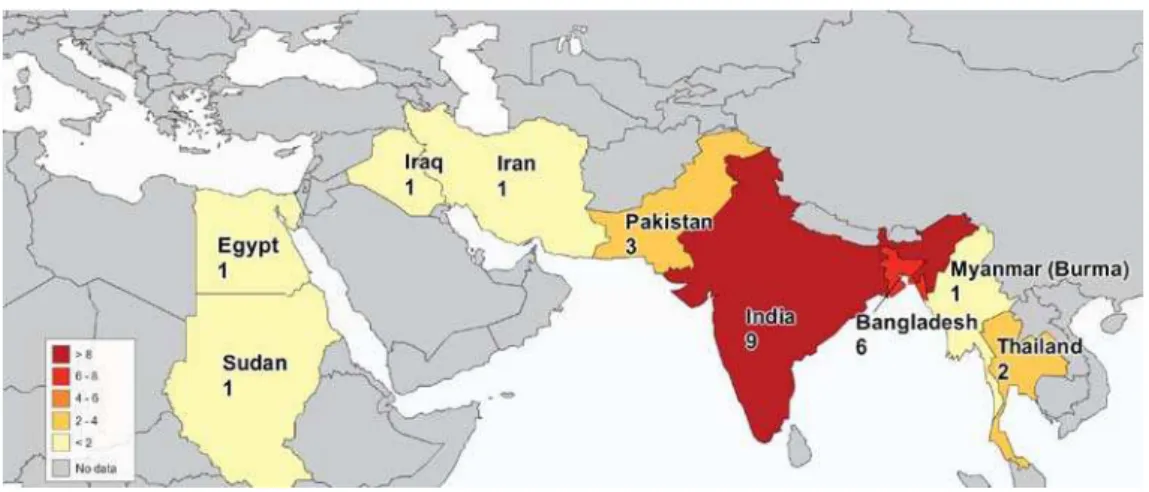
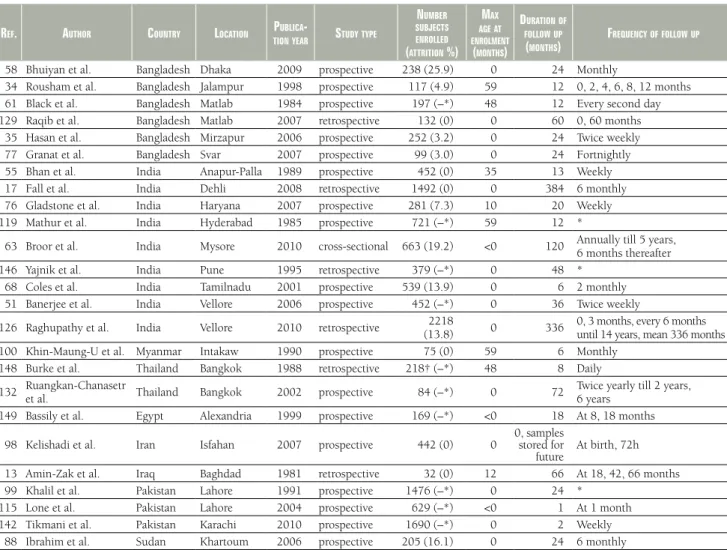
mental health were also noted. There were only 25 studies
taking biological samples (
Figure 5
) and their
characteris-tics are presented in
Tables 4–5
.
Biological sampling
We found a total of 25 studies in this region which took
and stored biological samples (9 of them conducted in
In-dia, 6 in Bangladesh and 3 in Pakistan) (
Figure 5
). Their
characteristics are shown in
T
able 4
. The samples
collect-ed in a total of ifteen studies that storcollect-ed blood samples are
shown in
Table 5
.
DISCUSSION
A review of birth cohort studies in the SEA and EM regions
has identiied some positive examples of research. There is
a distinct lack of studies addressing infectious diseases
however, especially respiratory tract infections (RTI).
Diar-rhoea and RTI are a major cause of child morbidity and yet
these topics receive little proportionate funding in research
(18). Furthermore, biobanking has emerged as the most
eficient way of studying the mechanisms of major
diseas-es. However, there was only a single study from the SEA
and EM regions in which DNA has been stored, in contrast
to the numerous studies in the developed world beneitting
from the Human Genome Project (19). A new birth cohort
study and biobank in the SEA or EM regions would require
signiicant planning, but such research must be directed to
these areas of high child mortality in order to ensure future
equity in health research.
In addition to infections, the incidence of
non-communi-cable diseases such as cardiovascular disease, diabetes,
can-cers, cognitive defects and mental illness, are also
increas-ing in low and middle-income countries (2,10). Thus, the
developed world faces a dual burden of communicable and
non-communicable disease. The diseases of adulthood
have known associations with risk factors in earlier life. A
life-course perspective of health determinants is now well
outlined with understanding being drawn from previous
longitudinal studies. Data from the UK NCDS study
(3) for
example outlined the association between maternal
smok-ing and low birth weight (20). Risk factors even for the
same non-communicable diseases are likely to differ
some-what between developed and developing countries.
There-fore, any future birth cohort studies in the developing
world would be more informative than those in the
devel-oped world.
Environmental exposures may differ in addition to
differ-ent cultural manifestations. Breastfeeding, for example, is
more prevalent in afluent members of developed countries
in contrast to an association with poor socioeconomic
sta-tus in low-income countries (21). Breastfeeding in the
de-veloped world is linked to obesity; however this may be
socially patterned with high income (21). Comparative
trends between countries with thus the removal of
con-founding factors may lead to a better understanding of
cau-sality of disease. Furthermore, the inluence of the
environ-ment on child developenviron-ment has been better explored with
new technologies made available by the Human Genome
Project (22). Following the association of maternal
smok-ing with low birth weight as outlined in the NCDS study
(3), speciic polymorphisms and their associations with
maternal smoking, birth weight and adult cardiovascular
disease have been examined (23).
VIEWPOINTS PAPERS
Table 4
Studies in South East Asia (SEA) and Eastern Mediterranean (EM) regions taking biological samples (n = 25)
ref. author Country LoCation PubLiCa
-tionyear studytyPe
number subjeCts enroLLed
(attrition %)
max ageat enroLment
(months)
durationof foLLoWuP
(months)
frequenCyoffoLLoWuP
58 Bhuiyan et al. Bangladesh Dhaka 2009 prospective 238 (25.9) 0 24 Monthly
34 Rousham et al. Bangladesh Jalampur 1998 prospective 117 (4.9) 59 12 0, 2, 4, 6, 8, 12 months
61 Black et al. Bangladesh Matlab 1984 prospective 197 (–*) 48 12 Every second day
129 Raqib et al. Bangladesh Matlab 2007 retrospective 132 (0) 0 60 0, 60 months
35 Hasan et al. Bangladesh Mirzapur 2006 prospective 252 (3.2) 0 24 Twice weekly
77 Granat et al. Bangladesh Svar 2007 prospective 99 (3.0) 0 24 Fortnightly
55 Bhan et al. India Anapur-Palla 1989 prospective 452 (0) 35 13 Weekly
17 Fall et al. India Dehli 2008 retrospective 1492 (0) 0 384 6 monthly
76 Gladstone et al. India Haryana 2007 prospective 281 (7.3) 10 20 Weekly
119 Mathur et al. India Hyderabad 1985 prospective 721 (–*) 59 12 *
63 Broor et al. India Mysore 2010 cross-sectional 663 (19.2) <0 120 Annually till 5 years, 6 months thereafter
146 Yajnik et al. India Pune 1995 retrospective 379 (–*) 0 48 *
68 Coles et al. India Tamilnadu 2001 prospective 539 (13.9) 0 6 2 monthly
51 Banerjee et al. India Vellore 2006 prospective 452 (–*) 0 36 Twice weekly
126 Raghupathy et al. India Vellore 2010 retrospective (13.8)2218 0 336 0, 3 months, every 6 months until 14 years, mean 336 months
100 Khin-Maung-U et al. Myanmar Intakaw 1990 prospective 75 (0) 59 6 Monthly
148 Burke et al. Thailand Bangkok 1988 retrospective 218† (–*) 48 8 Daily
132 Ruangkan-Chanasetr et al. Thailand Bangkok 2002 prospective 84 (–*) 0 72 Twice yearly till 2 years, 6 years
149 Bassily et al. Egypt Alexandria 1999 prospective 169 (–*) <0 18 At 8, 18 months
98 Kelishadi et al. Iran Isfahan 2007 prospective 442 (0) 0 0, samples stored for
future At birth, 72h
13 Amin-Zak et al. Iraq Baghdad 1981 retrospective 32 (0) 12 66 At 18, 42, 66 months
99 Khalil et al. Pakistan Lahore 1991 prospective 1476 (–*) 0 24 *
115 Lone et al. Pakistan Lahore 2004 prospective 629 (–*) <0 1 At 1 month
142 Tikmani et al. Pakistan Karachi 2010 prospective 1690 (–*) 0 2 Weekly
88 Ibrahim et al. Sudan Khartoum 2006 prospective 205 (16.1) 0 24 6 monthly
*Not stated.
†Branch (aged 4 years) of a larger study (aged 4 – 16 years).
Table 5
An overview of studies taking blood samplesreferenCe bLoodsamPLe anaLysis frequenCy
subjeCt Cord maternaL
58 Y Y N ELISA – ABO & Rh group; Anti-H Pylori iga and igg. (Samples stored at –70 °C) Every 3 months
34 Y (ingerprick) N N Serum albumin, IgA, alpha-1-antichymotripsinogen Every 2 months
61 Y N N T-cell telomere length, CD3 concentration, plasma interleukin 7 concentration; serum stored at at –70°C and PBMCs stored for DNA. Once (60.8 ± 3.2 months)
17 Y N N Serum glucose, lipids, insulin (fasting and afte oral load) Once (25–32 years)
63 N N Y Hb, B12, folate, homocysteine Once (30 ± 2 weeks gestation)
146 Y N N Glucose (0, 30 minutes after oral load) Once (48 months)
126 Y N N Fasting glucose, fastinginsulin Once (mean 28 years)
148 Y N N Anti-dengue antibodies – haemagluttinin inhibition methods At 0 and 8 months
132 Y N N Serum lead Biannually
149 Y N Y Maternal anti-H. Pylori IgG in 3(Pylori-stat ELISA) rd trimester; subject anti-H. Pylori 3rd trimester, At 7–9 and 18 months
98 N Y N Triglyceride, LDL-c, HDL-c, apo-A, apoB, Lpa; frozen plasma sample stored Once (birth) (stored for future study)
13 N N Y Mercury At 0–18 months
115 N N Y Hb Once (3rd trimester)
142 Y N N bilirubin If jaundiced (assessed weekly)
88 Y (heel prick) Y N ELISA and immunoluorescence for measles IgG At 6, 12, 24 months
Total = 15 11 3 4
VIEWPOINTSPAPERS
Limitations
The search for studies was systematic, explicit and designed
to have high sensitivity. The databases searched are
exten-sive and thus it is unlikely that any studies of interest were
missed. In the future, however, further databases could be
searched, including IndMed and the Global Health Library.
More studies may also be found by screening the cited
pa-pers. Due to the small number of studies, no further
qual-ity criteria were set, such as minimum number of subjects
or minimum duration. This ensured a valid overview.
Ap-plication of further exclusion criteria could highlight
high-er quality studies for analysis. Moreovhigh-er, no distinction was
made in this review between prospective and retrospective
studies (with individually linked data from cohort at <60
months). Detailed analysis of only prospective studies may
better inform the methodological considerations of a future
prospective birth cohort study. In addition, analysis of more
variables could be useful. Frequency of measurements,
al-though documented for individual studies, was not
com-pared accross studies for example. One author (24) noted
that more frequent anthropometric measurements resulted
in faster recognition of reduced growth in infants such that
therapeutic interventions (eg, food supplements) could be
directed to individuals more quickly but that it resulted in
more false reports of reduced growth at younger ages.
Moreover, attrition data was noted for individual studies
but no comparison made between studies, including for
example between geographic areas (rural vs. urban),
set-ting (community-based vs. facility-based), start number,
study duration, measurement types. Again, this may be
in-formative when planning a new study. Finally, whilst the
end date of studies was noted where possible, there was
often no indication in papers as to whether or not the
co-hort may be followed up later.
Study quality and comparison to
international birth cohort studies
A comparison with birth cohorts in other low-income
re-gions (including Sub-Saharan Africa) would be interesting,
as well as to cohorts in middle-income (25,26) and
devel-oped countries. The cohorts examined in the SEA and EM
regions are generally of a far smaller start number than
those in the developed world. The National Child
Devel-opment Study (3), British Cohort Study (4) and
Millenni-um Cohort Study (5) for example initially recruited 16 634,
17 287 and 18 818 babies, respectively. Studies in the SEA
and EM region are also generally of shorter duration than
such studies. Finally, only a single study stored DNA from
index children for later analysis, and no studies took
ge-netic material from family members. By contrast, for
ex-ample, the Avon Longitudinal Study of Parents and
Chil-dren (ALSPAC) in the UK included 10 000 mothers and
children for with consent for genetic sample storage and
future analysis. Cohorts in middle-income countries,
how-ever, including the Pelotas study (25,26) and
Birth-to-Twenty (27) recruited a large number of children for
ge-netic analysis, providing a positive example.
Funding
Few studies have detailed their source of funding, and this
should be further examined. Other publications, however
have described the main sources of funding in health
re-search (18) including governments, NGOs and private
or-ganisations.
Recommendations for future cohort studies
Considerable planning would be needed before a birth
cohort study is undertaken in SEA or EM regions. A
se-ries of papers have been published detailing the steps
to-wards a 2012 British Birth Cohort (28,29) and this review
highlights some of the considerations of a study in the
SEA or EM regions. Clear aims and objectives should be
agreed in order to facilitate direction and eficient
meth-odology. Data may be used to test future hypotheses, and
so as much information should be gathered as concisely
as possible. The Aberdeen cohort (30) has been criticised
for having no information on smoking in households,
de-spite making detailed social observations, since this was
before the association between maternal smoking and low
birth weight had been established (31). The study must
be feasible for staff, as well as not too invasive to subjects.
Studies should be sensitive to local cultures, with
adver-sities to certain measurements considered (32). Moreover,
consent for future analysis of measurements should be
obtained from subjects and family (33). In some studies
(34) ingerprints of parents were used to sign documents
where literacy rates were low.
VIEWPOINTS PAPERS
Acknowledgements: We would like to thank Sheila Fisken, librarian, for her advice on databases and reining of search terms and Edinburgh medical students Prasad Velu, Tom Roberts, and Alasdair Campbell for their consultation on var-ious aspects of the project.
Funding: None.
Ethical approval: Not required.
Authorship declaration: Both authors designed and conducted the study and wrote the paper.
Competing interests: All authors have completed the Uniied Competing Inter-est form at www.icmje.org/coi_disclosure.pdf (available on requInter-est from the cor-responding author) and declare: no support from any organization for the sub-mitted work; no inancial relationships with any organizations that might have an interest in the submitted work in the previous 3 years; no other relationships or activities that could appear to have inluenced the submitted work.
Local capacity must be developed and ensured before
ex-ecuting such a study. Laboratory staff should receive
train-ing and local ield workers should be recruited. A number
of sampling types towards the building of a biobank have
been described including blood, saliva, and hair (37).
Suit-able media and storage should be further considered. The
full list of studies retained for analysis in this paper is given
at the end of our reference list (38–149), and their
descrip-tion in
Supplementary Web Table 1
. None of the present
studies have included DNA from family members. Family
members can act as proxies of exposure and can help
iden-tify parent-of-origin effects and de novo mutations and can
help control for population stratiication effects and should
be included wherever possible (31).
1. World Health Organization. World Health Statistics 2010. Geneva: WHO.
Available at: http://www.who.int/whosis/whostat/EN_WHS10_Full.pdf. Accessed: 20 April 2011.
2. Lopez AD, Mathers CD, Ezzati M, Jamison DT, Murray CJL. Global and regional burden of disease and risk factors, 2001: systematic analysis of population health data. Lancet. 2006;367:1747–1757.
3. Power C, Elliott J. Cohort proile: 1958 British birth cohort (National Child Development Study). Int J Epi-demiol. 2006;35:34–41.
4. Elliott J, Shepherd P. Cohort proile:1970 British Birth Cohort (BCS70). Int J Epidemiol. 2006;35:836–843. 5. Smith K, Joshi H. The Millennium Cohort Study. Popul Trends. 2002;30–34.
Available at: http://www.esds.ac.uk/indingData/mcs.asp. Accessed: 15 April 2011.
6. Golding J. Determinants of child health and development: the contribution of ALSPAC – a personal view of the birth cohort study. Arch Dis Child. 2010;95:319–322.
7. Elliot J. Now we are 50. Key indings from the National Child Development Study. London: Centre for Longitudinal Studies, 2008. Available at:
http://www.cls.ioe.ac.uk/news.asp?section=000100010003&item=449. Accessed: 15 April 2011. 8. United Nations. The Millennium Development Goals report 2010. New York: UN. Available at:
http://www.un.org/millenniumgoals/pdf/MDG%20Report%202010%20En%20r15%20-low%20res%20 20100615%20-.pdf#page=28. Accessed 20 April 2011.
9. World Health Organization. The World Health Report 2005: Make every mother and child count. Geneva: WHO. Available at: http://www.who.int/whr/2005/en/index.html. Accessed: 15 April 2011.
10. Black RE, Cousens S, Johnson HL, Lawn JE, Rudan I, Bassani DG, et al. Global, regional, and national causes of child mortality in 2008: a systematic analysis. Lancet. 2010;375:1969–1987.
11. Mudur G. Anti-vaccine Lobby Resists Introduction of Hib Vaccine in India. BMJ. 2010;340:c3508. 12. The World Bank. Countries and economies. Income levels. Available at: http://data.worldbank.org/country.
Accessed: 20 April 2011.
13. Amin-Zak L, Majeed MA, Greenwood MR, Elhassani SB, Clarkson TW, Doherty RA. Methylmercury poison-ing in the Iraqi sucklpoison-ing infant:a longitudinal study over ive years. J Applied Toxicol. 1981;1:210–214. 14. Son M, Oh J, Choi YJ, Kong JO, Choi J, Jin E, et al. The effects of the parents’ social class on infant and child
death among 1995–2004 birth cohort in Korea. J Prev Med Public Health. 2006;39:469–476.
15. Alam N. Birth spacing and infant and early childhood mortality in a high fertility area of Bangladesh: Age-dependent and interactive effects. J Biosoc Sci. 1995;27:393–404.
16. Veena SR, Krishnaveni GV, Srinivasan K, Wills AK, Muthayya S, Kurpad AV, et al. Higher maternal plasma folate but not vitamin B-12 concentrations during pregnancy are associated with better cognitive function scores in 9- to 10- year-old children in south India. J Nutr. 2010;140:1014–1022.
R
E
FE
R
E
N
C
E
VIEWPOINTSPAPERS
17. Fall CH, Sachdev HS, Osmond C, Lakshmy R, Biswas SD, Prabhakaran D. Adult metabolic syndrome andimpaired glucose tolerance are associated with different patterns of BMI gain during infancy: data from the New Delhi birth cohort. Diabetes Care. 2008;31:2349–2356.
18. Enserink M. Global health. Some neglected diseases are more neglected than others. Science. 2009;324:700. 19. Rosenberg NA, Huang L, Jewett EM, Szpiech ZA, Jankovic I, Boehnke M. Genome-wide association studies
in diverse populations. Nat Rev Genet. 2010;11:356–366.
20. Barker DJ, Osmond C, Golding J, Kuh D, Wadsworth ME. Growth in utero, blood pressure in childhood and adult life, and mortality from cardiovascular disease. BMJ. 1989;298:564–567.
21. Batty GD, Alves JG, Correia J, Lawlor DA. Examining life-course inluences on chronic disease: the impor-tance of birth cohort studies from low- and middle-income countries. An overview. Braz J Med Biol Res. 2007;40:1277–1286.
22. Venter JC, Adams MD, Myers EW, Li PW, Mural RJ, Sutton GG, et al. The sequence of human genome. Sci-ence. 2001;291:1304.
23. Morales E, Sunyer J, Julvez J, Castro-Giner F, Estivill X, Torrent M, et al. GSTM1 polymorphisms modify the effect of maternal smoking during pregnancy on cognitive functioning in preschoolers. Int J Epidemiol. 2009;38:690–697.
24. Zumrawi FY, Dimond H. Determinants of growth in the irst 6 months of life among the urban poor in Su-dan. J Trop Med Hyg. 1988;91:139–146.
25. Araujo CL, Victora CG, Hallal PC, Gigante DP. Breastfeeding and overweight in childhood: evidence from the Pelotas 1993 birth cohort study. Int J Obes (Lond). 2006;30:500–506.
26. Hallal PC, Wells JC, Reichert FF, Anselmi L, Victora CG. Early determinants of physical activity in adoles-cence: prospective birth cohort study. BMJ. 2006;332:1002–1007.
27. Richter L, Norris S, Pettifor J, Yach D, Cameron N. Cohort proile: Mandela’s children:the 1990 birth to twenty study in South Africa. Int J Epidemiol. 2007;36:504–511.
28. Bynner J, Wadsworth M, Goldstein H, Maughan B, Purdon S, Michael R, et al. Scientiic case for a new birth cohort study. Report to the research resources board of the Economic and Research Council. London: Longview, 2007. Available at: http://www.longviewuk.com/pages/documents/FINALREPORTSCNCS.pdf. Accessed: 10 April 2011.
29. Bynner J, Wadsworth M, Goldstein H, Maughan B, Leesof C, Michael R. Options for the design of the 2012 birth cohort study. Report to the Research Resources Board of the Economic and Social Research Council and Appendices. London: Longview, 2009.
Available at: http://www.longviewuk.com/pages/documents/NewCohort.pdf. Accessed: 10 April 2011. 30. Leon DA, Lawlor DA, Clark H, MacIntyre S. Cohort proile: the Aberdeen children of the 1950s study. Int J
Epidemiol, 2006;35:549–52.
31. Lawlor DA, Andersen AM, Batty GD. Birth cohort studies: past, present and future. Int J Epidemiol, 2009;38:897–902.
32. Abel R. Traditional beliefs against weighing children regularly. Indian J Pediatr., 1994;31:377–413. 33. Sleeboom-Faulkner M, ed. Human genetic biobanks in Asia. Politics of trust and scientiic advancement. 1st
ed. Oxford: Routledge, 2009.
34. Rousham EK, Northrop-Clewes CA, Lunn PG. Maternal reports of child illness and the biochemical status of the child:the use of morbidity interviews in rural Bangladesh. Br J Nutr. 1998;80:451–456.
35. Hasan KZ, Pathela P, Alam K, Podder G, Faruque SM, Roy E, et al. Aetiology of diarrhoea in a birth cohort of children aged 0–2 year(s) in rural Mirzapur, Bangladesh. J Health Popul Nutr. 2006;24:25–35.
36. Gryboski KL. Maternal and non-maternal time-allocation to infant care, and care during infant illness in ru-ral Java, Indonesia. Soc Sci Med. 1996;43:209-219.
37. European Commission, The Wellcome Trust. From biobanks to biomarkers: translating the potential of hu-man population research to improve the quality of health of the EU citizens. Proceedings of a conference held at the Wellcome Trust Conference Centre, Hinxton, Cambridge, 20–22 September 2005. Available at: http://www.wellcome.ac.uk/stellent/groups/corporatesite/@sitestudioobjects/documents/web_document/ wtx032086.pdf. Accessed: 10 April 2011.
38. Agnihotri B, Antonisamy B, Priya G, Fall CH, Raghupathy P. Trends in human birth weight across two suc-cessive generations. Indian J Pediatr. 2006;75:111–117.
39. Ahmed NU, Zeitlin MF, Beiser AS, Super CM, Gershoff SN. A longitudinal study of the impact of behavioural change intervention on cleanliness, diarrhoeal morbidity and growth of children in rural Bangladesh. Soc Sci Med. 1993;37:159–171.
40. Akram DS, Agboatwala M. Growth parameters of Pakistani children. Indian J Pediatr. 1991;58:825–832. 41. Akram DS, Agboatwalla M, Bharmal FY. Community growth monitoring. J Pak Med Assoc. 2000;50:188–
191.
42. Alam DS, Marks GC, Baqui AH, Yunus M, Fuchs GJ. Association between clinical type of diarrhoea and growth of children under 5 years in rural Bangladesh. Int J Epidemiol. 2000;29:916–921.
43. Alam N, David PH. Infant and child mortality in Bangladesh:age-speciic effects of previous child’s death. J Biosoc Sci 1998;30:333–348.
R
E
FE
R
E
N
C
E
VIEWPOINTS PAPERS
44. Alam N, Saha SK, Razzaque A, van Ginneken JK. The effect of divorce on infant mortality in a remote area of Bangladesh. J Biosoc Sci. 2001;33:271–278.
45. Amin S. The effect of women’s status on sex differentials in infant and child mortality in South Asia. Genus. 1990;46:55–69.
46. Arifeen S, Black RE, Antelman G, Baqui A, Caulield L, Becker S. Exclusive breastfeeding reduces acute re-spiratory infection and diarrhea deaths among infants in Dhaka slums. Pediatrics. 2001;108:E67.
47. Ashraf RN, Jalil F, Khan SR, Zaman S, Karlberg J, Lindblad BS. Early child health in Lahore, Pakistan:V. Feed-ing patterns. Acta Paediatr Suppl. 1993;82 Suppl 390:47–61.
48. Avsm YS, Gandhi N, Tandon BN, Krishnamurthy KS. Integrated child development services scheme and nutritional status of Indian children. J Trop Paediatr. 1995;41:123–128.
49. Ayatollahi SM, Ahmadi K. Infants’ growth charts for southern Iran. Ann Hum Biol 2001;28:337–345. 50. Badari S, Gopal YS, Devaramani SC. Infant mortality, its components and correlates:indings from a
longi-tudinal study in rural Karnataka, India. Genus. 1991;47:89–108.
51. Banerjee I, Ramani S, Primrose B, Moses P, Iturriza-Gomara M, Gray JJ, et al. Comparative study of the epi-demiology of rotavirus in children from a community-based birth cohort and a hospital in South India. J Clin Microbiol. 2006;44:2468–2474.
52. Baqui AH, Black RE, Sack RB, Chowdhury HR, Yunus M, Siddique AK. Malnutrition, cell-mediated immune deiciency, and diarrhea:a community-based longitudinal study in rural Bangladeshi children. Am J Epide-miol. 1993;137:355–365.
53. Bavdekar AR, Vaidya UV, Bhave SA, Pandit AN. Catch up growth and its determinants in low birth weight babies:a study using z-scores. Indian Pediatr 1994;31:1483–1490.
54. Bhalla AK. Longitudinal growth of arm circumference in Punjabi infants. Indian Pediatr. 1999;36:257–262. 55. Bhan MK, Raj P, Levine MM, Kaper JB, Bhandari N, Srivastava R, et al. Enteroaggregative Escherichia Coli
associated with persistent diarrhea in a cohort of rural children in India. J Infect Dis. 1989;159:1061–1064. 56. Bhandari N, Bahl R, Taneja S, Martines J, Bhan MK. Pathways to infant mortality in urban slums of Delhi,
India: implications for improving the quality of community- and hospital-based programmes. J Health Pop-ul Nutr. 2002;20:148–155.
57. Bhardwaj N, Hasan SB, Zaheer M. Maternal care receptivity and its relation to perinatal and neonatal mor-tality. A rural study. Indian Pediatr. 1995;32:416–423.
58. Bhuiyan TR, Qadri F, Saha A, Svennerholm AM. Infection by Helicobacter pylori in Bangladeshi children from birth to two years: relation to blood group, nutritional status, and seasonality. Pediatr Infect Dis J. 2009;28:79–85.
59. Bhutta ZA, Yusuf K. Early-onset neonatal sepsis in Pakistan: a case control study of risk factors in a birth co-hort. Am J Perinatol. 1997;14:577–581.
60. Bishai D, Koenig M, Ali Khan M. Measles vaccination improves the equity of health outcomes: evidence from Bangladesh. Health Econ. 2003;12:415–419.
61. Black RE, Brown KH, Becker S. Effects of diarrhea associated with speciic enteropathogens on the growth of children in rural Bangladesh. Pediatrics. 1984;73:799–805.
62. Bosch AM, Baqui AH, van Ginneken JK. Early-life determinants of stunted adolescent girls and boys in Mat-lab, Bangladesh. J Health Popul Nutr. 2008;26:189–199.
63. Broor S, Parveen S, Bharaj P, Prasad VS, Srinivasulu KN, Sumanth KM, et al. A prospective three-year cohort study of the epidemiology and virology of acute respiratory infections of children in rural india. PLoS ONE. 2007;2:e491.
64. Brush G, Harrison GA. Components of length growth variation in infants from the same population but dif-ferent environments. Am J Human Biol. 2001;13:197–203.
65. Brush G, Harrison GA, Zumrawi FY. A path analysis of some determinants of infant growth in Khartoum. Ann Hum Biol. 1993;20:381–387.
66. Cheung YB, Yip PS, Karlberg JP. Fetal growth, early postnatal growth and motor development in Pakistani infants. Int J Epidemiol. 2001;30:66–72.
67. Chowdhury AK. Education and infant survival in rural Bangladesh. Health Policy Educ. 1982;2:369–374. 68. Coles CL, Kanungo R, Rahmathullah L, Thulasiraj RD, Katz J, Santosham M, et al. Pneumococcal
nasopha-ryngeal colonization in young south Indian infants. Pediatr Infect Dis J. 2001;20:289–295.
69. Drewett R, Wolke D, Asefa M, Kaba M, Tessema F. Malnutrition and mental development:is there a sensitive period? A nested case-control study. J Child Psychol Psychiatry 2001;42:181–187.
70. Dutt D, Srinivasa DK. Impact of maternal and child health strategy on child survival in a rural community of Pondicherry. Indian Pediatr. 1997;34:785–792.
71. Fikree FF, Rahbar MH, Berendes HW. Risk factors for stunting and wasting at age six, twelve and twenty-four months for squatter children of Karachi, Pakistan. J Pak Med Assoc. 2000;50:341–348.
72. Fikree FF, Rahbar MH, Berendes HW. Role of intrauterine growth retardation on physical growth of Pakistani squatter children from birth to 2 years of age. J Trop Pediatr. 1999;45:338–344.
73. Ghosh R, Mascie-Taylor CG, Rosetta L. Longitudinal study of the frequency and duration of breastfeeding in rural Bangladeshi women. Am J Hum Biol. 2006;18:630–638.
74. Ghosh S, Gidwani S, Mittal SK, Verma RK. Socio-cultural factors affecting breast feeding and other infant feeding practices in an urban community. Indian Pediatr. 1976;13:827–832.
R
E
FE
R
E
N
C
E
VIEWPOINTSPAPERS
75. Ghosh S, Kilaru A, Ganapathy S. Nutrition education and infant growth in rural Indian infants: narrowingthe gender gap? J Indian Med Assoc. 2002;100:483–484.
76. Gladstone BP, Muliyil JP, Jaffar S, Wheeler JG, Le Fevre A, Iturriza-Gomara M, et al. Infant morbidity in an Indian slum birth cohort. Arch Dis Child. 2008;93:479–484.
77. Granat SM, Mia Z, Ollgren J, Herva E, Das M, Piirainen L, et al. Longitudinal study on pneumococcal car-riage during the irst year of life in Bangladesh. Pediatr Infect Dis J. 2007;26:319–324.
78. Gubhaju BB. The effect of previous child death on infant and child mortality in rural Nepal. Studies Fam Plann. 1985;16:231–236.
79. Hafeman D, Factor-Litvak P, Cheng Z, van Geen A, Ahsan H. Association between manganese exposure through drinking water and infant mortality in Bangladesh. Environ Health Perspect. 2007;115:1107–1112. 80. Hagekull B, Nazir R, Jalil F, Karlberg J. Early child health in Lahore, Pakistan:iii. Maternal and family
situa-tion. Acta Paediatr Suppl 1993;82 Suppl 390:27–37.
81. Harrison GA, Brush G, Zumrawi FY. Comparative length and weight growth in Khartoum infants. Ann Hum Biol. 1994;21:399–405.
82. Harrison GA, Brush G, Zumrawi FY. Interrelations between growth, weaning and disease experience in Khar-toum infants. Eur J Clin Nutr. 1992;46:273–278.
83. Hauspie RC, Das SR, Preece MA, Tanner JM. A longitudinal study of the growth in height of boys and girls of west Bengal (India) aged six months of 20 years. Ann Hum Biol. 1980;7:429–440.
84. Hebert JR. Relationship of vegetarianism to child growth in South India. Am J Clin Nutr. 1985;42:1246– 1254.
85. Hirve SS, Ganatra BR. Determinants of low birth weight: a community based prospective cohort study. In-dian Pediatr. 1994;31:1221–1225.
86. Huttly SR, Hoque BA, Aziz KM, Hasan KZ, Patwary MY, Rahaman MM, et al. Persistent diarrhoea in a rural area of Bangladesh: a community-based longitudinal study. Int J Epidemiol. 1994;18:964–969.
87. Ibrahim MM, Aden AS, Omar HM, Wall S, Persson LA. Diarrhoea among children in rural Somalia. Mater-nal perceptions, management and mortality. AnnTrop Paediatr. 1994;14:215–222.
88. Ibrahim SA, Abdallah A, Saleh EA, Osterhaus AD, de Swart RL. Measles virus-speciic antibody levels in Su-danese infants: a prospective study using ilter-paper blood samples. Epidemiol Infect. 2006;134:79–85. 89. Jahari AB, Saco-Pollitt C, Husaini MA, Pollitt E. Effects of an energy and micronutrient supplement on
mo-tor development and momo-tor activity in undernourished children in Indonesia. Eur J Clin Nutr. 2000;54 Sup-pl 2:s60–68.
90. Jalil F, Karlberg J, Hanson LA, Lindblad BS. Growth disturbance in an urban area of Lahore, Pakistan related to feeding patterns, infections and age, sex, socio-economic factors and seasons. Acta Paediatr Scand Suppl. 1989;350:44–54.
91. Jalil F, Lindblad BS, Hanson LA, Khan SR, Ashraf RN, Carlsson B, et al. Early child health in Lahore, Paki-stan: i. Study design. Acta Paediatr Suppl. 1993; 82 Suppl 390:3–16.
92. Jeon BP, Berger MC. The demographic cycle and optimal schooling choices. South Econ J. 1996;63:301– 311.
93. Jirapinyo P, Densupsoontorn N, Chinrungrueng D, Wongarn R, Thamonsiri N. Relative risks of becoming over-weight and obese in children after 6 years in secondary school. J Med Assoc Thai. 2005;88:651–654. 94. Kabir M, Chowdhury RI, Amin R. Infant and child mortality levels and trends in Bangladesh. J Biosoc Sci.
1995;27:179–192.
95. Kabir Z, Long J. Child mortality rates in rural India: an experience from the Ballabgarh project. J Trop Pedi-atr. 2002;48:178–180.
96. Kabir Z, Long J, Reddaiah VP, Kevany J, Kapoor SK. Non-speciic effect of measles vaccination on overall child mortality in an area of rural India with high vaccination coverage: a population-based case-control study. Bull World Health Organ. 2003;81:244–250.
97. Kardjati S, Kusin JA, de With C, Renqvist UH. Low birth weight babies under village conditions: feeding pattern, growth and motor development. Paediatr Indones. 1991;31:84–98.
98. Kelishadi R, Badiee Z, Adeli K. Cord blood lipid proile and associated factors: baseline data of a birth cohort study. Paediatr Perinatal Epidemiol. 2007;21:518–524.
99. Khalil K, Lindblom GB, Mazhar K, Khan SR, Kajiser B. Early child health in Lahore, Pakistan: viii. Microbi-ology. Acta Paediatrica Suppl. 1993;82 Suppl 390:87–94.
100. Khin-Maung-U, Pereira SP, Bolin TD, Duncombe VM, Myo-Khin M, Nyunt-Nyunt-Wai N, et al., 1990. Mal-absorption of carbohydrate from rice and child growth:a longitudinal study with the breath-hydrogen test in Burmese village children. Am J Clin Nutr. 1990; 52:348–352.
101. Kim J, Son M, Kawachi I, Oh J. The extent and distribution of inequalities in childhood mortality by cause of death according to parental socioeconomic positions: a birth cohort study in South Korea. Social Sci Med. 2009;69:1116–1126.
102. Kim TH. Changing determinants of infant and child mortality: on the basis of the Korean experience, 1955– 73. J Biosoc Sci. 1988;20:345–355.
103. Kirksey A, Rahmanifar A, Wachs TD, McCabe GP, Bassily NS, Bishry Z, et al. Determinants of pregnancy outcome and newborn behavior of a semirural Egyptian population. Am J Clin Nutr. 1991;54:657–667.
R
E
FE
R
E
N
C
E
VIEWPOINTS PAPERS
104. Koenig MA, Khan MA, Wojtyniak B, Clemens JD, Chakraborty J, Fauveau V, et al. Impact of measles vacci-nation on childhood mortality in rural Bangladesh. Bull World Health Organ. 1990;68:441–447.
105. Koenig MA, Phillips JF, Campbell OM, d’Souza S. Birth intervals and childhood mortality in rural Bangla-desh. Demography. 1990;27:251–265.
106. Kolsteren PW, Kusin JA, Kardjati S. Morbidity and growth performance of infants in Madura, Indonesia. Ann Trop Paediatr. 1997;17:201–208.
107. Kolsteren PW, Kusin JA, Kardjati S. Pattern of linear growth velocities of infants from birth to 12 months in Madura, Indonesia. Trop Med Intl Health. 1997;2:291–301.
108. Kongsomboon K, Singhasivanon P, Kaewkungwal J, Nimmannitya S, Mammen MP Jr, Nisalak A, et al. Tem-poral trends of dengue fever/dengue hemorrhagic fever in Bangkok, Thailand from 1981 to 2000: an age-period-cohort analysis. Southeast Asian J Trop Med Public Health. 2004;35:913–917.
109. Krishnaswamy K, Naidu AN, Prasad MP, Reddy GA. Fetal malnutrition and adult chronic disease. Nutr Rev. 2002;60:S35–9.
110. Kulsoom U, Saeed A. Breast feeding practices and beliefs about weaning among mothers of infants aged 0–12 months. Journal Pakistani Med Assoc. 1997;47:54–60.
111. Kusin JA, Kardjati S, de With C, Rengvist UH. When does growth faltering start? Paediatr Indones. 1991;31:26–40.
112. Kusin JA, Kardjati S, Houtkooper JM, Renqvist UH. Energy supplementation during pregnancy and postna-tal growth. Lancet. 1992;340:623–626.
113. Kusin JA, Kardjati S, van Steenbergen WM, Renqvist UH. Nutritional transition during infancy in East Java, Indonesia:2. A longitudinal study of growth in relation to the intake of breast milk and additional foods. Eur J Clin Nutr. 1991;45:77–84.
114. Launer LJ, Habicht JP, Kardjati S. Breast feeding protects infants in Indonesia against illness and weight loss due to illness. Am J Epidemiol. 1990;131:322–331.
115. Lone FW, Qureshi RN, Emmanuel F. Maternal anaemia and its impact on perinatal outcome in a tertiary care hospital in Pakistan. Eastern Mediterr Health J. 2004;10:801–807.
116. Mahmud A, Jalil F, Karlberg J, Lindblad BS. Early child health in Lahore, Pakistan: vii. Diarrhoea. Acta Pae-diatr Suppl. 1993;82 Suppl 390:79–85.
117. Mahmud MA, Chappell C, Hossain MM, Habib M, Dupont HL. Risk factors for development of irst symp-tomatic Giardia infection among infants of a birth cohort in rural Egypt. Am J Trop Med Hyg. 1995;53:84–88. 118. Mathur R, Reddy V, Naidu AN, Ravikumar N, Krishnamachari KA. Nutritional status and diarrhoeal
morbidity:a longitudinal study in rural Indian preschool children. Hum Nutr Clin Nutr. 1985;39:447–454. 119. Meguid NA, El-Kotoury AI, Abdel-Salam GM, el-Ruby MO, Aii HH. Growth charts of Egyptian children
with Down syndrome (0–36 months). Eastern Mediterr Health J. 2004;10:106–115.
120. Mehta S, Nath N, Thukural S, Pasricha S. Growth proile of preschool children from an urban low socio-economic community in India. Trop Geograph Med. 1977;29:177–186.
121. Mo-suwan L, Tongkumchum P, Puetpaiboon A. Determinants of overweight tracking from childhood to ado-lescence: a 5 year follow-up study of Hat Yai schoolchildren. Int J Obes Relat Metab Disord. 2000;24:1642–1647. 122. Nagra SA. Body weight of Pakistani infants reared on different feeding regimes. Arch Latinoam Nutr.
1989;39:9–16.
123. Pandey A, Chakraborty AK. Undernutrition, vitamin A deiciency and ARI morbidity in underives. Indian J Public Health. 1996;40:13–16.
124. Paul B, Saha I, Dasgupta A, Chaudhuri RN. A study on catch up growth among low birth weight infants in an urban slum of Kolkata. Indian J Publ Health. 2008;52:16–20.
125. Raghupathy P, Antonisamy B, Geethanjali FS, Saperia J, Leary SD, Priya G. Glucose tolerance, insulin resis-tance and insulin secretion in young south Indian adults: relationships to parental size, neonatal size and childhood body mass index. Diabetes Res Clin Pract. 2010;87:283–292.
126. Rao S, Joshi S, Kanade A. Growth in some physical dimensions in relation to adolescent growth spurt among rural Indian children. Ann Hum Biol. 2000;27:127–138.
127. Rao S, Joshi SB, Kelkar RS. Changes in nutritional status and morbidity over time among pre-school chil-dren from slums in Pune, India. Indian Pediatr. 2000;37:1060–1071.
128. Raqib R, Alam DS, Sarker P, Ahmad SM, Ara G, Yunus M. Low birth weight is associated with altered im-mune function in rural Bangladeshi children: a birth cohort study. Am J Clin Nutr. 2007;85:845–852. 129. Ravikumara M, Bhat BV. Early neonatal mortality in an intramural birth cohort at a tertiary care hospital.
In-dian J Pediatr. 1996;63:785–789.
130. Rehman AM, Gladstone BP, Verghese VP, Muliyil J, Jaffar S, Kang G. Chronic growth faltering amongst a birth cohort of Indian children begins prior to weaning and is highly prevalent at three years of age. Nutr J. 2009;8:44.
131. Ruangkanchanasetr S, Suepiantham J. Risk factors of high lead level in Bangkok children. J Med Assoc Thai. 2002;85 Suppl 4:s1049–s1058.
132. Saha KK, Frongillo EA, Alam DS, Arifeen SE, Persson LA, Rasmussen KM. Use of the new World Health Or-ganization child growth standards to describe longitudinal growth of breastfed rural Bangladeshi infants and young children. Food Nutr Bull. 2009;30:137–144.
R
E
FE
R
E
N
C
E
VIEWPOINTSPAPERS
133. Saleemi MA, Ashraf RN, Mellander L, Zaman S. Determinants of stunting at 6, 12, 24 and 60 months andpostnatal linear growth in Pakistani children. Acta Paediatr. 2001;90:1304–1308.
134. Saleemi MA, Zaman S, Akhtar HZ, Jalil F, Ashraf RN, Hanson LA. Feeding patterns, diarrhoeal illness and linear growth in 0–24-month-old children. J Trop Pediatr. 2004;50:164–169.
135. Satyanarayana K, Prasanna Krishna T, Narasinga Rao BS. Effect of early childhood undernutrition and child labour on growth and adult nutritional status of rural Indian boys around Hyderabad. Human Nutr Clin Nutr. 1986;40:131–139.
136. Satyanarayana L, Indrayan A, Sachdev HP, Gupta SM. A comprehensive index for longitudinal monitoring of child health status. Indian Pediatr. 1995;32:443–452.
137. Schwekendiek D, Pak S, Kim HK. Variations in the birth-season effects on height attainment in the two Ko-reas. Ann Hum Biol. 2009;36:421–430.
138. Shahidullah M. Breast-feeding and child survival in Matlab, Bangladesh. J Biosoc Sci 1994;26:143–154. 139. Soudarssanane MB, Srinivasa DK, Narayan KA, Ramalingam G. Infant mortality in Pondicherry – an
analy-sis of a cohort of 8185 births. Indian Pediatr. 1992;29:1379–1384.
140. Thitasomakul S, Thearmontree A, Piwat S, Chankanka O, Pithpornchaiyakul W, Teanpaisan R, et al. A lon-gitudinal study of early childhood caries in 9- to 18-month-old Thai infants. Commun Dent Oral Epidemi-ol. 2006;34:429–436.
141. Tikmani SS, Warraich HJ, Abbasi F, Rizvi A, Darmstadt GL, Zaidi AK. Incidence of neonatal hyperbilirubi-nemia: a population-based prospective study in Pakistan. Trop Med Int Health. 2010;15:502–507. 142. Tripathy R, Das RN, Das MM, Parija AC. Growth in the irst year in children following IAP policy on infant
feeding. Indian Pediatr. 2000;37:1051–1059.
143. Tuntiseranee P, Olsen J, Chongsuvivatwong V, Limbutara S. Socioeconomic and work related determinants of pregnancy outcome in southern Thailand. J Epidemiol Community Health. 1999;53:624–629.
144. Veena SR, Krishnaveni GV, Srinivasan K, Wills AK, Hill JC, Kurpad AV, et al. Infant feeding practice and childhood cognitive performance in South India. Arch Dis Child. 2010;95:347–354.
145. Yajnik CS, Fall CH, Vaidya U, Pandit AN, Bavdekar A, Bhat DS, et al. Fetal growth and glucose and insulin metabolism in four-year-old Indian children. Diabetic Med. 1995;12:330–336.
146. Zaman S, Jalil F, Karlberg J. Early child health in Lahore, Pakistan:iv. Child care practices. Acta Paediatr. Suppl 1993;82 Suppl 390:39–46.
147. Zaman S, Jalil F, Karlberg J, Hanson LA. Early child health in Lahore, Pakistan:vi. Morbidity. Acta Paediatr. 1993;82 Suppl 390:63–78.
148. Burke DS, Nisalak A, Johnson DE, Scott RM. A prospective study of dengue infections in Bangkok. Am J Trop Med Hyg. 1988;38:172–180.
149. Bassily S, Frenck RW, Mohareb EW, Wierzba T, Savarino S, Hall E, et al. Seroprevalence of Helicobacter pylori among Egyptian newborns and their mothers: a preliminary report. Am J Trop Med Hyg. 1999;61:37–40.