www.nat-hazards-earth-syst-sci.net/9/1693/2009/ © Author(s) 2009. This work is distributed under the Creative Commons Attribution 3.0 License.
and Earth
System Sciences
CliFEM – Climate Forcing and Erosion Modelling in the Sele River
Basin (Southern Italy)
N. Diodato1, M. Fagnano2, and I. Alberico3
1TEDASS – Technologies Interdepartmental Center for the Environmental Diagnostic and Sustainable Development,
University of Sannio, Via Bartolomeo Camerario 35, Benevento, Italy
2DIAAT – Dipartimento Ingegneria Agraria e Agronomia del Territorio, University of Naples Federico II,
Via Universit`a 100, Portici, Italy
3CIRAM – Centro Interdipartimentale di Ricerca Ambiente, University of Naples Federico II,
Via Mezzocannone 16, Napoli, Italy
Received: 15 January 2009 – Revised: 23 July 2009 – Accepted: 25 Aug 2009 – Published: 14 October 2009
Abstract. This study presents a revised and scale-adapted Foster-Meyer-Onstad model (Foster et al., 1977) for the transport of soil erosion sediments under scarce input data, with the acronym CliFEM (Climate Forcing and Erosion Modelling). This new idea was addressed to develop a monthly time scale invariant Net Erosion model (NER), with the aim to consider the different erosion processes operating at different time scales in the Sele River Basin (South Italy), during 1973–2007 period. The sediment de-livery ratio approach was applied to obtain an indirect es-timate of the gross erosion too. The examined period was affected by a changeable weather regime, where extreme events may have contributed to exacerbate soil losses, al-though only the 19% of eroded sediment was delivered at outlet of the basin. The long-term average soil erosion was very high (73 Mg ha−1per year
±58 Mg ha−1). The estimate
of monthly erosion showed catastrophic soil losses during the soil tillage season (August–October), with consequent land degradation of the hilly areas of the Sele River Basin.
1 Introduction
The full knowledge of climate drivers of soil erosion needs extended meteorological, hydrological and land-cover records and the knowledge of the processes linking weather and geomorphology at different time and spatial scales. The nature of such linkages remains still poorly understood for
Correspondence to:I. Alberico ([email protected])
several Mediterranean Europe river basins (Rickson, 2006), where there aren’t satisfactory geo-data series because of mutability, discontinuity and sparsity of the available data (Poesen and Hooke, 1997a). In these basins, stream and tillage erosion probably are the dominant sediment sources (Poesen and Hooke, 1997b) and are considered an important limiting factor of farm soil fertility (Lal, 2001). Prolonged or accelerated erosion events cause irreversible soil losses, thus reducing soil ecological functions such as biomass pro-duction and filtering capacity (Gobin et al., 2004). Changes in the climate time patterns may have important effects on the interaction among erosive rainfalls, vegetation covers and runoff, which can affect soil degradation. In Mediterranean areas, erosion is particularly pronounced both in the semi-arid regions (200–300 mm year−1), and in the sub-humid
ones (900–1500 mm year−1) and the strong variability in
Although various models are reported in literature, it is dif-ficult to relate the occurrence of historical soil erosion rates to climate variability because there aren’t long-term research projects in river basins, especially as regards the sediment data. Some authors (Larson et al., 1997; Boardman, 2006) stressed the need to study the driving variables of soil loss with an high frequency, for the importance of the extreme rain time-clusters on climate aggressiveness and thus on soil losses.
According to the aforementioned Authors, our effort was to produce monthly sediment budget, for develop a process-based time-scale invariant Net Erosion model (NER). After-wards, monthly, seasonal and annual gross erosion rates were carried out within adown-scalingapproach by using Sed-iment Delivery Ratio (SDR), on the contrary ofup-scaling procedure commonly used by RUSLE (Renard et al., 1997). As remarked by Larson et al. (1997), the USLE-RUSLE ap-proach is aimed to simulate the average long-term soil ero-sion, but it neglects land vulnerability during severe rain-storms because it was not designed to accurately simulate soil losses of single events.
CliFEM approach, derived from Foster et al. (1977), was developed to include the major conceptual advantages of some erosion models. However, while NER model was largely determined by the required experimental data, the SDR model was constrained by weakness of the available data in Sele River Basin. Another important characteristic of the NER model was to consider the different erosion pro-cesses at different time scales (from monthly to annual). The major weakness of the approach here proposed may be in the sediment data quality, and in the consequent uncertainty in Sediment Delivery Ratio, that is a critical point in many models (L. Borselli, personal communication, 2007).
2 Model description
The process-based monthly time scale invariant Net Erosion model (NER) was aimed to consider the erosion processes at different time scales. The amount of sediments from a basin (net erosion) is in fact generally much smaller than the amount indicated by soil loss rate (gross erosion). The ratio between net and gross erosion is the sediment delivery ratio (SDR). Considering then that only a fraction of the eroded soils is transported to the basin outlet, as indicated by SDR, we can use this link to evaluate the soil amount removed by water within the watershed slope. A well known relationship to convert net erosion to gross soil loss is the following: GER=NER
SDR (1)
where GER is the monthly gross soil loss, NER is the net erosion, and SDR is the sediment delivery ratio.
Data exploration, development and model performance were supported by XLStatistics – Excel add-in Software for Statistical Data Analysis© Rodney Carr (1997–2007). 2.1 Process-based monthly Net Erosion (NER) model In this study we expanded and adapted a sub-routine intro-duced by Foster et al. (1977) to take into account the runoff shear stress effect on soil detachment for single storms. The new Time Scale-Invariant process-based monthly Net ERo-sion (NERTSI) model was used for predicting monthly net
erosion over medium basins (around 3000 km2). The hydro-logical ecosystem module, considers the interrelationships of rainfall erosivity, runoff, erodibility and vegetation cover as follows:
NERTSI=K· α·EIm+β·Qm ψ
·
exp −γ· NDVIm·100 (2)
where the first term in bracket is the modified erosivity fac-tor as adapted by Foster et al. (1977), while the second term is the modified vegetation erosion exponential function, as adapted by Thornes (1990);Kis the RUSLE erodibility fac-tor (Mg h MJ−1mm−1) changing with basin soils, that was set equal to 0.0362 (an approximate range ofKvalues can be founded in van der Knijff et al., 2000);α,β andψare em-pirical parameters equal to 0.40, 0.60 and 2.05, respectively; γis the parameter of the vegetation exponential function, set equal to 0.04 (early placed equal to 0.07 by Thornes, 1990). Note that the terms are averaged values upon an area (in our case of the basin-area).
Monthly rainfall erosivity at gauged station EIm
(MJ mm ha−1h−1month−1) was derived from rainfall measurements in the Italian area, according to RUSLE scheme (Diodato, 2005a):
EIm=0.1174·
√
p·d0.53·h1.18 (3) where p is the monthly precipitation amount (mm), d is the monthly maximum daily rainfall (mm), and h is the monthly maximum hourly rainfall (mm), respectively. In this approach, d and h are descriptors of the extreme rainfalls (storms and heavy showers respectively) (Diodato, 2005a). Since long series of meteorological variables do not include hourly rainfall intensities (i.e. the termh), the Eq. (3) was simplified as in the Eq. (4) (Diodato and Bellocchi, 2009a): EIm=0.0400·
p0.35·d0.60·(d·αm)0.70
(4) whereαmis a seasonal scale-factor in function of the month,
m=1, . . . , 12:
αm=
1−0.30·cos
2π
m
26−m
3
series, the whole erosivity dataset was subjected to a rigorous control of internal consistency (e.g., inspection and cross-check of the extremes of rain and hourly rain of the closest stations, zero of the erosivity values with temperature close to zero degrees during cold rains, check of outlier values).
The erosivity value averaged over the basin was calcu-lated according to the following multiple linear regression (r2=0.93):
EIm=0.684·EIm(P )+0.722·EIm(B) (6)
whereEIm(P )andEIm(B)are the estimated rainfall erosivity
with Eq. (4) at Pontecagnano and Buccino stations, respec-tively.
In lack of experimental measurements (after 1994 year in this specific case), monthly runoff (Qm) was estimated by
adapting the Vandewiele et al. (1992) approach:
Qm=ηm·
pm−AETm
0.5−exp
− pm
AETm
(7)
wherepmand AETmare the average values of rainfalls and
actual evapotranspiration, respectively; ηmare the monthly
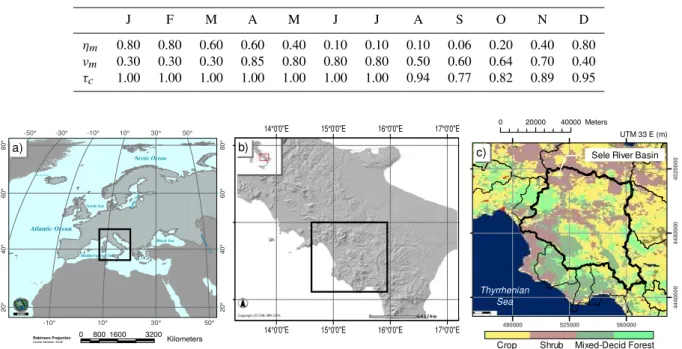
experimental coefficients related to soil (see Table 1, first row). The performance of calibration made with 46 monthly data was significant (r2=0.90).
pmwas estimated according to the following multiple non-linear regression (r2=0.94):
pm= pm(P )
0.70
+0.90·pm(B) (8)
wherepm(P ) andpm(B)are the measured monthly rainfalls
at Pontecagnano and Buccino stations, respectively.
Monthly AET was derived from Global Rapid Integrated Monitoring System (Global-RIMS available at webpage http: //rbis.sr.unh.edu/). For the last years (2001–2007), where AET was not updated in RIMS-database, the following em-pirical sub-model was approached to transfer AET from point-site to averaged AET over the SRB compatible with RIMS output:
AETm=0.570·AETm(P )·(0.4+νm)3+7.60 (9)
where AETm(P ) is the actual evapotranspiration at
Pon-tecagnano site in mm month−1 (derived from RAN-UCEA
Network, www.ucea.it/), andνmare the monthly
experimen-tal coefficients related to the soil moisture, (see Table 1, sec-ond row). Also in this case, the calibration process, made with 24 RIMS monthly AET data, gave a significant correla-tion (r2=0.90).
NDVI-biomass seasonal regime was represented by monthly MODIS (MOderate resolution Imaging Spectrora-diometer) composites, averaged on the 2000–2007 period, downloaded from Northern Eurasia Earth Science Partner-ship Initiative Monthly Products, NASA web site (http: //disc.sci.gsfc.nasa.gov/techlab/giovanni/#maincontent/). In this first approach the NDVI seasonal regime over SRB was
set constant for the whole simulation period, since MODIS NDVI data were not available before 2000 year. However, for accounting tillage erosion in Eq. (2) when running it for erosion reconstruction, the NDVI values were adjusted in au-tumn season multiplying it for the coefficients reported in Table 1 (third row).
2.2 Gross erosion evaluation
The simulation of daily SDR made with the Soil and Water Assessment Tool – SWAT (Arnold and Williams, 1995) was conceptually revised and adapted to the monthly scale by the following equation:
SDRm= a+b
Qm
EIm !c
(10)
where the terms of the ratio are those described above;a,b andcare three coefficients equal to 0.035, 0.010 and 0.50 respectively, derived imposing a values of SDR-long-term equal to 0.19, which, in turn, was supported by human-expert (L. Borselli, personal communication, 2007), and checked by CSIRO abaco (Lu et al., 2003) on the basis of the basin area and the storm duration.
2.3 Estimation of tolerable soil loss
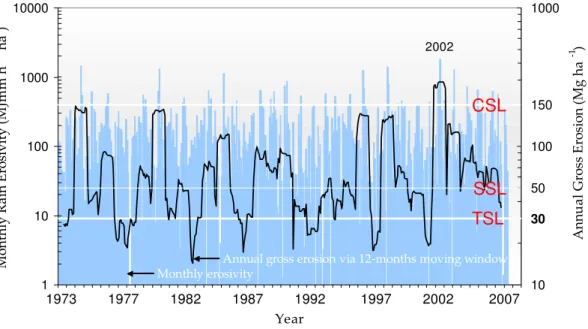
Since the effects of soil erosion on soil productivity depend on the depth of these soils, it is possible to define the tolerable amount of soil loss when the soil depth of an area is known. Combining the information gathered on topsoil loss depth (Sd) and proportion of land degraded (PLD), the tolerable soil loss (TSL) may be calculated by using the Bhattacharyya et al. (2007) approach:
TSL=PLD·D·Sp
T (11)
where PLD is the proportion of land downgraded to at least the next depth class (%, assumed equal to 15%), T is the time (years, assumed equal to 100),Dis the bulk density of the soil (assumed equal to 1.4 Mg m−3),Sdis the soil depth (assumed equal to 130 cm).
3 Results and discussions 3.1 Study site
Table 1. Monthly empirical coefficientsηmandνmarranging soil moisture for the Eqs. (5) and (6), respectively, andτcarranging tillage
erosion in NDVI autumnal values.
J F M A M J J A S O N D
ηm 0.80 0.80 0.60 0.60 0.40 0.10 0.10 0.10 0.06 0.20 0.40 0.80
νm 0.30 0.30 0.30 0.85 0.80 0.80 0.80 0.50 0.60 0.64 0.70 0.40
τc 1.00 1.00 1.00 1.00 1.00 1.00 1.00 0.94 0.77 0.82 0.89 0.95
17°0'0"E 17°0'0"E
16°0'0"E 16°0'0"E
15°0'0"E 15°0'0"E
14°0'0"E 14°0'0"E
42
°0
'0
"N
42
°0
'0
"N
41
°0'
0
"N
41
°0
'0
"N
40
°0'
0
"N
40
°0
'0
"N
3200 1600 800
0 Kilometers
Robinson Projection
Central Meridian: 30.00 Atlantic Ocean
Black Sea
Mediterranean Sea
Casp ian Sea
Ba ltic Sea
North Sea
Arctic Ocean
Arctic Circle
50° 50°
30° 30°
10° 10°
-10° -10° -30° -50°
80° 80°
60
°
60
°
40
°
40
°
20° 20°
a) b)
Meters
0 20000 40000
UTM 33 E (m)
UT
M
3
3
N
(
m
)
490000 525000 560000
4
440
0
00
4
4
80
000
4
520
00
0
Sele River Basin c)
Thyrrhenian Sea
Crop Shrub Mixed-Decid Forest
Fig. 1. Geographical setting(a)and peninsular Southern Italy(b), with land-cover across Sele River Basin in bold line(c). Land-cover source: http://hydis.eng.uci.edu/gwadi/.
shrub and mixed-deciduous woods (Fig. 1c). The Sele Plain comes from the aggradation of a Plio-Quaternary depres-sion located along the rifted inner margin of the southern Apennine Mountains. It is about 400 km2 wide and has a triangular shape, defined seawards by a straight sand coast stretching between the towns of Salerno and Agropoli and closed landwards from Lattari and Picentini Mts. to N-NW and from Alburni, Soprano-Sottano and Cilento Mts. to SE. The climate of the SRB is ofMediterraneantype, but with spatio-temporal differences in both precipitation and temper-ature. The average (1957–2000) annual precipitation, esti-mated over 62 raingauges, ranges from 700 to 2000 mm, with mean and standard deviation of 1180±367 mm, respectively. The original forest-covers have been fragmented by agricul-ture that is the main activity in this region. Especially during and after the typical tillage period (September–December), erosive rainfalls are very hazardous in this area that is af-fected by a mixed regime of frontal rainstorms and localised deluges (Fig. 2a). Annual rain-erosivity ranges from 600 to 4000 MJ mm ha−1h−1in this part of Southern Italy (Diodato
and Fagnano, 2009), with areal mean and standard deviation of 2000±883 MJ mm ha−1h−1(Fig. 2b).
In this context, weather has an important impact on erosion and on agricultural activity that plays an essential role in the economy and landscape of SRB.
The dataset supporting the present work consisted of two databases: one for model calibration and another for ero-sion reconstruction. The first database included hydrological
and sediment transport data for Calore River Basin (Diodato, 2006), a region adjacent to the SRB and with geographical features and extension very similar to SRB. The second one consisted of a long-term hydrological database for SRB, in-cluding precipitation, discharge and evapotranspiration data. The pluviometrical database included daily records from 50 raingauges over SRB (SIMN 1950–2000). Although long-term homogeneous pluviometrical series were available for only two stations (Pontecagnano and Buccino), their consis-tence allowed us to well represent the space and time vari-ability of data in the whole SRB basin. The runoff value records were registered at Albanella gauge, close to SRB out-let.
3.2 Exploratory data analysis
Exploratory data analysis was part of the preliminary re-sults, which should always be done before of more formal analysis and discussions. It was obvious that both net and gross erosion would have a very similar seasonal regime (his-tograms in Fig. 3a and b, respectively). Confidence interval at 95% were drawn too (vertical lines passing the single bars in Fig. 3a, b). Erosion regime was clearly autumnal with val-ues positioned around a mean rate of 8 Mg ha−1per month.
The frequency distribution was strongly skewed and bi-modal for net erosion (Fig. 5a1), as well as for gross erosion
a)
T
illi
n
g
p
e
rio
d
G
reenees seaso
n
D
ry and gr
owi
n
g
season
R
a
in
y sea
s
on
R
a
in
y season
Localised rainstorms
b)
4000
MJmmha-1h-1y-1
(mm d-1)
Fig. 2. (a): bioclimogram of Sele River Basin (SRB) with seasonal regime (coloured bands), and monthly trend of precipitation (turquoise curve), reference evapotranspiration (red curve) with 0.5 ETo (violet curve), as arranged by New LocClim – FAO software (http://www.fao. org/sd/dim en3/en3 051002 en.htm);(b): kriged map of long-term average annual rainfall erosivity over and around SRB by Diodato and Fagnano (2009).
0 5 10 15 20 25
0 128 256 384 512 640 768
J
F
re
q
ue
nc
y
0 100 200 300 400 500 600
J F M A M J J A S O N D
M onth
X
M
on
thl
y
f
requ
enc
y
a1)
a )
N
e
t er
os
ion (
M
g k
m
-2 ) Ne t E ro s io n
Net erosion Classes
0 50 100 150 200 250 300
1 4 7 10 13 16 19 22 25 28 31 34
Year
X
0 5 10 15 20 25 30
J F M A M J J A S O N D
Month
X
q
G ro s s E ro s io n
b1)
G
ros
s
er
os
ion (
M
g ha
-1 ) y = 222,67exp(-0,0763x)
A verage
G
ros
s
er
os
ion (
M
g
ha
-1 )
b)
Fig. 3. Long-term monthly predicted average for net erosion(a), and gross erosion(b)with related confidence interval at 95% (vertical lines passing on bars); net erosion frequency distribution(a1), and ordered gross erosion amount (histogram inb1) for the 35-years period
(1973–2007) with overimposed the related average value (horizontal dotted line) and exponential model (curve) at Sele River Basin.
period, the resulting curve was an exponential equation: y=a·exp(b·t), wherey=soil loss,t=year number, anda and b=two constants (Fig. 3b1).
Figure 3 shows that in only 10 of the 35 years the soil losses exceeded the long-term average (horizontal dotted line), with soil erosion accounting for 60% of the total esti-mated soil eroded. These examples illustrate the dominance of relatively few events in the determination of long-term erosion average.
Although erosion is a natural process and thus is naturally variable with climate, soils and topography, the anthropic
in-fluence can make the landscape more or less resilient to cli-mate events (Morgan, 2005). Increased erosion of soil by water was, in fact, a problem since man began to cultivate the land. In some Mediterranean areas, such as in the SRB, ero-sion is probably increased with deforestation since the Me-dieval age.
1 10 100 1000 10000
1 13 25 37 49 61 73 85 97 109121133145157169181193205217229241253265277289301313325337349361373385397409421
Year
10 100 1000
150
A
nnu
a
l
G
ro
ss
E
ro
si
o
n (
M
g
h
a
-1 )
M
o
nt
hly
R
a
in
E
ro
siv
it
y
(
M
Jm
m
h
-1 ha -1 )
30
CSL
TSL
SSL
50Annual gross erosion via 12-months moving window Monthly erosivity
2002
1973 1977 1982 1987 1992 1997 2002 2007
Fig. 4.Monthly variability of simulated gross erosion for the period 1973–2007 (blue histogram) over Sele River Basin, with overimposed cumulate erosion annual moving window (black line); Tolerable Soil Loss (TSL), Severe Soil Loss (SSL) and Catastrophic Soil Loss (CSL) threshold values are signed by horizontal white lines, according to Zachar (1982) guidelines.
3.3 Spatially integrated effects in long-time erosion series
3.3.1 Gross erosion timing
The net erosion can be reasonably converted to the gross soil losses (Fig. 4). The long-term average soil erosion was very high (73 Mg ha−1per year±58 Mg ha−1). Progressive yearly averaged values during 1973–2007 period (bold black line in Fig. 4) showed a changeable trend with short intervals carachterized by negligible soil losses, followed by periods with erosion above the Tolerable Soil Loss (TLS), and often above severe erosion rates too (SSL line). At the beginning of the 1990 decade, it was evident a more irregular temporal-pattern, with the highest annual erosion (264 Mg ha−1 in 2002). This was also confirmed by an increase in erosion 75th quantile (+25 Mg ha−1) upon the last decade, as com-pared to the previous one.
Weather and climate shifts strongly affected erosion sea-sonal and interannual regime, showing large fluctuations from month-to-month (Fig. 5). This was in agreement with the large instability of the agrosystems of the basin, that de-serves attention and immediate alert, especially, for the con-tinuous exceeding of TSL values and for the periodical ex-ceeding of the catastrophic threshold (CSL) too, especially during the last decade. The recent decade in fact showed the alternation of quiet-and-longer dry intervals with stormi-ness periods when soil was more vulnerable to tillage and post-tillage erosion periods (between the end August to De-cember). Hydrological shifts are known to occur because cli-mate changes and meteorological and environmental controls
affect probability, timing, and magnitude of specific basin-response-producing mechanisms (after Bartlein and Prentice, 1989; Katz and Brown, 1992). These events may be grouped in some years or months according to storms climatic vari-ability over interannual to century scales (after Garcia-Oliva et al., 1995; D’Odorico et al., 2001; Hollinger et al., 2002; Peterson et al., 2002).
3.3.2 Seasonal investigation
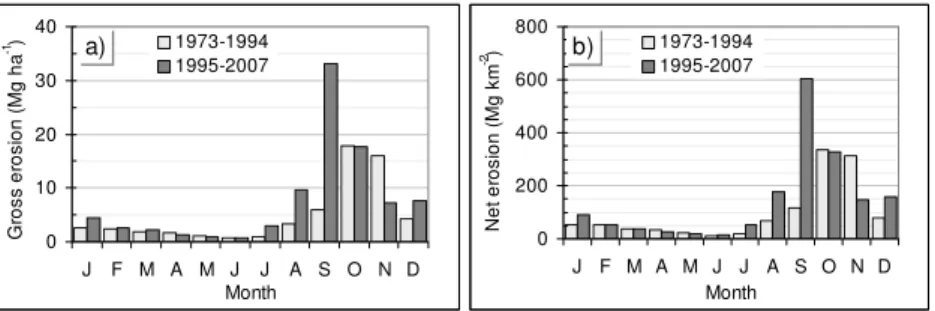
Seasonal changes in the soil erosion climatologies occurred in both gross and net erosion, especially in autumn and early of the winter season, as it is evident from the couples of bars shown in Fig. 5 (a, b), that compare the last period (1995– 2007), to the first one (1973–1994). A reduction in soil erosion occurred during last decades in March (−12), April (−9%), May (−8%), and mainly in November (−41%). On the contrary, there was an increase on July (+78%), August (+72%), December (+39%), January (+41%) and, especially, in September (+106%), increasing the soil loss mean rate from 6 Mg ha−1 to 33 Mg ha−1 (see Fig. 7a, b). However, only the 19% of eroded soil was lost, implying that about 81% of it was delivered to the valley system. Negligible changes occurred in the other months for both the erosion types.
0 10 20 30 40
J F M A M J J A S O N D
Month
%
1973-1994 1995-2007
0 200 400 600 800
J F M A M J J A S O N D Month
%
1973-1994 1995-2007
G
ros
s er
osi
o
n (
M
g
ha
-1)
N
e
t e
rosi
on (
M
g
km
-2)
a) b)
Fig. 5. Comparison of the monthly average for predicted gross erosion(a), and net erosion(b)between the 1973–1994 and 1995–2007 periods.
3.4 Model performance
The simulation of soil detachment and transport was coupled with the surface runoff modelling, following a reconciling approach from Foster et al. (1977) and Thornes (1990). Gully erosion processes were not explicitly simulated in our model and the vegetation cover was considered variable among the months but constant over the years. The coefficients of Eqs. (2), (4), (5), (6) and (7) were optimized by a calibra-tion process against the respective monthly values by using a solver to minimize the square error of estimation.
For net erosion calibration model of the Eq. (2), the solver system for Calore River Basin was run also at different time-aggregation scales, monthly plus seasonal (Fig. 6a, b), and annual (figure not shown). Determination coefficients were very high (r2from 0.94 to 0.98). On monthly and seasonal aggregation scales, the respective erosion box-and-Whisker plots (in a1and b1) showed that the actual distribution was
similar to the simulated one.
For monthly rainfall erosivity, runoff, and precipitation of Eqs. (6), (7) and (8), respectively, the solver system was run to obtain averaged variables over Sele River Basin with very good approximation (Fig. 7). Efficiency measures, de-rived from Nash and Sutcliffe (1970) algorithm, were also in agreement with the very low mean square error to the ob-served variance, with values equal to 0.93, 0.90 and 0.94, respectively for the three variables.
4 Conclusions
The most used models in soil erosion simulation don’t in-clude all the important soil erosion processes occurring in Mediterranean environments such as gully and stream ero-sion (Poesen and Hooke, 1997). This is especially true because usually there are few available data about land-cover and land-use variations, hydrological features, sedi-ment delivery ratio, channel erosion processes. Also the new model proposed in this work suffers of this weakness. The reconstructed series of erosion values for Sele River Basin are considered a sufficiently homogeneous sequence, but the limit of our approach is the uncertainty in
estimat-ing the amount of exported sediment, which was involved in NER-model calibration. Temporal trends can be consid-ered, however, a good indicator of the scenario. On the other hand, the average quantity of gross eroded soil here obtained (73 Mg ha−1per year) was similar to that predicted by an
adapted PISA model in SRB (90 Mg ha−1per year) (Bazzoffi
and Van Rompaey, 2003) and to that predicted by RUSLE approach in the Tusciano river basin (57 Mg ha−1per year), a sub-basin of the SRB (Ducci et al., 2007). Further-more, field experiments showed soil losses of 100 Mg ha−1 in one year of erosion (1981) in Piedmont vineyards (Tro-peano, 1983), 130 Mg ha−1per event with frequency of about 6-year period in the central Italy (Bazzoffi et al., 1997), and up to 54–88 Mg ha−1per year in southeast Spain (Poe-sen et al., 1997b). Also in more recent experiments, the mean annual erosion rates were included in the range 65– 116 Mg ha−1per year, in the Comunelli catchment reservoir (Sicily island) (Onori et al., 2006) and in Yatagan (Western Turkey) basin that is characterized by intensive agricultural activities (Sac¸ et al., 2007). Also long-term SDR value, used to convert net to gross erosion, was coherent with those re-ferred in the European Communities Report on Soil Erosion Risk Assessment in Italy (Van Rompaey et al., 2003).
Therefore, a mean rate included in a 95th confidence in-terval of 53–93 Mg ha−1per year predicted by CliFEM ap-proach was considered a good estimation.
Y X 1
10 100 1000 10000
a
Y X
0,1 1 10 100 1000 10000
w
N
e
t
E
ro
s
io
n
(M
g
k
m
-2 )
a1
Measured Modelled
N
et
E
ro
s
io
n (
M
g k
m
-2)
b1
Measured Modelled
0 1 10 100 1000 10000
0,1 1 10 100 1000 10000
Modelled Net Erosion (Mg km-2)
1 10 100 1000 10000
1 10 100 1000 10000
Modelled Net Erosion (Mg km-2)
b)
M
eas
u
red N
et
E
rosi
on
(
M
g k
m
-2)
r2 = 0.94
a)
0,1
Nash-Sutcliffe Coeff = 0.94
r2 = 0.95
Nash-Sutcliffe Coeff = 0.97
M
easur
e
d
N
e
t E
ro
s
ion (
M
g k
m
-2)
Fig. 6. Scatterplots between modelled and measured net erosion upon Calore River Basin (calibration dataset 1957–1961), at time-aggregation for monthly(a)and seasonal(b), with respective box-and-Whisker plots (a1andb1).
ModelledErosivity
O
b
s
e
rv
e
d
E
ro
s
iv
ity
a) Nash-Sutcliffe Coeff = 0.93
(MJmm ha-1h-1)
Modelled Runoff
O
b
ser
v
ed
R
u
no
ff
b) Nash-Sutcliffe Coeff = 0.90
Modelled Precipitation
Obs
e
rv
ed
Pr
ec
ip
itat
io
n
c) Nash-Sutcliffe Coeff = 0.94
(mm) (mm)
Fig. 7.Scatterplots between modelled and observed monthly precipitation(a), monthly rainfall erosivity(b), and monthly surface runoff(c), with efficiency-measured Nash-Sutcliffe, over Sele River Basin (Arranged by Web GIS-based Hydrograph Analysis Tool, Lim et al., 2005).
The information about the periods of soil losses, obtained in the above mentioned studies, could help farmers and pol-icy makers to aim toward a sustainable cropland manage-ment, particularly in hilly areas such as SRB, where mean annual soil loss is expected to be up to 70 Mg ha−1per year.
The environmental and social costs of these levels of ero-sion are very high, as reported by Torri et al. (2006) in their review of soil erosion in Italy. Further environmental effects of soil erosion are the worsening of topsoil fertility and agri-cultural productivity and the increase of sediment and con-taminants transport from agricultural fields to the surface wa-ters (Toy et al., 2002).
Acknowledgements. The authors wish to acknowledge two
anony-mous reviewers whose suggestions greatly improve the manuscript. This study was financially supported by VECTOR Project (line 2 VULCOST- chief, Bruno D’Argenio).
Edited by: L. Ferraris
Reviewed by: two anonymous referees
References
Bartlein, P. J. and Prentice, I C.: Orbital variations, climate and paleoecology, Trends Ecol. Evol., 4, 195–199, 1989.
Bhattacharyya, T., Babu, R., Sarkar, D., Mandal, C., Dhyani, B. L., and Nagar, A. P.: Soil loss and crop productivity model in humid subtropical India, Curr. Sci. India, 93, 1397–1403, 2007. Bazzoffi, P., Pellegrini, S., Chisci, G., Papini, R., and Scagnozzi, A.:
Erosion and discharge at catchment and field scales in argillous soils ad different use in Era Valley, Agricoltura Ricerca, 170, 5– 20, 1997 (in Italian).
Bazzoffi, P. and Van Rompaey, A.: PISA model to assess off-farm sediment flow indicator at watershed scale in Italy. In Proc. OECD: Agricultural impacts on soil erosion and soil biodiver-sity: developing indicators for policy analysis, Rome, 263–272, 25–28 March 2003.
Boardman, J. D. and Favis-Mortlock, T.: How will future climate change and land-use change affect rates of erosion on agricul-tural land, in: Soil Erosion Research for the 21st Century, Am. Soc. Agric. Biol. Eng., Honolulu, Hawaii, 498–501, 3–5 January 2001.
Boardman, J.: Soil erosion science: Reflections on the limitations of current approaches, Catena, 68, 73–86, 2006.
Coppus, R. and Imeson, A. C.: Extreme events controlling ero-sion and sediment transport in a semi-arid sub-Andean Valley, Earth Surf. Proc. Land., 27, 1365–1375, 2002.
Dickinson, A. and Collins, R.: Predicting erosion and sediment yield at catchment scale, in: Soil Erosion Multiple Scales, edited by: Penning de Vries, F. W. T., Agus, F., and Kerr, J., CABI Publishing, 317–342, 2007.
Diodato, N.: Predicting RUSLE (Revised Universal Soil Loss Equa-tion) monthly erosivity index from readily available rainfall data in Mediterranean area, The Environmentalist, 26, 63–70, 2005. Diodato, N.: Modelling net erosion responses to enviroclimatic
changes recorded upon multisecular timescales, Geomorphol-ogy, 80, 164–177, 2006.
Diodato, N. and Bellocchi, G.: Assessing and modelling changes in rainfall erosivity at different climate scales, Earth Surf. Proc. Land., 34(7), 969–980, 2009a.
Diodato, N. and Bellocchi, G.: Environmental implications of ero-sive rainfall across the Mediterranean, in: Environmental impact assessments, edited by: Halley, G. T. and Fridian, Y. T., NOVA Publishers, New York, NY, USA, 75–101, 2009b.
Diodato, N. and Fagnano, M.: A simple geospatial model climate-based for designing erosive rainfall pattern, in: The Environ-mental Pollution and its relation to Climate Change, edited by: El Nemr, A., in press, Springer, Nova Science Publishers, USA, 2009.
D’Odorico, P., Yoo, J., and Over, T. M.: An assessment of ENSO-induced patterns of rainfall erosivity in the Southwestern United States, J. Climate, 14, 4230–4242, 2001.
Ducci, D., Giugni, M., and Zampoli, M.: Evaluation of soil ero-sion process of the Tusciano river basin. In Proceeding: Soil and hillslope management using analysis and Runoff-erosion mod-els: a critical evaluation of current technique, COST 634, Flo-rence (Italy), 7–9 May 2007.
Easterling, D. R., Evans, J. L., Ya Groisman, P., Karl, T. R., Kunkel, K. E., and Ambenje, P.: Observed variability and trends in ex-treme climate events: a brief review, B. Am. Meteorol. Soc., 81, 417–425, 2000.
Esposito, E., Porfido, S., Violant, C., and Alaia, F.: Disaster induced
by historical floods in a selected coastal area (Southern Italy), in: PHEFRA – Paleofloods, Historical Data & Climatic Variability: Application in Flood Risk Assessmen, edited by: Thorndycraft, V. R., Benito, G., Barriendos, M., and Lalsat, M. C., Barcellona, 143–148, 2003.
Fagnano, M., Mori, M., Carone, F., and Postiglione, L.: Sistemi colturali per l’Appennino meridionale: Nota II. Deflussi ed ero-sione, Rivista di Agronomia, 34, 55–64, 2000 (in Italian). Favis-Mortlock, D. T., Boardman, J., and MacMillan, V. J.: The
limits of erosion modeling: why we should proceed with care, in: Landscape Erosion and Evolution Modeling edited by: Harmon, R. S. and Doe III, W. W., Kluwer Academic/Plenum Publishing, New York, 477–516, 2001.
Foster, G. R., Meyer, L. D., and Onstad, C. A.: A runoff erosivity factor and variable slope length exponents for soil loss estimates, T. ASAE, 20, 683–687, 1977.
Foster, G. C., Chiverrell, R. C., Harvey, A. M., Dearing, J. A., and Dunsford, H.: Catchment hydro-geomorphological responses to environmental change in the Southern Uplands of Scotland, The Holocene 18, 935–950, 2008.
Garcia-Oliva, F., Maass, J. M., and Galicia, L.: Rainstorm analysis and rainfall erosivity of a seasonal tropical region with a strong cyclonic influence on the Pacific Coast of Mexico, J. Appl. Me-teorol., 34, 2491–2498, 1995.
Gobin, A., Jones, R., Kirkby, M., Campling, P., Govers, G., Kos-mas, C., and Gentile, A. R.: Indicators for pan-European assess-ment and monitoring of soil erosion by water, Environ. Sci. Pol-icy, 7, 25–38, 2004.
Gomez, B., Phillips, J. D., Migilligan, F. J., and James, L. A.: Floodplain sedimentation and sensitivity: summer 1993 flood, Upper Mississippi river valley, Earth Surf. Proc. Land., 22, 923– 936, 1997.
Hollinger, S. E., Angel, J. R., and Palecki, M. A.: Spatial distri-bution, variation and trends in storm precipitation characteristics associated with soil erosion in the United States, Champaign, IL: United States Department of Agriculture and Atmospheric Envi-ronment Section (Illinois State Water Survey), 2002.
Hooke, D. D. and Mant, J. M.: Geomorphological impacts of a flood event of ephemeral cannels in SE Spain, Geomorphology, 34, 163–180, 2000.
Katz, R. W. and Brown, B. G.: Extreme events in a changing climate: Variability is more important than average, Climatic Change, 21, 289–302, 1992.
Lal, R.: Soil degradation by erosion, Land Degrad. Dev., 12, 520– 539, 2001.
Larson, W. E., Lindstrom, M. J., Schumacher, and T. E.: The role of severe storm in soil erosion: a problem needing consideration, J. Soil Water Conserv., 52, 90–95, 1997.
Lim, K. J., Engel, B. A., Tang, Z., Choi, J., Kim, K., Muthukrish-nan, S., and Tripathy, D.: Web GIS-based Hydrograph Analysis Tool, WHAT, J. Am. Water Resour. As., 41(6), 1407–1416, 2005. Lu, H., Moran, C. J., Prosser, I. P., Raupach, R. M., Olley, J., and Petheram, C.: Sheet an rill erosion sediment delivery to streams: a basin wide estimation at hillslope to Medium catchment scale, Report E to Project D10012, CSIRO Technical Report 15/03, 56 pp., 2003.
ele-vation models, Geoderma, 105, 125–140, 2002.
Michael, A. J., Schmidt, W., Deutschlander, E. T., and Malitz, G.: Impact of expected increase in precipitation intensities on soil loss results of comparative model simulations, Catena, 61, 155– 164, 2005.
Morgan, R. P. C.: Soil erosion and conservation, 3rd edn., Black-well Publishing Science Ltd., 304 pp., 2005.
Mul, M. L., Savenije, H. H. G., and Uhlenbrook, S.: Spatial rainfall variability and runoff response during an extreme event in a semi-arid catchment in the South Pare Mountains, Tanzania, Hydrol. Earth Syst. Sci. Discuss., 5, 2657–2685, 2008,
http://www.hydrol-earth-syst-sci-discuss.net/5/2657/2008/. Nearing, M. A., Jetten, V., Baffaut, C., Cerdan, O., Couturier, A.,
Hernandez, M., Le Bissonnais, Y., Nichols, M. H., Nunes, J. P., Renschler, C. S., Souch´ere, V., and van Oost K.: Modeling re-sponse of soil erosion and runoff to changes in precipitation and cover, Catena, 61, 131–154, 2005.
Newson, M. and Lewin, J.: Climatic change, river flow extremes and fluvial erosion – scenarios for England and Wale, Prog. Phys. Geog., 15, 1–17, 1991.
Nash, J. E. and Sutcliffe, J. V.: River flow forecasting through con-ceptual models. Part I – a discussion of principles, J. Hydrol., 27, 282–290, 1970.
Onori, O., De Bonis, P., and Grauso, S.: Soil erosion prediction at the basin scale using the revised universal soil loss equa-tion (RUSLE) in a catchment of Sicily (southern Italy), Environ. Geol., 50, 1129–1140, 2006.
Peterson, T. C., Taylor, M. A., Demeritte, R., Duncombe, D. L., Burton, S., Thompson, F., Porter, A., Mercedes, M., Villegasm E., Fils, R. S., Tank, A. K., Martis, A., Warner, R., Joyette, A., Mills, W., Alexander L., and Gleason, B.: Recent changes in climate extremes in the Caribbean region, J. Geophys. Res., 107(D21), 4601, doi:10.1029/2002JD002251, 2002.
Phillips, D. L., White, D., and Johnson, B.: Implications of climate change scenarios for soil erosion potential in the USA, Land De-grad. Rehabil., 4, 61–72, 2006.
Poesen, J. W. A. and Hooke, J. M.: Erosion, flooding and channel management in Mediterranean environments of southern Europe – Part II, Prog. Phys. Geog., 21, 179–199, 1997a.
Poesen, J. W. A. and Hooke, J. M.: Erosion, flooding and channel management in Mediterranean environments of southern Europe – Part I, Prog. Phys. Geog., 21, 157–178, 1997b.
Poesen, J. W. A., van Wesemael, B., Govers, G., Martinez-Fernandez, J., Desmet, P., Vandaele, K., Quine, T., and Degraer, G.: Patterns of rock fragment cover generated by tillage erosion, Geomorphology, 18(3–4), 183–197, 1997.
Quilb´e, R., Rousseau, A. N., Moquet, J.-S., Savary, S., Ricard, S., and Garbouj, M. S.: Hydrological responses of a watershed to historical land use evolution and future land use scenarios under climate change conditions, Hydrol. Earth Syst. Sci., 12, 101–110, 2008, http://www.hydrol-earth-syst-sci.net/12/101/2008/.
Renard, K. G., Foster, G. R., Weesies, G. A., McCool, D. K., and Yoder, D. C.: Predicting soil erosion by water: a guide to con-servation planning with the revised Universal Soil Loss Equa-tion (RUSLE), Washington DC: Agricultural Handbook, United States Department of Agriculture, 1997.
Rickson, R. J.: Management of sediment production and prevention in River catcments: a matter of scale?, in: Soil Erosion and Sed-iment Redistribution in River Catchments, edited by: Owens, P. N. and Collins, A. J., CABI Publishing, UK, 228–238, 2006. Rumsby, B. T.: Valley-floor and floodplain processes, in:
Geomor-phological processes and landscape change: Britain in the last 1000 years, edited by: Higgitt, D. L. and Lee, E. M., Blackwell Publisher, London, 90–115, 2001.
Sac¸, M. M., U˘gur, A., Yener, G., and ¨Ozden, B.: Estimates of soil erosion using cesium-137 tracer models, Enviro. Monit. Assess., 136, 461–467, 2007.
SIMN: Annali del Servizio Idrografico & Mareografico Nazionale, Roma, Istituto Poligrafico dello Stato Italiano, Parts I and II, 1950–2000.
Thornes, J. B.: The intercation of erosional and vegetational dy-namics in land degradation: spatial outcomes, in: Vegetation and erosion, edited by: Thornes, J. B., J. Wiley & Sons, 45–55, 1990. Torri, D., Borselli, L., Guzzetti, F., Calzolari, M. C., Bazzoffi, P., Ungaro, F., Bartolini, D., and Salvador Sanchis, M. P.: Italy, in: Soil erosion in Europe, edited by: Boardman, J. and Poesen, J., John Wiley & Sons, Ltd, 245–261, 2006.
Toy, T. J., Foster, G. R., and Renard, K. G.: Soil Erosion: Processes, Prediction, Measurement, and Control, John Wiley & Sons, Inc., New York, 2002.
Tropeano, D.: Soil erosion problem in north-western Italy: a short overview, in: Soil Erosion Abridged Proceedings of the Work-shop on Soil erosion and Conservation, an Assessment of the Problems and the State of the Art in EEC Countries, Florence, 19–21 October 1982, ECC, EUR 8427 Luxembourg, 36–41, 1983.
Van der Knijff, J. M., Jones, R. J. A., and Montanarella, L.: Soil erosion risk assessment in Italy, European Soil Bureau, JRC – Report EUR 19022EN, 52 pp., 2000.
Vandewiele, G. L., Xu, C. Y., and Lar-Win, N.: Methodology and comparative study of monthly water balance models in Belgium, China and Burma, J. Hydrol., 134, 315–347, 1992.
Van Rompaey, A. J. J., Bazzoffi, P., Jones, R. J. A., Montanarella, L., and Govers, G.: Validation of soil risk assessment in Italy, European Soil Bureau, Research Report No. 12, EUR 20676 EN, 25 pp., 2003.
Yang, D., Kanae, S., Oki, T., Koike, T., and Musiake, K.: Global potential soil erosion with reference to land use and climate changes, Hydrol. Process., 17, 2913–2928, 2003.