Radical prostatectomy and positive surgical margins:
relationship with prostate cancer outcome
_______________________________________________
Ricardo L. R. Felts de La Roca
1, Isabela Werneck da Cunha
3, Stephania Martins Bezerra
3, Francisco
Paulo da Fonseca
21Department of Oncology; 2Division of Urology; 3Department of Pelvic Surgery and Department of
Pathology, Fundação Antonio Prudente A. C. Camargo Cancer Center, São Paulo, SP, Brazil
ABSTRACT
ARTICLE
INFO
______________________________________________________________ ______________________
Introduction: Positive surgical margins (PSMs) are an adverse factor that may predict a worse outcome in patients submitted to radical prostatectomy (RP). However, not all of the-se cathe-ses will evolve to biochemical (BCR) or clinical (CR) recurrence, therefore relationship between PSMs and these recurrent events has to be correlated with other clinical and pa-thologic findings to indicate complementary treatment for selected patients.
Materials and Methods: Of 1250 patients submitted to open retropubic radical prostatec-tomy (RRP), between March 1991 and June 2008, the outcome of 161 patients with PSMs and of 67 without PSMs as a control group, comprising a total of 228 cases were retrospec-tively reviewed. A minimum follow-up time of 2 years after surgery was considered. BCR was determined when PSA ≥ 0.2ng/mL. CR was determined whenever there was clinical evidence of tumor. Chi-square test was used to correlate clinical and pathologic variables with PSMs. Time interval to biochemical recurrence was analyzed by the Kaplan-Meier product limit analysis using the log-rank test for comparison between groups. Univariate and multivariate Cox stepwise logistic regression models were used to identify significant predictors of risk of shorter intervals to BCR.
Results: Prostate circumference margin was the most common site with 78 cases (48.44%). Regarding the outcome of 228 cases from both groups, BCR occurred in 68 patients (29.82%), and CR in 10 (4.38%). Univariate analysis showed statistically significant asso-ciations (p < 0.001) between presence of PSMs with BCR, but not with CR (p = 0.05). At follow-up of the 161 patients with PSMs, only 61(37.8%) presented BCR, while 100 (62.8%) did not. BCR correlated with pathologic stage; Gleason score; preoperative PSA; tumor volume in the specimen; capsular and perineural invasion; presence and number of PSMs. CR correlated only with angiolymphatic invasion and Gleason score. Considering univa-riate analysis of clinical and pathologic factors predicting progression-free survival at 5 years, prostate weight; preoperative PSA; Gleason score; pathologic stage; tumor volume; PSMs; capsular and perineural invasion were correlated with BCR. At multivariate analysis, only Gleason score and percentage of tumor volume correlated as significant independent predictors of BCR.
Conclusion: At univariate analysis, presence, number and location of PSMs have consistent correlation with BCR after RRP, but at follow-up BCR occurred only in 37.8% of patients with PSMs. However at multivariate analysis, the significant risk factors for BCR were percentage of tumor volume (p = 0.022) and Gleason score (p < 0.005) in the surgical spe-cimen. Angiolymphatic invasion and Gleason score were significantly correlated with CR.
Key words:
Prostatic Neoplasms; Prostatec-tomy; Tumor Burden
Int Braz J Urol. 2014; 40: 306-15
_____________________
Submitted for publication: August 15, 2013
_____________________
INTRODUCTION
The finding of positive surgical margins (PSMs) after radical prostatectomy (RP) implies that cancer resection was not complete leading the surgeon to decide between complementary treat-ments such as: active surveillance, adjuvant radio-therapy or androgen-deprivation radio-therapy. Many studies report that PSM represents an independent predictor of biochemical recurrence (BCR) after RP. Furthermore, these studies have also shown that most men with PSMs do not develop BCR (1-3). At multivariate analysis, Gleason score of specimen, pathologic stage, percentage of tumor volume in the surgical specimen and PSMs were all signifi-cant risk factors for BCR. Each of these factors has previously been associated with BCR (4). Another study shows that PSM is an independent predic-tor of BCR after RP, where BCR rates were similar for cases with unifocal and multifocal PSMs, and the risk of BCR was highly dependent on the PSM location. Cases of base and anterior margins of the prostate have a worse prognosis and should be considered candidates for adjuvant treatment due to the very high likelihood of BCR. Although PSMs are more common on the apex, posterior and posterolateral sites, they are associated with lower BCR rates (5). To verify the relationship be-tween PSMs and BCR, we retrospectively analyzed the outcome of a group of patients submitted to RRP, for clinically localized prostate adenocarci-noma with PSMs, and studied the correlations of these results with clinical and pathologic variants.
MATERIALS AND METHODS
From a total of 1250 patients submitted to RRP to cure a clinically localized Prostate Can-cer, by the team of the Division of Urology, Pelvic Surgery Department, A.C. Camargo Cancer Center, between March 1991 and June 2008, we retros-pectively studied the outcome of 161 patients with PSMs, compared to a control group of 67 patients without PSMs, in a total of 228 cases. Our total number of patients with PSMs was of 298 cases (23.84%). We excluded from the study patients who received hormone therapy or radiotherapy before the surgery, 56 patients who have PSMs
ye-ars after surgery. The time interval to biochemi-cal recurrence was analyzed by the Kaplan-Meier product limit analysis using the log-rank test for comparison between groups. The univariate and multivariate Cox stepwise logistic regression mo-dels were used to identify significant predictors of risk of shorter intervals to BCR. The Kaplan-Meier method was used to calculate the curves of bio-chemical-recurrence free survival (from the date of RRP until date of the first PSA measurement > 0.2ng/mL or to the date of the last follow-up) and clinical-recurrence free survival (from the date of the RRP until the date of detection of local or distant disease or until date of the last follow--up). The Chi-square test was used to correlate cli-nical and pathologic variables with PSMs. Time interval to biochemical recurrence was analyzed by the Kaplan-Meier product limit analysis using the log-rank test for comparison between groups. Univariate and multivariate Cox stepwise logistic regression models were used to identify signifi-cant predictors of risk of shorter intervals to BCR. All statistical tests were performed with p < 0.05 to indicate statistical significance with R free sta-tistical software (www.r-project.org).
RESULTS
For the 228 patients, follow-up ≥ 5 years was available in 93 patients and ≤ 5 years in 135 patients. Minimum follow-up time after surgery was of 2 years, median follow-up 6.2 years (range 2-15 years). At diagnosis median age of patients was 64.5 years (range 43-81 years ), race was 68.42% white, 19.29% black, and 12.29% mulat-to, median preoperative PSA level was 8.47ng/mL (range 1.3-78.8ng/mL).
Prostate specimen weight ranged from 10 to 167g (mean 44.77g), and tumor volume was es-timated as ranging from 0.5% to 100% of total prostate volume (mean 12.82%). Prostate capsule invasion (focal and extracapsular) was present in 123 cases and absent in 105, perineural invasion was present in 162 cases and absent in 66, angio-lymphatic invasion was present in 18 cases and absent in 210.
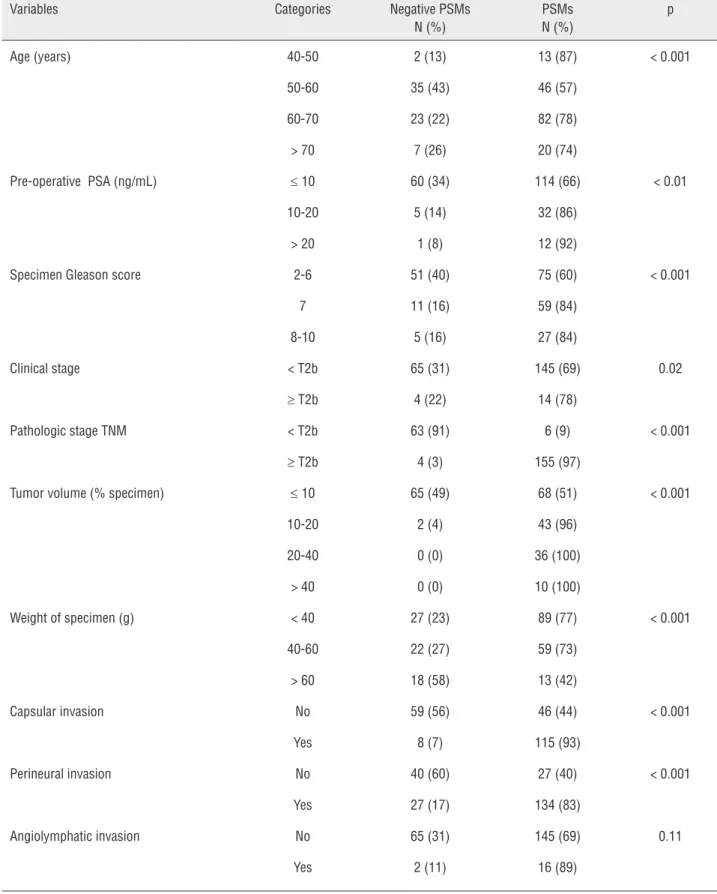
Table-1 shows demographic, clinical and pathologic parameters correlated with presence
of PSMs, age, preoperative PSA, specimen Glea-son score, weight, pathologic stage, percentage of tumor volume, capsular and perineural invasion. Clinical stage and angiolymphatic invasion were not correlated. Patients younger than 50 and ol-der than 70 years of age showed higher incidence of PSMs. Pre-treatment PSA ≥ 10ng/mL, specimen Gleason score ≥ 7, pathologic stage ≥ T2b, tumor volume ≥ 10% of specimen’s total volume and presence of capsular and perineural invasion sho-wed statistically significant associations with oc-currence of PSMs.
Conversely, when weight of the prostate was ≤ than 60g it was more correlated with PSMs. From the total of 228 patients, 161 (71%) had PSMs, while 67 (29%) had negative surgical mar-gins (NSMs). Of those with PSMs, 106 cases (46%) showed one margin, 44 (19%) two margins, and 11 (5%) three margins. The prostate circumference site was the most common PSM (48.44%) follo-wed by prostatic+urethral (apical) (17.39%), ure-thral (apical) (13.66%), and bladder neck (6.21%) (Table-2).
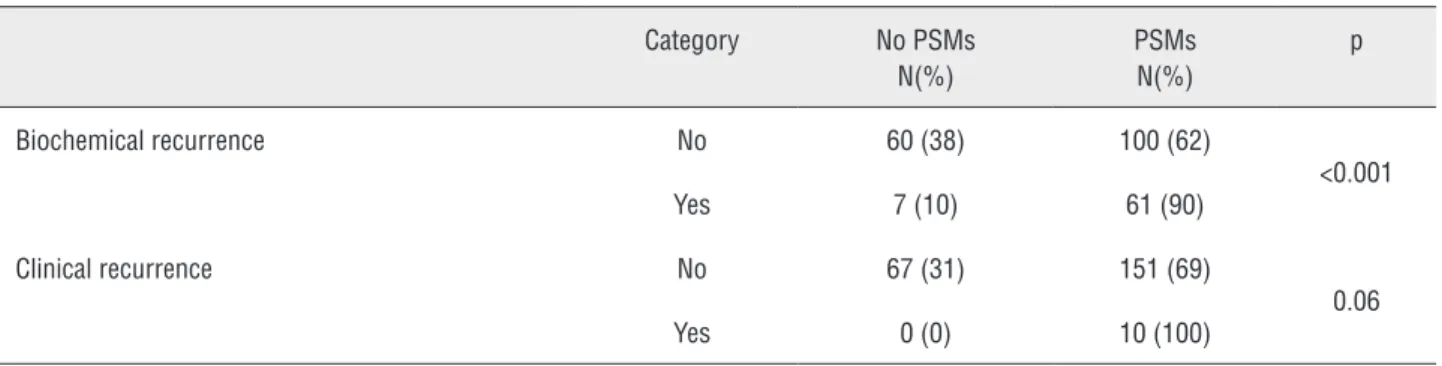
Of the 228 patients BCR occurred in 68 (30%), and did not in 160 (70%), whereas clinical recurrence (CR) occurred in 10 (4%) and did not in 218 (96%).
Univariate analysis showed statistically significant (p < 0.001) association between pre-sence of PSMs and BCR, however not with CR (p = 0.06).
BCR was found in 68 patients, wherein those with no PSMs corresponded to 7 (10.5%) ca-ses, while PSMs were present in 61 (89.5%) cases.
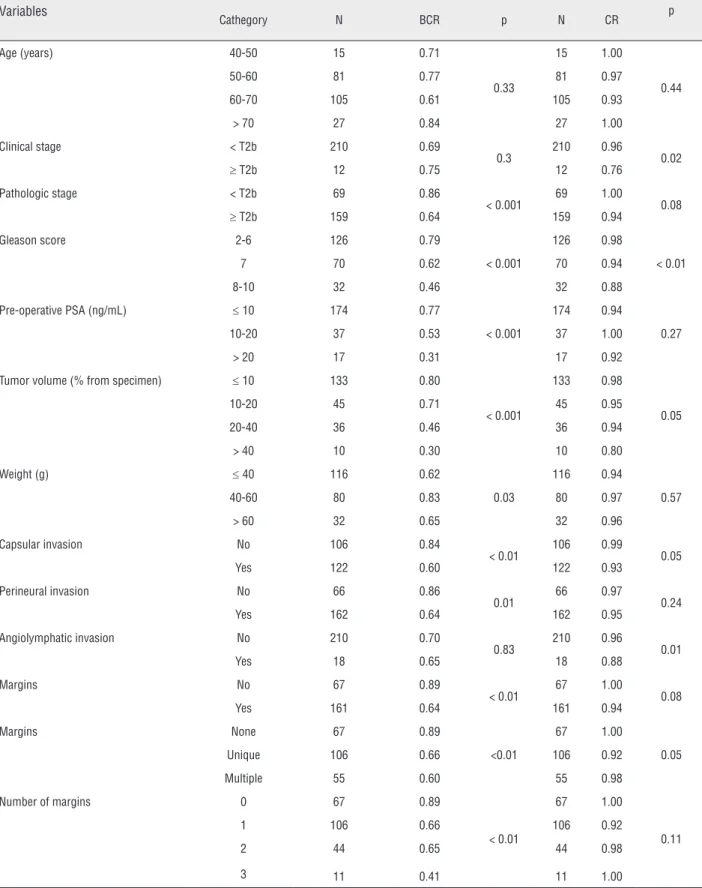
Among 161 patients with PSMs, 61 (37.88%) presented BCR, while 100 (62.12%) did not (Table-3). COX univariate analysis of patholo-gic factors predicting progression-free survival of BCR and CR in 5 years after RRP (Table-4) correla-ted BCR progression-free survival with pathologic stage, Gleason score, pre-treatment PSA, tumor volume in specimen, capsular and perineural in-vasion, presence and number of PSMs.
Interestingly, the progression-free survival time for CR was correlated only with angiolym-phatic invasion and Gleason score.
Table 1 - Demographic, clinical, and pathologic variables correlated with PSMs.
Variables Categories Negative PSMs
N (%)
PSMs N (%)
p
Age (years) 40-50 2 (13) 13 (87) < 0.001
50-60 35 (43) 46 (57)
60-70 23 (22) 82 (78)
> 70 7 (26) 20 (74)
Pre-operative PSA (ng/mL) ≤ 10 60 (34) 114 (66) < 0.01
10-20 5 (14) 32 (86)
> 20 1 (8) 12 (92)
Specimen Gleason score 2-6 51 (40) 75 (60) < 0.001
7 11 (16) 59 (84)
8-10 5 (16) 27 (84)
Clinical stage < T2b 65 (31) 145 (69) 0.02
≥ T2b 4 (22) 14 (78)
Pathologic stage TNM < T2b 63 (91) 6 (9) < 0.001
≥ T2b 4 (3) 155 (97)
Tumor volume (% specimen) ≤ 10 65 (49) 68 (51) < 0.001
10-20 2 (4) 43 (96)
20-40 0 (0) 36 (100)
> 40 0 (0) 10 (100)
Weight of specimen (g) < 40 27 (23) 89 (77) < 0.001
40-60 22 (27) 59 (73)
> 60 18 (58) 13 (42)
Capsular invasion No 59 (56) 46 (44) < 0.001
Yes 8 (7) 115 (93)
Perineural invasion No 40 (60) 27 (40) < 0.001
Yes 27 (17) 134 (83)
Angiolymphatic invasion No 65 (31) 145 (69) 0.11
Table 2 - Sites of PSMs in prostate surgical specimen.
Sites of PSMs N = 161 (%)
Prostatic (circunferential) 78 48.44
Urethral (apex) 22 13.66
Bladder neck (base) 10 6.21
Prostatic+urethral 28 17.39
Prostatic+bladder neck 6 3.72
Urethral+baldder neck 9 5.59
Prostatic+urethral+bladder neck 8 4.96
Table 3 - Correlation between PSMs and BCR and CR
Category No PSMs
N(%)
PSMs N(%)
p
Biochemical recurrence No 60 (38) 100 (62)
<0.001
Yes 7 (10) 61 (90)
Clinical recurrence No 67 (31) 151 (69)
0.06
Yes 0 (0) 10 (100)
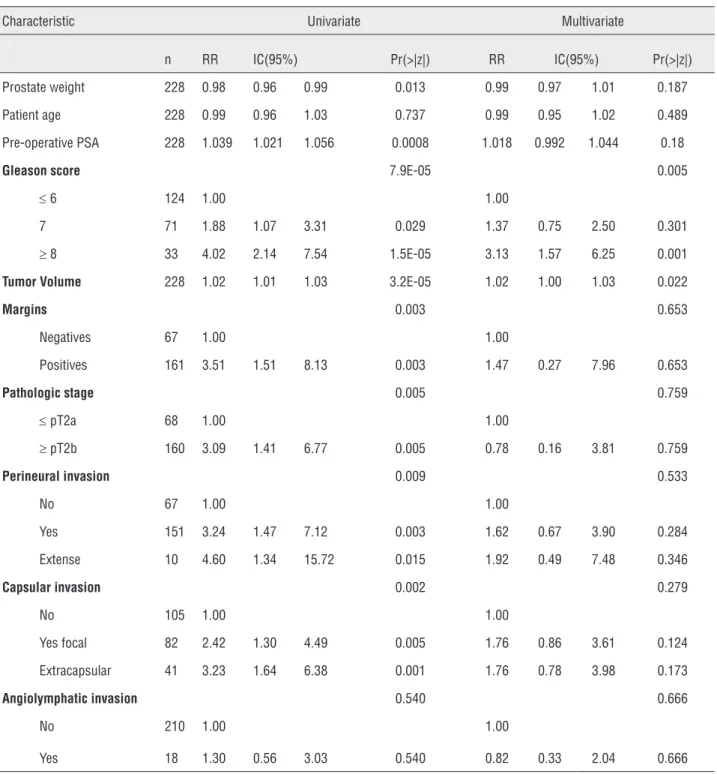
factors predicting BCR at 5 years post-RRP. At univariate analysis, prostate weight, preoperative PSA, Gleason score, pathologic stage, tumor volu-me, PSMs, capsular involvement, and perineural invasion were statistically significant.
Multivariate analysis correlated BCR only with Gleason score and tumor volume in surgical specimen as statistically significant independent predictors (p < 0.005 and p = 0.022 respectively).
DISCUSSION
In contemporary series, PSMs are reported in 11-38% of patients undergoing RP. The prog-nostic factors pointing at the presence of PSMs are many ranging from pathologic characteristics to the surgeons’ expertise and surgical techniques.
Our results correlate younger and older age, pre-treatment PSA higher than 10ng/mL,
specimen Gleason score ≥ 7, smaller glands with weight ≤ 40g, pathologic stage ≥ pT2b, percenta-ge of tumor volume higher than 10% of surgical specimen, capsular and perineural invasion with occurrence of PSMs, in accordance with several authors (7-9).
PSMs point to a greater risk of biochemi-cal progression. D’Amico et al. (8) found that after RP failure rates of 2-year PSA were of 45-55% in patients with PSMs, when compared to 15-25% of those with organ confined disease. Several factors have been assessed to verify whether it is possi-ble to further stratify risk of recurrence in patients with PSMs. In virtually all studies, multiple PSMs have signaled a worse prognosis. Number of PSMs
(single vs. multiple) showed that there was a sta-tistically significant higher risk of recurrence in patients with more than one PSM, with a hazard ratio of 2.19 at the 95% CI (9).
A similar result was reported by Obek et al. (10), who showed that at a mean follow-up of 25 months, the recurrence rate in patients with multiple PSMs was of 43% vs. 24% in those with a single focus. Furthermore, patients with two or more PSMs were 2.5 times more likely to have re-currence in a shorter period.
In our study, only 61 (37.88%) out of 161 patients with PSMs presented BCR. As in literatu-re, various PSMs sites, bladder neck and prostate circumference, lead to worse outcome. In our ca-ses with no PSMs, BCR was only found in 7 pa-tients (10.5%).
Table 4 - COX proportional hazard regression analyses of pathologic factors predicting BCR and CR progression-free survival in 5 years following RRP.
Variables
Cathegory N BCR p N CR p
Age (years) 40-50 15 0.71
0.33
15 1.00
0.44
50-60 81 0.77 81 0.97
60-70 105 0.61 105 0.93
> 70 27 0.84 27 1.00
Clinical stage < T2b 210 0.69
0.3 210 0.96 0.02
≥ T2b 12 0.75 12 0.76
Pathologic stage < T2b 69 0.86
< 0.001 69 1.00 0.08
≥ T2b 159 0.64 159 0.94
Gleason score 2-6 126 0.79
< 0.001
126 0.98
< 0.01
7 70 0.62 70 0.94
8-10 32 0.46 32 0.88
Pre-operative PSA (ng/mL) ≤ 10 174 0.77
< 0.001
174 0.94
0.27
10-20 37 0.53 37 1.00
> 20 17 0.31 17 0.92
Tumor volume (% from specimen) ≤ 10 133 0.80
< 0.001
133 0.98
0.05
10-20 45 0.71 45 0.95
20-40 36 0.46 36 0.94
> 40 10 0.30 10 0.80
Weight (g) ≤ 40 116 0.62
0.03
116 0.94
0.57
40-60 80 0.83 80 0.97
> 60 32 0.65 32 0.96
Capsular invasion No 106 0.84
< 0.01 106 0.99 0.05
Yes 122 0.60 122 0.93
Perineural invasion No 66 0.86
0.01 66 0.97 0.24
Yes 162 0.64 162 0.95
Angiolymphatic invasion No 210 0.70
0.83 210 0.96 0.01
Yes 18 0.65 18 0.88
Margins No 67 0.89
< 0.01 67 1.00 0.08
Yes 161 0.64 161 0.94
Margins None 67 0.89
<0.01
67 1.00
0.05
Unique 106 0.66 106 0.92
Multiple 55 0.60 55 0.98
Number of margins 0 67 0.89
< 0.01
67 1.00
0.11
1 106 0.66 106 0.92
2 44 0.65 44 0.98
Table 5 - Univariate and multivariate analyses of clinical and pathologic factors predictors of BCR in 5 years.
Characteristic Univariate Multivariate
n RR IC(95%) Pr(>|z|) RR IC(95%) Pr(>|z|)
Prostate weight 228 0.98 0.96 0.99 0.013 0.99 0.97 1.01 0.187
Patient age 228 0.99 0.96 1.03 0.737 0.99 0.95 1.02 0.489
Pre-operative PSA 228 1.039 1.021 1.056 0.0008 1.018 0.992 1.044 0.18
Gleason score 7.9E-05 0.005
≤ 6 124 1.00 1.00
7 71 1.88 1.07 3.31 0.029 1.37 0.75 2.50 0.301
≥ 8 33 4.02 2.14 7.54 1.5E-05 3.13 1.57 6.25 0.001
Tumor Volume 228 1.02 1.01 1.03 3.2E-05 1.02 1.00 1.03 0.022
Margins 0.003 0.653
Negatives 67 1.00 1.00
Positives 161 3.51 1.51 8.13 0.003 1.47 0.27 7.96 0.653
Pathologic stage 0.005 0.759
≤ pT2a 68 1.00 1.00
≥ pT2b 160 3.09 1.41 6.77 0.005 0.78 0.16 3.81 0.759
Perineural invasion 0.009 0.533
No 67 1.00 1.00
Yes 151 3.24 1.47 7.12 0.003 1.62 0.67 3.90 0.284
Extense 10 4.60 1.34 15.72 0.015 1.92 0.49 7.48 0.346
Capsular invasion 0.002 0.279
No 105 1.00 1.00
Yes focal 82 2.42 1.30 4.49 0.005 1.76 0.86 3.61 0.124
Extracapsular 41 3.23 1.64 6.38 0.001 1.76 0.78 3.98 0.173
Angiolymphatic invasion 0.540 0.666
No 210 1.00 1.00
Yes 18 1.30 0.56 3.03 0.540 0.82 0.33 2.04 0.666
of progression, the ability to stratify this risk nee-ds improvement along with other factors that may affect disease progression and survival (11). Focal capsular or extensive extracapsular involvement, were both correlated with BCR in our study. Other studies found that men with PSMs and no
Similar to our results, Stephenson et al. (13) noted that 7-year progression-free probability was observed in 60% of patients with positive surgical margins. A positive surgical margin was significan-tly associated with biochemical recurrence (HR 2.3, p < 0.001) after adjustment of the following fac-tors: age, prostate specific antigen, Gleason score, pathologic stage and year of surgery. An increased risk of biochemical recurrence was associated with multiple vs. single positive surgical margins (adjus-ted HR 1.4, p = 0.002) and extensive vs. focal posi-tive surgical margins (adjusted HR 1.3, p = 0.004) at multivariate analysis. However, neither parameter improved the predictive accuracy of a nomogram compared to one in which surgical margin status was modeled as positive vs. negative (concordance index 0.851 vs.0.850 vs. 0.850).
In our results, at univariate analysis pros-tate weight, preoperative PSA, Gleason score, pa-thologic stage, tumor volume, PSMs, capsular and perineural invasion were correlated with BCR in full agreement with literature. Nevertheless at mul-tivariate analysis only Gleason score and tumor volume were statistically significant independent predictors of BCR (Figure-1).
Guram et al. (14), conclude that patients with vascular invasion in the radical prostatectomy specimen are at high risk of recurrence after sur-gery, and that adjuvant systemic treatment should be considered for these patients. They further con-clude that patients with negative surgical margins and no vascular invasion are likely to be cured by radical prostatectomy. Similarly, our results showed that angiolymphatic invasion and Gleason score were significantly correlated only with CR.
Gleason score reflects tumor aggressive-ness, whereas cancer volume illustrates the extent of the lesion, as such it can be hypothesized that high-grade cancer volume and percentage simulta-neously reflect cancer invasion ability to spread and their impact on outcome. Our results support the conclusions of other authors (15,16) that high-grade cancer volume had the highest impact on recurren-ce-free survival in patients with surgically treated and pathologicly organ-confined prostate cancer or that prostate volume has prognostic value in patho-logy T2 radical prostatectomy specimens (17). These facts highlight the importance of the percentage of tumor volume in the surgical specimen, rather than the presence of PSMs, as important predictor
Figure 1 - Probability of biochemical recurrence-free and clinical progression-free survival at 5-10 years according to percentage tumor volume in the specimen.
Times (years)
Times (years) Volume
Volume
<=10 10-20 20-40 >40 <=10
10-20 20-40
>40 LogRank p= 0.05 LogRank p= 0.05
Biochemical recurrence-free survival Clinical recurrence-free survival
0 5 10 15 0 5 10 15 1.0
0.9
0.8
0.7
0.6
0.5
0.4
0.3
0.2
0.1
0.0 % patients free of recurrence % patients free of recurrence
1.0
0.9
0.8
0.7
0.6
0.5
0.4
0.3
0.2
0.1
of BCR. Other studies, however, argued that tumor extent does not provide additional information beyond that of Gleason score and surgical margin status (18-20).
CONCLUSIONS
Our results agree with numerous previous reports that presence, number and site of PSMs have consistent correlation with BCR following RRP within other pathologic factors at univaria-te analysis. However, not all patients with PSMs will present tumor progression. As confirmed in our study, BCR occurred only in 37.8% of patients with PSMs. Overall, CR was very rare, as it repre-sented 4% of the total number of cases (PSMs and no PSMs). At multivariate analysis, percentage of tumor volume (p = 0.022) and Gleason score (p < 0.005) in the surgical specimen were the indepen-dent significant prognostic risk factors for BCR, rather than the presence of PSMs, stressing the importance of these two pathologic factors. Fur-thermore, angiolymphatic invasion and Gleason score were significantly correlated only with CR.
ABBREVIATIONS
CaP = Prostate adenocarcinoma
PSMs = Positive surgical margins
RRP = Open retropubic radical prostatectomy
RP = Radical prostatectomy
BCR = Biochemical recurrence
CR = Clinical recurrence
CONFLICT OF INTEREST
None declared.
REFERENCES
1. Ohori M, Wheeler TM, Kattan MW, Goto Y, Scardino PT:
Prognostic significance of positive surgical margins in radical prostatectomy specimens. J Urol. 1995; 154: 1818-24.
2. Karakiewicz PI, Eastham JA, Graefen M, Cagiannos I, Stricker
PD, Klein E, et al.: Prognostic impact of positive surgical margins in surgically treated prostate cancer: multi-institutional assessment of 5831patients. Urology. 2005; 66: 1245-50.
3. Blute ML, Bostwick DG, Bergstralh EJ, Slezak JM, Martin SK, Amling CL, et al.: Anatomic site-specific positive margins in organ-confined prostate cancer and its impact on outcome after radicalprostatectomy. Urology. 1997; 50: 733-9.
4. Makarov DV, Trock BJ, Humphreys EB, Mangold LA, Walsh PC, Epstein JI, et al.: Updated nomogram to predict pathologic stage of prostate cancer given prostate-specific antigen level, clinical stage, andbiopsy Gleason score (Partin tables) based on cases from 2000 to 2005. Urology. 2007; 69: 1095-101.
5. Godoy G, Tareen BU, Lepor H: Site of positive surgical margins
influences biochemical recurrence after radical prostatectomy. BJU Int. 2009; 104: 1610-4.
6. Tan PH, Cheng L, Srigley JR, Griffiths D, Humphrey PA,van der
Kwast TH, Montironi R, Wheeler TM, Delahunt B, Egevad L, Epstein J I and the ISUP Prostate Cancer Group: International Society of Urological Pathology (ISUP) Consensus Conference on Handling and Staging of Radical Prostatectomy Specimens. Working group 5: surgical margins. Modern Pathology. 2011; 24: 48-57.
7. Ko J, Falzarano SM, Walker E, Streator Smith K, Stephenson
AJ, Klein EA, et al.: Prostate cancer patients older than 70 years treated by radical prostatectomy have higher biochemical recurrence rate than their matched younger counterpart. Prostate. 2013; 73: 897-903.
8. D’Amico AV, Whittington R, Malkowicz SB, Schultz D, Schnall
M, Tomaszewski JE, et al.: A multivariate analysis of clinical and pathological factors that predict for prostate specific antigen failure after radical prostatectomy for prostate cancer. J Urol. 1995; 154: 131-8.
9. Sofer M, Hamilton-Nelson KL, Civantos F, Soloway MS: Positive
surgical margins after radical retropubic prostatectomy: the influence of site and number on progression. J Urol. 2002; 167: 2453-6.
10. Obek C, Sadek S, Lai S, Civantos F, Rubinowicz D, Soloway MS: Positive surgical margins with radical retropubic prostatectomy: anatomic site-specific pathologic analysis and impact onprognosis. Urology. 1999; 54: 682-8.
11. Thurairaja R, Osborn J, McFarlane J, Bahl A, Persad R: Radical prostatectomy with positive surgical margins: how are patients managed? BJU Int. 2006; 97: 445-50.
12. Freedland SJ, Aronson W, Presti JC Jr, Kane CJ, Terris MK, Elashoff D, et al.: Should a positive surgical margin following radical prostatectomy be pathological stage T2 or T3? Results from the SEARCH database. J Urol. 2003; 169: 2142-6. 13. Stephenson AJ, Wood DP, Kattan MW, Klein EA, Scardino
PT, Eastham JA, Carver BS: Location, extent and number of positive surgical margins do not improve accuracy of predicting prostate cancer recurrence after radical prostatectomy. J Urol. 2009; 182: 1357-63.
15. Palisaar RJ, Graefen M, Karakiewicz PI, Hammerer PG, Huland E, Haese A, et al.: Assessment of clinical and pathologic characteristics predisposing to disease recurrence following radical prostatectomy inmen with pathologically organ-confined prostate cancer. Eur Urol. 2002; 41: 155-61. 16. Thompson IM 3rd, Salem S, Chang SS, Clark PE, Davis R,
Herrell SD, et al.: Tumor volume as a predictor of adverse pathologic features and biochemical recurrence (BCR) in radical prostatectomyspecimens: a tale of two methods. World J Urol. 2011; 29: 15-20.
17. Cho IC, Kwon WA, Kim JE, Joung JY, Seo HK, Chung J, et al.: Prostate volume has prognostic value only in pathologic T2 radical prostatectomy specimens. J Korean Med Sci. 2011; 26: 807-13.
18. Epstein JI, Carmichael M, Partin AW, Walsh PC: Is tumor volume an independent predictor of progression following radical prostatectomy? A multivariate analysis of 185clinical stage B adenocarcinomas of the prostate with 5 years of followup. J Urol. 1993; 149: 1478-81.
19. Salomon L, Levrel O, Anastasiadis AG, Irani J, De La Taille A, Saint F, et al.: Prognostic significance of tumor volume after radical prostatectomy: a multivariate analysis of pathological prognostic factors. Eur Urol. 2003; 43: 39-44.
20. Wolters T, Roobol MJ, van Leeuwen PJ, van den Bergh RC, Hoedemaeker RF, van Leenders GJ, et al.: Should pathologists routinely report prostate tumour volume? The prognostic value of tumour volume in prostate cancer. Eur Urol. 2010; 57: 821-9.
_______________________ Correspondence address: