A short-term arm-crank exercise program improved
testosterone deficiency in adults with chronic spinal
cord injury
_______________________________________________
Manuel Rosety-Rodriguez
1, Ignacio Rosety
2, Gabriel Fornieles
1, Jesus M. Rosety
5, Sonia Elosegui
4,
Miguel A. Rosety
3, Francisco Javier Ordoñez
31Medicine Department, School of Medicine; 2Department of Human Anatomy and 3School of Sports
Sciences, University of Cadiz, Cadiz; 4Division of Internal Medicine, Juan Ramon Jimenez General Hos-pital, 5Huelva and Division of Urology. University Hospital Puerta del Mar, Cadiz, Spain
ABSTRACT
ARTICLE
INFO
______________________________________________________________ ______________________
Purpose: To determine the influence of arm-crank exercise in reproductive hormone levels in adults with chronic SCI. Further objectives were to assess the influence of arm-crank exercise on muscle strength and body composition.
Materials and Methods: Seventeen male adults with complete SCI at or below the 5th thoracic level (T5) volunteered for this study. Participants were randomly allocated to the intervention (n = 9) or control group (n = 8) using a concealed method. The parti-cipants in the intervention group performed a 12-week arm-crank exercise program, 3 sessions/week, consisting of warming-up (10-15 min) followed by a main part in arm--crank (20-30 min [increasing 2 min and 30 seconds each three weeks]) at a moderate work intensity of 50-65% of heart rate reserve (HRR) (starting at 50% and increasing 5% each three weeks) and by a cooling-down period (5-10 min). Serum follicle-sti-mulating hormone (FSH), luteinizing hormone (LH), testosterone and estradiol were determined by ELISA. Muscle strength (handgrip) and body composition (waist circu-mference [WC]) were assessed.
Results: After the completion of the training program, testosterone level was signifi-cantly increased (p = 0.0166;d = 1.14). Furthermore, maximal handgrip and WC were significantly improved. Lastly, a significant inverse correlation was found between WC and testosterone (r =- 0.35; p = 0.0377).
Conclusion: The arm-crank exercise improved reproductive hormone profile by increa-sing testosterone levels in adults with chronic SCI. A secondary finding was that it also significantly improved muscle strength and body composition in this group.
Key words:
Spinal cord injury; Exercise; Testosterone; Abdominal obesity; Muscle strength
Int Braz J Urol. 2014; 40: 367-72
_____________________
Submitted for publication: August 20, 2013
_____________________
Accepted after revision: October 30, 2013
INTRODUCTION
Several studies have reported that measu-ring serum total testosterone levels should be in-cluded in standard screenings for patients with SCI,
particularly those with motor complete injuries, given their high prevalence of testosterone defi-ciency (1,2).
composition in this group (3). Similarly, a recent re-view reported it may also contribute to the impair-ment of semen quality in spinal cord injured men (4). Therefore, testosterone deficiency has been reported as a target in the therapeutic approach of this entity. In this respect, results achieved by using testosterone replacement therapy both in animal research (5) and human studies (3) have been pro-mising. To date, no studies have been focused on improving testosterone levels by performing an intervention program based on regular exercise in individuals with chronic SCI. However, a recent published trial has demonstrated that aerobic trai-ning at moderate intensity increased testosterone levels in abdominally obese, sedentary adults wi-thout SCI (6).
For the reasons already mentioned, this was the first study conducted to determine the influen-ce of arm-crank exercise in reproductive hormone levels in adults with chronic SCI. Further objectives were to determine the influence of arm-crank exer-cise on muscle strength and body composition.
MATERIALS AND METHODS
Study population
A total of 17 male adults with complete SCI at or below the 5th thoracic level (T5) volunte-ered for this study from the community. The ratio-nale of this sampling was that the work capacity of individuals with spinal cord injury at or above the 4th thoracic level (T4) is limited by reductions in cardiac output and circulation to the exercising musculature (7).
Injury level was determined from a motor and sensory physical examination using the Inter-national Standards for Neurological Classification of Spinal Injury written by the American Spinal Injury Association (ASIA) (8).
Inclusion criteria were defined as follows: man; aged 20-35 years-old; SCI below T5; all le-sions were traumatic; 4-5 years post-injury; medi-cal approval for physimedi-cal activity participation.
On the other hand, exclusion criteria were: pressure ulcers and/or coexisting infections; toxic habits (smoking or alcohol); receiving medication that may interfere with their metabolism; partici-pation in a training program in the 6 months prior
to their participation in the trial; not-completing at least 90% of the training sessions; a concurrent medical condition that might impact on their abi-lity to participate in an exercise program.
Ethics
This research has been conducted in full accordance with ethical principles, including the World Medical Association Declaration of Helsinki (version, 2002). Participants gave their written in-formed consent prior to study participation. Fur-thermore, the present protocol was approved by an Institutional Ethics Committee.
Intervention program
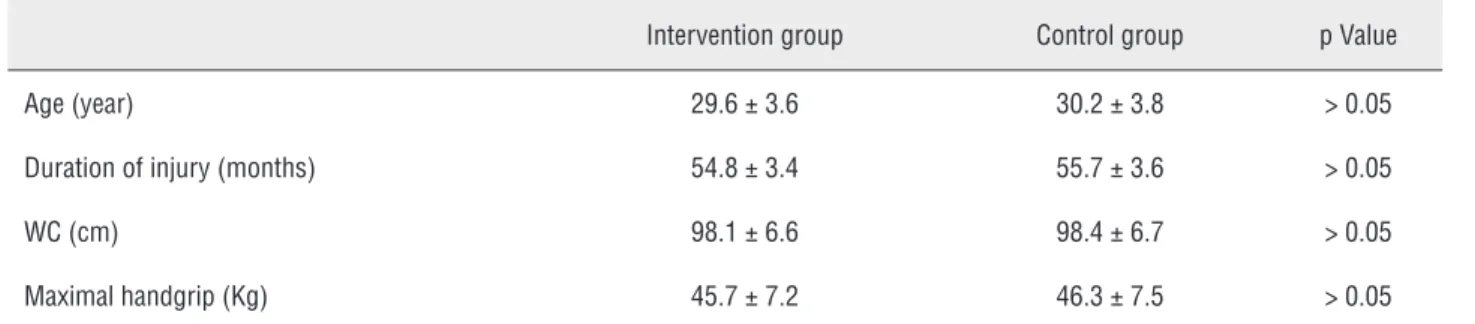
Participants were randomly allocated to the intervention (n = 9) or control group (n = 8) using a concealed method. Characteristics of par-ticipants at baseline are summarized in Table-1.
Subjects assigned to the intervention group performed a 12-week arm-crank exercise program 3 sessions per week, consisting of war-ming-up (10-15 min) followed by a main part in arm-crank (20-30 min [increasing 2 min and 30 seconds each three weeks]) at a moderate work intensity of 50-65% of heart rate reserve (HRR) (starting at 50% and increasing 5% each three weeks) and by a cooling-down period (5-10 min).
Heart rate reserve was obtained according to the following equation by Wilmore et al. (9):
HRR = ((HRact - HRrest) x (HR peak - HR-rest)-1) x 100%.
The resting heart rate (HRrest) was me-asured on one occasion during rest early in the morning before the training program had started. The peak heart rate (HRpeak) was derived from the pre-test arm-cranking maximal ergometry.
Exercise duration and intensity were ca-refully monitored and gradually increased in or-der to guarantee long-term compliance and in-jury avoidance (7). In this respect, each training session was supervised by researchers to ensu-re training workload was appropriate. In addi-tion, participants wore a wireless wearable heart rate monitor (Sport Tester PE3000, Polar Electro, Kempele, Finland).
session, they were placed on a chair that was con-nected to the arm-crank ergometer (Ergometrics 900 SH) with their legs and their hips fixed with belts for optimal stability. It should be pointed out the pedal axis was aligned with the participant’s shoulder, and participants were positioned such that their elbows were slightly flexed at maximal reach. Their feet were placed on the floor such that the knees were bent at an angle of approximately 90º. Control group included 8 age, sex and injury level matched individuals who did not take part in any training program. Further, it should be poin-ted out that all participants underwent a pre-trai-ning period to be familiarized with the correct use of the arm-crank ergometer. In addition, they were also asked not to perform strenuous workouts be-fore the testing session.
Muscle strength
The Jamar handgrip electronic dynamo-meter (Bolingbrook, Illinois, US) was used to as-sess maximal handgrip strength of the dominant hand, defined as the one preferred for daily ac-tivities. The standard testing position, approved by the American Society of Hand Therapists, was used (10). Three maximal attempts, separated each one by 90 second (maximal handgrip) and 20 min (peak torque) resting periods, were given by each subject. The highest value was considered for fur-ther analysis. Verbal encouragement was afforded to ensure maximal efforts. Furthermore, all parti-cipants included in the intervention and control group underwent a preliminary session to be fa-miliar with the correct use of the dynamometer as well as to determine the handle position at which they achieved maximal grip strength (11).
Biochemical outcomes
Blood samples were collected from the antecubital vein puncture after a 12h fast and collected by using an evacuated tube containing EDTA. The whole blood was centrifuged at 3000 rpm for 10 minutes in a clinical centrifuge.
The plasma was separated and stored at -80º C until further analysis. Serum levels of follicle-stimulating hormone (FSH), luteinizing hormone (LH), estradiol and testosterone were determined by ELISA (Diagnostics Systems Labo-ratories Inc., Texas, USA).
Abdominal fat mass
Waist circumference (WC) was determi-ned at minimal waist after normal expiration using an anthropometric measuring tape. It should be pointed out participants were placed in a sitting position.
Statistical analyses
The results were expressed as a mean (SD) and 95% confidence intervals (95%CI). The Sha-piro-Wilk test was used to assess whether data were normally distributed. To compare the mean values, a one-way analysis of variance (ANOVA) with post-hoc Bonferroni correction to account for multiple tests was used. Pearson´s correlation coefficient (r) was used to determine potential as-sociations among tested parameters. For all tests, statistical significance was set at an alpha level of 0.05. Finally, Cohen’s d statistics were used for determining mean effect sizes that were conside-red to be small d ≥ 0.2 and < 0.5, medium d ≥ 0.5 and <0.8 or large d ≥ 0.8 respectively.
Table 1 - Participant´s characteristics at baseline in the intervention (n = 9) and control (n = 8) groups.
Intervention group Control group p Value
Age (year) 29.6 ± 3.6 30.2± 3.8 > 0.05
Duration of injury (months) 54.8 ±3.4 55.7±3.6 > 0.05
WC (cm) 98.1 ±6.6 98.4± 6.7 > 0.05
Maximal handgrip (Kg) 45.7 ±7.2 46.3 ± 7.5 > 0.05
RESULTS
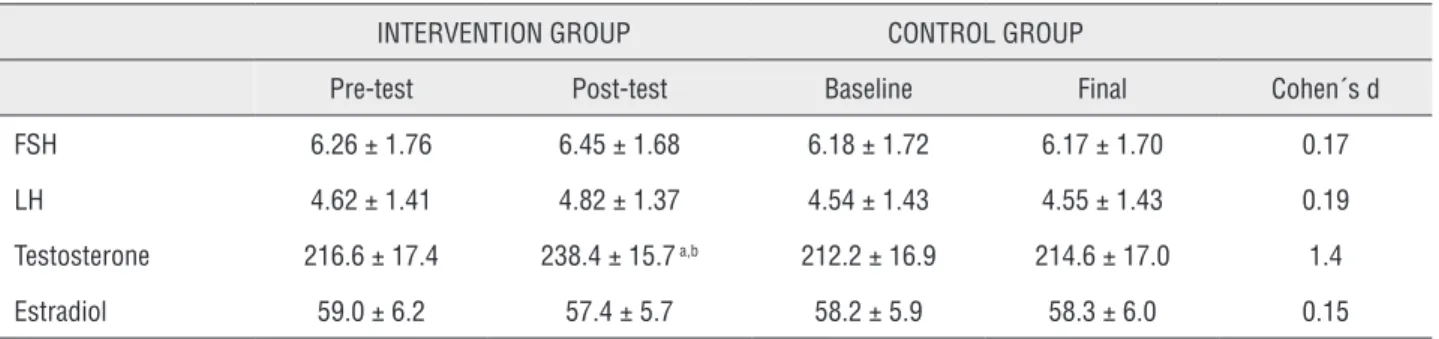
After the completion of the training pro-gram, testosterone level had significantly increa-sed (p = 0.0166; d = 1.14). Conversely, changes in levels of FSH and LH were not statistically signi-ficant in the intervention group. These results are detailed in Table-2.
Regarding muscle strength assessment, the maximal handgrip strength was significantly improved after the completion of the training pro-gram (45.7 ± 7.2 vs. 50.1 ± 6.9 Kg; p = 0.027; d = 0.76). Similarly, body composition was improved as WC was significantly reduced (97.7 ± 6.3 vs. 94.2 ± 6.2cm; p = 0.044; d = 0.82).
Lastly, a significant, negative, correlation was found between WC and testosterone levels (r =- 0.35; p = 0.0377) after being exercised. Simi-larly, testosterone concentration was significan-tly associated with handgrip strength (r = 0.31; p = 0.0412).
With respect to the control group, no signi-ficant changes in any of the tested parameters were found. Finally, neither sports-related injuries nor withdrawals from the program were reported during the entire study period in the intervention group.
DISCUSSION
To the best of our knowledge, this was the first study that demonstrated arm-crank exercise improved reproductive hormone profile, by increa-sing testosterone levels, in adults with chronic SCI.
Our results are consistent with a previous study that reported aerobic training at moderate intensity in-creased testosterone levels in abdominally obese, sedentary adults without SCI (6). Similarly, a 12-week resistance training significantly increased sex hormone-binding globulin (SHBG) in overweight/ obese, sedentary young men (12).
These findings are of particular interest gi-ven that considerable evidence had emphasized the role of testosterone in increasing and maintaining muscle mass leading to a better metabolic control and basal energy expenditure (13). Furthermore, low levels of androgens have been associated with cardiovascular disease progression, especially coronary artery disease, and increased mortality (14). The clinical relevance of the present study seem even more relevant given that morbidity and mortality from cardiovascular disease are greater and occur earlier among individuals with chronic SCI compared to able-bodied population (15).
The current results have also demons-trated that arm-crank exercise improved body composition, by reducing WC, in adults with SCI. Similarly, a 12-week mixed protocol based on re-sistance training using neuromuscular electrical stimulation (FES) + diet significantly reduced vis-ceral adipose tissue in men with chronic SCI (15). It should be emphasized our protocol was based only on exercise so that it may facilitate parti-cipants´ compliance with the intervention. These findings are of particular interest given that ab-dominal obesity has a negative impact on repro-ductive hormone levels such as testosterone (17).
Table 2 - Reproductive hormone profiles in sedentary adults with chronic SCI enrolled in the intervention (n = 9) and control (n = 8) groups.
INTERVENTION GROUP CONTROL GROUP
Pre-test Post-test Baseline Final Cohen´s d
FSH 6.26 ± 1.76 6.45± 1.68 6.18 ± 1.72 6.17 ±1.70 0.17
LH 4.62 ± 1.41 4.82 ±1.37 4.54 ± 1.43 4.55 ± 1.43 0.19
Testosterone 216.6 ± 17.4 238.4 ±15.7 a,b 212.2± 16.9 214.6 ± 17.0 1.4
Estradiol 59.0±6.2 57.4 ± 5.7 58.2 ±5.9 58.3± 6.0 0.15
Note:Results expressed as mean ± sd.FSH and LH expressed mIU/mL. Testosterone expressed as ng/dL. Estradiol expressed as pg/mL. Ratio T/E: Ratio testosterone/
In a more detailed way, current evidence suggests excess adipose tissue results in increased conver-sion of testosterone to estradiol, which may lead to secondary hypogonadism through reproducti-ve axis suppression (18).
Another challenge of the present trail was to identify significant associations between tes-tosterone and abdominal obesity in order to pro-vide an easier, quicker, cheaper and non-invasive assessment of this reproductive hormone. In this respect, a significant but negative correlation was found between WC and testosterone. Simi-larly, the significant inverse association between plasma levels of cytokines and testosterone sug-gests an important role of low-grade visceral fat inflammation in the testosterone deficiency (19).
Regarding muscle strength, a recent sys-tematic review of the literature concluded that handgrip dynamometry has a great potential, and could be used more often in clinical practice in a wide range of medical conditions (20), inclu-ding SCI (21). In the present study, it was shown that arm-crank exercise significantly improved handgrip strength in sedentary adults with chro-nic SCI. Despite functional outcomes were not included in the study, Larson et al. (22) repor-ted that the use of hand-held dynamometry to predict postural muscle strength for maintaining upright sitting in individuals with SCI has high intrarater and interrater reliability.
In spite of individuals with SCI have to face many obstacles to exercise (23), the current results are strong arguments for strengthening the role of exercise as a preventive strategy. It may also reduce healthcare costs associated to secon-dary conditions in this group, given the longer life expectancy observed in the last decades (24).
Finally, despite our significant results, the present study had some limitations that should be considered. Since all patients volunteered for this study from the community, a selection bias might be considered given that participants were highly motivated to undergo and follow through the program. The short sample size may also limit the generalization of the results. Lastly, a major weakness was the relatively short duration of the exercise intervention so that testosterone levels still remain below normality limit in spite of they
were significantly increased. Furthermore, the-re is a clear need for long-term, well-conducted studies to determine whether correction of repro-ductive hormone profile improves clinical outco-mes of individuals with SCI.
On the other hand, strengths of the cur-rent study included the homogeneous sample size in contrast to previous studies that included males and females, tetra- and paraplegia, diffe-rent etiologies for SCI, years since injury, etc... Furthermore, the presence of a control group consisting of age, sex and injury-level matched individuals may reduce the recruitment bias of able-bodied controls. Lastly, the excellent adhe-rence rate suggested the training program was effective and easy to follow-up. In fact, testos-terone may improve motivation and decrease fatigue and may therefore enable participants to better adhere to exercise (25). Furthermore, it may also give them the confidence to continue exercising after the trial finishes. It should be pointed out that erring on the conservative side of selected exercise durations and intensities are prudent and even more important for persons training with a disability than those without (7). Mainly, if we take into consideration that overu-se injuries, joint dislocations and fractures have been reported as common and may ultimately compromise performance of essential daily ac-tivities, including wheelchair propulsion, weight relief, etc. in this group (26).
CONCLUSIONS
A short-term intervention program based on arm-crank exercise improved reproductive hormone profile by increasing testosterone levels in adults with chronic SCI. A secondary finding was that arm-crank exercise significantly impro-ved muscle strength and body composition. In order to confirm and extend these preliminary findings, larger, randomized, controlled clinical trials are required.
CONFLICT OF INTEREST
REFERENCES
1. Clark MJ, Schopp LH, Mazurek MO, Zaniletti I, Lammy AB, Martin TA, et al.: Testosterone levels among men with spinal cord injury: relationship between time since injury and laboratory values. Am J Phys Med Rehabil. 2008; 87: 758-67.
2. Durga A, Sepahpanah F, Regozzi M, Hastings J, Crane DA: Prevalence of testosterone deficiency after spinal cord injury. PMR. 2011; 3: 929-32.
3. Bauman WA, Cirnigliaro CM, La Fountaine MF, Jensen AM, Wecht JM, Kirshblum SC, et al.: A small-scale clinical trial to determine the safety and efficacy of testosterone replacement therapy in hypogonadal men with spinal cord injury. Horm Metab Res. 2011; 43: 574-9.
4. Utida C, Truzzi JC, Bruschini H, Simonetti R, Cedenho AP, Srougi M, et al.: Male infertility in spinal cord trauma. Int Braz J Urol. 2005; 31: 375-83.
5. Ung RV, Rouleau P, Guertin PA: Effects of co-administration of clenbuterol and testosterone propionate on skeletal muscle in paraplegic mice. J Neurotrauma. 2010; 27: 1129-42.
6. Khoo J, Tian HH, Tan B, Chew K, Ng CS, Leong D, et al.: Comparing effects of low- and high-volume moderate-intensity exercise on sexual function and testosterone in obese men. J Sex Med. 2013; 10: 1823-32.
7. Jacobs PL, Nash MS: Exercise recommendations for individuals with spinal cord injury. Sports Med. 2004; 34: 727-51.
8. No Authors: International Standards for Neurological Classification of Spinal Injury. Chicago, American Spinal Injury Association. 2002.
9. Wilmore JHC: Physiology of sport and exercise. Champaign, Human Kinetics. 1994.
10. Mathiowetz V: Grip and pinch strength measurements. In: Amundsen LR (Ed), Muscle strength testing: instrumented and non-instrumented systems. New York, Churchill-Livingstone. 1990; pp. 163-77.
11. Trampisch US, Franke J, Jedamzik N, Hinrichs T, Platen P: Optimal Jamar dynamometer handle position to assess maximal isometric hand grip strength in epidemiological studies. J Hand Surg Am. 2012; 37: 2368-73.
12. Roberts CK, Croymans DM, Aziz N, Butch AW, Lee CC: Resistance training increases SHBG in overweight/obese, young men. Metabolism. 2013; 62: 725-33.
13. Emmelot-Vonk MH, Verhaar HJ, Nakhai Pour HR, Aleman A, Lock TM, Bosch JL, et al.: Effect of testosterone supplementation on functional mobility, cognition, and other parameters in older men: a randomized controlled trial. JAMA. 2008; 299: 39-52.
14. Malkin CJ, Pugh PJ, Morris PD, Asif S, Jones TH, Channer KS: Low serum testosterone and increased mortality in men with coronary heart disease. Heart. 2010; 96: 1821-5.
15. Garshick E, Kelley A, Cohen SA, Garrison A, Tun CG, Gagnon D, et al.: A prospective assessment of mortality in chronic spinal cord injury. Spinal Cord. 2005; 43: 408-16.
16. Gorgey AS, Mather KJ, Cupp HR, Gater DR: Effects of resistance training on adiposity and metabolism after spinal cord injury. Med Sci Sports Exerc. 2012; 44: 165-74. 17. M Al-Ali B, Gutschi T, Pummer K, Zigeuner R,
Brookman-May S, Wieland WF, et al.: Body mass index has no impact on sperm quality but on reproductive hormones levels. Andrologia. 2014; 46: 106-11.
18. Michalakis K, Mintziori G, Kaprara A, Tarlatzis BC, Goulis DG: The complex interaction between obesity, metabolic syndrome and reproductive axis: a narrative review. Metabolism. 2013; 62: 457-78.
19. Gautier A, Bonnet F, Dubois S, Massart C, Grosheny C, Bachelot A, et al.: Associations between visceral adipose tissue, inflammation and sex steroid concentrations in men. Clin Endocrinol (Oxf). 2013; 78: 373-8.
20. PM, RM, SH, MG, WK: A systematic review of dynamometry and its role in hand trauma assessment. Open Orthop J. 2012; 6: 95-102.
21. Sisto SA, Dyson-Hudson T: Dynamometry testing in spinal cord injury. J Rehabil Res Dev. 2007; 44: 123-36.
22. Larson CA, Tezak WD, Malley MS, Thornton W: Assessment of postural muscle strength in sitting: reliability of measures obtained with hand-held dynamometry in individuals with spinal cord injury. J Neurol Phys Ther. 2010; 34: 24-31. 23. Kehn M, Kroll T: Staying physically active after spinal cord
injury: a qualitative exploration of barriers and facilitators to exerciseparticipation. BMC Public Health. 2009; 9: 168. 24. Strauss DJ, Devivo MJ, Paculdo DR, Shavelle RM: Trends
in life expectancy after spinal cord injury. Arch Phys Med Rehabil. 2006; 87: 1079-85.
25. O’Connor DB, Archer J, Wu FC: Effects of testosterone on mood, aggression, and sexual behavior in young men: a double-blind, placebo-controlled, cross-over study. J Clin Endocrinol Metab. 2004; 89: 2837-45.
26. Ballinger DA, Rintala DH, Hart KA: The relation of shoulder pain and range-of-motion problems to functional limitations, disability, and perceived health of men with spinal cord injury: a multifaceted longitudinal study. Arch Phys Med Rehabil. 2000; 81: 1575-81.
_______________________ Correspondence address: