RE
VIE
W
AR
TICLE
Correspondence to: Gladson Ricardo Flor Bertolini – Rua Universitária, 2069 – Jardim Universitário – CEP: 85819-110 – Cascavel (PR), Brazil – E-mail: [email protected]
ABSTRACT | Kinesio taping is being increasingly used
under several conditions; however, its hypoalgesic ef-fect and mechanism of action do not show scientific re-sults. Therefore, the aims of this study were to describe the principles of the method and mainly to analyze the results of clinical trials with control groups, related to pain with Kinesio taping. The PubMed, SciELO, Lilacs, Scirus and Academic Google databases were consulted, using the keywords: Kinesio Taping and Kinesio Tape, either associated or not to pain. Ten clinical trials related to pain and Kinesio taping were selected, assessed by using the PEDro scale, and its results were analyzed. Kinesio taping provided higher, similar or lower pain reduction than in other groups (control, placebo or technique). The application continues to use the prin-ciples of Kenzo Kase, the gate control theory being the most described so far to justify the hypoalgesic effect; and the effects were only found in short-term (24 hours to 1 week). Pain relief provided by Kinesio taping was similar or slightly superior to other interventions, not representing a reason for it to be the main treatment of choice. However, it can be considered an adjunct or complementary technique.
Keywords | Physical Therapy Specialty; Physical Therapy Modalities; Rehabilitation.
RESUMO | O Kinesio taping vem sendo utilizado cada
vez mais em diversas condições, porém, seu efeito hi-poalgésico e mecanismo de ação não apresentam resul-tado científico. Portanto, os objetivos deste estudo foram
Kinesio taping: application and
results on pain: systematic review
Kinesio taping: aplicação e seus resultados sobre a dor: revisão sistemática
Kinesio taping: Aplicación y sus resultados sobre el dolor: una revisión sistemática
Dérrick Patrick Artioli1, Gladson Ricardo Flor Bertolini2Study conducted at the Núcleo de Fisioterapia Ortopédica, Desportiva e Terapias Alternativas (NAFDT) of Centro Universitário Lusíada (UNILUS) – Santos (SP) and Laboratory of Study of Injuries and Physical Therapy Resources of the Universidade Estadual do Oeste do Paraná (UNIOESTE) – Cascavel (PR), Brazil.
1Graduate Program of Musculoskeletal Physical Therapy by the Santa Casa de Misericórdia de São Paulo; Centro Universitário Lusíada
(UNILUS) – Santos (SP), Brazil.
2Graduate Program of Health Sciences Applied to the Locomotor System by the School of Medicine of Ribeirão Preto of the
Universidade de São Paulo (USP); Universidade Estadual do Oeste do Paraná (UNIOESTE) – Cascavel (PR), Brazil.
descrever os princípios do método e, principalmente, analisar quais foram os resultados dos ensaios clínicos, com grupo controle, referente à dor com Kinesio taping. Foram pesquisadas as bases de dados PubMed, SciELO, Lilacs, Scirus e Google Acadêmico, com o uso das pala-vras-chave: Kinesio Taping e Kinesio Tape associadas ou não à dor. Foram selecionados 10 ensaios clínicos refe-rentes à dor e Kinesio taping, os mesmos foram avaliados por meio da escala PEDro e seus resultados analisados.
Kinesio taping proporcionou redução da dor superior, se-melhante ou inferior a outros grupos (controle, placebo ou técnica). A aplicação continua utilizando os princípios de Kenzo Kase, a teoria das comportas é a mais descrita até o momento para justificar o efeito hipoalgésico e os efeitos só foram encontrados em curto prazo (24 horas a 1 semana). A redução da dor proporcionada por Kinesio taping foi semelhante ou pouco superior a outras inter-venções, não representando motivo para que esse seja o principal tratamento de escolha, sendo considerada técnica adjunta ou complementar.
Descritores | Fisioterapia; Modalidades de Fisioterapia; Reabilitação.
RESUMEN | El Kinesio taping viene siendo utilizado
Artioli et al. Kinesio taping, results on pain
INTRODUCTION
Originally developed in 1973 by Kenzo Kase in Japan, the Kinesio taping (KT), also known as elas-tic bandage, is a relatively new method that has be-come popular over the last 10 years, after the disclo-sure provided in major events such as the Olympic Games1-4. The tape is free of latex, with acrylic ad-hesive capacity, and activated by body heat, made of elastic polymer strand wrapped in cotton fibers (100%). Its features exceed the tapes commonly used in bandages, for it allows quick drying, longer time of usage and thinner and more elastic material (stretching / longitudinal stretching of 55-60% in resting position or overall elasticity of 120-140%), which facilitates involving tissues and joints accu-rately. According to its creator, KT provides: (1) Correction of muscle function by strengthening weak muscles; (2) cutaneous stimulation which fa-cilitates or limitates movement; (3) aid in the re-duction of edema by directing exudates towards the lymphatic duct and the lymph nodes; (4) correction of joint positioning for easing muscle spasms; and (5) reduction of pain by neural pathways1,3,5-10.
With so many possible benefits, in addition to its use in classical orthopedic conditions10, applications in various disorders — such as, cerebrovascular ac-cident11,12, drooling in cerebral palsy4, multiple scle-rosis13, post-mastectomy14,15, among others — arise. Although widely used in practice, the mechanism of action of KT is still not completely understood, and the scientific evidence are limited and contro-versial in relation to the hypoalgesic effect3,5-7,10,16. Therefore, it is necessary to analyze whether the use of KT, in pain, generates higher, lower or similar effects to other forms of treatment effects, if it is
just a placebo, or if incapable of providing signifi-cant change to a control group. The objective of this study was to conduct a systematic review in order to report the principles of the method and, specially to analyze what were the results of clinical trials with a control group regarding pain with the KT.
METHODOLOGY
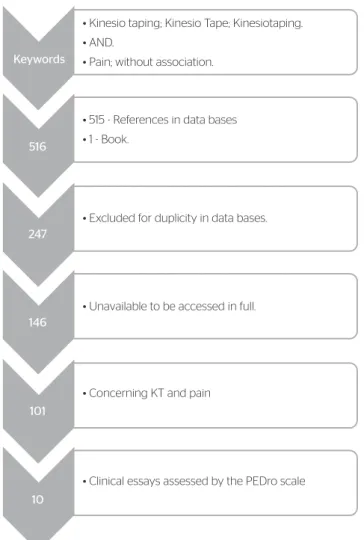
For this study, the PubMed, SciELO, Lilacs, Scirus, Google Scholar databases were consulted, as well as a manual search in indexed scientiic journals was developed, with the following keywords: “Kinesio Taping”; “Kinesio Tape”; and “Kinesiotaping”; asso-ciated or not with “pain”. In order to be included, the studies should provide access to the full assessment (availability of the material in an open way or maga-zines registered in the CAPES Journal), in the form of clinical trial with a control group that evaluated pain with the application of KT, without age limita-tion or language of the manuscript. he researches which did not use pain as a comparison parameter as to the use of KT — which used non-elastic ban-dages as a way of treatment — or the researches that did not involve comparative groups, were excluded. he studies which fulilled the inclusion criteria were assessed by the Physiotherapy Evidence Database (PEDro)17 scale, used by two experienced profession-als in musculoskeletical physical therapy, without aiming to exclude data as to the scores obtained, i.e., just point out the quality of the methodology of each study. In the sequence, the Statistica 7 software was used in order to analyze the data. Figure 1 presents the quantitative data of the conducted search. al dolor con Kinesio taping. Fueron investigadas las bases de
datos PubMed, SciELO, Lilacs, Scirus y Google Académico, uti-lizando las palabras clave: Kinesio taping y Kinesio Tape aso-ciada o no al dolor. Fueron seleccionados 10 ensayos clínicos relacionados con el dolor y Kinesio taping. Los mismos fueron evaluados mediante la escala Pedro y sus resultados analiza-dos. Kinesio taping proporcionó reducción del dolor superior, similar o inferior a otros grupos (control, placebo o técnica). La aplicación sigue utilizando los principios de Kenzo Kase, la
teoría de las compuertas es la más descrita hasta la fecha para justificar el efecto hipoalgésico y los efectos sólo fueron en-contrados en corto plazo (de 24 horas a 1 semana). La reduc-ción del dolor proporcionada por Kinesio taping fue similar o poco más alta que otras intervenciones, lo que no representa razón para que ese sea el tratamiento principal de elección, y es considerado como una técnica adjunta o complementaria.
Fisioter Pesq. 2014;21(1):94-99
RESULTS AND DISCUSSION
Before discussing the individual analysis of each study, it is noteworthy to pinpoint the similarities among them when it comes to the basic requirements of KT, concerning the ways for application, the skin prepara-tion, the positioning, the tension, the direction and the time of use. Among the forms of application of KT, the tape may be cut in “Y”, “I”, “X”, “fan”, “web” (modi-ied “fan”) and “donut” shapes, which will depend on the size of the afected muscle and on the desired treatment. hese forms of application are used, respec-tively, for muscle weakness (facilitatory or inhibitory efect), pain and swelling, biomechanical correction, lymphatic drainage (both “fan” and “web”), focused edema or speciic area (sports)1.
he skin must be free of lotions or moisturizing oils prior to application. When removing the protec-tive sheet of the adhesive, minimum contact should be done so that the adhesive capacity is preserved, there-fore, the adhesive protection shouldn’t be completely
removed. In basic corrective techniques, the position-ing of the kinesio tape must reproduce the positionposition-ing of the therapist’s hands on the patient. he base of the tape must be positioned 5 cm below the origin or above the insertion, without inputting any tension, to prevent discomfort. After stretching the muscle, the tensioned elastic tape must be positioned on top of it. If the KT is too stretched out, there will be reducing of the efect, therefore, it is best to have less rather than excessive ten-sion2,3. Graded by percentage, the traction of the elastic band is described as one of the key factors for successful implementation, that is: full tension 100%, intense 75%, moderate 50%, just the removal of the protective sheet or light 15-25%, very light 0-15%, no tension 0%1.
he direction towards which the tape is to be applied will depend on the purpose of the treatment. As a basic rule, it is placed from the insertion towards the muscle origin (15–25%) in order to inhibit the muscle function in acute situations, caused by overuse or muscle over-stretching. In the case of chronically weakened muscles, or when the increase of muscle contraction/activation is desired, KT should be positioned from the origin to the insertion (25–50%)2,3,5-7,9,10,16,18.
In about 10 minutes the patient will not notice its presence on the skin, and in about 20 minutes it will be fully adhered to the skin. he application shall last for 3-5 days, when the decreasing of the elastic polymer function occurs1,5,16.
Application forms may vary, but in the veriied stud-ies, they were all based on the principles of Kenzo Kase’s book1-3,5-7,9,10,16,18.
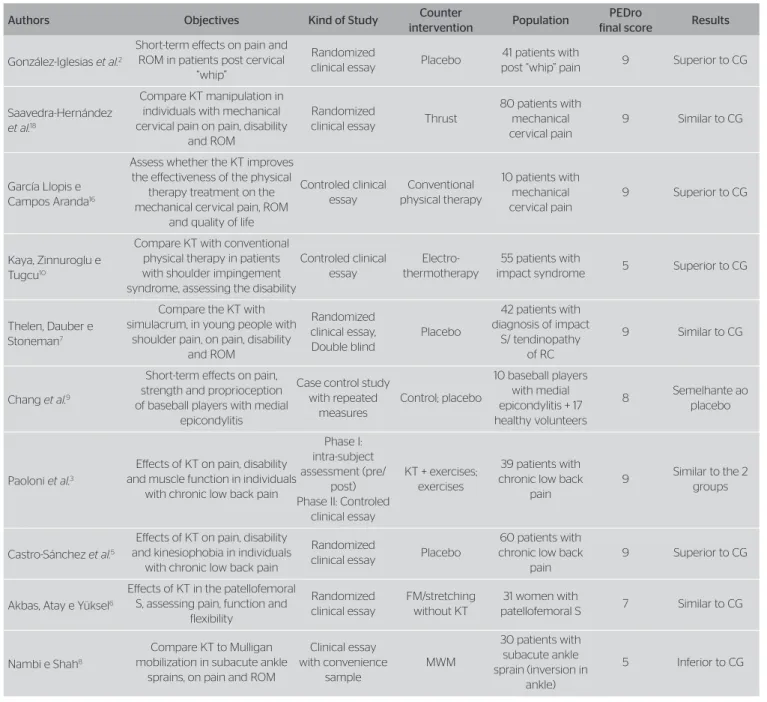
After the search for references, 10 studies met the inclusion criteria, the minimum methodological quality was 5, the maximum was 9 and the average was 7.9±1.6 points, determined by the PEDro scale. In general, 415 subjects participated in studies comparing KT with an-other group (control, placebo or intervention), 4 pre-sented superior results, 5 similar ones and 1 inferior to counterintervention (Table 1).
he authors of the studies in which the KT group had greater reduction in pain, when compared to intervention, described that clinically, it may not be relevant, because the algic decrease was minimally better, and that afterwards the results would be equivalent to the counterintervention ones. Moreover, the described improvement would only be a short-term one (24 hours to 1 week)2,3,5,7,10. Only 1 of the studies showing superior results with the use of KT obtained a relatively low score (5), the other 3 of them evidenced high methodological quality (9) by the PEDro scale, resulting in an average of 8±2 points.
Figure 1. Flowchart of the data found in the search on diferent databases
• Kinesio taping; Kinesio Tape; Kinesiotaping. • AND.
• Pain; without association.
• 515 - References in data bases • 1 - Book.
• Excluded for duplicity in data bases.
• Unavailable to be accessed in full.
• Concerning KT and pain
• Clinical essays assessed by the PEDro scale Keywords
516
247
146
101
Artioli et al. Kinesio taping, results on pain
In the studies in which the beneits observed were similar to the other group’s, it does not mean that there was no decrease in the patient’s pain with the use of KT, but that its application would be as eicient as the use of another technique, which does not justify using it as the main treatment to be chosen. As an example, one can use the study of Saavedra-Hernández et al.18 which, from among the other selected ones, was the one involv-ing the largest number of participants, with high meth-odology quality, according to the PEDro scale and that, when comparing KT to cervical manipulation, found equivalent decrease of pain after one week. However, as illustrated by the authors, the limitation was the absence of a group with no intervention (control) and
placebo groups, which would bring more conclusive in-formation. In another study, which compared KT and placebo groups for shoulder pain, it was only during the irst three days that the results of the irst group were signiicantly higher, but later on, the results re-vealed themselves equivalent between groups7. Unlike the last two studies, a six-week rehabilitation program for patellofemoral syndrome were compared, one group with and one without the addition of KT. In both of them there was an algic reduction, with no intergroup diference6. herefore, KT cannot be considered supe-rior nor infesupe-rior to the other interventions used in ive of the studies, which nearly obtained top marks in the assessment scale, reaching 8.4±0.8 points, on average.
Table 1. Clinical trials with a control group and their characteristics
Authors Objectives Kind of Study Counter
intervention Population
PEDro
final score Results
González-Iglesias et al.2
Short-term efects on pain and ROM in patients post cervical
“whip”
Randomized
clinical essay Placebo
41 patients with
post “whip” pain 9 Superior to CG
Saavedra-Hernández
et al.18
Compare KT manipulation in individuals with mechanical cervical pain on pain, disability
and ROM
Randomized
clinical essay Thrust
80 patients with mechanical cervical pain
9 Similar to CG
García Llopis e Campos Aranda16
Assess whether the KT improves the efectiveness of the physical
therapy treatment on the mechanical cervical pain, ROM
and quality of life
Controled clinical essay
Conventional physical therapy
10 patients with mechanical cervical pain
9 Superior to CG
Kaya, Zinnuroglu e Tugcu10
Compare KT with conventional physical therapy in patients with shoulder impingement syndrome, assessing the disability
Controled clinical essay
Electro-thermotherapy
55 patients with
impact syndrome 5 Superior to CG
Thelen, Dauber e Stoneman7
Compare the KT with simulacrum, in young people with
shoulder pain, on pain, disability and ROM
Randomized clinical essay, Double blind
Placebo
42 patients with diagnosis of impact
S/ tendinopathy of RC
9 Similar to CG
Chang et al.9
Short-term efects on pain, strength and proprioception of baseball players with medial
epicondylitis
Case control study with repeated
measures
Control; placebo
10 baseball players with medial epicondylitis + 17 healthy volunteers
8 Semelhante ao placebo
Paoloni et al.3
Efects of KT on pain, disability and muscle function in individuals
with chronic low back pain
Phase I: intra-subject assessment (pre/
post) Phase II: Controled
clinical essay
KT + exercises; exercises
39 patients with chronic low back
pain
9 Similar to the 2 groups
Castro-Sánchez et al.5
Efects of KT on pain, disability and kinesiophobia in individuals
with chronic low back pain
Randomized
clinical essay Placebo
60 patients with chronic low back
pain
9 Superior to CG
Akbas, Atay e Yüksel6
Efects of KT in the patellofemoral S, assessing pain, function and
flexibility
Randomized clinical essay
FM/stretching without KT
31 women with
patellofemoral S 7 Similar to CG
Nambi e Shah8
Compare KT to Mulligan mobilization in subacute ankle
sprains, on pain and ROM
Clinical essay with convenience
sample
MWM
30 patients with subacute ankle sprain (inversion in
ankle)
5 Inferior to CG
Fisioter Pesq. 2014;21(1):94-99
In only one study the KT was less eicient, in ankle sprain, providing a reduction of pain (55.6%), but this being a smaller improvement when compared to joint mobilization (MWM) (74.9 %), since both groups re-ceived only three sessions per week. However, it was one of the studies which reached the lowest scores on the PEDro scale (5 points), representing lower quality in conducting the survey8.
Most authors described hypotheses for the hypo-algesic mechanism attributed to the application of the KT. Among these, the most cited ones were the following. he tension provided by the tape generates aferent stimuli, facilitating the inhibitory mechanism of pain (gate control theory); the tape provides a sen-sorimotor feedback that only allows movements that cause minimal mechanical irritation of the tissues, hence less pain occurs2,5,7,8,10,18; another theory was based on the condition of mechanical cervical pain, in which the authors did not directly emphasized a mechanism for pain reduction, but they claim that this would occur, as the technique provides increased range of joint motion16; only one study mentioned the pos-sibility of improvement occurring by the increase of circulation in the injured area9.
he most accepted idea so far is the gate con-trol theory, in which the mechanical stimuli provided by the KT would act through fast-conducting ibers (Aβ), performing synapses with inhibitory interneu-rons when reaching the Roland’s Gelatinous Substance (posterior horn of the spinal cord), causing the closure of the gate and therefore, not allowing the passage of notion receptive stimulus (C and Aδ ibers)19. Another easily elucidative thesis in practice would be the imme-diate efect that can be obtained by applying the KT across the muscle or the compromised tendon (moder-ate to intense compression), previously or after physical therapy session. One can test this hypothesis, not yet scientiically explained, in cases of lateral epicondylitis of the elbow (tennis elbow), tendinopathy of the “goose foot” (sartorius, gracilis and semitendinous), patella (jumper’s knee) and calcaneus. It is believed that this way of using the tape decreases the load on a muscle or tendon for modifying the point of the lever (internal moment arm), decreasing the applied strength at the afected area, and as a consequence, decreasing the pain. It would be a literal mechanical efect, which gives in as the tape loses its ability to maintain the pressure on the area, due to the repeated use of the limb, but that, in most cases, provides greater pain relief when compared to standard applications on these regions.
After checking these studies on the use of KT in varied conditions, it may be noted that after the mus-cle/joint is wrapped by the band, the physical therapist should begin or previously apply some kind of method or correction technique to the cause of the injury. As elucidated, the application of KT is suggested as a short term additional strategy for the reduction of pain, such as chronic low back pain, although it does not replace the need for exercising3. herefore, the KT tape is de-scribed as an alternative or complementary treatment, as an option when an immediate and short-duration ef-fect, by application, is desired, although it shall not be used as the only form of treatment. It is suggested the association with other techniques and resources (man-ual therapy, muscle strengthening and electrothermal and phototherapy)10.
Up to date, no work has been developed in order to evaluate the long-term efects of KT, the maximum period was 4-6 weeks, with similar values obtained be-tween the observed groups2,3,5-7,18.
he combination of low cost, limited risk of com-plications and immediate reduction in pain (although small) makes the application of KT a considerable plan of action, even if literature cannot accurately describe its mechanism of action, yet5.
CONCLUSION
he KT produces hypoalgesic efects similar to those of other experimental groups (8.4±0.8 points, PEDro scale), which, clinically, does not justify its use as a pri-mary analgesic technique. hree studies of high meth-odological quality (9 points, PEDro scale) suggest that its efects on pain were higher, in the short term (24 hours after application), and its results are, mostly, described as beneicial, however there is no scientiic evidence that these efects may be prolonged.
REFERENCES
1. Kase K, Wallis J, Kase T. Clinical therapeutic applications of the Kinesio Taping Method. 2 ed. Tokyo: Ken Ikai; 2003. p. 19-39.
Artioli et al. Kinesio taping, results on pain
3. Paoloni M, Bernetti A, Fratocchi G, Mangone M, Parrinelo L, Del Pilar Cooper M, et al. Kinesio Taping applied to lumber muscles influences clinical and electromyographic characteristics in chronic low back pain patients. Eur J Phys Rehabil Med. 2011;47(2):237-44.
4. Ribeiro MO, Rahal RO, Kokanj AS, Bittar DP. O uso da bandagem elástica Kinesio no controle da sialorréia em crianças com paralisia cerebral. Acta Fisiatr. 2009;16(4):168-72.
5. Castro-Sánchez AM, Lara-Palomo IC, Matarán-Peñarrocha GA, Fernández-Sánchez M, Sánches-Labraca N, Arroyo-Morales M. KinesioTaping reduces disability and pain slightly in chronic non-specific low back pain: a randomised trial. J Physiother. 2012;58(2):89-95. 6. Akbas E, Atay AO, Yüksel I. The efects of additional kinesio taping
over exercise in the treatment of patellofemoral pain syndrome. Acta Orthop Traumatol Turc. 2011;45(5):335-41.
7. Thelen MD, Dauber JA, Stoneman PD. The clinical eficacy of Kinesio Tape for shoulder pain: a randomized, double-blind, clinical trial. J Orthop Sports Phys Ther. 2008;38(7):389-95.
8. Nambi G, Shah BT. Kinesio taping versus Mulligan’s mobilization with movement in sub-acute lateral ankle sprain in secondary school Hockey players - comparative study. Int J Pharmac Health Care. 2012;2(2):136-49. 9. Chang HY, Wang CH, Chou KY, Cheng SC. Could forearm Kinesio
Taping improve strength, force sense and pain in baseball pitchers with medial epicondylitis? Clin J Sport Med. 2012;22(4):327-33. 10. Kaya E, Zinnuroglu M, Tugcu I. Kinesio taping compared to physical
therapy modalities for the treatment of shoulder impingement syndrome. Clin Rheumatol. 2011;30(2):201-7.
11. Jaraczewska E, Long C. Kinesio taping in stroke: improving functional use of the upper extremity in hemiplegia. Top Sroke Rehabil. 2006;13(3):31-42.
12. Santos JCC, Giorgetti MJS, Torello EM, Meneghetti CHZ, Ordenes IEU. A influência da Kinesio Taping no tratamento da subluxação de ombro no Acidente Vascular Cerebral. Rev Neurocienc 2010;18(3):335-40.
13. Cortesi M, Cattaneo D, Jonsdottir J. Efect of kinesio taping on standing balance in subjects with multiple sclerosis: a pilot study. NeuroRehabilitation. 2011;28(4):365-72.
14. Stockheimer KR. Kinesio Taping & lymphoedema: applied Kinesio Taping for lymphoedema/chronic swelling of the arm and/or breast after a mastectomy and axilla lymph node removal. Adv Healing 2006,22-3.
15. Tsai HJ, Hung HC, Yang JL, Huang CS, Tsauo JY. Could Kinesio tape replace the bandage in decongestive lymphatic therapy for breast-cancer-related lymphedema? A pilot study. Support Care Cancer. 2009;17(11):1353-60.
16. García Llopis L, Campos Aranda M. Intervención fisioterápica con vendaje neuromuscular en pacientes con cervicalgia mecánica. Un estudio piloto. Fisioter. 2012;34(5):189-95.
17. Verhagen AP, de Vet HC, de Bie RA, Kessels AG, Boers M, Bouter LM, et al. The Delphi list: a criteria list for quality assessment of randomised clinical trials for conducting systematic reviews developed by Delphi consensus. J Clin Epidemiol. 1998;51(12):1235-41.
18. Saavedra-Hernández M, Castro-Sánchez AM, Arroyo-Morales M, Cleland JA, Lara-Palomo IC, Fernández-de-Las-Peñas C. Short-term efects ok kinesio taping versus cervical thrust manipulation in patients with mechanical neck pain: a randomized clinical trial. J Orthop Sports Phys Ther. 2012;42(8):724-30.