RESEARCH
Family farming and human and environmental health conservation
Agricultura familiar e a conservação da saúde humana e ambiental
Agricultura familiar y preservación de la salud humana y ambiental
Anelise Miritz Borges
I, Clarice Alves Bonow
II, Mara Regina Santos da Silva
I,
Laurelize Pereira Rocha
I, Marta Regina Cezar-Vaz
II Universidade Federal de Rio Grande, Nursing School, Postgraduate Program in Nursing. Rio Grande, Rio Grande do Sul, Brazil. II Universidade Federal do Pampa, Nursing School. Uruguaiana, Rio Grande do Sul, Brazil.
How to cite this article:
Borges AM, Bonow CA, Silva MRS, Rocha LP, Cezar-Vaz MR. Family farming and human and environmental health conservation. Rev Bras Enferm [Internet]. 2016;69(2):304-12. DOI: http://dx.doi.org/10.1590/0034-7167.2016690216i
Submission: 05-17-2015 Approval: 10-26-2015
ABSTRACT
Objective: understand how farmers identify positive and negative impacts of family farming work on the environment and
conserve the environmental health. Method: a qualitative study with 129 farmers from Ilha dos Marinheiros, Rio Grande, Brazil.
Secondary data and recorded interviews were used in this study, with subsequent analysis performed by Bardin and NVivo10,
both based on Enrique Leff’s cultural rationality. Results: the positive impacts included food production with responsibility, work
appreciation, and the correct, minimum or inexistent insertion of agrochemicals. The negative aspects included excessive and
incorrect use of agrochemicals and absent farming knowledge. Conclusion: environmental conservation consisted in reducing
impacts that could have a negative effect on health, while performing work activities.
Key words: Agriculture; Sustainable Development; Public Health Nursing; Environmental Health; Rural Workers.
RESUMO
Objetivo: compreender como os trabalhadores agricultores identifi cam os impactos positivos e negativos do trabalho agrícola
familiar no ambiente e conservam a saúde ambiental. Método: pesquisa qualitativa com 129 trabalhadores agricultores da Ilha
dos Marinheiros, Rio Grande, Brasil. Foram utilizados dados secundários e entrevistas gravadas, com posterior análise de Bardin
e NVivo10, ambos embasados na racionalidade cultural (Enrique Leff). Resultados: constaram, entre os impactos positivos, a
geração de alimentos com responsabilidade, a valorização do trabalho, a correta, mínima ou nula inserção dos agrotóxicos.
Como aspectos negativos, o uso excessivo e incorreto dos agrotóxicos e a ausência de conhecimentos para agricultar. Conclusão:
a conservação do ambiente consistiu na redução de suas agressões durante o trabalho, as quais podem comprometer a saúde.
Descritores: Agricultura; Desenvolvimento Sustentável; Enfermagem em Saúde Pública; Saúde Ambiental; Trabalhadores Rurais.
RESUMEN
Objetivo: comprender el modo en que los trabajadores agricultores identifi can los impactos positivos y negativos del trabajo
agrícola familiar en el ambiente y preservan la salud ambiental. Método: investigación cualitativa con 129 trabajadores
agrícolas de la Ilha dos Marinheiros, Rio Grande, Brasil. Fueron utilizados datos secundarios y entrevistas y entrevistas grabadas, posteriormente revisadas con análisis de Bardin y NVivo10, ambos con base en la racionalidad cultural (Enrique Leff).
Resultados: Se constataron, entre los impactos positivos, la producción responsable de alimentos, la valorización del trabajo, la correcta, mínima o nula aplicación de agroquímicos. Como aspectos negativos, el uso excesivo de agroquímicos y la falta de
conocimiento sobre la actividad agrícola. Conclusión: la preservación del ambiente se enfocó en reducir su agresión durante el
trabajo. Agredir el ambiente puede comprometer la salud.
Palabras clave: Agricultura; Desarrollo Sostenible; Enfermería en Salud Pública; Salud Ambiental; Trabajadores Rurales.
Marta Regina Cezar-Vaz E-mail: [email protected]
INTRODUCTION
The concern about promoting farming activities with no environmental impact, with people directly and indirectly involved, reminds of the concept of environmental
sustain-ability(1-2). The application of sustainability to family farming is
associated with generational knowledge(3), comprising the
cul-ture that is intrinsically established in the lifestyle and social
and economic interests of rural communities(2).
Cultural rationality involves human socialization, expressed
by values, beliefs and lifestyles(2), whose practices of land
cul-tivation in family units contribute to fulfilling human needs in
subsistence and product trading(1). In this sense, farming is a
great ally in economic development, as it is the second source of employment; farmers account for more than one third of
the global workforce in food production(4). This fact makes this
workforce potentially adverse to family farming sustainability, when its economic projection does not consider the
environ-ment as finite in relation to the life forms keeping it(2).
Family farming promotes the farmer-environment relation-ship, as it ensures not only family subsistence, but also an in-teraction with the community, establishing relationships with other farmers, and with the rural environment, considering the
farming activity depends on it(5). This way, work satisfaction is
combined with the action of land cultivation(6) in a sustainable
manner(7), that is, fulfilling the needs of the current population,
without affecting the ability to serve future generations(2).
In this perspective, it is not possible to detach farming work from the culture of each rural community and from the technology standards and economic interests, a fact that integrates, in cultural rationality, the development of social standards considering the practices of farming work and
natu-ral resource exploration(1). Such practices contribute to
posi-tive and negaposi-tive impacts on population and environmental
health, according to the way they are conducted(8), which
demands studies to be performed(3), because, unlike past
de-cades, the socio-environmental effects from farming work are
more evident and promote more debates(8), due to national
and international recognition of this work activity(9).
With this recognition, the South Region of Brazil presents a significant number of farming families. Rio Grande do Sul, in particular, has 85.7% of rural units dedicated to family farm-ing; this state has the highest percentage when compared to
other Brazilian states(10). This scenario is suitable to
investi-gations, and Ilha dos Marinheiros, in the municipality of Rio Grande was selected for its performance in the provision of
farming products to the region since the mid-17th century(11),
due to its land fertility. Considering the importance of this theme, this study aimed to understand how farmers identify positive and negative impacts of family farming work on the environment and conserve the environmental health.
METHOD
This is a qualitative, exploratory, descriptive study linked
with the macro project Natureza humana da força de trabalho
masculina e feminina: um estudo com trabalhadores (as) em
dois ambientes rurais do Rio Grande do Sul [Human nature of male and female workforce: a study with workers from two rural environments in Rio Grande do Sul], funded by the Na-tional Council for Scientific and Technological Development. This study was conducted in Ilha dos Marinheiros, in the mu-nicipality of Rio Grande, in Lagoa dos Patos estuary, a singular site in the South Region, as it is an island with rural characteris-tics, where land is cultivated for the subsistence of 1,259
inhab-itants(12) distributed in five subsectors in this territory: Porto Rei,
Bandeirinhas, Marambaia, Coreia, and Fundos da Ilha.
The participants of this study were farmers from family farms, that is, people in charge for managing the primary pro-duction of fruits, vegetables, grains and other farming
prod-ucts(13). Inclusion criteria were: adults over 18 years of age,
liv-ing and workliv-ing in family farms producliv-ing farmliv-ing products, even if for exclusive subsistence on the island.
Due to absent information about the number of farmers in Ilha dos Marinheiros at the Brazilian Institute of Geography and Statistics (IBGE, as per its acronym in Portuguese), official state and municipal bodies that support this population were con-sulted. Information was collected from the Trade Union for Farm
Workers in the municipality, the municipal bureau of Empresa
de Assistência Técnica e Extensão Rural (EMATER), and the Municipal Division of Agriculture, totaling 157 farmers on the island. Of these 157 farmers, 25 refused to participate and 17 were lost, whereas 14 other farmers were added, recommended by neighbors, totaling 129 interviewed farmers.
Data were collected from March to October 2013 using an individually applied semi-structured questionnaire, previous-ly developed and validated, and which was answered during the recorded interview. Secondary data were also collected regarding the geographical and cultural background of the island, obtained from the Municipal Division of Agriculture, IBGE and the city library.
The variables of this study were: age, gender, ancestry, positive and negative impacts/effects of work on the environ-ment and participants’ concerns about environenviron-mental health conservation while performing their farming activities. For the qualitative variables of positive and negative impacts, which were addressed separately, the numeric exclusive character was not assigned to thematic units; these variables were ana-lyzed through the speech of participants.
Ethical and scientific requirements established for stud-ies with human beings were observed, according to Resolu-tion 466/2012, and the macro project was approved by the Research Ethics Committee of the Federal University of Rio Grande. The participants were identified by the numbering system assigned to the questionnaire, followed by their gender and subsector.
For standardization purposes, “poison”, “chemical prod-uct” and “pesticide” mentioned by farmers were replaced with “agrochemical(s)”, the official term used by the Brazil-ian Health Surveillance Agency (ANVISA, as per its acronym
in Portuguese)(14). Environmental health is related to
sustain-able human development based on new production methods and lifestyles, which are related to healthy conservation of life
Borges AM, et al.
For data analysis, a thematic content analysis(15) was
con-ducted, using the three methodological steps required by the method, and software NVivo10 was used as well - both analy-sis were processes based on Enrique Leff’s cultural rationality. Rationality refers to values and beliefs established in a historic process, making social and productive practices in agriculture strongly influenced by economy and presence of natural re-sources, encouraging and confirming the relevance of local
environmental conservation(1).
With such theoretical basis that supported the conclusion of the first and second method steps, data were classified, ar-ranged and coded with NVivo, defining the knot trees and their subcategories. Each theme/knot represents the content and the meaning of thematic units/knot tree, which were con-densed and aligned in the third step of result treatment.
RESULTS
Of total 129 interviewed subjects, male predominance (78 farmers) was observed, and their mean age was 55.33±14.27 years. Among female participants (51 farmers) their mean age was 54.68±11.08 years; and general mean age was 55.69±13.10 years, minimum 25 and maximum 81 years. The conception of farming work effects on the environment and environmental health conservation were presented under
two themes: Positive and negative impacts of farming work on the environment and environmental health conservation.
Positive and negative impacts of farming work on the environment
Land cultivation work was a skill generationally required by the Portuguese ancestry for 106 farmers (84.80%), and this activity was transmitted to the island population by the first immigrants from Portugal.
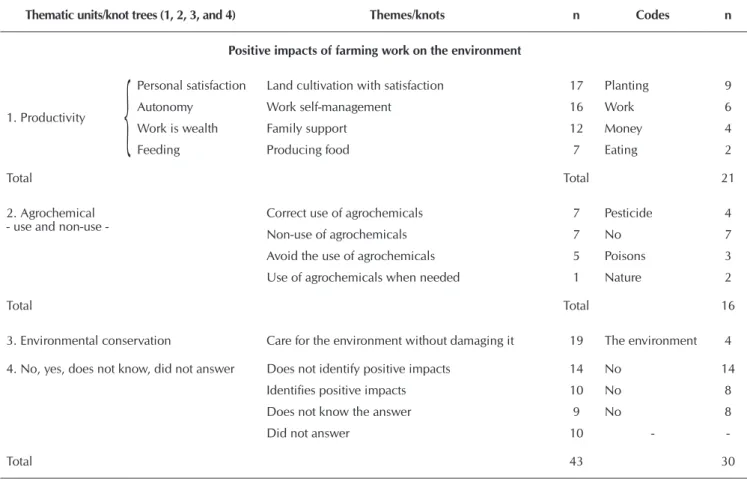
Regarding the effects of farming on the environment (Table 1), of 129 interviewees, 119 (92.24%) reported positive effects, which were arranged in four knot trees or thematic units (1, 2, 3, and 4), containing 13 themes/knots and 12 codes, with predomi-nance of male and “no” code. This code was represented by 14 answers reporting no positive impacts of the farming activity on the environment, due to the pollution caused by the use of ag-rochemicals, which contributed to environmental deterioration.
The negative impacts of farming activity on the environ-ment were environ-mentioned by 111 (86.04%) farmers, most were male, originating three thematic units (1, 2, and 3), 11 themes/ knots, and 10 codes. The code “no” was present in the speech of 61 (68.69%) farmers who mentioned absence of negative impacts, because they made all arrangements to prevent en-vironmental pollution, with mutual benefit (they caused no damage, and in return, they were not harmed).
Table 1 – Structuring of positive (n=119) and negative (n=111) impacts of farming activity on the environment based on Bardin’s analysis and using NVivo
Thematic units/knot trees (1, 2, 3, and 4) Themes/knots n Codes n
Positive impacts of farming work on the environment
1. Productivity
Personal satisfaction Land cultivation with satisfaction 17 Planting 9
Autonomy Work self-management 16 Work 6
Work is wealth Family support 12 Money 4
Feeding Producing food 7 Eating 2
Total Total 21
2. Agrochemical use and nonuse
-Correct use of agrochemicals 7 Pesticide 4
Non-use of agrochemicals 7 No 7
Avoid the use of agrochemicals 5 Poisons 3
Use of agrochemicals when needed 1 Nature 2
Total Total 16
3. Environmental conservation Care for the environment without damaging it 19 The environment 4
4. No, yes, does not know, did not answer Does not identify positive impacts 14 No 14
Identifies positive impacts 10 No 8
Does not know the answer 9 No 8
Did not answer 10 -
-Total 43 30
The group presenting the greatest inclusion of farmers re-garding positive impacts on the environment was related to productivity for 52 participants. Therefore, the knots resulting from this group constituted the act of planting to produce, to financially support the family through food production activ-ity. Some interviewees mentioned this concern:
With my work at the farm, I help food production for me and for people who buy from us, I guess this is a positive
point. (113, F, FI)
Because we sell what we produce, we earn our money for
daily expenses, I guess this is positive. (62, F, PR)
Because, the way things are today, if we stop producing, I guess there won’t be anything to eat in the future, and we
are helping in this aspect. (53, M, PR)
The responsibility for food production was appreciated by 52 farmers, benefitting farming families with the sale of prod-ucts and the consumer population. The importance of having fresh farming products for human health and maintaining this work activity to employ family members was also observed.
I guess everyone has a job and it is good for us. (6, F, B)
[...] and consumers have the possibility to consume a fresh
product. (75, M, PR)
Because it’s good, many people buy them because they’re
good for health, like the greens. (121, F, PR)
Work satisfaction was a relevant factor for 52 interviewees, justified by living in a calm environment and the autonomy for performing daily tasks, considering work as the wealth of Ilha dos Marinheiros.
I guess it’s a healthy job, we like what we do.It’s a good
thing to have a place like this to walk outdoors, in a healthy
environment. (25, F, PR)
It’s very good for me [...] it’s calm [...] we decide when to
do the things, now, later, or if we’ll do the things. (58, F, PR)
Our life is around that, we live on that [farming], then, I
guess it has benefits, and that enriches the environment on
the island. (129, M, B).
The agrochemicals mentioned by farmers as poison, toxic products, chemical products or pesticides caused both posi-tive and negaposi-tive impacts on the environment. The correct product handling, non-use, or avoiding the product were men-tioned as positive impacts by 20 interviewees, in the group of the second greatest inclusion of answers.
The proper use of agrochemicals was related to a better harvest result, and it was needed. On the other hand, it may cause human intoxication and sickness, when the period between product application and harvest is not observed or when the product application is not identified.
We know how and when a pesticide is necessary, and that we shouldn’t sell the product right after application, we have to wait the right period, because in fact we have to
Negative impacts of farming work on the environment
1. Agrochemical
- the use - Use of agrochemicals 30 Agrochemical 10
Incorrect use of agrochemicals 2 Pollute 2
Use of agrochemicals to guarantee harvest 1 Spoon 1
Total Total 13
2. Work Land cultivation changes the environment 8 Damages 3
Lack of knowledge for proper cultivation 3 Guidance 2
Insecurity regarding harvest and product sales 2 Selling 2
Daily requirements imposed on farmers 1 Hard work 1
Total Total 8
3. No, yes, does not know, did not answer Does not identify negative impacts 61 No 59
Identifies negative impacts 1 Yes 1
Does not know the answer 4 No 3
Did not answer 18 -
-Total 84 63
Note: The numeric exclusive character was not assigned to thematic units in relation to positive impacts (n=119 respondents) and negative impacts (n=111 re-spondents).
Borges AM, et al.
use [agrochemicals], otherwise, we can’t plant or harvest. (80, F, B)
[...] if we do it correctly, without so much poison, we work with
intelligence [...] planting cabbage, cauliflower, we don’t need
poison, it’ll be good for the environment; many are dying in the
city because of the poison. [...] they don’t cut and wash, if you
use pesticide, it is hidden, although it doesn’t kill, but it can
intoxicate and the person may be sick with time. (109, M, M)
Still about agrochemicals, the speech of 33 farmers con-stituted the first and largest group of themes/knots related to the negative impacts caused by these substances. These im-pacts were related to contamination of land, water, air and sur-rounding people, posing risks to everyone, especially when the product was improperly used in plantation.
It [farming activity] destroys the environment because of the chemicals, it can affect the water, soil, even our family
members, a contamination. (15, F, PR)
For chemicals, poison, pesticide, the smell affects the air,
then it can [contaminate]. (111, F, M)
[...] when working with these chemical, toxic substances [...] if farmers could work without them, it would be better for their health. [...] I tell my friends: don’t use it, it’s danger-ous. (92, M, FI)
It depends, if they [agrochemicals] are incorrectly used,
then yes, but if they are correctly used, then no. (110, M, M)
The farming activity contributed to changes in the environ-ment and future generations, which was present in the speech of 14 interviewees from the second group of themes/knots of negative impacts.
Every farming activity, working the soil, somehow it chang-es the system; farming activity will trigger an environmental
change [...], affecting life above the soil, plants, vegetation,
the life in the soil, fungi, bacteria, parasites. (77, M, M)
To the environment, a negative impact, because of these
poi-sons, we will, the younger generation will suffer a lot.Very hard,
difficult, only those dealing with that know well. (95, M, B)
Also resulting from these second group of themes/knots, routine challenges were mentioned, such as unsuccessful har-vest and product sales due to economic instability and unpre-dictable weather.
Sometimes, it’s difficult to sell, we take everything and bring everything back home, we plant but we don’t know if we will harvest, if we plant now, we don’t know if we will harvest every two months, the weather changes suddenly and we lose
everything, I’m tired of losing everything. (45, M, PR)
It involves hard work, many times performed without prop-er technical support, which is offprop-ered by farming organiza-tions, considering the continuous need to learn.
[...] we work very hard and we earn little, it’s a big sacrifice,
we walk in the rain, sun, in bad weather. (25, F, PR)
[...] many times we’re doing it wrong, and we don’t know it,
we don’t receive instructions. (26, M, PR)
No one provides guidance about how to do it, we follow the
recommendations of the [agrochemical] salesman. (49, F, PR)
Therefore, caring for the environment when planting mul-tiple crops - polyculture - without leading to infertile soil, was the concern of 19 interviewees from the third group of themes/knots of positive impacts.
We are producing, planting, caring for the environment, we
have to take care of the land to ensure its return. (68, M, PR)
Producing without making big changes, except the required
ones. It’s the question of multiple crops we see here, [...]
we think it’s working well, maybe it’s still not the ideal. (77, M, M)
The family farming activity appears as an important compo-nent of the cultural background of the interviewees, as it con-tributed to changes in the environment and future generations.
Environmental health conservation
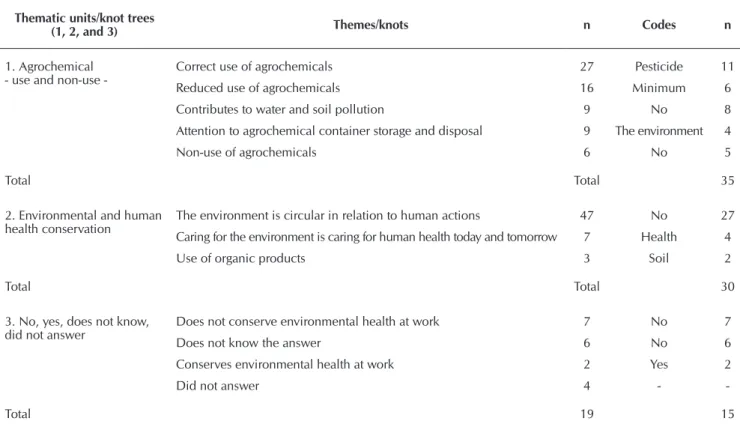
All 129 farmers were also asked about how they conserved the environmental health while performing their farming ac-tivity, most male interviewees, totaling three knot trees or the-matic units, 12 themes/knots and 11 codes. Of these codes, 27 indications were of code “no”, related to the negative an-swer to environmental pollution (Table 2).
In the first and largest group of themes/knots, 67 indica-tions referred to the use and non-use of agrochemicals, fol-lowed by 57 in the second group, regarding the relation be-tween environmental and human health.
In the first group of themes/knots, 27 speeches of interview-ees indicated environmental health conservation is possible with the correct use of agrochemicals and when the instruc-tions on the package insert and prescripinstruc-tions are observed.
These substances, we have to read the label carefully and
use as indicated on the label. (103, M, M)
I’m worried about it, so I use agrochemicals with attention, respecting the dosage and the period between product
ap-plication and harvest. (98, M, C)
Wearing personal protective equipment (PPE), attention to windy days and the presence of other people during the ap-plication of agrochemicals were also identified in the speech of 27 participants, due to the risk of contamination.
I tell them [family members] to take care, wear a mask,
safe-ty clothes, safesafe-ty glasses, we are never close, we wait until
the weather is calm [...] if it’s windy, the machine sprays the
substance, and when the weather is calm, the substance is
The speech of 16 interviewees showed minimal intention to use agrochemicals in harvest, due to the aggressive properties of the product to human and environmental health and life.
Agrochemicals are bad for the nature, the air, we shouldn’t
use much. (34, F, PR)
I worry because these chemical products are bad for
every-one, it’s bad for the health.Iuse only the necessary amount
of chemicals, farmers have to use it, otherwise there is no
harvest. (90, M, FI)
In addition, the speech of nine interviewees indicated the imprudent and excessive use of agrochemicals contributed to the pollution of water and soil, two important elements on the island.
[...] if we use a substance that will run to the sea, it’ll kill
fish, shrimps. (5, M, B)
[...] don’t use much pesticide, as it will damage the soil, the
health of humans, for sure. (57, M, PR)
Also in this larger group of themes/knots, the safe and prop-er storage of agrochemicals was identified in nine speeches as a strategy to environmental health conservation on the island. Some mentioned careful placement of containers in the sheds until the municipal collection, as well as container disposal,
avoiding container burning or bury, which would affect the plant development.
[...] don’t let the containers left on the ground, always put
them away, return them [to municipal collection] to prevent
exposure. (80, F, B)
I put containers away, I don’t let them on the floor, I don’t
put them in the trashcan, I don’t burn them. (43, M, PR)
Containers, urea plastic containers, fertilizer containers, don’t let them in open areas, on the soil, because of the crop, it can enter the root of a banana tree, of lettuce, and
it won’t grow properly. (71, F, PR)
In the second group of themes/knots, the speech of 47 farmers mentioned a circular link of their actions with the en-vironment, as there was a continuous retroaction involving the farmer, the environment, the neighbors, the community and the consumers, in relation to the farming activity performed on the island; then, providing environmental health required working without pollution.
We worry because we have to take care, [...] we try
every-thing to improve, not affecting anyevery-thing or anyone.The
en-vironment is everything, we work and we have water, we
have everything, and everything flows.It goes to the sea.
(29, F, PR)
Table 2 – Structuring of environmental health conservation, based on Bardin’s analysis and using NVivo (n=125)
Thematic units/knot trees
(1, 2, and 3) Themes/knots n Codes n
1. Agrochemical use and nonuse
-Correct use of agrochemicals 27 Pesticide 11
Reduced use of agrochemicals 16 Minimum 6
Contributes to water and soil pollution 9 No 8
Attention to agrochemical container storage and disposal 9 The environment 4
Non-use of agrochemicals 6 No 5
Total Total 35
2. Environmental and human health conservation
The environment is circular in relation to human actions 47 No 27
Caring for the environment is caring for human health today and tomorrow 7 Health 4
Use of organic products 3 Soil 2
Total Total 30
3. No, yes, does not know, did not answer
Does not conserve environmental health at work 7 No 7
Does not know the answer 6 No 6
Conserves environmental health at work 2 Yes 2
Did not answer 4 -
-Total 19 15
Borges AM, et al.
We have to try to help the environment, not to destroy it, otherwise, if we damage the environment, it will return to us, I believe many things happen now because the
environ-ment is damaged. (113, F, FI)
The speech of seven interviewees showed a concern about the excessive use of natural resources aiming to obtain profits in farming productivity and a concern about the future genera-tion’s access to these resources.
When I stop producing, I have the obligation to deliver a
soil in better conditions than when I started. [...] you can’t
just use the soil, profit with the activity, but make it viable,
productive in the future. (77, M, M)
[...] I think a lot about the future of children, the adolescents on the way [...] see a better world. (94, F, FI)
Promoting farming activities that do not affect other life forms lead to work performed with respect, potentially viable due to the insertion of organic products, as expressed in the speech of three interviewees.
[...] if it damages the environment, it also damages people
and our health. (1, F, B)
If I [...] put something wrong in the food, it will be bad for
me and for other people.What I don’t want for me, I don’t
want for the others either, I try to do good things for every-one. (16, M, PR)
I try to improve it [soil] [...] use organic products, take care,
use regular fertilizer, make the soil always strong. (38, M, PR)
[...] a lot of manure, rice hulls (63, M, M)
In this perspective of action and reaction, the farmers from Ilha dos Marinheiros expressed their understanding of the en-vironmental health when performing their work, reporting a sustainable perspective of the environment and, consequent-ly, of human health.
DISCUSSION
The practices used in farming activities are strongly
influ-enced by local cultural standards(1), then, the environment
where these activities are performed presents variations, just as the people involved. These are relations that involve beliefs, val-ues and information acquired during the life of a farming
popu-lation in that surrounding environment(3,5). This continuous and
interdependent relation between farmers and the environment is based on several aspects: onsite experiences, land cultivation, feeding with the products they produce, and handling unpre-dictable weather on a daily basis. As a result, human exhaustion is observed, triggered by exposure to sun, rain, humidity and
physical effort demanded by their occupation(16-17).
Ilha dos Marinheiros, as a singular area(11) in the South due
to its fertile soil, has farmers who are concerned about food production, an action that promotes work as wealth and profit
as a source of subsistence. At national and international lev-els, other islands have their economic development based on
farming activities of food production(18-19). An economic need
and a cultural power are seen in land cultivation and feeling proud of and satisfied with the work, a characteristic observed in family farming and the island population. Tranquility, calm-ness from rural areas and the possibility to make their own decisions without the figure of an employer are also positive
values related to farming(6).
Having farming activities conducted in a healthier man-ner, due to the short distance between farmers and the land, is a relevant aspect to both, which also favors environment conservation(2).
In addition, it is an insular environment, in which land and water constitute the structure of Ilha dos Marinheiros, just as work inserted in a farming culture. This singularity was con-sidered by most interviewees when using organic products and agrochemicals in a proper and careful manner, worrying not to pollute the soil, the air, water, and life forms present in the environment. Such prudence is supported by the Brazil-ian Health Surveillance Agency, which foresees polyculture and promotion of organic products to reduce the utilization of agrochemicals and potential deterioration of life, as well as insertion of PPE, proper storage and disposal of agrochemical containers, attention to the period between product applica-tion and harvest, based on the instrucapplica-tions on labels and
pack-age inserts from every substance(14).
Focus stands on healthy lands and farmers, caring for soil re-vitalization and human health, in a conception of action and
reaction(20). However, despite culture and natural resources
be-ing immeasurable and irreducible to economic calculation and technological efficiency, financial issues often prevail over sur-vival itself, producing profitable farming actions, but gradually
unviable to environmental and human sustainability(2), which
contributes to cultural resilience in times of constant economic,
technological and social changes required by this activity(2).
In this sense, the inclusion of agrochemicals may trigger such resilience, considering that, on the one hand, agrochem-ical use and non-use are contested, as these substances help increase productivity but may cause health problems. On the other hand, challenges with reduced appreciation of
cultivat-ed products(21), and negative impacts to health and
environ-ment are not included in the final price of these products(8).
Consequently, one of the challenges involved in the utiliza-tion of such substances is to highlight the socio-environmental effects and healthcare costs resulting from such substances,
promoting responsible consumption for life maintenance(8).
The intensive handling of agrochemicals, even when ob-serving all applicable laws/standards, causes contamination of foods, water, air, rain, workers, population and animals, that is,
it contaminates all life forms associated with these products(22). It
also causes intoxication related to the cycle of farming produc-tion and acute and chronic human effects due to occupaproduc-tional,
dietary and environmental exposure(23-24), in which hidden
REFERENCES
1. Leff E. Ecologia, capital e cultura. A territorialização da racionalidade ambiental. Petrópolis: Vozes; 2009.
2. Leff E. Saber ambiental: sustentabilidade, racionalidade, complexidade, poder. 9ª ed. Petrópolis: Vozes; 2012.
3. Laschefski KA, Dutra C, Doula SM. [Environmental legislation as focus of conflicts: an analysis based on the smallholders’ so-cial representations of nature in Minas Gerais, Brasil]. Soc Nat [Internet]. 2012[cited 2014 Nov 13];24(3):405-17. Available from: http://dx.doi.org/10.1590/S1982-451320120003000 03 Portuguese.
4. Organização Internacional do Trabalho. Repertorio de re-comendaciones prácticas sobre seguridad y salud en la ag-ricultura. WHO [Internet]. 2010[cited 2014 Nov 13]; Avail-able from: http://www.ilo.org/wcmsp5/groups/public/---dgre ports/---dcomm/---publ/documents/publication/wcms_ 159460.pdf
5. Ploeg JDVD. Dez qualidades da agricultura familiar. Rev Agric Fam Agroecol [Internet]. 2014[cited 2014 Nov 13];1(n.esp):7-14. Available from: http://aspta.org.br/re-vista/cadernos-para-debate-n1-dez-qualidades-da-agricult ura-familiar
6. García-Montoya ME, Callejón-Ferre AJ, Pérez-Alonso J, Sánchez-Hermosilla J. Assessment of psychosocial risks faced by workers in Almería-type greenhouses, using the Mini Psychosocial Factor method. Appl Ergon [Internet]. 2013[cited 2014 Nov 13];44(2):303-11. Available from: http://dx.doi.org/ 10.1016/j.apergo.2012.08.005
7. Weihs M, Mertens F. [Challenges for knowledge gen-eration in environmental health: an ecosystemic ap-proach]. Ciênc Saúde Coletiva [Internet]. 2013[cited 2014 Nov 13];18(5):1501-10. Available from: http://dx.doi. org/10.1590/S1413-81232013000500036 Portuguese.
8. Porto MF, Soares WL. [Development model, pesticides, and health: a panorama of the Brazilian agricultural reality and pro-posals for an innovative research agenda]. Rev Bras Saúde Ocup [Internet]. 2012[cited 2014 Nov 13];37(125):17-31. Available
from: http://dx.doi.org/10.1590/S0303-765720120001000 04 Portuguese.
9. Food and agriculture organization of the United Nations. Global Strategy Improving Ag-statistics. Global strategy to improve agricultural and rural statistics [Internet]. 2010[cit-ed 2014 Nov 13];56719-GLB):1-39. Available from: http:// www.fao.org/economic/ess/ess-capacity/ess-strategy/en/#. UvUx7fldWAn
10. Grando MZ. Um retrato da agricultura familiar gaúcha. Indic Econ FEE [Internet]. 2011[cited 2014 Nov 13];39:(4):159-76. Available from: http://revistas.fee.tche.br/index.php/ indicadores/article/viewFile/2645/3091
11. Brasil. Ministério do Meio Ambiente. Núcleo dos biomas mata atlântica e pampa (NAPMA) e Secretaria de Biodi-versidade e Florestas. Relatório final. Sub-projeto Ilha dos Marinheiros. Pampa: conhecimentos e descobertas sobre um bioma brasileiro [CD]. 2006.
12. Brasil. Instituto Brasileiro de Geografia e Estatística. Censo Demográfico e Contagem da População, 2010. Universo: Características da População e dos Domicílios [Internet]. IBGE; 2010[cited 2014 Nov 13]; Available from: http:// www.sidra.ibge.gov.br/cd/cd2010universo.asp?o=7&i=P
13. Brasil. Embrapa. Manual de Boas Práticas Agrícolas e Siste-ma. Qualidade e Segurança dos Alimentos. Projeto PAS Campo [Internet]. Brasília: EMBRAPA; 2004 [cited 2014 Nov 13]; Available from: http://ainfo.cnptia.embrapa.br/digital/bit stream/item/18226/1/manualboaspraticasagricappcc.pdf
14. Brasil. Agência Nacional de Vigilância Sanitária. Cartilha sobre agrotóxicos. Série Trilhas do campo. [Internet]. Bra-sília: ANVISA; 2011 [cited 2014 Nov 13]; Available from: http://www.marica.rj.gov.br/comite/leis/cartilha_agro.pdf
15. Bardin L. Análise de conteúdo. São Paulo: Edições 70; 2011.
16. Connor A, Layne L, Thomisee K. Providing Care for Mi-grant Farm Worker. Families in their unique sociocultur-al context and environment. J Transcult Nurs [Internet]. 2010[cited 2014 Nov 13];21(2):159-66. Available from:
moderate use of these substances, observing the agrochemical handling requirements. This practice should be observed by everyone - rural administrators or producers - as many of them do not recognize the impacts on environmental and human
health and prioritize farm productivity at all costs(22).
Associ-ated with such impact, insufficient information is available about the safe handling of agrochemicals, and such knowl-edge should be regularly disseminated and more accessible to
farmers(25). In addition, a successful polyculture(9) also requires
knowledge of each crop involved.
Attention to the health condition of farmers, their family members and the consumer population becomes a critical
aspect(24), considering the farming activity is an important
situ-ation of vulnerability determined by the relsitu-ations of health,
work and environment(22). This study presents some
limita-tions, due to its design and number of farmers included, but it contributes to healthcare practices of family farmers, once
social actions aware of the environmental and human health
incorporate the concept of sustainability(20), either because of
the farming activity inherent to the rural area, or the constant contact with the environment.
CONCLUSION
The farming activity allows human survival in terms of food production and requires a collective coordination of the soci-ety as a result of its appreciation; and the insertion of family members in the farming activity adds to the environment the value of local culture, an aspect that should be considered when investigating workers in rural areas.
Borges AM, et al.
http://www.ncfh.org/pdfs/2k9/8715.pdf
17. Dean SG, Hudson S, Hay-Smith JC, Milosavljevic S. Rural workers’ experience of low back pain: exploring why they continue to work. J Occup Rehabil [Internet]. 2011[cit-ed 2014 Nov 13];21(3):395-409. Available from: http:// dx.doi.org/10.1007/s10926-010-9275-z
18. Velmurugan A, Swarnam TP, Ravisankar N, Dam Roy S. Prospects for organic farming in Andaman and Nicobar is-lands. J Andaman Science Assoc [Internet]. 2014[cited 2014 Nov 13];19(2):116- 25. Available from: http://icar-ciari.res. in/19(2)2014/ch-1.pdf
19. Oliveira CFS, Silva AV, Santos KN, Fecury AA, Almeida MKC, Fernandes AP, et al. Hepatitis B and C virus infection among Brazilian Amazon riparians. Rev Soc Bras Med Trop [Inter-net]. 2011[cited 2014 Nov 13];44(5):546-50. Available from: http://dx.doi.org/10.1590/S0037-86822011000500003
20. Schirmer J, Berry HL, Brien LVO. Healthier land, healthi-er farmhealthi-ers: Considhealthi-ering the potential of natural resource management as a place-focused farmer health interven-tion. Health place. [Internet]. 2013[cited 2014 Nov 13];24: 97–109. Available from: http://dx.doi.org/10.1016/ j.health place.2013.08.007
21. Landini FP. [Problems faced by Brazilian rural exten-sionists and their relationship with their conception
of rural extension]. Ciênc Rural [Internet]. 2015[cited 2014 Nov 13];45(2):371-7. Available from: http://dx.doi. org/10.1590/0103-8478cr20140598 Portuguese.
22. Gregolis TBL, Pinto WJ, Peres F. [Risk perception associ-ated to pesticide use among family agriculture workers in Rio Branco, Acre, Brazil]. Rev Bras Saúde Ocup [Internet]. 2012[cited 2014 Nov 13];37(125):99-113. Available from: http://dx.doi.org/10.1590/S0303-76572012000100013 Portuguese
23. Tholkappian C, Rajendran S. Pesticide application and its adverse impact on health: evidences from Kerala. Int J Science Technol [Internet]. 2011[cited 2014 Nov 13];1(2):56-9. Available from: http://ejournalofsciences. org/archive/vol1no2/vol1no2_2.pdf
24. Smith LED, Siciliano G. A comprehensive review of con-straints to improved management of fertilizers in China and mitigation of diffuse water pollution from agricul-ture. Agric Ecosyst Environ [Internet]. 2015[cited 2014 Nov 13];209(1):15-25. Available from: http://dx.doi. org/10.1016/j.agee.2015.02.016