A
rt
igo
Brazilian Journal of Pharmacognosy 18(4): 539-543, Out./Dez. 2008 Received 14 August 2008; Accepted 7 October 2008
Aqueous leaf extract of Averrhoa carambola L. (Oxalidaceae)
reduces both the inotropic effect of BAY K 8644 on the guinea pig
atrium and the calcium current on GH
3cells
Carla M. L.Vasconcelos*
,1Antônio N. S. Gondim,
2Jader S. Cruz,
3Roberta A Mafra,
3Bagnólia A. Silva,
4Eduardo A. Conde-Garcia*
,11Laboratório de Biofísica do Coração, Departamento de Fisiologia, Universidade Federal de Sergipe, 49100-000
Aracaju-SE, Brazil,
2Laboratório de Bioquímica e Farmacologia, Departamento de Educação, Universidade do Estado da Bahia,
41195-001 Guanambi-BA, Brazil,
3Laboratório de Membranas Excitáveis e Biologia Cardiovascular, Departamento de Bioquímica e Imunologia,
Universidade Federal de Minas Gerais, 31270-901 Belo Horizonte-MG, Brazil,
4Laboratório de Tecnologia Farmacêutica “Delby Fernandes Medeiros”, Universidade Federal da Paraíba,
Caixa Posta 5009, 58051-970 João Pessoa-PB, Brazil
RESUMO: “Extrato aquoso das folhas de Averrhoa carambola L. (Oxalidaceae) reduz tanto o efeito inotrópico do BAY K 8644 em átrio de cobaia, quanto a corrente de cálcio
em células GH3”. Em estudo prévio mostrou-se que o extrato aquoso das folhas de Averrhoa
carambola (ExAq) reduziu o inotropismo atrial da cobaia. Por isso, este trabalho avaliou se o
ExAq interfere com o infl uxo de cálcio através da membrana celular. A investigação foi conduzida
em átrio esquerdo de cobaia, montado em cuba (5 mL, Tyrode, 27 ± 0,1 °C, 95 % O2, 5 % CO2),
estirado para uma tensão de repouso de 10 mN e submetido a uma estimulação de 2 Hz (0,5 ms, 400 V). O efeito do ExAq sobre a entrada de cálcio nas células foi avaliado em átrio de cobaia e
em células GH3, estas submetidas a ‘patch clamp’ na confi guração ‘whole cell’. No átrio, o ExAq
(1500 μg /mL) deslocou para direita a curva concentração-efeito do (±) BAY K 8644 (agonista
dos canais de cálcio tipo-L), aumentando a CE50 (concentração capaz de produzir 50 % do efeito
máximo) de 7,8 ± 0,38 para 115,1 ± 0,44 nM (N = 3, p < 0,05). Em células GH3, este extrato (500
μg /mL) reduziu de 282 para 190 pA (30 %) a corrente de cálcio, sem contudo alterar a voltagem
de pico da curva desta corrente. Estes resultados mostram que, pelo menos em parte, o efeito
inotrópico negativo do ExAq em átrio de cobaia se deve a uma diminuição do infl uxo de cálcio
pelos canais tipo-L.
Unitermos: Averrhoa carambola, extrato aquoso, corrente de cálcio tipo-L, átrio de cobaia,
células GH3.
ABSTRACT: It was previously showed that aqueous leaf extract (AqEx) of Averrhoa carambola
depresses the guinea pig atrial inotropism. Therefore, experiments were carried out on guinea
pig left atrium and on pituitary GH3 cells in order to evaluate the effect of AqEx on the cellular
calcium infl ux. The atrium was mounted in an organ chamber (5 mL, Tyrode, 27 ± 0.1 °C, 95
% O2, 5 % CO2), stretched to 10 mN, and paced at 2 Hz (0.5 ms, 400 V) and GH3 cells were
submitted to a whole cell voltage clamp confi guration. In the atrium, the AqEx (1500 μg/mL)
shifted to the right the concentration-effect curve of the positive inotropic effect produced by
(±) BAY K 8644, an L-type calcium channel agonist. The AqEx increased EC50 (concentration
required to promote 50% of the maximum effect) of the inotropic effect of BAY K 8644 from 7.8
± 0.38 to 115.1 ± 0.44 nM (N = 3; p < 0.05). In GH3 cells assayed with 500 μg/mL of AqEx, the
L-type calcium inward current declined 30 % (from 282 to 190 pA). Nevertheless, the extract did not change the voltage correspondent to the peak current. These data suggest that, at least in part, the negative inotropic effect of AqEx on the guinea pig atrium is due to a reduction of the L-type calcium current.
Keywords: Averrhoa carambola, aqueous extract, L-type calcium current, guinea pig atrium,
GH3 cells
INTRODUCTION
Averrhoa carambola L. (Oxalidaceae) is a
vomiting, cough, and insomnia (Agra et al., 2008; Oliveira et al., 1989; Pio-Correa, 1931). Nevertheless, chronic nephropathic patients can develop severe and acute intoxication after eating the star fruit or drinking its juice. The main signals and symptoms were: intractable hiccups, sudden onset of limb numbness, muscle weakness, consciousness disturbance, and seizure (Muir & Lam, 1980; Martin et al., 1993; Chang et al., 2000; Neto et al., 2003; Tse et al., 2003; Chang & Yeh, 2004; Tsai et al., 2005). These clinical manifestations have only disappeared after administrating propofol or when the patients were submitted to hemodialysis (Tsai et al., 2005; Wang et al., 2006).
Vasconcelos et al. (2005) reported that the AqEx of A. carambola leaves exerts a negative inotropic and chronotropic effects on the guinea pig atria. Furthermore, Vasconcelos et al. (2006) showed that it decreased the conduction velocity of the atrial impulse and increased the elapsed time to conduct the myocardial impulse from the right atrium to the His bundle. The authors reported that the AqEx induced different degrees of atrioventricular block, prolonged the QT interval, and increased the QRS complex duration.
The present study aimed to investigate if the AqEx of A. carambola leaf can change the cellular calcium infl ux offering thus a mechanism to explain the mechanical and electrophysiological effects promoted by the leaf extractof A. carambola on the mammalian myocardium.
MATERIAL AND METHODS
Preparation of the aqueous leaf extract of Averrhoa carambola
A. carambola L. leaves were collected near to the campus of the Universidade Federal de Sergipe (10o 53’ 57.55’’S, 37o 07’ 14.30’’W, altitude 10 m) from a healthy and agrotoxic-free plant. Botanical identifi cation was performed by the specialized staff of the Herbarium of the Universidade Federal de Pernambuco, Recife, Pernambuco, Brazil (Voucher #24,720). The water extract was prepared in a Soxhlet apparatus by submitting dry A. carambola leaves to the following sequence of solvents: hexane, chloroform, acetone, ethanol, and methanol. After this procedure the leaves were extracted with deionized water. This aqueous extract was concentrated in a rotative evaporator (Tecnal TE 210, Piracicaba, São Paulo, Brazil) and then stored at a room temperature (27 ± 3 oC). No care was taken to protect it from the environmental light. To adjust the extract concentration in the organ bath, its water-insoluble residue was determined.
Animals
The experiments were carried out on the guinea
pig (Cavia porcellus) atria obtained from adult animals (300 to 500 g) of both genders. The animals, supplied by the Biotery of the Universidade Federal de Sergipe, have had free access to food and water and were kept at room temperature (27 ± 3 oC) with 12 h of light-dark cycles. Animal handling followed the rules of the Colégio Brasileiro de Experimentação Animal (COBEA).
Drugs
The following drugs and salts were used: reserpine, 1,4-dihydro-2,6-dimethyl-5-nitro-4-[2-(trifl uoromethyl)phenyl]pyridine-3-carboxylic acid methyl ester (± BAY K 8644), tetrodotoxin (TTX), tetraethylammonium chloride (TEA), ethylene glycol bis(β-aminoethyl ether)-N,N,N'N'-tetraacetic acid (EGTA), (N-[2-Hydroxyethyl]piperazine-N’-[2-ethanesulfonic acid]) (HEPES), HEPES-buffered Dulbecco modifi ed Eagle's medium (DMEM-HEPES), NaCl, KCl, MgCl2.6 H2O, BaCl2, Glucose, CsCl, CsOH, CaCl2.2 H2O, NaH2PO4.H2O, NaHCO3, fetal bovine serum, penicillin, and streptomycin. Drugs were purchased from Sigma-Aldrich (St. Louis, MO, USA) except reserpine that was gently supplied by Laboratório Gross S.A. (Rio de Janeiro, Brazil), and fetal bovine serum that were both purchased from Cultilab (Campinas, SP, Brazil).
Solutions
Tyrode solution was prepared according to Dorigo et al (1990), in mM: NaCl 120, KCl 2.7, MgCl2.6 H2O 0.9, NaHCO3 11.9, CaCl2.2H2O 1.37, Glucose 5.5, NaH2PO4.H2O 0.4. External solution, in mM: NaCl 126; BaCl2 10; CsCl 5.4; HEPES 10; Glucose 10; TTX 3 x 10⁻⁴ (pH adjusted to 7.4 with CsOH). Internal solution, in mM: MgCl2 4; CsCl 130; EGTA 10; HEPES 10; TEA 10 (pH adjusted to 7.2 with CsOH).
Experimental assemblage to evaluate the effect of the aqueous leaf extract of Averrhoa carambola on the guinea pig atrium contractility
Reserpine-treated animals (5 mg/kg, i.p., 24 h before the experiment) were sacrifi ced by a blow applied to the skull base. The left atrium was rapidly removed and mounted in an organ bath (5 mL, Tyrode solution, 27 ± 0,1 oC, 95 % CO
Protocol to evaluate the effect of the aqueous leaf extract of Averrhoa carambola on the inotropic action of BAY K 8644
Effect-concentration curves were obtained by adding cumulatively BAY K 8644 - an agonist of the L-type calcium channels - to the organ bath. The contractile force amplitude was determined at each concentration (5, 10, 30, 50, 100, 300 e 500 nM) and plotted against the logarithm of the related concentration. This procedure was carried out before and after adding AqEx (1500 μg/mL) to the bath and EC50 (concentration to produce 50 % of the maximal effect) was determined.
GH3 cell culture
GH3 cells (ATCC, American Type Culture Collection, Rockville, Maryland, USA) from rat pituitary tumor, were cultured in DMEM-HEPES supplemented by sodium bicarbonate 1.2 g/l plus fetal bovine serum (10 %). Penicillin (5,000 IU/mL) and streptomycin (5 mg/mL) were added to the culture medium to reach a fi nal concentration of one percent. The cells were routinely grown as stocks in 75 cm2fl asks (COSTAR, Cambridge, MA, USA) maintained at 37 oC in a humidifi ed atmosphere. The medium was changed twice a week. For electrophysiological recordings, cells were subcultured on glass coverslips (CORNING INCORPORATED, Acton, MA, USA) and plated in 35 mm plastic dishes.
Protocol to evaluate the effect of the aqueous leaf extract of A. carambola on the calcium inward current on GH3 cells
GH3 cells were assayed by the whole-cell confi guration of the patch-clamp technique (Hamill et al., 1981). The experiments were performed on the platine of an inverted microscope (OLYMPUS IMT-2), which was disposed on an antivibration table (TMC, Peabody, MA, USA). Glass electrodes were pulled by a two-stage puller (PP-83, Narishige, Setagaya-ku, Tokyo, Japan) from soft nonheparinized microhematocrit glass capillaries (~1.5 mm external diameter, PERFECTA, São Paulo, Brazil) or borosilicate glass capillaries (1.5 mm external diameter, CLARK, Reading, UK). The pipette resistance ranged from 1.5 to 2.5 MΩ when fi lled with the appropriate pipette solution. Membrane currents were recorded by an EPC 9 amplifi er (HEKA, Mahone Bay, Canada) controlled and analysed by Pulse and Pulse-Fit softwares (INSTRUTECH, Port Washington, NY, USA). The experiments were performed only on isolated cells to minimize space-clamp errors. Cells were rejected if the initial seal resistance was less than 2 GΩ or if they presented a series resistance greater than 10 MΩ. Series resistances were compensated in at least
50 % to minimize voltage errors. Capacitive transients as well as the leakage current were canceled by using a programmed P/4 protocol (Bezanilla and Armstrong, 1977). The calcium inward membrane current was measured by two experimental protocols. In the fi rst one, cells were submitted to a hold potential (-80 mV, 100 ms) and then depolarized to 0 mV by applying electrical pulses lasting 100 ms. In the second one, which was used to determine the voltage-current relationship, membrane current was recorded during a consecutive series of step pulses (100 ms) varying from -80 to + 70 mV with increments of 10 mV. Currents were fi ltered by a low-pass fi lter (2.5 kHz) and converted to digital signal at a 10 kHz rate. Data recordings were only initiated 3 to 5 min after the break-in in order to allow a more stable and reliable control membrane current. Control data were recorded when the cells were superfused by the extracellular solution. The effect of AqEx (500 μg/ mL) on the membrane calcium current was measured by recording both the time-course and current-voltage sequences during superfusion with AqEx. No correction was made for the liquid junction potential.
Statistical analysis
The univariate analysis of variance ANOVA (General Linear Model) followed by the Tukey’s multiple comparisons test was used to determine differences between means. The results were considered statistically different when p < 0.05. Data in this paper are shown as mean ± SD.
RESULTS
Figure 1 (upper panel) shows the inotropic effect of (±) BAY K 8644 (5-100 nM) added cumulatively to the organ bath. Contraction force start increasing when BAY K 8644 concentration was 5 nM. After adding AqEx (1500 μg/mL) to the bath, the atrial force declined progressively until reach a near zero amplitude. In such situation, BAY K 8644 only produced a signifi cant increase in force amplitude when its concentration was greater than 300 nM (lower panel).
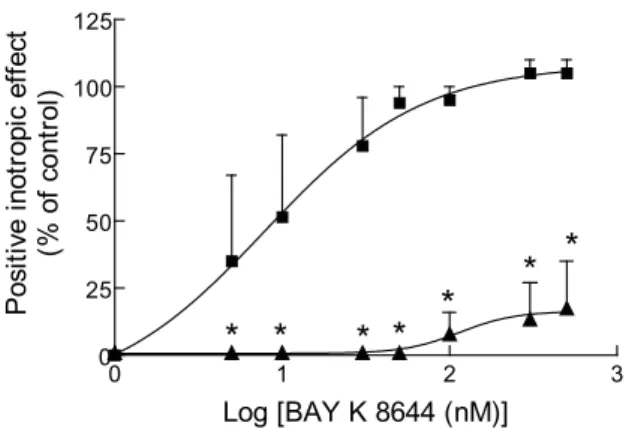
Figure 2 shows concentration-response curves for BAY K 8644 in the absence and in the presence of AqEx (1500 μg/mL). The extract shifted to the right the Hill-Langmuir curve and reduced the maximum effi cacy from 100 to 10 %. The EC50 of BAY K 8644increased from 7.8 ± 0.38 to 115.1 ± 0.44 nM in the presence of AqEx (N = 3 atria; p < 0.0001).
depicts the effect produced by AqEx (500 μg/mL) on the L-type calcium inward current in GH3 cells. The extract reduced the calcium current from 282 to 190 pA.
The effect of AqEx on the current-voltage plot concerned to the calcium inward current through the L-type calcium channels can be seen in Figure 4. The AqEx (500 μg/mL) reduced in 32 % the calcium current but did not change either the voltage related to the maximum current (-10 mV) or the inactivation kinetics of the L-type calcium channel.
DISCUSSION
Aqueous extract of A. carambola leaves (AqEx) reversibly reduced the contractility of guinea pig atrium in a concentration-dependent manner. When acting on the natural right atrial pacemaker, this extract promoted a signifi cant bradicardia (Vasconcelos et al., 2005). In guinea pig isolated heart, it was observed that AqEx induced different degrees of atrioventricular block (Vasconcelos et al., 2006). It is well known that drugs that reduce the membrane calcium inward current, besides exerting a negative inotropic effect on the myocardium, can also depress the atrial pacemaker activity and reduce the conduction velocity through the atrioventricular node. To shed light on this theme the present work sought to evaluate the effect produced by extracts of A. carambola leaf on the cellular calcium inward current. The investigation was performed on both guinea pig atrial tissue and GH3 neuroendocrine cells.
To evaluate the effect of AqEx on the L-type calcium current several experiments were performed by submitting the guinea pig left atrium to different concentrations of BAY K 8644. This agonist acts as a positive inotropic modulator by increasing the calcium channel opening time (Näbauer et al., 1988). Such effect is not mediated by the intracellular AMPc
5 10 30 50 100 300 500 BAY K 8644 (nM)
AqEx 1500 µg/ml
5 10 30 50 100 BAY K 8644 (nM)
Figure 1. Representative effect of AqEx on the positive
inotropic response to (±) BAY K 8644 observed on the guinea
pig left atrium. Upper panel: contractile response to different concentrations of BAY K 8644. Lower panel: BAY K 8644
inotropic effect in the presence of AqEx (1500 μg/mL). Vertical
lines are marks of experimental maneuvers (27 ± 0.1 °C,
Stimulation: 400 V, 0.5 ms, 2 Hz).
0 1 2 3
0 25 50 75 100 125
* *
*
*
*
*
*
Log [BAY K 8644 (nM)]
P
o
si
ti
ve i
n
ot
ropi
c ef
fe
ct
(%
of
co
nt
ro
l)
-350 -300 -250 -200 -150 -100 -50 0
-100 -50 0 50 100
Membrane potential (mV)
C
u
rre
n
t (p
A
)
Figure 2. Concentration-response curves for the positive
inotropic effect of BAY K 8644 on the guinea pig left atria
obtained in control (squares, EC50 = 7.8 ± 0.38 nM) and after
adding 1500 μg/mL of AqEx (triangles, EC50 = 115.1 ± 0.44
nM) to the bathing medium (N = 3 atria, * p < 0.0001; 27 ± 0.1
°C; Stimulation: 400 V, 0.5 ms, 2 Hz).
Figure 3. L-type calcium current recorded on GH3 cell. Control:
control current; AqEx: current recorded after adding AqEx (500
μg/mL) to the bath medium. Whole-cell currents were activated
by 100 ms pulses starting from -80 mV (holding potential) to 0 mV (test potential) every 5 s. Barium (10 mM) was used as the
cation charge carrier through the calcium channels (24 ± 1 °C).
Figure 4. Representative current-voltage curves of L-type
calcium inward current obtained in GH3 cells measured in
control medium (triangles) and during cell superfusion with
AqEx of A. carambola (500 μg/mL, open squares). Membrane
current was elicited by 100 ms test pulses starting from a holding potential of -80 to +70 mV with increments of 10 mV at each
concentration (Böhn et al., 1985). BAY K 8644 increases the myocardial contractile force due to its positive action on the L-type calcium current (Fassina et al., 1991). These fi ndings allowed us to investigate if the AqEx could exert its inotropic action by changing the calcium inward current in the mammalian myocardium. To do so, atrial concentration-response curves were obtained by progressively increasing the BAY K 8644 concentration in the organ bath. This protocol was
fi rstly executed before and then after adding the AqEx to the bath. The results showed that AqEx shifted that curve to the right leading to an increase of the EC50 from to 7.8 ± 0.38 to 115.1 ± 0.44 nM. Furthermore, it also reduced in 90 % the maximum inotropic effect of BAY K 8644. These data suggest the AqEx is able to reduce the calcium inward current explaining thus, at least in part, the negative inotropic effect of this leaf extract on the guinea pig atrial myocardium.
GH3 cells are known to express both T- and L-type calcium channels (Simasko et al., 1988). Because they are easily cultivated in the laboratory, our patch clamp experiments performed to measure calcium currents were carried out on those neuroendocrine cells. This investigation was done using barium as the charge carrier through the L-type calcium channel (Araújo et al., 2003). AqEx reduced in 30 % this inward current without changing the peak of the current-voltage curve. Such result suggests that the AqEx does not modify the L-type calcium channel kinetics but it reduces the magnitude of the calcium inward current possibly explaining the negative inotropic effect of the AqEx on the guinea pig atrial tissue.
ACKNOWLEDGMENTS
The authors are in debt to Professor Marlene Carvalho de Alencar Barbosa from the Herbarium of the Universidade Federal de Pernambuco for the botanical identifi cation of Averrhoa carambola L. The research was supported by Universidade Federal de Sergipe, CNPq, ELETROBRÁS and FAPITEC.
REFERENCES
Agra MF, Silva KN, Basílio IJLD, França PF, Barbosa-Filho JM 2008. Survey of medicinal plants used in the region Northeast of Brazil. Rev Bras Farmacogn 18: 472-508.
Araújo DAM, Mafra RA, Rodrigues ALP, Miguel-Silva V, Beirão PSL, Almeida RN, Quintans Jr L, Souza MFV, Cruz JS 2003. N-Salicyloyltryptamine, a new
anticonvulsant drug, acts on voltage-dependent Na+,
Ca2+, and K+ ion channels. Brit J Pharmacol 140:
1331-1339.
Bezanilla F, Armstrong CM 1977. Inactivation of the sodium channel. I. Sodium current experiments. J Gen Physiol 70: 549-566.
Böhm M, Burmann H, Meyer W, Nose M, Schmitz W, Scholz H 1985. Positive inotropic effect of BAY K 8644: cAMP independence and lack of inhibitory effect of
adenosine. N-S Arch Pharmacol 329: 447-450. Chang JM, Hwang SJ, Kuo HT, Tsai JC, Guh JY, Chen HC,
Tsai JH, Lai YH 2000. Fatal outcome after ingestion of star fruit (Averrhoa carambola) in uremic patients. Am J Kidney Dis 35: 189-193.
Chang C-H, Yeh J-H 2004. Non-convulsive status epilepticus and consciousness disturbance after star fruit (Averrhoa carambola) ingestion in a dialysis patient. Nephrology 9: 362-365.
Dorigo P, Gaion RM, Bergamin M, Giacometti A, Valentini E, Moragno I 1990. Comparison between the cardiac effects induced by muzolimine and furosemide in
guinea-pig atria. Cardiovasc Drugs Ther 4:
1477-1486.
Fassina G, Biasi M, Ragazzi E, Caparrotta L 1991. Adenosine: a natural modulator of L-type calcium channels in atrial myocardium? Pharmacol Res 23: 319-326. Hamill OP, Marty A, Neher E, Sakmann B, Sigworth FJ 1981.
Improved patch-clamp techniques for high-resolution current recording from cells and cell-free membrane
patches. Pfl ügers Arch 391: 85-100.
Martin LC, Caramori JST, Barreti P, Soares VA 1993. Soluço intratável desencadeado por ingestão de carambola (“Averrhoa carambola”) em portadores de
insufi ciência renal crônica. J Braz Nefrol 15: 92-94.
Muir CK, Lam CK 1980. Depressant action of Averrhoa carambola L. Med J Malaysia 34: 279-280.
Näbauer M, Brown L, Edmann E 1988. Positive inotropic effects of the calcium channel activator BAY K 8644 on guinea-pig and human isolated myocardium. N-S Arch Pharmacol 337: 85-92.
Neto MM, Costa JA, Garcia-Cairasco N, Netto JC, Nakagawa B, Dantas M 2003. Intoxication by star fruit (Averrhoa carambola) in 32 uraemic patients: treatment and outcome. Nephrol Dial Transplant 18: 120-125. Oliveira VPV, Cavalcanti FS, Bezerra CLF, Pinto JL 1989.
Plantas medicinais: considerações ecológicas e uso popular. Salusvita 8: 49-58.
Pio-Correa M 1931. Dicionário de plantas úteis do Brasil. Ministério da Agricultura, Brasil.
Simasko SM, Weiland GA, Oswald RE 1988. Pharmacological characterization of two calcium currents in GH3 cells. Am J Physiol Endocrinol Metab 254: E328-E336. Tsai M-H, Chang W-N, Lui C-C, Chung K-J, Hsu K-T, Huang
C-R, Lu C-H, Chuang Y-C 2005. Status epilepticus induced by star fruit intoxication in patients with chronic renal disease. Seizure 14: 521-525.
Tse K-C, Yip P-S, Lam M-F, Choy B-Y, Li F-K, Lui S-L, Lo W-K, Chan T-M, Lai K-N 2003. Star fruit intoxication in uraemic patients: case series and review of the literature. Int Med J 33: 314-316.
Vasconcelos CML, Araújo MS, Silva BA, Conde-Garcia EA 2005. Negative inotropic and chronotropic effects on the guinea pig atrium of extracts obtained from Averrhoa carambola L. leaves. Braz J Med Biol Res 38: 1113-1122.
Vasconcelos CML, Araújo MS, Conde-Garcia EA 2006. Electrophysiological effects of the aqueous extract of Averrhoa carambola L. leaves on the guinea pig heart. Phytomedicine 13: 501-508.