AR
TICLE
1 Departamento de Ciências Sociais, Escola Nacional de Saúde Pública, Fiocruz. R. Leopoldo Bulhões 1480, Manguinhos. 21041- 210 Rio de Janeiro RJ Brasil. nilsondorosario@ terra.com.br
Street-level Bureaucracy and Social Policy in Brazil
Abstract This paper describes the Brazilian cen-tral government bureaucracy and people with disabilities’ access to the Continuous Cash Benefit (BPC). This access depends on the Ministry of So-cial Security bureaucracy’s evaluation of the con-dition of vulnerability. We performed a literature review, analysis of secondary data from time se-ries and cross-sectional data to describe street-lev-el federal bureaucracy. Legal documents and indi-cators describe the expert evaluation regimen of the Ministry of Social Security (MPS). This paper shows the uneven growth of the number of career public servants of the central government in the last two decades. The Brazilian central govern-ment has adopted the international concept of person with disabilities in the evaluation of BPC applicants. Despite this decision, it is shown that the Brazilian central government expanded selec-tively the career bureaucracy to work in the social area. It was found that the result of the evalua-tion process was quite strict, favoring applicants in conditions of extreme biomedical vulnerability. Despite adopting the social model, BPC eligibility is tied to medical diagnosis.
Key words Social policy, People with disabilities,
Street-level-bureaucracy, Medical diagnosis, Ac-cess
Nilson do Rosário Costa 1
Introduction
This paper analyzes the decision-making model to assess the eligibility of persons with disabili-ties to the Continuous Cash Benefit (BPC). BPC was formalized in the Federal Constitution of 1988 (FC-88) and regulated by the Social Welfare Organic Law (LOAS) in December 1993. Access to BPC is tied to the evaluation of street-level bureaucracy. If disabled persons are assessed in a situation of vulnerability, a continuous gov-ernment income is provided to them to cater for basic needs. This work analyzes the effects of the guidelines of the International Convention on the Rights of Persons with Disabilities, ratified by Federal Decree Nº 6.949 dated August 25, 2009, within Brazilian social protection1.
As highlighted by Silva & Diniz, the Conven-tion adopted a comprehensive conceptualizaConven-tion for the disabled person that influenced the deci-sions of the Brazilian government. Thus, Brazil-ian legislation defines that persons with disabili-ties have long-term physical, mental, intellectual or sensorial impediments that may obstruct their total and effective participation in society in equal conditions with other people2.
This expanded conceptualization favored the deconstruction of the narrative of the decrees and regulations that defined disability at the in-dividual level as a bodily phenomenon associ-ated with the lack of functional parts or limita-tions3. According to Silva & Diniz, after formal
ratification at the governmental level, there was a need to fit what is known as the “expert and social regime for the assessment of disability” to the supra-national principles of the Convention ratified by Brazil2. Authors said that the new BPC
granting regulations set forth in the LOAS incor-porate the broad set of principles for the protec-tion of persons with disabilities contained in the Convention, but return the discursive authority on the disabled body to the biomedical field2.
Worth noting in this paper is that the dis-cursive authority in the evaluation of disabled persons is exercised by specialized bureaucracies firmly established in the state apparatus. BPC access mechanisms are thus not constrained by the widespread practice of patronage, typical of clientelist exchanges identified in other areas, but suffer the consequences of the application of standardized routines of technical assessment of the vulnerability of individuals who declare or are declared by a third party as persons with a disability. Thus, this self-assessment of appli-cants’ disability status is subject to judgment by
a specialized career bureaucracy of the Executive power. The effects of the international guidelines on the BPC implantation and development stan-dard are not so obvious and linear as most do-mestic studies tend to reiterate in a surprisingly uncritical way.
Cavalcante & Lotta have correctly pointed out the lack of empirical studies on the professional bureaucracies that holding positions within the Brazilian federal government. Authors argue that the intervention of the professional street-level bureaucracy in the administration and regula-tion of allocative decisions of social policies is one of the areas of extreme relevance of the na-tional governmental action that needs to be stud-ied4. In the book Bureaucracy and Health Policy
Implementation5 (English free translation from
the Portuguese title), Lotta provides a specific contribution to the field of collective health by analyzing the processes of final delivery of pol-icies through a street-level sectoral bureaucracy, focusing on the Family Health Strategy. Follow-ing this perspective, this papers aims to situate the organizational mechanisms that influence the implementation of public policies within the scope of Brazilian social security, which includes health, as a special attention to the intervention of the medical professional bureaucracy.
The intellectual production of the Brazilian professional street-level bureaucracy can be clas-sified into three main currents: the first results from the explanation of the role of the burecratic apparatus of developmentalist bias in au-thoritarianism (1964-1985)6,7; the second is the
result of the reflection on the agenda of the un-finished administrative reform of the first years
of democratic government (1995-2002)8,9 and
the third is dedicated to the description of the recent growth of the federal government bureau-cracy influenced by the service delivery require-ments of the social and budgetary and fiscal co-ordination areas (1995-2016)10-13.
In convergence with the third article, it is interesting to argue in this article that the con-stitutionalization of social rights can be strong-ly associated with the expanded state apparatus, strengthening what Pereira has called the “uni-versalist and meritocratic” feature of the high federal bureaucracy in recent years14. The
aúd
e C
ole
tiv
a,
22(11):3505-3514,
2017
combination of the process of bureaucratic mod-ernization vis-à-vis expanded social citizenship.
The BPC was formulated and implemented as a public policy highly focused on the elderly pop-ulation and people with disabilities in extreme poverty, integrating Basic Social Protection with-in the scope of the Unified Social Welfare System (SUAS)1. Currently, people who are 65 years of
age or older and people with disabilities who are unable to cater for their own livelihood or whose families cannot afford to do it for them are eligi-ble for a minimum wage.
The condition of inability to provide survival conditions is measured by the bureaucracy of the Ministry of Social Security through the quantifi-cation of social risks by the National Institute of Social Security (INSS). A crucial variable in eligi-bility is the applicant’s family situation. The fam-ily is incapable of providing subsistence when the household per capita income is less than ¼ of the minimum wage.
The family group includes those who live under the same roof – the applicant, the spouse, the companion, the non-emancipated child, in any condition, under the age of 21 or disabled, the parents, and the non-emancipated brother, in any condition, under 21 or disabled. The house-hold income is calculated by considering the sum of gross income earned monthly by the mem-bers and composed of wages, salaries, pensions, private pension benefits, commissions, per-job compensation, other income from self-employ-ment, income from the informal or autonomous market and income earned from equity1.
Bureaucracy and Medical Diagnosis
Within the scope of the Brazilian central gov-ernment, the evaluation of the eligibility condi-tion of the person with disability is the responsi-bility of individuals of professions recognized by law and holding monopolies of competence. It is worth highlighting the role of the paradigmatic profession of physicians, which holds the mo-nopoly of competence to diagnose the condition of functional vulnerability of BPC applicants. The intervention of the medical profession is a central reference in the functioning of the expert and social system to evaluate disabled persons. Doctors compose a state career with high deci-sion-making autonomy with the technical scope in the operational structure of the MPS/INSS.
The influence of professional bureaucracy on government decision-making is widely rec-ognized in the field of social sciences, while little
studied in collective health. Lipsky was one of the first to identify that value, opinion, preference of professions influence the development of public policies. Professionals working in government organizations are categorized by the author as street-level bureaucracy. This state bureaucracy has discretionary power in the exercise of author-ity15. Discretionary power stems from the relative
autonomy that they have when policies are imple-mented. They are the ones that decode the rules that affect the users or demanding parties. As Lipsky points out, the discretion exercised by bu-reaucrats is also the result of the interaction be-tween their values, the values of other stakehold-ers involved, procedures, incentives, structures and prohibitions at the organizational level15.
The analysis of the position of the public bu-reaucracy is thus justified by the impact it has on the life of the average citizen in determining eli-gibility for social benefits, mediating the institu-tional relationship with the State apparatus. This may be a radically new realm in understanding the place of Brazilian street-level bureaucracy. We are before street-level bureaucracy linked to the social protection structure consolidated in the last decades in the country16 and that
inter-acts directly with the citizen.
Most of the times, Brazilian public service us-ers cannot choose the services to which they are linked. They must accept the schools, health or social services of their municipality or region. If they are poor, as Keizer17 points out in another
context, they must accept government arrange-ments for health care, income transfers, housing programs, or other social programs.
It is important to note that the criteria for evaluating BPC applicants were explicitly subject to biomedical guidance in Brazil until the end of the 1990s. In that period, disability assessment was the sole responsibility of INSS Medical Ex-perts. Persons with disabilities’ access to the BPC required, essentially, complying with the per cap-ita household income criteria and the character-ization of disability in purely biomedical terms, as inability to work and have an independent life.
The evaluation performed by INSS medical experts verified the ability to work, the level of visual, hearing, motor and speech difficulties; the level of difficulty to perform daily life activities, such as personal hygiene, food and clothing; the evacuation control level; the dependence of per-manent care of health professionals or others, and diagnosed schizophrenia18.
new procedures for social and medical evaluation of people with disabilities applying for BPC1. The
evaluation started to be performed by the two professional communities – INSS Social Workers and Medical Experts – with functional attribu-tions of evaluating social and environmental bar-riers, bodily functions change, limited activities and restricted social participation1.
Article 2 of Joint Ordinance MDS/INSS N° 1/2009 detailed the division of labor of social workers and medical experts and formal proce-dures for the assessment of the disabled and the “level of incapacity”. The social evaluation pro-poses to qualify: 1) the so-called “environmen-tal factors” through “realms”: products, living conditions and environmental changes; support and relationships; attitudes; services, systems and policies; 2) activities and social participation for those over and under 16 years of age through analysis of the “realms” interpersonal relation-ship and interaction and community, social and civic life. The evaluation of the social service is carried out through a face-to-face interview with the applicant at the headquarters of an MPS agency.
The medical evaluation checks the bodily functions via anamnesis, considering the follow-ing “realms”: mental, vision, hearfollow-ing, voice and speech sensory functions, skin, genitourinary, neuromusculoskeletal and movement-related functions and the cardiovascular, hematological, immunological, respiratory, digestive, metabolic and endocrine systems.
The evaluation of the medical expert should also qualify the activity and participation through the “realms” of learning and application of knowledge, tasks, communication, mobility and personal care. In any case, it should be noted that the diagnosis of changes in bodily functions is exclusively assigned by medical experts and prevails over the social evaluation of social work-ers. Intensity of functional limitations and con-straints is defined in five (5) levels: none, mild, moderate, severe, and total.
The new international guidelines supported by the World Health Organization (WHO) have forced national states to broaden their under-standing of disability mainly through the dis-semination of the International Classification of Functioning, Disability and Health (ICF)19.
In ICF, human functionality problems are cate-gorized into three areas: changes in bodily struc-tures and functions; limitations to perform ac-tivities such as walking or eating, and restricted participation in multiple aspects of life, such as
discrimination in employment or transporta-tion. However, WHO recognizes the autonomy of national states to set limits on the severity of disability, limitations to perform activities or re-stricted participation20.
In the Brazilian experience, due to the adop-tion of an extremely low household income lim-it and the biomedical risk categories, the MPS/ INNS decision-making process was not immune to the challenge – although ICF guidelines were the normative reference. It is worth mentioning the influential revisionist intervention of the BPC eligibility decisions exercised in recent years by the Judiciary1. The establishment of the limit
of a basic income by the BPC has also been sub-ject of debate in the specialized literature. Silva & Diniz reiterate that the reduced social minimum needs pose a threat to universal social welfare in Brazil2.
It is especially important to highlight the crucial role played by medical diagnosis based on the conception of specific diseases that ex-ist regardless of the individual21. As Rose points
out, medicine is associated with the scheme of values where individuals are described in terms of health and disease and patterns of normality and pathology. The truth of the diagnosis is not based on “subjective narrative” or the description of “symptoms” – considered as sources of error. The exercise of diagnosis consolidates a system of expert knowledge and increases the power of the medical sphere22. This power is increased when
such diagnoses condition access to social rights23.
Therefore, this paper considers that a complete shift from the expert medical scheme to the so-cial ICF-based model is not identifiable in the organizational process of evaluation of BPC ap-plicants, but rather a conflict between normative principles on the conceptualization of persons with disabilities.
Methodology
aúd
e C
ole
tiv
a,
22(11):3505-3514,
2017
were used to demonstrate the trend and scope of bureaucracy of the Brazilian central government. The main descriptive variables of the historical series are: 1) Number of active central govern-ment servants; 2) Number of active MPS, istry of Health, Ministry of Education and Min-istry of Budget and Management servants. The relative participation of INSS medical experts in this structure is shown with data from the 2006 and 2015 Statistical Yearbook of Social Security.
The Statistical Bulletin of Social Security was used to describe the number of beneficiaries of the General Social Security Regime and BPC beneficiaries. This information is shown accord-ing to the different national governments and the different areas of administration of public pol-icies of the period: government Fernando Hen-rique Cardoso (FHC) (1997-2002); Luís Inácio Lula da Silva (2003-2010) and Dilma Rousseff (2011-2016). Following Souza’s analysis24, for
de-scriptive purposes, we consider that different co-alitions of government and different public pol-icies faced the task of modernizing the State-so-ciety relationship and State-State in Brazil in the last decades.
This paper uses the log-linear model de-scribed by the equation ln Yt = β1 + β2t + µt to analyze the mean variation of the overall num-ber of bureaucracy in central government and of selected ministries. The log-linear model is like any other linear regression, in which parameters
β1 and β2 are linear. The difference here is that
the regressand is the logarithm of Y and the in-dependent variable is time, represented by “t”, which will assume values of 1,2,3, +...+ n, [...]”, corresponding to the analyzed period25.
The source used in the analysis of the MPS medical professional bureaucracy decision-mak-ing pattern is the balance of deferrals and denials according to the intensity of medical diagnosis on the bodily functions limitations and restric-tions of the Continuous Cash Benefit Assessment System for Persons with Disabilities (SIAVBPC). These data were produced in the Research Proj-ect “Improvement of Public Policy for Persons with Disabilities and Elderly Persons”, a part-nership between the Oswaldo Cruz Foundation and the Petrópolis Medical School, based on a collaboration agreement with the Ministry of Social Development and Fight against Hunger – 2015-2017.
Results
The recent expanded federal bureaucracy was well described in the works of Cavalcante & Carval-ho11, Nunberg & Pacheco13 and Souza24. Graphic
1 allows us to identify two distinct moments of this trend in the last decades: the first, of decline (1997-2002) during the FHC government, and the second, of reversion or rearrangement of the active staff in subsequent governments (2003-16). The decentralization processes in the health area, the acceleration of pensions and reduced frequency of public tenders, besides the privat-izations of federal companies influenced the ex-pressive decrease of the federal bureaucracy of the first moment; in the second period, the fed-eral government began to significantly expand the number of public tenders, which elevated the annual number of new servants11,24.
Table 1 also shows that the mean annual vari-ation in the number of public servants was quite uneven among the different areas of activity of the central government (Table 1). For compar-ison purposes, Table 1 shows the trend of the statutory bureaucracy of the Ministries of Social Security, Health, Education and Planning and Budget, and the federal government as a whole.
Surprising in Table 1 is the increased number of servants of the Ministry of Education, driven by the massive entry of teachers and technicians in federal universities, as also observed by Nun-berg & Pacheco13 and Souza24. The area of
educa-tion grew on average at a rate of 3% in the period, with great expansion of the last 5 years of the his-torical series. The same growth can be observed in relation to MPOG, which had similar average expansion of 2.1% per year in the period 1997-2016, with a significant hike in the 2015-2016 bi-ennium. Health and social security sectors were the most affected by the reduced number of ser-vant over 20 years, with an annual average fall of 0.66 and 0.72 in the period, respectively.
Graphic 2 further shows the variation in the number of MPS servants in the federal bureau-cracy structure in the period 1997-2016. Graphic 2 evidences that the decline in the MPS statutory workforce has become more pronounced since 2006.
between 2000 and 2016. This robust elevation indicates that the dissemination of managerial routines aimed at increasing workforce’s pro-ductivity was certainly intense in the MPS/INSS structure.
In the general context of reducing MPS/ INSS staff and growing productivity, it is also worth noting the insignificant decline of the propor-tional participation of medical experts in the INSS statutory human resources structure be-tween 2006 and 2015, as shown in Table 2. The reduced number of medical experts by a mere 3.3% in the period reveals that the supposed shift of the evaluation model centered on medical ex-pertise has marginally affected the position of the profession in the MPS/INSS structure.
The authority suffered a flattening of 12.6% in the statutory staff in the 2006-2015 period, fol-lowing the framework observed for the MPS be-tween the two decades. Table 2 also shows a mon-umental reduced participation of social welfare in the composition of the INSS professional bu-reaucracy, at 25% of the workforce between 2006 and 2015. This reveals an unexpected contradic-tion between the adopcontradic-tion of the guideline for expanding the evaluation criteria and decreasing, in absolute terms, the share of the street-level bu-reaucracy with a greater propensity to accept the normative guidelines of the expanded evaluation inspired by the ICF.
Graphic 1. Variation of the statutory workforce of the Brazilian federal government - 1997-2016.
Source: Brasil. Ministério do Planejamento, Desenvolvimento e Gestão. Estatística de Pessoal e Informações Organizacionais. Brasília. Outubro, 2016.
T
otal f
ed
er
al statu
to
ry ci
v
il se
rv
ants
years 1997-2016
Governments FHC_Lula_Dilma
+ FHC Lula Dilma
Table 1. Annual mean variation of the number of statutory civil servants in the central government and selected ministries - 1997-2016.
Central Government and Ministries
Annual Mean Variation
Brazilian Central Government 1.3
Ministry of Education 3.0
Ministry of Health (0.72)
Ministry of Planning, Development and Management
2.1
Ministry of Social Security (0.66)
aúd
e C
ole
tiv
a,
22(11):3505-3514,
2017
Graphic 2. Variation of the number of statutory servants of the ministry of social security (MPrev) – Brazil – 1997-2016.
Source: Brasil. Ministério do Planejamento, Desenvolvimento e Gestão. Estatística de Pessoal e Informações Organizacionais. Brasília. Outubro, 2016.
Lo
g.
MPRE
V statu
to
ry se
rv
ants
years 1997-2016
Governments FHC_Lula_Dilma
+ FHC Lula Dilma
Graphic 3. Beneficiary/MPS statutory servant ratio.
Source: Brasil. Ministério do Planejamento, Desenvolvimento e Gestão. Estatística de Pessoal e Informações Organizacionais. Brasília. Outubro, 2016.
B
eneficiar
y/MPS S
er
v
ant R
at
io
Period 2000-2016
Governments
Given this setting, the analysis of the results of medical expertise performance in 2010 reveals a severe final decision-making process – only 50.5% of the 414,000 BPC application were ap-proved. In the same year, the approval rate of disability allowance applications to the General Social Security Scheme (RGPS) was 61%26. If the
same standard of decision-making for the diag-nosis of medical experts for the RGPS applicant were observed for the disabled persons demand to the federal government, 39,000 BPC applicants would be included in the public policy in 2010.
Table 3 also shows the remarkable preference for deferral of applicants when diagnosed on the scale of changes in bodily functions in the condi-tion of extreme disability (severe (98%) or total (100%)). There are clear indications of medical diagnostic prevalence in the eligibility decision, despite the introduction of the social assessment model in 2009. Thus, Table 3 also demonstrates that all the requirements of persons assessed as having no change or slight alteration in bodily functions were denied. It is quite plausible that a non-irrelevant portion of the applicants diag-nosed in biomedical terms as having no alter-ation or slight alteralter-ation in bodily functions has been evaluated by the social service in the situa-tion of severe or total vulnerability according to
the “environmental factors” and was consequent-ly rejected.
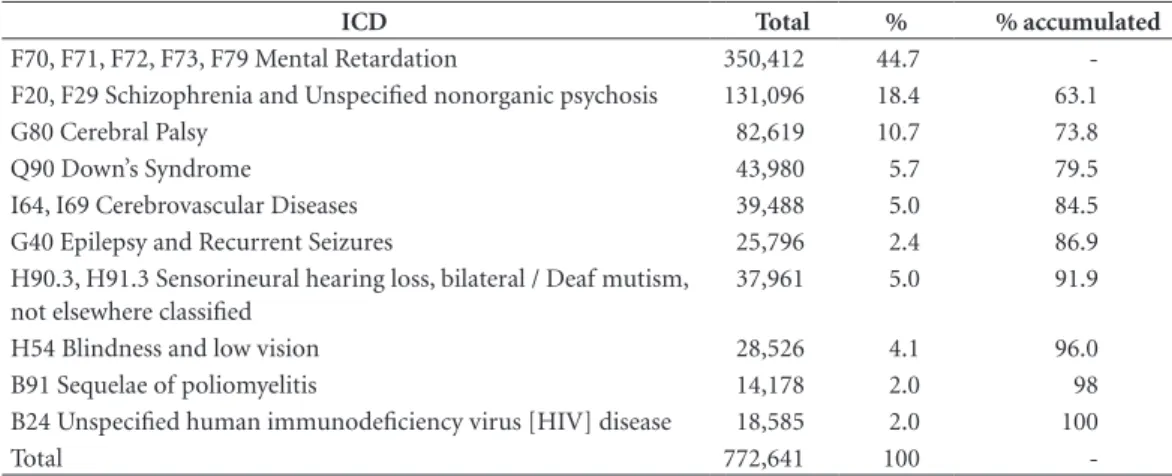
Table 4 shows the medical diagnosis of a sample of 772,641 active BPC beneficiaries in December 2015, according to the International Statistical Classification of Diseases and Related Health Problems (ICD). This year, the total num-ber of BPC beneficiaries as persons with a dis-abilities totaled 2,323,797 individuals27.
In Table 4, particular attention is drawn to the fact that 43% of sample beneficiaries were diagnosed with “mental retardation” according to the ICD (ICD F70-F79). The medical diag-nostic category “mental retardation” is similar to what, for example, in the 2013 National Health Survey (PNS) is categorized as “intellectual dis-ability”. It is worth noting that, in the PNS, the estimated prevalence of “intellectual disability” is only 0.8% in the Brazilian population, without regional variation28.
According to Table 4, the neuropsychiatric diagnosis, when grouped, accounts for 86.9% of the sample of 772,641 active BPC beneficiaries of people with disabilities in 2015. This paradoxical result allows us to enquire about the scope of the repertoire of diagnoses of INSS medical experts within the BPC. In what way does this restricted repertoire differ from the perception of common
Table 2. Variation in the number of medical experts and social workers in the INSS organizational structure – 2006-2015.
Descritors 2006 2015 Variation
Total Statutory Servants 43,623 38,130 (12.6)
Medical Experts 4,866 4,704 (3.3)
Social Workers 563 420 (25.4)
Source: Brasil. Ministério da Previdência Social Anuário Estatístico da Previdência Social – 2008 e 2015.
Table 3. Results of the evaluation of the applicants by the INSS medical experts according to the bodily functions change criteria – Brazil – 2010.
Bodily Functions Change Applicants (A) Granted (B) Grant Ratio (B/A*100)
None 39,214 0 0.0
Mild 108,538 0 0.0
Moderate 110,081 63,002 57.2
Severe 111,597 103,258 92.5
Total 44,720 42,369 94.7
Total 414,150 208,629 50.4
aúd
e C
ole
tiv
a,
22(11):3505-3514,
2017
Table 4. Active Beneficiaries for the Person with Disabilities according to the International Statistical Classification of Diseases and Related Health Problems ICD 10 – Brazil – December – 2015.
ICD Total % % % accumulated
F70, F71, F72, F73, F79 Mental Retardation 350,412 44.7
-F20, F29 Schizophrenia and Unspecified nonorganic psychosis 131,096 18.4 63.1
G80 Cerebral Palsy 82,619 10.7 73.8
Q90 Down’s Syndrome 43,980 5.7 79.5
I64, I69 Cerebrovascular Diseases 39,488 5.0 84.5
G40 Epilepsy and Recurrent Seizures 25,796 2.4 86.9
H90.3, H91.3 Sensorineural hearing loss, bilateral / Deaf mutism, not elsewhere classified
37,961 5.0 91.9
H54 Blindness and low vision 28,526 4.1 96.0
B91 Sequelae of poliomyelitis 14,178 2.0 98
B24 Unspecified human immunodeficiency virus [HIV] disease 18,585 2.0 100
Total 772,641 100
-Source: Brasil. Ministério do Desenvolvimento Social e Combate à Fome. Boletim - BPC 2015. Benefício de Prestação Continuada. Brasília: Secretaria Nacional de Assistência Social, 2015, p. 20-21.
sense regarding persons with disabilities? Does overrepresentation of the neuropsychiatric diag-nosis mean that the other diagnostic categories listed or missing in Table 4 are being routinely rejected?
Discussion
This paper shows that the Brazilian central gov-ernment has a specialized bureaucracy that acts with high autonomy in the decisions of eligibility to social benefits. This bureaucracy makes BPC eligibility decisions via evaluation procedures influenced by professional values. While this de-cision-making process distances itself from the patrimonial practices attributed to Brazilian so-cial welfare as a whole29, it is necessary to reflect
on whether the preferences of this bureaucracy fit the objectives of the public policy.
This paper shows that the introduction of the new BPC social evaluation model at the end of the last decade occurred in a context of effec-tive decline in the relaeffec-tive participation of the workforce with stability in the bureaucratic ca-reers of Brazilian social security. The systematic decreased number of social welfare professionals was an unexpected result of the reduced statutory workforce of MPS/INSS in the last two decades. This paper also shows that the reduced share of medical experts was negligible in the period. Giv-en this evidGiv-ence, the thesis of a detachmGiv-ent of the decision-making role of the biomedical field in the evaluation of BPC applicants in the scope of MPS/INSS can hardly be sustained.
The critical point of the Brazilian experience can be attributed to the ongoing normative con-flict between the biomedical model and the social model in the BPC eligibility process. This paper demonstrates that, despite mediation of the so-cial model through the influence of international guidelines and domestic legislation, BPC eligibil-ity is subjected to clinical diagnosis, which favors limitations defined in biomedical terms by a spe-cialized bureaucracy.
There is no doubt that the country needs to broaden the reflection on the condition of access of disabled persons to the BPC and the reliability of the diagnosis-based final decision. This pro-cess will facilitate the acpro-cess of more vulnerable individuals to established rights and, in the face of refusal, such individuals could have more el-ements for legitimate political action and even judicial demand.
Acknowledgments
References
1. Costa NR, Marcelino MA, Duarte CMR, Uhr D. Pro-teção Social e Pessoa com Deficiência no Brasil. Cien Saude Colet 2016; 21(10):3037-3047.
2. Silva JLP, Diniz D. Mínimo social e igualdade: deficiên-cia, perícia e benefício assistencial na LOAS. R. Katálisis 2012; 15(2):262-269.
3. França TH. Modelo Social da Deficiência: uma ferra-menta sociológica para a emancipação social. Lutas Sociais 2013; 17(31):59-73.
4. Cavalcante P, Lotta G. organizadores. Burocracia de Médio Escalão: perfil, trajetória e atuação. Brasília: ENAP; 2015.
5. Lotta G. Burocracia e Implementação de Políticas de Saúde. Rio de Janeiro: Editora Fiocruz; 2015.
6. Martins L. Estado Capitalista e Burocracia no Brasil Pós 64. Rio de Janeiro: Paz e Terra; 1985.
7. Schneider B. Burocracia Pública e Política Industrial no Brasil. São Paulo: Editora Sumaré; 1994.
8. Abrucio FL, Pedroti P, Pó MV. A Formação da Buro-cracia brasileira; trajetória e o significado das reformas administrativas. In: Loureiro MR, Abrucio FL, Pacheco RS. organizadores. Burocracia e Política no Brasil. São Paulo: Editora FGV; 2010. p. 27-72.
9. Abranches SHD. Presidencialismo de coalizão: o dilema institucional brasileiro Revista Dados 1988; 31(1):5-32. 10. Loureiro MR, Olivieiri C, Martes ACB. Burocratas, Par-tidos e Grupos de Interesse: o Debate sobre política e Burocracia no Brasil. In: Loureiro MR, Abrucio FL, Pa-checo RS, organizadores. Burocracia e Política no Brasil. São Paulo: Editora FGV; 2010. p. 73-109.
11. Cavalcante P, Carvalho P. Profissionalização da Buro-cracia Federal Brasileira (1995-2014): avanços e dile-mas. Rev. Adm. Pública 2017; 51(1):1-26.
12. Organization for Economic Cooperation and Devel-opment (OECD). 2008. “Brazil: Strengthening Gover-nance for Grow. [acessado 2017 Jan. 18]. Disponível: http://www.oecd.org/dataoecd.pdf.
13. Nunberg B, Pacheco RS. Public Management Incon-gruity in 21st Century in Brazil. In: Schneider R, editor. New Order and Progress. Development and Democracy in Brazil. New York: Oxford University Press; 2016. p-134-161.
14. Pereira AW. Is the Brazilian State “Patrimonial”? Latin American Perspectives, 2016; 43(2):135-152.
15. Lipsky M. Street-Level Bureaucracy. New York: Russel Sage Foundation; 2010.
16. Cardoso JC, Jaccoud L. Políticas Sociais no Brasil: Or-ganização, Abrangência e Tensões da Ação Estatal, In: Jaccoud L, organizadora. Questão Social e Políticas So-ciais no Brasil Contemporâneo. Brasília: IPEA; 2009. 17. Keiser LR. Understanding Street-Level Bureaucrats’
Decision Making: Determining Eligibility in the Social Security Disability Program. Public Administration Re-view 2010; 3(2):247-257.
18. Medeiros M, Diniz D, Squinca F. Cash Benefits to Dis-abled Persons in Brazil: an Analysis of BPC (Continuous Cash Benefit). Brasília: IPEA; 2006. (Texto para Dis-cussão, n.1166)
19. Evans T, Harris J. Street-Level Bureaucracy, Social Work and the (Exaggerated) Death of Discretion. Brit-ish Journal of Social Work 2004; 34(1):971-895. 20. Organização Mundial da Saúde (OMS). Relatório
Mundial sobre a Deficiência. São Paulo: Secretaria de Estado dos Direitos da Pessoa com Deficiência de São Paulo; 2011.
21. McGann PJ, Hutson DJ. Sociology of Diagnosis. Bingley: Emerald Group Publishing; 2011.
22. Rose N. Reassessing. Medicine, History and the Pres-ent In: Jones C, Porter R, editors. Reassessing Foucault – Power Medicine and the Body. London: Routledge; 1994.
23. Rosenberg C. The Tyranny of Diagnosis: Specific and Individual Experience. Milibank Quarterly 2002; 80(20):237-260.
24. Souza C. State modernization and the building of bu-reaucratic capacity for the implementation of federal-ized policies. Brazilian Journal of Public Administration 2017; 51(1):27-45.
25. Gujarati DM. Basic Econometrics. New York: Mc-Graw-Hill; 1995.
26. Brasil. Ministério da Previdência Social. Boletim Esta-tístico da Previdência Social [documento na Internet]. 2013 Jan [acessado 2017 fev 23]; 19(1):[cerca de 4 p.]. Disponível em: www.previdencia.gov.br/wp-content/ uploads/2013/05/Beps012014_final.xls
27. Brasil. Ministério do Desenvolvimento Social e Com-bate à Fome. Boletim - BPC 2015. Benefício de Prestação Continuada. Brasília: Secretaria Nacional de Assistência Social; 2015.
28. Instituto Brasileiro de Geografia e Estatística (IBGE). Pesquisa Nacional de Saúde: 2013: ciclos de vida: Brasil e grandes regiões. Rio de Janeiro; 2015.
29. Witvliet MI, Kunst AE, Stronks K, Arah OA. Assessing Where Vulnerable Groups Fare Worst: A global multi-level analysis on the impact of welfare regimes on dis-ability across different socioeconomic groups. J Epide-miol Community Health 2012; 66(9):775-781.
Article submitted 15/05/2017 Approved 03/07/2017