Original Article
Artigo Original
Communication self-assessment by public
prosecutors in a north-eastern
Brazilian state
Autoavaliação da comunicação em promotores
de justiça em um estado do nordeste, Brasil
Neuza Josina Sales1 Daniel Francisco Neyra Castaneda1 Íkaro Daniel de Carvalho Barreto2 Marina Paoliello3 Silvia Márcia Andrade Campanha4
Keywords
Public Attorneys Voice Speech Communication Motivation Psychological Stress Persuasive Communication
Descritores
Ministério Público Voz Fala Comunicação Motivação Estresse Psicológico Comunicação Persuasiva
Correspondence address: Neuza Josina Sales
Rua Senador Rolemberg, 550/701, Bairro São José, Aracaju (SE), Brazil, CEP: 49015-120.
E-mail: [email protected]
Received: September 14, 2015 Study carried out at Ministério Público do Estado de Aracaju, Aracaju (SE), Brazil.
1Universidade Federal de Sergipe – UFS - Aracaju (SE), Brazil.
2Universidade Federal Rural de Pernambuco – UFRPE - Recife (PE), Brazil. 3ACT Comunicação - Belo Horizonte (MG), Brazil.
4Universidade Federal de Mato Grosso do Sul – UFMS - Campo Grande (MS), Brazil.
Financial support: nothing to declare.
Conlict of interests: nothing to declare.
ABSTRACT
Purpose: To describe how public prosecutors self-assess their communication approaches and how listeners react to them; to analyze how this relates to gender, age, and work experience. Methods: Descriptive, transversal study. A questionnaire was developed and sent to 126 public prosecutors for completion. Thirty-three completed questionnaires were sent back. The independent variables were gender, age, and number of years of professional experience. The dependent variables were communication self-assessment throughout the years of work, communication parameters used, and listeners’ reactions. A descriptive analyzis and Fisher’s Exact Test was carried out. Results: the sample contained both male and female participants with a median age of 43 years and an average of 20 years of professional experience. Most of the respondents claimed they had experienced demotivation, insecurity, tension, and dificulty when trying to convince listeners. More women than men reported they felt that their communication had worsened throughout their careers. All the women reported they experienced insecurity when speaking in public. One third of the public prosecutors stated they suffered from disorders on their voice. Those respondents aged over 43, experienced greater proportion on voice change than younger ones. In contrast to their younger colleagues, the majority of public prosecutors with more than 20 years of professional experience revealed that they felt insecure when speaking in public. Conclusion: the public prosecutors identiied their strong and weak communication parameters. Gender, age, and work experience affect communicative performance.
RESUMO
Objetivo: Descrever a autoavaliação do promotor de justiça quanto à sua comunicação e reação do ouvinte e analisar a relação com o gênero, idade e anos de trabalho. Método: Desenho descritivo, transversal. Foi elaborado um questionário e enviado aos 126 promotores, sendo devolvidos 33 questionários preenchidos. As variáveis independentes foram o gênero, idade e anos do exercício proissional. As variáveis dependentes foram a autoavaliação da comunicação ao longo dos anos de trabalho, os parâmetros de comunicação utilizados e a reação do ouvinte. Foi realizada análise descritiva e o Teste Exato de Fisher. Resultados: A amostra foi constituída por ambos os gêneros, mediana de 43 anos de idade e 20 anos de trabalho. A maioria dos respondentes referiu que ao falar em público sente desmotivação, insegurança, tensão e diiculdade de persuadir o ouvinte. Houve maior proporção em mulheres de piora da comunicação ao longo dos anos de trabalho que em homens. Todas as mulheres relataram insegurança ao falar em público. Um terço dos promotores referiu alteração de voz. Os respondentes com mais de 43 anos de idade tiveram maior proporção de voz alterada que aqueles com idade menor. A maioria dos promotores com mais de 20 anos de trabalho revelou insegurança ao falar em público comparado com aqueles com idade menor. Conclusão: Os promotores identiicam seus parâmetros fortes e
INTRODUCTION
The various professional categories, regardless of experience and vocal demand, evaluate the contexts of public speaking as challenging, with a frequent shift in communication and symptoms of nervousness and anxiety(1). However, the communication is a requirement in interpersonal working relationships, especially those who need to persuade the listener.
In this sense, in recent decades, there has been greater interest of researchers in understanding the communication used by workers in general(1,2), including the lawyer, judge and prosecutor(3-7). The legal practitioner must have a communication that can persuade the listener and conveys credibility too.
Considering this, a study with 300 professionals was developed in this area, increasing the occurrence of vocal problems in these professionals. It was concluded that there is a need for speech-language pathologist to improve communication and the good performance of the profession(5).
The Public Prosecutor, object of this study, is a public servant and acts as an inspector of the law and can enter actions and investigations, to investigate suspected crimes, such as misuse of public resources. He is employed by the State Prosecutor Ofice (SPO) and operates in several civil and criminal courts. The SPO is responsible for the investigation and punishment of regional crimes such as those committed by mayors and governors or the withholding tax on transactions relating to the Circulation of Goods and Provision of Interstate and Inter municipal Transportation and Communications Services, between others. In addition to the regular courts, the prosecutor is also present in the Special Justice Courts - Military, General Election, and Labour issues(8).
Communication is an essential part of a prosecutor routine, within customer service, in person or by phone, and especially in meetings and court hearings. In hearings or in trials, they need oratory sustention to achieve success in a cause(3). The Justice Prosecutor uses his voice professionally in a leadership manner, usually with much demand with short periods of uninterrupted speaking, using the voice to inluence people with increased intensity(1,9).
In the Prosecutor professional arena, it is necessary knowledge of the subject and conscious selection of words. The literature points out that the verbal and nonverbal communication are resources used to control the message effect on the listener and thus, dominating the speech constructed(10).
A previous study analyzed retrospectively, 116 records of dysphonic patients at a School Clinic in the 2007-2011 period. The data on self-vocal assessment were recorded. Those assessed which uses professional voice, showed worse rates in vocal self-assessment. The authors concluded that being a professional that uses the voice for working purposes seems to negatively inluence their self-assessment on the impact of dysphonia in their daily life(11).
A small number of studies on self-assessment of the vocal communication of national Prosecutors were found. This particular study seeks to understand the context of their vocal communication and perception of it by the professionals in question. Furthermore, it may propose interventions to be
included in the organizational planning strategies in order to promote assertive communication.
The goal is to describe the Prosecutor of Justice self-assessment in relation to their vocal communication and the reaction of the listener, analyzing then, the relationship of these variables with gender, age and length of work years.
METHODS
Study design
This was a descriptive cross-sectional design.
Sample selection
The sample included Prosecutors, of both genders, working in various municipalities of the State of Sergipe, regardless of age, gender and professional practice time. We excluded from the sample: not respond to the questionnaire or do so incompletely; do not agree to participate in the study; and do not sign the consent.
Independent and dependents variables
The independent variables selected were: gender; age; and years of professional experience as a Prosecution. The dependent variables were: self-assessment, professional communication at work over the years, the perception of the speaker on the use of communication parameters when speaking in public, such as voice, motivation, personal interaction, assertiveness, credibility, warmth, insecurity, tension; and the listener’s reaction in the speaker’s impression: persuades attracts, changes ideas of other inluences, generates attitudes, arouses feelings, causes expectations, induces behaviour and credibility.
Research tool and procedures
of the Prosecutor, since the evaluation by the speech-language pathologist was not the objective of this study.
The prosecutor Ofice informed a total of 126 active prosecutors distributed among the municipalities. Through active search, the questionnaires were sent in equal number to the workplaces of the Prosecutors and 33 were given back.
Data analyzis
In analyzing the data initially a database was built using Microsoft Excel. Further, the data were entered in Statistical Package Program for Social Sciences (SPSS 17.0). Descriptive statistical analyzis using simple and percentage frequencies was performed. Variables years of professional experience and age were discretized respectively for 20 years of work (≤20 years and> 20 years) and 43 years of age (≤43 years and> 43 years), the median being the criterion used for this discretization. For the analyzis of independence, it was used Fisher’s exact test. The missing ones were not replaced. The signiicance level was 5% and the software used was R Core Team (2014).
Ethical criteria
The Ethics and Research involving human beings - Entrepreneurial Management Center approved the execution of this study under number 125/2011. After the approval from the President of the Public Prosecution Ofice in the State of Sergipe, all Prosecutors who agreed to participate signed the consent form, agreeing with the completion and dissemination of this research and its results, according to the Council Resolution 466/12 national Research Ethics.
RESULTS
The inal sample consisted of 33 Justice Prosecutors, aged between 43 years and 20 years of work. The ratio between the genders was similar. Respondents perceive worsening of their vocal communication over the years of professional practice.
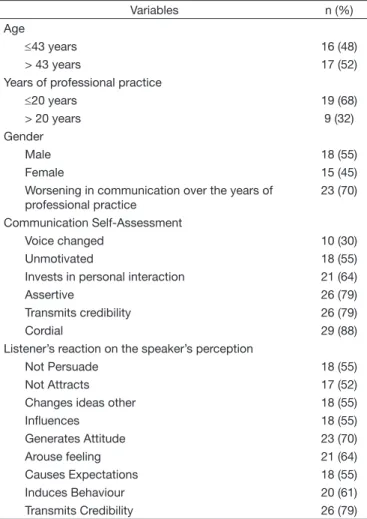
Prosecutors stated that selected vocal communication parameters were used in this study, while noting altered voice and feelings of discouragement and insecurity, tension, and not able to persuade and attract the listener. Table 1 describe the sample characteristics.
Women showed a greater proportion of deterioration in vocal communication over the years of professional experience when compared to men (p = 0.009). All women report feeling of insecurity and tension when talking to the public (p <0.001) Table 2 compares the ratio between gender and vocal communication parameters. The data show a greater proportion of vocal alteration among Prosecutors aged 43 plus years than those with less age (p = 0.007). The Table 3 shows the ratio between age and the communication parameters.
The largest proportion of insecurity- tension feeling in communication with the public, was apparent in Prosectuors with more than 20 years of professional practice compared to those under 20 years of occupation (p = 0.049). Table 4 shows the ratio between the years of professional experience with the vocal communication parameters.
DISCUSSION
In this study, most respondents referred worsening in communication over years of work and a third respondent perceived voice alteration amongst the years. The literature considers that in some professions, voice and communication suffer interference from environmental and organizational factors such as worker’s lack of training on professional communication, further on the inluence of biological factors, such as aging, allergies, among others(14).
In addition to these factors, other authors consider that other variables may contribute to the development of vocal deviation, such as the personality characteristics, vocal demands, anxiety, stress(15-17), and even signs of depression in some professional categories(18).
Most prosecutors in this study have feelings of discouragement, insecurity, and tension when speaking in public. This result is consistent with the literature. Previous researches, investigated the prevalence and symptoms of fear and anxiety when speaking in public, among the São Paulo state population. Participated 503 individuals of both genders and diverse professions, and it was found that public speaking was among the top ten reported fears. Symptoms of anxiety in this situation were reported by 24% of respondents, the highest scores being: palpitation, trembling voice, discomfort, and xerostomia(19).
Table 1. Sample characterization (n = 33)
Variables n (%)
Age
≤43 years 16 (48)
> 43 years 17 (52)
Years of professional practice
≤20 years 19 (68)
> 20 years 9 (32)
Gender
Male 18 (55)
Female 15 (45)
Worsening in communication over the years of professional practice
23 (70)
Communication Self-Assessment
Voice changed 10 (30)
Unmotivated 18 (55)
Invests in personal interaction 21 (64)
Assertive 26 (79)
Transmits credibility 26 (79)
Cordial 29 (88)
Listener’s reaction on the speaker’s perception
Not Persuade 18 (55)
Not Attracts 17 (52)
Changes ideas other 18 (55)
Influences 18 (55)
Generates Attitude 23 (70)
Arouse feeling 21 (64)
Causes Expectations 18 (55)
Induces Behaviour 20 (61)
Table 2. Gender association with the sample characteristics
Variables Gender (p)
Male Female
Worsening in communication over the years of professional practice
Yes 9 (50) 14 (93) 0.009*
No 9 (50) 1 (7)
Communication perception voice changed
Yes 7 (39) 3 (20) 0.283
No 11 (61) 12 (80)
Motivated
Yes 10 (56) 5 (33) 0.296
No 8 (44) 10 (67)
Invests in personal interaction
Yes 13 (72) 8 (53) 0,300
No 5 (28) 7 (47)
Assertive
Yes 14 (78) 12 (80) 1.000
No 4 (22) 3 (20)
Transmits credibility
Yes 15 (83) 11 (73) 0.674
No 3 (17) 4 (27)
Cordial
Yes 17 (94) 12 (80) 0.308
No 1 (6) 3 (20)
Insecure and tense
Yes 5 (28) 15 (100) 0.000**
No 13 (72) 0 (0)
Listener’s reaction on the speaker’s perception entice
Yes 6 (33) 9 (60) 0.170
No 12 (67) 6 (40)
Attracts
Yes 8 (44) 8 (53) 0.732
No 10 (56) 7 (47)
Changes Ideas another
Yes 9 (50) 9 (60) 0.729
No 9 (50) 6 (40)
Influences
Yes 10 (56) 8 (53) 1.000
No 8 (44) 7 (47)
Attitude generates
Yes 11 (61) 12 (80) 0.283
No 7 (39) 3 (20)
Elicited feelings
Yes 11 (61) 10 (67) 1.000
No 7 (39) 5 (33)
Causes Expectations
Yes 7 (39) 11 (73) 0.080
No 11 (61) 4 (27)
Induces Behaviour
Yes 9 (50) 11 (73) 0.284
No 9 (50) 4 (27)
Transmits Credibility
Yes 14 (78) 12 (80) 1.000
No 4 (22) 3 (20)
Caption: Fisher’s Exact Test (p) - p-value; *p <0.05,
Table 3. Age of the association with the sample characteristics
Variables age (p)
≤43 years > 43 years
Worsening in communication over the years of professional practice 1.000
Yes 11 (69) 12 (71)
No 5 (31) 5 (29)
Communication Self-Assessment voice changed 0.007*
Yes 1 (6) 9 (53)
No 15 (94) 8 (47)
Motivated 0.491
Yes 6 (38) 9 (53)
No 10 (63) 8 (47)
Personal interaction 1.000
Yes 10 (63) 11 (65)
No 6 (38) 6 (35)
Assertive 0.688
Yes 12 (75) 14 (82)
No 4 (25) 3 (18)
Credibility 0.688
Yes 12 (75) 14 (82)
No 4 (25) 3 (18)
Cordial
Yes 13 (81) 16 (94) 0.335
No 3 (19) 1 (6)
Insecure and tense 1.000
Yes 10 (63) 10 (59)
No 6 (38) 7 (41)
Listener’s reaction on the speaker’s perception Entice 1.000
Yes 7 (44) 8 (47)
No 9 (56) 9 (53)
Attracts 1.000
Yes 8 (50) 8 (47)
No 8 (50) 9 (53)
Changes ideas 0.084
Yes 6 (38) 12 (71)
No 10 (63) 5 (29)
Influences 0.732
Yes 8 (50) 10 (59)
No 8 (50) 7 (41)
Attitude generates 1.000
Yes 11 (69) 12 (71)
No 5 (31) 5 (29)
Awakes feeling 0.481
Yes 9 (56) 12 (71)
No 7 (44) 5 (29)
Causes Expectations 0.084
Yes 6 (38) 12 (71)
No 10 (63) 5 (29)
Induces Behaviour 0.296
Yes 8 (50) 12 (71)
No 8 (50) 5 (29)
Credibility 1.000
Yes 13 (81) 13 (76)
No 3 (19) 4 (24)
Table 4. Association of years of professional practice with the characteristics of the sample
Variables Years of professional practice (p)
≤20 years > 20 years
Worsening in communication over the years of professional practice 1.000
Yes 12 (63) 6 (67)
No 7 (37) 3 (33)
Voice Changed 0.097
Yes 4 (21) 5 (56)
No 15 (79) 4 (44)
Communication Self-Assessment Motivated
0.432
Yes 7 (37) 5 (56)
No 12 (63) 4 (44)
Personal interaction 0.670
Yes 12 (63) 7 (78)
No 7 (37) 2 (22)
Assertive 1,000
Yes 15 (79) 8 (89)
No 4 (21) 1 (11)
Credibility 1.000
Yes 15 (79) 8 (89)
No 4 (21) 1 (11)
Cordial 0.530
Yes 16 (84) 9 (100)
No 3 (16) 0 (0)
Insecure and tense 0.049*
Yes 9 (47) 8 (89)
No 10 (53) 1 (11)
Listener’s reaction on the speaker’s perception Entice
0.420
Yes 8 (42) 6 (67)
No 11 (58) 3 (33)
Attracts 1.000
Yes 10 (53) 5 (56)
No 9 (47) 4 (44)
Changes ideas 0.687
Yes 10 (53) 6 (67)
No 9 (47) 3 (33)
Influences 1.000
Yes 11 (58) 5 (56)
No 8 (42) 4 (44)
Attitude generates 1,000
Yes 14 (74) 6 (67)
No 5 (26) 3 (33)
Awakes feeling 0.670
Yes 12 (63) 7 (78)
No 7 (37) 2 (22)
Causes Expectations 0.223
Yes 9 (47) 7 (78)
No 10 (53) 2 (22)
Induces Behaviour 0.670
Yes 12 (63) 7 (78)
No 7 (37) 2 (22)
Credibility 1.000
Yes 16 (84) 8 (89)
No 3 (16) 1 (11)
Comparing genders in this study, women showed higher proportion of deterioration in professional communication over the years than men. All women in the study feel insecurity and tension while talking in public. A previous study examined the self-assessment of public speaking and vocal skills in different professions, including nervousness and anxiety situations, according to gender and age. Participated 456 women and 244 men, average age 35 years. They concluded that the situation of public speaking is more dificult to be faced in some aspects, for women. There was inluence of gender in some aspects of voice alteration, as well as the situations of nervousness and anxiety, and women showed greater deviations in its communication in public than men(1).
With regard to the voice, in this study, the Prosecutors aged 43 years had higher proportion in their perception of vocal disorders than those aged less. This could be associated with the accumulation of vocal, physical and emotional wear in the many years of work, added to the lack of vocal care specialized. There are reports in the literature indicating that the professional category of teacher notices disorders in their voice and communication, but it is not decisive to get these alterations reduced or eliminated. The tasks and excessive professional responsibilities lead the professionals to prioritize their profession, to the detriment of their quality of life(20).
Regarding the emotional aspect, another study qualitatively examined the effects of emotion on the voice, speech and luency when speaking in public in four people who reported having dificulty doing so. Data were collected in a workshop situation/lecture with pre and post interviews lecture. In discourse analyzis, prior to the presentation, respondents reported fear and insecurity, and after the presentation, tranquillity and relief. All reported fear. In conclusion, the disorders in emotion interfere with communication. There was concern among respondents with both the content and in the way of speaking(21).
Regarding the years of professional practice, Prosecutors with more than 20 years of profession showed higher proportion of insecurity and tension when speaking in public compared to those under 20 years of occupation. This can be understood by increased responsibilities when speaking to the public arising from professional maturity, including new demands in communicating and greater public exposure in social media and television
With regard to the reactions that the speaker causes the listener, most of the present study respondents, realize that they do not persuaded and attracted the listener when speaking in public. Previous study analyzed expression of speech characteristics of a group of executives from perceptual and acoustic data of vocal dynamics. They found that those who used properly prosodic features passed security and were considered by the evaluators as objective, empathetic and compelling. On the other hand, those who utilized breaks in prosodic groups did not pass security and were appointed as less objectives, not empathic and unconvincing(22).
Other authors emphasize the need to use appropriate communication strategies in each profession so that the content and form convey credibility and interaction(13,23). In this sense, the development of an assertive communication can have a
positive impact on interpersonal relations at work and also in life quality(24-26). The self-reported impact on quality of life related to a vocal disorder is perceived similarly by men and women(27).
A previous study found the relationship between the evaluation of the speech-language pathologist and the vocal self-assessment and the impact of dysphonia on a quality of life among 48 individuals complaining voice-altering, aged of 51 years old, and 48 without vocal complaints and healthy voice, age of 46 years. They concluded that the perception of the subject on his own voice and the impact of dysphonia on their quality of life complement the perception of clinicians in relation to the general degree of this change(28).
The limitations of this study, highlighted by the reduced adhesion of Prosecutors taking part on the research and, consequently size of the sample, plus the lack of research on the subject area for data comparison. The data presented are intriguing and open perspectives for further research. Such information may contribute to future research with an interest in deepening the indings presented in this study, including clinical assessment of communicative competence with a control group.
CONCLUSION
Regards the self-assessment of communication to talk to the public, prosecutors in this study identiied strong parameters and those that need to be developed and leveraged in their communication. The variables within the females, who are over 43 years of age and over 20 years of professional practice, inluence negatively their communicative performance. In this context, the inclusion of the speech-language pathologist in graduation law school and the Public Prosecutor becomes extremely important to improve the communication the various stages on their public career.
ACKNOWLEDGEMENTS
The authors thanks the Public Ministry of the State of Sergipe unconditional partnership in active search of the sample for data collection; the prosecutors who participated in the study; and the speech-language pathologist Profº Drº Leonardo Wanderley Lopes for his contribution to the manuscript initial review.
REFERENCES
1. Ugulino ACN. Autoavaliação do comportamento comunicativo ao falar em público das diferentes categorias profissionais [tese]. São Paulo: Universidade Federal de São Paulo, Escola Paulista de Medicina, Programa de Pós-graduação em Distúrbios da Comunicação Humana; 2014. 65 p. 2. Sales NJ, Gurgel RQ, Gonçalves MI, Cunha E, Barreto VM, Todt JC
No, et al. Characteristics and professional use of voice in street children in Aracaju, Brazil. J Voice. 2010;24(4):435-40. PMid:19665349. http:// dx.doi.org/10.1016/j.jvoice.2008.12.007.
3. Pitombo C. Ampliando horizontes. Jornal Voz Ativa. 2006 Jun;13(2):1-4. 4. Ruiz DMCF, Tsuji SACN, Faccio CB, Romanini JS, Ghedini SG. Ocorrência de queixas vocais em advogados, juízes e promotores. Pro Fono. 1997;9(1):27-30.
LP, Costa HO. Voz ativa: falando sobre o profissional da voz. São Paulo: Roca; 2000. p. 181-5.
6. Barreto MASC. Professores/operadores do Direito: sua consciência vocal. J Bras Fonoaudiol. 2003;4(17):261-7.
7. Campanha SMA, Alonso AC, Thomsen LPR. Conhecimento dos advogados sobre os cuidados relacionados à saúde vocal [monografia]. Belo Horizonte: Faculdade de Estudos Administrativos de Minas Gerais, Centro de Gestão Empreendedora; 2007.
8. MPSE: Ministério Público do Estado de Sergipe. Promotorias [Internet]. Aracaju: Ministério Público do Estado de Sergipe; 2015 [citado em 2015 Ago 21]. Disponível em: http://www.mpse.mp.br/Promotorias.aspx 9. Shewell C. Voice work: art and science in changing voices. West Sussex:
Wiley-Blackwell; 2009. p. 463-4. http://dx.doi.org/10.1002/9780470745588. 10. Panico ACB. Expressividade da fala construída. In: Kyryllos LR. Expressividade da teoria à prática. Rio de Janeiro: Revinter; 2005. p. 43-6. 11. Leite APD, Carnevale LB, Rocha HL, Pereira CA, Lacerda L Fo. Relação entre autoavaliação vocal e dados da avaliação clínica em indivíduos disfônicos. Rev CEFAC. 2015;17(1):44-51. http://dx.doi.org/10.1590/1982-021620151214.
12. Polito R. Como preparar boa palestra e apresentações. São Paulo: Saraiva; 1995. 199 p.
13. Behlau MS. Vozes preferidas: considerações sobre opções vocais nas profissões. Fono Atual. 2001;4(16):10-4.
14. Behlau M, Zambon F, Guerrieri AC, Roy N. Epidemiology of voice disorders in teachers and nonteachers in Brazil: prevalence and adverse effects. J Voice. 2012;26(5):665.e9-18. PMid:22516316. http://dx.doi.org/10.1016/j. jvoice.2011.09.010.
15. Stemple J, Glaze LE, Gerdeman BK. Clinical voice pathology: theory and management. 2nd ed. USA: Singular; 1995.
16. Almeida AAF, Behlau M, Leite JR. Correlação entre ansiedade e performance comunicativa. Rev Soc Bras Fonoaudiol. 2011;16(4):384-9. http://dx.doi. org/10.1590/S1516-80342011000400004.
17. Almeida LNA, Lopes LW, Costa DB, Silva EG, Cunha GMS, Almeida AAF. Características vocais e emocionais de professores e não professores com baixa e alta ansiedade. Audiol, Commun Res. 2014;19(2):179-85. http://dx.doi.org/10.1590/S2317-64312014000200013.
18. Rocha LM, Behlau M, Souza LDM. Behavioral dysphonia and depression in elementary shool teathers. J Voice. 2015;29(6):712-7. http://dx.doi. org/10.1016/j.jvoice.2014.10.011.
19. Ribeiro MT, Ugulino AC, Behlau M. Prevalência e sintomas do medo de falar em público no estado de São Paulo. In: 21º Congresso Brasileiro e 2° Ibero-Americano de Fonoaudiologia; 2013 Set 22-25; Porto de Galinhas, PE. Anais. Porto de Galinhas: Sociedade Brasileira de Fonoaudiologia; 2013.
20. Penteado RZ. Relações entre saúde e trabalho docente: percepções de professores sobre saúde vocal. Rev Soc Bras Fonoaudiol. 2007;12(1):18-22. http://dx.doi.org/10.1590/S1516-80342007000100005.
21. Barbosa RA, Friedman S. Emoção: efeitos sobre a voz e a fala na situação em público. Distúrb Comum. 2007;19(3):325-36.
22. Marquezin DMSS, Viola I, Ghirardi ACAM, Madureira S, Ferreira LP. Executives’ speech expressiveness: analysis of perceptive and acoustic aspects of vocal dynamics. CoDAS. 2015;27(2):160-9. PMid:26107082. http://dx.doi.org/10.1590/2317-1782/20152014188.
23. Hancock AB, Stone MD, Brundage SB, Zeigler MT. Public speaking attitudes: Does curriculum make a difference? J Voice. 2010;24(3):302-7. PMid:19481418. http://dx.doi.org/10.1016/j.jvoice.2008.09.007. 24. Penteado RZ, Pereira IMTB. Qualidade de vida e saúde vocal de professores.
Rev Saude Publica. 2007;41(2):236-43. PMid:17384799. http://dx.doi. org/10.1590/S0034-89102007000200010.
25. Putnoki DS, Hara F, Oliveira G, Behlau M. Qualidade de vida em voz: o impacto de uma disfonia de acordo com gênero, idade e uso vocal profissional. Rev Soc Bras Fonoaudiol. 2010;15(4):485-90. http://dx.doi. org/10.1590/S1516-80342010000400003.
26. Jardim R, Barreto SM, Assunção AA. Condições de trabalho, qualidade de vida e disfonia entre os docentes. Cad Saude Publica. 2007;23(10):2439-61. PMid:17891304. http://dx.doi.org/10.1590/S0102-311X2007001000019. 27. Gasparini G, Behlau M. Quality of life: validation of the Brazilian version of the voice-related quality of life (V-RQOL) measure. J Voice. 2009;23(1):76-81. PMid:17628396. http://dx.doi.org/10.1016/j.jvoice.2007.04.005. 28. Ugulino AC, Oliveira G, Behlau M. Perceived dysphonia by the clinician’s
and patient’s viewpoint. J Soc Bras Fonoaudiol. 2012;24(2):113-8. PMid:22832676. http://dx.doi.org/10.1590/S2179-64912012000200004.
Author contributions
Appendix A. Questionnaire: Communication Self-Evaluation when Prosecutors are Talking in Public
1. Identiication:
1.1. Gender: Male ( ) Female ( ) 1.2. Age (years):
1.3. Current function: 1.4. Current County:
1.5. Time of professional activity developed in the prosecution (in years).
2. Do you perceive and deterioration in communication over the years of professional practice? No ( ) Yes ( ).
3. Self-perception of communication in public:
3.1. Do you realize any alteration in your voice No ( ) Yes ( )
3.2. Are you motivated to talk? No ( ) Yes ( )
3.3. Do you invest on interpersonal interaction? No ( ) Yes ( )
3.4. Do you feel assertive? No ( ) Yes ( )
3.5. Do you pass credibility? No ( ) Yes ( )
3.6. Are you friendly? No ( ) Yes ( )
3.7. Are there times when you feel insecure and tense to express yourself professionally in public? No ( ) Yes ( )
4. Listener reaction on the speaker’s perception:
4.1. Do you think you persuade? No ( ) Yes ( )
4.2. Do you think you attract people? No ( ) Yes ( ) 4.3. Do you think you can change the others ideias? No ( ) Yes ( )
4.4. Do you think you inluence people? No ( ) Yes ( )