This is the pre-review version of the paper published in
Journal of Organic Chemistry, 74, 6120-6129
The final version of this paper is available through the American Chemical
Society website in
Computational studies on the reactivity of substituted
1,2-dihydro-1,2-azaborines
Pedro J. Silva§ and Maria João Ramos†
§
REQUIMTE, Fac. de Ciências da Saúde, Univ. Fernando Pessoa, Rua Carlos da Maia, 296,
4200-150 Porto-Portugal
†
REQUIMTE, Faculdade de Ciências do Porto, Rua do Campo Alegre, 687, 4169-007 Porto –
Abstract:
We have investigated important intermediates of electrophilic aromatic substitution reactions and
one-electron oxidation of substituted 1,2-dihydro-1,2-azaborines with density-functional theory. The
results show that electrophilic substitution reactions and one-electron oxidation of substituted
1,2-azaborines are generally much more favorable than those of the corresponding benzene derivatives.
Both chlorination and nitration of several boron-unsubstituted 1,2-azaborines are expected to break
the hydrogen bond, yielding chlorinated 1,2-azaborines and a novel class of
boron-bound 1,2-azaborinyl nitrites, respectively. Comparison between the relative stabilities of C3-boron-bound
and C5-bound Wheland intermediates of different electrophilic substitution reactions of
1,2-azaborines further suggests that the preference of the C3- over C5-substitution decreases with
decreasing electrophilicity of the attacking group.
KEYWORDS: 1,2-azaborines; electrophilic aromatic substitution; density-functional theory;
reactivity; FeCl3
*
I. Introduction
1,2-dihydro-1,2-azaborine (Scheme 1, henceforth abbreviated as 1,2-azaborine) is isosteric and
isoelectronic with the ubiquitous benzene ring. Several syntheses of substituted 1,2-azaborines have
been described since the 1960’s1,2, but the chemistry of these compounds remained largely
unexplored until the development (during the last decade) of new synthetic strategies3,4,5,6 which
allow the functionalization of the 1,2-azaborine ring with a large array of substituents. The similarity
of this class of compounds with the arenes has recently been furthered through reports that
1,2-azaborines possess delocalized structures consistent with aromaticity7. Substituted 1,2-azaborines
have recently been shown to be highly nucleophilic species: they readily undergo electrophilic
aromatic substitution6 on the 3- or 5- positions, depending on the specific reaction conditions. In late
2008, the preparation and spectroscopical characterization of the long-sought unsubstituted
1,2-dihydro-1,2-azaborine was achieved8. The continuing development of the chemistry of
1,2-azaborines is expected to allow the syntheses of boron-containing isosteres of pharmacological
Sheme 1: 1,2-dihydro-1,2-azaborine and important intermediates in its electrophilic aromatic
substitutions
In order to explore the reactivity of this interesting class of compounds, we have investigated
important intermediates of electrophilic aromatic substitution reactions (nitration, halogenation and
acylation) and one-electron oxidation through density functional computations. The results show
that electrophilic substitution reactions and one-electron oxidation of substituted 1,2-azaborines are
generally much more favorable than that of the corresponding benzene derivatives. Both
chlorination and nitration of several B-unsubstituted 1,2-azaborines are expected to break the B-H
bond, yielding B-chlorinated 1,2-azaborines and a novel class of B-bound nitrite 1,2-azaborines,
respectively.
All calculations were performed at the DFT Becke3LYP level of theory,9,10,11. Autogenerated
delocalized coordinates12 were used for geometry optimizations, using a medium-sized basis set,
6-31+G(d,p). More accurate energies of the optimized geometries were calculated with a triple-ζ quality basis set, 6-311+G(3d,2p). In reactions including Fe species, the SBKJC effective-core
potential13 was used for Fe. Zero point (ZPE) and thermal effects (T=298.15 K, P=1 bar) were
evaluated using a scaling factor of 0.9857 for the computed frequencies14. Redox potentials were
computed as the energy differences between the geometry-optimized neutral and cationic species.
Reorganization energies of the redox reactions were obtained using the neutral structure for the
cationic state, and the cationic structure for the neutral state. Solvation effects (in dichloromethane)
were computed by applying the polarizable conductor model15,16,17, as implemented in PcGamess18,
on gas-phase optimized geometries. All solution energies presented include electrostatic and
cavitation energies. Solution energies for the reactions with methyleniminium cations and with NO2+
also include dispersion and repulsion effects, which were evaluated as described by Amovilli and
Mennucci19. Except for PCM calculations in steps involving paramagnetic species, which were
performed with Gamess-US20 (22nd February 2006 release), all calculations were performed with the
PcGamess software package. Computation of natural atomic charges21 and natural resonance theory
analysis22,23,24 were performed with NBO 5.G25.
III. Results.
In order to perform a study of a representative number of 1,2-azaborine derivatives, we performed
computations with a large number of ring substituents, which were chosen based on their presence
on actual synthesized 1,2-azaborines. Computations with the corresponding benzene derivatives then
afford both a convenient comparison scale and the possibility of validation of the computational
methods employed.
One-electron oxidation of substituted 1,2-azaborines generally results in similar geometric
changes: a 0.03-0.06 Å increase in the N1-B2 and C5-C6 bond lengths, and a 0.03-0.05 Å shortening
of the C6-N1 bond. The most notable exception to this general trend arises with
2-formyl-1,2-azaborine, whose geometry changes very little upon oxidation: its reorganization energy (Table 1) is
accordingly the lowest among all studied derivatives.
The redox potentials of benzene derivatives computed with the basis set/theory level combination
above agree reasonably well (Table 1) with the experimental values26, and therefore we expect the
computed redox potentials for the substituted 1,2-azaborines to be of comparable quality. The
predicted redox potential of the parent compound, 1,2-dihydro-1,2-azaborine, was found to be ≈0.7 V lower than that of benzene. In all cases, B-substituted 1,2-azaborines prove to be better reductants
than corresponding benzene derivatives. The smallest difference (0.14 V) arises in the comparison
between 2-amino-1,2-azaborine and aniline. Substitution on the nitrogen atom of 1,2-azaborines
affords a much more erratic behavior: some derivatives are better reductants than their benzene
counterparts, whereas e.g. 1-amino-1,2-azaborine is more difficult to oxidize than its counterpart,
aniline. N-substituted 1,2-azaborines are generally worse reductants than the corresponding
B-substituted compounds. Computed redox potentials in dicloromethane closely follow the gas phase
trends (Table 2).
According to Marcus theory, the activation energies of outer-sphere electron transfer reactions
depend not only on the redox potentials but also on the reorganization energy of the system. For
each of the studied species (and their one-electron oxidized counterparts) we evaluated the
corresponding reorganization energies by computing the electronic energies of the oxidized structure
for the reduced state, and the reduced structure for the oxidized state. In almost all cases, differences
in reorganization energies of the electron self-exchange reactions ( A + A+→ A+ + A) amounted to less than 8 kcal.mol-1 (Table 1). The most notable exception is (again) 1-amino-1,2-azaborine, which
is less reactive than its arene counterpart, aniline, in self-exchange electron transfer reactions. This
observation raises the possibility of using 1-amino-1,2-azaborines as a (somewhat less reactive)
Table 1: Computed absolute redox potentials (in gas phase) and reorganization energies of
substituted 1,2-azaborines.
Absolute Redox potential (V) Reoganization energy (kcal.mol-1)
Substituent Benzene derivatives (reference values) Benzene derivatives (computed) N-substituted 1,2-azaborines (computed) B-substituted 1,2-azaborines (computed) Benzene derivatives N-substituted 1,2-azaborines B-substituted 1,2-azaborines
Hydrogen 9.24 8.94 8.21 8.21 6.62 7.73 7.73
Phenyl 8.16 7.76 7.77 7.42 8.46 6.26 5.92
Methyl 8.83 8.46 8.01 7.88 7.51 8.05 8.90
Vinyl 8.46 8.04 7.94 7.74 6.49 5.72 6.57
Chloro 9.07 8.71 8.41 8.20 7.70 7.88 9.19
Thiol 8.30 8.00 8.09 7.75 5.38 12.54 5.98
Hydroxyl 8.49 8.19 8.21 7.75 8.93 7.65 9.93
Amino 7.72 7.43 7.73 7.30 10.74 21.89 6.70
Ethynyl 8.82 8.37 8.27 7.96 5.53 5.74 6.72
Formyl 9.50 9.22 8.48 8.51 7.97 9.78 2.35
Table 2: Computed absolute redox potentials in dicloromethane and reorganization energies of
substituted 1,2-azaborines. The absolute redox potential of the standard hydrogen electrode, in
water, is 4.43 V27.
Absolute Redox potential (V) Reoganization energy (kcal.mol-1)
Substituent Benzene derivatives (computed) N-substituted 1,2-azaborines (computed) B-substituted 1,2-azaborines (computed) Benzene derivatives N-substituted 1,2-azaborines B-substituted 1,2-azaborines
Hydrogen 6.94 6.23 6.23 6.37 7.29 7.29
Phenyl 6.16 6.16 5.81 8.37 6.02 6.02
Methyl 6.57 6.15 5.98 7.33 7.49 8.39
Vinyl 6.25 6.15 5.93 6.41 5.53 6.46
Chloro 6.81 6.48 6.26 7.65 7.55 8.75
Thiol 6.14 6.23 5.90 5.39 11.07 6.12
Hydroxyl 6.25 6.29 5.85 8.63 7.28 9.10
Amino 5.53 5.84 5.46 10.47 21.40 6.43
Ethynyl 6.60 6.46 6.17 5.42 5.78 6.59
1,2-azaborine as a benzene substituent
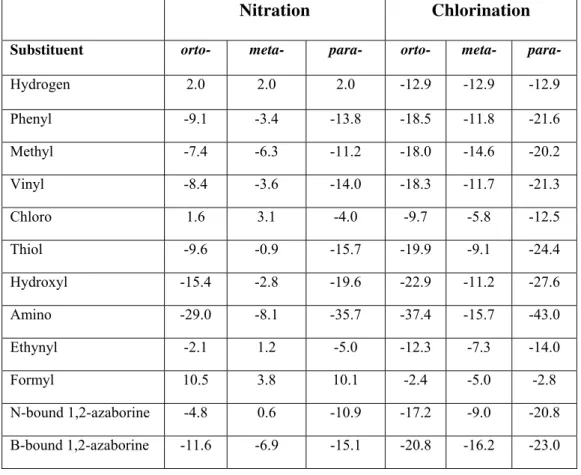
The energies of nitration and chlorination intermediates of selected benzene derivatives were
computed as described in Methods, and compared with N- and B- bound 1,2-azaborine. The results
clearly show that 1,2-azaborine is a benzene-activating substituent, which stabilizes the para- and
orto- intermediates of their electrophilic aromatic substitution reactions (Table 3). The effect of
1,2-azaborines is similar to that of vinyl and thiol substitutents (slightly smaller than that of OH) and
seems to be slightly larger when it is bound to the benzene ring through its boron atom. However,
since the 1,2-azaborine ring is much more reactive than benzene in electrophilic aromatic
substitutions (see full results below), its potential use as a benzene-activating group is expected to be
quite limited.
Table 3: Computed free energies (in dicloromethane solution) of the nitration (NO2+ + R → RNO2+) and chlorination reactions (FeCl3 + Cl2 + R → FeCl4- + RCl+) of benzene derivatives (in kcal.mol-1). All data in kcal.mol-1. ZPE and thermal effects computed at 298.15 K.
Nitration Chlorination
Substituent orto- meta- para- orto- meta- para-
Hydrogen 2.0 2.0 2.0 -12.9 -12.9 -12.9
Phenyl -9.1 -3.4 -13.8 -18.5 -11.8 -21.6
Methyl -7.4 -6.3 -11.2 -18.0 -14.6 -20.2
Vinyl -8.4 -3.6 -14.0 -18.3 -11.7 -21.3
Chloro 1.6 3.1 -4.0 -9.7 -5.8 -12.5
Thiol -9.6 -0.9 -15.7 -19.9 -9.1 -24.4
Hydroxyl -15.4 -2.8 -19.6 -22.9 -11.2 -27.6
Amino -29.0 -8.1 -35.7 -37.4 -15.7 -43.0
Ethynyl -2.1 1.2 -5.0 -12.3 -7.3 -14.0
Formyl 10.5 3.8 10.1 -2.4 -5.0 -2.8
N-bound 1,2-azaborine -4.8 0.6 -10.9 -17.2 -9.0 -20.8
Nitration
Nitration of benzene derivatives has been extensively studied by theoretical methods28-31: upon
formation of a loosely-bound π-complex between NO2+ and the aromatic ring (ArX), either a single-electron transfer from the ring to the NO2+ moiety or direct electrophilic attack (depending on the
ring substituents, reactants ionization potentials, etc.) leads to the formation of the well-known
“arenium ion” intermediate (ArXNO2+), also known as the σ–complex or the “Wheland intermediate” (1a),(1b),(1d) and (1e). The presence of substituents on the aromatic ring affects the regioselectivity of the reaction by differentially stabilizing the orto-, meta- and para- positions of the
aromatic ring. The transition states leading to the Wheland intermediates lie very low in energy, so
that regioselectivity is mostly determined by the relative thermodynamic stabilities of the Wheland
intermediates28,29.
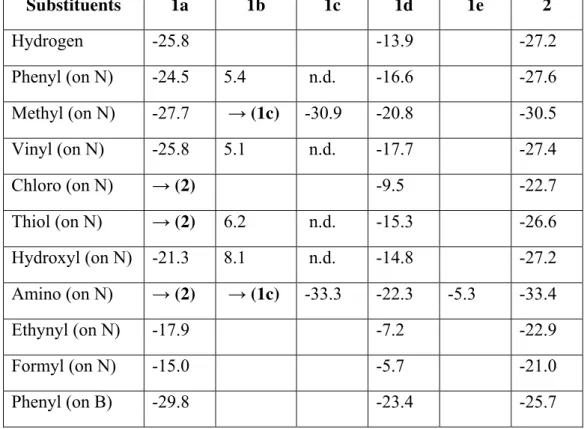
We computed the energies of every Wheland intermediate arising from nitration of selected N- or
B-substituted azaborines (Table 4). A Wheland intermediate (with a very high energy) on C6 (1e)
could only be found on 1-amino-1,2-azaborine. Nitration at the C4-position (1b) afforded the least stable intermediates, which is consistent with the limited resonance landscape available at that
position. In several cases, the intermediate on C4 is so high in energy that a hydride spontaneously
moves from C4 to C3 in order to yield a much more stable configuration with larger resonance
possibilities (1c). Electrophilic attack on C5 (1d) yielded intermediates 5-14 kcal.mol-1 higher in energy than on the remaining C3 position (1a) , which is clearly favored in every instance, even in the presence of electron-withdrawing substituents. Nitration on C3 may afford either the regular
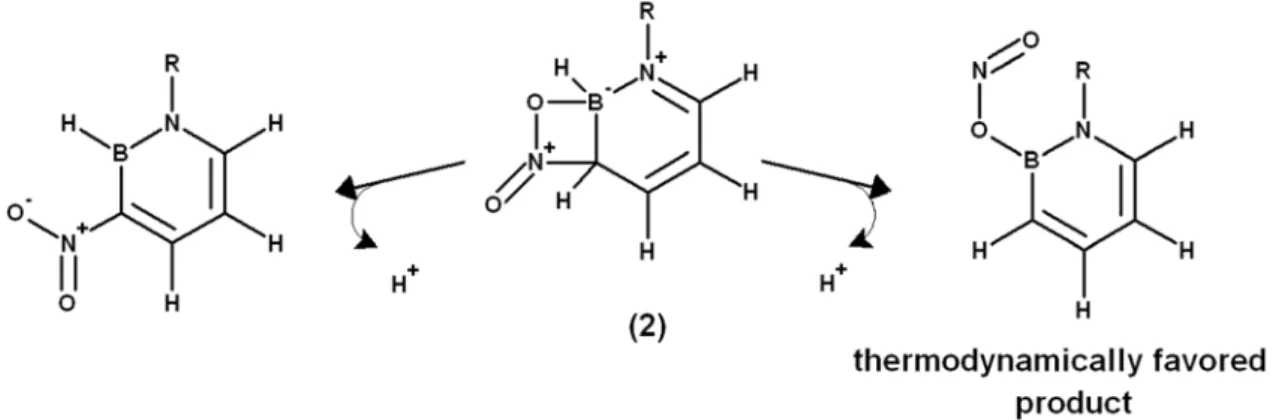
Wheland intermediate (1a) or a novel bicyclic intermediate (2) where an oxygen atom from the NO2+ electrophile engages the electron-deficient boron atom. In B-substituted 1,2-azaborines, this
intermediate lies at slightly higher energies than the regular σ–complex (1a). However, in 1,2-azaborines lacking any substituent in the boron atom it lies a few kcal.mol-1 below (1a). In these cases, loss of the boron-bound H+ leads to an electronic rearrangement which breaks the incipient
C3-NO2 bond and yields novel 1,2-azaborinyl nitrites. The compounds thus obtained are 26-28
obtained through loss of H+ from (1a), and further increase the range of molecular scaffolds available from these interesting aromatic compounds.
Figure 1: Gas phase (A-C) and solution (D-F) free energies (relative to isolated reactants) of the
most stable Wheland intermediates in nitration (A/D), chlorination (B/E), and acylation (C/F) of
1,2-azaborines (dotted bars). The most stable Wheland intermediate is usually (1a), except in nitration reactions of N-substituted 1,2-azaborines, where the Wheland intermediate (1a) is not stable due to collapsing into the novel intermediate (2), and in the chlorination of N-amino-substituted 1,2-azaborine.
In the corresponding benzene derivatives, nitration is known to be consistently favored on the
orto-and para- positions (except in the deactivated benzaldehyde ring). Comparison of the energies of the postulated Wheland intermediates with the isolated reactants shows that the bare 1,2-azaborine is a
highly activated ring, since nitration of 1,2-azaborine is much more favorable than that of any of the
tested benzene derivatives except phenol, aniline and phenylbenzene (Figure 1A). The effect of
substitutions on the reactivity of the 1,2-azaborines is generally less dramatic than on benzene,
especially if the substitution occurs on the nitrogen atom. Boron-substituted 1,2-azaborines are
generally more reactive than the corresponding nitrogen-substituted 1,2-azaborines. As expected
from the charged nature of the electrophile, solvation stabilizes reactants more effectively than the
Wheland intermediates (where the positive charge is delocalized through the conjugated system), so
that the reactions become ≈15-30 kcal.mol-1less favorable.
Surprisingly, OH- was found to have a deactivating effect on 1,2-azaborine when bound to its nitrogen atom, in contrast to its strong activating effect on benzene. In order to gain further insight
into this unexpected observation, we analyzed the electron distributions on the 1,2-azaborine (and
benzene) derivatives using Natural Bond Orbital21 and Natural Resonance theories22,23,24. Analysis
of the natural electron populations on the ring atoms (see Supporting Information, tables S26 and
S27) shows that in all studied 1,2-azaborines C3 carries the largest negative charge (-0.46 to -0.54)
of all carbon atoms, followed by C5 (-0.27 to -0.32), in agreement with the significant reactivity at
these positions. Substituent effects on the partial charges of N-substituted 1,2-azaborines at the
(most reactive) C3-position is negligible (<0.01 e-), and is also very small at the C5 atom (0.01-0.02
e-), the other reactive position. The effects on the partial charges at the C3- position of
orto-or para- positions of benzene derivatives (0.01-0.08 e-). These trends agree reasonably well with the observation of smaller substituent effects on the reactivity of N-substituted than on B-substituted
1,2-azaborines. Inspection of the contributing resonance forms yielded more interesting details on
the origin of the different behaviors of substituted 1,2-azaborines: the substitution of the
nitrogen-bound H atom by OH yields an electronic distribution in which the second-most important resonance
structure (11.5% contribution) has an electrophilic C3 atom, instead of the nucleophilic resonance
structures most frequently observed with the other azaborines, which explains the unexpected low
reactivity of this azaborine. Important electrophilic resonance structures are also observed on
1,2-azaborines N-substituted with NH2 (8.8% contribution) or ethynyl (9.8%), which are indeed less
reactive (vs. 1,2-azaborine) than expected from their influence on benzene.
Table 4: Computed free energies (in dicloromethane solution) of the nitration reactions (NO2+ + R
→ RNO2+) of 1,2-azaborines derivatives (in kcal.mol-1). All data in kcal.mol-1. ZPE and thermal effects computed at 298.15 K. Instances where an intermediate spontaneously collapses into a
different structure are highlighted. Blank fields mean that the structures could not be found as
minima on the potential energy surface after geometry optimization. n.d.: not optimized.
Substituents 1a 1b 1c 1d 1e 2
Hydrogen -25.8 -13.9 -27.2
Phenyl (on N) -24.5 5.4 n.d. -16.6 -27.6
Methyl (on N) -27.7 →(1c) -30.9 -20.8 -30.5 Vinyl (on N) -25.8 5.1 n.d. -17.7 -27.4
Chloro (on N) →(2) -9.5 -22.7 Thiol (on N) →(2) 6.2 n.d. -15.3 -26.6 Hydroxyl (on N) -21.3 8.1 n.d. -14.8 -27.2
Amino (on N) →(2) →(1c) -33.3 -22.3 -5.3 -33.4 Ethynyl (on N) -17.9 -7.2 -22.9
Formyl (on N) -15.0 -5.7 -21.0
Methyl (on B) -28.8 →(1c) -34.3 -22.9 -28.7 Vinyl (on B) -29.3 -22.1 -25.9
Chloro (on B) -20.5 -15.7 -21.3
Thiol (on B) -29.3 →(1c) -32.2 -23.2 -22.3 Hydroxyl (on B) -33.5 -27.2 -28.0
Amino (on B) -43.2 →(1c) -44.4 -34.5 → (1a) Ethynyl (on B) -23.5 -17.5 -22.9
Formyl (on B) →(2) -8.9 -22.4
Chlorination
Chlorination of most benzene derivatives requires the use of Lewis acids (such as FeCl3 or AlCl3) to
facilitate the heterolytical cleavage of Cl2 into Cl- and the reactive Cl+ electrophile. Although we
found the addition of Cl+ to benzene derivatives or 1,2azaborines to be highly exergonic (110 to
-170 kcal.mol-1 in the gas phase, and -120 to -150 kcal.mol-1 in solution), the formation of Cl+ from
Cl2and FeCl3 is not at all spontaneous, since it is endergonic by approximately 200 kcal.mol-1 in the
gas phase (and 90 kcal.mol-1 in solution since the electrostatic stabilization of the (charged) products
is much more important than that of the neutral reactants). The reaction must therefore proceed
through the formation of a ternary complex R-Cl-Cl-FeCl3, as already suggested by lower level
computations on the halogenation of benzene32 and for Friedel-Crafts alkylations33. In agreement
with the neutral character of the reactants and the charged nature of the intermediate, our
computations show that solvation makes the chlorination reactions of benzene- and 1,2-azaborine-
derivatives ≈75-85 kcal.mol-1 more favorable than in the gas phase.
As expected from the natural population analysis described in tables S26 and S27 of Supporting
Information, attack on C3 yields the most stable Wheland intermediates, followed by attack on C5.
Except for the N-amino-substituted 1,2-azaborine, the energy differences between these
intermediates are relatively small (3.8-7.6 kcal.mol-1) (Table 5), and therefore the reaction may
Interestingly, in the intermediates arising from attack on C3 of N-substituted 1,2 azaborines Cl+
migrates to a “bridging” position above the C3-B bond (Figure 2), and in the amino-substituted
derivative, Cl+ added to C3 fully migrates to the boron atom. Loss of H+ from these intermediates is
≈30 kcal.mol-1 more favorable from boron than from C3, and these reactions are therefore predicted to yield boron-chlorinated azaborines, rather than carbon-chlorinated compounds. Our computations
therefore show that halogenation of the carbon atoms of 1,2-azaborines is only feasible on
boron-substituted 1,2-azaborines.
Figure 2: Gas phase geometries of the intermediates arising from Cl+ addition to the C3 atom in
N-substituted 1,2-azaborines. B-Cl and C3-Cl distances (in Å) are shown. Substitutents bound to the
nitrogen atom are (from left to right, and from top to bottom): H, phenyl, methyl, vinyl, Cl, SH,OH,
Table 5: Computed free energies (in dicloromethane solution) of the chlorination reactions (FeCl3 +
Cl2 + R → FeCl4- + RCl+) of 1,2-azaborines derivatives (in kcal.mol-1). ZPE and thermal effects computed at 298.15 K. Blank fields mean that the structures could not be found as minima on the
potential energy surface after geometry optimization.a: intermediate bound on boron, rather than on
C3.
Substituents 1a 1b 1c 1d 1e
Hydrogen -31.4 -43.1 -26.8
Phenyl (on N) -31.6 -26.8
Methyl (on N) -34.2 -44.9 -30.3 -12.7
Vinyl (on N) -32.0 -42.6 -27.2 -10.9
Chloro (on N) -25.1 -17.4
Thiol (on N) -29.7 -40.0 -24.5 -8.9
Hydroxyl (on N) -29.8 -40.4 -25.9 -8.9
Amino (on N) (-41.4)a -11.3 n.d. -32.0 -15.1
Ethynyl (on N) -25.0 -36.2 -18.7 -7.6
Formyl (on N) -23.7 -16.8
Phenyl (on B) -37.2 -33.5
Methyl (on B) -37.4 -47.8 -32.5
Vinyl (on B) -37.2 -46.6 -32.3
Chloro (on B) -29.5 -40.4 -25.4
Thiol (on B) -35.9 -32.0
Hydroxyl (on B) -40.9 -50.5 -36.1
Amino (on B) -48.7 -56.7 -44.0
Ethynyl (on B) -31.4 -27.1
Formyl (on B) -24.0 -36.3 -19.6 -5.5
The reaction mechanism of metal chlorides-assisted Friedel-Crafts acylation of aromatic
compounds is known to be quite complex: Lewis acid complexation to either the carbonyl34,35 or the
halogen36,37 of the acyl chloride has been described, as well as additional complexation of a second
Lewis acid molecule to an acylium cation intermediate38, and more complex kinetical models39
including fourth-order rate constants and inhibition of the Lewis acid by product. Our computations
show that, like chlorination, Friedel-Crafts acylation (using FeCl3 as Lewis acid) must proceed in the
gas phase through the formation of some kind of ternary complex (e.g. R-HC=O-Cl-FeCl3), since the
formation of HCO+ from HCOCland FeCl3 is too unfavourable (ΔG=119.5 kcal.mol-1in gas phase). In solution, such a ternary complex does not appear to be required on thermodynamic grounds, since
solvation effects make HCO+ formation feasible (ΔG=6.4 kcal.mol-1).
The gas-phase stability of the Wheland intermediates formed upon acylation of substituted
1,2-azaborines (Table 6) broadly follows the trends reported above for nitration and chlorination
reactions: C3-bound intermediates are favored (by 2.5-8.9 kcal.mol-1) over C5-bound intermediates
for all studied molecules; C4-bound and C6-bound intermediates are strongly disfavored. The effects
of solvation (Table 3) are however less uniform than those observed for the other studied reactions:
in particular, no N-substituted azaborine is substantially more reactive than the bare
1,2-azaborine, and only very strong substituents (OH, NH2) on boron have noticeable activating effects.
Interestingly, stable Wheland intermediates on every carbon atom of a substituted 1,2-azaborine
ring could be found in the acylation reactions of 1-phenyl-1,2-azaborine. These intermediates afford
a convenient set of structures for the study of the relative importance of the different resonance
structures stabilizing the different σ–complexes (Figure 3). Analysis of the electron-densities in these intermediates with Natural Resonance Theory shows that in the most unstable intermediates
(C2- and C4-bound) the most-heavily weighted resonance structures contain several point charges
Figure 3: Most-important contributing resonance structures for the σ–complexes formed from addition of formyl cation to 1-phenyl-1,2-azaborine , as computed by Natural Resonance Theory.
Table 6: Computed free energies (in dicloromethane solution) of the acylation reactions (FeCl3 +
HCOCl + R → FeCl4- + HCOR+) of 1,2-azaborines derivatives (in kcal.mol-1). ZPE and thermal effects computed at 298.15 K. Instances where an intermediate spontaneously collapses into a
different structure are highlighted. Blank fields mean that the structures could not be found as
minima on the potential energy surface after geometry optimization.
Substituents 1a 1b 1d 1e cyclic 1a
Hydrogen -0.6 4.4 18.5 4.3
Phenyl (on N) 6.1 35.2 12.6 26.4 13.1
Methyl (on N) -3.0 2.3 →(1d) 3.5 Vinyl (on N) 2.9 7.0 20.8 7.5
Chloro (on N) 7.5 13.6 22.6 9.7
Thiol (on N) 4.6 8.5 20.4 7.2
Hydroxyl (on N) 3.3 6.9 20.1 5.7
Ethynyl (on N) 8.7 13.6 22.6 10.8
Formyl (on N) 10.2 16.4 24.9 12.0
Phenyl (on B) 3.3 7.0 →(1d) 14.6 Methyl (on B) -3.7 1.1 →(1d) 4.5 Vinyl (on B) -1.2 2.1 →(1d) 8.2 Chloro (on B) 3.4 7.6 22.0 10.4
Thiol (on B) -0.7 2.0 18.9 9.3
Hydroxyl (on B) -11.7 -2.8 15.9 →(1a)
Amino (on B) -15.6 -9.3 12.8 →(1a)
Ethynyl (on B) 3.0 6.5 22.3 10.6
Formyl (on B) 9.1 12.4 26.1 11.1
Mannich reactions with methyleneiminium cations
In their experimental study of electrophilic aromatic substitution in 1,2-azaborines, Pan et al.6
described a consistent trend for substitution to occur at the C3- position. The reactions with
methyleneiminium cations, however, yielded C5-substituted products. Our computations on these
reactions show that the methyleneiminium cation is a very poor electrophile: in reactions with
benzene derivatives, Wheland intermediates could only be found in the presence of strong activating
substituents (Fig. 4). Reactions with substituted 1,2-azaborines were more favorable and followed
the trends observed in the other electrophilic substitutions studied above, with boron-substituted
1,2-azaborines generally more reactive than the corresponding nitrogen-substituted molecules (with the
notable exception of B-formylated 1,2-azaborines, which do not react at all). The energy differences
between the C3- and C5- Wheland intermediates in these reactions (Table 7) were found to be the
smallest among the electrophilic substitution reactions we studied (often only a couple of kcal.mol-1)
and these reactions are therefore expected to yield larger amounts of C5-substituted products than
either nitration, chlorination or acylation. Comparison with experimental results by Pan et al.6
affords a test of our computational methods: the computations show that the C3- and
1-ethyl-1,2-dihydro-2-phenyl-1,2-azaborine (which has been shown6 to yield the C5-substituted product) differ in energy
by less than 0.2 kcal.mol-1 (1.5 kcal.mol-1 in gas phase), and that deprotonation of the C5-Wheland
intermediates affords a more stable product (by 7.4 kcal.mol-1) than the one formed upon
electrophilic substitution on C3.
Figure 4: Gas phase (A) and solution (B) free energies (relative to isolated reactants) of the most
stable Wheland intermediates in methyleneiminium cation addition to substituted benzenes (white
bars), N-substituted 1,2-azaborines (grey bars) and B-substituted 1,2-azaborines (dotted bars).
Table 7: Computed free energies (in gas phase and in dichloromethane solution) of the reactions of
1,2-azaborines derivatives with methyleneiminium cations (in kcal.mol-1). ZPE and thermal effects
computed at 298.15 K. Blank fields mean that the structures could not be found as minima on the
potential energy surface after geometry optimization.
Gas phase Solution
Substituents 1a 1d 1a 1d
Hydrogen 1.1 20.8
Methyl (on N) -2.5 0.7 19.6 22.1
Vinyl (on N) -1.6 2.0 21.0 24.3
Chloro (on N) 6.1 26.9
Thiol (on N) 1.8 5.6 23.3 26.8
Hydroxyl (on N) 2.1 4.4 22.8 25.2
Amino (on N) -3.3 -1.3 18.9 20.1
Ethynyl (on N) 4.5 26.5
Formyl (on N) 7.8 27.4
Phenyl (on B) -7.1 -5.0 18.8 19.3
Methyl (on B) -4.3 -1.2 16.9 19.1
Vinyl (on B) -4.0 -2.0 19.2 19.9
Chloro (on B) 2.6 6.4 23.3 26.0
Thiol (on B) -3.1 -0.6 18.0 19.9
Hydroxyl (on B) -9.4 -6.6 12.3 14.4
Amino (on B) -13.5 -10.3 8.6 10.7
Ethynyl (on B) -1.2 2.8 21.7 24.5
Formyl (on B)
Conclusions
The computations described in this paper afford interesting insights into the reactivity of a large
array of 1,2-azaborines, and expand our knowledge of the chemistry of this promising class of
compounds. In particular, 1,2-azaborines are shown to be usually better nucleophiles than
corresponding benzene derivatives; 1,2-azaborines with an intact B-H bond afford the possibility of
cross-reaction of some electrophiles with both the B atom and C3, allowing the synthesis of e.g. a
novel class of 1,2-azaborinyl nitrite compounds, and are usually better reductants than their benzene
analogues. Comparison between the relative stabilities of C3-bound and C5-bound Wheland
intermediates of different electrophilic substitution reactions of 1,2-azaborines further suggests that
the preference of the C3- over C5-substitution decreases with decreasing electrophilicity of the
acylation, to ≈ 2 kcal.mol-1 in reactions with methyleneiminium cations). Whether this observation reflects a broader trend or only a fortuitous coincidence remains to be tested experimentally.
Supporting information
Geometries (computed at the B3LYP/6-31+G(d,p) level) of all species described in this paper, as
well as their gas phase, ZPE and thermal effects and solution energies (computed at the
B3LYP/6-311+G(3d,2p) level, in CH2Cl2). Most-important resonance structures contributing to the computed
electron densities of substituted benzenes and 1,2-azaborines, as predicted by Natural Resonance
Theory.
Acknowledgments
The authors thank Derek Lowe (Vertex Pharmaceuticals) for bringing the subject to their
attention.
IV. References
1 Dewar, M.J.S, Marr, P.A. (1962) J. Am. Chem. Soc., 84: 3782
2 White, D.G. (1963) J. Am. Chem. Soc., 85: 3634-3636 3 Ashe, A.J. III, Fang, X. (2000) Org. Lett., 2: 2089-2091
4 Ashe, A.J. III, Fang, X., Fang, X. , Kampf J.W. (2001) Organometallics, 20: 5413-5418 5 Marwitz, A.J.V., Abbey, E.R., Jenkins, J.T., Zakharov, L.N. , Liu, S.-H. (2007) Org. Lett., 9:
4905-4908
6 Pan, J. , Kampf, J.W. Ashe, A.J. III (2007) Org. Lett., 7: 679-681
7 Abbey, E.R., Zakharov, L.N. , Liu, S.-H. (2008) J. Am. Chem. Soc., 130: 7250-7252
8 Marwitz, A.J.V., Matus, M.H., Zakharov, L.N. , Dixon, D.A., Liu, S.-H. (2009) Angew.
Chem. Int. Ed., 48: 973-977
10 Lee, C.; Yang, W.; Parr, R. J. (1998) Phys. Rev. B, 37: 785. 11 Hertwig, R. W.; Koch, W. (1995) J. Comp. Chem., 16: 576.
12 Baker, J., Kessi, A., Delley, B. (1996) J.Chem.Phys. 105: 192-212
13 Stevens, W.J., Krauss, M., Basch, H., Jasien, P. G. (1992) Can. J. Chem. 70: 612-630
14 Merrick, J.P., Moran, P., Radom, L. (2007) J. Phys. Chem. A 111:11683-11700 15 Tomasi, J., Persico, M. (1994) Chem. Rev. 94: 2027-2094
16 Mennucci, B., Tomasi, J. (1997) J.Chem.Phys. 106: 5151-5158
17 Cossi, M., Mennucci, B., Pitarch, J., Tomasi, J. (1998) J. Comput. Chem. 19: 833-846
18 A. A. Granovsky, PC GAMESS version 7.0,
http://classic.chem.msu.su/gran/gamess/index.html.
19 Amovilli C., Mennucci B. (1997) J. Phys. Chem. B 101: 1051-1057
20 Schmidt, M.W., Baldridge, K.K., Boatz, J.A., Elbert, S.T., Gordon, M.S., Jensen, J.J.,
Koseki, S., Matsunaga, N., Nguyen, K.A., Su, S., Windus, T.L., Dupuis, M., Montgomery, J.A.
(1993) J.Comput.Chem. 14: 1347-1363
21 Reed, A. E.; Weinstock, R. B.; Weinhold, F. (1985) J. Chem. Phys., 83: 735-746. 22 Glendening, E.D; Weinhold, F. (1998) J. Comput. Chem., 19: 593-609
23 Glendening, E.D; Weinhold, F. (1998) J. Comput. Chem., 19: 610-627
24 Glendening, E.D; Badenhoop. J.K.; Weinhold, F. (1998) J. Comput. Chem., 19: 628-646
25 Glendening, E.D., Badenhoop J. K., Reed, A. E. , Carpenter, J. E., Bohmann, J. A., Morales,
C. M. and Weinhold, F. (2004) NBO 5.G. (Theoretical Chemistry Institute, University of
Wisconsin, Madison, WI, 2004); http://www.chem.wisc.edu/~nbo5
26 Lias, S.G., "Ionization Energy Evaluation" in NIST Chemistry Webbook, NIST Standard
Reference Database Number 69, Eds. P.J. Linstrom and W.G. Mallard, National Institute of Standards and Technology, Gaithersburg MD, 20899, http://webbook.nist.gov
27 Reiss, H. and Heller A. (1985) J. Phys. Chem., 89: 4207-4213
28 Esteves, P.M., Carneiro J.W.M. Cardoso, S.P., Barbosa, A.G.H., Laali, K.H., Rasul, G.,
30 Gwaltney, S.R., Rosokha, S.V., Head-Gordon, M. Kochi, J.K. (2003) J. Am. Chem. Soc. 125: 3273-3283
31 Queiroz, J.F., Carneiro, J.W., Sabino, A.A., Sparrapan, R., Eberlin, M.N., Esteves, P.M.
(2006) J. Org. Chem., 71: 6192-6203
32 Osamura, Y.; Terada, K.; Kobayashi, Y.; Okazaki, R.; Ishiyama, Y. (1999) J. Mol. Struct. (THEOCHEM), 461-462: 399-416
33 Vos A.M., Schooheydt, R.A., De Proft, F., Geerlings, P. (2003) J. Catal. 220, 333-346 34 Chevrier, B.; Weiss, R. (1974) Angew. Chem., Int. Ed. Engl., 13, 1-10.
35 Bigi, F.; Casnati, G.; Sartori, G.; Predieri, G. (1991) J. Chem. Soc., Perkin Trans 2, 1319 -1321.
36 Fairbrother, F. (1937) J. Chem. Soc., 503-506.
37 Oulevey, G.; Susz, B. P. (1964) Helv. Chim. Acta, 47, 1828-1832.
38 Vol’pin, M.; Akhrem, I.; Orlinkov, A. (1989) New J. Chem., 13, 771-790.
39 Scheele, J. J. (1991) Electrophilic Aromatic Acylation. Dissertation, Technische Hogeschool
Delft. Available at online at the TU Delft Repository