697
DOI: 10.1590/0004-282X20160128
ARTICLE
Olfactory alterations in patients with multiple
sclerosis
Alterações de olfato em portadores de esclerose múltipla
Sergio Semeraro Jordy1, Alberto Starzewski Junior2, Felipe André Basso Macedo2, Gabriela Reginatto Manica2, Charles Peter Tilbery1, Eduardo Gregorin Carabetta1
Multiple sclerosis (MS) is an autoimmune neurological disease with a progressive nature, culminating in demyelination and axonal damage in the central nervous system. It is the most common cause of non-traumatic neurological disability in young adults.
Historically, the onset of MS is often preceded by a clinically isolated syndrome, frequently in the optic nerve, brain stem, or spinal cord. A large number of patients present with a relapsing-remitting condition (RRMS), which may be followed by a progressive decline called the secondary progressive form. A few patients do not experience relapses, having the progressive course from the onset of the condition
(primary progressive form). Around 10% to 15% of RRMS patients may also remain clinically stable for many years (benign MS)1. he clinical characteristics of MS relect the
complex interaction between inlammation, demyelination
and axonal damage2.
Olfactory dysfunction is often ignored by health teams as it may appear irrelevant and is rarely life-threatening, however, it usually entails psychosocial and nutritional problems,
which afect the patient’s quality of life. he olfactory function
is essential in everyday life activities such as tasting food
and beverages, alerting for ire, toxic gases and expired food.
Many professionals require full olfactory function: cooks,
1Centro de Atendimento e Tratamento de Esclerose Múltipla – CATEM, Santa Casa de Misericórdia de São Paulo, São Paulo SP, Brasil; 2Universidade Anhembi Morumbi, Faculdade de Medicina, São Paulo SP, Brasil.
Correspondence: Charles Peter Tilbery; CATEM, Irmandade da Santa Casa de Misericórdia de São Paulo; Rua Cesario Mota Junior, 112 / 3° andar; 01221-020 São Paulo SP, Brasil; Email: [email protected]
Conflict of interest: There is no conlict of interest to declare.
Received 11 January 2016; Received in inal form 29 May 2016; Accepted 31 May 2016. ABSTRACT
This cross-sectional study involves 100 multiple sclerosis (MS) and 100 non-MS patients, under the age of 60 years old, with nasal obstruction, traumatic brain injury, previous rhinoplasty or neurosurgery, and so forth. Objective: To assess olfactory function using the Connecticut test and verify correlations between olfactory alteration, disease duration and the Expanded Disability Status Scale (EDSS). Methods: One hundred MS patients and 100 healthy control patients responded to a questionnaire. Those with olfactory alteration underwent a facial CT to exclude other causes. Results: Thirty-two percent of patients showed alterations, compared with 3% in the healthy control group. Patients having EDSS above 4, showed a 5.2-times increased risk of dysfunction. Patients over 38 years of age have a 2.2-times increased risk over younger patients. Conclusions: Because MS patients are likely to experience olfactory alterations, this study is a useful tool in follow-up care, although more studies are necessary to evaluate the correlations in MS evolution.
Keywords: multiple sclerosis; smell.
RESUMO
Estudo transversal em que pacientes portadores de esclerose múltipla (EM) do ambulatório do CATEM e controles saudáveis foram submetidos a avaliação de função olfativa. Objetivo: Avaliar a função olfativa através do teste de Connecticut (CCCRC) em pacientes com EM e veriicar possível correlação entre a alteração de olfato com o tempo de doença e o Expanded Disability Status Scale (EDSS). Métodos: No total, 100 pacientes com EM e 100 pacientes controles participaram do estudo. Aqueles que apresentaram alteração de olfato realizaram TC de face para excluir outras possíveis causas para a alteração olfativa. Resultados: 32% apresentaram alterações do olfato, enquanto apenas 3% dos controles apresentaram semelhante alteração. Obtendo-se uma correlação entre o EDSS e alteração olfatória para pacientes com EDSS acima de 4. Pacientes com mais de 38 anos apresentam 2,2 vezes mais risco de ter alterações no olfato. Conclusões: Neste estudo observou-se que a alteração olfativa está presente nos pacientes portadores de EM e essa alteração pode ser uma ferramenta útil no acompanhamento desses pacientes.
698 Arq Neuropsiquiatr 2016;74(9):697-700
ireighters, beverage tasters, natural gas, chemicals and
industrial substances workers3,4.
Olfactory dysfunction is often an early manifestation of other central nervous system neurodegenerative diseases
such as Parkinson’s disease, Alzheimer’s disease, Huntington’s
disease5 and Lewy body dementia, and its assessment may
be useful for diagnosis6. Olfactory dysfunction in MS has also
been reported in the literature7. Some studies have shown
that it is related to lesions in the olfactory regions in the brain (inferior frontal and temporal lobe) 6.
Studies that investigated the olfactory function in MS patients showed a hyposmia of 15% according to Hawkes and Shepard8; according to Zivadinov et al.9 it was 22%,
and according to Doty’s study, 38.5% compared to control
groups10. he reduction of olfactory function can improve
during remission periods and worsen during relapses6.
he olfactory function in MS patients afects the detection
threshold capacity, which is damaged in the early stage of the disease, and the ability to identify smells, which appears to be
more correlated with the disease’s progression11.
his study aimed to assess the olfactory function in patients
diagnosed with MS using the Connecticut Chemosensory Clinical Research Center olfactory test, to determine any correlation between the olfactory alteration, the disease duration, and the Expanded Disability Status Scale (EDSS).
METHOD
Population
his was a controlled cross-sectional study conducted
with 100 MS patients (McDonald’s criteria)12, treated at the
Multiple Sclerosis Care and Treatment Center of the School of Medical Sciences of Santa Casa de São Paulo, between January and June 2015. All the patients were recruited during their MS follow-up visits.
he inclusion criteria were the diagnoses of MS and being
monitored and treated at the Multiple Sclerosis Care and
Treatment Center’s clinic.
Exclusion criteria were patients over 60 years of age, complaint of nasal obstruction, nasal allergies and/or rhinorrhea, trauma, nasal surgery, or previous neurosurgery, respiratory tract infections and the use of immunosuppressives.
All the assessed patients underwent a facial CT to exclude any other explanation for the olfactory alteration13.
Before the olfactory function test, we conducted a test with
the Glatzel mirror as an aid to the diagnosis of mechanical
nasal obstruction14. Besides that, we assessed a control group
of 100 non-MS patients, using the same exclusion criteria. Olfactory test
After collecting data about their disease, and about the presence or absence of an olfactory complaint, the patients
took the Connecticut Chemosensory Clinical Research Center olfactory test15. Only patients who had regular
olfactory function (normosmia) underwent the screening16.
hose who had olfactory alterations were thoroughly tested. he Connecticut test is divided into two parts: the irst
assesses the smell threshold, and the second assesses the
identiication of smells. In both stages, each nasal cavity is
assessed separately during the presentation of smells, closing them one at a time by digital compression, as it is possible to present with unilateral hyposmia/anosmia. During the test, the patient remained blindfolded15.
he threshold test uses diferent concentrations and dilutions of 1-butanol in 11 separate glass lasks, numbered
from “0 to 10”, in descending order of concentration.
he lask “0” corresponds to 1-butanol without dilution, at a concentration of 4%. he other dilutions were in the ratio 1:3. he blindfolded patient was ofered the lask of the lowest concentration (n # 10) and a lask with water, to identify
which had the strongest smell. If the answer was wrong, the
patient took the next highest concentration lask (n # 9), and so on until they were successful. After the irst correct response, the same lask was again presented to the patient,
as the test is completed only when the patient responded to
it correctly four times in a row, thus conirming their smell
threshold, represented by the lask number15.
In the smell identiication phase, seven plastic lasks containing diferent substances (talc, chocolate, cofee,
cinnamon, naphthalene, ethyl alcohol and tobacco) are
randomly presented to the patient. he patient had to name
the substance after smelling it. Responses like “no smell” or
“I don’t know” were considered. If the response was wrong,
the same substance was presented for the second time, but if there was a correct response, the previous mistake was
ignored. he test score was the number of items correctly identiied in the irst or the second endeavor15.
he patient was inally presented with a lask containing
ammonium chloride, to evaluate trigeminal perception.
his was important to detect possible simulators, as the
trigeminal is generally preserved in the impairment of the
olfactory pathway. he total score for each cavity test was
expressed by the arithmetic mean of the scores obtained in
the smell threshold and smell identiication.
Statistical analysis
Analysis of the results was with the statistical program
SPSS version 20. he variables were expressed as mean and
standard deviation for continuous variables, and recorded as a percentage (categorical variables). All tests were two-caudate. Normality tests were used based on the method of Kolmogorov-Smirnov and Shapiro-Wilk. Categorical
variables were analyzed by the chi-squared method and we used the Fisher’s exact test correction whenever it
699
Jordy SS et al. Olfactory alterations in MS the Student’s T test. To analyze olfactory alterations and
continuous variables, we used linear regression.
RESULTS
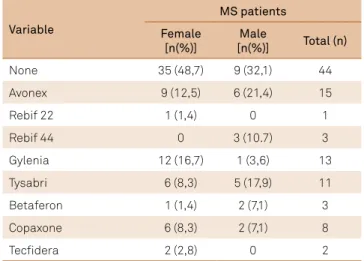
One hundred MS patients were assessed, 72 women and 28 men, with an EDSS mean of 2, and an average time after diagnosis of 93 months. Olfactory alterations were observed in 32% of the MS patients, while in the control group only 3% had olfactory alteration. Tables 1 and 2 shows
each group’s characteristics.
he boxplot shows a cutof of 4 for EDSS (Figure 1), which
approximately coincides with the EDSS mean in patients
with olfactory alteration. herefore, if a patient has an EDSS
above 4, they have (odds ratio) 5.2 times the risk of having an olfactory alteration, when compared to a patient with a
lower EDSS (p = 0.001), range of conidence (95%): 1.8–15.1. With a sensitivity of 97% and speciicity of 88%, this study
showed that when the EDSS value is smaller than 0.5, the patient is unlikely to show olfactory alteration.
We also observed that if an MS patient is older than 38 years, the risk of having an altered test is 2.2 times greater than a younger person (p = 0.01) .
Table 1. Characteristics of the study population (n = 200).
Variable MS patients [n (%)] Health controls [n (%)]
Female Male Total Female Male Total
N (%) 72 (72) 28 (28) 100 (100) 55 (55) 45 (45) 100 (100)
Age 39.8 35.9 38.7 30.52 30.54 30.47
EDSS 2 2 2 - - -
Olfaction affetions [n (%)] 22 (68.75) 10 (31.25) 32 (100) 1 (33.3) 2 (66.6) 3 (100)
Time of diagnosis 91 76 93 - - -
MS: multiple sclerosis; EDSS: Expanded disability status scale.
Table 2. Treatment and medications (n = 200).
Variable
MS patients
Female [n(%)]
Male
[n(%)] Total (n)
None 35 (48,7) 9 (32,1) 44
Avonex 9 (12,5) 6 (21,4) 15
Rebif 22 1 (1,4) 0 1
Rebif 44 0 3 (10.7) 3
Gylenia 12 (16,7) 1 (3,6) 13
Tysabri 6 (8,3) 5 (17,9) 11
Betaferon 1 (1,4) 2 (7,1) 3
Copaxone 6 (8,3) 2 (7,1) 8
Tecidera 2 (2,8) 0 2
We also observed that MS patients without olfactory alteration were within 80.5 months after diagnosis, against 119 months duration after diagnosis in the patients who had olfactory alteration, showing a correlation between olfactory alteration and time since diagnosis (p = 0.031).
DISCUSSION
he frequency of olfactory alteration in MS patients was 32%, which is consistent with other indings in the
literature, for example, the studies of Hawkes (15%), Zivadinov (22%) and Doty (32.5%)8,9,10. he sense of smell is
very important to the safety and quality of life. People with
olfactory alterations have a signiicant reduction in food
intake because of decreased pleasure, thus becoming even more susceptible to injuries3,4.
When analyzing the results, a patient with EDSS above
4 had 5.2 times the increased risk of olfactory alteration, which is consistent with other studies. Caminiti et al.7 and
Silva et al.6 showed that olfactory dysfunction was correlated
with higher EDSS scores, and a longer duration of disease, corroborating previous studies in which the olfactory dysfunction correlates directly to the level of disability8,9,11,17.
Figure 1. Boxplot from cutoff EDSS in olfactory alterations.
NO YES
EDSS
8.0
6.0
4.0
2.0
0
700 Arq Neuropsiquiatr 2016;74(9):697-700
Considering the relationship between the time of diagnosis and olfactory alteration, this study showed that patients with an abnormal test had a longer duration since diagnosis (p = 0.031), an average of 119 months, and that the older the patient, the greater the risk of olfactory alteration, as described by Silva et al6. he correlation of olfactory alteration and age
demonstrated that MS patients over 38 years old are 2.2 times (p = 0.01) more likely to have olfactory alteration.
In the study by Silva et al.6, it was observed that the
EDSS mean in all the patients studied was 2.92 ± 2.25 with a mean age of 41.91 ± 11.28 years, while in patients with
olfactory alterations the EDSS mean was around 5.26 ±2.22 (p < 0.001), with a mean age of 51,47± 10.03 years. In our
study, the studied population’s EDSS mean was 2, but it
was 4 in patients with alteration, with an age of 38 years. This demonstrates similarity between our population and Silva et al.6.
In conclusion, through the data obtained in this study we observed that MS patients are likely to experience olfactory alteration, so its assessment may be a useful tool to the follow-up care of these patients, although more studies are necessary to evaluate correlations in MS evolution.
References
1. Gold R, Wolinsky JS. Pathophysiology of multiple sclerosis and the place of terilunomide. Acta Neurol Scand. 2011;124(2):75-84. doi: 10.1111/j.1600-0404.2010.01444.x
2. Lassmann H. Axonal and neuronal pathology in multiple scle rosis: what have we learnt from animal models. Exp Neurol. 2010;225(1):2-8. doi:10.1016/j.expneurol.2009.10.009
3. Starzewski Junior A, Guilherme A, Augusto LBS. Distúrbios do olfato. Rev Bras Med. 2008;3:78-84.
4. Deems DA, Doty RL, Settle RG, Moore-Gillon V, Shaman P, Mester AF et al. Smell and taste disorders: a study of 750 patients from the University of Pennsylvania Smell and Taste Center. Arch Otolaryngol Head Neck Surg. 1991;117(5):519-28. doi:10.1001/archotol.1991.01870170065015
5. Barresi M, Ciurleo R, Giacoppo S, Foti Cuzzola V, Celi D, Bramanti P et al. Evaluation of olfactory dysfunction in neurodegenerative diseases. J Neurol Sci. 2012;323(1-2):16-24. doi:10.1016/j.jns.2012.08.028
6. Silva AM, Santos E, Moreira I, Bettencourt A, Coutinho E, Gonçalves A et al. Olfactory dysfunction in multiple sclerosis: association with secondary progression. Mult Scler. 2011;18(5):616-21. doi:10.1177/1352458511427156
7. Caminiti F, De Salvo S, De Cola MC, Russo M, Bramanti P, Marino S et al. Detection of olfactory dysfunction using olfactory event related potentials in young patients with multiple sclerosis. PLoS One. 2014;9(7):e103151. doi:10.1371/journal.pone.0103151
8. Hawkes CH, Shephard BC. Olfactory evoked responses and identiication tests in neurological disease. Ann N Y Acad Sci. 1998;855 1 OLFACTION AND:608-15. doi:10.1111/j.1749-6632.1998.tb10631.x
9. Zivadinov R, Zorzon M, Monti Bragadin L, Pagliaro G, Cazzato G. Olfactory loss in multiple sclerosis. J Neurol Sci, 1999;168(2):127-30. doi:10.1016/S0022-510X(99)00189-6
10. Doty RL, Li C, Mannon LJ, Yousem DM. Olfactory dysfunction in multiple sclerosis. Relation to plaque load in inferior frontal and temporal lobes. Ann N Y Acad Sci. 1998;855 1 OLFACTION AND:781-6. doi:10.1111/j.1749-6632.1998.tb10658.x
11. Luterotti A, Vedovello M, Reindl M, Ehling R, DiPauli F, Kuenz B et al. Olfactory threshold is impaired in early, active multiple sclerosis. Mult Scler. 2011;17(8):964-9. doi:10.1177/1352458511399798
12. Polman CH, Reingold SC, Banwell B, Clanet M, Cohen JA, Filippi M et al. Diagnostic criteria for multiple sclerosis: 2010 revisions to the McDonald criteria. Ann Neurol. 2011;69(2):292-302. doi:10.1002/ana.22366
13. Palheta Neto FX, Targino MN, Peixoto VS, Alcântara FB, Jesus CC, Araújo DC et al. Anormalidades sensoriais: olfato e paladar. Arq Int Otorrinolaringol. 2011;15(3):350-8 . doi:10.1590/S1809-48722011000300014
14. Altmann EBC, Khoury RBF, Ramos ALNF. Avaliação fonoaudiológica. In: Altmann EBC. Fissuras labiopalatinas. 4a ed. Carapicuiba: Pró-Fono; 1997. p. 325-66.
15. Cain WS, Gent JF, Goodspeed RB, Leonard G. Evaluation of olfactory dysfunction in the Connecticut Chemosensory Clinical Research Center. Laryngoscope. 1988;98(1):83-8. doi:10.1288/00005537-198801000-00017
16. Toledano A, González E, Rodríguez G, Galindo AN. Desarrollo de un test de screening olfatorio a partir del test de Connecticut (CCCRC). Acta Otorrinolaringol Esp. 2005;56(3):116-21. doi:10.1016/S0001-6519(05)78585-X