DOI: 10.1590/0004-282X20160060
ARTICLE
Presence or absence of cognitive complaints
in Parkinson’s disease: mood disorder or
anosognosia?
Presença ou ausência de queixas cognitivas na doença de Parkinson: transtorno de humor
ou anosognosia?
Pollyanna Celso F. Castro1,2, Camila Catherine Aquino1,2, André C. Felício1,2, Flávia Doná1,4, Leonardo M. I.
Medeiros1, Sônia M. C.A. Silva1, Henrique Ballalai Ferraz1, Paulo Henrique F. Bertolucci 2,3, Vanderci Borges1
Non-motor deicits have been recognized as important features of Parkinson’s disease (PD) over the past years1.
Among them, cognitive impairment, with or without dei
-nite dementia, is increasingly recognized and has mean
-ingful clinical impact, being associated with higher risk of nursing home placement, caregiver burden, and higher morbidity and mortality2
. he prevalence of PD associated
dementia (PDD) ranges from 24 to 31%, with a lifelong risk of 83%(3). PDD is estimated to account for 3.6% of dement
-ed patients, with estimat-ed prevalence of 0.2% in the popu
-lation older than 65 years3.
he characteristics of the cognitive impairment in PD can vary regarding afected domains, timing of onset, and rate of progression. he most frequently afected domains
1Universidade Federal de São Paulo, Departamento de Neurologia e Neurocirurgia, Setor de Transtornos do Movimento, São Paulo SP, Brasil;
2Hospital Israelita Albert Einstein, Instituto Israelita de Ensino e Pesquisa, São Paulo SP, Brasil;
3Universidade Federal de São Paulo, Departamento de Neurologia e Neurocirurgia, Setor de Doenças Neurodegenerativas, São Paulo SP, Brasil;
4Universidade Anhanguera de São Paulo, Programa de Mestrado em Reabilitação do Equilíbrio Corporal e Inclusão Social, São Paulo SP, Brasil.
Correspondence: Pollyanna Celso F. Castro; Rua Botucatu, 740; 04023-062 São Paul SP, Brasil; E-mail: [email protected]
Conflict of interest: There is no conlict of interest to declare.
Support: This study was supported by Coordenação de Aperfeiçoamento de Pessoal de Nível Superior (CAPES).
Received 10 October 2015; Received in inal form 02 March 2016; Accepted 31 March 2016.
ABSTRACT
We intended to evaluate whether non-demented Parkinsons’s disease (PD) patients, with or without subjective cognitive complaint, demonstrate differences between them and in comparison to controls concerning cognitive performance and mood. We evaluated 77 subjects between 30 and 70 years, divided as follows: PD without cognitive complaints (n = 31), PD with cognitive complaints (n = 21) and controls (n = 25). We applied the following tests: SCOPA-Cog, Trail Making Test-B, Phonemic Fluency, Clock Drawing Test, Boston Naming Test, Neuropsychiatric Inventory, Hospital Anxiety and Depression Scale (HADS) and Beck Depression Inventory. PD without complaints presented lower total score on Scales for outcome of Parkinson’s disease-cognition as compared to controls (p = 0.048). PD with complaints group showed higher scores on HADS (p = 0.011). PD without complaints group showed poorer cognitive performance compared to controls, but was similar to the PD with complaints group. Moreover, this group was different from the PD without complaints and control groups concerning mood.
Keywords: Parkinson disease; cognition; dementia; depression; anxiety.
RESUMO
Avaliar se pacientes com doença de Parkinson (DP) sem demência, com ou sem queixa cognitiva subjetiva, demonstram diferenças entre eles e comparativamente aos controles relativos a desempenho cognitivo e humor. Avaliados 77 indivíduos entre 30 e 70 anos: PD sem queixas cognitivas (n = 31), PD com queixas cognitivas (n = 21) e controles (n = 25). Testes aplicados: SCOPA-cognição, Trail Making Test-B, Fluência Fonêmica, Teste do Relógio, Teste Nominativo de Boston, Inventário Neuropsiquiátrico, Escala Hospitalar de Depressão e Ansiedade (HADS) e Inventário de Depressão de Beck. PD sem queixas apresentaram menor pontuação total na SCOPA-cognição, comparativamente aos controles (p = 0,048). Por outro lado, PD com queixas apresentaram maior pontuação no HADS (p = 0,011) em comparação aos controles. O grupo PD sem queixas mostrou pior desempenho cognitivo em comparação aos controles, mas foi semelhante ao PD com queixas. Este grupo foi diferente dos grupos PD sem queixas e controle em relação ao humor.
are: attention, frontal executive functions, visuospatial abil
-ities, memory and language4. his heterogeneity of cogni
-tive dysfunction is not surprising, given the distinct pattern of neuronal degeneration in PD5. he disease is pathologi
-cally deined by loss of dopaminergic cells in the substantia nigra and by the presence of Lewy bodies, mainly compris
-ing alpha-synuclein, which is likely implied in the neuronal death in PD6. here are evidences of subcortical involve
-ment in earlier stages of the disease, including noradren
-ergic neurons in the locus ceruleus, serotonergic neurons in
the raphe dorsal nuclei, and cholinergic neurons in nuclei basalis of Meynert, which takes place since early stages of the disease5. Moreover, there is strong evidence that meso
-cortical dopaminergic system contributes to cognitive and behavioral disturbances7.
In this heterogeneous context, studies have demonstrat
-ed distinct subgroups of PD patients in respect to cognitive deicits, some of them particularly vulnerable to convert to dementia8
. Identifying patients with higher risk of dementia at earlier stages could be an opportunity for further inter
-ventions9
. In line with this, it has recently been shown that subjective cognitive complaints (SCC) may harbor early de
-mentia10,11. On the other hand, it has been also found that
cognitive complaints in the absence of dementia might be at
-tributed to an underlying mood disorder12.
In this study, we intended to evaluate whether non-demented PD patients, with or without subjective cog
-nitive complaint, demonstrate diferences between them and in comparison to controls concerning cognitive performance and mood.
METHOD
Patients
We enrolled subjects in regular follow-up at the Movement Disorders Unit of Universidade Federal de Sao Paulo. he sample constituted of subjects with PD meeting the United Kingdom Brain Bank Criteria13, with age between
30-70 years old, and stable doses of PD medications for at least 8 weeks. PD subjects were separated into two groups: with SCC (PD-C), and with no SCC (PD-NC). Control group was constituted of healthy volunteers, mainly non-related caregivers, with exception of one, who was a healthy sister of one PD subject, all without SCC. Subjective cognitive com
-plaint was deined as the existence of any self-reported im
-pairment in memory and/or attention. Complaints reported by spouses or caregivers were not taken into account.
Subjects were excluded if they had dementia, poor visual acuity, past medical history of brain injury, brain surgery, stroke or psychiatric illness. They were also ex
-cluded if there was current established major depression or in the last 6 months before the study, or in use of drugs
that could potentially interfere in cognition (e.g.; anti
-cholinergics, benzodiazepines).
Clinical and neuropsychological evaluation were done during the on – medication phase. Data were collected over 10 months. We initially screened 150 PD subjects, of whom 73 (48.6%) were excluded and 77 fulilled the criteria for the study. All patients provided written informed consent to par
-ticipate in the study.
Clinical protocol
PD subjects were submitted to a complete neurologi
-cal examination, evaluation of PD motor symptoms with the Uniied Parkinson’s disease rating scale (UPDRS) part
III14, Hoehn and Yahr scale15, and the Schwab and England
scale16. Neuropsychological battery applied to all subjects in
-cluded: Scales for outcome of Parkinson’s disease - cognition (SCOPA-COG)17,18, phonemic verbal luency19
, Boston nam
-ing test (BNT)20, neuropsychiatric inventory (NPI)21
, and the Hospital anxiety and depression scale (HADS)22
, all in vali
-dated Portuguese versions. Subjects were also assessed using clock drawing test (CDT)23, trail-making-test part B (TMT)24
and Beck depression inventory (BDI)25. Pfefer scale was used
in the screening visit to support the exclusion of subjects with dementia.
Statistical analysis
he outcome variables were analyzed with Kolmogorov-Smirnov test for normality of distribution. Student’s T test for independent samples was used to ana
-lyze UPDRS motor score duration of the disease and levodo
-pa equivalent dose, and Mann Whitney test for indepen
-dent samples to compare the Hoehn & Yahr and Schwab England and ultimately the Pfefer Scale scores in PD groups. To compare the performance in the TMT and gender we used Chi-square test.
Afterwards, ANOVA with Post Hoc Tukey was applied to compare the three groups regarding a age, years of education, phonemic luency, SCOPA-COG (total score), HADS (total score and separated anxiety and depression items) and BDI. Kruskal-Wallis test was used to compare the three groups regarding NPI, Boston naming test, CDT and SCOPA-COG score in sub-items.
Finally, it was used ANOVA with covariate (HADS, HADS – depression and BDI) and comparisons using the Bonferroni’s method, when needed, with the purpose of com
-paring the total and sub-items’ score of SCOPA-COG, phone
-mic luency, CDT and Boston naming test. In the same way, it was performed a controlled analysis for the UPDRS.
Ethics
he study protocol has been approved by the ethics com
-mittee from the Universidade Federal de Sao Paulo (project number 32906/12).
RESULTS
We evaluated 150 patients, of which 77 were included in the study. he main reasons for exclusion were mood disorders (24%), use of benzodiazepines or biperiden (22.5%) in the PD group, and cognitive complaints (50%) in the control group.
Of the 77 patients included in the study, 49 were male and 28 female. We found no statistically signiicant diferences in cognitive performance between males and females (p > 0.05).
Demographic information
Table 1 shows demographic information of the patients studied. There were no differences in age and level of education among the three groups. The PD-NC group showed significantly higher scores on the UPDRS than the PD-C group, but we found no signiicant diferences in cogni
-tive performance between these two groups after controlling the analysis for this variable.
Neuropsychological assessment
he PD-NC group showed lower scores on the Scales for Outcomes in Parkinson’s Disease-Cognition (SCOPA-COG) as compared to control group (p = 0.048), but the scores of PD-C group were similar to those seen in all the other groups (Table 2).
In the fist-palm-side test (p = 0.022) and verbal semantic fluency test (p = 0.045) the PD-NC group also showed low
-er scores (2.00 and 3.61, respectively) than the control group (2.72 and 4.36, respectively). he same was seen in the CDT (p = 0.023) (Table 3).
After we conducted an ANOVA controlling for the co
-variates HADS, HADS-D and BDI scores, there were no lon
-ger diferences (p = 0.32) in the word-list generation per
-formance between the PD-C (mean = 1.24) and the control group (mean = 2.04). An analysis controlled for UPDRS scores did not change the results we previously obtained.
A comparison of the trail making test results showed nearly 57% errors in the PD-C group, 81% in the PD-NC group and 52% in the control group. Although 81% of the patients in the PD-NC group did not manage to complete the test task, the diference did not reach statistical signiicance (p = 0.056) when groups were compared.
Table 1. Clinical and demographic features of patients (mean ± SD).
Variable PD-C (n = 21 ) PD-NC (n = 31 ) CG (n = 25 ) p*
Age (years) 60.62 ± 8.40 60.74 ± 7.06 55.76 ± 8.69 0.06b
Education (years) 10.38 ± 4.87 7.48 ± 5.84 9.3 ± 4.00 0.11bb
Disease duration (years) 10.73 ± 5.67 9.74 ± 5.37 NA 0.54a
UPDRS 23.95 ± 9.08 30.29 ± 11.10 NA 0.02*a
HY 2.35 ± 0.56 2.38 ± 0.54 NA 0.79c
SE (%) 79 ± 13 80 ± 14 NA 0.77c
Pfeffer 0.95 ± 0.92 0.87 ± 1.2 NA 0.36c
Levodopa Equivalent dosage 704.76 ± 303.89 690.25 ± 325.46 NA 0.87a
SD: standard deviation; PD-C: PD with cognitive complaints; PD-NC: PD with no cognitive complaints; CG: control group. UPDRS: uniied Parkinson’s disease rating scale; HY: Hoehn Yahr; SE: Schwab & England;. a: Teste T de Student; b: ANOVA; c: Mann Whitney; NA: Non-aplicable; *p < 0,05.
Table 2. Comparison of groups concerning scores on scales for outcome of Parkinson’s disease – cognition (SCOPA-COG).
Test Group mean ± SD 95%CI p
SCOPA-COG
PD-C (n = 21) 20.38 ± 6.8 17.28–23.48 > 0.999
PD-NC (n = 31) 18.35 ± 6.67 15.91–20.8 0.048*b
CG (n = 25) 22.84 ± 5.27 20.66–25.02 NA
PD-C: PD with cognitive complaints; PD-NC: PD with no cognitive complaints; CG: control group. b: ANOVA with covariance; NA: Non-aplicable; *p < 0,05
Table 3. Comparison of groups concerning score on Boston naming test (BNT) and clock drawing test (CDT).
Test Group mean ± SD 95%CI p
BNT
PD-C 13.71 ± 1.90 12.85–14.58 > 0.999
PD-NC 13.23 ± 2.09 12.46–13.99 0.619
CG 13.76 ± 1.42 13.17–14.35 NA
CDT
PD-C 11.24 ± 3.52 9.64–12.84 > 0.999
PD-NC 10.74 ± 3.74 9.37–12.11 NA
CG 13.16 ± 1.72 12.45–13.87 0.023*a
For all other cognitive tests, there was no signiicant dif
-ference in performance among the groups.
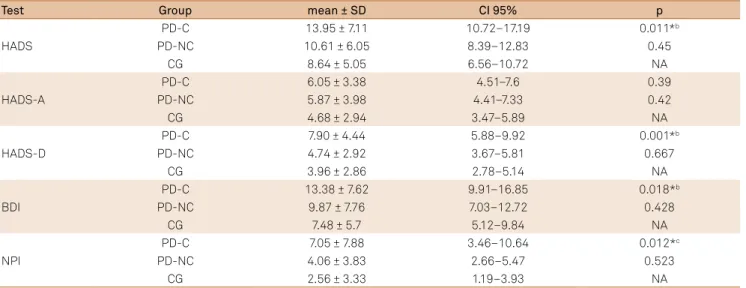
Regarding mood assessment, PD-C group showed high
-er scores on the HADS than the control group (p = 0.011). PD-C group also showed higher mean scores in the HADS depression subscale when compared to the PD-NC group (p = 0.004) and the control group (p = 0.001) (Table 4). PD-C group also had higher scores on the Beck depression invento
-ry (p = 0.018) and the neuropsychiatric onvento-ry (p = 0.012) when compared to the control group (Table 4).
DISCUSSION
In our study, patients with PD-NC had worse mean cognitive performance – assessed by the SCOPA-COG, ist-hand-palm sequence, verbal semantic luency test and clock-drawing test – than controls. However, we found no diferences in mean cognitive performance between PD-C and the control group.
his inding suggests that PD patients may have misper
-ceptions of their cognitive impairment. As Seltzer26 noted,
patients with PD and Alzheimer’s disease misperceive their cognitive deicits in multiple domains, which is associated with overall cognitive impairment and poor performance on tests assessing memory, attention and constructional abil
-ity. However, PD patients can have a better “insight” about their cognitive deicits when compared to patients with Alzheimer’s disease, although they have poor perception of their functional and social deicits27.
Leritz et al.28
reported that PD patients had low percep
-tion of impairment in daily living activities, and they in
-ferred that basal ganglia dysfunction might afect their “in
-sight” about the severity of their condition.
Rosen27
claimed that, although the underlying mecha
-nisms of anosognosia are not yet clearly understood, neu
-rotransmitter pathways in the brain’s frontal lobes must be preserved so that, self-perception is intact. From a neuro
-pathological viewpoint, PD is characterized by neuronal de
-generation in the substantia nigra leading to dopamine deple
-tion in the nigrostriatal dopaminergic projec-tions. It, in turn, is associated with disruptions of subcortico-frontal circuits29
which may cause anosognosia in these patients. Anosognosia is very common in patients with neurodegenerative condi
-tions and signiicantly impact on function and quality of life of these patients and their caregivers27.
According to Sitek et al.30 it is a relevant aspect for patient
follow-up since, misperception of one’s own deicits in patients with PD has been associated to the development of dementia.
PD-C group had similar cognitive performance as com
-pared to the other groups studied. On the other hand, mood disorders seem to be present in this group (PD-C) as com
-pared to the other two groups.
Diferent from what Hong et al.11
, we could not find significant differences in comparison to PD-NC group. They have found that PD-C group had the poorest performance on phonemic and semantic fluency tests and backward digit span test. The reason for this conlicting results could be the longer disease duration (mean = 27 years) in Hong’s patients as compared to ours (mean = 10 years). his inding may sug
-gest that, as disease progresses, cognitive decline prevails over the misperceptions of these deicits.
he PD-C group had higher scores on the HADS, HADS-D, BDI and NPI, and that were signiicantly diferent compared to the control group. hey also showed signiicantly higher HADS-D scores when compared to PD-NC group. hese ind
-ings may be explained by the fact that patients with depressive symptoms are likely to overestimate their cognitive symptoms30.
Table 4. Comparison of groups concerning mood assessment.
Test Group mean ± SD CI 95% p
HADS
PD-C 13.95 ± 7.11 10.72–17.19 0.011*b
PD-NC 10.61 ± 6.05 8.39–12.83 0.45
CG 8.64 ± 5.05 6.56–10.72 NA
HADS-A
PD-C 6.05 ± 3.38 4.51–7.6 0.39
PD-NC 5.87 ± 3.98 4.41–7.33 0.42
CG 4.68 ± 2.94 3.47–5.89 NA
HADS-D
PD-C 7.90 ± 4.44 5.88–9.92 0.001*b
PD-NC 4.74 ± 2.92 3.67–5.81 0.667
CG 3.96 ± 2.86 2.78–5.14 NA
BDI
PD-C 13.38 ± 7.62 9.91–16.85 0.018*b
PD-NC 9.87 ± 7.76 7.03–12.72 0.428
CG 7.48 ± 5.7 5.12–9.84 NA
NPI
PD-C 7.05 ± 7.88 3.46–10.64 0.012*c
PD-NC 4.06 ± 3.83 2.66–5.47 0.523
CG 2.56 ± 3.33 1.19–3.93 NA
his is consistent with Marino et al.12
who concluded that PD patients with memory-related complaints showed mood disor
-ders and that there was no relationship between subjective com
-plaints and objective cognitive impairment.
Another hypothesis could be the impact of depressive symptoms on attention and memory. he poorer word-list generation performance of the PD-C group compared to the control group disappeared after controlling for HADS, HADS-D and BDI scores in the covariate analysis, i.e., when the impact of depressive symptoms assessed by these scales on cognitive performance was removed.
Our indings regarding the presence of depressive symp
-toms in the PD-C and PD-NC groups contrast with those re
-ported by Hong et al.11
who found no mood diferences be
-tween these groups. his may be due to the smaller number of patients with PD (n = 35) of their study. Dujardin et al.10 also
found a greater rate of depressive symptoms in PD patients with cognitive complaints.
We should consider that our study has some limitations. Possibly, patients could misunderstand the meaning of atten
-tion or memory complaints. Another possible limita-tion was our small sample size since we had diiculty in recruiting pa
-tients who met study criteria.
Despite these limitations, the study indings and their comparison with literature data allow to further interpreting the signiicance of cognitive complaints in PD patients. hey may vary not only with factors such as depressive symptoms, but also with disease progression.
This study showed that PD patients without cognitive complaints had worse cognitive performance as compared to controls, as measured by total score on the SCOPA-COG, fist-hand-palm sequence, verbal semantic fluency test and clock-drawing test. However, their cognitive performance was similar to that seen in the PD-C group.
PD subjects with cognitive complaints scored higher on HADS in comparison to controls and scored higher on items related to depressive symptoms on the HADS, when com
-pared to PD-NC group.
In conclusion, our results suggest that cognitive com
-plaints in PD patients could point to mood disorders instead of real cognitive impairment. On the other hand, the absence of cognitive complaints could be related to anosognosia.
hese indings help better understanding the signiicance of subjective cognitive complaints in PD patients, but further investigations are warranted.
References
1. Chaudhuri KR, Healy DG, Schapira AH. Non-motor symptoms of Parkinson’s disease: diagnosis and management. Lancet Neurol. 2006;5(3):235-45. doi:10.1016/S1474-4422(06)70373-8
2. Levy G, Tang MX, Louis ED, Coté LJ, Alfaro B, Mejia H et al. The association of incident dementia with mortality in PD. Neurology. 2002;59(11):1708-13. doi:10.1212/01.WNL.0000036610.36834.E0
3. Hely MA, Reid WG, Adena MA, Halliday GM, Morris JG. The Sydney multicenter study of Parkinson’s disease: the inevitability of dementia at 20 years. Mov Disord. 2008;23(6):837-44. doi:10.1002/mds.21956
4. Watson GS, Leverenz JB. Proile of cognitive impairment in Parkinson’s disease. Brain Pathol. 2010;20(3):640-5. doi:10.1111/j.1750-3639.2010.00373.x
5. Jellinger KA. Post mortem studies in Parkinson’s disease: is it possible to detect brain areas for speciic symptoms? J Neural Transm Suppl. 1999;56:1-29. doi:10.1007/978-3-7091-6360-3_1
6. Tan EK, Skipper LM. Pathogenic mutations in Parkinson’s disease. Hum Mutat. 2007;28(7):641-53. doi:10.1002/humu.20507
7. Mattay VS, Tessitore A, Callicott JH, Bertolino A, Goldberg TE, Chase TN et al. Dopaminergic modulation of cortical function in patients with Parkinson’s disease. Ann Neurol. 2002;51(2):156-64. doi:10.1002/ana.10078
8. Lewis SJ, Foltynie T, Blackwell AD, Robbins TW, Owen AM, Barker RA. Heterogeneity of Parkinson’s disease in the early clinical stages using a data driven approach. J Neurol Neurosurg Psychiatry. 2005;76(3):343-8. doi:10.1136/jnnp.2003.033530
9. Burn DJ, McKeith IG. Current treatment of dementia with Lewy bodies and dementia associated with Parkinson’s disease. Mov Disord. 2003;18(Suppl 6:)S72-9. doi:10.1002/mds.10566
10. Dujardin K, Duhamel A, Delliaux M, Thomas-Antérion C, Destée A, Defebvre L. Cognitive complaints in Parkinson’s disease: its relationship with objective cognitive decline. J Neurol. 2010;257(1):79-84. doi:10.1007/s00415-009-5268-2
11. Hong JY, Lee JE, Sohn YH, Lee PH. Neurocognitive and atrophic patterns in Parkinson’s disease based on subjective memory complaints. J Neurol. 2012;259(8):1706-12. doi:10.1007/s00415-011-6404-3
12. Marino SE, Meador KJ, Loring DW, Okun MS, Fernandez HH, Fessler AJ et al. Subjective perception of cognition is related to mood and not performance. Epilepsy Behav. 2009;14(3):459-64. doi:10.1016/j.yebeh.2008.12.007
13. Hughes AJ, Ben-Shlomo Y, Daniel SE, Lees AJ. What features improve the accuracy of clinical diagnosis in Parkinson’s disease: a clinicopathologic study. Neurology. 1992;42(6):1142-6. doi:10.1212/WNL.42.6.1142
14. Goetz CG, Tilley BC, Shaftman SR, Stebbins GT, Fahn S, Martinez-Martin P et al. Movement Disorder Society-sponsored revision of the Uniied Parkinson’s Disease Rating Scale (MDS-UPDRS): scale presentation and clinimetric testing results. Mov Disord. 2008;23(15):2129-70. doi:10.1002/mds.22340
15. Hoehn MM, Yahr MD. Parkinsonism: onset, progression and mortality. Neurology. 1967;17(5):427-42. doi:10.1212/WNL.17.5.427
16. Schwab RS, England AC. Projection technique for evaluating surgery in Parkinson’s disease. In: Gillingham FJ, Donaldson IML, editors. Third symposium on Parkinson’s disease. 20-22 May 1968; Edinburgh. Edomburgh: E and S Livingstone; 1969. p. 152-7.
17. Marinus J, Visser M, Verwey NA, Verhey FR, Middelkoop HA, Stiggelbout AM et al. Assessment of cognition in Parkinson’s disease. Neurology. 2003;61(9):1222-8. doi:10.1212/01.WNL.0000091864.39702.1C
18. Carod-Artal FJ, Martínez-Martin P, Kummer W, Ribeiro LS. Psychometric attributes of the SCOPA-COG Brazilian version. Mov Disord. 2008;23(1):81-7. doi:10.1002/mds.21769
20. Goodglass HKE, Barresi B. The Boston diagnostic aphasia examination. Philadelphia: Lippincot Williams Wilkins; 2001.
21. Cummings JL, Mega M, Gray K, Rosenberg-Thompson S, Carusi DA, Gornbein J. The neuropsychiatric inventory: comprehensive assessment of psychopathology in dementia. Neurology. 1994;44(12):2308-14. doi:10.1212/WNL.44.12.2308
22. Zigmond AS, Snaith RP. The hospital anxiety and
depression scale. Acta Psychiatr Scand. 1983;67(6):361-70. doi:10.1111/j.1600-0447.1983.tb09716.x
23. Ih O. Aspectos cognitivos da doença de Alzheimer no teste do relógio: avaliação de amostra da população brasileira (tese de doutorado). São Paulo: Escola Paulista de Medicina; 2001.
24. Gill DJ, Freshman A, Blender JA, Ravina B. The Montreal cognitive assessment as a screening tool for cognitive impairment in Parkinson’s disease. Mov Disord. 2008;23(7):1043-6. doi:10.1002/mds.22017
25. Gorestein C AL. Inventário de depressão de Back: propriedades psicométricas da versão em português. Rev Psiq Clin. 1998;25(5):245-50.
26. Seltzer B, Vasterling JJ, Mathias CW, Brennan A. Clinical and neuropsychological correlates of impaired awareness of deficits in Alzheimer disease and Parkinson disease: a comparative study. Neuropsychiatry Neuropsychol Behav Neurol. 2001;14(2):122-9.
27. Rosen HJ. Anosognosia in neurodegenerative disease. Neurocase. 2011;17(3):231-41. doi:10.1080/13554794.2010.522588
28. Leritz E, Loftis C, Crucian G, Friedman W, Bowers D. Self-awareness of deicits in Parkinson disease. Clin Neuropsychol.
2004;18(3):352-61. doi:10.1080/1385404049052412
29. Henry JD, Crawford JR. Verbal luency deicits in Parkinson’s disease: a meta-analysis. J Int Neuropsychol Soc. 2004;10(4):608-22. doi:10.1017/S1355617704104141