http://doi.org/10.1590/0004-282X20170178
ARTICLE
Medical perception of stroke care conditions
in Brazil
Percepção médica sobre as condições para atendimento do AVC no Brasil
Vivian Dias Baptista Gagliardi1,2, Marcel Simis3, Hideraldo Luiz Souza Cabeça4, Rubens José Gagliardi1,5
Stroke is an increasingly-important cause of death and disability in low- and middle-income countries1. his fact is
largely driven by demographic changes (increase and aging of the population) and reinforced by an increase in the
preva-lence of the main modiiable risk factors, especially among
the urban population1. In Brazil, stroke is currently the sec
-ond leading cause of death and disabling sequelae2,3.
Stroke, despite its severity, is a disease with good potential
for prevention and should be treated as an emergency after its onset4. Patients often do not readily recognize the signs
of a stroke, either in Brazil5 or in developed countries, like
Australia6 and the United States of America7, delaying the call
for immediate medical care and thereby reducing the thera-peutic success.
In the face of the scenario where the population lacks
information, which interferes with a more efective treatment, eforts have been made to raise awareness about this prob
-lem in order to improve primary and secondary prevention, as well as to advise on the possible beneits of immediately
seeking out a service specializing in cases with signs
sugges-tive of stroke. In the United States of America, Reeves et al.8
demonstrated a signiicant improvement in public awareness
1 Irmandade da Santa Casa de São Paulo, Disciplina de Neurologia, São Paulo SP, Brasil;
2 Universidade Federal de São Paulo, Departamento de Neurologia e Neurocirurgia, São Paulo SP, Brasil;
3 Universidade de São Paulo, Faculdade de Medicina, Hospital das Clínicas, Instituto de Medicina Física e Reabilitação, São Paulo SP, Brasil; 4 Conselho Federal de Medicina, Câmera Técnica, Brasília DF, Brasil;
5 Faculdade de Ciências Médicas da Santa Casa de São Paulo, São Paulo SP, Brasil. Correspondence: Rubens Jose Gagliardi; Rua Cesario Motta Jr, 112; 01221-020 São Paulo SP, Brasil; E-mail: [email protected]
Conflict of interest: There is no conlict of interest to declare. Received 28 June 2017; Accepted 19 September 2017.
ABSTRACT
Stroke is currently the second leading cause of death in Brazil. Neurologists’ reports on the absence of adequate resources for stroke care are frequent; however, there are no objective data on this perception. Objective: To assess the perception of neurologists of stroke care conditions in Brazil. Methods: Neurologists from all over Brazil were surveyed by means of an anonymous questionnaire about the main shortcomings in stroke care, focusing particularly on physical structure and infrastructure (diagnostic methods, patient transport, availability of beds, multi-professional team). Results: The main shortcomings are indicated: the worst conditions, among all items surveyed, were found in the public sector. In the private sector, conditions were better. Conclusions: Care conditions are worse in the public sector with regard to both infrastructure and human resources. Future public health policies for the prevention and treatment of stroke should be formulated, taking into consideration neurologists’ perceptions.
Keywords: stroke; surveys and questionnaires; medical care.
RESUMO
O acidente vascular cerebral é atualmente a segunda causa de morte no Brasil. São frequentes os relatos de médicos neurologistas sobre a ausência de recursos adequados para o atendimento do AVC, no entanto, não existem dados objetivos sobre essa percepção. Objetivo: Analisar a percepção de médicos neurologistas sobre as condições para o atendimento de AVC no Brasil. Métodos: Neste estudo foi realizada pesquisa por questionário anônimo com médicos neurologistas de todo o Brasil, perguntando-se as principais deiciências para o atendimento, com foco na estrutura física, infraestrutura (métodos diagnósticos, transporte do doente, disponibilidade de leitos, equipe multiproissional). Resultados: As principais deiciências são apontadas; no setor público notou-se as piores condições, em todos os itens pesquisados. No setor privado, as condições são melhores. Conclusões: As condições de atendimento são piores no setor público, tanto de infraestrutura quanto de recursos humanos. Futuras políticas de saúde pública para prevenção e tratamento do AVC deveriam ser elaboradas levando em consideração a percepção do neurologista.
among the population in the state of Michigan after a
contin-uous ive-year public education campaign on the issue. Some
systematic reviews9,10 haveattempted to deine what kind of
educational approach yields better results in improving the population’s knowledge in the United States of America.
In Brazil, policies for stroke have had a boost since 2008,
when the Brazilian Ministry of Health included the disease
in an emergency project, creating the “Projeto Nacional de AVC”11 (the National Stroke Project), aimed at setting up a
multiprofessional task force to increase the scientiic sup
-port needed for improving education, treatment and sci
-entiic research on the subject in the country. he educa
-tional eforts to improve this outlook included the “World Stroke Day” in Brazil, coordinated by the Brazilian Academy
of Neurology (Academia Brasileira de Neurologia) and the Brazilian Society of Cerebrovascular Diseases (Sociedade Brasileira de Doenças Cerebrovasculares) with the support of
the Brazilian Ministry of Health, which received the award for the best stroke awareness campaign from the World Stroke Organization in 2012, 2013, and 201412.
Despite the work conducted in Brazil on education tar-geted at both laypeople and healthcare professionals13 and
aimed at increasing the efectiveness of prevention and treat
-ment of stroke, there are still no studies on the working con
-ditions faced in this type of care. It is, therefore, necessary to
assess the human resources and infrastructure available in
Brazil, both of which may have implications for the optimal
treatment of stroke.
his study aims to give an overview of the perception of
neurologists of the current conditions of stroke care in Brazil and collaborate on improvement of policies for the preven-tion and treatment of stroke.
METHODS
E-mails were sent to all neurologists registered with the Brazilian Academy of Neurology (Academia Brasileira de Neurologia) (a total of 1,732) with an open invitation to vol -untarily participate in a questionnaire on personal percep-tions of stroke treatment condipercep-tions in their clinical prac-tice. Students and non-neurologists were excluded from the
research. Of the total, 384 neurologists agreed to participate
in the survey.
An anonymous and conidential questionnaire was administered, with 14 “multiple-choice” questions related to neurological care provided by public services, private ser
-vices, and private health insurance organizations. here were three demographic questions, and one open question for suggestions (Appendix). he estimated time to complete the
questionnaire was seven minutes.
he questionnaire was open for responses from October 17 to November 30, 2015. It was designed on the online
questionnaire platform provided by the Survey Monkey
web-site, with conidentiality of information being guaranteed.
RESULTS
The first question referred to the workplace; most
neu-rologists work in the public service (76.4%), followed by private healthcare (53.9%) and private health insurance
organizations (48.4%). Many neurologists work at more than one location.
The survey inquired about the conditions under which
health care was provided, and the structure of the ser
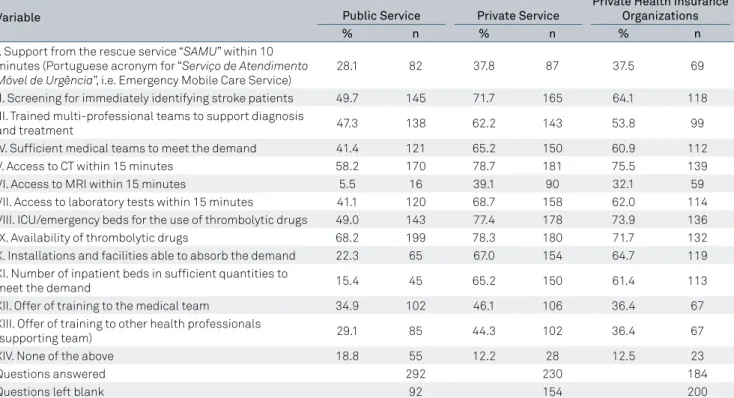
-vice where professionals worked, by using an open mul -tiple-choice question. The results are shown in the Table and Figure 1.
Neurologists were also questioned about which aspects
of human resources should be improved for outpatient care, aiming at the prevention and treatment of stroke, with pos -sible ratings ranging from 1 to 5 (1 being the highest priority
for improvement, and 5 being the lowest priority). Figure 2 shows the mean ratings for each item, with a comparison of the three professional ields of practice.
Infrastructure aspects were assessed by ratings from 1 to
5, shown in Figures 3 and 4.
With respect to the length of time since graduation from medical school, the analysis of the participants’ epidemio
-logical proile showed 20.6% with less than ive years, 29.2% between ive and 10 years, 23.4% from 11 to 20 years, 13.9% from 21 to 30 years, and 12.8% with over 30 years of neurolog -ical practice. Seventy-eight percent of these neurologists deal
with neurological emergencies. Twenty-ive Brazilian states
were represented.
DISCUSSION
Multiple eforts have been made to improve the educa -tion of patients and professionals on stroke care in Brazil11,12,
but we have little information about the current situation in which the neurologist operates within the purview of infra-structure and human resources.
his study sought to quantify the medical conditions of
stroke care in Brazil by recording the opinion of neurologists
directly involved with the management of these patients. he
studies with records of personal opinions in a large
popula-tion attract signiicant interest as they give one an overview of the current situation, point out shortcomings and contrib -ute to establishing public policies aimed at improving the
medical service provided. his study involved signiicant col -laboration with the neurologists who answered the call from the Brazilian Academy of Neurology; questionnaires were
rate corresponds to 22.17% of the sample, which is consid -ered suitable for this type of analysis.
Most of the participants work in the public service; the number of participants working in the private sector or pri-vate health insurance organizations was similar. Seventy-eight percent of the total sample deal with neurological
emergencies. With reference to the length of time dedicated to specialized training, there was signiicant participation
Table. Structural features of the service premises (items I-XIV), according to the professional’s ield of practice.
Variable Public Service Private Service
Private Health Insurance Organizations
% n % n % n
I. Support from the rescue service “SAMU” within 10 minutes (Portuguese acronym for “Serviço de Atendimento Móvel de Urgência”, i.e. Emergency Mobile Care Service)
28.1 82 37.8 87 37.5 69
II. Screening for immediately identifying stroke patients 49.7 145 71.7 165 64.1 118 III. Trained multi-professional teams to support diagnosis
and treatment 47.3 138 62.2 143 53.8 99
IV. Suficient medical teams to meet the demand 41.4 121 65.2 150 60.9 112
V. Access to CT within 15 minutes 58.2 170 78.7 181 75.5 139
VI. Access to MRI within 15 minutes 5.5 16 39.1 90 32.1 59
VII. Access to laboratory tests within 15 minutes 41.1 120 68.7 158 62.0 114
VIII. ICU/emergency beds for the use of thrombolytic drugs 49.0 143 77.4 178 73.9 136
IX. Availability of thrombolytic drugs 68.2 199 78.3 180 71.7 132
X. Installations and facilities able to absorb the demand 22.3 65 67.0 154 64.7 119 XI. Number of inpatient beds in suficient quantities to
meet the demand 15.4 45 65.2 150 61.4 113
XII. Offer of training to the medical team 34.9 102 46.1 106 36.4 67
XIII. Offer of training to other health professionals
(supporting team) 29.1 85 44.3 102 36.4 67
XIV. None of the above 18.8 55 12.2 28 12.5 23
Questions answered 292 230 184
Questions left blank 92 154 200
n: number of responses.
of all groups. Most questionnaires were answered by
phy-sicians in southeastern Brazil (states of São Paulo, Minas Gerais, and Rio de Janeiro) and southern Brazil (states of Paraná and Rio Grande do Sul), which have the highest con -centrations of neurologists.
With respect to the human and physical resources avail
-able to professionals for stroke care, all resources inquired
about were observed to be present in smaller amounts in 0.0%
0.0% 20.0% 30.0% 40.0% 50.0% 60.0% 70.0% 90.0%
80.0%
I II III IV V VI VII VIII IX X XI XII XIII XIV
Public Setor Private Setor Private health insurance organization
0.00 2.60 2.74 2.65 2.45 2.92 2.94 2.74 2.92 2.73 2.46 2.73 2.64 2.76 3.27 3.14 3.50 3.00 2.50 2.00 1.50 1.00 0.50 Offer of training to the
multi-professional teams
Multi-professional teams in quantity to meet the demand
Offer of training to the medical team
Medical teams in quantity to meet the demand
Quality of the screening service for identifying stroke patients
Public Setor Private Setor Private health insurance organization
Figure 2. Aspects of human resource that should be improved, by ield of practice; mean ratings given for each aspect, with 1 being the highest priority for improvement and 5, the lowest priority.Questions 3, 7, and 11: Considering the past six weeks in the public service/private service/private health insurance organization in which you work, which among the following aspects of human resources should be improved in outpatient care for stroke prevention and treatment?
0 3.37 3.38 2.88 3.36 3.44 3.14 2.94 3.19 2.52 3.24 3.49 2.47 3.46 3.57 3.09 4 3 2 1
Access to medicines
Access to laboratory tests
Access to magnetic resonance imaging scans
Access to computed tomography scans
Quality of the physical installa-tions and facilities
Public Setor Private Setor Private health insurance organization
Figure 3. Structural aspects that should be improved, by ield of practice; mean ratings given for each aspect, with 1 being the highest priority for improvement and 5, the lowest priority. Questions 4, 8 and 12: Considering the past six weeks in the public service/private service/private health insurance organization in which you work, which among the following structural aspects should be improved in outpatient care for stroke prevention and treatment?
Public Setor Private Setor Private health insurance organization 0% 1.7% 4.4% 5% 20% 15% 0% 25% 30%
0 1 2 3 4 5 6 7 8 9 10
1.6% 2.2% 7.5% 2.7% 2.6% 8.5% 2.7% 2.6% 9.9% 2.7% 7.4% 14.0% 9.1% 4.8% 17.1% 9.1% 16.1% 18.1%18.8% 26.5% 10.6% 23.1% 22.6% 5.98% 18.8% 10.9% 1.0% 5.4% 1.3% 2.2% 3.1%
the public sector. he availability of resources in the private
sector and private health insurance organizations is
simi-lar, being slightly higher in the private sector. he most sig
-niicant diferences (greater than 20%) were found in the
following items:
1) Suicient medical teams to meet the demand; 2) Access to CT within 15 minutes;
3) Access to MRI within 15 minutes;
4) ICU/emergency beds for the use of thrombolytic drugs; 5) Installations and facilities compatible with absorbing the demand;
6) Number of inpatient beds in suicient quantities to meet the demand;
7) Ofer of training for other health professionals.
We thus observed that the public sector’s shortage is greater concerning infrastructure, with respect to both the
access to imaging studies necessary for the service and the
allocation of beds to these patients. Furthermore, it was
found that there are fewer medical teams than required to meet the needs of these patients and less available train-ing for other professionals who participate in the medical care. It is also interesting to note that the presence of
res-cue support for the patient within 10 minutes was small
in the three fields of practice (reaching the highest
per-centage, 37.8%, in the private sector), as was the access to MRI within 15 minutes (the highest percentage, 39.1%, was observed in the private sector), thus indicating the need for an intervention to improve these items, not only
in the public sector.
With respect to the ratings for human resources and improvement priority (Figure 2), it was found that, in the public service, greater priority is given to the need for sui
-cient multiprofessional teams to meet the demand, followed
by quality in the screening service for identifying patients
with stroke. he private healthcare sector and private health
insurance organizations listed their priorities for improve-ments as better quality of the screening service for identi-fying patients with stroke and available training for
multi-professional teams. hese data show the need for education programs targeted for practitioners of other professions,
especially those who conduct the screening of patients, which would beneit the three medical care sectors.
he structural features (Figure 3) that would be a prior -ity for improvement in the public sector are the qual-ity of the
physical installations and facilities and access to MRI scans. Interestingly, these were the same items found to be a pri -ority for improvement in private health insurance organiza-tions (with the highest priority being the availability of access
to MRI). hose working in the private sector described their major priorities as the access to MRI and medicines. he availability of access to MRI is hindered by the high cost of this apparatus, which seems to be important in the three ields of practice.
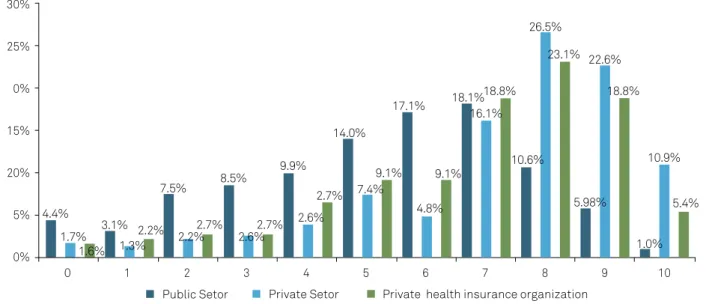
he general perception of the infrastructure available for treatment, as assessed by ratings from 0 to 10 (Figure 4), also
shows a tendency towards worse ratings for the public sector
(with 49% of ratings ranging between 5–7 points). he private
sector and private health insurance organizations obtained
better ratings, the former having performed better than the latter (private sector, 65.2% of ratings ranging between 7 and 9; private health insurance organizations, 60.7% of ratings rang
-ing between 7 and 9). he need to request better infrastructure
conditions from the relevant authorities for the public sector in order to improve stroke care becomes apparent.
In conclusion, this study shows that in the working reality of Brazilian neurologists, the public sector has the largest deicits, both in infrastructure resources and human resources (sui -cient professionals for medical care and the training of
multipro-fessional teams). Ways to promote improvements, both struc
-tural and in human resources should, therefore, be explored
with the relevant authorities in the public health sector.
Acknowledgments
To Dr Lidia Moura, from Harvard School, and to the jour -nalist Paulo Henrique de Souza from the Federal Council of Medicine (Conselho Federal de Medicina), for their collabo -ration in the prepa-ration of the questionnaire and revision of materials.
References
1. Bonita R, Beaglehole R. Stroke prevention in poor countries: time for action. Stroke. 2007;38(11):2871-2. https://doi.org/10.1161/STROKEAHA.107.504589
2. Lotufo PA, Goulart AC, Fernandes TG, Benseñor IM. A reappraisal of stroke mortality trends in Brazil (1979-2009). Int J Stroke. 2013;8(3):155-63. https://doi.org/10.1111/j.1747-4949.2011.00757.x
3. Datasus. Centro Tecnológico de Informação e Informática do SUS. 2015 [cited 2015 Dec]. Available from: http://www.datasus.gov.br
4. Martins SC, Freitas GR, Pontes-Neto OM, Pieri A, Moro CH, Jesus PA et al. Guidelines for acute ischemic stroke treatment. Part II: stroke treatment. Arq. Neuropsiquiatr. 2012;70(11):885-93. https://doi.org/10.1590/S0004-282X2012001100012
5. Pontes-Neto OM, Silva GS, Feitosa MR, Figueiredo NL, Fiorot Junior JA, Rocha TN et al. Stroke awareness in Brazil: alarming results in a community-based study. Stroke. 2008;39(2):292-6. https://doi.org/10.1161/STROKEAHA.107.493908
6. Sug Yoon S, Heller RF, Levi C, Wiggers J, Fitzgerald PE. Knowledge of stroke risk factors, warning symptoms, and treatment among an Australian urban population. Stroke. 2001;32(8):1926-30. https://doi.org/10.1161/01.STR.32.8.1926
8. Reeves MJ, Rafferty AP, Aranha AA, Theisen V. Changes in knowledge of stroke risk factors and warning signs among Michigan adults. Cerebrovasc Dis. 2008;25(5):385-91. https://doi.org/10.1159/000121338
9. Lecouturier J, Rodgers H, Murtagh MJ, White M, Ford GA, Thomson RG. Systematic review of mass media interventions designed to improve public recognition of stroke symptoms, emergency response and early treatment. BMC Public Health. 2010;10(1):784. https://doi.org/10.1186/1471-2458-10-784
10. Payne GH, Fang J, Fogle CC, Oser CS, Wigand DA, Theisen V et et al. Stroke awareness: surveillance, educational campaigns, and public health practice. J Public Health Manag Pract. 2010;16(4):345-58. https://doi.org/10.1097/PHH.0b013e3181c8cb79
11. Martins SC, Pontes-Neto OM, Alves CV. Past, present, and future of stroke in middle-income countries: the Brazilian experience. Int J Stroke. 2013;8 suppl A 100:106-11. Https://doi.org/10.1111/ijs.12062
12. Pontes-Neto OM. Stroke awareness in Brazil: what information about stroke is essential? Arq. Neuropsiquiatr. 2014;72(12):909-10. https://doi.org/10.1590/0004-282X20140197