Decision Directed Algorithms for Blind Equalization Based
on Constant Modulus Criteria
Carlos AlexandreR. Fernandes1∗, Joao CesarM. Mota2, G´erardFavier1
1Laboratoire I3S
Les Algorithmes/Euclide B - 2000 route des Lucioles, BP 121, 06903 Sophia-Antipolis Cedex, France.
2GTEL/DETI/CT/UFC
Campus do Pici, 60.755-640, 6007 Fortaleza, Brazil [email protected], [email protected]
R´esum´e – Le but de cet article est de proposer une famille de techniques d’´egalisation aveugle de signaux du type QAM.
Les algorithmes propos´es sont dirig´es par la d´ecision et bas´es sur des fonctions de coˆut du type Module Constante modifi´ees. Deux approches sont consid´er´ees: l’approche du Gradient Stochastique et l’approche duNormalized Constant Modulus Algorithm
(NCMA). Les simulations num´eriques confirment les r´esultats attendus et montrent que les techniques propos´ees am´eliorent les performances des algorithmes classiques bas´es sur la fonction de coˆut CM.
Abstract –A family of techniques aiming to perform blind equalization for Quadrature Amplitude Modulation (QAM) signals
is presented. The proposed algorithms are decision directed and based on modified Constant Modulus (CM) criteria. Two approaches are used to develop the algorithms: the Stochastic Gradient Descent approach and the Normalized Constant Modulus Algorithm (NCMA) approach. Computer simulations confirm the expected results and show that the proposed algorithms outperform the conventional CM based algorithms.
1
Introduction
The Constant Modulus Algorithm (CMA), developed in-dependently by Godard [1] and Treichler [2], is one of the most used techniques to perform blind equalization and it works very well for modulations in which all points of the signal constellation have the same radius, like Phase Shift Keying (PSK) modulations. However, when the con-stellation points are characterized by multiple radii, the estimation error obtained with algorithms based on the CM criterion does not reach zero, even if the channel is perfectly equalized. This is one of the reasons for the un-satisfactory performance of conventional CM algorithms with QAM signals. It can only achieve a moderate level of Steady-State Error (SSE). Moreover, we can say that the speed of convergence is another important drawback of the CM-type algorithms.
The main contribution of this work is to propose two new classes of algorithms inspired on the CMA to im-prove its performance for high level QAM signals. The considered cost functions can be viewed as modifications of the CM criterion. In fact, one of the proposed modified CM cost functions can be viewed as a generalization of the CM criterion for constellations with multiple radii. The others can be seen as generalizations of the Modified CM (MCM) criterion, which allows to jointly perform blind equalization and carrier recovery.
∗Supported by the Program Alban, the European Union
Pro-gram of high Level Scholarships for Latin America, scholarship n. E04M049616BR.
It is well-known that the NLMS algorithm outperforms the LMS algorithm. Thus, we will develop normalized versions of the algorithms trying to improve their perfor-mance, specially in the case of high level QAM signals. Actually, each family is composed of four algorithms with very desirable properties and advantages over the origi-nal CM algorithms (CMA and NCMA). Dual-mode ver-sions of the algorithms are also studied. They start with a robust algorithm, i. e. not decision directed, and after switch to a novel one, aiming to avoid an excessive number of incorrect decisions during initial iterations.
2
Description of the Algorithms
Let us assume that: the transmitted i.i.d. sequence{a(n)} can take the value of any constellation symbol with equal probability; the output sequence of the equalizer {y(n)} is given by (1), whereh= [h(0)h(1). ... h(N−1) ] is the
impulse response of the Moving-Average (MA) channel,
N is the length of the channel and υ(n) is an additive white Gaussian noise (AWGN). The number of taps of the transversal equalizer isM and w(n) is its tap-weight
vector. ˆa(n) is the output of the decision device (estimated symbol).
y(n) =
M
X
i=1
w(i)x(n−i), where x(n) =
N
X
i=0
h(i)a(n−i)+υ(n).
2.1
CMA-type Algorithms
In [3] we proposed a technique inspired by the CMA for blind equalization of QAM signals: the Decision-Directed Modulus Algorithm (DDMA). The DDMA can be seen as a generalization of the CM cost function for multi-ple radii constellations and it uses the squared magni-tude of the decided symbol. The DDM cost function is expressed in Table 1(line 2). Taking the stochastic gradi-ent of the DDM cost function, we obtain the tap-weight vector update equation of the Decision-Directed Modulus Algorithm (DDMA):
w(n+ 1) =w(n)−µe(n)x∗(n). (2)
where e(n) is given in Table 1 (line 2). The derivative of ˆa(n) relative tow(n) was assumed to be zero. As we
can see, the DDM cost function is able to reach to zero for any symbol of the constellation. We may say that the DDM is a ”constellation matched” cost function. For PSK modulations, the DDM and the CM cost functions are equivalent. The main advantage of the DDMA algorithm is its great performance with QAM constellations, in terms of convergence speed and steady-state error (SSE). When perfect equalization is achieved, the second term of the DDMA update equation (2) goes to zero while in CMA it never does so.
In [4] we did an analysis of the minima of the DDM cost function based on the CMA analysis in [6]. It was demonstrated, for the case of real signals, that the Wiener solution is, approximately, a solution of the DDM crite-rion minimization. It was also shown that the DDMA has convergence properties that are very similar to that of the CMA. However, the DDMA uses information of last decided symbol, which makes the performance of the DDMA worst if the number of incorrect decisions is too large. To solve this problem, the initial adjustment of the tap weight vector can be done by the CMA and when some switching criterion is achieved, the equalization algorithm switches to DDMA. In [3], this algorithm was called dual-mode DDMA(or CMA-DDMA). The dual-mode DDMA has a better performance than the DDMA, in terms of convergence speed and SSE.
In [5] it was proposed a very interesting algorithm based on a decomposition of the CM cost function: the Modi-fied Constant Modulus Algorithm (MCMA). The MCM cost function has real and imaginary references instead of one modulus of reference in the CM cost function. These in-phase and in-quadrature references make the MCMA more adapted to QAM signals than the CMA. The MCM cost function is the CM one decomposed into the real and imaginary parts (Table 1 - line 3). The MCMA is able to remove ISI and perform the carrier recovery jointly. It implicitly corrects phase errors and may outperform the conventional CMA with almost the same computational cost.
It is possible to unify the modifications done in the CM cost function to create a new cost function that incor-porates the improvements of the DDMA and MCMA to-gether. This cost function will be similar to the MCM cost function, but with variable references to the real and
imaginary parts of the signal. We will call this cost function of Modified DDM (MDDM) cost funcfunction (Table 1 -line 4). Taking the stochastic gradient of the MDDM cost function, we obtain the tap-weight vector update equation of the Modified DDMA (MDDMA) (eq. 2 and Table 1 -line 4). The MDDMA is also able to perform jointly blind equalization and carrier recovery and it has the advan-tages of both CMA and DDMA. However, the MDDMA is also decision directed, so it also suffers if the number of incorrect decisions is too large. In this case, we can use the same approach as before: a robust algorithm per-forms the initial adjustments (MCMA in this case) of the equalizer and after we switch the algorithm.
2.2
NCMA-type Algorithms
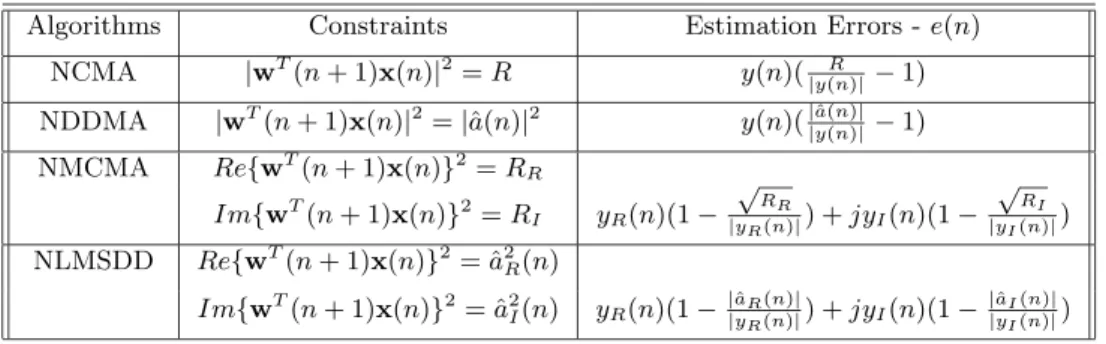
The Normalized CMA (NCMA), proposed by a number of authors, e.g. [7], is based on a particular choice of the step-size and does not work very well with high QAM constel-lations. At each iteration a step-size is chosen such that the updated filter coefficients achieve the desired modulus when applied to current data vector.
Based on the idea behind the DDMA, we can change the NCMA constraint (Table 2 - line 2) to develop an algorithm with good performances for blind equalization with high QAM signals. The solution to this optimization problem can be obtained in a similar way of the develop-ment of the NCMA and leads to the Normalized DDMA (NDDMA):
w(n+ 1) =w(n) + µ
kx(n)k2e(n)x
∗(n). (3)
where e(n) is shown in Table 2 (line 2). This new algo-rithm can be seen as a generalization of the NCMA for multiple radii constellations. The squared magnitude of the NDDMA constraint can assume any of the squared magnitude values of the constellation symbols, allowing more flexibility to the algorithm. So the NDDMA should provide a significant performance improvement in relation to the NCMA, when applied to high level QAM constel-lations. The NDDMA can also be used as a dual-mode algorithm, but, in this case, the initial algorithm is the NCMA (to have less computational complexity).
A next step in the improvement of this family of algo-rithms is to employ the idea behind the MCMA. For this we can break the NCMA constraint into two (Table 2 -line 3), and develop the Normalized MCMA (NMCMA) in a similar way of NCMA (eq. 3 and Tab. 2 - line3). It is important to remark that the NMCMA has almost identi-cal complexity than the NCMA. The NMCMA implicitly corrects phase errors and is not decision directed, which means that it is not prejudiced by an incorrect decision.
Tab.1: The family of the CMA-type Algorithms
Algorithms Cost Functions Estimation Errors -e(n) CMA E{(|y(n)|2−R)2} y(n)(|y(n)|2−R) DDMA E{(|y(n)|2− |ˆa(n)|2)2} y(n)(|y(n)|2− |ˆa(n)|2)
MCMA E{(y2R(n)−RR)2 + (yI2(n)−RI)2} yR(n)(yR2(n)−RR) +jyI(n)(yI2(n)−RI)
MDDMA E{(y2R(n)−ˆa2R(n))2 + (yI2(n)−aˆ2I(n))2} yR(n)(yR2(n)−aˆ2R(n)) +jyI(n)(yI2(n)−ˆa2I(n))
Tab.2: The family of the NCMA-type Algorithms
Algorithms Constraints Estimation Errors -e(n) NCMA |wT(n+ 1)x(n)|2=R y(n)( R
|y(n)|−1)
NDDMA |wT(n+ 1)x(n)|2=|aˆ(n)|2 y(n)(|aˆ(n)|
|y(n)|−1)
NMCMA Re{wT(n+ 1)x(n)}2=RR
Im{wT(n+ 1)x(n)}2=RI yR(n)(1−
√
RR
|yR(n)|) +jyI(n)(1−
√
RI
|yI(n)|)
NLMSDD Re{wT(n+ 1)x(n)}2= ˆa2
R(n) Im{wT(n+ 1)x(n)}2= ˆa2
I(n) yR(n)(1−||yˆaRR((nn))||) +jyI(n)(1−||ˆayII((nn))||)
In this case, we can use the same dual-mode approach as before. To make the complexity lower, we can start with the NMCMA and make the switch to the NLMS-DD by only switching the ”reference radii”: √RR to |ˆaR| and √
RI to|ˆaI|.
3
Simulation results
The proposed family of algorithms was tested by means of computational simulations. The simulation scenario con-sists in a transmitted signal with a 16QAM or 64QAM modulation, an equalizer with 9 taps, a 30dB SNR and a discrete-time channel with impulse response given by:
h(n) = 0.2798δ(n) + 1δ(n−1) + 0.2798δ(n−2). A PLL is used to correct phase shift at the output of the equal-izer, except for the algorithms of the ”Modified” type, which perform the carrier recovery by themselves. All the Mean Squared Error (MSE) curves were obtained via Monte Carlo simulations using 50 independent data real-izations and the horizontal line shows the optimum Wiener MSE.
Fig. (1) shows the learning curve of the CMA-type fam-ily of algorithms for a 16QAM signal. First, we remark that the DDMA has a SSE approximately 7dB smaller than the CMA. As regards the modified algorithms, it is clear from fig. (1) that they have provided improvements on the CMA and on the DDMA (MDDMA converges after 1800 iterations and DDMA after 4500 iterations approx-imately). In this case, again it was not necessary to em-ploy the dual-mode algorithms. However, for a 64QAM signal the dual-mode approach provides very good im-provements. We can see in fig. (2) that the MCMA has the better performance among all the single-mode algo-rithms, since decision directed algorithms were penalized by a high modulation level. Moreover, the DDMA has a higher convergence speed than the MDDMA and the
Decision Directed Algorithm (DDA), which does not have an acceptable level of MSE even after 40000 iterations. However, working in a dual-mode version, the MDDMA has a very good improvement of its performance, outper-forming even the dual-mode DDMA and the dual-mode DDA (MCMA-MDDMA converges after 1500 iterations, CMA-DDMA after 3200 iterations and the CMA-DDA af-ter 2700 iaf-teration, approximately).
0 0.2 0.4 0.6 0.8 1 1.2 1.4 1.6 1.8 2
x 104 −20
−15 −10 −5 0 5 10
Iterations
Mean Squared Error − dB CMA
MCMA
DDMA
MDDMA
Fig. 1: MSE curves for the LMStype algorithms -16QAM.
0 0.2 0.4 0.6 0.8 1 1.2 1.4 1.6 1.8 2
x 104 −20
−15 −10 −5 0 5 10
Iterations
Mean Squared Error − dB
CMA MDDMA
MCMA
MCMA−MDDMA
CMA−DDMA
DDMA DDA
CMA−DDA
Fig. 2: MSE curves for the LMStype algorithms -64QAM.
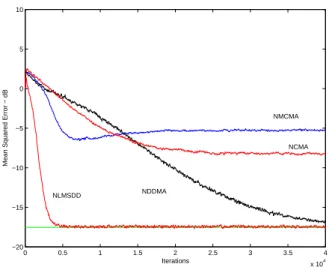
after 40000 iterations. Moreover the NMCMA does not suffer so much in this case, as it is not decision directed. Moreover, by working in a dual-mode version, the ND-DMA and the NLMSDD have a very good improvement in their performance. It should be highlighted that the NLMSDD had a better performance when working with the NMCMA than with the NCMA.
0 0.5 1 1.5 2 2.5 3 3.5 4
x 104 −20
−15 −10 −5 0 5 10
Iterations
Mean Squared Error − dB
NMCMA
NLMSDD NDDMA
NCMA
Fig. 3: MSE curves for the NLMStype algorithms -16QAM.
4
Conclusions
In this paper, we have presented a new family of algo-rithms characterized by some very desirable properties when performing blind equalization for QAM signals. Sim-ulation results confirms the behavior expected, showing a great improvement of the proposed algorithms in relation to the conventional ones. Their gain in performance is very significative, with a very reasonable computational cost (in relation to the original CM algorithms). The SSE of the proposed algorithms are, in general, very close to the Wiener MSE. The MDDM based algorithms can per-form jointly blind equalization and carrier recovery, and
0 0.5 1 1.5 2 2.5 3 3.5 4
x 104 −20
−15 −10 −5 0 5 10
Iterations
Mean Squared Error − dB
NCMA−NDDMA
NMCMA
NCMA NLMS−DD
NMCMA−NLMSDD NDDMA
NCMA−NLMSDD
Fig. 4: MSE curves for the NLMStype algorithms -64QAM.
have shown to outperform the DDM based algorithms. Perspectives of this work include a study of convergence and generalization to nonlinear filter structures.
References
[1] D. N. Godard. Self-recovering equalization and car-rier tracking in two dimensional data communication system. IEEE Trans. on Communic., V. 28, pp. 1867– 1875, 1980.
[2] J.R. Treichler and B. Agee.A new approach to mul-tipath correction of constant modulus signals. IEEE Transactions on ASSP, V. 31, n. 4, pp. 459–472, 1983. [3] C. A. R. Fernandes and J. C. M. Mota.New Blind Al-gorithms Based on Modified Constant Modulus Crite-ria for QAM Constellations. Lecture Notes in Comp. Science (LNCS), V. 3124, pp. 498 – 503, aug 2004. [4] C. A. R. Fernandes and J. C. M. Mota.Novos
Algo-ritmos Baseados em Estatisticas de Ordem Superior de Decisoes Dirigidas para Equalizacao Autodidata. Proc. of the 21 Simp. Brasileiro de Telecom., B´elem - Brazil, sep 2004.
[5] K. N. Oh and Y. O. Chin.Modified Constant Modulus Algorithm: Blind Equalization and Carrier Phase Re-covery Algorithm. Proc. of the 1995 Int. Conf. Com-mun., V. 1, pp. 498–502, 1995.
[6] Z. Ding, R. A. Kennedy, B. D. O. Anderson and C. R. Johnson Jr.Ill-Convergence of Godard Blind Equal-izers in Data Communications Systems. IEEE Trans. on Comm., V. 39, pp. 1313 – 1327, 1991.