Study performed at Post Graduation Program in Human Communication Disorders, Universidade Federal de Santa Maria – UFSM – Santa Maria (RS), Brazil, with scholarship by the Coordenação de Aperfeiçoamento de Pessoal de Nível Superior (CAPES) to the two first authors. The third author is scholarship student of Productivity in Research (Produtividade em Pesquisa) CNPq. The research was financed by (Edital PqG-02/2011).
(1) Post Graduation Program in Human Communication Disorders, Universidade Federal de Santa Maria – UFSM – Santa Maria (RS), Brazil.
(2) Speech-Language, Pathology and Audiology Course and Post Graduation Program (Master’s and Doctor’s Degree) in Human Communication Disorders, Universidade Federal de Santa Maria – UFSM – Santa Maria (RS), Brazil.
Conflict of interests: No
Authors’ contribution: AS participated in the research and schedule elaboration, literature survey, data collection and analysis, article writing, submission of the article; MIC, coauthor, participated in the research and schedule elaboration, literature survey, data analysis and collection, article writing review, article organiza-tion, and final version review; MKS, advisor, participated in the research and schedule elaboration, data analyses, article writing review and final version review. Correspondece address: Angélica Savoldi. R. Permião José Tosetto 719, Progresso, Tapera (RS), Brazil, CEP: 99490-000.
E-mail: [email protected] Received: 11/7/2012; Accepted: 7/31/2013
What are the best words to compose an evaluation
phonological instrument?
Quais são as melhores palavras para compor um instrumento de
avaliação fonológica?
Angélica Savoldi1, Marizete Ilha Ceron1, Márcia Keske-Soares2
ABSTRACT
Purpose: To judge what kind of words would be more appropriate to the social and/or linguistic reality to compose an instrument of phonological evaluation to Brazilian Portuguese children. Methods: From an initial list of 722 words of the lexicon child and phonological assessments cur-rently used, examined judged the best words to compose the instrument according to its theoretical and practical knowledge. A new list was formed with 316 selected words, these were illustrated and analyzed by specialists as judges not to familiarity and proper elicitation through Li-kert scale. Results: Analysis of expert judges had a weak agreement with Kappa value equivalent to 0.378 resulting in 316 selected words. The trial judges not experts resulted in the list of words to compose the most appropriate assessment tool by phonological criteria as the percentage of correct familiarity and elicitation. Conclusion: There were selected considering the analyzes of the judges 116 words, with its illustration, to compose the phonological assessment tool.
Keywords: Speech; Speech disorders; Child language; Articulation disorders; Speech articulation tests
RESUMO
Objetivo: Julgar quais palavras seriam adequadas à realidade social e/ou linguística para compor um instrumento de avaliação fonológica infantil para o Português Brasileiro. Métodos: Partindo de uma lista inicial de 722 palavras do léxico infantil e avaliações fonológicas disponíveis, utilizadas atualmente, juízes especialistas julgaram as melhores palavras para compor o instrumento, de acordo com seu conhecimento teórico e prático. Formou-se uma nova lista com 316 palavras selecionadas, que foram ilustradas e analisadas por juízes não especialistas (crianças), quanto à familiaridade e eliciação corretas, através de escala Likert. Resultados: A análise dos juízes especialistas obteve uma concordância fraca com valor de Kappa equivalente a 0,378, resultando em 316 pala-vras selecionadas. O julgamento dos juízes não especialistas resultou na lista de palavras mais indicadas para compor um instrumento de avalia-ção fonológica, utilizando critérios de porcentagem de acerto quanto à familiaridade e eliciação. Conclusão: Foram selecionadas pelas análises dos juízes 116 palavras, com respectivas ilustrações, para compor o instrumento de avaliação fonológica.
INTRODUCTION
The acquisition of a language involves, among other aspects, the learning and organization of sounds. Most children develop the oral language naturally, producing all speech sounds pro-perly, until they are, approximately, five years old(1). By only hearing the disordered productions, it is started to think about the acquisition complexity. Several researches(2,3-5,6,7-13) have been performed, related to typical and atypical phonological acquisition, and, to analyze that production complexity in the evaluated population, it is important to use proper evaluation instruments, validated and standardized.
In Brazil, in the different Speech-Language areas, there is lack of formal instruments and available objects to the evalua-tion and diagnosis of those difficulties(2,14). Some studies(15-18) have been performed, mainly in the area of Neuropsychology, with the purpose of building or adapting evaluation instruments which correspond to the cultural and linguistic characteristics of our country. Some of those instruments may be used by speech--language therapists, such as the Montreal communication eva-luation battery (MAC battery), which was adapted to Brazilian Portuguese(17) after the original French battery (Canadian).
In other countries, such as the United Stated, that context is different. Professionals (speech-language therapists) provide several formal tests, created and/or adapted and validated to the population, available for language and speech evaluation for children and adults. For example, in the Directory of Speech-Language Pathology Assessment Instruments, from American Speech-Language-Hearing Association, 2006 Edition, there is a list with more than 100 tests(14).
However, the Brazilian research and clinical reality, curren-tly and moscurren-tly, is based on translated instruments and on the international rules. There are some adaptations of evaluation instruments which were adapted to Brazilian reality, but in a restricted number. There are, also, tests which were not effec-tively validated for the Brazilian population.
It should be emphasized that the construction of Brazilian speech-language instruments and/or the adaptation of interna-tional clinical tools for Brazilian Portuguese (BP) is still rash. The lack of objective and formal instruments certainly reflect in the diagnosis, in the definition of therapeutic conducts and in the elaboration of intervention plans, what might damage the efficiency of the treatments, because they are not proper for the Brazilian population(19,20). A detailed evaluation, performed with accuracy is one of the main tools for the therapist and for the researcher.
In careful selection of words for a phonological evaluation instrument, it is essential to analyze the most used instru-ments in Brazil. In the south, the Children’s Phonological Evaluation(21) (CPA) is frequently used and it consists of five thematic pictures: vehicles, living room, toilet, kitchen and zoological. According to the authors, those pictures help the elicitation of 125 selected items to represent the vocabulary
of three years old children, they provide a balanced sample of adult phonological system and they present, at least, three possibilities of occurrence for each language consonant, in all possible syllable positions.
That test also presents some mistakes, which are mentioned by the authors(21). In the clinical practice, it is observed that chil-dren have presented difficulties in the elicitation of some pictures, because they do not have contact with the target, or because it is difficult for them to access the name, what makes the researchers believe that the used pictures should be updated. It is possible to quote some examples of their difficulty in the words “radio”, “globe”, “disk”, “zoological”, “circus”, “elephant”, “antenna”, “church”, “couch”, “shelf”, “tile”, “anchor”, etc(3).
Another test which is used in Brazil, mainly in the Southeast, is the ABFW – Children’s language test, in the areas of speech--language therapy, vocabulary, fluency and pragmatics(19), for age groups from 3 to 12 years old. The Phonology Test has the purpose of verifying the phonetic inventory and the phonological rules used by children. It consists of two tests: imitation and naming. For the imitation test, 39 words are used, and for the naming, there are 34 pictures. However, it is noticed that, through the proposed pictures, it is not possible to test all the possibilities of occurrence of some Brazilian Portuguese (BP) sounds.
So, the lack of formal, objective and linguistically and culturally instruments adapted to the Brazilian population, justified the performance of this study. This first step in the creation of an evaluation instrument is crucial, that is to say, the words judgment by specialist judges and through the drawings of non specialist judges. It will enable the insertion of target words, proper to the instrument, which belong to the children’s vocabulary and which allow the evaluation of all consonantal sounds of BP in all word/syllable positions. So, the purpose of this study is judge which are the most proper words to the social and/or linguistic reality of BP, composing a children’s phonological evaluation instrument.
METHODS
This research was approved by the ethics research com-mittee at Universidade Federal de Santa Maria (UFSM), protocol n. 23081.005433/2011-65. All participants signed the free consent term or they were authorized by their parents or responsible people.
Participants
This study consisted of two different samples: specialist judges and non specialist judges.
specialist judges were selected through the Lattes Platform, by searching the keywords Doctor, Speech-language the-rapy and Linguistics. After that, experienced researchers from different Brazilian regions were selected and invited to participate in this study.
2. No specialist judges: group of 72 children from three years old to eight years old and eleven months, from different socio-economical levels, with typical phonological develo-pment, 36 girls and 36 boys. All non specialist judges were originally from the South of Brazil.
Material
List with 722 words, containing all Brazilian Portuguese phonemes, in all word and syllable positions, to be analyzed and judged by the specialists. After the analysis result by the specialist judges, it was created a list with 316 words, which was illustrated to be identified and named by the non specialist judges.
Procedures
For the selection of the specialist judges, the researchers made an investigation in the Lattes Platform and they selected the ones who were best matched in the studied subjects. Those researchers were invited to participate in the research and the ones who accepted the invitation received the rest of the ma-terial to analyze the words.
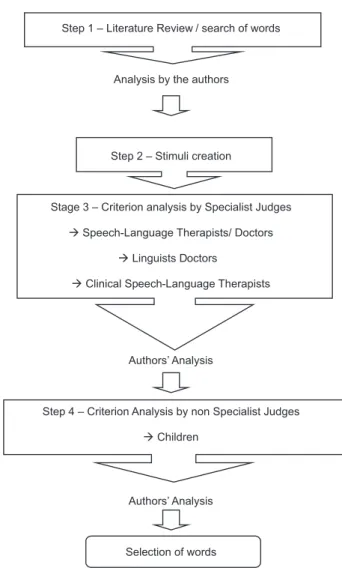
The general procedures to select the best words in the ela-boration of a phonological evaluation instrument were: search of words, criterion analysis by the specialists and criterion analysis by the non specialist judges. Those procedures were developed in four steps (Figure 1).
Step 1: Literature review and words selection: the search of words was performed from commercialized tests in BP (AFC and ABFW), from the list of basic expression vocabulary(4) and from the bank of indexed images – free images(5), creating a list of possible to evaluate words.
Based on literature, it was possible to identify common points, favorable and unfavorable to the AFC and ABFW eva-luation instruments, because both are the most common current instruments, used in clinics and, mainly, in speech-language therapy in Brazil.
Following the list of basic expression vocabulary(4), it was decided to exclude onomatopoeias (piu-piu, etc.), trademarks (Coca-Cola®), foreign words (CD – compact disc e pizza), and words from the following categories: parental [mamãe (mother), papai (father), tia (aunt), vovó (grandma), etc)], social terms [(não (no), oi (hi), sim (yes), etc], pronouns [meu and minha (my), aqui (here), eu (I), onde (where), por que (why), etc], time adverbs [depois (after)].
In the selection of the words to compose the list, the rese-archers considered the following linguistic criteria: syllable
position (initial onset, medial onset, medial coda, final coda, initial complex onset and medial complex onset), word position (initial (IO), medial (MO and MC), and final (FC) and syllable structure (V, VC, CV, CVC, CCV, CCVC, VG, CVG). Besides, the words should be easily represented by pictures which chil-dren would be able to identify. Finally, the words should be part of the vocabulary of children with three years old (minimal age evaluated by the test), from any social and economical level, considering regional differences (linguistic variations).
In this initial selection, it was defined the minimal number of 12 words for each phoneme in the different word and syllable positions and, when it did not occur, the researchers selected the words to complete the defined number, following the criterion that the word would be possible to be represented by pictures. In the end, it was formed a list of 722 words, the equivalent of 1797 phonemes to be judged and analyzed.
Step 2: Incentive choice: all the options of words for each phoneme, in each word and syllable position were inserted in a program which was built by a Computer Sciences student, forming several lists. Then, the program was sent to the spe-cialist judges.
Figure 1. Flow chart of the steps of the process of words selection to
Step 3: Criterion analysis by specialist judges: each judge should choose ten words from each list, according to criteria selected by them. The criteria and the generated file with the responses about the word selection, with indication, by the specialists, of the criteria which lead them to the selection, were sent to the researchers.
After the words were analyzed by the specialized judges, it was chosen, among the ones which presented more agreement, six words from each list to be drawn. When there was standoff with more than one word in the 6th position, all the words with the same number of votes were selected. In the total, 316 words remained to be drawn by the student of Industrial Design to be, then, judged by the non specialist judges.
Step 4: Criterion analysis by the non specialist judges: a new computer program was created and the pictures with the selected words were presented, one by one, in a computer screen, to be identified (familiarity) and named (elicitation) by the children.
The non specialists judged the stimuli according to the familiarity with the pictures, based on the Scale Likert of fami-liarity(22). In this task, the children were questioned if they knew the pictures or not, according to the following understandings: not familiar (he/she does not know the picture), more or less familiar (he/she knows the picture, but he/she does not know its name, but he/she knows what it does/ what it is used for) and familiar (he/she knows the picture, its name and what it is for). After answering about the picture familiarity, the children were asked to elicit the name of the picture through the ques-tion “what is it?” that was classified according to four criteria: elicited correctly, elicited similar words, elicited wrongly and did not elicit.
In the end of that step, from the six pictures for each phoneme in each word/syllable position, analyzed by the non specialist judges, three pictures were selected, considering the occurrence of three possibilities of the segments production in different word positions.
The criteria used for the words selection after the non spe-cialist judges’ answers were:
1. Criterion 1: 100% of correct responses by the non specialist judges, as for familiarity as for elicitation (target correct naming);
2. Criterion 2: 100% of correct responses for familiarity and 90% or more for elicitation, in case it is not reached the number of three possibilities of production;
3. Criterion 3: 80%, or more, of correct responses, as for familiarity, as for elicitation, for the phonemes in which it was not possible to complete the minimum of three words for each position.
After the analyses of the results by the specialist and non specialist judges, it was determined a list of words with its respective pictures cards, in order to indicate the best words to create an evaluation instrument of phonological evaluation to children speakers of BP.
Data analysis
In the search of better words to represent an evaluation instrument, it was used the analysis method by judges with important knowledge of what is being measured. That judges considered the instrument selected criteria, trying to relate the inclusion of those items with concepts and theoretical relevance(23). To do that, it was performed a descriptive analy-sis of responses by the specialist judges and the best words were determined, after the mode and the Kappa Concordance Analysis. The criteria used by the judges in the words selection were also analyzed.
The percentage of familiarity and correct elicitation for each tested word was obtained from the non specialist judges’ evaluation. With that percentage, it was possible to calculate the Confidence Interval of 95%, used to identify the previously referred criteria. The other words were not considered.
RESULTS
In the selection of the best words to evaluate the children’s phonology, the specialist judges described the criteria which were used for the selection.
All doctors speech-language therapists (DSLT) referred to prefer words with easy representation in pictures and words which belong to the children’s vocabulary, avoiding words with difficult definition. Three judges reported they only selected words which were not used in specific Brazilian regions. The DSLT referred also that they considered the word extension, and all of them preferred shorter words and phonetic and pho-nological contexts, in order to balance the options. Finally, one of the DSLTs referred some more criteria such as the selection of only lexical coda, justifying that morphological codas (plural and infinitive verbs) are acquired in a different way; the non use of the suffix “zinho(a)”, because in lexical phonology it is considered apart words; codas with the “ul” sequence [azul (blue)] were not selected, because of their difficult perception; complex coda was also avoided, because it is acquired diffe-rently from simple coda.
For the clinical speech-therapist judges (CSTJ), the used criteria were basically the same as the ones from the previous group. All the judges chose mainly nouns, because they are easily represented by pictures, and they are considered as stable. They also considered the inherence of words in the children’s vocabula-ry, with higher communicative value, and they chose shorter and less complex words. The variations in the phonological context, as well as the regional variation were mentioned by one judge. Another judge referred avoiding words related to “bad things”.
attention, being observed the height and nasality presence in the previous and posterior vowels, and the accent in the syllable which presented the mentioned phoneme. For each consonant, it was verified if all the possible vowels were contemplated.
It was observed a tendency for nouns, justified by a judge because they are easier to form images and they are more punc-tual, with predomination of the semantic category of animals, house and school objects, parts of the body, colors and numbers.
After the results of the judges’ analyses, it was performed the Kappa statistical test to verify the agreement among them. By analyzing the agreement among the responses by 11 spe-cialist judges, without considering the groups in which they were organized, it was obtained weak agreement, with Kappa value of 0.378.
It is believed that weak agreement among the judges might be related to the different criteria used by them. In the total, the involved professionals presented different views about the words’ analyses, resulting in a certain divergence among them. Besides, it was verified choice agreement intra groups, where, in general, it was observed higher agreement in the group of speech-language therapists’ group (Kappa=0.505), a moderate agreement.
The words resulted from the specialized judgment were 316, which were illustrated and presented individually to the non specialist judges. The best words, classified according to
familiarity and elicitation, are presented in Tables 1, 2, 3, 4 and 5. An aspect which was highlighted among the results was that the number of right answers for the question which corresponds to picture familiarity was higher than regarding correct elicita-tion. The recognition and the correct elicitation of nouns were more favorable than of words which belong to other grammar classes, mainly verbs.
In some sounds/positions (for /n/ and /z/ in IO) the purpose was not reached, according to the previously established rese-arch purposes. In those cases, the reserese-archers used words with higher percentage of recognition.
In BP complex onset, the options are restricted in terms of presence in the younger children’s vocabulary and, in the perfor-med evaluation, the number of words which were indicated as familiar and correctly elicited by the non specialist judges was limited. According to the possibility, it was decided to indicate two words for complex onset in each position (initial and medial).
Thus, the final result of the list of words is indexed below, with some words repetition for some phonemes:
Phoneme /p/ in IO: “porta”, “pé” e “panela” (door, fot and pan); in MO: “copo”, “sapo” e “tapete” (glass, frog and rug).
Phoneme /b/ in IO: “banana”, “bicicleta” e “bola” (banana, bicycle and ball); in MO: “cabelo”, “bebê” e “rabo” (hair, baby and tail).
Table 1. Words selected with the highest percentages for the plosive phonemes in IO and MO positions
Phoneme IO Familiarity Elicitation Criterion MO Familiarity Elicitation Criterion
/p/
Porta* 1.000 1.000 C1 Copo* 1.000 1.000 C1
Pé* 1.000 0.972 C2 Sapo* 1.000 0.972 C2
Panela* 0.986 1.000 C3 Tapete* 1.000 0.972 C2
/b/
Balão 1.000 1.000 C1 Cabelo* 1.000 1.000 C1
Banana* 1.000 1.000 C1 Bebê* 1.000 0.931 C2
Bicicleta* 1.000 1.000 C1 Ônibus 1.000 0.931 C2
Bola* 1.000 1.000 C1 Rabo* 1.000 0.917 C2
Bolo 1.000 1.000 C1
/t/
Tênis* 1.000 1.000 C1 Bicicleta 1.000 1.000 C1
Tesoura* 1.000 1.000 C1 Porta* 1.000 1.000 C1
Tapete* 1.000 0.972 C2 Prato* 1.000 1.000 C1
Presente* 1.000 1.000 C1
/d/
Dedo* 0.986 0.958 C3 Cadeira* 1.000 1.000 C1
Dado* 0.917 0.806 C3 Escada* 1.000 1.000 C1
Dente* 0.889 0.875 C3 Roda* 1.000 0.861 C3
/k/
Cabelo 1.000 1.000 C1 Escada* 1.000 1.000 C1
Cadeira* 1.000 1.000 C1 Faca* 1.000 1.000 C1
Cama 1.000 1.000 C1 Macaco* 1.000 1.000 C1
Casa* 1.000 1.000 C1 Óculos 1.000 1.000 C1
Cavalo 1.000 1.000 C1
Coelho 1.000 1.000 C1
Copo* 1.000 1.000 C1
/g/
Gato* 1.000 0.986 C2 Língua* 1.000 0.986 C2
Garfo* 1.000 0.972 C2 Fogo* 0.986 0.972 C3
Galinha* 0.986 0.931 C3 Água 0.986 0.931 C3
Barriga* 0.986 0.917 C3
Fogão 0.986 0.917 C3
*Selected words for each phoneme
Table 2. Words selected with the highest percentages for the fricative phonemes in IO and MO positions
Phoneme IO Familiarity Elicitation Criterion MO Familiarity Elicitation Criterion
/f/
Faca* 1.000 1.000 C1 Sofá* 1.000 1.000 C1
Fogo* 0.986 0.972 C2 Garfo* 1.000 0.972 C2
Fogão 0.986 0.917 C3 Café* 1.000 0.944 C2
Folha* 0.986 0.917 C3
/v/
Vassoura* 1.000 1.000 C1 Avião* 1.000 1.000 C1
Ventilador* 0.986 0.986 C3 Cavalo* 1.000 1.000 C1
Vaca* 0.986 0.944 C3 Ovo* 1.000 0.972 C2
Violão 0.986 0.944 C3
/s/
Sofá* 1.000 1.000 C1 Bicicleta* 1.000 1.000 C1
Sapo* 1.000 0.972 C2 Vassoura* 1.000 1.000 C1
Sapato* 0.972 0.931 C3 Coração* 1.000 0.986 C2
/z/
Zebra 0.889 0.722 - Casa 1.000 1.000 C1
Zero 0.833 0.653 - Mesa* 1.000 1.000 C1
Zíper 0.708 0.139 - Presente* 1.000 1.000 C1
Tesoura* 1.000 1.000 C1
//
Chinelo* 1.000 0.986 C2 Bruxa* 1.000 1.000 C1
Chapéu* 0.986 0.986 C3 Caixa* 1.000 0.986 C2
Chave* 0.986 0.986 C3 Cachorro* 1.000 0.972 C2
//
Jacaré* 1.000 0.944 C2 Relógio* 0.986 0.958 C3
Joelho* 1.000 0.875 C3 Laranja* 0.972 0.833 C3
Girafa* 0.986 0.944 C3 Beijo* 0.958 0.875 C3
*Selected words for each phoneme
Note: IO = initial onset; MO = medial onset; C1 = criterion 1; C2 = criterion 2; C3 = criterion 3
Tabela 3. Words selected with the highest percentages for the nasal phonemes in IO and MO positions
Phoneme IO Familiarity Elicitation Criterion MO Familiarity Elicitation Criterion
/m/
Macaco* 1.000 1.000 C1 Cama* 1.000 1.000 C1
Mão* 1.000 1.000 C1 Caminhão* 0.986 0.958 C3
Meia 1.000 1.000 C1 Tomate* 0.972 0.903 C3
Mesa* 1.000 1.000 C1
/n/
Nariz* 0.986 0.972 C3 Banana* 1.000 1.000 C1
Nuvem* 0.972 0.944 C3 Tênis* 1.000 1.000 C1
Navio* 0.931 0.681 - Chinelo* 1.000 0.986 C2
//
- - - - Caminhão* 0.986 0.958 C3
- - - - Galinha* 0.986 0.931 C3
- - - - Passarinho* 0.986 0.917 C3
*Selected words for each phoneme
Note: IO = initial onset; MO = medial onset; C1 = criterion 1; C2 = criterion 2; C3 = criterion 3
Phoneme /t/ in IO: “tênis”, “tesoura” e “tapete” (tennis, scissors and rug); in MO: “presente”, “porta” e “prato” (pres-ent, door and plate).
Phoneme /d/ in IO: “dedo”, “dado” e “dente” (finger, dice and tooth); in MO: “cadeira”, “escada” e “roda” (chair, stairs and wheel).
Phoneme /k/ in IO: “copo”, “copo” e “cadeira” (glass, glass and chair); in MO: “escada”, “macaco” e “faca” (stairs, monkey and knife).
Phoneme /g/ in IO: “gato”, “garfo” e “galinha” (cat, fork and chicken); in MO: “língua”, “fogo” e “barriga” (tongue, fire and stomach).
Phoneme /f/ in IO: “faca”, “fogo” e “folha” (knife, fire and leave); in MO: “sofá”, “garfo” e “café” (sofá, fork and coffee).
Phoneme /v/ in IO: “vassoura”, “ventilador” e “vaca”
(broom, fan and cow); in MO: “cavalo”, “avião” e “ovo” (horse, plane and egg).
Phoneme /s/ in IO: “sofá”, “sapo” e “sapato” (sofa, frog, shoe); in MO: “bicicleta”, “vassoura” e “coração” (bicycla, broom and heart); in IO: “escada”, “espelho” e “estrela” (stairs, mirror and star); in FC: “tênis”, “óculos” e “lápis” (tennis, glasses and pencil).
Phoneme /z/ in IO: “zebra”, “zero” e “zíper” (zebra, zero, zipper); in MO: “presente”, “tesoura” e “mesa” (present, scis-sors and table).
Phoneme /S/ in IO: “chinelo”, “chapéu” e “chave” (sandals, hat and key); in MO: “bruxa”, “caixa” e “cachorro” (witch, box and dog).
(watch, orange and kiss).
Phoneme /m/ in IO: “macaco”, “mão” e “mesa” (monkey, hand and table); in MO: “cama”, “caminhão” e “tomate” (bed, truck and tomato).
Phoneme /n/ in IO: “nariz”, “nuvem” e “navio” (nose, cloud and ship); in MO: “banana”, “tênis” e “chinelo” (banana, tennis, sandals).
Phoneme // in IO: “caminhão”, “galinha” e “passarinho” (truck, chicken and bird).
Phoneme /l/ in IO: “língua”, “lápis” e “luva” (tongue, pencil and gloves); in MO: “bola”, “cabelo” e “cavalo” (Ball, hair and horse); in MC: “bolsa”, “calça” e “fralda” (bag, pants and diapers); in FC: “pastel”, “anel” e “jornal” (pastry, ring and newspaper).
Phoneme /r/ in MO: “tesoura”, “cadeira” e “vassoura” (scissors, chair and broom); in MC: “porta”, “garfo” e “porco” (door, fork and pig); in FC: “colher”, “ventilador”, “flor”
(spoon, fan and flower).
Phoneme // in MO: “coelho”, “joelho” e “colher” (rabbit, knee and spoon).
Phoneme /R/ in IO: “rabo”, “roda” e “relógio” (tail, wheel and watch); in MO: “cachorro”, “barriga” e “terra” (dog, stomach and land).
Phoneme /N/ in MC: “presente”, “língua” e “branco” (present, tongue and white); in FC: “trem”, “batom” e “nuvem” (train, lipstick and cloud).
Complex onset in IO: “presente”, “prato”, “plástico”, “placa”, “bruxa”, “brinco”, “blusa”, “blusão”, “glacê”, “grama”, “gritar”, “crocodilo”, “cruz”, “classe”, “clara”, “dragão”, “trem”, “travesseiro”, “flor”, “floresta”, “fralda” e “fruta” (present, plate, plastic, sign, witch, earring, blouse, sweater, icing, Grass, scream, crocodile, cross, class, clear, dragon, train, pillow, flower, forest, diapers and fruit, respectively).
Complex onset in MO: “soprar”, “cobra”, “zebra”, Table 4. Words selected with the highest percentage for the liquid phonemes in OI and MO positions
Phoneme IO Familiarity Elicitation Criterion MO Familiarity Elicitation Criterion
/R/
Rabo* 1.000 0.917 C2 Cachorro* 1.000 0.972 C2
Roda* 1.000 0.861 C2 Barriga* 0.986 0.917 C3
Relógio* 0.986 0.958 C3 Terra* 0.986 0.806 C3
/l/
Língua* 1.000 0.986 C2 Balão 1.000 1.000 C1
Lápis* 1.000 0.958 C2 Bola* 1.000 1.000 C1
Luva* 0.986 0.972 C3 Bolo 1.000 1.000 C1
Cabelo* 1.000 1.000 C1
Cavalo* 1.000 1.000 C1
Óculos 1.000 1.000 C1
/r/
- - - - Cadeira* 1.000 1.000 C1
- - - - Tesoura* 1.000 1.000 C1
- - - - Vassoura* 1.000 1.000 C1
//
- - - - Coelho* 1.000 1.000 C1
- - - - Joelho* 1.000 0.875 C2
- - - - Colher* 0.986 0.986 C3
*Selected words for each phoneme
Note: IO = initial onset; MO = medial onset; C1 = criterion 1; C2 = criterion 2; C3 = criterion 3
Table 5. Words selected with the highest percentage for the phonemes in MC and FC positions
Phoneme MC Familiarity Elicitation Criterion FC Familiarity Elicitation Criterion
/s/
Escada* 1.000 1.000 C1 Óculos* 1.000 1.000 C1
Espelho* 0.986 0.944 C3 Tênis* 1.000 1.000 C1
Escorregador 0.986 0.903 C3 Lápis* 1.000 0.958 C2
Estrela* 0.972 0.931 C3
/N/
Presente* 1.000 1.000 C1 Trem* 1.000 0.958 C2
Língua* 1.000 0.986 C2 Batom* 0.986 0.958 C3
Branco* 0.986 0.903 C3 Nuvem* 0.972 0.944 C3
/L/
Bolsa* 1.000 0.972 C2 Pastel* 0.972 0.903 C3
Calça* 0.986 0.972 C3 Anel* 0.972 0.889 C3
Fralda* 0.944 0.931 C3 Jornal* 0.972 0.833 C3
/r/
Porta* 1.000 1.000 C1 Colher* 0.986 0.986 C3
Garfo* 1.000 0.972 C2 Ventilador* 0.986 0.986 C3
Porco* 0.986 0.958 C3 Escorregador 0.986 0.903 C3
Flor* 0.972 0.903 C3
*Selected words for each phoneme
“bíblia”, “biblioteca”, “igreja”, “magro”, “microfone”, “es-crever”, “bicicleta”, “chiclete”, “vidro”, “pedra”, “letra”, “estrela”, “livro”, “refri”, “chifre” (blow, snake, zebra, bible, library, church, slim, mycrophone, write, bicycle, bubble gum, glass, stone, letter, star, book, soda, horn).
DISCUSSION
The phonology evaluation requires that the target words to be elicited by children are part of their vocabulary, mainly when the evaluation involves spontaneous naming. The specialist judges, from all groups, reported in their criteria of word selection, to choose the words which were part of the children’s vocabulary to reach targets which were proper to the studied age group.
The result with higher number of right answers by the non specialist judges for the analysis was expected to correspond more to familiarity than to elicitation, because it is considered as easier to a child to recognize the target represented in the illustration, than correctly elicit that target. Observing the ty-pical language acquisition, it is verified that the children’s first word (with about one year old) presents a familiar referent and it is used generically to name objects with some similarity in several situations(6). Before the occurrence of the vocabulary spurt, almost half of the words used by children are related to the name of familiar objects(24). About the second year of life children experience the vocabulary spurt – moment in which they learn new words easily and surprisingly fast – with sig-nificant vocabulary increase(6). The period between 2 and 4 years old corresponds to the development of the naming skill(7).
The familiarity and the frequency of the objects in the children’s routine are important for them to name them cor-rectly, because those factors influence in the lexical access activation, through short and long term memory(8). As higher the familiarity with the words (pictures) is, lower is the incidence of naming mistakes(5).
The recognition and the correct elicitation of nouns were more favorable than words which belong to other grammar classes, mainly the verbs. Another study(9) refers that the ca-tegories with the highest production in the initial vocabulary development are, respectively, nouns, verbs, adjectives and adverbs. Children have more easiness to learn and to improve their vocabulary initially with nouns, because they are visu-ally possible to represent. The verbs present great semantic and grammar variety, what obstructs their fast generalization, requiring children to be more often exposed to verbs to learn their meaning. The verbs acquisition is usually more gradual because there is no clear referent, when compared with nouns(6). That fact was thought by three groups of specialist jud-ges who reported, among their criteria for words choice, the preference for nouns, avoiding words with difficult conceptualization.
The frequency, the familiarity and the extension of the words are stimuli and factors which seem to interfere in the
lexical acquisition(9). As lower the number of syllables is, lower are the difficulties found by children to produce words, and, consequently, higher is the easiness for their production(10). The words extension was another criterion considered by the judges as important for the words choice.
According to the specialist judges, the phonetic and pho-nological contexts are also important aspects, because of their influence in the phonological acquisition. Those contexts are relevant variables to be considered in the choice of proper words to create a phonological evaluation instrument, searching a balance between what is favorable, neutral and non favorable. It is believed that balance among the words is fundamental for the trustworthy evaluation result. It is neither too much easy nor too much difficult for the naming.
The highest number of mistakes for familiarity and elicita-tion demonstrated by the non specialist judges from the lowest age group (three to three years old and eleven months) occurred because they still present restricted vocabulary, when compared to the children from the other researched aged group.
The number of non named items increases according to the children’s age decreases. It means that children with 4, 5, and 6 years old present similar and better performance than children with 3 years old, regarding the number of named items(11).
For the first age groups which were included in the research, it was expected the occurrence of semantic deviation, in which the children recognize the picture, but there is generalization for similar representations, probably more common in their daily routine, with more frequent access(7). The children in normal process of language development may make several deviations, because their group of semantic features which distinguish one word from another in different linguistic contexts is still not well organized(11).
Because it is a spontaneous naming test, the list of words presented without the correspondent pictures (judged by the non specialists) do not have value for analysis. So, as it was previously described, to prefer words with easy representation by pictures and words which belong to the infants’ vocabulary is important to obtain the production of the desired target. Thus, testing the familiarity and the correct elicitation (target production) of the pictures to compose an instrument to evaluate children from different age groups is essential, because, on the other hand, the target words may not be elicited because they do not belong to children’s vocabulary (not familiar), and/or because the stimuli are difficult to be represented by pictures.
phonological contexts and/or words which have been already selected to evaluate another phoneme. Therefore, it was obtai-ned a lower number of words to evaluate the phonemes, which are varied and present balance regarding possible production difficulty and proficiency.
In some phonemes, even following the criteria based on the number of right answers by the non specialist judges, no word was selected, for example, for the phoneme /z/ in IO. All listed options for this phoneme, in that position, presented the number of right answers lower than 80%, considering that the choices were based on high percentages of familiarity. By observing the lists of vocabulary of children in that age group, it is perceived a restricted number of words involving the target phoneme. It was also not possible to reach the minimum of three occurrences for the phoneme /n/ in IO. Through the analysis of the other words which were initially indicated by the specialist judges [“navio” (ship), “neve” (snow), “ninho” (nest), “nó” (node) and “novelo” (ball of wool)], it was decided to use the word “navio”, following the reference instruments AFC and ABFW, which also present that word as production target.
CONCLUSION
Trough the performed analyses, it was obtained the indi-cation of 116 words, possible to compose an instrument to evaluate the phonology of children with typical or atypical acquisition. Those words evaluate all BP phonemes in different word/syllable positions and in different structures.
REFERENCES
1. Santos JLF, Parreira LMMV, Leite RCD. Habilidades de ordenação e resolução temporal em crianças com desvio fonológico. Rev CEFAC. 2010;12(3):371-6.
2. Oshima M, Moret ALM, Amorim RB, Alvarenga KF, Bevilacqua MC, Lauris JRP, et al. Early Listening Function (ELF): adaptação para a língua portuguesa. Rev Soc Bras Fonoaudiol. 2010;15(2):191-6. 3. Savoldi A, Gubiani MB, Brancalioni AR, Keske-Soares M. Relação
entre as palavras eliciadas na Avaliação Fonológica da Criança e as variáveis idade, gênero e gravidade do desvio fonológico. Rev Soc Bras Fonoaudiol. 2012;17(3):293-8.
4. Bastos JC. Vocabulário básico inicial de um grupo de crianças dos municípios de Itajaí e Balneário Camboriú na faixa etária de 1 ano a 2 anos e 6 meses: discussão das metodologias de coleta. [dissertação]. Curitiba (PR): Universidade Tuiuti do Paraná; 2000. 5. Capovilla FC, Negrão VB, Damazio M.Teste de vocabulário auditivo
e teste de vocabulário expressivo - TVAud e TVExp: validado e normatizado para o desenvolvimento e compreensão da fala dos 18 meses aos 6 anos de idade. São Paulo: Memnon Edições Científicas; 2011. 582p.
6. Befi-Lopes DM, Cáceres AM, Araújo K. Aquisição de verbos em pré-escolares falantes do português brasileiro. Rev CEFAC. 2007;(9)4:444-52.
7. Athayde ML, Carvalho Q, Mota HB. Vocabulário expressivo de crianças com diferentes níveis de gravidade de desvio fonológico. Rev CEFAC. 2009;(11)2:161-8.
8. Scheuer CI, Stivanin L, Mangilli LD. Nomeação de figuras e a memória em crianças: efeitos fonológicos e semânticos. ProFono. 2004;16(1):49-56.
9. Brancalioni AR, Marini C, Cavalheiro LG, Keske-Soares M. Desempenho em prova de vocabulário de crianças com desvio fonológico e com desenvolvimento fonológico normal. Rev CEFAC. 2011;13(3):428-36.
10. Mezzomo CL, Mota HB, Dias RF, Giacchini V. O uso da estratégia de alongamento compensatório em crianças com desenvolvimento normal e desviante. Letras Hoje. 2008;43(3):35-41.
11. Hage SRV, Pereira MB. Desemprenho de crianças com desenvolvimento típico de linguagem em provas de vocabulário expressivo. Rev CEFAC. 2006;8(4):419-28.
12. Rvachew S, Bernhardt BM. Clinical implications of dynamic systems: theory for phonological development. Am J Speech-Lang Pathol. 2010;19:34-50.
13. Gierut JA, Morrisette ML. Age of word acquisition effects in treatment of children with phonological delays. Appl Psycholinguistics. 2012;33:121-44.
14. Giusti E, Befi-Lopes DM. Tradução e adaptação transcultural de instrumentos estrangeiros para o Português Brasileiro. Pro Fono. 2008;20(3):207-10.
15. Fonseca RP, Parente MAMP, Côté H, Joanette Y. Processo de adaptação da bateria Montreal de avaliação da comunicação - bateria MAC - ao Português Brasileiro. Psicol Reflex Crit. 2007;20(2);259-67. 16. Fonseca RP, Parente MAMP, Côté H, Ska B, Joanette Y. Apresentando um instrumento de avaliação da comunicação à Fonoaudiologia Brasileira: bateria MAC. Pro Fono. 2008a;20:285-91.
17. Fonseca RP, Parente MAMP, Côté H, Ska B, Joanette Y. Bateria Montreal de avaliação da comunicação – bateria MAC. São Paulo: Pró-Fono. 2008b.
18. Casarin FS. Bateria Montreal de avaliação da comunicação breve – Bateria MAC breve: estudos de adaptação. [dissertação]. Porto Alegre: Pontifícia Universidade Católica do Rio Grande do Sul; 2011. 19. Andrade CRF, Befi-Lopes DM, Fernandes FDM, Wertzner H.
ABFW: Teste de linguagem infantil nas áreas de fonologia, vocabulário, fluência e pragmática. 2a. ed. São Paulo: Pró-fono; 2004. 98p.
20. Andrade CRF, Juste F. Proposta de análise de performance e de evolução em crianças com gagueira desenvolvimental. Rev CEFAC. 2005;7(2):158-70.
21. Yavas M, Hernandorena CLM, Lamprecht RR. Avaliação fonológica da criança: reeducação e terapia. Porto Alegre: Artes Médicas, 1991. 148p.
22. Pasquali L. Instrumentos psicológicos: manual prático de elaboração. Brasília: LabPAM/IBAPP, 1999.
23. Anastasi A, Urbina S. Testagem psicológica. 7a. ed. Porto Alegre: Artes Médicas, 2000. 575p.