J. res.: fundam. care. online 2015. jul./set. 7(3):2774-2780
2774
RESEARCH
O enfermeiro e a temática da hanseníase no contexto escolar: relato de experiência
The nurse and the theme of leprosy in the school context: case studies La enfermera y el tema de la lepra en el contexto escolar: estudios de caso
Mônica Gisele Costa Pinheiro¹, Ilana Barros Gomes Medeiros², Akemi Iwata Monteiro³, Clélia Albino Simpson4
Objective: Assessing the knowledge of students about Hansen’s disease and providing health education
actions. Method: Case studies on the implementation of extension activity focused on health education about leprosy, held in a public school, involving 190 high school students, aged between 16 and 23 years old, of both sexes. Ethical principles for research involving human subjects were considered after approval by the Committee of Ethics in Research, opinion No. 072/09 and CAAE 00780051000-09. Results: It was demonstrated that the activities of health education targeted at school, with an emphasis on leprosy, are of fundamental importance, because it denotes the appropriation of disease-related knowledge.
Conclusion: The metalling about leprosy can contribute to the dissemination of such knowledge, since the
school may feel encouraged to disclose information to others, such as family. Descriptors: Nursing, Health Education, Leprosy.
Objetivo: Avaliar o conhecimento de escolares acerca da hanseníase e implementar ações de educação em
saúde sobre esta temática. Método: Relato de experiência acerca da execução de atividade de extensão focada na educação em saúde sobre a hanseníase, realizada em uma escola pública, envolvendo 190 estudantes do ensino médio, com idade entre 16 e 23 anos, de ambos os sexos. Foram considerados os princípios éticos da pesquisa envolvendo seres humanos, e após aprovação pelo Comitê de Ética em Pesquisa, sob parecer nº 072/09 e CAAE 00780051000-09, a pesquisa foi iniciada. Resultados: Evidenciou-se que as atividades de educação em saúde dirigidas aos escolares, com ênfaEvidenciou-se na hanEvidenciou-seníaEvidenciou-se, são de fundamental importância, pois denotam a apropriação de conhecimento relacionado à doença. Conclusão: O empoderamento sobre hanseníase pode contribuir com a disseminação de tais conhecimentos, visto que os escolares poderão se sentir instigados a divulgar as informações a outras pessoas, como familiares.
Descritores: Enfermagem, Educação em Saúde, Hanseníase.
Objetivo: Evaluar el conocimiento de los estudiantes acerca de la enfermedad de Hansen y efectuar
acciones de educación sanitaria acerca de esta temática. Método: Informe de experiencia acerca de la ejecución de la actividad de extensión que se centró en la educación para la salud acerca de la lepra, realizada en una escuela pública, con la participación de 190 estudiantes de secundaria, con edades comprendidas entre 16 y 23 años, de ambos sexos. Se consideraron los principios éticos para la investigación en seres humanos, con aprobación por el Comité de Ética en Investigación de la Opinión N º 072/09 y CAAE 00780051000-09. Resultados: Se demostró que las actividades de educación para la salud, dirigidos a la escuela, con un énfasis en la lepra, son de una importancia fundamental, ya que denotan la apropiación de los conocimientos relacionados con la enfermedad. Conclusión: El empoderamiento acerca de la lepra puede contribuir a la difusión de esos conocimientos, ya que la escuela puede sentirse alentada a revelar información a otros, tales como familiares. Descriptores: Enfermería, Educación para la Salud, Lepra.
1Nurse, Doctoral Student of Nursing at the Postgraduate Nursing Program of the Federal University of Rio Grande do Norte (UFRN), Natal/RN, Brazil. Email: [email protected]. 2Nurse, Mastership in Nursing at the Postgraduate Nursing Program of UFRN, Natal/RN, Brazil. Email: [email protected]. 3Nurse, Doctorate in Nursing, Teaching at the Nursing Department of UFRN, Natal/RN, Brazil. Email: [email protected]. 4Nurse, Doctorate in Nursing, Teaching at the Nursing Department of UFRN, Natal/RN, Brazil. Email: [email protected] br
ABSTRACT
RESUMEN RESUMO
J. res.: fundam. care. online 2015. jul./set. 7(3):2774-2780
2775
T
he actions developed within health education aimed at empowering, by the subjects, about the health/disease process and therapeutic and preventive measures, culminating in a position of greater quality of life and well-being.¹ This understanding, the present work deals with the application of the educational approach with high school students of a public school, on important considerations about leprosy.
Thus, it is necessary to understand the concept of this, as an infectious-contagious disease caused by the Mycobacterium bacterium leprae, which has affinity for dermatoneurological cells, which justifies the involvement of the skin and nerves in people living with leprosy, which can generate physical disabilities or even deformities.1
These disabilities and deformities can cause problems, such as the reduction of working capacity, limitation of social life and psychological problems, accounting also for stigma and prejudice against the disease.2
Its diagnosis can be clinical, laboratory or differential, since it shows signs and symptoms similar to other illnesses, being classified into four types, namely: undetermined, tuberculoid, virchowiana and dimorphs, being the first two paucibacillary and the last two multibacillary.1
Over the years it was regarded as an incurable illness, incapacitating and segregated, with adoption of the compulsory isolation in hospitals colonies as a measure of control, for those affected by leprosy. Currently, your treatment is done with chemotherapy in outpatient level and has purpose of eliminating leprosy as a public health problem.3
Given the changing reality in the context of involvement of infectious diseases by the Brazilian population, for chronic diseases, keeping in view the commitment elucidated by medical assistance hegemonic model privatized, which gave great emphasis on therapeutic and healing, the country showed a significant change process in its morbidity and mortality profile.
Despite this fact, the data relating to morbidity specifically by leprosy show that in the Americas, Brazil is the country with the highest number of cases and the second number in the world rankings, behind India, which contributed 58% of new cases reported worldwide in 2011.4
In this same year, leprosy prevalence rate in Brazil was of 1,24 per 10.000 populations and in the Northeast of 1,56 per 10.000 populations.5 Introducing above the
elimination target set by the World Health Organization (WHO) is to achieve less than one case of leprosy for each 10.000 inhabitants.6
Meanwhile, leprosy is conceived as an important public health problem, worthy of emphasis by public policies in order that it may happen increased awareness by health professionals involved in health care, about the importance of education activities with the
J. res.: fundam. care. online 2015. jul./set. 7(3):2774-2780
2776
RESULTS AND DISCUSSION
population. In these conditions, users can understand what leprosy and their ways of early detection, which can facilitate better living conditions and health care.
Thus, health education appears as an important nursing work opportunity, to promoting health and preventing injuries and causes the autonomy of users. However, it is important to emphasize that these actions must be operationalized of horizontalized mode, based on active listening and humanized relationship, overcoming the mere transmission of content.7
It is noteworthy that in recent years the dissemination of signs and symptoms of leprosy by various media contributes to the increase in the detection and absolute number of leprosy cases in Brazil.8
Specifically in the case of nursing work in the school environment and the implementation of educational approach, it is essential that this professional identify prior knowledge of those with whom the health education action is taken. Thus, the dialogue will be facilitated; it would favor a better relationship between the subject and the appreciation of their needs.7
Thus confirms the importance of working the theme of early leprosy through health education at school, with a view to prevention and early diagnosis, since this disease is curable, but if they do not receive proper care and due the lack of knowledge about it can generate disabilities or serious sequelae. In this perspective, the question is: what high school students from a public school in the city of Parnamirim/RN know about the theme involving leprosy?
From this research question, if we list those following objectives: to evaluate the school of knowledge about leprosy and implement health education activities on this theme. This work has potential for contributory understanding among adolescents and young people about this important public health problem, and these, to perpass knowledge to family and other friends, can contribute towards early diagnosis and consequent reduction in the incidence rates of disease. Also, considering the history of exclusion and existing stigma surrounding the disease and the patient, the dissemination of information on the epidemiology of leprosy chain as well as on the existence of treatment and cure, can reduce biased attitudes towards leprosy.
Bearing in mind the role that the school develops in the training of students, there was the idea of holding timely health education activities among high school students, encouraging people to learn the knowledge of leprosy.
The experience of health education along the students
The design of this study is characterized as descriptive as it describes an experience of undergraduate nursing students during the execution of an extension activity focused on the achievement of leprosy-related dialogues, such as education and health promotion.
J. res.: fundam. care. online 2015. jul./set. 7(3):2774-2780
2777
The health education activities, with emphasis on leprosy, aimed at the populationof school are of fundamental importance, because high detection rates in this age group suggest transmission assets outbreaks. They are also relevant to promote early diagnosis and prevention of future social stigmas.9
The extent of implementing concerning activities occurred in a public high school, present in Cohabinal neighborhood in the city of Parnamirim/RN, precisely in the classroom. The development of the activity occurred in five times, involving: extension of proposal submission to the school principal; scheduling days for performing the extension action; a questionnaire containing questions related to leprosy; realization of dialogued lectures focusing on leprosy; and reapplication of the above questionnaire.
Initially, the proposal was presented to the director and other school staff, and they showed interest in the development of outreach activity. Thus, the school environment and school hours were assigned to carry out health education work as previously scheduled.
The extension was held in September 2011 in eight classrooms of this school, in a class by day. Totaled the participation 190 students aged between 16 and 23 years old of both sexes. Present at the activity the students enrolled in the aforementioned school, who were in the classroom during the course of the extension and signed the Informed Consent and Informed - IC. Those who were younger than 18 had the IC signed by their legal guardian.
This work succeeded submission and approval by the Ethics Committee of the Federal University of Rio Grande do Norte (UFRN), with protocol number 072/09 and Presentation Certificate of Appreciation for Ethics - CAAE 00780051000-09.
Before the conduct of lectures, students were asked to answer a questionnaire containing questions about leprosy developed based on Primary Care Pad 21. The results are shown in Table 1.
Table 1 – Percentage of correct answers to the questions of the questionnaire before the lecture. Parnamirim, 2011
Questioning Correct alternative Percentage
Etiological agent Bacteria 38.0% Signs and Symptoms Affects skin and peripheral nerves 37.0% Health service to be searched for Basic Health Unit 48.0%
After the questionnaire, was initiated to dialogued lectures. The dialogic education with the population favors the exchange of knowledge, encouraging the autonomy of health care and quality of life of the population.10
The syllabus explained was related to the definition of leprosy, leprosy change nomenclature for leprosy, etiologic agent, mode of transmission, symptoms, healing and health service being sought on suspicion of the disease. Therefore, the content was work to the construction and reconstruction of knowledge and proper understanding of leprosy.
While performing the lecture were distributed leaflets, posters and used illustrative flipchart as material resources to facilitate understanding and encourage student
J. res.: fundam. care. online 2015. jul./set. 7(3):2774-2780
2778
CONCLUSION
participation. In parallel to this realization, the students expressed their doubts and questions, particularly regarding the transmission and the cure of leprosy.
There were also observed misconceptions related to myths and prejudices against leprosy, cast by school. This was an opportune time to infer the history of leprosy, which was reported to be an ancient disease which, if not treated early, can lead to deformities and disabilities.
Although marked by stigma and social segregation, today leprosy has treatment and cure, and drug therapy is of fundamental importance to prevent physical disabilities, as well as break the chain of transmission of the disease and achieve the goal of eliminating.11
There was emphasized the importance of recognizing the signs and symptoms of leprosy in favor of promoting the diagnostic self-suspection and subsequent demand for health services to clarify the diagnosis and immediate initiation of treatment.
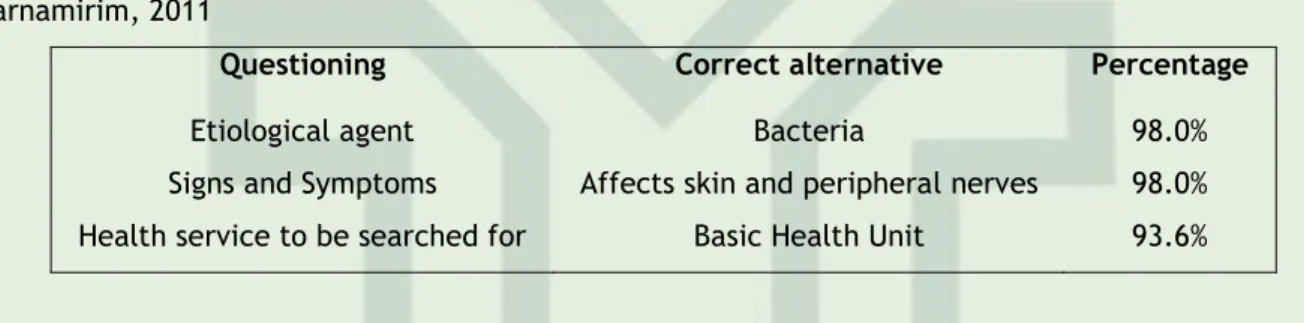
At the end of dialogued exposure, the same questionnaire was reapplied. Later responses were tabulated and the answers are shown in Table 2.
Table 2 – Percentage of correct answers to the questions of the questionnaire after the lecture. Parnamirim, 2011
Questioning Correct alternative Percentage
Etiological agent Bacteria 98.0% Signs and Symptoms Affects skin and peripheral nerves 98.0% Health service to be searched for Basic Health Unit 93.6%
In principle there were difficulties in conducting lectures because students now were euphoric and seemingly uninterested in theme, sometimes shy to question and promote the maintenance of a dialogue. Nevertheless, during the lecture was involved and demonstration of interest by students and the inhibition was gradually reduced.
Thus, the result of the questionnaire denotes clarification related to leprosy, which can contribute to the dissemination of such knowledge to be disseminated to the people who are closest to him, as their families.12
The present study may contribute to the dissemination of information related to leprosy, as by allowing some degree of empowerment on the subject, the students may feel urged to disclose information to others.
Educational activities related to leprosy control should encourage the development of the autonomy of the subject with the possibility of spreading information, and early diagnosis and treatment of disease with consequent drop in the transmission chain.
J. res.: fundam. care. online 2015. jul./set. 7(3):2774-2780
2779
REFERENCES
It was observed during the study the effectiveness of educational activities held at the school, which is proven by comparing the statistics before and after dialogued lectures. Thus, it was observed that after these, students had submitted a theme of empowerment of leprosy, which is presented as something very positive with regard to the health/disease process of people with the disease as well as in aspects of prevention and early diagnosis.
Thus, we see the importance of professional nurses be able to develop activities that allow the construction of knowledge, which should be aimed not only at school, but also to people affected by leprosy, their families, institutions and community groups.
Therefore the understanding of the disease will be enhanced, which may contribute to the prevention of leprosy and reorientation of attitudes against the stigma and healing in the face of affected people, providing greater security by these and their families.
1. Carvalho LKCAA, Souza IBJ, Silva AAG, Pereira ISA, Silva RCC, Tapety FI. Epidemiological profile of leprosy in municipality of Sao Luis - Ma from 2006 to 2010. Rev Pesq Cuid Fundam [periódico online]. 2013 [acesso em 2013 Dez 10];5(6):306-14. Disponível em: http://www.seer.unirio.br/index.php/cuidadofundamental/article/view/3490/pdf_1180
2. Duarte MTC, Ayres JA, Simonetti JP. Consulta de enfermagem: estratégia de cuidado ao portador de hanseníase em atenção primária. Texto Contexto Enferm. 2009;18(1):100-7.
3. Simpson CA, Miranda FAN, Meneses RM, Carvalho IHS, Cabral AMF, Santos VRC. Within the habitus of the former colony hospital - social representations of leprosy. Rev Pesq Cuid Fundam [periódico online]. 2013 [acesso em 2013 Dez 10];5(3):104-13. Disponível em: http://www.seer.unirio.br/index.php/cuidadofundamental/article/view/3003/pdf_825
4. World Health Organization. Global leprosy situation, 2012. Wkly Epidemiol Rec [periódico
online]. 2012 [acesso em 2014 Mar 15];87(34): 317-28,. Disponível em:
http://www.who.int/wer/2012/wer8734.pdf
5. Ministério da Saúde (Brasil). Secretaria de vigilância em saúde. Situação epidemiológica da hanseníase no Brasil: 2011. Brasília: Ministério da Saúde; 2012.
6. Melão S, Blanco LFO, Mounzer N, Veronezi CCD, Simões PWTA. Perfil epidemiológico dos pacientes com hanseníase no extremo sul de Santa Catarina, no período de 2001 a 2007. Rev Soc Bras Med Trop. 2011;44(1):79-84.
7. Roecker S, Budó MLD, Marcon SS. Trabalho educativo do enfermeiro na estratégia saúde da família: dificuldades e perspectivas de mudanças. Rev Esc Enferm USP. 2012;46(3):641-9.
8. Arantes CK, Garcia MLR, Filipe MS, Nardi SMT, Paschoal VDA. Avaliação dos serviços de saúde em relação ao diagnóstico precoce da hanseníase. Epidemiol Serv Saúde. 2010;19(2):155-164. 9. Sousa BRM, Moraes FHA, Andrade JS, Lobo ES, Macedo EA, Pires CAA, et al. Educação em saúde e busca ativa de casos de hanseníase em uma escola pública em Ananindeua, Pará, Brasil. Rev Bras Med Fam Comunidade. 2013;8(27):143-9.
10. Maciel MED. Educação em saúde: conceitos e propósitos. Cogitare Enferm. 2009;14(4):773-6. 11. Cid RDS, Lima GG, Souza AR, Souza AR, Moura ADA. Percepção de usuários sobre o preconceito da hanseníase. Rev Rene. 2012;13(5):1004-14.
J. res.: fundam. care. online 2015. jul./set. 7(3):2774-2780
2780
12. Simpson CA, Pinheiro MGC, Duarte LMCPS, Silva TMS. Schoolchildren’s knowledge on prevention, diagnosis and treatment of leprosy. Rev enferm UFPE on line [Periódico online].
2011 [acesso em 2013 Dez 01];5(5):1161-167. Disponível:
http://www.revista.ufpe.br/revistaenfermagem/index.php/revista/article/view/1533/pdf_546
Received on: 21/07/2014 Required for review: 19/01/2015 Approved on: 03/02/2015 Published on: 01/07/2015
Contact of the corresponding author: Mônica Gisele Costa Pinheiro Rua Minas de Prata, 125, Conjunto Parque dos Coqueiros, Bairro Nossa Senhora da Apresentação. Natal, Rio Grande do Norte. Brazil. CEP 59114-550. Email: [email protected].