Miguel Bispo Alves
Licenciado em Engenharia InformáticaIntegrated Data model and DSL modifications
Dissertação para obtenção do Grau de Mestre em Engenharia Informática
Orientadores : João Costa Seco, Prof. Doutor, Universidade Nova de Lisboa Lúcio Ferrão, Chief Architect, Outsystems
Júri:
Presidente: Prof. Dr. Nuno Manuel Ribeiro Preguiça
Arguente: Prof. Dr. Francisco Cipriano da Cunha Martins
iii
Integrated Data model and DSL modifications
Copyright cMiguel Bispo Alves, Faculdade de Ciências e Tecnologia,
Universi-dade Nova de Lisboa
Acknowledgements
This dissertation is the result of the last five year dedication and hard work, aim-ing to achieve a dream. That would not be possible without the contribute of many people that I would like to thank. I hope I have remembered everyone.
I would like to thank to my advisors, João Costa Seco and Lucio Ferrão. They provided me guidance and support at key moments in my work. Their careful review of several versions of this manuscript improved the quality of this disser-tation. Without them this work would not have been possible. To António Melo, that gave the opportunity to do this thesis in a collaboration between the Facul-dade de Ciências e Tecnologias of UniversiFacul-dade Nova de Lisboa (FCT-UNL) and the R & D team of OutSystems. I also ankowledge FCT-UNL for giving me work conditions and partial financial support.
I am also thankful to Hugo Lourenço, Luís Lopes and many other R & D team elements for their availability to help whenever was possible along the project.
And because the last five years were not made only of hard work, thanks to André Simões, Nuno Grade, Stefan Alves, Miguel Pinheiro, Sérgio Casca, Diogo Matos, Pedro Almeida and Tiago Almeida for all the great moments we spent during our academic journey.
To all my friends that always have supported me and showed their friendship. Pedro Marques, Álvaro Paulino, Luís Fernandes, João Paixão, Bruno Lameiras, Jorge Pinto, Diogo Valente, Pedro Costa, Ana Afonso, Rafaela Proença and many others: Thank You !
viii
Abstract
Companies are increasingly more and more dependent on distributed web-based software systems to support their businesses. This increases the need to maintain and extend software systems with up-to-date new features. Thus, the develop-ment process to introduce new features usually needs to be swift and agile, and the supporting software evolution process needs to be safe, fast, and efficient.
However, this is usually a difficult and challenging task for a developer due to the lack of support offered by programming environments, frameworks, and database management systems. Changes needed at the code level, database model, and the actual data contained in the database must be planned and developed to-gether and executed in a synchronized way.
Even under a careful development discipline, the impact of changing an ap-plication data model is hard to predict. The lifetime of an apap-plication comprises changes and updates designed and tested using data, which is usually far from the real, production, data. So, coding DDL and DML SQL scripts to update database schema and data, is the usual (and hard) approach taken by develop-ers. Such manual approach is error prone and disconnected from the real data in production, because developers may not know the exact impact of their changes. This work aims to improve the maintenance process in the context of Agile
Platform by Outsystems. Our goal is to design and implement new data-model
evolution features that ensure a safe support for change and a sound migration process. Our solution includes impact analysis mechanisms targeting the data model and the data itself. This provides, to developers, a safe, simple, and guided evolution process.
Resumo
No dias de hoje, as empresas estão cada vez mais dependentes de aplicações centralizadas para sustentar os seus negócios. Devido a esse facto, é necessário evoluir os sistemas de software adicionando-lhe novas funcionaliades, de forma a mante-los actualizados. Portanto, esse processo de desenvolvimento tem de ser rápido e ágil, sendo que o suporte de evolução desses sistemas tem também que ser seguro, rápido e eficiente.
No entanto, é normalmente difícil e desafiante para os programadores, pois os ambientes de programação, plataformas e sistems de suporte de bases de dados, não oferecem o devido suporte. As alterações necessárias no código, base de dados e nos dados existentes, têm que ser planeadas, desenvolvidas e aplicadas de uma forma sincronizada.
Mesmo seguindo rigorosos critérios no desenvolvimento de aplicações, é di-ficil de prever o impacto das mudanças efectuadas ao seu modelo de dados. O ciclo de vida de uma aplicação envolve mudanças e actualizações, desenhadas e testadas em dados que estão longe de ser os dados reais em produção.
A abordagem mais utilizada por programadores para evoluir e actualizar o modelo de dados é o desenvolvimento manual de scripts SQL. Essa abordagem é propicia a erros e não está em sintonia com os dados reais existentes em produção. Esta dissertação tem como objectivo melhorar o processo de manutenção e de-senvolvimento de aplicação no contexto daAgile PlatformdaOutSystems. O nosso
xii
analise do impacto das mudanças ao modelo de dados das aplicações em produ-ção e nos dados existentes nas mesmas. Pretende-se fornecer aos programadores um processo de evolução das aplicações seguro, simples e guiado.
Palavras-chave: DSLs, Refactorização de Bases de Dados , Gestão de mudança
Contents
1 Introduction 1
1.1 Problem and Goals . . . 3
1.2 Approach. . . 4
1.3 Outline . . . 5
2 The Agile Platform 7 2.1 Service Studio . . . 8
2.1.1 Data Model . . . 9
2.2 Programming language . . . 11
2.3 Applications Lifecycle . . . 13
2.3.1 Deploying an application . . . 13
3 Related Work 15 3.1 Background . . . 15
3.2 Database Refactoring . . . 17
3.2.1 Database Smells . . . 18
3.2.2 Process of Database Refactoring . . . 19
3.2.3 Database Refactoring Strategies. . . 20
3.2.4 Database Refactoring Categories . . . 21
3.3 Schema Modification Language . . . 21
3.3.1 SMO Invertibility . . . 23
3.4 Data Migration . . . 24
3.5 Access Program Adaptation . . . 25
3.6 Change Patterns . . . 25
xiv CONTENTS
4.1.1 First Part . . . 30
4.1.2 Second part . . . 30
4.2 Interviews Notes . . . 31
4.3 Change Operations Identified . . . 33
5 Model Solution 35 5.1 Migrations Model . . . 37
5.1.1 Merging Migrations . . . 43
5.1.2 Commutativity of migrations . . . 46
5.1.3 Impact Analysis on Production Environment . . . 47
5.2 Deploy into Production. . . 51
5.3 Deprecated Data . . . 51
6 Implementation 53 6.1 Migrations Object Model . . . 53
6.2 Generating Migrations . . . 55
6.3 Migrations through different environments . . . 56
6.4 Merging Migrations. . . 60
6.5 Production Warnings . . . 61
7 Final Remarks 65 7.1 Future Work . . . 66
List of Figures
2.1 Agile Platform Architecture . . . 7
2.2 Service Studio - Outsystems applications development environment. 9 2.3 Service Studio - Application Data Model. . . 10
2.4 Example of anAction flow . . . 12
2.5 Ousystems applications lifecycle . . . 14
3.1 Relational Schema Diagram Example. . . 16
3.2 Database architectures . . . 18
3.3 Schema Modification Operators . . . 22
3.4 Schema Example . . . 22
3.5 SMO Language: SMO+ICMO . . . 23
3.6 Schema Modification Operators Inverses . . . 24
4.1 Interviews second part results . . . 31
5.1 Application Development and Deployment process . . . 36
5.2 Migrations withinAgile Platform . . . 36
5.3 Class Diagram. . . 38
5.4 Property IsMandatory changed from No to Yes. . . 41
5.5 Generated Migration after the property was changed. . . 42
5.6 Merge Example . . . 43
5.7 Merge Example . . . 44
5.8 Merge between two consecutive migrations. . . 44
5.9 Merge Conditions Example . . . 45
5.10 Relevant architecture components for Impact Analysis . . . 48
5.11 Before changing the attribute . . . 49
xvi LIST OF FIGURES
5.13 Relevant Architecture component to deploy the application into
production . . . 52
5.14 Deprecated Data . . . 52
6.1 Service Studio: Entity Editor. . . 57
6.2 Service Studio: Entity Editor with final state of entityClient. . . 58
6.3 Service Studio: Generated migration for the changes on entityClient. 59 6.4 Service Studio: Production Warning. . . 62
Listings
3.1 Information-Preserving Example . . . 23
6.1 Migrations Object Model Example . . . 54
1
Introduction
This work aims to design and implement software evolution features in the
Out-systems Agile Platform. We focus on the modification operations targeting the
database layer of web applications, by adding database evolution features to the
Service Studio, the development environment of theAgile Platform, in order to help
the developers to change applications database model in a safer and sound way and to reduce the development teams effort.
Enterprise applications are continuously evolving to be up-to-date to contex-tual changes. In software maintenance in large and long-lived applications, the most challenging changes derive from the evolution of the database schema of an application, as well as the associated changes in code and data. Most web applications are centralized around a database (or the opposite), where the struc-ture of data is represented through a database schema. Thus, changes to the database model have significant impact on the rest of the application components [Sjo93], requiring adequate adaptation to occur. During the maintenance phase of a project, the developer teams face problems when trying, to evolve the database model. Changing is difficult for several reasons. The missing access to data in production, hence it is difficult to predict the impact of those changes, the cost and the risk to execute the desired changes on the data model can be very high, since it can decrease the performance and the integrity of the application, and they must change model data and code. Besides, database models are usually shared by several applications, which requires a very broad impact analysis.
1. INTRODUCTION
application with a few hundred tables, some of those tables with millions of rows. He needs to evolve the database model by replacing a foreign key column from
userforeign key to user_master. The process would require manually: 1)column
rename from userId to user_masterId; 2) Fix the application code referencing the
old attribute; 3) Validate the new attribute type in all applications sharing the
database model;4)Fill the new column defining a rule based on the old attribute
values, assuming that is possible to convertuservalues touser_mastervalues. The
usual approach to accomplish such operation is to write SQL scripts, applying it on the database schema and data, change the code by hand, and deploy a new version of the application. The problem is that typically developers do not know the impact of the database change operations nor its risk on the database model of the application already in production. Due to this fact developers try to start with the more complete possible, and flexible, database model, and then change as less as possible the database model during maintenance operations. Running the scripts manually in the database can break data consistency and integrity, that may lead to system downtimes, as well as the errors within the application code. Application downtimes are not acceptable for every enterprise because it means profit loss.
While changing and evolving applications database model, developers do not know the impact of those changes on the real data in production. When an op-erator wants to deploy the application to the production environment, does not have any information about what changes are going to be applied to the database model. If the operator gets some error the deployment needs to be aborted, he needs to ask to the developer teams to fix those errors and the deployment of the applications needs to be postponed.
So, this problem provides fertile ground to new developments that improve the life of developers in this kind of scenarios. On this dissertation, we exercise a solution in the context of theAgile Platform, an integrated development
environ-ment that includes the database modelling, the application modelling and a con-nection to both development and production environments. Thus, the main mo-tivation for this thesis is to implement database model evolution features within
the Outsystems Agile Platform, to allow the evolution of the database model and
1. INTRODUCTION 1.1. Problem and Goals
1.1
Problem and Goals
The process requires to modify the database by upgrading its schema, migrating the data and adapt the programs accessing to the database model to work with the new changed version. To fully support database modifications is a major and unrealistic endeavour. Thus, we need at first to identify which features are most needed, and which solutions are more effective in this context. So, in order to build a solution reducing the risk and the effort of developers when evolving applications database model we try to answer the following questions:
• Which evolution features give us a greater gain?
• In which steps should the evolution process be divided in?
• How can we measure the impact and cost of changes?
• How and to what extent should the data migration be automatic?
• How and to what extent should be code automatically adapted ?
At this moment, theOutystems Agile Platformdoes not provide mechanisms to
allow the developer to automatically change the database model and to migrate data. However, it provides a tool calledLifeTime, having full visibility of all
appli-cations across all the environments, where developers can see the exact version of each application running in the development and production environments.
The main goal of this work is to implement evolution features within
Out-systems Agile Platform. Our approach relies on the concept of migrations.
Mi-grations are generated when developers changes applications database model. Then, through LifeTime the system analyzes the impact of those changes in the real data in production and presents warnings to developers inService Studioif
the data needs to be fixed.
Our approach is to bring the necessary information related to the database, from the production environment to the development environment, making it available to developers when evolving the database model. Afterwards, taking into account the information presented developers may write upgrade rules in order to fix the bad data. The process can be performed by measuring the impact of the transformation made to the database model and by warning the user about the impact of such change within the database model and its data. For example, changing theIsMandatoryproperty of an attribute may srequires all rows in the
1. INTRODUCTION 1.2. Approach
At this moment, developers need to run manual SQL scripts against the database model to execute changes, which is more difficult than an automatic tool to per-form those changes because developers do not know the impact of the operations specified within the scripts.
For example, some operations need to be preceded by other ones in order to be executed. So, if the tools help and advise developers about the impact of their changes in applications database model, integrity and consistency errors may be avoided.
That said, this project aims:
• to enrich theService Studiowith new database model change features;
• to enrich the deployment support system to support the model changes and
data migration;
• to build an impact analysis tool to give feedback about the data in the
pro-duction environment to the developer.
• to provide to developers safe, guided and simple evolution process
1.2
Approach
In our project we will implement new evolution features to the development en-vironment, the Service Studio. We anticipate that the new features introduced
will provide enough information to specify the transportation of relevant data from the production environment to the development environment. Develop-ers are able to execute the operations in the development environment having the knowledge about the impact of such changes in the production environment database model. The impact is measured depending on whether there is data in the database of the production environment. If there is no data in the production environment the developer can change safely knowing that he will not loose any information. On the other hand and in most of cases, if exists data in the produc-tion environment database the developer should receive a warning and should be able to specify a rule in order to upgrade the information.
In the first phase of this thesis, we inquired some Outsystems developers to
1. INTRODUCTION 1.3. Outline
as a basis to the design and implement our solution, for example, database refac-toring techniques [AS06], schema modification operators [CMZ08] and data mi-gration approaches.
We aim to build a solution that improves the database model change process in the Agile Platform, helping the developers during the process, by performing
changes to the database model and by calculating the impact of those both on data and code.
1.3
Outline
In this chapter we introduced the motivation for our work. After that, we pre-sented the problem we are trying to solve, the goals we expect to reach in the end of this thesis and the approach we are planning to take.
Chapter 2 presents the context of the project, by referring the architecture and functionalities of theAgile Platform, and where our work fits on the platform.
Chapter 3 describes the approach for the first stages of the project. We analyze the interviews we did to developers to capture the goals, risks, cost and the most frequent and potential interesting change scenarios. We describe the interviews structure, followed by a discussion about the patterns that we extracted.
In chapter 4 we provide the state of art relevant for our work. We discuss about database refactoring, database migration, query adaptation, modification languages and change patterns, referring in which systems we can find those patterns and how they implement them.
In chapter 5 we describe in detail the solution model and its features. We present our database migrations based solution and they are integrated in the
Agile Platform.
Chapter 6 explains how the prototype for our solution model was imple-mented and which features we were able to implement. We also describe the limitations of implementing our solution through the other Agile Platform
com-ponents.
2
The Agile Platform
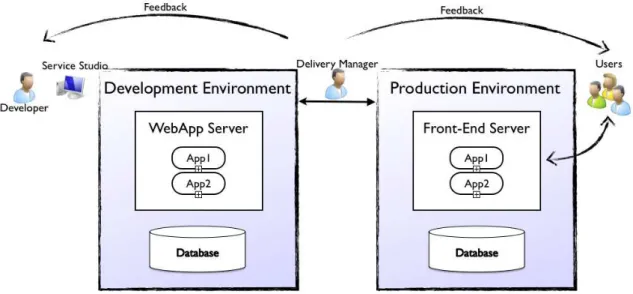
This project is being developed in the context of the R&D team of Outsystems, particularly in the context of theAgile Platform, an integrated platform to develop
and model enterprise web applications. In this chapter we present the platform and its components, in order to know more deeply the environment where we want to implement and test our solution.
The Agile Platform offers to developers a fast and incremental way to build
and maintain a complete web application. In Figure2.1 is depicted the platform high level architecture, in the perspective of the software development process.
2. THEAGILEPLATFORM 2.1. Service Studio
The web applications are developed withinService Studio, which is
develop-ment tool. Service Studiois an IDE based on a safe and easy to use visual Domain
Specific Language (DSL), that covers the definition of business processes, user interfaces, business logic, and data definition and manipulation, web services, security, emails and scheduled jobs. After that, through the 1-Click Publishing
feature, applications are sent to the application server and the compiler located there generated the C#, Java, HTML, CSS, JavaScript, SQL code. This feature ends with the deploy process, an operation that updates theeSpacepublished version.
Afterwards, the application is ready to be used in a web browser.
Our work is focused on equippingService Studio, with new database
refactor-ing operations directed towards the database model and to design and implement the required changes across the whole platform targeting a set of features. In the next section we describeService Studio.
2.1
Service Studio
Service studio is a tool integrated in the Outsystems Agile Platform that supports
the development of web applications available in the Agile Platform and allows
the development ofeSpaces. AneSpaceis an OML (OutSystems Markup Language)
file containing all definitions needed to develop and manage those applications, such as the application logic, database model, web pages interfaces, and security settings.
This tool implements a visual programming language, where screen, pro-gram, and process flows are represented by graphs. Hence, the applications el-ements are created though simple drag and drop actions, having the developer only to configure some properties.
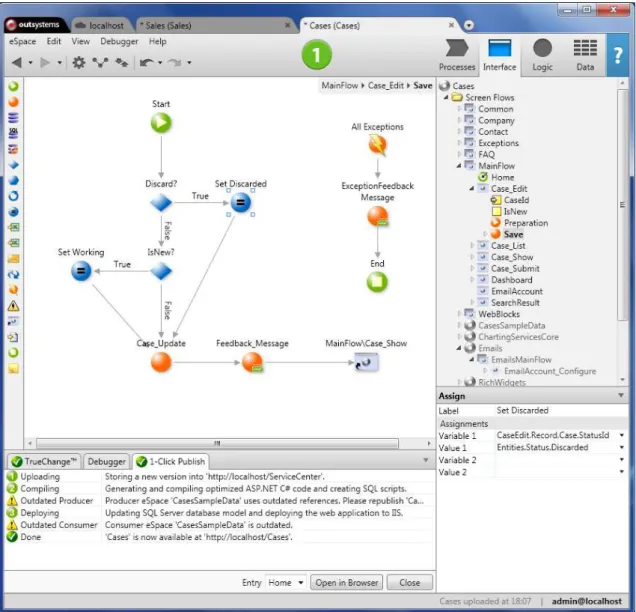
Figure 2.2 depictsService Studiointerface. The most left part of the interface
contains the elements the user adds to the action flows. The right part is divided by the elements tree, showing the elements within the eSpace. Below there is
the properties panel where elements properties are edited. In the top part of the interface we have the navigation commands, as well as the 1 Click Publish
button. The middle part of the interface is the flow screen, where the user draws the application interfaces and defines the actions flow. The lower panel contains three tabs: 1)TrueChangewhere developer checkseSpaceerrors and warnings; 2)
2. THEAGILEPLATFORM 2.1. Service Studio
Figure 2.2: Service Studio - Outsystems applications development environment.
2.1.1
Data Model
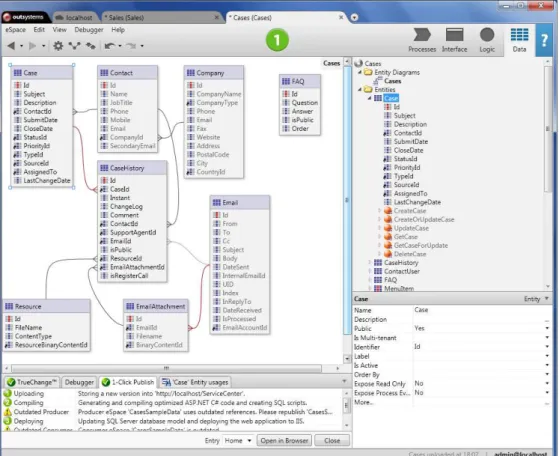
InService Studiowe define the logic, interface and database model for the
applica-tions. Our work focus on the database model and in this section we explain how the developer can build it withinService Studio.Figure2.3depicts aService Studio
screen showing the created Entity Diagram for an application.
As we observe in Figure2.3, the application has defined an Entity-relationship diagram [Che76]. We have two types of Entities: Entity and Static Entity. An
Entityis an element which allows the developer to keep business information in a
persistent way. Entities are used to represent and manage the database model. A
Static Entityis an entity that has static data associated to it, The static data is then
2. THEAGILEPLATFORM 2.1. Service Studio
2. THEAGILEPLATFORM 2.2. Programming language
Good examples of static data implementation are constants and enumerations. In the right side of the tool we can add new Entities and in order to visualise them in the diagram, the users need to drag and drop the Entity they want. To edit anEntitythe user clicks on the respective one, and then edits the properties
associated to it. To add new attributes to an Entity the user selects the Entity and then he adds new attributes to it. To check where the Entity is being used the
user needs to select theFind Usagesfeature. The information is presented below
within the tab "Application_NameEntity usage".
The structures defined by the tables in the database model are used not only in the database queries, but also in the application logic and interface.
2.2
Programming language
A Domain Specific languages (DSL) is a programming language that is focused, through appropriate notations and abstractions, on a particular problem domain. Due to its focus on a specific domain, a DSL allows a very efficient application development process, since the development is not focused on implementation details. Examples of its usage are programming languages for robots, graphic environments definition or physics simulations. Some web developing tool like
Agile platform, implement a DSL. The tool interacts with the system components
though simple constructions, making easier the communication with data repos-itories, the manipulation of its data, and the interface with the user.
The main components of the language implemented by Service Studio are: 1)
Web Flows, to connect the application web pages and define the possible end-user
interaction sequence; 2)Web ScreensandWeb Blocks, to define the application web
interface; 3)Action Flows, to implement system behaviour; 4)Entities, to build the
database model.
Aweb flowis represented by an directed graph, containing an initial node
fol-lowed by an infinite number of nodes. Each node represent aweb Screenand the
edges the transitions betweenweb Screens. Theweb screensrepresent the
applica-tion web pages.
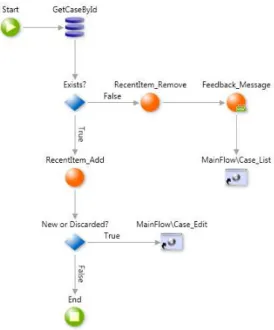
Anaction flowis also a directed graph, representing each node an operation of
the language. An edge defines the next action to perform. Figure2.4 depicts an example of anAction flow.
In order to handle the events triggered by user interaction with the applica-tion, the language allows the creation ofActions. AnActionis formed by: 1) Input
2. THEAGILEPLATFORM 2.2. Programming language
Figure 2.4: Example of anAction flow
describe some constructs supported by the language:
• If & Switch- Control the execution flow by evaluating expressions.
• Assign- Assign a value to a variable.
• Foreach- Performs a single or a collection of actions for each element of a
list.
• Simple Query- Executes a database query over one or moreEntitieswithin
theeSpace. Service Studioprovides a graphical interface to define the query
elements, which permits the user to build database queries without coding SQL.
• Advanced Query - Similar to the previous construct, however in this case
the user needs to specify the SQL code for the query.
• Destination- Deviates the execution flow to a web page created within the
application (web screen).
• Execution Action- Executes any action defined in the eSpace. The user has
available various action types, likeEntity ActionsorUser Actions.
Figure2.4representing the action flowis possible to see some of the language
2. THEAGILEPLATFORM 2.3. Applications Lifecycle
By adding new data migration constructs to the Service Studiolanguage, we
offer to developers functionalities to reduce the difficulty, effort and problems for the maintenance process.
After building the applications, those are ready to compile and publish to
Platform Server. In the next section we describe the application lifecycle.
2.3
Applications Lifecycle
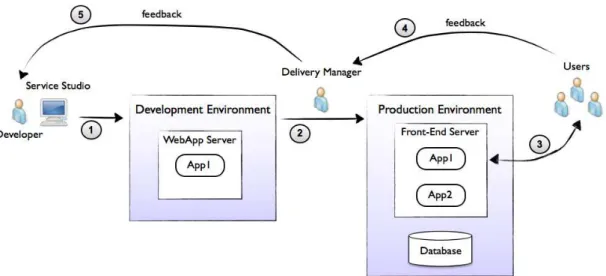
In Outsystems application lifecycle consists in two environments: Development
and Production. Considering applications lifecycle depicted in Figure 2.5 we briefly describe the main steps:
1. Developers use Service Studio to implement and model their web
applica-tions. To test those applications it is necessary to publish them to the devel-opment environment.
2. After the testing phase, if the application is ready to go into production the
delivery manageris responsible for that.
3. The users use the applications published to the production environment.
Service Center is a web application within the web server connecting Service
Studio and the development environment. In the last version of the Agile
Plat-form, was integrated a tool called LifeTime1. The tool is similar to Service Center,
however it connects both development and productionService Centers.
2.3.1
Deploying an application
When the implementation process is concluded, the application is ready to be de-ployed to the development environment through the1Click-Publishfeature. This
operation involves four main steps:
• Save - Saves theeSpace
• Upload -UploadstheeSpace (OML)to the server
• Compile - The compiler receives theeSpaceand generates C#, Java, HTML,
CSS, SQL and more files. After that, the files are compiled into assem-bly/byte code files.
2. THEAGILEPLATFORM 2.3. Applications Lifecycle
Figure 2.5:Ousystems applications lifecycle
• Deploy - Updates the last publishedeSpaceversion.
In this chapter we described the Agile Platform components and services to
support the development and execution of Outsystems web applications. We
3
Related Work
In order to better understand the context of our problem, it is necessary to discuss concepts and the related work previously done. In this chapter we will provide an overview of this subject’s state of the art.
3.1
Background
Relational Data Model The relational model is the primary model used by
commercial data-processing applications, and uses relational algebra as its under-lying theory. We will describe the structure of the relation model briefly. There-fore, to know more about relational algebra and the relational model we refer to [SKS10].
The Relation model is consists in a collection of tables or relations, each one
with a unique name. Those relations consist in a set of attributes, each with a unique name within the relation. Each attribute in a relation defines the set of allowed values of a given attribute, being calleddomainof the attribute.
keysaim to distinguish various Entities. There are the following key types:
• Primary Keyis a candidate key to identify the tuples within the relation.
• Foreign Key- If we have two relations R1 andR2, a foreign key ofR2 is the
primary key ofR2referenced inR1
3. RELATEDWORK 3.1. Background
• Relations are represented by boxes
• Relation attributes are listed on those boxes
• Attributes belonging to the primary key of relation are listed first
• Foreign key dependencies are drawn as arrows from the referencing relation
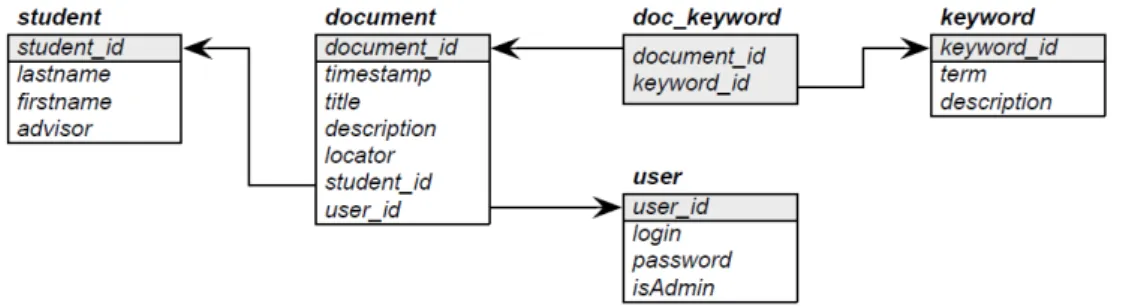
to the referenced relation.
We can see an example of a diagram in Figure3.1.
Figure 3.1: Relational Schema Diagram Example
SQL language [SKS10] is the standard language for relational databases. Each
relational database management system (RDBMS) uses this as its front-end. The language is composed by :
1. Data Definition Language (DDL) - Constructs supported by a database that enable the insertion, delete or modification of structures (relational tables or classes) within the database.
2. Data Manipulation Language - Constructs supported by a database that en-ables the access of data within it, including insertion, delete, search, and update of data.
We will refer next the important SQL commands for our work. For a complete list and more deeply explanation about the SQL language we refer [SKS10]:
• The SELECT command specifies the structure of the result of the query. It is
one of the most used SQL commands.
• The FROM command do specify the data sources for a given query. It can be
3. RELATEDWORK 3.2. Database Refactoring
• The clauses WHERE, ORDER BY, HAVING or GROUP BY are used to filter
the results of a given query.
• The INSERT and UPDATE commands. The first one allows to insert new
data into the database, whereas the second one allow to update the existent data within the database.
• The CREATE or ALTER commands that allows to create and alter tables in
the database schema.
These commands fit in our work since we want to have modification and cre-ation clauses to allow us to perform the changes both in the data model and its data. Consequently, we present an example of a query updating a field of a table gathering the data from another table using the SELECT command:
1 UPDATE Customer SET 2 TotalAccountBalance =
3 (SELECT SUM(balance) FROM Account
4 WHERE Accound.CustomerId = Customer.CustomerId)
The most usual and used way to modify and migrate the schema and data is through SQL scripts. Due to the difficulty (because it is a manual approach ) of that method arises the need to build tools to help the developers to perform changes on the data models and its data in a more automatic way. In the next sec-tion we will speak about Database refactoring, explaining the process and strate-gies to refactor database models.
3.2
Database Refactoring
In [AS06], a Database Refactoring is defined as a simple change to a database, that improves not only its design, but retains its behavioural and informational semantics. Refactoring a database is conceptually more difficult than performing code refactorings [FBB+99], since code refactorings need to maintain behavioural
semantics, whereas database refactoring must also maintain informational se-mantics [AS06].
3. RELATEDWORK 3.2. Database Refactoring
single-application database architecture consists in only one application interact-ing with the database, whereas the second architecture is much more complicated because there are many external sources interacting with the database, some of them beyond our control.
Application
Database
Other Applications
Application
Other Applications
Persistent
frameworks Other
Databases
Data Files
Test Code Database
Figure 3.2: Database architectures
3.2.1
Database Smells
"code smell" concept was introduced by Fowler in [FBB+99], defining it as
cate-gories of problems in the code that lead us to the need of refactoring. Similarly, the concept of database smells was defined in in [AS06], indicating the possible
need to refactor the database. The smells identified by the authors were the fol-lowing:
• Multipurpose column- a column being used for many purposes can
possi-bly mean extra code exists to ensure the use of the data in the right way.
• Multipurpose table - when a table is being used to represent for example
several types of entities, which means that we possibly could have some NULL values. As an example, if we have aCustomertable to represent
peo-ple and companies, and to represent a company we need a legal name, while a person has first,middle and last name, in some rows we will have NULL values.
• Redundant data - This can lead to inconsistency issues, once we have the
3. RELATEDWORK 3.2. Database Refactoring
• Tables with too many columns- When a table has lots of columns, it
indi-cates a lack of cohesion, then we need to normalize the structure.
• Tables with too many rows- Large tables are an indicative of poor
perfor-mance, since the search is time-consuming in a table with millions of rows.
• SmartColumns- Smart Columns are the ones in which different positions
within the data represent different meanings. We need to parse to discover more granular information.
• Fear of change- If we have fear to change the database it is because we are
afraid of breaking something, and it is a sign that we really need to refactor our database schema. This is one of the main goals of our work, we want to reduce the fear of change of the developers when facing a change scenario.
3.2.2
Process of Database Refactoring
In this section we describe the process implementing safely a refactoring within a production environment [AS06]. The process of a database refactoring starts when the developers has the need to fix an issue in the application or when he his faced with a new requirement to implement. The order we should follow defined by [AS06] is:
• Verify if the refactoring is appropriate;
• Choose the most appropriate refactoring;
• Deprecate the original schema;
• Test before, during and after;
• Modify the schema;
• Migrate Source Data;
• Modify the programs accessing the database;
• Run regression tests;
• Version Control;
• Announce the refactoring.
3. RELATEDWORK 3.2. Database Refactoring
Verify and choose the most appropriate refactoring Before performing a database
refactoring we should reflect if it is really necessary perform that refactoring or if it is the right one to perform. Moreover, we should think if the change it is worth of the effort.
Deprecate the original schema The life cycle of a database refactoring consists
in three phases: Implementation, Transition and, Completed. While the refac-toring is not completed and could exist applications accessing the old data we should maintain in the database the data as deprecated data.
Modify the schema This step is one of our main goals. We want to modify
a schema in a more user friendly and automatic way. In [AS06] is proposed a manual way to perform the changes in the schema, which we believe is the most used nowadays due to the interviews we did in Chapter 4. Two characteristics we should take in account is the Simplicityof performing the changes, by not
creating scripts difficult to maintain, and theCorrectness, once we want that the
database schema evolves in a defined manner.
Migrate the source data We may want not only change the schema, but all the
cases when we are in a production environment we need to take in account the data. Thus, we can have DML scripts to migrate the data.
Modify the programs accessing the database Changes on the database schema,
may require the adaption of the external programs that access the changed por-tion of the schema. When many programs are accessing to the database schema, we run the risk that some of the application were not changed to work with the new version. So, we should assign to someone (usually a team) the task of update the external programs.
3.2.3
Database Refactoring Strategies
[AS06] refers strategies we could follow to accomplish the refactorings. We will use the ones we think are more relevant to our work, letting to the reader the reference to know more deeply the description of each one.
• Smaller changes are easier to apply;
• Identify uniquely individual refactoring;
3. RELATEDWORK 3.3. Schema Modification Language
• Have a database configuration table;
• Choose a sufficient deprecation period.
3.2.4
Database Refactoring Categories
Refactoring were divided by categories in [AS06], those being:
• Structural Refactorings- Changing the table structure of the database schema
• Data Quality Refactorings- Intended to improve the quality of the
informa-tion within the database. Improve consistency and usage of the values.
• Referential Integrity Refactorings- Changes that ensure that a referenced row
exists in another table.
• Architectural Refactorings- To improve the overall manner in which the
ex-ternal programs interact with the database.
In the Appendix we list all refactorings associated to each category. We do not explain all of them, besides we analyze the change pattern we are more interested for our work and that we identified in Chapter 4. In the next section we will discuss about Schema modification language[CMZ08], an approach to evolve a schema with a set of defined operators.
3.3
Schema Modification Language
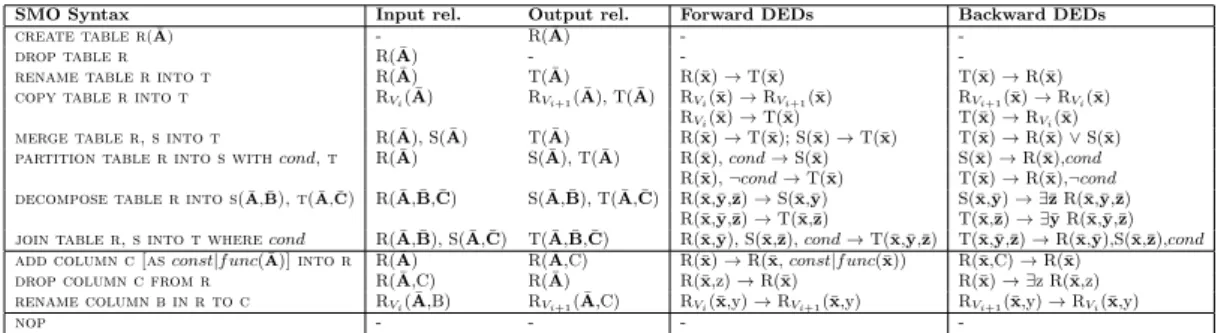
A Schema modification Operator (SMO) is a function that receives a schema with a database as input and produces as output the modified version of that schema and a migrated version of the database. These operators tie together schema and data transformations and they carry enough information to enable the automatic query mapping. The SMOs together represent the SMO language and are shown in3.3.
As an example we can consider the operation"JOIN TABLE R,S into T". This
operation creates a table T that results from joining the tablesRandS.
Consider-ing sequences of SMOs we have the followConsider-ing characteristics:
• Depending the order in which operator is used the result can be different;
• Each operator acts in isolation on its input to produce the output;
3. RELATEDWORK 3.3. Schema Modification Language
SMO Syntax Input rel. Output rel. Forward DEDs Backward DEDs
create table r(A¯) - R( ¯A) -
-drop table r R( ¯A) - -
-rename table r into t R( ¯A) T( ¯A) R(¯x)→T(¯x) T(¯x)→R(¯x)
copy table r into t RVi( ¯A) RVi+1( ¯A), T( ¯A) RVi(¯x)→RVi+1(¯x) RVi+1(¯x)→RVi(¯x) RVi(¯x)→T(¯x) T(¯x)→RVi(¯x)
merge table r, s into t R( ¯A), S( ¯A) T( ¯A) R(¯x)→T(¯x); S(¯x)→T(¯x) T(¯x)→R(¯x)∨S(¯x)
partition table r into s withcond, t R( ¯A) S( ¯A), T( ¯A) R(¯x),cond→S(¯x) S(¯x)→R(¯x),cond
R(¯x),¬cond→T(¯x) T(¯x)→R(¯x),¬cond
decompose table r into s(A¯,B¯), t(A¯,C¯) R( ¯A, ¯B, ¯C) S( ¯A, ¯B), T( ¯A, ¯C) R(¯x,¯y,¯z)→S(¯x,¯y) S(¯x,¯y)→ ∃¯zR(¯x,¯y,¯z) R(¯x,¯y,¯z)→T(¯x,¯z) T(¯x,¯z)→ ∃¯yR(¯x,¯y,¯z)
join table r, s into t wherecond R( ¯A, ¯B), S( ¯A, ¯C) T( ¯A, ¯B, ¯C) R(¯x,¯y), S(¯x,¯z),cond→T(¯x,¯y,¯z) T(¯x,¯y,¯z)→R(¯x,¯y),S(¯x,¯z),cond
add column c [asconst|f unc(A¯)] into r R( ¯A) R( ¯A,C) R(¯x)→R(¯x,const|f unc(¯x)) R(¯x,C)→R(¯x)
drop column c from r R( ¯A,C) R( ¯A) R(¯x,z)→R(¯x) R(¯x)→ ∃z R(¯x,z)
rename column b in r to c RVi( ¯A,B) RVi+1( ¯A,C) RVi(¯x,y)→RVi+1(¯x,y) RVi+1(¯x,y)→RVi(¯x,y)
nop - - -
-Figure 3.3: Schema Modification Operators
[CMDZ10] extends the SMO language by introducing new six operators called ICMO (Integrity Constraints Modification Operators), used to perform the evo-lution of integrity constraints. Following we can analyze an example integrating both types of operators, and then in Figure 3.5is presented the SMO and ICMO syntax.
1 ALTER TABLE exon DROP PRIMARY KEY pk1; 2 DROP COLUMN rank FROM exon;
3 ALTER TABLE exon ADD PRIMARY KEY pk2(id) ENFORCE;
In Figure3.4we have the tableexon. The evolution example starts by dropping
the primary key of the table exon, dropping therank column too after that. The
last step adds a new primary key for the same table, but the new key is only composed by theidfield.
id description
g_descr
id type
gene
region start end region_id name
seq_region
length id rank
exon
region start end
S 1 S
Figure 3.4: Schema Example
Forcing Information Preservation for SMOs Some technical challenges for the
data migration and query rewriting problems were raised by the operators that were not information-preserving. The authors defined that an operator O is
information-preserving if and only if:
• Is invertible
• The old and new schema are equivalent, i.e. have the same information.
3. RELATEDWORK 3.3. Schema Modification Language
Table 1:
A language for schema evolution: SMO+ICMOSchema Modification Operators (SMO) Syntax
CREATE TABLE R(a,b,c) DROP TABLE R
RENAME TABLE R INTO T COPY TABLE R INTO T MERGE TABLE R, S INTO T
PARTITION TABLE R INTO S WITH cond, T DECOMPOSE TABLE R INTO S(a,b), T(a,c) JOIN TABLE R,S INTO T WHERE cond
ADD COLUMN d [AS const|f unc(a, b, c)] INTO R DROP COLUMN c FROM R
RENAME COLUMN b IN R TO d
Integrity Constraints Modification Operators (ICMO) Syntax
ALTER TABLE R ADD PRIMARY KEY pk1(a, b) <policy>
ALTER TABLE R ADD FOREIGN KEY f k1(c, d) REFERENCES T(a, b) <policy> ALTER TABLE R ADD VALUE CONSTRAINT vc1 AS R.e= “0” <policy> ALTER TABLE R DROP PRIMARY KEY pk1
ALTER TABLE R DROP FOREIGN KEY f k1
ALTER TABLE R DROP VALUE CONSTRAINT vc1
Figure 3.5: SMO Language: SMO+ICMO
because of an ICMO and not because of a SMO. With this approach the manage-ment of structural changes and alterations of information capacity can be sepa-rated.
To better understand this approach we have the Listing3.1. Constraining the values of table gene with operator 2, guarantees that the JOIN operator will be
information preserving, and consequently any loss of tuples will be imputed to operator 2 and not to operator 3.
Listing 3.1: Information-Preserving Example
1 RENAME COLUMN type IN gene TO biotype; 2 ALTER TABLE gene ADD FOREIGN KEY fk2 (id) 3 REFERENCES g_descr(id) ENFORCE; 4 JOIN TABLE gene,g_descr INTO gene 5 WHERE gene.id = g_descr.id;
3.3.1
SMO Invertibility
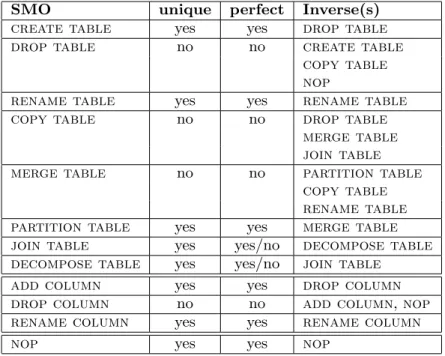
PRISM [CMDZ10] deals with invertibility within the operational SMO language, having each SMO one or more inverses. The invertibility of each operator is characterized by the existence of a perfect/quasi inverse and uniqueness of the
inverse. As we can see in Figure3.6JOIN TABLE and DECOMPOSE TABLE rep-resents each other’s inverse, in the case of the information preserving step, while if the forward step is not information preserving they represent a quasi inverse.
3. RELATEDWORK 3.4. Data Migration
Table 3: SMO inverses
SMO unique perfect Inverse(s)
create table yes yes drop table
drop table no no create table
copy table nop
rename table yes yes rename table
copy table no no drop table
merge table join table merge table no no partition table
copy table rename table partition table yes yes merge table join table yes yes/no decompose table decompose table yes yes/no join table
add column yes yes drop column drop column no no add column,nop rename column yes yes rename column
nop yes yes nop
Figure 3.6: Schema Modification Operators Inverses
the integrity constraints do not carry enough information the DBA can define a unique inverse for all the queries or he can manage each query independently and choose different inverses for different queries.
3.4
Data Migration
After the changes were made to the database structure, arises the need to mi-grate and maintain the data consistent, hence the data needs to be mimi-grated in a manner it can work with the new version of the schema. There are several ways to perform the migration of the data of a database. The migration mechanisms proposed by [AS06] are manual SQL scripts, while in [CMZ08,CMDZ10] the mi-gration of the data is done through logical mappings called DEDs (Disjunctive Embedded Dependencies).
In [VWV11] is presented a DSL for the coupled evolution associated to data models and its data. After creating the WebDSL language [GHKV08], the authors modeled an evolution model, defining three types of migrations:
1. Schema Modification - Operators only requiring schema modification;
2. Conservative Migrations - To change the schema and re arrange the data;
3. RELATEDWORK 3.5. Access Program Adaptation
Ruby on Rails1 supports migration of databases for an evolving web
applica-tion. Those applications use an ORM to persists data in a relational database, and the developer needs to specify the migrations himself.
A tool implementing the migration mechanisms referred in [AS06] is Liquibase2,
which stores the changes in XML files and after that applying it to the databases.
3.5
Access Program Adaptation
We can have databases shared by many applications and databases accessed only by an application. In both cases it is important to adapt the code of those pro-grams, for example, queries working with an old schema version need to be adapted to work with the refactored version of the schema.
[CMZ08, CMDZ10] solve that issue by using the chase and backchase algo-rithm [DNR08] to rewrite the queries to work with the new version of the schema, using the algorithm the DEDs referred in the previous section to rewrite the queries.
3.6
Change Patterns
The goal of this section is to analyze the motivations, tradeoffs, impact on applica-tion code and how to perform data migraapplica-tion in the change patterns we identify with the interviews in chapter4. Our is based in [AS06].
Move Column Move Columnconsists on moving a column from a table to
an-other one.
The motivation to achieve this refactoring is that we may want to normalize the table, or to perform a refactoring afterwards, or denormalize if the column is inserted in a join only due to its existence in the wrong place. Reorganizing the tables structure is another motivation.
As potential tradeoffs, reducing the data redundancy may decrease the per-formance if additional joins are required by the applications to obtain the data. If we improve the performance we will increase data redundancy.
Updating the schema we need to take care about the value of the column and if referential integrity constraints exists.
3. RELATEDWORK 3.6. Change Patterns
Change ID column type This change is usually related with integrity constraints,
since by changing them deals with the consistency of the database. In some point, because of a new requirement, the foreign key that was pointing, for example, to
usertable is now pointing to theUserMastertable.
According to our research, we did not find any tools implementing a simi-lar pattern, however it was realized in Chapter 4that this is a common pattern, withinOutsystemscontext.
Adding a new constraint Constraints enforce data dependencies at the database
level [AS06], preventing persistent data to be invalid.
Adding foreign key constraints can decrease the performance of the database, since the foreign key table will be always verified when an update is done to the data. Furthermore, we need to take into account the order of insert or delete oper-ations. Liquibase implements this operation by defining a change set specifying the attributes required. [CMDZ10] allows the user to perform the refactoring through the SMO operator "ALTER TABLE R ADD FOREIGN KEY fk1(c,d) REF-ERENCES T(a,b) <policy>", having the user to specify the relation R to be changed
and the how the foreign key is formed. The last parameter policycan be as
fol-lowing defined by the authors:
• CHECK: The system verifies if the database instance satisfies the new
con-straint and, if not, the ICMO operation is rolled back.
• ENFORCE: The system removes all tuples violating a new integrity
con-straint. That removed tuples are kept in a temporary table namedviolation tables.
Master/Detail table This operation consists on vertically split an existing table
into one or more tables. Consider as an example, a tableClientwith the attributes
Id, Name, Address, Phone, Phone_2, and Email. After, we realized we want to have
more than two phone numbers. Thus, we need to evolve our model by creating a detail table, possibly with the name Contacts, to accomplish such
functional-ity. This operation implies splitting the tableClientand migrate the existent data
within Phone,Phone_2 and email attributes into the Contacts table. Besides, we
need to take into account the applications using those fields. Using SMO opera-tors [CMZ08,CMDZ10] it is possible to use the operation using theDECOMPOSE
Tableoperator. Liquibasedoes not implement theSplit Tablerefactoring. A possible
3. RELATEDWORK 3.6. Change Patterns
Other Patterns There are simpler patterns that we are not discussing, but they
are completely identified. Although, because the patterns are already imple-mented on usual database management systems we will not give then a special emphasis. Those patterns are for example:
• Rename a column,
• Rename a table,
• Adding new attribute,
4
Preliminary Analysis
The early stages of the project were dedicated to learn about the Agile Platform.
At first we performed tutorials available onOutSystems Academy, in order to
un-derstand how applications are developed in the Agile Platform. We wanted to
understand developers difficulties when developing web applications inService
Studiofocusing on the data model. Afterwards, we studied concepts, techniques
and solutions that guided our decisions along the solution model design and im-plementation phase. Our research was focused on database refactoring, database migrations and database schema evolution.
After that, in order to understand problems and difficulties faced by develop-ers when evolving database models we interviewed experienced developdevelop-ers and project managers frequently evolving applications database model, in the context of the OutSystems Agile Platform. Interviews intended to capture the most
4. PRELIMINARYANALYSIS 4.1. Interviews Structure
4.1
Interviews Structure
Interviews were split in two parts. The first part was composed by questions aiming to capture the problems, difficulties and most common scenarios faced by the interviewee when evolving applications database model. In the second part our goal was to understand if the scenarios captured from the related work, are common in the context of theAgile Platform.
4.1.1
First Part
The questions composing the first part of the interviews are:
1. Which are the most frequent scenarios that require changing the database model?
• Goals, Driver, Processes, Risk, Human Effort both for Development
and Operations
2. Which are the most costly scenarios that require changing the database model?
3. How do you handle high risk database changes?
On this part, we forced the interviewee to think on scenarios faced during previous projects, in order to understand, which are the most frequent scenar-ios, when changing applications database model. We asked also, what is their approach and how much effort was required to accomplish the requirements re-quiring database changes. The second question aims to know, how costly were the scenarios they faced. The third question aimed to know, how the intervie-wee handles high risk database changes, for example when applications already contain data in production.
4.1.2
Second part
The questions composing the second part of the interviews are:
• Can you prioritize the following scenarios by saying if they are Frequent or
Not Frequent?
4. PRELIMINARYANALYSIS 4.2. Interviews Notes
3. Convert column between two different type of entity identifiers. e.g.:
ProductId→CustomerId
4. Split column. e.g.: convertNametoFirstName,LastName.
5. Merge column e.g.: convertFirstName,LastNameintoName
6. Move column to entities that have a one to one relation. e.g.: moving binary data column to an extension entity, or moving back data from an extension entity to the main entity
7. Move data from a master entity to a detail entity. e.g.: emailattribute
from apersonentity to aperson_contactdetail entity
8. Move data from a detail entity to a master entity. e.g.: Last modified attribute
Chart4.1depicts the answers collected on the second part of interviews , and also shows the frequency of the proposed database change scenarios.
Figure 4.1: Interviews second part results
4.2
Interviews Notes
4. PRELIMINARYANALYSIS 4.2. Interviews Notes
when evolving applications. They described the most difficult problems in the development and maintenance process of applications, focusing on the database layer.
As a common observation, respondents referred that in the early stages of applications development, they aim to have the database model as clean as pos-sible, because when later they need to evolve applications and introduce new features requiring database model changes the process may be simpler. Writing SQL scripts to update and evolve the database is the usual approach, as referred by the respondents during interviews.
The most challenging problems when changing applications database struc-ture, arise when applications already contain real data in production, as reported in two interviews. It was also referred, that the evolution process is usually painful for the developers, since loosing data or having application downtimes are not acceptable options.
In addiction to the scenarios presented during interviews, respondents also reported other common scenarios as for example:
• Changes in attribute type (Similar to the Change foreign key), reported in
three interviews;
• Change the attribute propertyisMandatory;
• Adding new constraint - When the developers want to add a new constraint
to the model, they insert manually the constraint in the database manage-ment system, publishing after that in theeSpace.
In order to migrate data and change the database model, writing SQL scripts is the most frequent approach as reported in an interview. Because of that, was also reported that having an impact analysis tool analyzing the real data in pro-duction would be very useful, since developers may know, if the transformations performed in the database model on the development environment are compati-ble with the real data in production. A tool analyzing the real data in production, would improve extensively the maintenance process.
In the first part of the interviews, was difficult to developers to identify sce-narios they faced on previous projects, while in the second part they properly understood the scenarios and they gave us useful feedback.
Discussion Analyzing interviews results, we conclude that developers face the
4. PRELIMINARYANALYSIS 4.3. Change Operations Identified
the database models, data and code. Thus, implementing automatic features to evolve database models and its data, it is very useful to improve applications development and maintenance processes, keeping applications compatible along the different environments.
4.3
Change Operations Identified
This section describes change operations identified during interviews. We also analyze which are the most interesting and useful to provide to developers, and how they can accomplish those tasks with tools available at the moment. We also discuss which are the most frequent, costly and risky. Analyzing Figure 4.1, we can conclude that scenarios usually faced by developers are similar.
Change Foreign Key In the sixth interview, this scenarios was defined as
fre-quent. Changing the foreign key type is a very specific scenario in the context of
Service Studio, but can bring problems related to integrity constraints.
Adding a new constraint It was referred in sixth and fourth interviews that
adding a new constraint to the database model is a very common scenario. The usual approach is to add the constraint manually in the DBMS, before publishing the application, in order to avoid integrity errors.
Change attribute type Analyzing the interviews this is a very common
sce-nario. Thus, it is a change pattern that deserves our attention. This operation consists on changing the type an attribute/column. When changing an attribute type, the real data in production may not keep compatible. That is an issue we aim solve with our solution.
Master/Detail table Analyzing only the table 4.1, we realize that this is not a
frequent scenario. However, the respondents referred that besides is not one of the most frequent scenarios, they face sometimes this kind of refactoring. For example, consider a tableClientwith the attributesId, Name, Address, Phone, Phone
2, and Email. After that, we realized that we want to have more than two phone
numbers. Thus, we need to evolve our model by creating a detail table, possibly with the nameContacts, to accomplish that requirement. In conclusion, although
4. PRELIMINARYANALYSIS 4.3. Change Operations Identified
In this chapter the approach taken on the early stages of this dissertation was described. We started by getting familiar with the Agile Platform studying
af-ter that concepts, techniques and solutions that guided our decisions along the solution model design and implementation phase.
After that we interviewed experienced developers and project managers in the context of theAgile Platform. With that, we extracted common scenarios faced
by the developers when evolving applications and which scenarios carry higher risk. This research was aimed to identify and analyze scenarios captured during interviews and identified in the previous study of the state of the art, in order to select the most interesting scenarios to support in our work.
5
Model Solution
In this chapter we present our solution to introduce database evolution features in theAgile Platform. As presented in chapter1, our goal is to provide a safe and
guided process for developers to change applications data model. We focus on applications already in the maintenance phase, i.e., applications that were already deployed to production. The main problem to developers is to evolve those ap-plications that already deal with real and sensible data which cannot be lost, and whose migrations cannot be directly tested in development environments. Thus, our solution allows developers to maintain the synchronization between both development and production environments. One of the problems that usually arises when developers are changing the database schema in the development environment, is that they do not have access to the real data in production envi-ronment. Thus, is difficult to developers to know what is the impact of changing the database structure on the application data. Having information about the state of the real data in production, helps the developers to know the real risk of their changes in the applications database structure. Figure5.1 shows the flow from applications development phase until applications are deployed into pro-duction. The developer changes the application in Service Studioand publishes
it in the development environment. The system is responsible to deploy the ap-plication when it is ready. The system deploys the apap-plication in the production environment through LifeTime. In this case, we have two different scenarios:
5. MODELSOLUTION Developer Service Studio Development Environment LifeTime Production Environment
Publish to Development Deploy
Operator
Figure 5.1: Application Development and Deployment process
The second case when there are problems in the data migration is critical be-cause the deployment process is postponed and the operator needs to inform the development team about the errors in the migration script and wait for it to be fixed. The common approach followed by developers is to write SQL scripts to fix the database conflicts problems and to also to migrate data if needed.
Developer Service Studio Development Environment LifeTime Production Environment Operator Migration_n Pending Migrations Migration_n Migration_n
Already applied in Development Environment
Already applied in Production Environment Migration_n Migration_n Migration_n Migration_n Migration_n Migration_n
Migrations Pending to apply to Production environment
Migration_n Migration_n
Migration_n
Figure 5.2: Migrations withinAgile Platform
5. MODELSOLUTION 5.1. Migrations Model
in theAgile Platform. Migrations are a mechanism to capture transformations in
a database model and schema in a structured and organized way (we explain migrations in detail in the next sections). Figure5.2 depicts how migrations are integrated. To distinguish the migrations already applied on the different envi-ronments we divide them into categories according to their application stage:
• Pending migrations- Generated inService Studiowhen the developer changes
the database model;
• Already applied in Development Environment- Changes to the database
model already published in the development environment;
• Already applied in Production Environment - Changes to the database
model already deployed into production.
Whenever developers change the database model or schema, a new migra-tion is generated and stays pending until it is published to the development en-vironment. The generated migrations contain information about who changed, when and what was changed. After that, the development environment contacts
LifeTimethat communicates with the production environment to get information
about the impact of the migration in the database data already in production. This is possible because theLifeTimeallows developers to have information about the
version of each application running in development and production environment and also to access to an instant snapshot of any applications inconsistencies be-tween environments. Thus, after developers change the database model in the
Service Studio, the system analyzes on demand the impact of those changes in
the data model already in production. As the production data analysis may take some time to complete, developers continue changing and evolving their appli-cations while the system is analysing the impact of their transformations in the database model in production. After a while, the developer receives a warning that requires a migration rule to fix the incompatible data in production.
Thus, developers have on demand what is the impact on the database model in production, of the changes they made in the development environment. In the next sections we present the migrations model in more detail.
5.1
Migrations Model
5. MODELSOLUTION 5.1. Migrations Model
AbstractMigration
Developer : Integer Version : Date Timestamp : Date AttributeName : Text
CreateAttribute
Type : AbstractType IsAutoNumber : Boolean Label : Text
Length : Integer IsMandatory : Boolean DefaultValue : DefaultValue
DropAttribute RenameAttribute
NewAttributeName : Text
UpdateAttribute
NewAttributeValue : Text
ChangeAttribute
AttribtuePropertyNewValue : Text DefaultValue : DefaultValue AttributePropertyName : Text Entity
Figure 5.3: Class Diagram.
schema in a structured and organized way. We describe the implementation of migrations withinService Studio in the next chapter. It is important to refer that
migrations are not editable by the developer, except the ones requiring updates. Migrations represent operations made by the developer to the database model to evolve it. So, the developer modifies the database structure and migrations are generated automatically creating a sequence of operations. Then, they are applied to the database model according to their order. To represent the mod-ifications made by the developers in the database model, we have defined the following kinds of operations, represented in the Figure5.3:
• Create Attribute: captures the creation of an entity attribute;
• Drop Attribute: captures the dropping of an entity attribute;
• Rename Attribute: captures the renaming of an entity attribute;
• Change Attribute: captures a change in a property of an entity attribute;
• Update Attribute: defines a new value for the entity attribute.
The presented operations capture the transformations on the database model and represent specific kinds of migrations extending the generic migration class (Figure5.3). In our model a generic migration has the following properties: