Vol.55, n. 4: pp.613-621, July-August 2012
ISSN 1516-8913 Printed in Brazil BRAZILIAN ARCHIVES OF
BIOLOGY AND TECHNOLOGY
A N I N T E R N A T I O N A L J O U R N A L
Influence of Essential Oil Fractionation by Vacuum
Distillation on Acaricidal Activity Against the Cattle Tick
Fernando Cidade Torres
1,2, Aline Machado Lucas
1, Vera Lucia Sardá
Ribeiro
2, João
Ricardo
Martins
3, Gilsane von Poser
4, Maria Silvia Guala
5, Heriberto Victor Elder
5and
Eduardo Cassel
1*1Laboratório de Operações Unitárias; Faculdade de Engenharia; Pontifícia Universidade Católica do Rio Grande
do Sul; Av. Ipiranga, 6681; 90619-900; Porto Alegre - RS - Brasil. 2Laboratório de Acarologia e Entomologia; Faculdade de Veterinária; Universidade Federal do Rio Grande do Sul, Av. Bento Gonçalves, 9090; 91540-000; Porto Alegre - RS - Brasil. 3Instituto de Pesquisas Veterinárias Desidério Finamor; Estrada do Conde s/n; Guaíba - RS-– Brasil. 4 Programa de Pós-Graduação em Ciências Farmacêuticas; Universidade Federal do Rio Grande do Sul, Av. Ipiranga, 2752; 90610-000; Porto Alegre - RS - Brasil. 5Facultad de Ingeniería Química; Universidad Nacional del Litoral; Santa Fe - Argentine
ABSTRACT
The aim of this work was to study the influence of essential oil fractionation on acaricidal activity against the cattle tick Rhipicephalus (Boophilus) microplus. The citronella (Cymbopogon winterianus J.) and pepper tree (Schinus molle L.) essential oils were fractionated by vacuum distillation yielding fractions that were analyzed by the GC/MS. Laboratory tests were carried out to determine the effect of the total essential oil and fractions on larvae of the cattle tick R. (B.) microplus. The fractions 04 and 05 of the C. winterianus essential oil were the most active showing LC50 values of 1.20 and 1.34 µL/mL, respectively. The LC50 of the total oil was 3.30 µL/mL while the effect of the fractions 01, 02 and 03 was less pronounced, with LC50 values of 4.37, 4.24 and 3.49 µL/mL, respectively. The fraction 03 of the S. molle essential oil was the most active showing LC50 value of 8.80 µL/mL while the fractions 01 and 02 did not show toxic effects on the larvae.
Key words: Cymbopogon winterianus J., Schinus molle L., acaricidal activity, vacuum distillation, Rhipicephalus (Boophilus) microplus
*Author for correspondence: [email protected]
INTRODUCTION
The cattle tick Rhipicephalus (Boophilus) microplus represents a major problem for the cattle
production in several regions of the world. It causes blood loss, reduction in both weight gain and milk production. It also serves as a vector for certain diseases such as bovine babesiosis, a cattle tick-borne disease caused by the haemoprotozoan parasites of the genus Babesia, and anaplasmosis,
caused by obligate intracellular bacteria of the
genus Anaplasma that parasitize erythrocytes and
monocytes of higher vertebrates, mostly ruminants. In addition, the parasite causes damage to skin of the cattle directly affecting the value of hides for leather manufacture (García-García et al. 1999; Ducornez et al. 2005). The economical losses world-over were estimated as $7 billion (Castro-Janer et al. 2009) due to this.
environment and directly on the animal skin. However, the indiscriminate use of these substances leads to increase in acaricide resistance and environmental contamination (Chagas et al. 2002; Chagas 2004). Therefore, effective and easily accepted methods of tick control are extremely necessary (Cordovés 1997).
Natural products can be considered a valuable alternative. A large number of plants and entomopathogenic agents have been reported to have acaricidal effect against the diverse stages of several species of ticks such as Ixodes scapularis
and R. (B.) microplus (Borges et al. 2003;
Freitas-Ribeiro et al. 2005; Dietrich et al. 2006; Freitas-Ribeiro et al. 2007; Fernandes et al. 2008; Ribeiro et al. 2008). Among them, essential oils components are known to possess repellent, chemosterilant, antifeeding and biocidal activities against different acarus, showing promissory potential as products for tick control, since some of them are selective and have little or no harmful effects on non-target organisms (Facey et al. 2005; Panella et al. 2005; Dietrich et al. 2006; Tunon et al. 2006; Apel et al. 2009).
The genus Cymbopogon, family Poaceae,
comprises a group of about 40 tropical aromatic grasses. The essential oils from several species of this genus have demonstrated insecticidal and repellent activity (Kim et al. 2004; Ketoh et al. 2006; Samarasekera et al. 2006). The citronella (Cymbopogon winterianus J.) essential oil presents
repellent properties and represents a significant parcel of the essential oil national production being used in sprays, soaps, candles and other mosquito repellent products (Tanu and Adholeya 2004). Studies performed with the oil distilled from the leaves of citronella showed high acaricidal activity against the larvae and adult females of the cattle ticks when pure oil and diluted (1:4) in ethanol (Chungsamarnyart and Jiwajinda 1992) was used. Olivo et al. (2008) investigated the effect of the essential oil of citronella on R. (B.) microplus
engorged females and reported 90% of egg laying inhibition at the concentrations of 1, 10, 25 and 100%. Other study carried out with C. winterianus
essential oil demonstrated that the concentrations of 6.1 and 4.1% were lethal to engorged females and larvae of R. (B.) microplus, respectively.
Hatching was not observed in the eggs from the engorged females treated with the essential oils at the concentration of 7.14% and egg lying was inhibited by the oil at 10%. Citronellal, geraniol
and citronellol were the main components identified in the essential oil (Martins 2006).
Schinus molle L. (Anacardiaceae) is a tree from the
South America, originating from Peru (Huerta et al., 2010). It has active substances, such as terpenes, tannins, alkaloids, flavonoids, essential oils, and oleoresins, mainly in the leaves and fruits (Ferrero et al. 2007). Ferrero et al. (2006 2007) studied the insecticidal and repellent effects of the extracts from S. molle. Hayouni et al. (2008).
Investigated the antimicrobial activity of pepper tree essential oil.
In this work, the essential oils of C. winterianus
and S. molle were fractionated by vacuum
distillation (Babu and Kaul 2007) and tested against R. (B.) microplus.
MATERIAL AND METHODS
Plant material and extraction of the essential oil
The aerial parts of C. winterianus were collected
from the Experimental Farm of Tekton Óleos Essenciais Ltda in the state of Rio Grande do Sul. The essential oil was extracted from the fresh aerial parts by steam distillation in the Tekton industrial distillery (Cassel and Vargas 2006; Cassel et al. 2009). The average yield of the extraction, 0.62% p/p, was calculated on a wet weight basis from the relationship between the essential oil mass and mass of leaves of the fresh aromatic plants.
The S. molle essential oil was extracted from the
fresh plant (fruit – 25% p/p; leaves – 65% p/p; stems – 10 % p/p) by steam distillation. The average yield of the pepper tree essential oil on industrial scale was 0.30% p/p. The fresh plants were collected and the essential oil was extracted in Experimental Center Angel Gallardo.
Essential oil fractionation
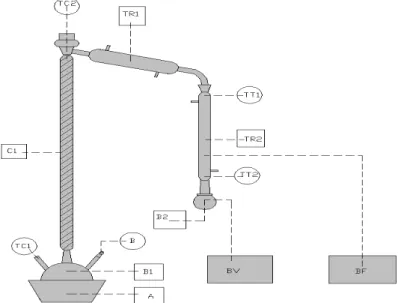
The fractionating column was 1.5 m in height and was packed with titanium alloy. The packing material was selected in order to protect against the corrosion. The measure of temperature at the top of the fractionating column was determined by the thermocouple with a precision of ± 1.5 °C.
Temperatures in the condensers were controlled by a thermostatic bath (TECNAL, Model TE-2000) and the maintenance of the system pressure was made by vacuum pump (TECNAL, Model TE-058).
Figure 1- Schematic diagram of the vacuum distillation apparatus: B1 - round bottom flask; C1 – packed column; TR1 and TR2 – condenser, B2 – sample flask, BV – vacuum pump; BF – thermostatic bath, TC1, TC2 – temperature controllers.
Qualitative and quantitative analyses
The quantitative and qualitative analyses of the oils were performed by the capillary GC/MS on an Agilent 7890A mass selective (MS) detector system operating at 70 eV using a HP-5MS capillary column (30 m x 0.25 mm x 0.25 µm). Injector and detector temperatures were set at 60 and 325/350 ºC, respectively; the oven temperature was programmed from 60 - 300 ºC in HP-5 column and 60 - 230 ºC.
Compound identification was based on a comparison of the retention indices (determined relatively to the retention times of a series of n
-alkanes) and mass spectra with those of authentic samples and/or with literature data (Adams, 2007).
Acaricidal tests
The essential oils and fractions were serially diluted in ethanol (95%) in order to obtain the concentrations of 25.0, 12.5, 6.25, 5.0, 2.5, 1.25 and 0.625 µL/mL. The Mozo strain used as susceptible reference strain was provided by the IPVDF (Instituto de Pesquisas Veterinárias Desidério Finamor). Engorged females R. (B.)
microplus were collected from the infested
animals, washed with water and dried in paper towel. The average weight of engorging ticks was 0.3 g. These females were incubated at 27–28 oC and 70–80% relative humidity for two weeks until the egg laying. These eggs provided the larvae used for the larval immersion test - LIT (Ribeiro et al. 2007).
RESULTS AND DISCUSSION
The citronella and pepper tree essential oils have been widely used as insect repellent. Several studies have been done and the efficacy of the oils against mosquitos and ticks has been demonstrated. Nevertheless, no study has been carried out with the essential oil fractionated by vacuum distillation. In order to prepare the
fractions, the essential oils obtained from the aerial parts of C. winterianus and from the fruits and
aerial parts of S. molle by steam distillation were
submitted to vacuum distillation at constant pressure varying the temperatures. The average yield of each fraction was calculated from the relationship between the fraction volume and essential oils volume. The results are shown in Table 1.
Table 1 - Yield of C.winterianus and S. molle essential oil fractions obtained by vacuum distillation.
C. winterianus S. molle
Fractions Temperature Range (ºC) Yield (% v/v) Temperature Range (ºC) Yield (% v/v)
FR1 25-50 10.0 25-35 12.0
FR2 50-75 16.5 35-50 18.0
FR3 75-100 15.0 > 50 70.0
FR4 100-125 13.5
FR5 > 125 45.0
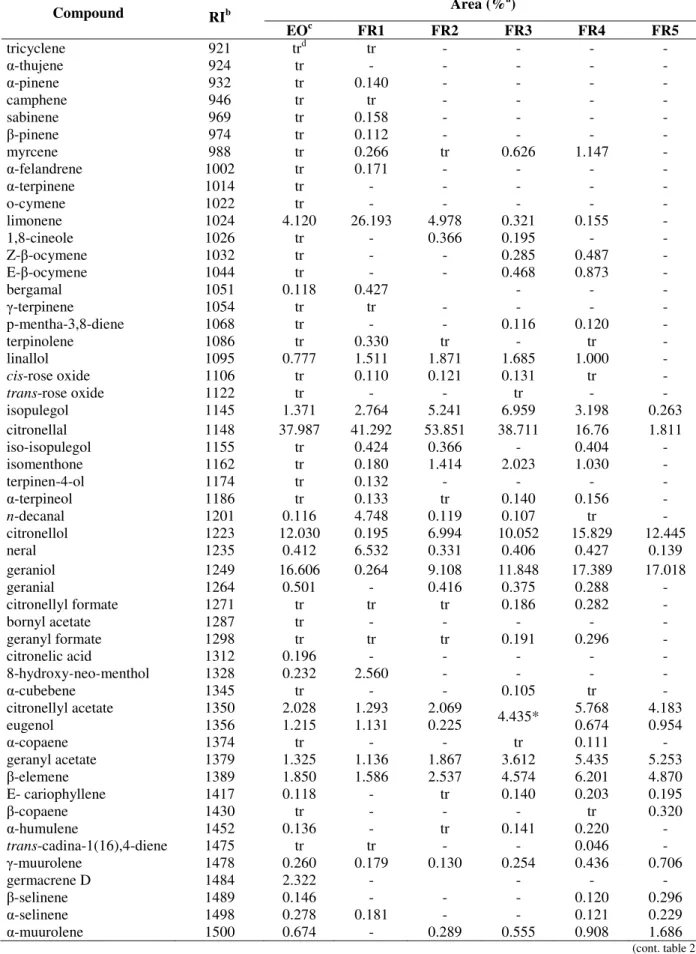
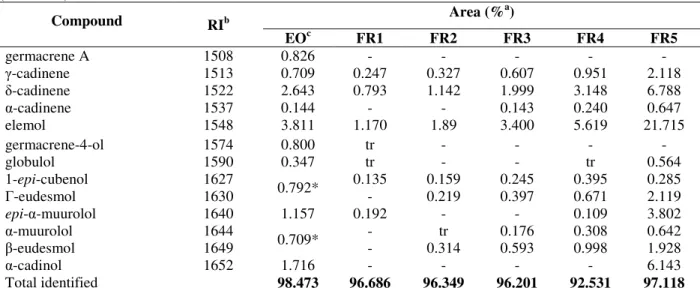
The percentages of each component of the C. winterianus and S. molle essential oils and
fractions obtained by vacuum distillation are reported as raw percentages without standardization in the Table 2 and Table 3, respectively. Some compounds not detected in the essential oils and present in the heavy fractions could be formed by thermal degradation or they were detected in these fractions since the main components, more volatiles, were removed in the former fractions.
Laboratory tests were carried out to determine the toxicity of the citronella and pepper tree essential oil fractions on the larvae of the cattle tick R. (B.) microplus by the larval immersion test. In the
experiments performed with the citronella essential oil and fractions, the samples presented activity in relation to the control. According to the lethal concentration values (LC) presented in Table 4, the fractions FR1 and FR2 were less active than the total essential oil. Fraction FR3 presented LC values similar to those obtained for the essential oil while fractions FR4 and FR5 proved to be the most active samples. Although the chemical composition of the fractions FR4 and FR5 were different, the activities did not differ significantly. In the present study, the essential oil of C. winterianus demonstrated activity against the
larvae of the cattle tick in concentrations lower than those previously reported (Olivo et al. 2008).
The result could be explained by the variability in the components of the essential oil due to environmental factors or by the susceptibility of the strain.
Martins (2006) demonstrated that when tested separately, citronellal and geraniol exhibited higher acaricidal properties compared to citronellol. Nevertheless, in this work, the fractions containing lower amount of citronellal were the most active. The high activity could be enhanced by the presence of higher amount of geraniol. The activity of the fraction FR5 could be attributed to the geraniol and to the presence of sesquiterpenes and diterpenes, which, due to the higher molecular weight, could remain longer in contact with the parasite.
The other essential oil investigated in this work, the pepper tree essential oil, has been previously studied showing antimicrobial and repellent activity (Ferrero et al. 2006, Ferrero et al. 2007; Hayouni et al. 2008, Huerta et al. 2010). In this work, the toxicity of the S. molle essential oil and
fractions obtained by the vacuum distillation on larvae of the cattle tick R. (B.) microplus was
determined, as shown in Table 5. In relation to fractionation of S. molle essential oil, it could be
Table 2 - GC–MS of C. winterianus essential oil and fractions obtained by vacuum distillation.
Compound RIb Area (%
a )
EOc FR1 FR2 FR3 FR4 FR5
tricyclene 921 trd tr - - - -
α-thujene 924 tr - - - - -
α-pinene 932 tr 0.140 - - - -
camphene 946 tr tr - - - -
sabinene 969 tr 0.158 - - - -
β-pinene 974 tr 0.112 - - - -
myrcene 988 tr 0.266 tr 0.626 1.147 -
α-felandrene 1002 tr 0.171 - - - -
α-terpinene 1014 tr - - - - -
o-cymene 1022 tr - - - - -
limonene 1024 4.120 26.193 4.978 0.321 0.155 -
1,8-cineole 1026 tr - 0.366 0.195 - -
Z-β-ocymene 1032 tr - - 0.285 0.487 -
E-β-ocymene 1044 tr - - 0.468 0.873 -
bergamal 1051 0.118 0.427 - - -
γ-terpinene 1054 tr tr - - - -
p-mentha-3,8-diene 1068 tr - - 0.116 0.120 -
terpinolene 1086 tr 0.330 tr - tr -
linallol 1095 0.777 1.511 1.871 1.685 1.000 -
cis-rose oxide 1106 tr 0.110 0.121 0.131 tr -
trans-rose oxide 1122 tr - - tr - -
isopulegol 1145 1.371 2.764 5.241 6.959 3.198 0.263
citronellal 1148 37.987 41.292 53.851 38.711 16.76 1.811
iso-isopulegol 1155 tr 0.424 0.366 - 0.404 -
isomenthone 1162 tr 0.180 1.414 2.023 1.030 -
terpinen-4-ol 1174 tr 0.132 - - - -
α-terpineol 1186 tr 0.133 tr 0.140 0.156 -
n-decanal 1201 0.116 4.748 0.119 0.107 tr -
citronellol 1223 12.030 0.195 6.994 10.052 15.829 12.445
neral 1235 0.412 6.532 0.331 0.406 0.427 0.139
geraniol 1249 16.606 0.264 9.108 11.848 17.389 17.018
geranial 1264 0.501 - 0.416 0.375 0.288 -
citronellyl formate 1271 tr tr tr 0.186 0.282 -
bornyl acetate 1287 tr - - - - -
geranyl formate 1298 tr tr tr 0.191 0.296 -
citronelic acid 1312 0.196 - - - - -
8-hydroxy-neo-menthol 1328 0.232 2.560 - - - -
α-cubebene 1345 tr - - 0.105 tr -
citronellyl acetate 1350 2.028 1.293 2.069 4.435* 5.768 4.183
eugenol 1356 1.215 1.131 0.225 0.674 0.954
α-copaene 1374 tr - - tr 0.111 -
geranyl acetate 1379 1.325 1.136 1.867 3.612 5.435 5.253
β-elemene 1389 1.850 1.586 2.537 4.574 6.201 4.870
E- cariophyllene 1417 0.118 - tr 0.140 0.203 0.195
β-copaene 1430 tr - - - tr 0.320
α-humulene 1452 0.136 - tr 0.141 0.220 -
trans-cadina-1(16),4-diene 1475 tr tr - - 0.046 -
γ-muurolene 1478 0.260 0.179 0.130 0.254 0.436 0.706
germacrene D 1484 2.322 - - - -
β-selinene 1489 0.146 - - - 0.120 0.296
α-selinene 1498 0.278 0.181 - - 0.121 0.229
α-muurolene 1500 0.674 - 0.289 0.555 0.908 1.686
(cont.Table 2)
Compound RIb Area (%
a )
EOc FR1 FR2 FR3 FR4 FR5
germacrene A 1508 0.826 - - - - -
γ-cadinene 1513 0.709 0.247 0.327 0.607 0.951 2.118
δ-cadinene 1522 2.643 0.793 1.142 1.999 3.148 6.788
α-cadinene 1537 0.144 - - 0.143 0.240 0.647
elemol 1548 3.811 1.170 1.89 3.400 5.619 21.715
germacrene-4-ol 1574 0.800 tr - - - -
globulol 1590 0.347 tr - - tr 0.564
1-epi-cubenol 1627
0.792* 0.135 0.159 0.245 0.395 0.285
Γ-eudesmol 1630 - 0.219 0.397 0.671 2.119
epi-α-muurolol 1640 1.157 0.192 - - 0.109 3.802
α-muurolol 1644 0.709* - tr 0.176 0.308 0.642
β-eudesmol 1649 - 0.314 0.593 0.998 1.928
α-cadinol 1652 1.716 - - - - 6.143
Total identified 98.473 96.686 96.349 96.201 92.531 97.118
a Relative proportions of the essential oil constituents were expressed as percentages obtained by peak-area normalization, all
relative response factors being taken as one. b RI (retention index), relative to C9-C20
n-alkanes on DB-5MS capillary column (Adams, 2007).
cC. winterianus essential oil. d 0.01< tr <0.10 %.
* Peak overlap
Table 3 - GC–MS of S. molle essential oil and fractions obtained by vacuum distillation.
Compound RIb Area (%
a )
EOc FR1 FR2 FR3
tricyclene 921 0.045 0.106 tr -
α-thujene 924 1.782 3.861 3.312 0.431
α-pinene 932 8.345 18.479 17.114 3.243
camphene 946 0.32 0.577 0.569 0.124
sabinene 969 34.301 53.578 57.149 28.501
β-pinene 974 2.979 6.94 7.828 5.225
myrcene 988 1.985 1.773 1.694 0.964
α-felandrene 1002 0.178 0.126 0.549 0.334
α-terpinene 1014 1.892 1.107 - -
o-cymene /p-cymene 1022/1020 4.517 3.177 5.025 8.964
limonene 1024 5.987 4.354 4.610 6.493
E-β-ocymene 1044 0.143 - - tr
γ-terpinene 1054 3.598 1.385 0.956 1.524
cis-sabinene hydrate 1065 tr - - 0.134
terpinolene 1086 1.049 0.297 0.221 0.615
trans-sabinene hydrate 1098 tr - - 0.135
cis-p-menth-2-en-1-ol 1118 0.281 - - 0.364
trans-sabinol 1137 tr - - 0.184
terpinen-4-ol 1174 8.214 1.157 0.683 11.091
p-cimen-8-ol 1179 0.274 - - 0.702
α-terpineol 1186 0.428 - - 0.570
trans-piperitol 1207 0.175 - - 0.248
trans-ascaridol glycol 1266 tr - - 0.362
p-cymen-7-ol 1289 tr - - 0.334
carvacrol 1298 0.333 - - 0.384
α-copaene 1374 0.295 - - 0.394
β-elemene 1389 0.198 - - 0.585
α-gurjunene 1409 0.182 - - 0.186
(cont. Table 3)
Compound RIb Area (%
a )
EOc FR1 FR2 FR3
E- cariophyllene 1417 2.276 0.171 0.121 2.589
aromandrene 1439 tr - - tr
α-humulene 1452 0.328 - - 0.324
9-epi-E-cariofilene 1464 1.812 0.111 - 2.427
γ-muurolene 1478 0.14 - - tr
germacrene D 1484 1.348 - - 0.623
valencene 1496 0.161 - - -
bicyclogermacrene 1500 1.215 - - 0.426
α-muurolene 1500 0.513 - - 0.686
γ-cadinene 1513 2.227 0.107 - 2.843
δ-cadinene 1522 1.764 - - 2.169
α-cadinene 1537 0.153 - - -
nerolidol 1561 0.133 - - 0.111
spathulenol 1577 2.222 - - 1.787
gleenol 1586 0.344 - - -
ledol 1602 0.114 - - -
1.10-di-epi-cubenol 1618 0.595 - - 0.580
1-epi-cubenol 1627 tr - - -
epi-α-cadinol 1638 4.276 - - 6.631
TOTAL 97.132% 99.662% 99.831% 93.286%
a Relative proportions of the essential oil constituents were expressed as percentages obtained by peak-area normalization, all relative response factors being taken as one.
b RI (retention index), relative to C9-C20
n-alkanes on DB-5MS capillary column (Adams. 2007).
c
S. molle essential oil.
d 0.01< tr <0.10 %.
Table 4 - Lethal concentration values (µL/mL) of the essential oil of C. winterianus and fractions obtained by vacuum distillation on the larvae of R. (B.) microplus.
LC (µL/mL) FR1 FR2 FR3 FR4 FR5 C.winterianus EO
LC1 2.42 1.75 0.63 ND ND 0.70
LC50 4.37 4.24 3.49 1.19 1.34 3.30
LC99.9 6.86 6.85 6.41 4.38 4.19 5.95
ND: not verified; LC values were determined by linear regression; EO essential oil.
Table 5 - Lethal concentration values (µL/mL) of the essential oil of S. molle and fractions obtained by vacuum distillation on the larvae of R. (B.) microplus
LC (µL/mL) FR1 FR2 FR3 S. molle EO
LC1 ND ND 5.13 ND
LC50 ND ND 8.8 ND
LC99.9 ND ND 12.5 ND
ND: not verified; LC values were determined by linear regression, OE essential oil.
Results from this study showed that the less volatile fractions were more active against the tick, which indicated that the contact time of the extract with the larvae was a factor that could influence the toxic effects. It was also observed that the chemical composition of the fractions varied
CONCLUSIONS
From the results, it could be concluded that the less volatile essential oil fractions obtained by vacuum distillation were more active against the cattle tick larvae. Especially for the S. molle
essential oil, it was observed that a change in the composition caused a significant variation in acaricidal activity. The citronella essential oil fractions presented different behavior against the cattle tick, mainly the fractions FR4 and FR5, when compared with the total essential oil. Results showed that the use of vacuum distillation process could be an alternative in the development of new natural products to be used in the tick control, since the changes in the composition of the essential oils promoted a change in their toxicity against the larvae of R. (B.) microplus.
ACKNOWLEDGMENTS
The authors would like to thank to Programa CYTED, CAPES and CNPq for financial support.
REFERENCES
Adams RP. Identification of Essential Oil Components by Gas Chromatography/Mass Spectrometry. Allured, Illinois, USA; 2007.
Apel MA, Sardá Ribeiro VL, Bordignon SAL, Henriques AT, von Poser G. Chemical composition and toxicity of the essential oils from Cunila species (Lamiaceae) on the cattle tick Rhipicephalus (Boophilus) microplus. Parasitol Res. 2009; 105: 863-868.
Babu KGD, Kaul VK. Variations in quantitative and qualitative characteristics of wild marigold (Tagetes minuta L.) oils distilled under vacuum and at NTP. Ind Crops Prod. 2007; 26: 241-251.
Borges LMF, Ferri PH, Silva WJ, Silva WC, Silva JG. In vitro efficacy of extracts of Melia azedarach against the tick Boophilus microplus. Med Vet Entomol. 2003; 17: 228–231.
Cassel E, Vargas RMF. Experiments and modeling of the Cymbopogon winterianus essential oil extraction by steam distillation. J Mex Chem Soc. 2006; 50: 126-129.
Cassel E, Vargas RMF, Martinez N, Lorenzo D, Dellacassa E. Steam distillation modeling for essential oil extraction process. Ind Crops Prod. 2009; 29: 171–176.
Castro-Janer E, Rifran L, Piaggio J, Gil A, Miller RJ, Schumaker TTS. In vitro tests to establish LC50 and
discriminating concentrations for fipronil against Rhipicephalus (Boophilus) microplus (Acari: Ixodidae) and their standardization. Vet Parasitol. 2009; 162: 120-128.
Chagas ACS. Controle de parasitas utilizando extratos vegetais. Rev Bras Parasiltol Vet. 2004; 13: 156–160. Chagas ACS, Prates HT, Leite RC, Furlong J. Ação
larvicida de derivados arilsulfonílicos da (+)-cânfora e da (+)-isopinocanfona sobre o carrapato Boophilus microplus. Arq Bras Med Vet Zootec. 2002; 54: 462– 467.
Chungsamarnyart N, Jiwajinda S. Acaricidal activity of volatile oil from lemon and citronella grasses on tropical cattle ticks. Kasetsart J. 1992;26: 46-51. Cordovés CO. Carrapato: controle ou erradicação. Porto
Alegre: Guaíba Agropecuária; 1997.
Dietrich G, Dolan MC, Peralta-Cruz J, Schmidt J, Piesman J, Eisen RJ, Karchesy JJ. Repellent activity of fractioned compounds from Chamaecyparis nootkatensis essential oil against nymphal Ixodes scapularis (Acari: Ixodidae). J Med Entomol. 2006; 43: 957-961.
Ducornez S, Barré N, Miller RJ, de Garine-Wichatitsky M. Diagnosis of amitraz resistance in Boophilus microplus in New Caledonia with the modified Larval Packet Test. Vet Parasitol. 2005; 130: 285-292.
Facey PC, Porter RB, Reese PB, Williams LA. Biological activity and chemical composition of the essential oil from Jamaican Hyptis verticillata Jacq.J Agric Food Chem. 2005; 53: 4774-4777.
Fernandes FF, Bessa PAD, Paula E, Freitas S. Evaluation of Activity of the Crude Ethanolic Extract of Magonia pubescens St. Hil (Sapindaceae) Against Larvae of the Cattle Tick Rhipicephalus (Boophilus) microplus (Canestrini, 1887) (Acari: Ixodidae). Braz Arch Biol Technol. 2008; 51: 1147-1152.
Ferrero AA, Sánchez Chopa C, Werdin González JO, Alzogaray RA. Repellence and toxicity of Schinus molle extracts on Blattella germanica. Fitoterapia. 2007; 78: 311–314.
Ferrero AA, Werdin González JO, Sánchez Chopa C Biological activity of Schinus molle on Triatoma infestans. Fitoterapia. 2006; 77: 381–383.
Freitas-Ribeiro GM, Furlong J, Vasconcelos VO, Dolinski C, Loures-Ribeiro A. Analysis of Biological Parameters of Boophilus microplus Canestrini, 1887 Exposed to Entomopathogenic Nematodes Steinernema carpocapsae Santa Rosa and All Strains(Steinernema: Rhabditida). Braz Arch Biol Technol. 2005; 48: 911-919.
Huerta A, Chiffelle I, Puga K, Azúa F, Ara ya JE. Toxicity and repellence of aqueous and ethanolic extracts from Schinus molle on elm leaf beetle Xanthogaleruca luteola. Crop Prot. 2010; 29: 1118-1123.
García-García JC, Gonzalez IL, González DM, Valdés M, Méndez L, Lamberte J, D'Agostino B, Citroni D, Fragos, H, Ortiz M, Rodríguez M, De La FuenteJ. Sequence variations in the Boophilus microplus Bm86 locus and implications for immunoprotection in cattle vaccinated with this antigen. Exp Appl Acarol. 1999; 23: 883-895.
Ketoh GK, Koumaglo HK, Glitho IA, Huignard J. Comparative effects of Cymbopogon schoenanthus essential oil and piperitone on Callosobruchus maculatus development. Fitoterapia. 2006; 77: 506-510.
Kim S, Yi J, Tak J, Ahn YJ. Acaricidal activity of plant essential oils against Dermanyssus gallinae (Acari: Dermanyssidae). Vet Parasitol. 2004; 120: 297-304. Olivo CJ, Carvalho NM, Silva JHS, Vogel FF,
Massariol P, Meinerz G, Agnolin C, Morel AF, Viau LV. Citronella oil on the control of cattle ticks. Ciênc Rural. 2008; 38: 406-410.
Martins RM. In vitro study of the acaricidal activity of the essential oil from the Citronella of Java (Cymbopogon winterianus Jowitt) to the tick Boophilus microplus. Rev Bras Pl Med. 2006; 8: 71-78.
Panella NA, Dolan MC, Karchesy JJ, Xiong Y, Peralta-Cruz J, Khasawneh M, Montenieri JA, Maupin GO. Use of novel compounds for pest control: insecticidal and acaricidal activity of essential oil components from heartwood of Alaska yellow cedar. J Med Entomol. 2005; 42: 352-358.
Ribeiro VLS, Toigo E, Bordignon SAL, Gonçalves K, von Poser GL. Acaricidal properties of extracts from the aerial parts of Hypericum polyanthemum on the cattle tick Boophilus microplus. Vet Parasitol. 2007; 147: 199-203.
Ribeiro VLS, Avancini C,Gonçalves K, Toigo E, Von Poser G. Acaricidal activity of Calea serrata (Asteraceae) on Boophilus microplus and Rhipicephalus sanguineus. Vet Parasitol. 2008; 151: 351-354.
Samarasekera R, Kalhari KS, Weerasinghe IS. Insecticidal Activity of Essential Oils of Ceylon Cinnamomum and Cymbopogon species against Musca domestica. J Essent Oil Res. 2006; 18: 352-354.
Tanu PA, Adholeya A. Effect of different organic manures/composts on the herbage and essential oil yield of Cymbopogon winterianus and their influence on the native AM population in a marginal alfisol. Biores Technol. 2004 ; 92: 311-319.
Tunon H, Thorsell W, Mikiver A, Malander I. Arthropod repellency, especially tick (Ixodes ricinus), exerted by extract from Artemisia abrotanum and essential oil from flowers of Dianthus caryophyllum. Fitoterapia. 2006; 77: 257-261.