www.scielo.br/aabc
The effect of precursors salts on surface state of Pd/Al
2O
3and Pd/CeO
2/Al
2O
3catalysts
ANDRÉ L. GUIMARÃES2, LÍDIA C. DIEGUEZ1 and MARTIN SCHMAL1
1Universidade Federal do Rio de Janeiro, NUCAT/PEQ/COPPE, Cidade Universitária Cx. Postal 68502, 21945-970 Rio de Janeiro, Brasil
2Present address: Hiroshima University, 1-4-1 Kagamiyama, Higashi Hiroshima Hiroshima 739-8527 – Japan
Manuscript received on May 21st, 2004; accepted for publication on August 20, 2004; contributed byMartin Schmal*
ABSTRACT
The influence of the precursors on the promoting effect of ceria on Pd/Al2O3catalyst, when ceria is coated over alumina was studied. The reaction of propane oxidation proceeded under different feed conditions and the surface active sites were characterized by X-ray photoelectron spectroscopy (XPS) and in situ diffuse reflectance spectroscopy (DRS).
XPS and DRS results show that PdO/Pd0interface are the active sites independent of the precursor, while the catalysts containing CeO2showed formation of palladium species in the highest oxidation state, probably PdO2(338 eV) after the oxidation of propane. Besides, the O/Al and O/Ce ratios evidenced the increase of oxygen storage in the presence of CeO2. In addition, the precursor acetylacetonate favors the oxygen storage in the lattice.
Key words:Palladium, cerium oxide, precursors, characterization.
INTRODUCTION
Investigations on oxidation of light hydrocarbons such as the partial oxidation of light hydrocarbons are nowadays significant for hydrogen generation in fuel cells. However, there are questions as how to enhance the hydrogen production with minor CO formation. The choice of the catalyst is very impor-tant.
Palladium active sites are influenced by several factors, such as the particle mean size, the support interaction, and the nature of precursor salts. The particle size plays an important role for
structure-*Member Academia Brasileira de Ciências Correspondence to: Martin Schmal E-mail: [email protected]
sensitive reactions since, either the site coordination, such as kink, step, and terrace atoms, or the crys-tal orientation affect the cacrys-talytic reactivity (Somor-jai 1994). The metal-support interaction also con-tributes to change in Pd sites, especially when they are supported on reducible transition metal oxides.
Restructuring of catalytic sites at the interface, electronic transfer or encapsulation of metal par-ticles by reduced support species are some of the explanations that are found in literature to define metal-support interaction nature (Alexandrou and Nix 1994, Bernal et al. 1999).
prepara-tion of catalysts. The nature of palladium precursors and their interaction with CeO2affected the metallic
dispersion and the site morphologies. Highly
dis-persed metal particles (d>50%) were obtained by
using palladium chloride and acetylacetonate
pre-cursors on Pd/Al2O3 catalysts. In the presence of
ceria, the Pd dispersion was a function of the way in
which each Pd precursor interacted with CeO2. The
metallic redispersion may be the result of the occu-pancy of ceria oxygen vacancies by the palladium crystallites (Appel et al. 1998).
Previous results evidenced that the presence of
CeO2affected the propane oxidation, inhibiting the
reaction as well as the reforming in the first domain. But the combination of both was beneficial in terms
of higher H2production. XPS results showed that
in catalysts containing CeO2, palladium species in
the highest oxidation state, probably PdO2(338 eV)
were formed after the oxidation of propane. More-over, the Cl/Al ratio showed a drastic reduction in residual chlorine. From these results, it was
sug-gested that during the reaction the Pd0 and PdO
could be transformed into PdO2, favoring the
se-lective oxidation for reforming and high production of hydrogen (Guimarães et al. 2003).
The present study focus attention on the influ-ence of the precursors of palladium salts and the effect on CeO2/Al2O3samples, for the oxidation of
propane. XPS and DRS in situ reaction characteri-zation are used for identification of the surface sites.
EXPERIMENTAL
Preparation of the Catalysts
Gama alumina (Harshaw) with a surface area of
208 m2/g was used as support. Samples were
pre-pared with 1% of palladium, using the impregnation method and different precursor salts. The catalyst was prepared in two steps. First, impregnation of cerium oxide over the alumina support was carried out, using a cerium acetylacetonate solution with a concentration of 17% of cerium oxide, correspond-ing to a theoretical monolayer, as described else-where (Monteiro et al. 2001) and then calcined with
flowing air at 773 K for 4 h. The BET area was
193 m2/g and pore volume 0.40 cm3/g. This system
was well characterized as reported previously (Mon-teiro et al. 2001). Then, Pd was similarly impreg-nated with 1% metallic palladium. The Pd
precur-sors were PdCl2(Aldrich, 99.999%) and Pd(acac)2
(Aldrich, 99%). A hydrochloric acid solution was
used to dissolve the PdCl2, followed by heating in
order to evaporate chloride residues. The solution volume for incipient wetness impregnation was the same as the pore volume of the support. Toluene
(Vetec, 99%) was used to dissolve Pd(acac)2and wet
impregnation was carried out at room temperature for 24 hrs, followed by filtration. After impregna-tion the catalysts were dried in a muffle at 393 K for 18 hrs, followed by calcination in an aerated muf-fle furnace at 773 K for 4 hrs. Pd-X or PdCe-X
(X means Cl or acac) was used to denote Pd/Al2O3
or Pd/CeO2/Al2O3catalysts prepared using chloride
and acetylacetonate precursors (Table I).
TABLE I
Metal contents and dispersions.
Sample Pd metal content Dispersion (%)
Pd-Cl 0.99 51
Pd-acac 0.94 51
PdCe-Cl 0.91 25
PdCe-acac 0.93 50
Both materials were pretreated differently, as reported previously (Guimarães et al. 2003). While the Pd/Al2O3catalyst was submitted to a He flow at
423 K for 30 min, the Pd/CeO2/Al2O3was first
cal-cined with 5%O2/He at 673 K for 60 min, followed
by He flow at 50 ml/min, at 773 K for 90 min. The reduction was similar, first with pure H2, at 773 K
for 60 min, then purging with He at the same tem-perature.
Characterizations and Reactions
X-ray Photoelectron Spectroscopy (XPS)
X-ray photoelectron spectroscopy (XPS) was per-formed in a Perkin Elmer instrument using radiation
source Al Kα, with energy of 1486.6 eV and 12 kV.
The pass time was 0.2 s and scanning of 20, 100, 50, 30 and 10 for elements Ce 3d, Cl 2p, Al 2p, C 1s and O 1s, respectively. For palladium (Pd 3d), 30 and 200 scanning were used in order to observe if photo-reduction of palladium might occur after exposure to the X-ray beams. The correction for charging ef-fects was made with the C 1s peak at 284.6 eV. Anal-yses were performed recording spectra of Pd 3d, Ce 3d, Cl 2p, Al 2p, C 1s and O 1s, for the Pd/Al2O3
and Pd/CeO2/Al2O3 systems. Samples were
pre-treated with hydrogen and propane oxidation in the presence or absence of water under stoichiometric reaction condition in a pre-chamber. After evacu-ation and cool down, samples were introduced in the UHV chamber and spectra were obtained as de-scribed elsewhere (Guimarães et al. 2003). Aim-ing to identify the oxidation state of palladium and cerium during the oxidation of propane, the
sam-ples were submitted separately to 1% C3H8/He with
5% O2/He, and 1% C3H8/He, 5% O2/He with 5%
H2O, both under stoichiometric conditions (R=5.0),
at 150 ml/min and at 673 K for 60 min. These ex-periments were performed ex-situ and the samples were transferred to the pretreatment chamber.
Diffuse Reflectance Spectroscopy (DRS)
Diffuse Reflectance Spectroscopy (DRS) was car-ried out in a Cary 2000 spectrophotometer equipped with a Harrick System cell and measurements were obtained in situ under similar reaction conditions, as described above. Spectra were taken after treat-ment at the reaction temperature and cooled to room temperature, in the range of 800-200 nm.
Reaction
The catalytic reaction test was carried out in a mi-cro reactor, using 25 mg of the catalyst diluted in 250 mg of glass. Reaction was performed
flow-ing a mixture of 150 ml/min of 1000 ppm C3H8/He
and different O2/C3H8ratios (R) with balance He.
The reaction temperature was 673 K. The reaction of propane oxidation was performed under differ-ent O2/C3H8 ratios (reduction R=2.5;
stoichiomet-ric R=5 and excess of oxygen R=7.5 and 10). The reaction was stable after 20 h of time on stream. In addition, water was introduced through a saturator under controlled temperature, such as the concen-tration of water was around 3%. Conversions were calculated by measuring the exit gas composition on a GC chromatograph.
RESULTS
Reaction Kinetics and the Influence of the R ratio ([O2]/[C3H8]) on the Precursor
Figure 1 shows the conversion of propane for dif-ferent precursors after 20 h with time on stream as function of the oxygen/propane ratio, and at a con-stant temperature (673 K). The conversion increases with the R ratio but presents a different behavior for the acetylacetonate precursor, indicating a minimum around R=5.
2 4 6 8 10 12
0 10 20 30 40 50 60 70 80 90 100
Pd-Cl Pd-acac PdCe-Cl PdCe-acac
C
onv
e
rs
ion of
propa
ne
(
%
)
Ratio O2/C3H8 ( R )
Fig. 1 – Conversion of propane – the effect of the ratio oxy-gen/propane and the precursor.
The reaction rate was determined using the gen-eral power rate law according to
Rat eC3H8 = k(CC3H8)
α(C O2)
β(C H2O)
γ
where k = reaction constant;α,β andγ = reaction
These parameters were calculated from the ex-perimental data. Table II and III present the values with or without water addition. Results show an in-hibiting effect of water and dependence of the feed
conditions. In these cases, theαandγ values are
negative for all catalysts.
TABLE II
Influence of partial pressure on the reaction
order in the presence of water.
Catalyst Reaction order C3H8(α) O2(β) H2O(γ )
Pd-Cl – –0.7 –0.6
Pd-acac –0.4 –1.0 –0.6
PdCe-Cl – 0 –0.6
PdCe-acac –0.7 0 –0.6
TABLE III
Influence of propane and oxygen partial pressures
on the reaction rate in the absence of water.
Catalyst Reaction order
C3H8(α) O2(β)
Pd-Cl 0.3 0.6
Pd-acac 0.3 0.6
PdCe-Cl 0.3 0.9
PdCe-acac 0.3 1.0
The effect of the partial pressure of oxygen, as presented in Table II and III, indicates strong
influ-ence of the CeO2. The chloride and acetylacetonate
precursors (Pd-Cl and Pd-acac) exhibited negative
values, β = –0.7 and –1.0, respectively. We
ob-served, as described in the discussion, re-dispersion of Pd after introducing water in the reactants, which means that these reactants are strongly adsorbed pro-voking negative orders, as indicated in Table II. The effect of the precursor on the reaction rate is indeed noticed in Table II. The reaction orders of oxygen are different for chlorine and acetylacetonate precursors in the presence of water. The more negative order of oxygen for the acetylacetonate precursor decreases the reaction rate with increasing oxygen until satura-tion (R=5), as shown in Figure 1. On the other hand,
it seems that ceria affected the interaction of oxygen with the palladium sites during the reaction, because
the reaction order wasβ =0 for both cases,
PdCe-Cl and PdCe-acac. However, in the absence of wa-ter (Table III) the effect of propane partial pressure on the reaction rate was relatively small, because
α∼=0.3 in the range of 5≤R≤10. On the other
hand, the value ofβ varies from 0.6 to 1.0 without
water for all catalysts, suggesting that the reaction rate increases with oxygen partial pressure.
Diffusion Reflectance Spectroscopy in situ (DRS)
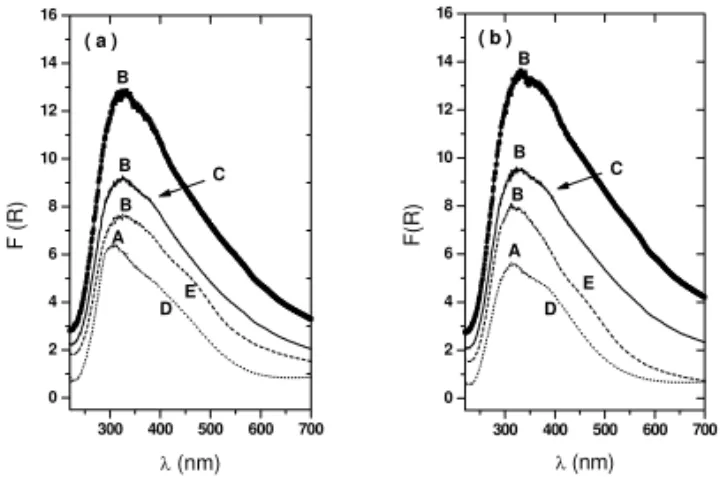
The DRS spectra of the Pd/Al2O3 and Pd/CeO2/
Al2O3catalysts, after successive cycles of treatment,
are presented in Figure 2 and 3, respectively. The Pd-Cl and Pd-acac catalysts exhibit ionic palladium species, even after reduction, as shown in bands A and B. The oxide samples present besides the band A (300 nm) the band D (400 nm), which is attributed to the transition band d-d of palladium, according to the literature (Tessier et al. 1992, Rakai et al. 1992). After treatment of the reduced samples with inert gas and oxygen, both in the presence of water, there are two new bands appearing at C (370-380 nm) and E (450-460 nm). According to Tessier et al. (1992) these bands are associated to the formation of two types of complexes in the coordination sphere of pal-ladium, such as Pd(H2O)4+2and PdO2, respectively.
The DRS spectra of the Cl and PdCe-acac, in Figure 3, exhibit significant modifications. Besides the small intensity band relative to the pal-ladium, the band C (370-380 nm) disappeared and a new band appeared at C’ (480 nm), which is at-tributed to the formation of palladium oxide as bulk oxide, and therefore, an oxide which is less suscep-tible to the support. In addition, notice the absence of band A’ (420-430 nm), which is attributed to the transfer charge of palladium.
With CeO2the transition d-d bands are shifted
300 400 500 600 700 0 2 4 6 8 10 12 14 16
( a )
E D C A B B B F ( R )
O (nm)
300 400 500 600 700
0 2 4 6 8 10 12 14 16
( b )
C D E A B B B F( R)
O (nm)
Fig. 2 – DRS spectra after successive treatment cycles; (· · ··) oxidation, (
–
) reduction, (—
) reduction +3% H2O/He at 673K, (- - - -) reduction +3% H2O/5% O2/He at 673K. (a) Pd-Cl e (b) Pd-acac.300 450 600 750 900 1050
0 2 4 6 8 10 12 14 16
( a )
C' D' B' B' x 3 x 3 x 3 x 3 F( R)
O (nm)
300 450 600 750 900 1050
0 2 4 6 8 10 12 14 16
( b )
E' B' B' B' x 3 x 3 x 3 x 3 F(R)
O (nm)
Fig. 3 – DRS spectra after successive treatment cycles; (· · ··) oxidation, (
–
) reduction, (—
) reduction +3% H2O/He at 673K, (- - - -) reduction +3% H2O/5% O2/He at 673K. (a) PdCe-Cl e (b) PdCe-acac.(1992) it is probably a superposition of the adsorp-tion bands of the ionic and the reduced species, which cannot be disregarded and probably avoids the formation of surface of palladium complexes with chlorine.
X-ray Photoelectron Spectroscopy (XPS)
XPS results for Pd/Al2O3are displayed in Table IV,
showing that the binding energy of Pd 3d5/2changed
after successive cycles of treatment. The binding energy of Pd after reduction was 335.2 eV, in agree-ment with the literature for metallic palladium (Brun
et al. 1999). However, after oxidation of propane (O2/C3H8, R=5.0 at 673 K), it is shifted to 337.2 eV
for the Pd-Cl catalyst. The Pd-acac shifted similarly to 336.8 eV under similar reaction conditions.
The effect of water is seen comparing the line shapes. No significant difference was observed for
the Pd5/2binding energy, which was shifted towards
336.9 eV and 336.6 eV in the presence of water for Pd-Cl and Pd-acac, respectively. This value corre-sponds to a higher oxidation state of palladium than
PdO (336.3 eV), probably Pd+x, according to the
literature (Brun et al. 1999).
The XPS results for Pd/CeO2/Al2O3(Table V)
after reduction also evidence the presence of metal-lic Pd (335.4 eV), similar to the reduced Pd/Al2O3.
However, after oxidation and with water, the band shift of Pd was greater than 2.0 eV, which also
cor-responds to a higher oxidation state, probably PdO2
(338 eV). The binding energy of Pd5/2for the
PdCe-acac was 338.0 and 337.6 eV, without and with wa-ter, respectively. Similar values were obtained for PdCe-Cl.
Table IV presents the surface atomic ratio of the elements for the Pd/Al2O3catalysts. The Cl/Al ratio
is 0.004 for the catalyst with chloride precursor af-ter reduction. However, afaf-ter oxidation it increases, evidencing enrichment of chlorine at the surface and with water it decreases to 0.0115. The same occurs with the Pd-acac catalyst, which evidences that the support contains residual chlorine and was practi-cally eliminated after oxidation of propane with wa-ter, reducing their content from 0.0060 to 0.0011.
The O/Al ratio on the reduced samples was 2.07, while after reaction it increases to 2.15 and 2.16 for the precursors Pd-Cl and Pd-acac, respec-tively; thus, above the theoretical value of Al2O3
(O/Al ≥ 1.50). After oxidation with water it
in-creases slightly to 2.20 and 2.25, for Cl and Pd-acac, respectively. However, with the incorporation of CeO2, these ratios increased drastically, ranging
from 3.70 after reduction to 5.60 and 6.80 after oxi-dation, or 6.60 and 7.20 with water, for the PdCe-Cl and PdCe-acac, respectively. This is approximately
TABLE IV
Bond energy for Pd 3d5/2and atomic ratios by XPS for Pd/Al2O3.
Sample Treatment Bond Energy1 Atomic ratio
(eV) Pd/Al2 Cl/Al3 O/Al4
Pd-Cl reduced 335.2 0.0024 0.0040 2.07
C3H8/O2 337.2 0.0022 0.0150 2.15
C3H8/O2/H2O 336.9 0.0029 0.0115 2.20
Pc-acac C3H8/O2 336.8 0.0018 0.0060 2.16
C3H8/O2/H2O 336.6 0.0016 0.0011 2.25
1Pd 3d
5/2 2Al 2p 3Cl 2p 4O 1s.
TABLE V
Bond Energy for Pd 3d5/2and atomic ratios by XPS for Pd/CeO2/Al2O3.
Sample Treatment Bond Energy1 Atomic ratio
(eV) Pd/Al2 Cl/Al3 O/Al4 O/Ce5
PdCe-Cl reduced 335.4 0.05 0.29 3.70 3.10
C3H8/O2 337.8 0.22 0.18 5.60 3.30
C3H8/O2/H2O 337.6 0.23 0.12 6.60 4.10
PdCe-acac C3H8/O2 338.0 0.11 0.03 6.80 3.60
C3H8/O2/H2O 337.6 0.12 0.03 7.20 3.80
1Pd 3d
5/2 2Al 2p 3Cl 2p 4O 1s 5Ce 3d total.
This big increase of O/Al ratio and the shift of the
binding energy of Pd 3d5/2reveal the incorporation
of oxygen, suggesting storage of oxygen in the CeO2
lattice and in the palladium after the reaction cycle. Table IV and V present the Pd/Al ratio for sim-ilar conditions of treatments. After reduction the Pd/Al ratio was 0.0024 for Pd-Cl, increasing drasti-cally to 0.05 for the PdCe-Cl. After oxidation, both precursors follow the same trend, evidencing strong
modification in the Pd surface with CeO2.
DISCUSSION
The catalysts with different precursors, as shown in Fig. 1, displayed marked differences due to the
pre-cursors and the promoter CeO2. Indeed, XPS and
DRS results showed surface modifications after the reduction and oxidation reactions, which affected the nature of sites and the interaction of the palla-dium with the support, although, the dispersion was approximately equal for all precursors, with the ex-ception of the catalyst PdCe-Cl, as shown in Table I.
Burch et al. (1998) observed the effect of
chlorine on the palladium dispersion employing an alumina support. Indeed, during the oxidation of propane the water formation is responsible for the release of residual chlorine, re-dispersing Pd at the surface with the formation of oxy-chloride interme-diates (PdxOyClz), as also observed by Schmal et
formed on the catalyst recombine easily with chloride at the interface of the metal, regenerat-ing the metal sites for the propane oxidation. In fact, DRS measurements evidence the presence of
Pdx(OH)yClz and XPS results show oxi-chloride
species (PdxOyClz), as evidenced by the binding
energy of Pd 3d5/2 located between the energy of
PdO (336.3 eV) and PdCl2 (337.8 eV).
DRS results showed also the presence of
Pd(H2O)4+2 and PdO2, respectively. Rakai et al.
(1992) assert that palladium is present in square pla-nar coordination, where the formation of a palladium complex is a function of the strength of the bonding
molecule, such as O2, H2O and NH3. In addition,
DRS results evidence an electronic interaction of the Pd-Ce in the coordination sphere. Similar to the Pd/Al2O3catalysts also ionic species of Pd+xin the
reduced catalysts were observed in the presence of the promoter.
On the other hand, the XPS results before and after oxidation in the pre-chamber show a shift of the binding energy of Pd towards 337.2 eV, which is attributed to a higher oxidation state of palla-dium, according to the literature (Burch et al. 1998, Guimarães et al. 2003). This shift evidences that
metallic Pd and PdO/Pd0 interfaces coexist, which
are the active sites for the oxidation reaction (Burch et al. 1998).
XPS results for the catalysts containing CeO2
showed the same tendency, however, there is an in-dication of the formation of palladium species in a
higher oxidation state, probably PdO2(338 eV)
af-ter the oxidation of propane. Probably, the presence
of PdO2is due to oxygen transfer from the promoter
to the PdO interface, inducing the formation of new interfacial sites for the oxidation reaction.
We observed another effect of the precursor, based on Figure 1, indicating that during the oxi-dation the conversion varied with the O2/C3H8
ra-tio, and differed for each precursor. For reduction conditions, low O2/C3H8ratio, the effect of the
pre-cursor is noteworthy. Searching for an explanation, we observed through XPS analysis, that the oxygen content and in particular the O/Al and O/Ce ratios
before and after oxidation exhibited marked differ-ences with the precursors and with the presence or
absence of CeO2, which evidences excess of
oxy-gen in the lattice. According to Tables IV and V the
O/Al ratio increased 3 times with CeO2 compared
to the non-promoted catalysts. After oxidation and with the addition of water this ratio doubled and in-creased yet more for the PdCe-acac precursor. These results confirm the occurrence of redox processes and oxygen storage in the lattice, depending of the precursor. This oxygen supplies the oxygen needed for the oxidation of propane and the oxygen for the
higher oxidation sate of palladium. Moreover, CeO2
not only is a source of oxygen but also a stabilizer of the catalyst. It also affects the selectivity for hydro-gen formation in the partial oxidation, as reported previously (Guimarães et al. 2003).
CONCLUSIONS
XPS results evidence Pd0(335.2 eV) in the fresh cat-alyst. After reaction, results show PdO/Pd0interface as the main active sites, independent of the
precur-sor. Catalysts containing CeO2 showed the same
trend, indicating formation of palladium species in
the highest oxidation state, probably PdO2after the
oxidation of propane. Besides, the O/Al and O/Ce ratios evidenced an increase of oxygen storage in
the presence of CeO2, which depends of the
precur-sor. The precursor acetylacetonate favors oxygen storage.
RESUMO
Estudo da influência dos precursores sobre os catalisado-res de Pd/Al2O3promovidos com céria ancorado sobre a alumina. A oxidação do propano foi feita sob diferentes condições de alimentação sendo caracterizados os sítios superficiais por Espectroscopia Fotoeletrônica de raios X (XPS) e por Refletância Difusa em ‘‘situ’’.
propano. Além disso, as razões O/Al e O/Ce evidencia-ram um aumento de oxigênio armazenado na presença de CeO2. O precursor acetilacetonato favoreceu o armazena-mento de oxigênio na rede.
Palavras-chave: Paládio, Céria, precursores, caracteri-zação.
REFERENCES
Alexandrou M and Nix RM.1994. The growth, struc-ture and stability of ceria overlayers on Pd (111). Surf Sci 321: 47-57.
Appel LG, Eon JG and Schmal M.1998. The CO2 -CeO2interaction and its role in the CeO2reactivity. Cat Letters 56: 199-202.
Bernal S, Calvino JJ, Cauqui MA, Gatica JM, Larese C, Omil JAP and Pintado JM.1999. Some recent results on metal/support interaction effects in NM/CeO2 (NM: noble metal) catalysts. Cat Today 50: 175-206.
Brun M, Berthet A and Bertolini JC.1999. XPS, AES and Auger parameter of Pd and PdO. J Electron Spectroscopy and Related Phenomena 104: 55-60.
Burch R, Halpin E, Hayes M, Ruth K and Sulli-van JA.1998. The nature of activity enhancement for propane oxidation over supported Pt catalysts ex-posed to sulfur dioxide. Appl Cat B 19: 199-207.
Gaspar AB and Dieguez LC.2000. Dispersion stability and methylcyclopentane hydrogenolysis in Pd/Al2O3 catalysts. Appl Cat A 201: 241-251.
Guimarães AL, Dieguez LC and Schmal M.2003. Surface Sites of Pd/CeO2/Al2O3Catalysts in the Par-cial Oxidation of Propane. J Phys Chem B 107: 4311-4319.
Marécot P, Fakche A, Kellali B, Mabilon G, Pri-gent M and Barbier J.1994. Propane and propene oxidation over platinum and palladium on alumina. Effects of chloride and water. Appl Cat B 3: 283-294.
Monteiro RS, Dieguez LC and Schmal M. 2001. The role of Pd precursors in the oxidation of carbon monoxide over Pd/Al2O3and Pd/CeO2/Al2O3. Cat Today 65: 77-89.
Rakai A, Tessier D and Bozon-Verduraz F.1992. Palladium-alumina catalysts: a diffuse reflectance study. New J Chem 16: 869-875.
Ribeiro FH, Chow M and Dalla BRA.1994. Ki-netics of the Complete Oxidation of Methane over supported Palladium Catalysts. J Cat 146: 537-544.
Salasc S, Perrichon V, Primet M, Chevrier M, Mathis F and Moral N.1999. Magnetic study of the interaction of hydrogen with a Pt/CeO2-Al2O3 catalyst: influence of the presence of chlorine. Cat Today 50: 227-235.
Schmal M, Aranda DAG, Noronha FB, Guimarães AL and Monteiro RS.2000. Oxidation and reduc-tion effects of propane-oxygen on Pd-chlorine/ alumina catalysts. Cat Letters 64: 163-169.
Somorjai GA.1994. Introduction to Surface Chemistry and Catalysis. New York: J. Wiley, p. 442.