
Universidade de Brasília
Instituto de Ciências Exatas Departamento de Ciência da Computação
A Domain-Specific Modeling Approach Supporting
Technology-oriented Experiments
Eneias Cordeiro da Silva
Brasília
2018
Universidade de Brasília
Instituto de Ciências Exatas Departamento de Ciência da Computação
A Domain-Specific Modeling Approach Supporting
Technology-oriented Experiments
Eneias Cordeiro da Silva
Dissertação apresentada como requisito parcial para conclusão do Mestrado em Informática
Orientador
Prof. Dr. Vander Ramos Alves
Coorientadora
Prof.ª Dr.ª Alba Cristina Magalhães Alves de Melo
Brasília
2018
Ficha catalográfica elaborada automaticamente, com os dados fornecidos pelo(a) autor(a)
CSI586d
Cordeiro da Silva, Eneias
A Domain-Specific Modeling Approach Supporting
Technology-oriented Experiments / Eneias Cordeiro da Silva; orientador Vander Ramos Alves; co-orientador Alba Cristina Magalhães Alves de Melo. -- Brasília, 2018.
150 p.
Dissertação (Mestrado - Mestrado em Informática) --Universidade de Brasília, 2018.
1. Experimentos controlados. 2. Experimentos orientados a tecnologia. 3. Modelagem específica de domínio. 4. Linguagem específica de domínio. I. Ramos Alves, Vander, orient. II. Cristina Magalhães Alves de Melo, Alba, co orient. III. Título.
Universidade de Brasília
Instituto de Ciências Exatas Departamento de Ciência da Computação
A Domain-Specific Modeling Approach Supporting
Technology-oriented Experiments
Eneias Cordeiro da Silva
Dissertação apresentada como requisito parcial para conclusão do Mestrado em Informática
Prof. Dr. Vander Ramos Alves (Orientador) CIC/UnB
Prof. Dr. Guilherme Horta Travassos Prof. Dr. Rodrigo Bonifácio de Almeida
COPPE/UFRJ CIC/UnB
Prof. Dr. Bruno Luiggi Macchiavello Espinoza Coordenador do Mestrado em Informática
Dedicatória
Dedico este trabalho ao meu pai Agenor (in memorian) e à minha mãe Regina. Aos meus irmãos Narciso, Dorotéia, Aline, Raquel, Jonas e Joel. À minha esposa Diesse, ao meu filho Emmanuel e à minha filha Sophia.
Agradecimentos
À Diesse, minha esposa, e ao Emmanuel, meu filho, pelo apoio incondicional e também pela paciência em compreender os momentos de ausência. Agradeço também por me incentivarem nos momentos de desânimo.
Aos meus pais Agenor (in memorian) e Regina, e aos meus irmãos Narciso, Dorotéia, Aline, Raquel, Jonas e Joel, por terem sido meus primeiros professores e por servirem de exemplo de dedicação aos estudos.
Ao meu orientador, Prof. Vander Alves, pelos ensinamentos e pela valiosa orientação ao longo da pesquisa, sempre me desafiando a ir mais além. Estendo também os agradeci-mentos à minha coorientadora Prof.a Alba Alves de Melo pelas valorosas contribuições.
Ao Alessandro Leite, que participou intensamente desde o início do projeto com o apoio ao uso do Dohko, o que enriqueceu consideravelmente o trabalho. Agradeço também ao Prof. Rodrigo Ribeiro, pelas contribuições em relação à formalização, e ao Prof. Eduardo Nakano, pelas contribuições em relação à análise estatística.
À Fundação de Apoio à Pesquisa do Distrito Federal (FAPDF), pelo apoio na reali-zação da visita técnica ao Departamento de Ciência da Computação e Matemática da Universidade de Passau, Alemanha. Agradeço também ao Prof. Sven Apel pela recepção durante a visita técnica e pelas preciosas contribuições ao trabalho.
Aos colegas de orientação André Lanna, Thiago Castro, Ricardo Lima e Junier Amorim, pela inspiração de seus trabalhos e pelos comentários e sugestões sempre muito úteis.
Aos membros da banca, Prof. Guilherme Travasos e Prof. Rodrigo Bonifácio, pelas sugestões e críticas que contribuíram para o aprimoramento do trabalho.
Ao Prodasen e ao Senado Federal, pela concessão de licença para capacitação, a qual possibilitou dedicação mais intensa na pesquisa durante o período, bem como a realização da visita técnica à Universidade de Passau.
“We should be taught not to wait for inspiration to start a thing. Action always generates inspi-ration. Inspiration seldom generates action.”
Resumo
Contexto: Experimentação é um meio de produzir mudanças controladas e medir as
variáveis envolvidas no fenômeno em estudo; experimentação deve também prover dados para suas futuras replicações. Entretanto, a condução e replicação de experimentos orientados a tecnologia (ou seja, experimentos cujos tratamentos são aplicados aos objetos por uma ferramenta computacional) sem suporte ferramental adequado é frequentemente uma tarefa que consome tempo e altamente sujeita a erros. Apesar de muitas técnicas terem sido propostas para auxiliar na condução de experimentos controlados, nenhuma delas trata simultaneamente (1) especificações executáveis de experimentos em alto nível de abstração; (2) execução de tratamentos e análise automatizadas a partir da especificação do experimento; e (3) garantias formais da corretude dos resultados de acordo com a especificação do experimento para experimentos orientados a tecnologia.
Objetivos: Os objetivos desse trabalho são os seguintes: (a) prover meios para
especificar experimentos orientados a tecnologia em alto nível de abstração; (b) possibilitar execução e análise automatizadas dessas especificações; e (c) apresentar um modelo formal da nossa abordagem e propriedades de corretude essenciais.
Método: Nós usamos uma abordagem Domain-Specific Modeling (DSM) para criar
uma ferramenta baseada em Web compreendendo uma Domain-Specific Language (DSL), geradores de scripts de execução e de análise, um framework de suporte e uma infraestrutura de execução. Um experimentador usa a DSL para especificar um experimento usando conceitos do domínio de experimentação. A partir dessa especificação, as aplicações correspondentes aos tratamentos subjacentes são executadas, os resultados de execução são coletados e analisados e, finalmente, os resultados da análise são apresentados para o experimentador. Estabelecemos a consistência desses resultados em relação à especificação do experimento por meio da formalização e prova de propriedades de corretude essenciais da nossa ferramenta.
Resultados: Nós avaliamos empiricamente a solução em relação a automação por
meio da replicação de três experimentos já publicados; avaliamos também o nível de abstração por meio de uma avaliação qualitativa. Nossa avaliação empírica mostra que a DSL é expressiva o suficiente para especificar três experimentos orientados a tecnologia
selecionados e que a ferramenta de suporte pode ser usada para prover correta automação da execução e da análise a partir de especificações de experimentos orientados a tecnologia. Além disso, a DSL eleva o nível de abstração das especificações dos experimentos usando conceitos de experimentação. A prova formal de propriedades de corretude essenciais (por exemplo, corretude da geração do script de execução, otimização de recursos de execução e corretude do experimento) garante que os resultados são consistentes em relação à especificação do experimento.
Conclusão: Contribuímos com uma solução DSM e uma ferramenta correspondente
compreendendo uma DSL, geradores de scripts de execução e de análise, um framework de suporte e uma infraestrutura de execução. A avaliação empírica e formal indica que a solução oferece ao experimentador abstrações e suporte de automação adequados, o que pode auxiliar na melhoria de produtividade e confiabilidade no processo de experimentação.
Palavras-chave: Experimentos controlados, Experimentos orientados a tecnologia,
Abstract
Context: Experimentation is a means to produce controlled changes and to measure the
variables involved in the phenomena under study; experimentation must also provide data to its further replication. However, conducting and replicating technology-oriented experi-ments (i.e., experiexperi-ments in which treatexperi-ments are applied to objects by a computer-based tool) without proper tool support is often a time-consuming and highly error-prone task. Although many techniques have been proposed to help conducting controlled experiments, none of them simultaneously addresses (1) runnable specification of experiments at a high level of abstraction; (2) automated treatment execution and automated data analysis from the experiment specification; and (3) formal guaranties of the correctness of results according to an experiment specification for technology-oriented experiments.
Objective: The objectives of this work are the following: (a) provide means to specify
technology-oriented experiments at a high level of abstraction; (b) enable automated execution and automated data analysis of such specification; and (c) present a formal model of our approach and key correctness properties.
Method: We used a Domain-Specific Modeling (DSM) approach to create a Web-based tool comprising a Domain-Specific Language (DSL), execution and analysis script generators, a supporting framework, and a running infrastructure. An experimenter uses the DSL to specify an experiment using experimentation concepts. From this specification, applications corresponding to the underlying treatments are executed, execution results are collected and analyzed, and, finally, the analysis results are presented to the experimenter. We establish the consistency of such results with respect to the experiment specification by formalizing and proving of key correctness properties of our tool.
Results: We empirically evaluated the solution with respect to automation by
repli-cating three already published experiments; we evaluated also the level of abstraction by a qualitative assessment. Our empirical evaluation shows that the DSL is expressive enough to specify three selected technology-oriented experiments and that the supporting tool can be used to enable sound automation of execution and analysis from the specification of technology-oriented experiments. In addition, the DSL raises the level of abstraction of experiment specifications by using experimentation concepts. The formal proof of key
correctness properties (e.g., execution script generation soundness, execution resource optimization, and experiment soundness) assures that the results are consistent with the experiment specification.
Conclusion: We contribute a DSM approach and corresponding tool comprising
a DSL, execution and analysis script generators, a supporting framework, and a running infrastructure. The empirical and formal assessment indicate that the contribution provides the experimenter with proper abstractions and automation support, which can help to improve productivity and reliability on the experimentation process.
Keywords: Controlled experiments, Technology-oriented experiments, Domain-specific
List of Figures
3.1 Illustration of an experiment (adapted from Wohlin et al. [2012]). . . 15
3.2 Experiment Process (adapted from Wohlin et al. [2012]). . . 17
3.3 Autonomic properties implemented by Dohko [Leite et al., 2016] . . . 25
4.1 Proposed DSM-based solution . . . 28
4.2 Supporting Framework Interactions . . . 43
5.1 DSL Editor . . . 46
5.2 Generate and Run command . . . 47
5.3 Execution Status . . . 47
5.4 Excerpt of an Analysis Report . . . 48
5.5 Tool Components . . . 49
7.1 Results of Optimization Comparison [Bak and Duggirala, 2017] . . . 60
7.2 Results of replicating Experiment 1 . . . 60
7.3 Relative differences between replications with and without the tool for Experiment 1 . . . 61
7.4 Relative differences between replications with and without the tool for Experiment 2 . . . 64
7.5 Relative differences between replications with and without the tool for Experiment 3 . . . 66
List of Tables
7.1 Results of Model counting SMC-Big and SMC-Small [Brennan et al.,2017] 62
7.2 Effect of transformations on orbit refinement [Brennan et al.,2017] . . . . 62
7.3 Results of Model counting SMC-Big and SMC-Small (replication) . . . 63
7.4 Effect of transformations on orbit refinement (replication). . . 63
7.5 Results of SPF-based quantitative analyses of string programs [Brennan et al., 2017] . . . 65
7.6 Results of SPF-based quantitative analyses of string programs (original scripts). . . 65
7.7 Results of SPF-based quantitative analyses of string programs (tool). . . . 67
7.8 Comparison between DSL constructs and Domain Concepts (high-level constructs). . . 72
7.9 DSL mid-level constructs . . . 72
List of Definitions
1 Definition (Experiment specification well-formedness) . . . 29
2 Definition (Execution script well-formedness) . . . 30
3 Definition (Infrastructure semantics) . . . 33
4 Definition (Analysis script well-formedness) . . . 36
List of Properties
1 Property (Execution script generation well-formedness) . . . 30
2 Property (Execution script generation soundness) . . . 32
3 Property (Execution resource optimization) . . . 33
4 Property (Analysis script generation well-formedness) . . . 36
Acronyms
ANTLR ANother Tool for Language Recognition. AST Abstract Syntax Tree.
CAV International Conference on Computer Aided Verification. CRAN Comprehensive R Archive Network.
CTAN Comprehensive TEX Archive Network.
DSL Domain-Specific Language. DSM Domain-Specific Modeling.
EMF Eclipse Modeling Framework.
eSEE experimental Software Engineering Environment.
FSE Joint Meeting on Foundations of Software Engineering.
Ginpex Goal-oriented INfrastructure Performance EXperiments.
HPC High Performance Computing.
IDE Integrated Development Environment.
MWE2 Modeling Workflow Engine 2.
SESE Simula Experiment Support Environment.
Contents
List of Figures xi
List of Tables xii
List of Definitions xiii
List of Properties xiv
Acronyms xv 1 Introduction 1 1.1 Problem Statement . . . 2 1.2 Proposed Solution. . . 3 1.3 Main Contributions . . . 4 1.4 Outline. . . 5 2 Motivation 6 3 Background 13 3.1 Experimentation . . . 13 3.1.1 Experimentation Concepts . . . 14 3.1.2 Experimentation Process . . . 16
3.1.3 Data Analysis and Presentation Tools. . . 18
3.2 Domain-Specific Modeling . . . 19
3.2.1 Domain Specific Modeling Architecture . . . 20
3.2.2 DSL Implementation . . . 21
3.3 Running Infrastructures . . . 22
3.3.1 Docker Containers . . . 23
4 Method 26
4.1 Overview. . . 26
4.2 The DSL . . . 27
4.3 Experiment Execution Script Generation and Experiment Execution . . . . 29
4.4 Analysis Script Generation and Analysis . . . 34
4.5 Running Infrastructure . . . 42 4.6 Supporting Framework . . . 42 5 Tool Support 44 5.1 Functional View . . . 44 5.2 Architecture . . . 46 5.3 Implementation . . . 49 6 Preliminary Evaluation 54 6.1 Execution and Analysis Automation. . . 54
6.1.1 Evaluation Method . . . 54
6.1.2 Experiments Selection . . . 55
6.2 Level of Abstraction . . . 58
6.2.1 Evaluation Method . . . 58
7 Results and Analysis 59 7.1 Execution and Analysis Automation. . . 59
7.2 Level of Abstraction . . . 67
7.2.1 Experiment Specifications . . . 68
7.2.2 DSL Constructs . . . 71
7.3 Discussion and Lessons Learned . . . 73
7.4 Threats to Validity . . . 74 8 Conclusion 76 8.1 Limitations . . . 77 8.2 Related Work . . . 77 8.3 Future Work . . . 81 References 82 A DSL Grammar 88 B DSL Validators 97 C Generators 101
Chapter 1
Introduction
Empirical research is based on observations of or experimentation with real-world phenom-ena and its measurable changes. Experimentation is a means to produce controlled changes and to measure the variables involved in the phenomena under study. Experimentation provides further data so that other researchers can replicate original experiments and verify the results [Juristo and Moreno,2013].
The purpose of controlled experiments is to conduct studies under strictly controlled conditions. The objective is to manipulate one or more variables and to check the effects on dependent variables. In controlled experiments, quantitative data are collected, and statistical analyses are performed [Juristo and Moreno, 2013; Wohlin et al., 2012]. Experiments can be human-oriented or technology-oriented. In the former, a person applies treatments to objects, whereas, in the latter, treatments are applied to objects by a computer-based tool [Wohlin et al., 2012].
Technology-oriented experiments are important not only in software engineering but also in other research fields, such as Bioinformatics, Engineering, Physics, and Chemistry [Chen and Chang, 2017; Houben and Lapkin, 2015; Pavlov et al., 2014; Tabatabaei, 2016]. Technology-oriented experiments can be used in several ways. First, software can be used to evaluate methodologies or approaches [Medeiros et al., 2016]. Moreover, software can be used in simulation based studies [Banks, 1999]. For example, in Engineering, systems can be simulated by using software to avoid the costs of building real systems [Tabatabaei,
2016]. In some studies, (e.g., use and occupation of the soil), evaluations cannot be performed in real-world, so they need to use simulations [Ralha et al., 2013]. Furthermore, software can also be used together with physical instruments. For example, Chemistry and Physics laboratories can have instruments connected to computers to automate experiments [Houben and Lapkin,2015;Pavlov et al.,2014]. In this work, we focus on such technology-oriented experiments and hereafter use experiments to refer to this context, which includes not only in silico simulation based studies [Travassos and Barros, 2003]
but also experiments that evaluate algorithms or computer-based tools. For example,
Lanna et al. [2018] presented a novel feature-family-based analysis strategy to compute the reliability of all products of a software product line. To evaluate their strategy, the authors created a tool named ReAna1 and used it to compare the performance of different reliability analysis strategies for software product lines.
1.1
Problem Statement
Conducting an experiment is often a complex and time-consuming task. Since experi-mentation involves many steps, such as goal definition, planning, execution, analysis, and packaging, all steps must be performed in a systematic and consistent way to achieve a replicable experiment and valid results [Juristo and Moreno, 2013; Wohlin et al., 2012]. In addition, since the scale of scientific problems has been increasing, this is reflected not only on data size but also on the complexity of the computer-based tools required to investigate such problems [Sonntag et al., 2010; Zhao et al., 2011]. Thus, such tools must run in an infrastructure that provides computing power, data storage, and network resources. However, deploying and executing applications in such infrastructure (e.g., a cloud computing infrastructure) are complex tasks and require advanced computational skills [Kephart and Chess, 2003]. Likewise, data analysis requires knowledge on statistics so that results can be correctly analyzed and interpreted. Therefore, conducting and replicating controlled experiments is an error-prone task.
First, experiments are usually specified in natural language. Since specifications in natural language are not runnable, one has to code such specification into a general purpose programming language (e.g., scripting languages). These specifications are at a low level of abstraction, though.
Problem 1
An experimenter needs to deal with different levels of abstraction while specifying an experiment and writing execution and analysis scripts. High-level specifications are usually in natural language and are not runnable, whereas runnable specifications are usually written in general purpose languages, at a low-level of abstraction.
Second, to execute applications related to the treatments defined for the hypotheses of the experiment, execution scripts have to be manually written. This is often time-consuming and requires knowledge on a general purpose programming language. In addition, there may be inconsistencies between the experiment specification and its execution script. Also
data analysis is often complex, time-consuming, and requires knowledge on statistics so that results can be correctly analyzed and interpreted.
Problem 2
An experimenter needs to manually create the execution and the analysis scripts.
Furthermore, although there are empirical evidences, none of the existing solutions provide formal evidences of the correctness of results provided by their approaches. With correct results we mean that the results of the overall experimentation process are consistent with the experiment specification.
Problem 3
In the context of technology-oriented experiments, there is a lack of formal evidence of the correctness of results in relation to the experiment specification.
There is a number of approaches supporting experiment conduction and replication, focusing on distinct phases of the experimentation process, and supporting human-oriented or technology-oriented experiments (Section 8.2). Although these approaches help in conducting controlled experiments, none of them simultaneously addresses runnable specification of experiments at a high level of abstraction; automated treatment execution and automated data analysis from the experiment specification; and formal guaranties of the correctness of results for technology-oriented experiments. The lack of proper tool support may lead not only to extra time or resources consumption but also to incorrect results.
1.2
Proposed Solution
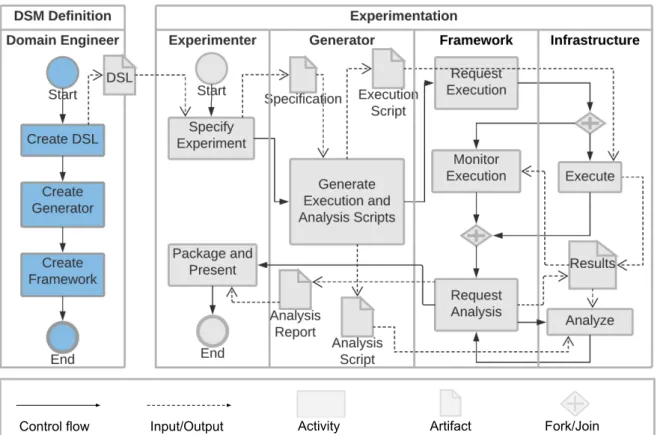
To address this issue, we propose a Domain-Specific Modeling (DSM) approach [Kelly and Tolvanen,2008] supporting technology-oriented experiments. The approach is implemented as a Web-based tool and comprises a Domain-Specific Language (DSL), execution and analysis script generators, a supporting framework, and a running infrastructure. The DSL empowers researchers to specify experiments using experimentation concepts. An experi-mentation concept is a concept that is directly related to the experiexperi-mentation domain (e.g., experimental design, treatment, experimental object, dependent variable). Execution and analysis scripts are automatically generated from the specification. Next, applications (i.e., computer-based tools) related to the treatments defined in the research hypotheses of the
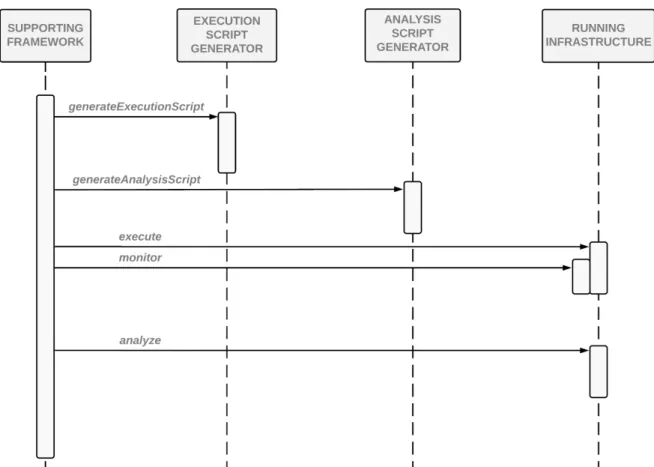
experiment are executed by the infrastructure, and results are then collected and analyzed by the previously generated analysis script. Finally, an analysis report is presented to the experimenter. The supporting framework integrates all the components and interacts with the running infrastructure to start and monitor execution, and also to analyze the results. The whole procedure of generating execution and analysis scripts, executing, and analyzing an experiment from an experiment specification has been formally specified, and key correctness properties have been stated. The formal proof of these properties assures the correctness of results according to the experiment specification.
We evaluated the proposed solution with respect to level of abstraction, automation, and correctness. To show that our DSL raises the level of abstraction of experiment specifications, we evaluated it by an analytical comparison between DSL concepts and experimentation concepts and by comparing the level of abstraction of experiment specifi-cations across different studies. Although the experimenter must learn a new language, the results suggest that the use of our DSL raises the level of abstraction of experiment specifications. By comparing the DSL constructs with domain concepts, we found that 54.35% are high-level constructs, 15.22% are mid-level constructs, and 30.43% are low-level constructs. To show that our tool can automate execution and analysis, we replicated three already published experiments using our tool. The results suggest that the DSL is expressive enough to specify technology-oriented experiments and that the proposed tool can be used to enable sound automation of execution and analysis from the specification of technology-oriented experiments. Finally, we assured correctness by proving key formal properties of the formal specification.
1.3
Main Contributions
In summary, we make the following contributions:
• We present a Domain-Specific Modeling (DSM) approach that supports technology-oriented experiments (Chapter 4), comprising a DSL (Section 4.2), execution and analysis script generators (Sections4.3and4.4), a running infrastructure (Section4.5), and a supporting framework (Section 4.6).
• We present a Web-based tool that implements the DSM approach (Chapter 5), providing a means to specify runnable experiment specifications at a high level of abstraction; automated execution, data analysis, and results presentation.
• We empirically evaluate the practical applicability of the tool to provide automation in the experimentation process and its level of abstraction (Sections 6.1 and 6.2).
• We present a formal model of the whole procedure and proofs of correctness (Chap-ter 4).
1.4
Outline
The remainder of this work is organized as follows:
• Chapter 2presents the motivation of the work and a further discussion about the problem statement.
• Chapter3lays conceptual foundations for the proposed research. We present concepts regarding Experimentation (Section 3.1),Domain-Specific Modeling (Section 3.2), and Running Infrastructures (Section 3.3).
• Chapter 4 presents the method, comprising a DSL (Section 4.2), execution and analysis script generators (Sections4.3and4.4), a running infrastructure (Section4.5), and a supporting framework (Section 4.6).
• Chapter5presents a Web-based tool that implements the DSM approach presented in Chapter4. We present its functional view (Section5.1), its architecture (Section 5.2), and its implementation (Section 5.3).
• Chapter6presents a preliminary evaluation of automation (Section 6.1) and level of abstraction (Section 6.2).
• Chapter 7 presents and analyzes the results of the evaluation of automation (Sec-tion 7.1) and level of abstraction (Section7.2). It also presents the discussions and lessons learned (Section 7.3), as well the threats to validity (Section 7.4).
• Finally, Chapter 8 presents the conclusions, as well the limitations (Section 8.1), related work (Section 8.2), and future work (Section 8.3).
Chapter 2
Motivation
As mentioned previously, conducting an experiment is often a complex, time-consuming, and error-prone task. This complexity is inherent in all phases of the experimentation pro-cess. Validity and replicability must be addressed from the earliest phases onwards [Juristo and Moreno, 2013; Wohlin et al.,2012].
Definition and planning are critical phases. Indeed, an experiment correctly designed can gather much information from fewer executions, whereas an incorrect design can lead to extra time and resource consumption or even invalidate the results of the experiment [Juristo and Moreno,2013;Wohlin et al.,2012]. Worse, experiments are usually specified in natural language, which may lead to ambiguity, inconsistency, and lack of information [Ciolkowski,
2012]. Specifications in natural language are not executable, therefore one has to code such specification into a general purpose programming language (e.g., a scripting language). These specifications are then at a low level of abstraction, though. In the context of technology-oriented experiments, ambiguity, inconsistency, and lack of information of natural language specifications may hamper not only the coding of low-level scripts but also future replications of the experiment.
For instance,Bak and Duggirala [2017] presented a technique to perform simulation-equivalent reachability and safety verification of linear systems with inputs. To evaluate their proposal, they created a tool named Hylaa (HYbrid Linear Automata Analyzer). Their experiment was specified, executed, and measured using Python scripts1. Plots were generated by Gnuplot. Listing 2.1 presents an excerpt of the corresponding execution script in Phyton.
In one of their evaluations, the authors examined the effects of optimizations for computing reachability for linear-time invariant systems with inputs. Optimizations, which correspond to treatments, are defined in Lines 11 to 20. In fact, each optimization is defined by appending distinct parameters to the tool (Lines 13 and 18). To measure
runtime, each optimization is applied to the input file (io.xml). In addition, the number of steps in the problem is varied by changing the step size. Thus, each step size used to run the tool corresponds to an experimental object. The first experimental object is defined by step_sizevariable (Line 24). The following objects are defined in Line 36 inside a loop (Line 26) until the timeout is reached (Line 33). Each treatment is applied to an experimental object in Line 32. This is executed inside a loop (Line 31), which is repeated the number of times defined in the variable num_trials (Line 10).
Likewise, Lanna et al. [2018] used Python scripts to perform an experiment comparing the performance of different reliability analysis strategies for software product lines. An excerpt of the experiment execution script2 is presented in Listing2.2. The loop in Line
6 iterates over treatments (strategy) and experimental objects (spl). Each treatment is applied to each object (Line 11). This execution is repeated the number of times defined in number_of_runs(Line 25).
Although this approach to conducting an experiment works in both of the aforemen-tioned studies, there are limitations. First, the execution scripts have to be written. This is often time-consuming and requires knowledge on a general purpose programming language, so the experimenter, in this case, should also be a programmer, which is not always the case. As a result, experimentation concepts are not clearly defined, which hampers their understanding and future replications of the experiment. Although variable names may help, there is no standard way to define experimentation concepts, such as treatments, experimental objects, and the number of tests to run. For instance, num_trials in List-ing 2.1and number_of_runsin Listing2.2 were used to represent the same concept. Second, there may be inconsistencies between the experiment specification and its execution script. A treatment or an object could be repeated, resulting in unnecessary executions, or a parameter could be incorrectly assigned to a treatment, resulting in wrong results. For example, parameters assigned to the treatment Warm (Line 18, Listing 2.1) could be incorrectly assigned to the treatment Hylaa (Line 13). Finally, there are unexplored commonalities between scripts of distinct experiments, such as treatments, objects, and dependent variables definitions, not to mention the application of treatments to objects and the repetition of executions. This results in development of similar scripts with duplicated code for distinct experiments, which could be error-prone and time-consuming.
Also data analysis is often complex, time-consuming, and requires knowledge on statistics. Statistics is used to discover and to understand relationships between variables. Significance tests are used to check whether the differences observed in collected data are statistically significant [Juristo and Moreno, 2013]. A series of parametric and non-parametric analysis methods can be used in significance testing. Although non-parametric
Listing 2.1: Excerpt of an execution script in Python [Bak and Duggirala, 2017]
1 def main ():
2 '''main function ''' 3 measure ()
4 plot (" opt_comparison . gnuplot ") 5 plot (" tool_comparison . gnuplot ") 6
7 def measure ():
8 '''run the measurements ''' 9 timeout_secs = 15
10 num_trials = 10
11 tools . append ('hylaa ') 12 labels . append ('Hylaa ')
13 tool_params . append ('-settings settings . print_output = False ') 14 input_xml . append ('io. xml ')
15
16 tools . append ('hylaa ') 17 labels . append ('Warm ')
18 tool_params . append ('-settings settings . print_output = False ' +
19 'settings . opt_decompose_lp = False ')
20 input_xml . append ('io. xml ') 21 for i in xrange(len( tools )):
22 tool = tools [i]
23 with open('out / result_ {}. dat '.format( label ), 'w') as f:
24 step_size = 0.2 25 26 while True : 27 timeout = False 28 total_secs = 0.0 29 measured_secs = [] 30
31 for _ in xrange( num_trials ):
32 res = e. run ( print_stdout =True , run_tool = True ) 33 if avg_runtime > timeout_secs :
34 break
35
Listing 2.2: Excerpt of an execution script in Python [Lanna et al., 2018]
1 def run_all_analyses ( number_of_runs , in_results ):
2 '''
3 Runs all analyses for all SPLs and returns an AllStats object .
4 '''
5 all_stats = []
6 for (spl , strategy ), command_line in CONFIGURATIONS . iteritems ():
7 try:
8 name = strategy + " ("+ spl +")"
9 print name
10 print " ---"
11 stats = run_analysis (spl , strategy , command_line , number_of_runs )
12
13 all_stats . append ( stats )
14 print " Flushing data to replay "
15 replay . save ( AllStats ( all_stats ), in_results ) 16 test_hypotheses ( AllStats ( all_stats ))
17 print " ==================================== "
18 except:
19 print " Unexpected error :",
sys . exc_info () [0] , sys . exc_info () [1]
20 traceback . print_tb ( sys . exc_info () [2] , limit =None , file= None ) 21 print " Error running analysis "
22
23 return AllStats ( all_stats )
24 def run_analysis (spl , strategy , command_line , number_of_runs ): 25 data = [ _run_for_stats ( command_line ) for i in
xrange( number_of_runs )]
Listing 2.3: Excerpt of a Gnuplot configuration file [Bak and Duggirala, 2017]
1 plot \
2 " out / result_Basic . dat " with linespoints title " Basic " ls 1, \ 3 " out / result_Warm . dat " with linespoints title " Warm " ls 2 pi -1, \ 4 " out / result_Decomp . dat " with linespoints title " Decomp " ls 3, \ 5 " out / result_Hylaa . dat " with linespoints title " Hylaa " ls 4 pi -1, \ 6 " out / result_NoInput . dat " with linespoints title " NoInput " ls 5, \
models can be more useful, they make stronger assumptions. Collected data must be consistent with the assumptions made by the method. Misusing an analysis method can lead to wrong results and, thus, affect the validity of the experiment [Rosenberg, 2008;
Singer et al., 2008].
To make this point clearer, a Gnuplot configuration file is presented in Listing 2.3. This file is used to plot experiment results from data files, which are then used to draw the conclusions of the experiment. Since this file is manually created, it may contain wrong correspondences between treatments and execution results. In addition, there may be inconsistencies between the execution script presented in Listing 2.1 and the Gnuplot file presented in Listing 2.3. For instance, each Line from 2 to 6 relates a title to the corresponding execution results. However, a title could be misassigned to a result file, what would lead to a wrong interpretation and thus incorrect results.
Another example is presented in Listing 2.4. Lanna et al. [2018] used this script3
not only to generate plots but also to perform statistical analysis. To create this script, some knowledge on statistics was necessary. Its purpose is to check whether two data samples are significantly different. To make this comparison, either a non-parametric Mann-Whitney test or a parametric T-test can be applied. The script first checks if the assumptions made by the parametric test are met, and then apply the corresponding test. An error in this script, for instance, usingp ≤SIGNIFICANCE instead of p ≥SIGNIFICANCE in
Line 30 would lead to the use of a parametric test when it should not be used, and, thus, invalidate the results.
Listing 2.4: Excerpt of a Python analysis script [Lanna et al., 2018]
1 def _compare_samples ( sample1 , sample2 ):
2 '''
3 Returns -1 if sample2 is higher , +1 if sample1 is higher or 0 if
they are
4 not significantly different .
5 '''
6 mean1 = mean ( sample1 ) 7 mean2 = mean ( sample2 )
8 gain = max(mean1 , mean2 )/min(mean1 , mean2 ) 9
10 if not _is_normally_distributed ( sample1 ) or not _is_normally_distributed ( sample2 ):
11 normality = " Not all are normal "
12 are_equal , details = _non_normal_are_equal ( sample1 , sample2 )
13 else:
14 normality = " All are normal "
15 are_equal , details = _normal_are_equal ( sample1 , sample2 ) 16
17 if not are_equal :
18 result = mean1 - mean2
19 else: 20 result = 0 21 aggregated_details = ( normality , 22 details , 23 {" mean 1": mean1 , 24 " mean 2": mean2 , 25 " gain ": str( gain ) + "x"}) 26
27 return result , aggregated_details 28 def _is_normally_distributed ( sample ): 29 w, p = normaltest ( sample )
30 return p ≥ SIGNIFICANCE
31 32
33 def _non_normal_are_equal ( sample1 , sample2 ): 34 u, p = mannwhitneyu ( sample1 ,
35 sample2 ,
36 use_continuity = False )
37 return p ≥ SIGNIFICANCE , ("Mann - Whitney ", {"U": u, "p- value ": p})
38 39
40 def _normal_are_equal ( sample1 , sample2 ):
41 equal_vars = _variances_are_equal ( sample1 , sample2 )
42 are_equal , details = _test_normal_equality ( sample1 , sample2 , equal_vars )
43 return are_equal , details 44
45 def _variances_are_equal ( sample1 , sample2 ): 46 stat , p = bartlett ( sample1 , sample2 ) 47 return p ≥ SIGNIFICANCE
48
49 def _test_normal_equality ( sample1 , sample2 , equal_variances ):
50 stat , p = ttest_ind ( sample1 , sample2 , equal_var = equal_variances ) 51 method = "T- test " if equal_variances else " Welch "
52 return p ≥ SIGNIFICANCE , ( method , {" statistic ": stat , "p- value ": p})
Conducting experiments without proper tool support to automatically generate execu-tion and analysis scripts is often a highly time-consuming and error-prone task. Although some techniques provide support in conducting controlled experiments (Section 8.2), none of them simultaneously provide from a specification at a high level of abstraction automated generation of execution and analysis scripts for technology-oriented experiments.
Finally, none of the existing solutions to support technology-oriented experiments provide formal evidence of the correctness of results they produce. With correct results we mean that the results of the overall experimentation process are consistent with the experiment specification. That is, analysis is evaluating execution results that actually correspond to the hypotheses defined in the experiment specification, using a suitable analysis procedure and the correct parameters. For instance, execution results could be misassigned to the underlying treatments of the hypotheses, or analysis could misplace the execution results in the analysis test, or even use an unsuitable analysis function. Either case, would lead to incorrect results. Thus, there is still a lack of formal guaranties of the correctness of results with respect to the experiment specification.
In the context of technology-oriented experiments, there is a lack of tool support simultaneously addressing (1) runnable specification of experiments at a high level of abstraction; (2) automated treatment execution and automated data analysis from the experiment specification; and (3) formal guaranties of the correctness of results according to an experiment specification.
Chapter 3
Background
To better understand the problem and the proposed solution, it is useful to bear in mind concepts regardingExperimentation (Section3.1), Domain-Specific Modeling(Section 3.2), and Running Infrastructures (Section 3.3). In what follows, we lay these conceptual foundations for the proposed research.
3.1
Experimentation
Scientific research is a process of directed learning that follows an inductive-deductive process. In the inductive step, from observations of the reality, an initial model, theory or hypothesis is created. This model is then, in the deductive step, checked against the reality through observation or experimentation. When the collected data and the model fail to agree, the discrepancy can lead, by induction, to modifications in the model, and another iteration can be initiated. Experimentation is a means to produce controlled changes and to measure the variables involved in the phenomena under study. Experimentation also produces data so that other researchers can replicate the experiment and verify the results [Box et al., 2005;Juristo and Moreno, 2013].
Empirical studies can be classified as qualitative or quantitative. Qualitative studies, or exploratory studies, aim to study objects in their natural setting and let the findings emerge from the observations. In contrast, quantitative studies, or explanatory studies, aim to get a numerical relationship between several variables or alternatives under examination. In addition, quantitative studies promote comparisons and statistical analysis [Juristo and Moreno, 2013; Wohlin et al., 2012].
Empirical studies include surveys, controlled experiments, and case studies. Surveys are used to identify the characteristics of a broad population. Surveys can be conducted by using questionnaires, structured interviews, or data logging. However, surveys provide no control of the execution or the measurement. The purpose of controlled experiments is
to conduct studies under strictly controlled conditions. The objective is to manipulate one or more variables and check the effects on dependent variables. In controlled experiments, quantitative data are collected, and statistical analyses are performed. In circumstances where the subjects cannot be randomly assigned to the treatments, quasi-experiments can be conducted. Case studies are done by observation of an ongoing project or activity in its real-life context in situations where the context is expected to play a central role or where the effects are expected to take a long time to appear. In these cases, controlled experiments would be inappropriate. However, in study cases, data collection and analysis are more open to interpretation and researcher bias [Easterbrook et al., 2008;Juristo and Moreno, 2013; Wohlin et al., 2012].
Travassos and Barros [2003] presented a four-staged taxonomy to classify empirical studies in software engineering:
• In vivo: such experiments involve people in their own environments. In Software Engineering, in vivo studies are executed in software development organizations throughout the development process and under real conditions and under real circumstances;
• In vitro: such experiments are executed in a controlled environment, such as a labo-ratory or a controlled community. Most in vitro studies are executed in universities, research centers or among selected groups of software development organizations; • In virtuo: such experiments involve the interaction among participants and a
com-puterized model of reality. The behavior of the environment with which subjects interact is described as a model and represented by a computer program. In Soft-ware Engineering, these studies are usually executed in universities and research laboratories characterized by small groups of subjects manipulating simulators; • In silico: such experiments are characterized for both the subjects and real world
being described as computer models. The environment is fully composed by numeric models with no human interaction.
In this work, we focus on technology-oriented experiments, which includes not only
in silico simulation based studies but also other experiments that evaluate algorithms or
computer-based tools.
3.1.1
Experimentation Concepts
We may use an experiment to evaluate our beliefs, i.e., to test a theory or hypothesis. The starting point is that we have an idea of a cause and effect relationship, which we are able
to state formally in a hypothesis. Experiments are launched when we want control over the situation and want to manipulate behavior directly, precisely and systematically to compare the outcomes. Experiments may be oriented or technology-oriented. In human-oriented experiments, humans apply different treatments to objects, whereas in technology-oriented experiments, typically different tools are applied to different objects [Wohlin et al.,
2012].
To better understand the experimentation process, it is useful to bear in mind some experimentation concepts. Some of them are also despicted in Figure 3.1.
Independent variables ... Experiment design ... Independent variables with fixed levels
Process Dependent
variable Experiment
Treatment
Figure 3.1: Illustration of an experiment (adapted from Wohlin et al. [2012])
Experimental subject. In human-based experiments, is the person who applies
the methods or techniques to experimental objects. In contrast, in technology-based experiments, experimental subject is usually the software that applies treatments to experimental objects [Juristo and Moreno,2013;Wohlin et al.,2012].
Experimental Object Or experimental unit. The objects on which the experiment is run [Juristo and Moreno, 2013; Wohlin et al., 2012].
Example. We want to study the effect of a new development method on the productivity
of the personnel. We may have chosen to introduce an object-oriented design method instead of a function-oriented approach. The objects are the programs to be developed and the subjects are the personnel [Wohlin et al.,2012].
Independent Variable. All variables in a process that are manipulated and controlled
are called independent variables [Wohlin et al., 2012].
Dependent Variable. Or response variable, is the outcome of an experiment that we want to study to see the effect of the changes in some input [Juristo and Moreno, 2013;
Wohlin et al., 2012].
Example. The dependent variable in the previous example experiment is the productivity. Independent variables may be the development method, the experience of the personnel,
Factor. The factors of an experiment are any characteristics that are intentionally
varied during experimentation to examine their influence on the dependent variable [Juristo and Moreno, 2013; Wohlin et al.,2012].
Treatment. Or alternative, or level. A treatment is one particular value of a factor.
This means that each treatment of a factor is an alternative for that factor [Juristo and Moreno, 2013; Wohlin et al., 2012].
Example. The factor for the example experiment above, is the development method
since we want to study the effect of changing the method. We use two treatments of the factor: the old and the new development method [Wohlin et al.,2012].
Parameter. The independent variables that are controlled at a fixed level during the
experiment to set a controlled environment. These are characteristics that we do not want to investigate but may influence the result of the experiment [Juristo and Moreno, 2013;
Wohlin et al., 2012].
Elementary experiment. Or tests, or trials. A combination of treatment, subject
and object [Juristo and Moreno, 2013; Wohlin et al., 2012].
Example. A test can be that person N (subject) uses the new development method
(treatment) for developing program A (object). [Wohlin et al.,2012]
Experiment Design. A design of an experiment describes how the tests are organized
and run. The designs range from simple experiments with a single factor to more complex experiments with many factors or treatments [Wohlin et al.,2012].
3.1.2
Experimentation Process
Conducting an experiment is a complex and time-consuming task. The experimenter has to prepare, conduct, and analyze experiments properly. A process provides support in setting up and conducting an experiment [Juristo and Moreno,2013;Wohlin et al.,2012]. In what follows, we describe an experimentation process (Figure 3.2). Although this process is described for controlled experiments, it could be adapted to other empirical strategies. The phases of the process are: scoping (definition); planning; operation (execution); analysis and interpretation; and presentation and package.
In scoping, or definition phase, the experimenter describes the goals of the experiment, i.e., what the experiment aims to investigate and its motivation. The goal is formulated from the problem to be solved. Then, a hypothesis is clearly defined in terms of what variables are going to be examined [Juristo and Moreno,2013; Wohlin et al.,2012].
In planning phase, the hypothesis is formally stated, including a null hypothesis and an alternative hypothesis. The context is thoroughly defined and variables and scales of measure are determined. Next, the experimental design is defined. This design defines an
Experiment idea Experiment scoping Experiment planning Experiment operation Analysis & interpretation Presentation & package Experiment report
Figure 3.2: Experiment Process (adapted fromWohlin et al. [2012])
In addition, design defines how many tests are going to be run [Juristo and Moreno, 2013;
Wohlin et al., 2012].
Design and analysis are closely related since the statistical analyses that are going to be applied depend on the chosen design and measurement scales defined in design. In the same way, to design an experiment, the experimenter has to take into account which statistical analysis must be performed to reject the null hypothesis [Juristo and Moreno,
2013; Wohlin et al., 2012].
The plan must consider validity of the results. Easterbrook et al. [2008] classifies validity as construct validity, internal validity, external validity, and reliability. Construct validity focuses on whether the theoretical constructions are correctly interpreted and measured. Internal validity focuses on the design and whether the results actually follow the data. External validity is related to the generalization of the results. Finally, reliability is related to bias in the research. Independent researchers repeating the experiment must yield the same results.
Planning phase is crucial to provide further replications of the experiment. In addition, there are several types of replication. Despite the use of the term replication with distinct meanings in literature, replications usually fall into three groups: replications that vary little or not at all with respect to the reference experiment; replications that do vary but still follow the same method as the reference experiment; and replications that use different methods to verify the reference experiment results [Gómez et al., 2010]. In this work,
we use the term replication with the meaning of exact replication: “An exact replication is one in which the procedures of an experiment are followed as closely as possible to determine whether the same results can be obtained” [Shull et al., 2008].
During operation, or execution phase, the first step is to prepare the subjects, the instruments, and the material needed. Then, the subjects apply the treatments to the objects according to the experimental design, and data are collected. Finally, the collected data must be validated to make sure that they are correct and provide a valid picture of the experiment [Juristo and Moreno,2013;Wohlin et al.,2012].
In analysis and interpretation phase, data collected in execution are analyzed and interpreted. First, descriptive statistics is applied to provide a visualization of the data and help the experimenter to understand and interpret the data informally. Next, data reduction is performed, which consists in considering whether the data set should be reduced, either by removing data points or by reducing the number of variables. After that, based on the design and on the nature of the data, hypothesis tests are performed. Finally, results are interpreted [Juristo and Moreno,2013;Wohlin et al.,2012].
Presentation and package is the documentation and presentation of the results. It can be done in a paper, in a technical report, or in a package for replication of the experiment, depending on the purpose of the experiment. A common problem is that experiments are poorly or heterogeneously reported [Jedlitschka et al., 2008;Juristo and Moreno,2013], which hampers further replications, due to difficulty to find context information from the original experiment [Wohlin et al., 2012].
3.1.3
Data Analysis and Presentation Tools
As mentioned before, data analysis is complex, time-consuming, and requires knowledge on Statistics so that results can be correctly analyzed and interpreted. Statistics is used to discover and to understand relationships between variables. Significance tests are used to check whether the differences observed in collected data are statistically significant [Juristo and Moreno,2013]. Misusing an analysis method can lead to wrong results and, thus, affect the validity of the experiment [Rosenberg, 2008; Singer et al., 2008]. Equally important is presentation and package. Not only must data analysis be correct but also all scripts and raw data must be presented, so that other researchers can easily re-analyze the data either using the same data analysis technique to verify that no errors were made during the data analysis phase, or with other analysis techniques to verify whether similar findings can be obtained using the same data of a previous experiment [Gómez et al., 2010;Madeyski and Kitchenham, 2017]. For this reason, using proper tool supporting data analysis and presentation of results is essential to achieve valid and reproducible results.
In Computational Science there is an initiative called reproducible research. Repro-ducible research refers to the idea that the ultimate product of research is the paper plus the entire environment used to produce the results in the paper (data, software, etc.). Reproducible research aims that anything in a scientific paper should be reproducible by the reader, including results, plots and graphs [Kovacevic,2007;Madeyski and Kitchenham,
2017].
Furthermore, Madeyski and Kitchenham [2017] discussed the use of Reproducible Research to address some problems found in empirical software engineering research, par-ticularly issues related to validity and reproduction of data analysis. The authors suggested the use of a set of free and open-source tools to use in practice to produce reproducible research, including R [Team, 2018], LaTeX [Lamport, 1994], and Sweave [Leisch, 2002].
R is a programming language and free open-source (GNU-licensed) environment derived from the earlier S language developed at Bell Labs. Its main application fields are statistical computing and graphics. The main repository for software products developed by the R community, known as packages, is the Comprehensive R Archive Network (CRAN)1. In
addition, a large number of packages also exists independently on code repositories like GitHub [Plakidas et al.,2016]. R is important for Reproducible Research because the use of a statistical language and open source environment provides more traceability to the details of the statistical analysis than a closed source statistical package. In addition, typing an R script is more reproducible and easier to communicate than using the point-and-click user interface often adopted in other statistical packages [Madeyski and Kitchenham, 2017].
LaTeX is an ideal language for representing mathematical and statistical equa-tions [Madeyski and Kitchenham, 2017]. LaTeX is an extremely popular system for typesetting documents in the scientific and academic communities, and it is extensively used in industry. An experienced user can define commands to represent mathematical structures, for instance, and use these commands to keep the format of the mathematical structures consistent along all the document. In addition, an user do not have to worry about formatting while writing a document. Formatting decisions can be made and changed at any time [Lamport,1994]. Besides the default functions provided by LaTex, the LaTeX community also creates and makes available additional packages in Comprehensive TEX Archive Network (CTAN)2.
Sweave embeds the statistical analysis in LaTex. The purpose is to create dynamic reports, which can be updated automatically if data or analysis change, while using standard tools for both data analysis and word processing. Sweave is written in the S language but either the open source R or the commercial Splus3 can be used for statistical
1https://cran.r-project.org/ 2https://ctan.org/
data analysis. Sweave is part of every R installation (version 1.5.0 or higher). Sweave files are easy to write and offer the full power of LaTex for high-quality typesetting. Storing code and documentation in a single source file makes research completely reproducible since all results can easily be verified and regenerated [Leisch,2002].
The use of the aforementioned tools supports the iterative nature of research where results are often revised and re-analyzed by providing mechanisms to easily update tables and figures, thus keeping reports updated if data are changed or new analyses are required [Madeyski and Kitchenham, 2017].
3.2
Domain-Specific Modeling
Models are used in Software Engineering to raise the level of abstraction and hide imple-mentation details. DSM aims to raise the level of abstraction by using domain concepts. The solution is specified by using a DSL, which is a language optimized to a given class of problems related to the domain. From the language, complete code is then generated. This is possible because both language and generator are domain specific [Kelly and Tolvanen,
2008; Voelter et al.,2013].
Domains can be horizontal or vertical. Horizontal domains are technical domains, such as persistence, user interface, communication, or transactions. In contrast, vertical domains are business domains, such as telecommunication, banking, robot control, insurance, or retail. Each DSM solution focuses on a narrow domain because it offers substantial gains in expressiveness with corresponding gains in productivity and reduced maintenance costs [Kelly and Tolvanen, 2008; Mernik et al., 2005].
Using DSM brings many benefits. First, due to the higher level of abstraction and to code generation, productivity is improved. Less code must be written and read, and common code is reused. Improved productivity also leads to shorter time-to-market and lower development costs. Second, the product quality is improved. Modeling languages can include correctness rules of the domain, which makes finding and correcting bugs easier and cheaper. Finally, DSM hides the solution complexity and implementation details. Since the technical aspects of the solution are designed and implemented during the DSM construction, domain experts can use the DSL to provide specifics solutions at a high level of abstraction [Fowler, 2010; Kelly and Tolvanen,2008;Voelter et al., 2013].
3.2.1
Domain Specific Modeling Architecture
To get the benefits from using DSM, Kelly and Tolvanen [2008] proposed a three-layer architecture composed by DSL, Generator, and Framework.
A DSL is a small, usually declarative, language that offers expressive power and an abstraction mechanism to deal with complexity in a given domain. Instead of using concepts of a programming language, the solution is specified by using domain concepts. Using DSL improves communication between developers and domain experts. In addition, DSL allows domain experts to actively take part in the development process [Kelly and Tolvanen, 2008; van Deursen et al., 2000].
The code generator plays a central role in DSM. A generator specifies how information is extracted from models and transformed into code. Instead of having source code, developers have source model, which are specified by using the DSM. Generated code must be complete code. As a result, no generated code should be touched by hand. Any changes must be done either in the models or in the generator. In addition, the generator target is not limited to programming language code. From the model, the generator can also generate another model or a text file in any format [Fowler,2010;Kelly and Tolvanen,
2008].
Although generated code is complete in the sense that no further modification is required, generated code, due to its narrow focus, usually does not provide a whole solution for the problem. Some extra utility code or components may be necessary. These components can be new or existing code. The domain framework provides the interface between generated code and the underlying platform [Kelly and Tolvanen,2008].
3.2.2
DSL Implementation
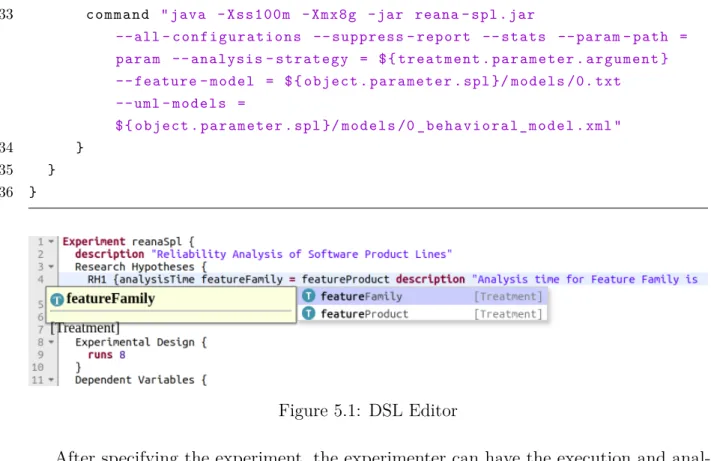
Implementing a DSL means developing a program that is able to read text written in that DSL, parse it, process it, and then possibly interpret it or generate code in another language. Xtext is an Eclipse framework for implementing programming languages and DSLs. It covers all aspects of a complete language infrastructure, starting from the parser, code generator, or interpreter, up to a complete Eclipse Integrated Development Environment (IDE) integration with all the typical IDE features, such as syntax highlighting, background validation, error markers, content assist, quick-fixes, and automatic build [Bettini, 2016]. To start a DSL implementation, Xtext needs only a grammar specification similar to ANother Tool for Language Recognition (ANTLR). From this specification, Xtext automatically generates the lexer, the parser, the Abstract Syntax Tree (AST) model, the construction of the AST to represent the parsed program, and the Eclipse editor with all the IDE features. AST is a convenient representation in memory of a program and represents the abstract syntactic structure of the program [Bettini,2016].
Xtext uses the Modeling Workflow Engine 2 (MWE2) DSL to configure the generation of its artifacts. During the MWE2 workflow execution, Xtext generates artifacts related to the User Interface (UI) editor for the DSL, and derive an ANTLR specification from the
Xtext grammar with all the actions to create the AST while parsing. Xtext automatically infers the Eclipse Modeling Framework (EMF) meta-model for the language, and using this meta-model, generates the classes for the nodes of the AST [Bettini, 2016].
The EMF is a modeling framework that provides code generation facilities for building tools and applications based on structured data models. Most of the Eclipse projects that in some way deal with modeling are based on EMF since it simplifies the development of complex software applications with its mechanisms [Steinberg et al., 2008].
Parsing a program is only the first stage in a programming language implementation. In particular, the overall correctness of a program cannot always be determined during parsing. Some additional static analysis can be performed only when other program parts are already parsed. Actually, the best practice is to do as little as possible in the grammar and as much as possible in validation. In Xtext, these validations are implemented using a validator that performs constraint checks on the elements of an EMF model [Bettini,
2016].
After a program written in the DSL has been parsed and validated, typically code in another language, for example, Java code, a configuration file, XML, or a text file, is generated from the parsed EMF model, that is, the AST of that program. In all of these cases, one needs to write a code generator. Then, Xtext automatically integrates the code generator into the Eclipse build infrastructure [Bettini, 2016].
Although the validators and code generators can be implemented in Java, Xtend provides useful mechanisms for writing code generators, for example, multi-line template expressions, in addition to powerful features that make model visiting and traversing really easy, straightforward, and natural to read and maintain. Xtend is a statically typed language that uses the Java type system, including Java generics and Java annotations. Xtend programs are translated into Java, and Xtend code can access all the Java libraries; thus Xtend and Java can cooperate seamlessly [Bettini,2016].
For instance, using Xtext, Freire et al. [2013] created a DSL named ExpDSL to specify controlled experiments in software engineering. ExpDSL comprises four views: process view, which allows defining the procedures of data collection from the experiment participants; metric view, used to define the metrics that have to be collected during the experiment execution; experimental plan view, used to define the experimental plan; and questionnaire view, which allows defining questionnaires in order to collect quantitative and qualitative data from participants of the experiment.
Their approach also comprises model-driven transformations that allow workflow models generation, and a workflow execution environment. First, a researcher uses ExpDSL to specify the experiment. Then, model-driven transformations are applied to the experiment specification to generate customized workflows for each experiment participant. Finally,
the workflow is executed in a Web-based workflow engine and the researchers running the experiment can monitor the activities performed by the participants. The purpose of the workflow is to guide participants in human-based experiments by providing instructions for their tasks.
Complementary to Xtext, DSLFORGE [Lajmi et al., 2014] is a framework for the generation of web textual DSL editors from the DSL grammar, validators, and code generators created using Xtext. The generated editors are packaged into workbench web applications based on Eclipse Remote Application Platform (RAP) and let users create, edit, and launch transformations from models. These on-line editors are also easily customizable and extensible.
3.3
Running Infrastructures
Since the scale of scientific problems has been increasing, this is reflected not only on data size but also on the complexity of the computer-based tools required to investigate such problems [Sonntag et al., 2010;Zhao et al., 2011]. Thus, such tools must run in an infrastructure that provides computing power, data storage, and network resources. Among many others, Docker Containers(Section 3.3.1) and Autonomic Computing (Section 3.3.2) help in providing an infrastructure to run technology-oriented experiments.
3.3.1
Docker Containers
When it comes to technology-oriented experiments, the concept of Reproducible Research discussed in Section 3.1.3 must also consider the execution environment. Crucial scientific processes, such as replicating the results, extending the approach or testing the conclusions in other contexts, or even merely installing the software used by the original researchers can become immensely time-consuming if not impossible [Boettiger, 2015].
Docker is a platform supporting container for developing, shipping and running dis-tributed applications. Although Docker has largely focused on the needs of businesses in deploying web applications and the potential for a lightweight alternative to full virtual-ization, these features have potentially important implications for systems research in the area of scientific reproducibility [Boettiger, 2015; Chung et al.,2016].
A Docker based approach works similarly to a virtual machine image in addressing the “Dependency Hell” problem by providing other researchers with a binary image in which all the software has already been installed, configured and tested. A key difference between Docker images and virtual machines is that the Docker images share the Linux kernel with the host machine. Sharing the Linux kernel makes Docker more light-weight and higher performing than complete virtual machines. On the other hand, any Docker
image must be based on a Linux system with Linux-compatible software, which includes R, Python, Matlab, and most other scientific programming needs. When running a job, each container is assigned a unique PID; it can be observed equivalently as a process at the view of host machine [Boettiger, 2015; Chung et al., 2016].
The steps necessary to build up a Docker image are documented within a Dockerfile. While machine images can be very large, a Dockerfile is just a simple script file that can be easily stored and shared. Dockefile is also suited for use with a version management system such as Subversion or Git. In addition, it is straightforward for other users to extend or customize the resulting image by editing the script directly [Boettiger, 2015].
3.3.2
Autonomic Computing
The term Autonomic Computing was first used by IBM in 2001 to describe self-managed systems, in an analogy with the human autonomic nervous system. Autonomic System is also refereed as Self-Managing System or Self-Adaptive System [Huebscher and McCann,
2008].
The growing complexity of information technology infrastructures threatens the benefits the systems aims to provide. Installing, configuring, and executing applications in such infrastructures are complex, time-consuming, and error-prone tasks even for experts. Autonomic computing aims to decrease human involvement in managing resources [Horn,
2001; Huebscher and McCann,2008;Kephart and Chess,2003]
Autonomic Computing hides the complexity of managing infrastructure resources from users since they have only to specify the goals of the infrastructure instead of specifying how to achieve them. From the goals and the high level policies, autonomic systems must be capable of running themselves, adjusting to varying circumstances and anticipating resource needs [Horn, 2001].
The essence of Autonomic Computing is self-management. This involves self-configuration, self-optimization, self-healing, and self-protection [Horn, 2001; Kephart and Chess,2003]. First, with self-configuration, autonomic systems will configure themselves automatically according to the user’s goals and high-level policies. This includes installing, configuring, and integrating large complex systems. Second, self-optimization means that autonomic system will continuously seek for improving their operation. Furthermore, an autonomic system with self-healing will detect, diagnose, and repair localized problems resulting from failures in hardware or software. Finally, self-protection means that an autonomic system will protect the whole system against large-scale problems arising from malicious attacks or cascade failures. In addition, the system will, based on early reports from sensors, anticipate problems to avoid or mitigate them.
![Figure 3.1: Illustration of an experiment (adapted from Wohlin et al. [2012]) Experimental subject](https://thumb-eu.123doks.com/thumbv2/123dok_br/19251947.976205/34.892.126.781.377.566/figure-illustration-experiment-adapted-wohlin-et-experimental-subject.webp)
![Figure 3.2: Experiment Process (adapted from Wohlin et al. [2012])](https://thumb-eu.123doks.com/thumbv2/123dok_br/19251947.976205/36.892.121.780.138.499/figure-experiment-process-adapted-wohlin-et-al.webp)
![Figure 3.3: Autonomic properties implemented by Dohko [Leite et al., 2016]](https://thumb-eu.123doks.com/thumbv2/123dok_br/19251947.976205/44.892.112.780.128.365/figure-autonomic-properties-implemented-by-dohko-leite-al.webp)
![Figure 7.1: Results of Optimization Comparison [Bak and Duggirala, 2017]](https://thumb-eu.123doks.com/thumbv2/123dok_br/19251947.976205/80.892.124.749.161.568/figure-results-optimization-comparison-bak-duggirala.webp)
