ORIGIN
AL RESEAR
CH
418
Corresponding address: Fabiola Hermes Chesani – Rua Uruguai, 458, Bloco F6, Sala 311, Centro, Itajaí (SC) – Zip Code 88302-202 – E-mail: [email protected] – Finance source: Fundação de Amparo à Pesquisa de Santa Catarina (FAPESC – Research Support Foundation of Santa Catarina) – Conflict of interests: Nothing to declare – Presentation: May 18th, 2017 – Accepted for publication: Mar. 22th, 2018. Approved by the Research Ethics Committee of the Universidade do Vale do Itajaí (Univali) under the number 694.257.
Study performed in the Universidade do Vale do Itajaí (Univali) – Itajaí (SC), Brazil.
1PhD Professor at the Professional Master’s Degree in Health and Work Administration in the Universidade do Vale do Itajaí (Univali) – Itajaí (SC), Brazil.
2Professor in the Health Sciences Center of the University of Brighton – Brighton (EN), United Kingdom. 3Scholar in Physical Therapy by the Universidade do Vale do Itajaí (Univali) – Itajaí (SC), Brazil.
Quality of life perception of people with motor
disability: differences between wheelchair
dependent and ambulatory patients
A percepção de qualidade de vida de pessoas com deficiência motora: diferenças entre
cadeirantes e deambuladores
La percepción de la calidad de vida de las personas con discapacidad motora: las diferencias
entre los con silla de ruedas y los deambuladores
Fabiola Hermes Chesani1, Tatiana Mezadri1, Leo Lynce Valle de Lacerda1, Anne Mandy2, Francielly Nalin3
ABSTRACT | The routine of people with physical disabilities includes the use of different assistive technology resources that can aid in their physical and intellectual development, which directly affects their quality of life. The objective of this study was to evaluate the life quality perception of Wheelchair users and non-Wheelchair users living in the municipality of Itajaí, in the state of Santa Catarina. This is a cross-sectional study with exploratory and quantitative analysis. The sample consisted of 163 participants, of whom 91 were wheelchair users and 72 were non-wheelchair users. Participants responded to a structured questionnaire with socioeconomic and health information and the World Health Organization Quality of Life Instrument, WHOQOL_bref, to measure quality of life. In the evaluation of the physical and psychological domains, no significant differences were observed between the two groups. Therefore, in these two areas, the perception of quality of life was not affected by the use of wheelchair. However, by examining the social relations and environment domain the perception of quality of life was significantly lower for wheelchair users with paresis, regarding the plegias and amputation.
Keywords | Quality of Life; Disabled Persons; Biomedical Technology; Wheelchairs.
RESUMO | A rotina das pessoas com deficiência física inclui o uso de diferentes recursos de tecnologia assistiva, que podem auxiliar em seu desenvolvimento físico e intelectual, afetando diretamente sua qualidade de vida. O
objetivo deste estudo foi avaliar a percepção da qualidade de vida de pessoas cadeirantes e deambuladoras com deficiência física no município de Itajaí, Santa Catarina. Trata-se de uma pesquisa descritiva de corte transversal e caráter exploratório quantitativo, cuja. amostra foi constituída por 163 participantes (91 cadeirantes e 72 deambuladores), que responderam a um questionário estruturado com informações socioeconômicas e de saúde e ao instrumento do World Health Organization Quality of Life Instruments (WHOQOL-bref), para mensurar a qualidade de vida. Na avaliação dos domínios físico e psicológico não foram observadas diferenças significativas entre os dois grupos, portanto a percepção da qualidade de vida não foi afetada pela utilização da cadeira de rodas. No entanto, examinando-se o domínio de relações sociais e meio ambiente, a percepção da qualidade de vida foi significativamente menor para cadeirantes com paresias, em relação às plegias e à amputação.
Descritores | Qualidade de Vida; Pessoas com Deficiência; Tecnologia Biomédica; Cadeiras de Rodas.
Itajaí, Santa Catarina (Brasil). Se trata de un estudio descriptivo de cohorte transversal y de tipo exploratorio cuantitativo, con una muestra de 163 participantes (91 en silla de ruedas y 72 deambuladores), que respondieron a un cuestionario estructurado con datos socioeconómicos y de salud y al instrumento World Health Organization Quality of Life Instruments (WHOQOL-bref) para medir la calidad de vida. En la evaluación de los dominios físico y psicológico, no se observaron diferencias significativas
entre los dos grupos, por lo que la percepción de la calidad de vida no fue afectada por el uso de la silla de ruedas. Sin embargo, al examinar el dominio relaciones sociales y medio ambiente, la percepción sobre la calidad de vida fue significativamente menor a los usuarios de silla de ruedas cuanto a las paresias, plejías y amputación.
Palabras clave | Calidad de Vida; Personas con Discapacidad; Tecnología Biomédica; Sillas de Ruedas.
INTRODUCTION
The routine of people with physical disabilities includes the use of different assistive technology resources that can aid in their physical and intellectual development, which directly affects their quality of life. An equipment commonly used by people with reduced mobility is the wheelchair1,2, since it enables their movement and, thus,
a greater autonomy1.
In Europe, the number of wheelchair users surpasses 3.3 million people3. In Brazil, the National Health
Research (2013) estimated 200.6 million people living in permanent private households, of which 6.2% had at least one of the four investigated disabilities (intellectual, physical, hearing, and visual) and 1.3% declared having physical disabilities (0.3% were born with physical disabilities, while 1.0% acquired it due to a disease or accident). About 10% of the world population has any disability and 10% of it require wheelchairs for their limited walking capacity4. In the last decades, the number
of manual wheelchair (MW) users has increased due to automotive accidents, which mainly cause medullar injury or the amputation of lower limbs5.
Despite the MW being used to increase the individuals’ functionality and independence, both at home and in the community, users see them as the main factor that prevents them to move around with greater ease and efficiency, limiting them more than their paralysis itself. The causes for such limitation are the environmental barriers and the bad adjustment of wheelchairs6 due to the lack of
specific training to prescribe and/or adjust the MW in most clinical centers. Pain and the commitment of upper limbs, problems that happen because of maladjustment, are reported by more than 70% wheelchair users7.
With the use of MWs, it is expected for people with physical disabilities to become more autonomous and to find ways of dealing with their disabilities. However,
health and well-being are a combination of biological, psychological, and social factors. As certain physical disabilities are permanent, it is necessary to identify the factors affecting well-being, which can be influenced by the rehabilitation team. Traditional health indicators provide a measure of the disease’s impact, but they do not assess the quality of life (QoF) in the context of culture, value system, goals, expectations, standards, and concerns7.
However, the QoF evaluates the individuals’ perception of their positions in life, considering their insertion in the social, cultural, religious, and economic contexts they live. Their personal values, goals, expectations, standards and concerns also affect this perception8.
The inclusion of QoF evaluation in healthcare promotes a comprehensive care approach and encourages health professionals to answer to their patients’ perceptions and personal values. Therefore, assessing the QoF is a crucial issue for future national health planning7.
The choice for this theme was based on the observation that there are few national studies dealing with the QoF of people with acquired physical disabilities (ambulatory and wheelchair dependent). Given that, the aim of this study was to get to know the quality of life perception of people with acquired physical disabilities.
METHODOLOGY
This study is a transversal descriptive research, with exploratory and quantitative approach, involving the quality of life of people with physical disabilities living in the municipality of Itajaí, Santa Catarina. The municipality is 90 km far from the state’s capital and it has an estimated population of 216,615 inhabitants9.
Regarding the primary care, the city has 34 Health Units and 44 teams of the National Family Health Strategy. As the study’s locations, five Health Units were selected in Itajaí, considering the researchers easy access and the fact that they count on support networks: Associação dos
Deficientes Físicos da Foz do Itajaí (Adefi – Association
of Physical Disabled of Foz do Itajaí), Associação de Pais e
Amigos dos Excepcionais (Apae – Association of Atypical
Parents and Friends); and specialized networks: Physical Therapy Clinic and the Specialized Rehabilitation Center of the Universidade do Vale do Itajaí (CER-2/Univali), both inserted in Univali and partners of the Municipal Health Secretary.
In these places, people with acquired physical disabilities were identified and interviewed. The ones attending the Physical Therapy Clinic and CER-2 were interviewed there, in previously booked hours, the ones attending the support networks were interviewed in the associations’ headquarters, and the other ones at home. The interviews were performed by previously trained researchers.
The study’s sample was composed by 163 participants (83 male and 81 female participants) of different age groups: teenagers (from 10 to 19 years-old), adults (20 to 59 years-old), and elderly people (60 years-old or older), from February 2015 to February 2016.
To select these individuals, the inclusion criteria considered was presenting acquired physical disabilities (paraplegia, paraparesis, monoplegia, monoparesis, tetraplegia, tetraparesis, triplegia, triparesis, hemiplegia, hemiparesis, limb lack or amputation, limbs with acquired deformity, or amputated, amyotrophic sclerosis), and they were then classified into two groups: wheelchair users and ambulatory patients. As exclusion criteria, we considered congenital disabilities or dwarfism, and ostomate and mastectomate individuals.
To obtain the intended information, two tools were used: a structured questionnaire with socio-economic and health information to characterize the sample and the World Health Organization Quality of Life Instruments (WHOQOL-bref ) to measure quality of life. The first questionnaire looked for information on age, gender, schooling levels, marital status, family income (valid value for the period of study of R$ 880.00), type of disability, and presence of comorbidity. The second, WHOQOL-bref10,
is a reduced version of the World Health Organization Quality of Life (WHOQOL-100). In this research, we have used the 24 questions of the second tool, which are divided into four domains: “physical”, “psychological”, “social relationships”, and “environment”. To assess quality
of life, there is no cut-off point, so that the higher the score is, better is the quality of life8,11.
To compare the average quality of life scores for each domain, the two-way analysis of variance was used, followed by the Tukey’s test, if needed. For the factors, we considered socio-economic variables, the type of disability, and using or not wheelchairs. We chose the parametric test, considering the normal distribution of the scores, using a significance level of 5%. The application Statistica v.1012 was used for the analysis.
This research was approved by the Research Ethics Committee of the Universidade do Vale do Itajaí, under the number 694.259, and it was sponsored by the Fundação de
Amparo à Pesquisa de Santa Catarina (Fapesc – Foundation
for Research Support of Santa Catarina – Universal Program), by the Fundo de Apoio à Manutenção e ao
Desenvolvimento da Educação Superior (Fumdes – Fund
for Support to the Maintenance and Development of Higher Education - articles 170 and 171).
OUTCOMES
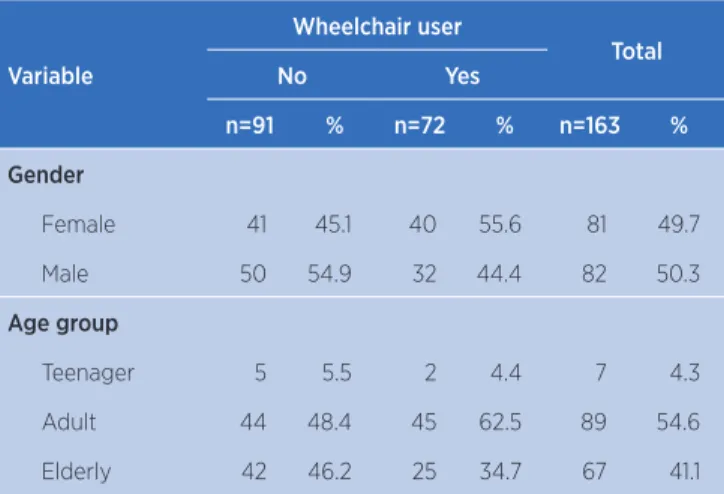
Table 1 summarizes the main characteristics and the type of disabilities of assessed individuals. We have used the terms plegias and paresis to define if the result impairment in the motor system was total or partial, and as for the amputation, if the impairment was due to the circulatory system. Overall, there was a gender equality in the sample, with a higher percentage of women in the wheelchair user group. Most participants were adults, with an emphasis on wheelchair users, who had a higher percentage of adults than elderly people.
Table 1. Characterization of people with acquired physical disability, wheelchair and non-wheelchair users, according to socio-economic and health information in the municipality of Itajaí (SC), in 2016.
Variable
Wheelchair user
Total
No Yes
n=91 % n=72 % n=163 %
Gender
Female 41 45.1 40 55.6 81 49.7
Male 50 54.9 32 44.4 82 50.3
Age group
Teenager 5 5.5 2 4.4 7 4.3
Adult 44 48.4 45 62.5 89 54.6
Elderly 42 46.2 25 34.7 67 41.1
Variable
Wheelchair user
Total
No Yes
n=91 % n=72 % n=163 %
Schooling levels*
Illiterate 8 9.6 6 9.8 14 9.7
Elementary 41 49.4 22 36.1 63 43.8
High School 24 28.9 25 41.0 49 34.0
Higher
Education 10 12.0 8 13.1 18 12.5
Income (minimum wage)
Up to 2 51 56.0 47 65.3 98 60.1
From 2 to 4 31 34.1 19 26.4 50 30.7
More than 4 9 9.9 6 8.3 15 9.2
Physical disability
Plegia 43 47.3 51 70.8 94 57.7
Paresis 30 33.0 13 18.1 43 26.4
Amputation 18 19.8 8 11.1 26 16.0
*Total number of 144 participants, considering that 19 research participants did not answer this item, eight non-wheelchair users and 11 wheelchair users
As for the schooling levels, most ambulatory patients had studied only until elementary school, indicating low schooling levels. In the wheelchair dependent group, it was observed a higher schooling level, in which 15.3% studied up to high school, although the difference to the ones that finished only elementary school (13.5%) is not significant. We highlight that not all participants have answered this question.
Regarding the monthly income, 60.1% received up to two minimum wages in both groups, with a percentage of 65.3% in the wheelchair dependent group.
The most prevalent disability was plegia, with a significant percentage in the wheelchair user group, as expected.
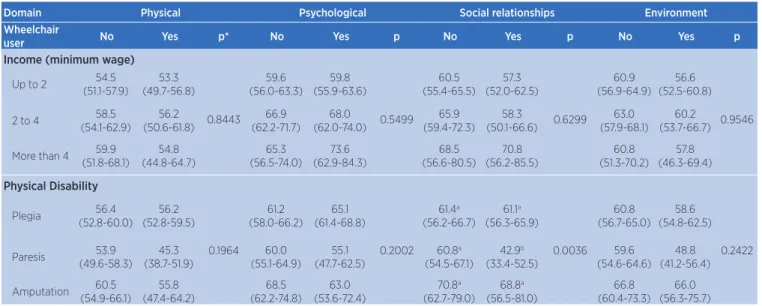
In the evaluation of the domains (“physical” and “psychological”), when the WHOQOL_bref was applied, no significant differences between both groups were observed, therefore, in these domains, the quality of life perception was not affected by the use of wheelchairs. When the domains “social relationships” and “environment” were assessed, in the first one there was a significantly lower quality of life perception for wheelchair users with paresis (between 33.4 and 52.5) in relation to the other disability types (above 56).
Table 2. Averages and confidence interval (in parenthesis) of the quality of life scores, divided into domains according to socio-economic variables and the type of disability for people with acquired disabilities, wheelchair and non-wheelchair users, in the municipality of Itajaí (SC), in 2016.
Domain Physical Psychological Social relationships Environment
Wheelchair
user No Yes p* No Yes p No Yes p No Yes p
Gender
Female (55.9-67.2)61.6 (52.2-63.6)57.9
0.4241
62.8 (58.5-67.1)
63.1 (58.8-67.4)
0.9887 61.6 (55.9-67.2)
57.9 (52.2-63.6)
0.8598 63.3 (59.0-67.7)
56.7 (52.3-61.2)
0.2400 Male (59.2-69.5)64.3 (53.2-66.0)59.6 (58.7-66.5)62.6 (58.2-67.9)63.0 (59.2-69.5)64.3 (53.2-66.0)59.6 (56.2-64.2)62.2 (53.9-63.9)58.9
Age group
Teenager (57.5-78.2)67.9 (46.1-78.9)62.5 0.7238 (64.6-87.1)75.8 (42.6-78.2)60.4 0.1251 (52.3-84.4)68.3 (49.7-100.3)75.0 0.5507 (51.9-76.9)64.4 (34.9-74.5)54.7 0.8769
Adult (55.2-62.2)58.7 (53.7-60.6)57.1 (61.6-69.2)65.4 (64.2-71.7)68.0 (61.1-71.9)66.5 (53.9-64.6)59.3 (59.9-68.3)64.1 (55.1-63.5)59.3
Elderly (49.1-56.2)52.6 (43.5-52.8)48.1 (54.3-62.1)58.2 (49.5-59.5)54.5 (53.4-64.5)58.9 (49.2-63.5)56.3 (54.3-62.9)58.6 (49.4-60.6)55.0
Schooling levels
Illiterate 57.6 (49.4-65.7)
50.0 (40.6-59.4)
0.5205 63.0 (53.6-72.4)
57.6 (46.8-68.5)
0.8907 64.6 (51.4-77.8)
56.9 (41.7-72.2)
0.6388 66.0 (56.0-76.0)
55.2 (43.7-66.7)
0.4677 Elementary (50.9-58.1)54.5 (49.5-59.3)54.4 (59.6-67.9)63.7 (58.6-69.9)64.2 (58.8-70.5)64.6 (47.7-63.7)55.7 (58.2-67.0)62.6 (54.2-66.2)60.2
High School 58.6 (53.9-63.3)
57.0 (52.4-61.6)
63.5 (58.1-69.0)
z61.5 (56.2-66.8)
59.4 (51.7-67.0)
59.7 (52.2-67.1)
60.2 (54.4-65.9)
58.4 (52.7-64.0)
Higher Education
59.3 (52.0-66.6)
51.3 (43.2-59.5)
62.5 (54.170.9)
60.4 (51.0-69.8)
63.3 (51.5-75.2)
56.3 (43.0-69.5)
64.1 (55.1-73.0)
52.3 (42.4-62.3)
(continues)
Domain Physical Psychological Social relationships Environment Wheelchair
user No Yes p* No Yes p No Yes p No Yes p
Income (minimum wage)
Up to 2 54.5
(51.1-57.9) 53.3 (49.7-56.8) 0.8443 59.6 (56.0-63.3) 59.8 (55.9-63.6) 0.5499 60.5 (55.4-65.5) 57.3 (52.0-62.5) 0.6299 60.9 (56.9-64.9) 56.6 (52.5-60.8) 0.9546
2 to 4 58.5
(54.1-62.9) 56.2 (50.6-61.8) 66.9 (62.2-71.7) 68.0 (62.0-74.0) 65.9 (59.4-72.3) 58.3 (50.1-66.6) 63.0 (57.9-68.1) 60.2 (53.7-66.7)
More than 4 59.9 (51.8-68.1) 54.8 (44.8-64.7) 65.3 (56.5-74.0) 73.6 (62.9-84.3) 68.5 (56.6-80.5) 70.8 (56.2-85.5) 60.8 (51.3-70.2) 57.8 (46.3-69.4) Physical Disability Plegia 56.4 (52.8-60.0) 56.2 (52.8-59.5) 0.1964 61.2 (58.0-66.2) 65.1 (61.4-68.8) 0.2002 61.4a (56.2-66.7) 61.1a (56.3-65.9) 0.0036 60.8 (56.7-65.0) 58.6 (54.8-62.5) 0.2422 Paresis 53.9 (49.6-58.3) 45.3 (38.7-51.9) 60.0 (55.1-64.9) 55.1 (47.7-62.5) 60.8a (54.5-67.1) 42.9b (33.4-52.5) 59.6 (54.6-64.6) 48.8 (41.2-56.4) Amputation 60.5 (54.9-66.1) 55.8 (47.4-64.2) 68.5 (62.2-74.8) 63.0 (53.6-72.4) 70.8a (62.7-79.0) 68.8a (56.5-81.0) 66.8 (60.4-73.3) 66.0 (56.3-75.7)
*Probability value in the bifactorial ANOVA test for first order interaction
Table 2. Continuation
DISCUSSION
This study has assessed social and economic characteristics, and the disability type of wheelchair users and ambulatory patients. Regarding the gender, there was an overall similar percentage among participants (49.7% were women and 50.3% men), in opposition to the study by Felicíssimo et al.13, who investigated the
prevalence and factors related to disabilities, with 53.1% female participants. The research by Assis and Carvalho-Freitas14 has corroborated to the results of this research,
since the prevalence of people with physical disabilities was of male patients (68%).
Regarding the age group, adult wheelchair users (62.5%) has a higher percentage than elderly (34.7%) and teenager ones (4.4%). As in the study by Kirby et al.15,
the average age was of 39 years-old, that is, adults. Dolan and Henderson16 have concluded that 53.4% of people
with physical disabilities who depend on wheelchairs presented an average age of 45 years-old.
Concerning schooling levels, Gomes et al.17 presented
a sample with a schooling range varying from incomplete elementary school to complete high school, making it similar to this research. Also in the study by Gomes et al.17,
the neurologic level of injuries ranged from thoracic (T6) to lumbar (L1), which were caused by firearms, falls, and tumor, which was similar in this study, since the majority of the sample is paraplegic. The work by Schoeller et al.18,
which aimed to characterize people with medulla injuries treated in a state reference rehabilitation center, presented automotive accidents as the most frequent cause.
Pangalila et al.22 have assessed the quality of life of 79
adult men with Duchenne muscular dystrophy and, in the WHOQOL-bref, the score in the social relationships domain was lower. The main issues were intimate relations, work, leisure, transportation and meaning of life. Seventy-three percent patients declared their quality of life was “(very) good”.
The results of the study by França et al.23 have shown that
the QoL of people with medullar injuries is unsatisfactory. The limitations due to this injury affect negatively the life of patients and the domains with higher negative influence for the QoL are the physical and environmental ones. Ganesh and Mishra7 have assessed the QoL of paraplegic
people and observed low average scores for the physical health, psychological well-being, social relationships and environment domains (49.76±18.74, 48.57±17.04, 57.88±17.04 e 49.85±17.77, respectively).
However, in the quality of life evaluation by Toro et al.24, the physical domain has improved significantly for
women who received a wheelchair, and the environmental health has also improved significantly for women and men who received wheelchairs, in relation to the ones who were still on the waiting list.
Riggins et al.25, when examining the QoL factors and
the changes in mobility for individuals with traumatic spinal cord injury (SCI), concluded that individuals who began using wheelchairs within an year after the injury have had low QoL factors, including high scores for pain and depression.
Ganesh and Mishra7 have observed low average scores
relationships, and environment domains of the QoL (49.76±18.74, 48.57±17.04, 57.88±17.04 e 49.85±17.77, respectively). There was a strong positive association between the physical activity levels and all the domains (P<0.050).
The study by Martins et al.26 has assessed the QoL
of teenagers with osteogenesis imperfecta (OI) and the results have indicated that they are satisfied with their overall QoL (69.3). The religiosity/spirituality/personal beliefs and social relationships domains had the higher scores (77.6 and 73.7, respectively). The worst score was the environmental one (64.9), which was the only one with p<10 among the OI types.
Milioli et al.27 have evaluated the quality of life of
amputees and concluded that 36.4% subjects evaluated their QoL as not bad nor good; however, 45.50% participants were not satisfied nor dissatisfied with their health. As for the domains, the physical, social, and environmental ones, which represented 34.70%, 31.85%, and 30.30%, respectively, were assessed was neither good or bad, while 33,32% participants assessed the psychological domain as having good QoL.
Whereas the study by Chow28 concluded that the
study on the biomechanics of the wheelchair propulsion focuses on how the wheelchair user confers potency to the wheels to gain mobility and, with that, reduces the physical distress associated to the propulsion of wheelchairs in order to improve the quality of life.
CONCLUDING REMARKS
The perception of quality of life was not affected by the use of wheelchair, with the exception of the social relationships domain, in which this perception was significantly lower for wheelchair users with paresis than for other disability types.
REFERENCES
1. Jung HS, Park G, Kim YS, Jung HS. Development and evolution of one-hand drivable manual wheelchair hemiplegic patients. Appl Ergon. 2015;48:11-21. doi: 10.1016/j.apergo.2014.10.020 2. Sawada N, Hatta T, Kishigami H, Shimizu M, Yoda T, Goda H.
The effect of a newly developed wheelchair with thoracic and pelvic support on cervical movement and muscle activity in healthy elderly women. Eur Geriatr Med. 2015;6(3):286-90. doi: 10.1016/j.eurger.2014.11.001
3. Mandy A, Graham S, Jon M. User evaluation of the Neater uni-wheelchair in the home environment: an exploratory pilot study. Int J Ther Rehabil. 2011;18(4):231-7. doi: 10.12968/ijtr.2011.18.4.231
4. World Health Organization. Guidelines on the provision of manual wheelchairs in less-resourced settings. Geneva: Author; 2008.
5. Instituto Brasileiro de Geografia e Estatística (BR). Censo demográfico: 2000: características da população e dos domicílios: resultados do universo. Rio de Janeiro: Author; 2000. 6. Askari S, Kirby RL, Parker K, Thompson K, O’Neill J. Wheelchair
propulsion test: development and measurement properties of a new test for manual wheelchair users. Arch Phys Med Rehabil. 2013;94(9):1690-8. doi: 10.1016/j.apmr.2013.03.002
7. Ganesh S, Mishra C. Physical activity and quality of life among adults with paraplegia in Odisha, India. Sultan Qaboos Univ Med J. 2016;16(1):e54-61. doi: 10.18295/squmj.2016.16.01.010
8. Fleck MPA, Louzada S, Xavier M, Chachamovich E, Vieira G, Santos L, et al. Aplicação da versão em português do instrumento abreviado de avaliação de qualidade de vida “WHOQOL-bref”. Rev Saúde Pública. 2000;34(2):178-83. doi: 10.1590/S0034-89102000000200012
9. Instituto Brasileiro de Geografia e Estatística (BR). Itajaí: panorama [Internet]. Rio de Janeiro: Author; 2017 [updated 2017 Jul 1st; cited 2018 Feb 27]. Available from: https://cidades. ibge.gov.br/brasil/sc/itajai/panorama
10. World Health Organization. Development of the World Health Organization WHOQOL-BREF quality of life assessment. Psychol Med. 1998;28(3):551-8. doi: 10.1017/S0033291798006667
11. World Health Organization. The World Health Organization quality of life assessment (WHOQOL): development and general psychometric properties. Soc Sci Med. 1998;46(12):1569-85. doi: 10.1016/S0277-9536(98)00009-4
12. StatSoft, Inc. Statistica: data analysis software system. Version 10 [software]. Palo Alto: Author; 2011.
13. Felicíssimo MF, Friche AAL, Andrade ACS, Andrade RG, Costa DAS, Xavier CC, et al. Prevalence and factors associated with self-reported disability: a comparison between genders. Rev Bras Epidemiol. 2017;20(1):147-60. doi: 10.1590/1980-5497201700010013
14. Assis AM, Carvalho-Freitas MN. Estudo de caso sobre a inserção de pessoas com deficiência numa organização de grande porte. REAd Rev Eletrôn Adm (Porto Alegre). 2014;20(2):496-528. doi: 10.1590/1413-2311022201342126
15. Kirby RL, Worobey LA, Cowan R, Pedersen JP, Heinemann AW, Dyson-Hudson TA, et al. Wheelchair skills capacity and performance of manual wheelchair users with spinal cord injury. Arch Phys Med Rehabil. 2016;97(10):1761-9. doi: 10.1016/j. apmr.2016.05.015
16. Dolan MJ, Henderson GI. Patient and equipment profile for wheelchair seating clinic provision. Disabil Rehabil Assist Technol. 2013;9(2);136-43. doi: 10.3109/17483107.2013.807441
18. Schoeller SD, Grumann ARS, Martini AC, Forner S, Sader LT, Nogueira GC. Knowing to care: characterization of individuals with spinal cord injury treated at a rehabilitation center. Fisioter Mov. 2015;28(1):77-83. doi: 10.1590/0103-5150.028.001.AO08 19. Adriaansen JJE, Ruijs LE, Van Koppenhagen CF, Van Asbek
FWA, Snoek GJ, Van Kuppevelt D, et al. Secondary health conditions and quality of life in persons living with spinal cord injury for at least ten years. J Rehabil Med. 2016:48(10):853-60. doi: 10.2340/16501977-2166
20. Tate D, Forchheimer M. Review of cross-cultural issues related to quality of life after spinal cord injury. Top Spinal Cord Inj Rehabil. 2014;20(3):181-90. doi: 10.1310/sci2003-181
21. Razak MMA, Tauhid MZ, Yasin NF, Hanapiah FA. Quality of life among lower limb amputees in Malaysia. Procedia Soc Behav Sci. 2016;222:450-7. doi: 10.1016/j.sbspro.2016.05.135
22. Pangalila RF, Van den Bos GAM, Bartels B, Bergen MP, Kampelmacher MJ, Stam HJ, et al. Quality of life of adult men with Duchenne muscular dystrophy in the Netherlands: implications for care. J Rehabil Med. 2015;47(2):161-6. doi: 10.2340/16501977-1898
23. França ISX, Coura AS, Sousa FS, Almeida PC; Pagliuca LMF. Qualidade de vida em pacientes com lesão medular. Rev Gaúcha Enferm. 2013;34(1):155-63. doi: 10.1590/S1983-14472013000100020
24. Toro ML, Eke C, Pearlman J. The impact of the World Health Organization 8-steps in wheelchair service provision in wheelchair users in a less resourced setting: a cohort study in Indonesia. BMC Health Serv Res. 2016;16:26. doi: 10.1186/s12913-016-1268-y
25. Riggins MS, Kankipati P, Oyster ML, Cooper RA, Boninger ML. The relationship between quality of life and change in mobility 1 year postinjury in individuals with spinal cord injury. Arch Phys Med Rehabil. 2011;92(7):1027-33. doi: 10.1016/j.apmr.2011.02.010
26. Martins AJ, Campos MR, Ilerena JC Jr., Soares AHR. Adolescentes com osteogênese imperfeita: qualidade de vida. Adolesc Saúde. 2014;11(1):7-17.
27. Milioli R, Vargas MAO, Leal SMC, Montiel AA. Qualidade de vida em pacientes submetidos à amputação. Rev Enferm UFSM. 2012;2(2):311-9. doi: 10.5902/217976924703